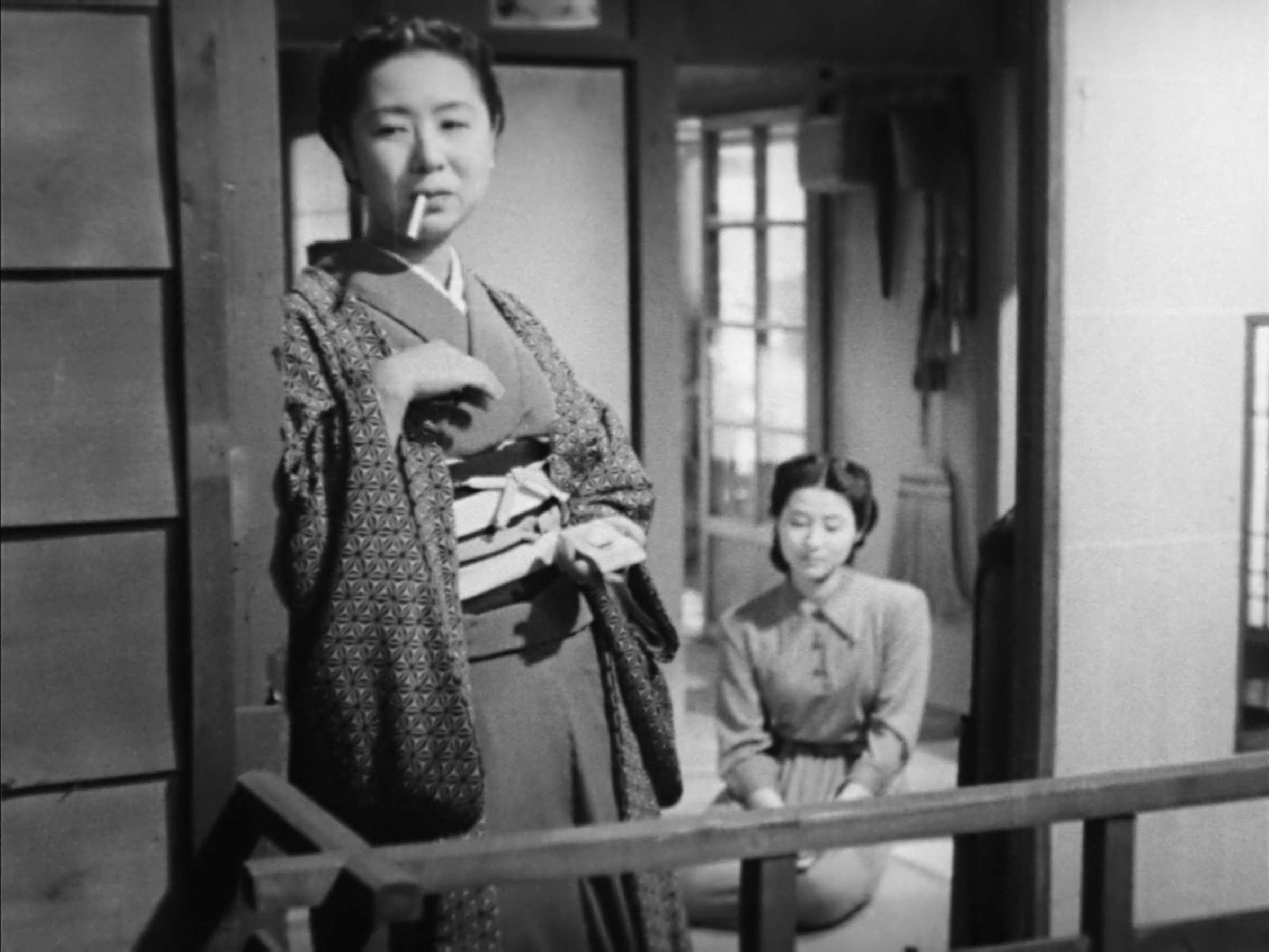
Tomorrow There Will Be Fine Weather (明日は日本晴れ, Hiroshi Shimizu, 1948)

According to the driver aboard the bus at the centre of Hiroshi Shimizu’s Tomorrow There Will Be Fine Weather (明日は日本晴れ, Asu wa Nipponbare),  “that ridiculous war ruined everything”. Shimizu had directed a similar film in 1936, Mr Thank You, in which times had been hard for all but people tried to stay cheerful and help where they could. But here, by contrast, the atmosphere is much less jovial. Everyone is fed up, unhappy, dissatisfied, and irritated far beyond the inconvenience of being delayed on their journey.

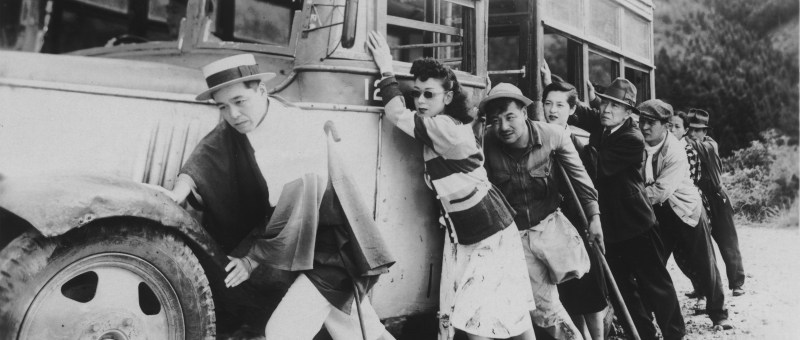
Once again shot on location, the film follows a bus on the outskirts of Kyoto making the journey along a mountain pass from the city to an onsen town before breaking down half way. It’s several miles across difficult mountainous terrain to the nearest town in either direction and many people aboard the bus are elderly or have disabilities that make simply walking the rest of the way a difficult prospect while no one can really say when help will come because they’re dependent on the arrival of the following service or some other form of transport that could get a message out for a mechanic or replacement bus. 

In any case, just as in Mr Thank You there is a diverse contingent aboard each of whom have particular reasons for travelling and for being upset about the delay. A trio of men begin by complaining that this journey which once took two hours now takes three while the bus itself has become worn down and unreliable. Even so, the fares are now much more expensive. What’s most surprising is that the men loudly and openly discuss their occupation as black market traders while simultaneously complaining about an increased police presence interfering with their work. An irritated, besuited man sitting across the aisle is the only one to challenge them, asking if they pay taxes on their clearly illegal earnings to which the answer is obvious though the men mostly complain about how it wouldn’t be worth their while if they did rather than outright denying a responsibility to pay. The man tells them that they’re part of the problem and that the future of the country is assured only if people pay their taxes, with which the men otherwise seem to agree. When the bus breaks down, one of them is most worried that his late arrival will cause concern for his wife who may assume he’s been caught and arrested.

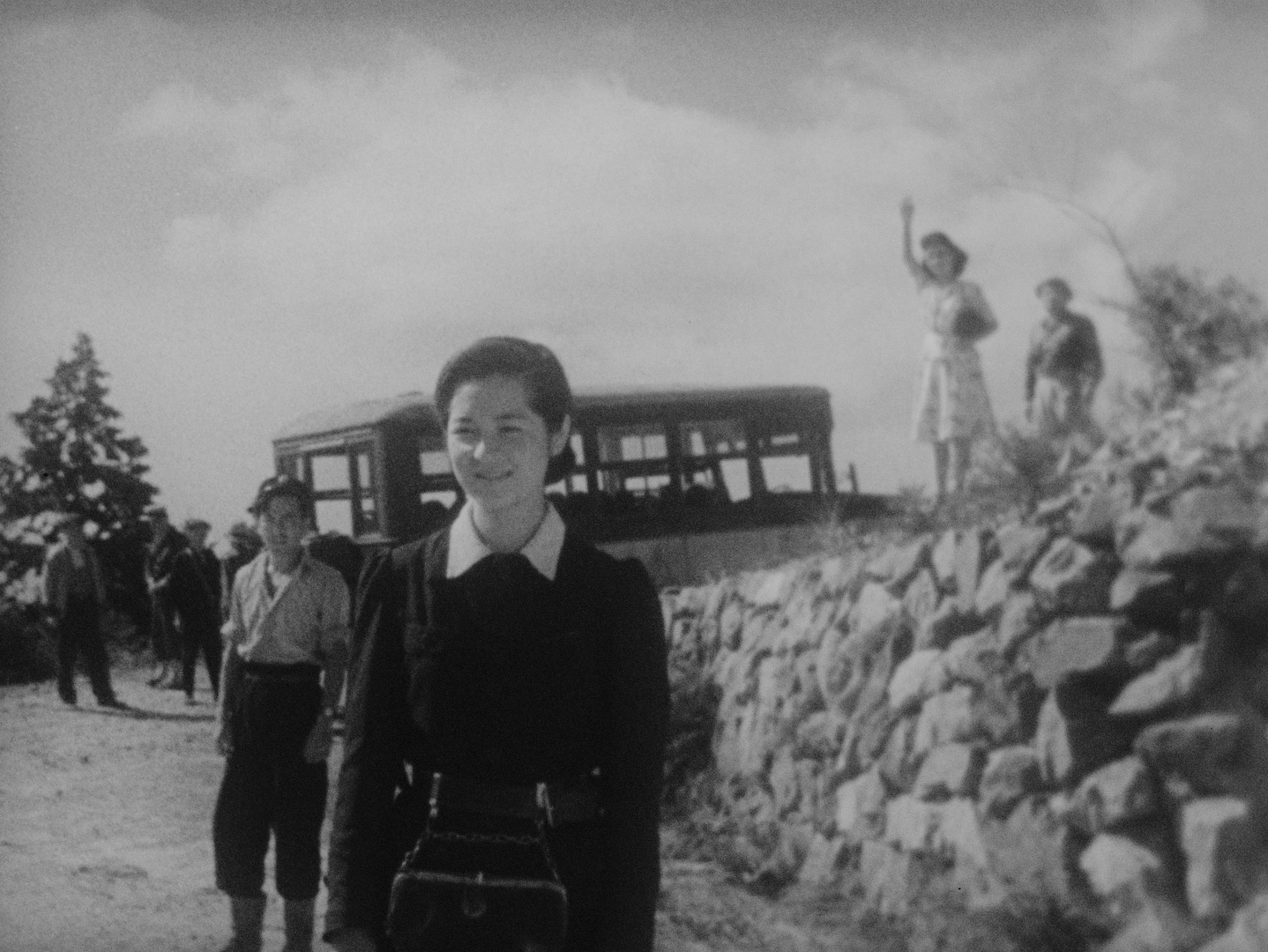
But there’s a small drama playing out in the front of the bus too as the conductress gossips with the driver certain that the beautiful woman sitting half-way back is a well-known Tokyo dancer, Waka, who she’s heard is on her way to bury the ashes of her child seemingly born out of wedlock. The driver, Sei, grimaces slightly as if he didn’t want to have this conversation and as we later discover once knew Waka long ago before the war which has changed each of them. A blind man, Fuku, now working as a masseur after losing his sight in the war, once knew them both hatches a plan to try and get them to patch things up. But as Sei later says, they’ve both been through far too much and are no longer the same people. Nothing can be as it was before, but in a way that’s alright. There is still hope for the future on the broken bus that is post-war Japan if only someone can figure out how to get the engine going again. 

Nevertheless, the scars from this war are still very noticeable. One of the black-marketers has a missing leg and later lays into an old man who confesses that he was a military commander, hounding him for his responsibility for the folly of the war which men like him forced them to continue long after it was obvious that it was lost. Fuku is much more sanguine and after a minor misunderstanding able to find a way to communicate with an elderly man who is deaf despite the incompatibility of their disabilities as they help each other board the replacement bus to the new Japan. Sei, and the slightly younger conductress who is not so secretly in love with him, meanwhile remain stuck on the broken bus symbolically unable to move forward no matter how much Sei insists it’s time to “get over the war” and that he just wants to forget the past and start living again. Perhaps it’s for men like him who seem fine on the surface that the scars run deepest, overburdened by all that this “ridiculous war” took from them in unlived futures and broken dreams. Meanwhile Shimizu follows the other bus onward along the precarious and winding mountain roads hoping for better weather in the hot springs town ahead.


Tomorrow There Will Be Fine Weather screens at Japan Society New York on May 17 as part of Hiroshi Shimizu Part 2: The Postwar and Independent Years.
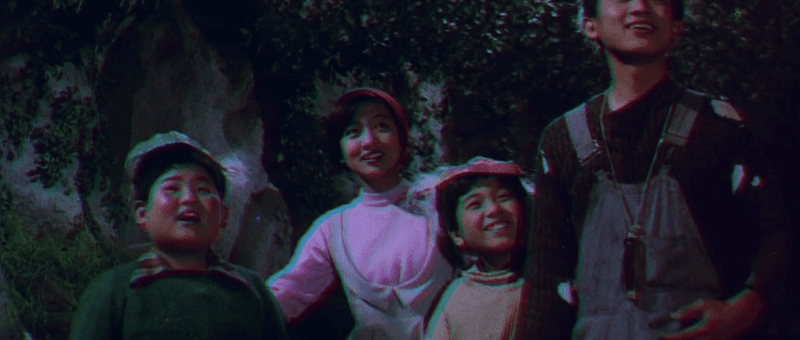
The Green Music Box (緑はるかに, Umetsugu Inoue, 1955)

An incredibly surreal musical kids adventure, The Green Music Box (緑はるかに, Midori Haruka ni) saw the film debut of future Nikkatsu star Ruriko Asaoka who in fact took her stage name from the character she plays in the movie. She was born in Manchuria in 1940 as Nobuko Asai (she retains the first character of her surname but the second “oka” or “hill” is also inspired by the “faraway” in the Japanese title). Her father was a political secretary but the family was extremely poor and her entry into the film world came about through an open audition for the role of Ruriko in the film adaptation of a serialised novel for children by Makoto Hojo which would be produced by Takiko Mizunoe and directed by Umetsugu Inoue. Junichi Nakahara who handled the costume design for the film personally picked Asaoka out from the 3000 applicants reportedly saying “this is the girl” after seeing her in makeup. 

A classic children’s adventure movie, the film nevertheless has a strong theme of loneliness and displacement as each of the young protagonists either has no parents or has in some way been separated from them. Ruriko’s father is a scientist who left for a research project in Hokkaido a year previously and has since stopped responding to her letters. Missing him, Ruriko uses a green music box he had given her as a present as a means of floating off into a surreal dream world on the moon filled with children dressed as bunny rabbits who sing and dance with her. Later she teams up with a trio of orphans who have left their orphanage in search of adventure as well as another girl a little younger than herself, Mami (Noriko Watanabe), who has run away from the countryside to look for her mother in Tokyo. At the film’s conclusion all the children have happy family homes, Mami now living with her mother and the three boys adopted by Ruriko’s family meaning that she’s no longer lonely with her brothers now beside her as they all take a trip to the moon and a nation ruled by love, justice, and peace. 

Before all that, however, Ruriko and her mother are kidnapped by a spy, Tazawa (Kenjiro Uemura), claiming to be a colleague of her father’s. Explaining that Professor Kimura (Minoru Takada) has been taken ill, he bundles the pair into a car but takes them to a secret lab in the middle of nowhere where Kimura is being held and attempts to use them to blackmail him into giving up the scientific research he burned on learning that Tazawa belonged to a foreign power explaining that his creation could greatly benefit the world if used peacefully but cause great destruction if not. He manages to sneak the key to his research into Ruriko’s music box and tells her to escape with it though at the film’s conclusion he’ll decide to burn it anyway resolving that it’s too dangerous were it to end up in the wrong hands. 

Such dark events are not exactly unusual in children’s films, though the level of violence is surprising. Ruriko’s mother is taken off and hanged by her wrists while the foreign spies whip her. Though much of it occurs off screen, the whip cracks and screams are audible to Ruriko and her father while we also see her spin and twist, writhing in agony before falling silent perhaps having died as Ruriko comes to infer from the eerie quiet. Later, during the chaos at a circus which is also a front for international espionage a large goon slams the head of one of the children, Fatty (Hideaki Ishii), repeatedly into a table though he appears relatively unhurt and soon fights back cartoonishly by hitting him on the head with an iron bar. 

It’s not really clear why the spies operate out of a weird circus which is also seemingly guilty of copyright infringement given the various Disney-inspired papier-mâché masks lying around, but it is strangely scary for something meant to entertain small children including a surreal performance by Frankie Sakai in a brief cameo as a clown beckoning the kids towards the circus tent. The film was also Nikkatsu’s first colour movie using the short-lived Konicolor method and has a slightly sickly, washed out effect that lends an additional layer of discomfort to the brightly decorated circus environment. In any case, Ruriko and her friends are eventually able to triumph, regaining the music box and even convincing the police that the circus guys really are foreign spies even if it’s partly down to the otherwise unexplained reappearance of her parents who are in fact alive and well. In some ways melancholy, appealing to a sense of loneliness in post-war children who either may have become orphaned or are otherwise separated from their parents, the film ends on a more hopeful note in championing the sense of family that emerges between the children themselves through generational solidarity in offering a happy ending that might seem overly optimistic but nevertheless returns the kids to the kingdom of the Moon Queen and a happy world of love, justice, and peace. 


Ginza Cosmetics (銀座化粧, Mikio Naruse, 1951)

1951’s Ginza Cosmetics (銀座化粧, Ginza Kesho) is often said to mark a kind of rebirth in the career of director Mikio Naruse whose output in the 1940s was perhaps unfairly denigrated not least by Naruse himself. As in much of his golden age work and in anticipation of When a Woman Ascends the Stairs, Ginza’s heroine is a resilient bar hostess whose brief hopes of escape through romance are doomed to failure, but it’s also, like the slightly later Tokyo Profile (Hiroshi Shimizu, 1953) and Tales of Ginza (Yuzo Kawashima, 1955) an ode to the upscale district and all the defeated hopes of its illusionary glitz and glamour. 

Yukiko (Kinuyo Tanaka), the heroine, is a single-mother approaching middle age and working as a hostess in a Ginza bar. Her landlady who runs a nagauta school on the ground floor and constantly complains about her feckless though goodnatured unemployed husband seems to think she could do better, pointing out that she is an educated woman who seems slightly out of place in the rundown backstreets of this otherwise aspirational area. Even for educated women, however, there may not be many other opportunities in the straitened and socially conservative post-war economy especially for those without connections, and Yukiko also needs to provide for her young son Haruo (Yoshihiro Nishikubo), born out of wedlock after an affair with a customer with whom she had fallen in love but abandoned her when she became pregnant. 

As a slightly older woman who has been working at the Bel Ami bar for many years, seemingly from war to occupation, Yukiko is both looked up to by the younger women and resented as a stern older sister who does not approve of the way some of them ply their trade. She’s taken one, Kyoko (Kyoko Kagawa), who often babysits for her, under her wing, cautioning her against making the same mistakes that she once made in taking the kinds of men that come into the bar at their word. “Men are all animals” she warns her, supporting her desire not to give in to her parents’ attempts to arrange for her not a marriage but a “position” as a mistress. Unlike Yukiko, Kyoko still has hope of leaving the Ginza bar world behind to become a respectable wife even if those hopes are fading with the relative unlikelihood of finding a “good” man with a salary good enough to support a wife who is not already married and can be understanding of her bar girl past. 

The bar world may be on the fringes of the sex trade, but the bar girls are not necessarily sex workers even if some of the younger women are clearly engaging in the kinds of casual sex work of which Yukiko clearly disapproves even while not against consensual romantic liaisons. For her own part, she finds herself in the awkward situation of a continuing non-relationship with a failed businessman, Fujimura (Masao Mishima), who was fairly wealthy during the war but apparently no longer. Yukiko attributes this to him being in someway too good to prosper, though having money in the war which disappeared afterwards perhaps implies the opposite. She does not love him and seems to find his presence a little irritating, but feels indebted because he stood by her when she was pregnant and alone. In any case, he has a wife (whom he apparently resents) and children (whom he claims to adore) and so she feels at best conflicted, especially as the tables have turned and it’s him now constantly asking her for money. Money is not something Yukiko has a lot of, but she isn’t mean and often consents to losing it with a resigned shrug as she does by taking on Kyoko’s bar debt after a customer runs out on the bill and then tricks Yukiko into buying more drinks while waiting for a “friend” to arrive. 

Men, it seems, will always be predatory and unreliable. On hearing from her boss and longtime friend that the bar is in trouble and may have to close, Yukiko ends up acting on an introduction from an acquaintance, Shizue (Ranko Hanai), to meet a “stingy” industrialist who had expressed an interest in her. Shizue has escaped the bar world by becoming a wealthy man’s mistress and with it has claimed a kind of independence. He splits his time between Tokyo and Osaka, leaving her free to do whatever she likes (including meeting other men) for most of her time with none of the strings that go with being a wife. Yukiko is perhaps too “pure” for that kind of arrangement, hinting at the Ginza paradox that only those who learn to accept a certain level of complicity can ever truly be happy there. She agrees to meet Kanno (Eijiro Tono), the businessman, in order to ask him to “invest” in the bar, suggesting they talk things over in a coffeeshop while he tries to pull her into various shady establishments before pushing her into a warehouse and attempting to rape her to get his money’s worth. Yukiko escapes and resolves not to see him again. After all, the point of getting the money to keep the bar open was precisely to avoid having to make arrangements with men like Kanno. 

It’s Shizue, however, who later gives her a last shot at escape when she introduces her to her “true love”, Ishikawa (Yuji Hori), making a brief trip into the city. Shizue can’t entertain him herself because her patron is in town and so entrusts him to Yukiko with the strict instruction not to try it on. Despite herself, however, Yukiko becomes fond of him, reassuming something of a past persona in engaging in intellectual conversation, once again an educated, middle-class woman rather than a bar hostess used to telling men what they want to hear. She has been warned, however, that Ishikawa hates anything “low culture” which is why Shizue has told him they are both war widows and discovers that he has a strong dislike for Ginza which sees him longing for the wholesome charms of home. 

The crisis occurs when Yukiko has to break a promise to Haruo to take him to the zoo in order to look after Ishikawa, causing him to go temporarily missing when he wanders off on his own roaming all over the endless construction site of the contemporary city standing in for the makeshift, in-progress reconstruction of the post-war society. She perhaps feels she’s being punished for choosing to disappoint her son in order to pursue a dream of romantic escape she might also feel is somehow undeserved, but pays in quite a different way after accidentally setting Ishikawa up with Kyoko whom she introduced as her “sister”. Originally angry and resentful, proclaiming herself disappointed with Kyoko in assuming she is the same as the other young women at the bar, Yukiko’s good nature eventually wins out as she realises that Kyoko and Ishikawa seem to have fallen in love in a single night. She has told him everything, and he apparently wants to marry her anyway. Kyoko, at least, is getting out, and Yukiko can be happy about that while privately internalising defeat. Acknowledging that Haruo is the only one on whom she can depend, she resolves to live on as a mother only, trapped in the deceptive diminishing returns of a Ginza bar life even while knowing it has increasingly little place for her.  


A Mother’s Love (母情, Hiroshi Shimizu, 1950)

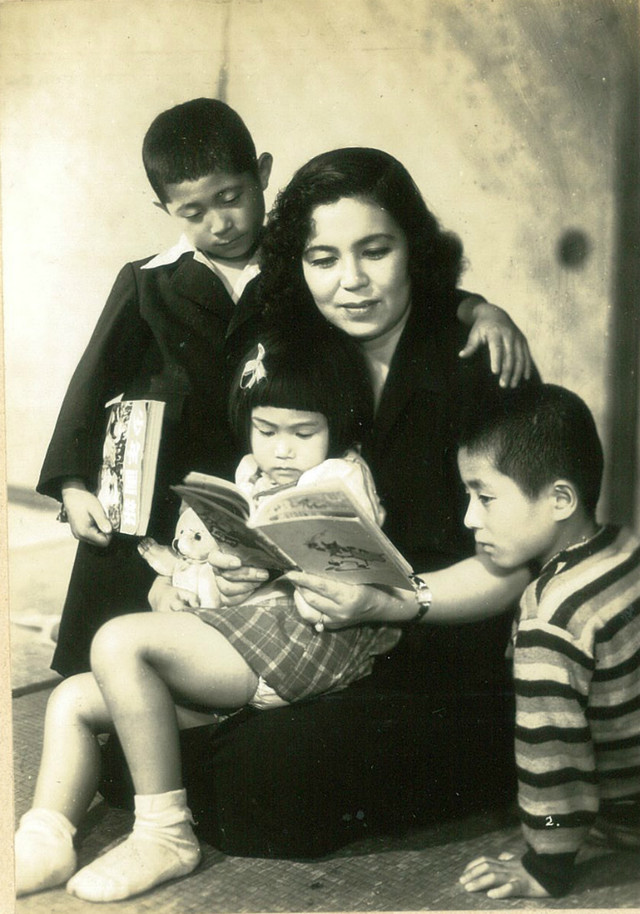
mothers-loveShimizu’s depression era work was not lacking in down on their luck single mothers forced into difficult positions as they fiercely fought for their children’s future, but 1950’s A Mother’s Love (母情, Bojo) takes an entirely different approach to the problem. Once again Shimizu displays his customary sympathy for all but this particular mother, Toshiko, does not immediately seem to be the self sacrificing embodiment of maternal virtues that the genre usually favours.

Tellingly, when we first meet Toshiko she’s asleep on a bus as her three children badger a friendly artist who’s entertaining them by drawing a picture of their pretty mother. The boys are quick correct themselves when talking about the woman they’re with – she’s their “aunt” not their mother, but the artist sees through the ruse. Toshiko is heading to visit her brother in the country in the hope that he will look after her children for awhile offering the explanation that she wants to get married again. Her brother is sympathetic to her problems, but has six children of his own already (and perhaps a seventh on the way) so taking in three extra mouths to feed is not really an option. Agreeing to look after the youngest girl, they suggest trying an elderly uncle but remind her that he has a rather conservative mindset and may ask all sorts of questions about Toshiko’s recent past which she might not want to answer.

Not to worry, the uncle seems to have mellowed with age though he can’t take in two growing boys either and suggests asking a friend of his who’s been trying for a baby for years but has been unable to have one. When that doesn’t work out Toshiko deposits her second son at the uncle’s and travels on with just her oldest boy, Fusao, but as time goes on Toshiko begins to rethink her decision to have her children fostered out and wonders if just being together might be worth more than a stable economic life founded on the pain of abandonment.

The protagonists of “hahamono” which praise the idea of the noble, self sacrificing mother are not universally saintly but the one thing they never do is consider leaving their children. In this regard Toshiko is not immediately sympathetic. Rejecting the name “mother” for “aunt” in the hope of hooking a prospective husband, Toshiko has already marked herself as falling outside of the idealised mother standards and her rather cool, snappy way of addressing the children does not go in her favour either. Her brother greets her warmly (even if he seems to suspect that she’s probably come because she wants something) and has no desire to drag up the past but points out that other people might not be so charitable given that all three children have different fathers and Toshiko has never revealed how she supported herself towards the end of the war and in its immediate aftermath. Nevertheless, Shimizu refuses to judge her. Her life has been a hard one and she herself was fostered out herself as a child. Toshiko’s decision may not be one everyone would agree with but that doesn’t mean it was an easy one for her to make, or that she feels nothing in giving up her children.

The biggest tragedy is that the kids will be separated. Apparently often left to fend for themselves at home whilst Toshiko works, the children are a mini band of three and it seems even more cruel that they will be deprived not only of a mother but of their siblings too. Though the youngest girl tries to run after her mother and brothers, and the second son cries so much that his brother goes back to give him one of his comic books to cheer him up, Fusao is even more upset and anxious as the last remaining child. Constantly wetting the bed which costs him his place at a few prospective new homes, Fusao is plagued by the idea that his mother is about to abandon him and finally pleads with her that he can take care of his siblings by himself if only they can all stay together.

Fusao’s pleas eventually soften his mother’s heart though she begins to think again after coming across a band of itinerant performers, one of whom is nursing an infant despite her poverty and the harshness of her life. The young woman seems devoted to her child and is determined to take care of it even though she has no husband to help her. The child’s grandmother urged her daughter to give the baby up to someone with more resources to raise it but the girl refused, no matter how hard it may turn out to be. Moved, and feeling even more guilty in witnessing the hardships another mother is bearing for her child, Toshiko’s resolve begins to weaken.

When Toshiko is taken ill at an inn and her friend from the city, Mitsuko, comes to visit her it is revealed that Toshiko’s plan is not another marriage but that the two women are in the process of opening a bar – hence why she needs to farm out her children. Mitsuko has also sent her daughter to a relative so that she can plow all her time and money into the enterprise though no one knows how long it will take until the place is successful enough to support the full families of both women. It may be, therefore, that Toshiko’s desire to run her own business is for the ultimate benefit of her children who will finally have a degree of economic security. On thinking again, she wonders if it isn’t selfish vanity and that she’s sacrificing her children to fulfil her own desires.

Shimizu takes a more conservative viewpoint than that found in his other work by encouraging Toshiko to reject the prospect of being her own boss to embrace the traditional values of her natural maternity. The old nurse Toshiko visits in the hope that she will take in Fusao (which she almost certainly would have done) remarks that a full belly isn’t everything and being together might be enough, but that doesn’t quite explain what the obviously desperate Toshiko is going to do to survive from here on in. One can only hope that she somehow finds a way to make the bar work (even if it takes a little longer) rather than be left with nothing all over again. Focusing less on the children than on the maternal conflict as Toshiko becomes torn by the traditional values as seen in her rural hometown and the less forgiving modernism of the city, Shimizu retains an understanding tone but also eschews the concessions to pragmatism which so often went hand in hand with his forward looking idealism, for a reassertion of conservative values which fly in the face of his usually compassionate acceptance of the very real difficulties faced by women in a conformist and male dominated society.