Revenge of the Pearl Queen (女真珠王の復讐, Toshio Shimura, 1956)

Born amid the labour disputes that engulfed Toho in the late 1940s, Shintoho began as a rather lofty endeavour mostly geared towards artistic films, but after a series of box office failures was soon in the red. Impresario Mitsugu Okura was brought in to turn the company around, but his ethos was decidedly populist. He shifted the studio away from the auteurist focus of its early days towards the racy dramas and ghost films with which it would become associated. 

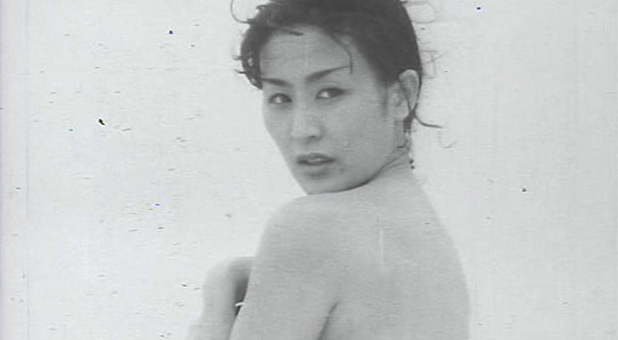
Revenge of the Pearl Queen (女真珠王の復讐, Onna shinju-o no fukushu) was key to this transformation and made a star out of its leading lady Michiko Maeda who had been discovered working in the kimono department of the Mitsukoshi department store. Though sometimes billed as the first mainstream feature to depict full female nudity, what it really sells is the promise rather than the reality. The nudity in the film is generally abstract or artistic, shooting Maeda from behind and at a distance amid nature or capturing brief shots of her rear as her skirt flutters in the wind. Otherwise, she is seen in loose, torn clothing or with her hands covering her bare breasts as she, ironically, tries to escape from a series of men trying to assault her.

Adapted from a novel by Yoshihisa Aoki, the film is also inspired by a real life incident in which a group of men and one woman were marooned on Anatahan island at the end of the war. The men eventually ended up killing each other over the woman. The same incident inspired the 1953 film by Josef von Sternberg. Natsuki (Michiko Maeda), an office worker, is engaged to diligent employee Kizaki (Ken Utsui) and about to undertake a trip abroad with her boss, Asamura (Susumu Fujita). An early scene sees their passports arrive with some fanfare as it was still difficult at this time for ordinary people to acquire one or indeed to travel outside of Japan. But it soon turns out that her boss has an ulterior motive. Kizaki is framed for the murder of the company president, while Asamura first attempts to blackmail Natsuki into entering a sexual relationship with him, then tries to assault her when she refuses. She manages to get away from him, but he chases her and she ends up being thrown overboard.

She then washes up on an island and is “rescued” by five shipwrecked sailors. Three of them are desperate to rape her, while the oldest of the men Ishizuka (Saburo Sawai) is against it and tries to protect her along with his son-in-law to be Yuzo (Shigeru Amachi). Ishizuka takes the men to task and asks them how they could show their faces in Japan having done something so heinous, but they just laugh at him. In some ways, this seems to be an echo of wartime atrocities and the fishermen stand-ins for men who did terrible things overseas and then were able to forget about it and live normal lives in post-war Japan. The same is true of Asamura whose wartime service in intelligence is often referenced, though his subordinate Noguchi (Tetsuro Tanba) later suggests he’s embellished his record. Asamura isn’t even his real name, though he’s been able to build a business empire for himself largely based on fraud, tax evasion, forgery, and apparently also drug smuggling. He used Kizaki as a foil to kill his boss and take over the company, while hoping to also bed Natsuki at the same time.

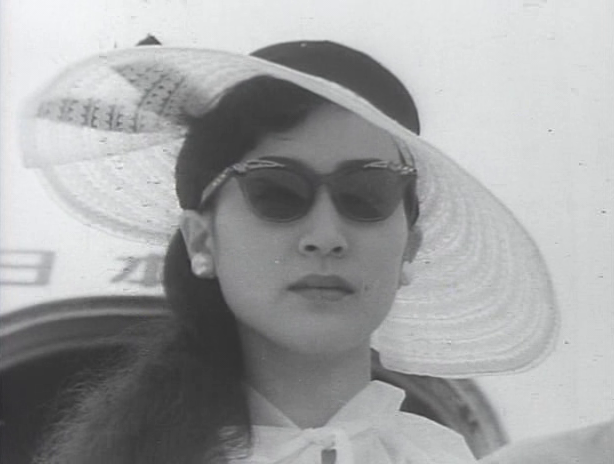
Nevertheless, after the three aspiring rapists turn on each other and are killed, Natsuki discovers a wealth of riches under the sea while attempting to save one of them from a whirlpool. Spending her entire time diving for pearls, she becomes incredibly wealthy and is able to rebrand herself as “Helen Minami”, a Japanese-American “pearl queen”, on her return to Japan. Sharing her riches with Ishizuka and Yuzo, the trio plot revenge hoping to clear Kizaki’s name and expose Asamura’s corruption. They use the money to attack them through the stock market while also discouraging their clients from doing business with them until the company is finally on its knees. The crows are coming home to roost for Asamura with Natsuki returning to expose all his wrong doing, though such occurrences were perhaps rare for other men like him in reality. By reinventing herself, Natsuki is at least able to cure this corruption and restore her innocent connection with Kizaki in a dramatic nightclub showdown in which justice is finally served.

Ginza Cosmetics (銀座化粧, Mikio Naruse, 1951)

1951’s Ginza Cosmetics (銀座化粧, Ginza Kesho) is often said to mark a kind of rebirth in the career of director Mikio Naruse whose output in the 1940s was perhaps unfairly denigrated not least by Naruse himself. As in much of his golden age work and in anticipation of When a Woman Ascends the Stairs, Ginza’s heroine is a resilient bar hostess whose brief hopes of escape through romance are doomed to failure, but it’s also, like the slightly later Tokyo Profile (Hiroshi Shimizu, 1953) and Tales of Ginza (Yuzo Kawashima, 1955) an ode to the upscale district and all the defeated hopes of its illusionary glitz and glamour. 

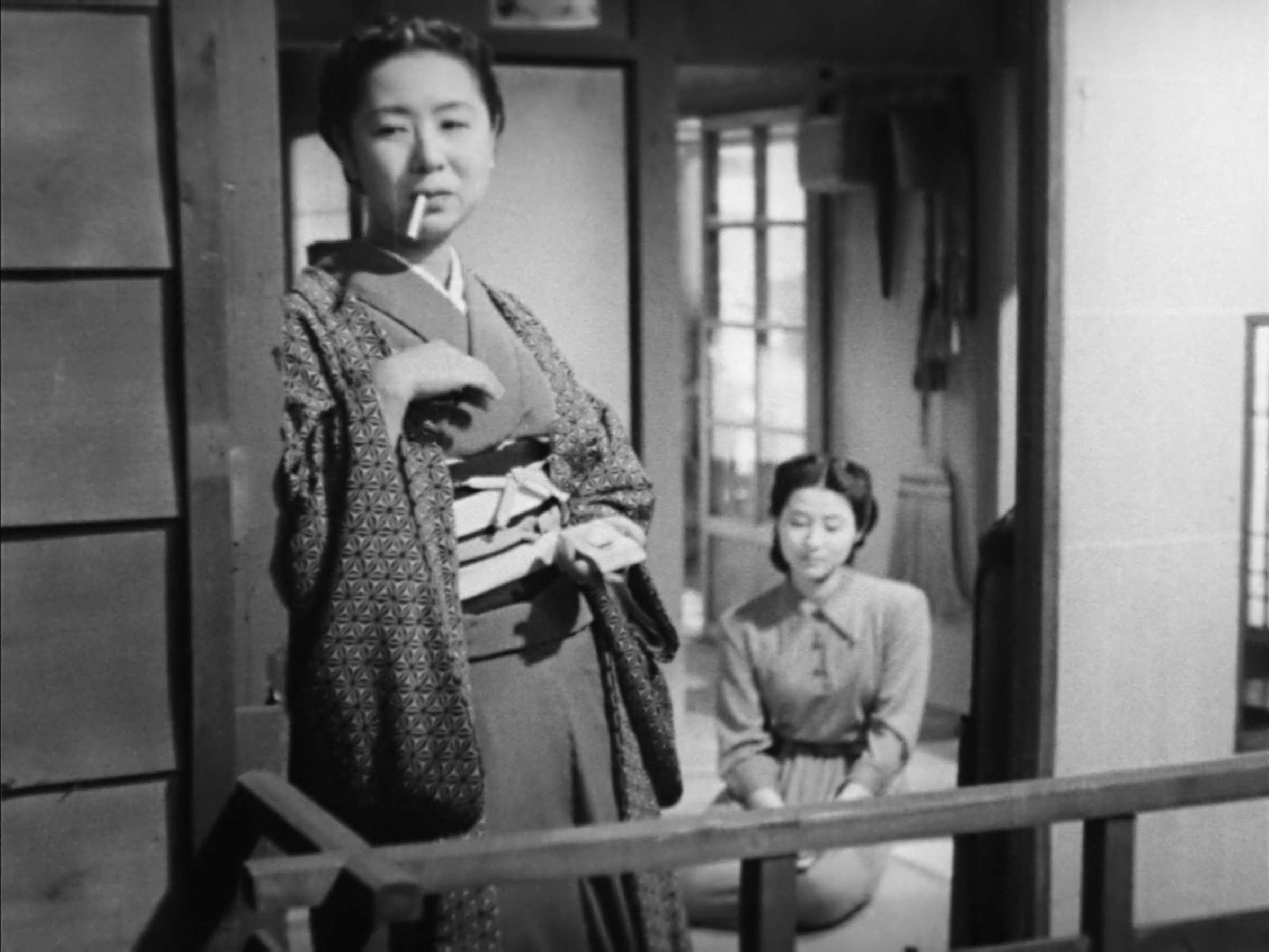
Yukiko (Kinuyo Tanaka), the heroine, is a single-mother approaching middle age and working as a hostess in a Ginza bar. Her landlady who runs a nagauta school on the ground floor and constantly complains about her feckless though goodnatured unemployed husband seems to think she could do better, pointing out that she is an educated woman who seems slightly out of place in the rundown backstreets of this otherwise aspirational area. Even for educated women, however, there may not be many other opportunities in the straitened and socially conservative post-war economy especially for those without connections, and Yukiko also needs to provide for her young son Haruo (Yoshihiro Nishikubo), born out of wedlock after an affair with a customer with whom she had fallen in love but abandoned her when she became pregnant. 

As a slightly older woman who has been working at the Bel Ami bar for many years, seemingly from war to occupation, Yukiko is both looked up to by the younger women and resented as a stern older sister who does not approve of the way some of them ply their trade. She’s taken one, Kyoko (Kyoko Kagawa), who often babysits for her, under her wing, cautioning her against making the same mistakes that she once made in taking the kinds of men that come into the bar at their word. “Men are all animals” she warns her, supporting her desire not to give in to her parents’ attempts to arrange for her not a marriage but a “position” as a mistress. Unlike Yukiko, Kyoko still has hope of leaving the Ginza bar world behind to become a respectable wife even if those hopes are fading with the relative unlikelihood of finding a “good” man with a salary good enough to support a wife who is not already married and can be understanding of her bar girl past. 

The bar world may be on the fringes of the sex trade, but the bar girls are not necessarily sex workers even if some of the younger women are clearly engaging in the kinds of casual sex work of which Yukiko clearly disapproves even while not against consensual romantic liaisons. For her own part, she finds herself in the awkward situation of a continuing non-relationship with a failed businessman, Fujimura (Masao Mishima), who was fairly wealthy during the war but apparently no longer. Yukiko attributes this to him being in someway too good to prosper, though having money in the war which disappeared afterwards perhaps implies the opposite. She does not love him and seems to find his presence a little irritating, but feels indebted because he stood by her when she was pregnant and alone. In any case, he has a wife (whom he apparently resents) and children (whom he claims to adore) and so she feels at best conflicted, especially as the tables have turned and it’s him now constantly asking her for money. Money is not something Yukiko has a lot of, but she isn’t mean and often consents to losing it with a resigned shrug as she does by taking on Kyoko’s bar debt after a customer runs out on the bill and then tricks Yukiko into buying more drinks while waiting for a “friend” to arrive. 

Men, it seems, will always be predatory and unreliable. On hearing from her boss and longtime friend that the bar is in trouble and may have to close, Yukiko ends up acting on an introduction from an acquaintance, Shizue (Ranko Hanai), to meet a “stingy” industrialist who had expressed an interest in her. Shizue has escaped the bar world by becoming a wealthy man’s mistress and with it has claimed a kind of independence. He splits his time between Tokyo and Osaka, leaving her free to do whatever she likes (including meeting other men) for most of her time with none of the strings that go with being a wife. Yukiko is perhaps too “pure” for that kind of arrangement, hinting at the Ginza paradox that only those who learn to accept a certain level of complicity can ever truly be happy there. She agrees to meet Kanno (Eijiro Tono), the businessman, in order to ask him to “invest” in the bar, suggesting they talk things over in a coffeeshop while he tries to pull her into various shady establishments before pushing her into a warehouse and attempting to rape her to get his money’s worth. Yukiko escapes and resolves not to see him again. After all, the point of getting the money to keep the bar open was precisely to avoid having to make arrangements with men like Kanno. 

It’s Shizue, however, who later gives her a last shot at escape when she introduces her to her “true love”, Ishikawa (Yuji Hori), making a brief trip into the city. Shizue can’t entertain him herself because her patron is in town and so entrusts him to Yukiko with the strict instruction not to try it on. Despite herself, however, Yukiko becomes fond of him, reassuming something of a past persona in engaging in intellectual conversation, once again an educated, middle-class woman rather than a bar hostess used to telling men what they want to hear. She has been warned, however, that Ishikawa hates anything “low culture” which is why Shizue has told him they are both war widows and discovers that he has a strong dislike for Ginza which sees him longing for the wholesome charms of home. 

The crisis occurs when Yukiko has to break a promise to Haruo to take him to the zoo in order to look after Ishikawa, causing him to go temporarily missing when he wanders off on his own roaming all over the endless construction site of the contemporary city standing in for the makeshift, in-progress reconstruction of the post-war society. She perhaps feels she’s being punished for choosing to disappoint her son in order to pursue a dream of romantic escape she might also feel is somehow undeserved, but pays in quite a different way after accidentally setting Ishikawa up with Kyoko whom she introduced as her “sister”. Originally angry and resentful, proclaiming herself disappointed with Kyoko in assuming she is the same as the other young women at the bar, Yukiko’s good nature eventually wins out as she realises that Kyoko and Ishikawa seem to have fallen in love in a single night. She has told him everything, and he apparently wants to marry her anyway. Kyoko, at least, is getting out, and Yukiko can be happy about that while privately internalising defeat. Acknowledging that Haruo is the only one on whom she can depend, she resolves to live on as a mother only, trapped in the deceptive diminishing returns of a Ginza bar life even while knowing it has increasingly little place for her.