
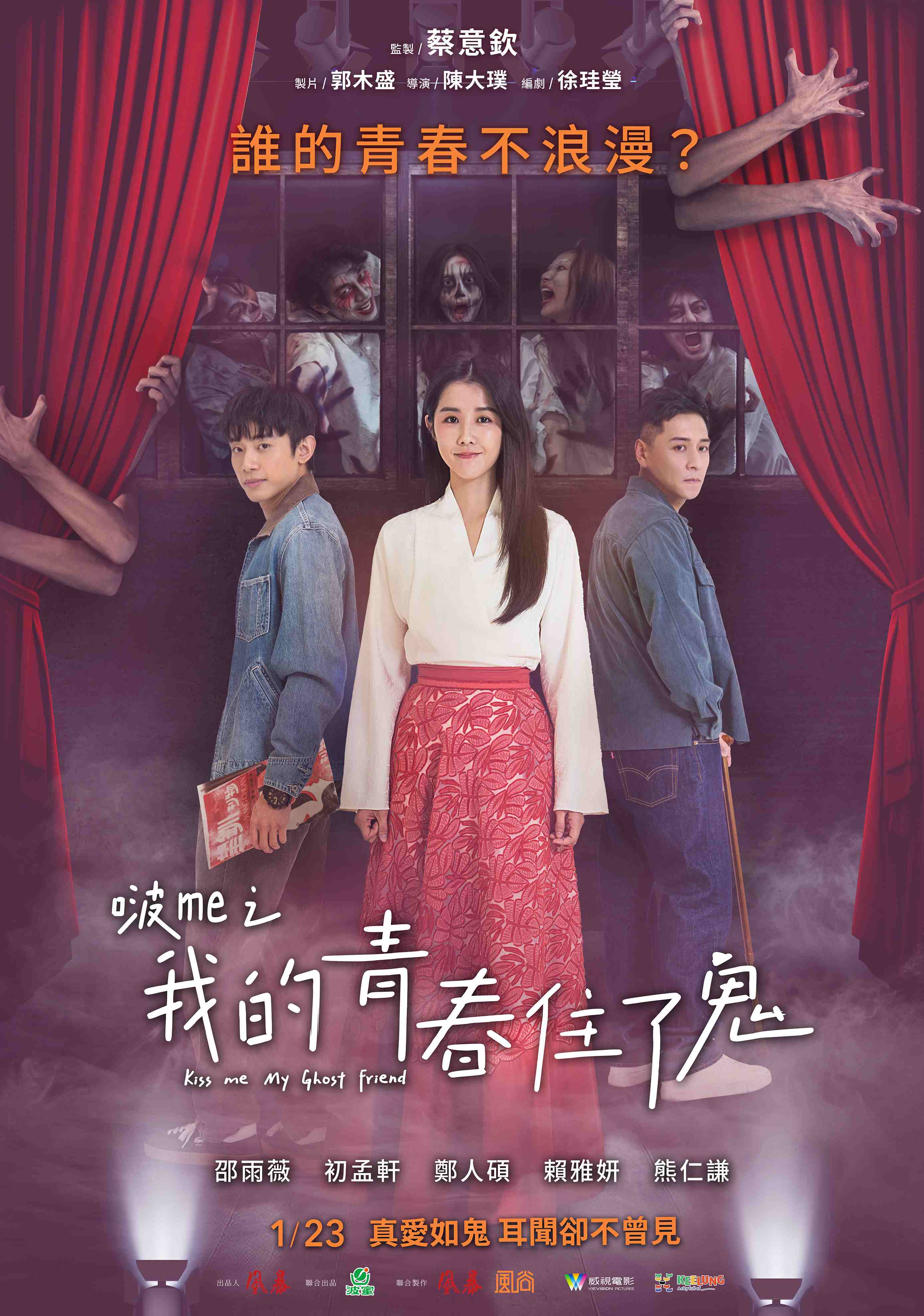
A young director finds himself unwittingingly bonding with a ghost after agreeing to stage a performance in a disused theatre in Chen Ta Pu’s romantic dramedy, Kiss Me, My Ghost Friend (啵me之我的青春住了鬼, bō me zhī wǒ de qīngchūn zhù le). The theatre in question turns out to be haunted, not just by its past and legacy but by young woman betrayed in love whose story dovetails neatly with the tale he has been asked to tell.
To that extent, Jim is also haunted though only by the spectre of his father, a once prominent playwright who has become a recluse. His Bo-Chuan was to be a new and revolutionary kind of theatre updating traditional opera for a new age. It was, however, never staged and following the death of his grandfather, Jim’s mother wants to have the ASI theatre torn down. Jim is less than keen on accepting the job, in part because he is embarrassed by his privilege and prefers to keep the fact that he has a financial safety net in coming from a wealthy and prominent family secret, and because he does not really want to reckon with his family legacy.
The irony is that Jim’s previous show was an interactive ghost experience set in a disused building. Unfortunately, it failed to find an audience and the last performance had to be cancelled. After a year with no success, Jim’s theatre troupe is forced to disband and he’s dumped by his girlfriend, formerly the troupe’s lead actress. He wanted to explore the meaning of life through a ghost story, but laments that the audience just wanted entertainment. He has no idea that Shi is a ghost and originally believes her to be the assistant managing the theatre, but it’s true enough that she has a connection to the story of Bo-Chuan, not just in her involvement with the original production but the ways in which it mirrors her own life as a woman left in limbo, haunted by the spectre of lost love.
Bo-Chuan too waited 18 years for the man she loved to return, though while alive Shi had her doubts about the story. She thought this tale of love and sacrifice was too old-fashioned and bound to destructive patriarchal mores. If it were her, she says, she’d spend the 18 years looking for value in her life rather than waiting around for man. She and Jim’s father decide to change the end of the play, but still, Shi became a lonely ghost trapped in the theatre that itself became a relic of the past. Though she can no longer play a leading role, helping Jim stage another Bo-chuan with an ending of his own allows her to restore the theatre to what it once was, purifying it of its evil spirits and overcoming her romantic trauma.
Jim too gets a second chance at his artistic career having previously decided to give up the theatre after his repeated failures. Though a potential romance with Shi never gains traction, she does however lead him towards artistic fulfilment in the acceptance of his legacy as his father’s son as they finish the play together. The other members of Jim’s troupe too all come to accept Shi even after realising that she is a ghost. They too had all be financially inconvenienced by Jim’s failure, though unlike his girlfriend his troupe chose to stand by him and return for this gig in an apparently haunted theatre which nevertheless offers huge financial rewards. Unlike Bo-chuan, Ying Ying wouldn’t wait, but her place is quickly taken by Shi who patiently teaches Jim’s actors how to work with this more classical material. Though Jim’s mother may want to tear the theatre down because it reminds her of a past she’d rather forget and symbolises her guilt, in the end it becomes a place of healing that allows all to move on from the past while giving Jim’s theatre troupe a new place to belong along with a brighter artistic future rooted firmly in the past.
Kiss Me My Ghost Friend screens as part of this year’s New York Asian Film Festival.
Trailer (Traditional Chinese / English subtitles)
 Windows on Worlds