Hong Kong Paradise (香港パラダイス, Shusuke Kaneko, 1990)

A tour guide on her maiden voyage finds herself swept into intrigue in Shusuke Kaneko’s madcap caper, Hong Kong Paradise (香港パラダイス). Effectively a Japanese take on mo lei tau nonsense comedy, it’s also a commentary on Japan at the tail end of the Bubble era as the heroine dreams of an exciting world of travel only to find herself shepherding a collection of mostly elderly retirees whose most pressing concern is finding the duty free shop.

Mamiko (Yuki Saito) wanted to go Paris, but according to her boss she’s not really the type, so he’s sending her to Hong Kong instead. Everyone keeps remarking on the fact that she looks just like a fugitive princess, Yoko Kitashirakawa, who eloped with the man she loved to escape from an arranged marriage with a member of the imperial family. Mamiko has also, apparently, recently broken up with a boyfriend which might explain her desire for travel, as the film flirts with the idea she might really be Yoko enjoying a kind of Roman Holiday and not wanting to return to her constrained life as an aristocrat. But on the plane over, she ends up running into Ando (Tsuyoshi Ihara), a man who’s on the run after committing a heist in which he stole a pair of golden chess pieces as part of an insurance scam.

The golden king and the queen who end up getting separated are a representation of frustrated romance as various parties try to get them back together for different reasons. Mamiko evidently took a liking to Ando, but sadly he is soon killed, leaving her to be rescued by Oishi (Kaoru Kobayashi), a man of dubious motivations. Having lost her memory after being press-ganged into being the subject at a hypnotism show, Mamiko must once and for all re-establish her identity by finding her way through the conspiracy while slowly falling for Oishi despite his irritating qualities. In order to find the treasure, Oishi lies to her, telling Mamiko that she’s Yoko while she’s also chased by a man claiming to be a police officer and Hong’s goons who are convinced that she knows where the chess pieces are.

For the criminals, and perhaps for us too, the missing king and queen are a kind of MacGuffin, but they link back to another tragic love story. Believing that Mamiko is Yoko, Mrs Yang (Keiko Awaji) sympathises with her predicament acknowledging that love across the class divide is never easy. The love of her life was an English prince called Charles, incongruously played by an American in the opening and closing voice over, whom she met thanks to her father’s work as a diplomat. Times being what they were (and perhaps are), she knew they could never marry. Oishi tries to trick Mamiko by playing on her sympathy, claiming that the chess pieces were a gift for Mrs Yang from the man she loved in an effort to get Mamiko to help him find them without realising that he has actually stumbled on the truth.

Hong Kong then becomes a place of romance not unlike the Paris of Mamiko’s imagination in being the paradise of a tragic love story even if in reality the chess pieces were “stolen” as part of an insurance fraud scam which is about as unromantic as it’s possible to get. Nevertheless, princess Yoko apparently got a happy ending, marrying an ordinary person even if there are many people who think she’s crazy for turning down the opportunity to become a member of the imperial household. Mamiko’s occupation as tour guide, or tour conductor as she keeps reminding the participants, is largely unromantic too, mostly consisting of shuttling disinterested guests from one tourist spot to another which is to say it’s not so much broadening her horizons as narrowing them.

But in any case through her zany adventure she does perhaps get to experience the romance of life in being pulled into unlikely intrigue and fighting to reunite the separated king and queen on a symbolic and spiritual level beyond the simply physical. “It doesn’t matter who I am,” she eventually reflects on embracing her liberated anonymity and enjoying the thrill of the chase, while paradoxically rediscovering her identity in the process. Critics at the time objected to the nonsensical plot and frequent tonal shifts, but they are, of course, a key element of mo lei tau and what gives the film its zany, madcap charm as the heroine careers from one ridiculous situation to another all while falling in love.

Kubi (首, Takeshi Kitano, 2023)

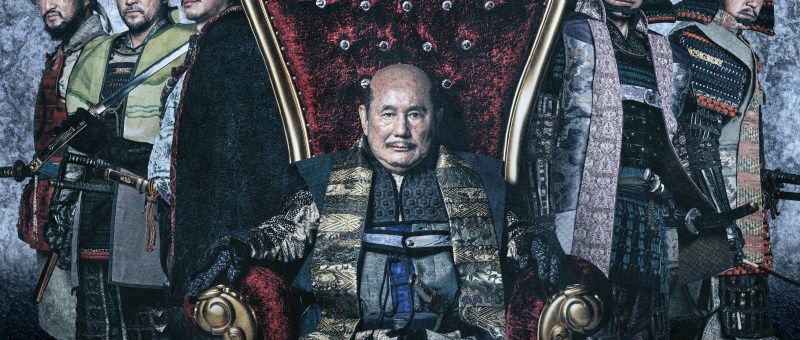
Apparently in gestation for a couple of decades, it’s unsurprising that Takeshi Kitano gave himself the role of Hideyoshi in a long-awaited historical drama adapted from his own novel, Kubi (首). Played as an irascible but wily old man, Hideyoshi is the second of Japan’s great unifiers and, unlike his predecessor, died as a result of an illness rather than intrigue. He was also a peasant who rose through the ranks and is perhaps witness to the tumultuous class conflict and social divisions of a hierarchal society.

Even so, in this version of events, Oda Nobunaga (Ryo Kase) too speaks in a thick rural dialect that sets him apart from his retainers and seems to hint at his uncouthness. This Nobugana is an unhinged despot who threatens and humiliates his subordinates, not to mention sexually assaulting them. In short, there’s no real mystery why his men have begun to turn against him and there is intrigue in the court. The film opens with Murashige’s (Kenichi Endo) quickly quelled rebellion which floundered when his reinforcements failed to arrive. Murashige is on the run and Nobunaga has heavily suggested whoever brings in his head will be first in line for the succession, but Murashige is also in a relationship with Mitsuhide (Hidetoshi Nishijima) another courtier vying for favour in more ways than one from the capricious Nobunaga. 

The striking thing about the staging is how like a yakuza drama this intrigue really is with each of the main factions manoeuvring for control, forming temporary or duplicitous alliances forged in the mutual desire of ousting a ruler whose increasing instability presents only the likelihood of a return to chaos. Nobunaga’s flamboyant speech and threatening manner are reminiscent of a yakuza boss on his way out, as is his obvious tactic of setting his rivals against each other while secretly planning to hand the reins to his son anyway. The film takes place in a largely homosocial world, the only women on screen are sex workers and peasants about to be murdered, only this time defined by romantic intrigue in which the various relationships between the men are inescapably linked with power and duplicity.

Mitsuhide’s relationship with Murashige is originally framed as a giri/ninjo conflict, Mitsuhide torn between the exercise of his duty as a samurai and his love for Murashige, only to later be set wondering if Murashige isn’t also playing him in urging him too towards rebellion, while Murashige accuses him of harbouring desires for Nobunaga which would also necessarily be desire for advancement. Advancement is something sought by all and in particular Mosuke (Shido Nakamura), a peasant who is taken on as a foot soldier after looting a battlefield for amour and killing his friend to get his hands on the prize only to realise just at the critical moment how pointless the constant desire for heads really is. The absurdity is rammed home in the closing scene in which Hideyoshi declares himself uninterested in the severed head he asked for, rendering the quest entirely pointless.

This absurdity extends to introducing the character of a comedian who is later killed for talking too much, while Kitano wise cracks his way along as the affable Hideyoshi. Kitano is in his way in dialogue with other samurai epics, using Akira Kurosawa’s horizontal wipes and introducing a pair of bumbling comic relief peasants only to suddenly kill one of them off because at the end of the day this world isn’t very funny. It’s cruel, and mean, and meaningless, so you might as well laugh like Hideyoshi. Residents of a ninja village conduct a festival in which they pray for death and to be released from this earthly torment as soon as possible, while farmers still dream of becoming samurai little knowing the reality of samurai life.

It’s this cycle of futility that is echoed in the opening image of a severed neck into which crabs in a river are crawling. Kitano stages lavish battle scenes, but ones that are often horrifying and absurd, a visceral struggle in mud and blood fought for no real reason. These samurai live their lives on the point of a sword, but they move and behave like yakuza fighting pointless turf wars and games of petty intrigue until someone finally comes for their heads. In the end, the victor is the one who doesn’t play the game at all, but sits and laughs at the absurd cruelty all around them in which the only stable force is ambition accompanied by a nihilistic lust for blood in an already bloody world.


Kubi  screens in New York July 16 as part of this year’s JAPAN CUTS.

Trailer (English subtitles)

Hime-anole (ヒメアノ~ル, Keisuke Yoshida, 2016)

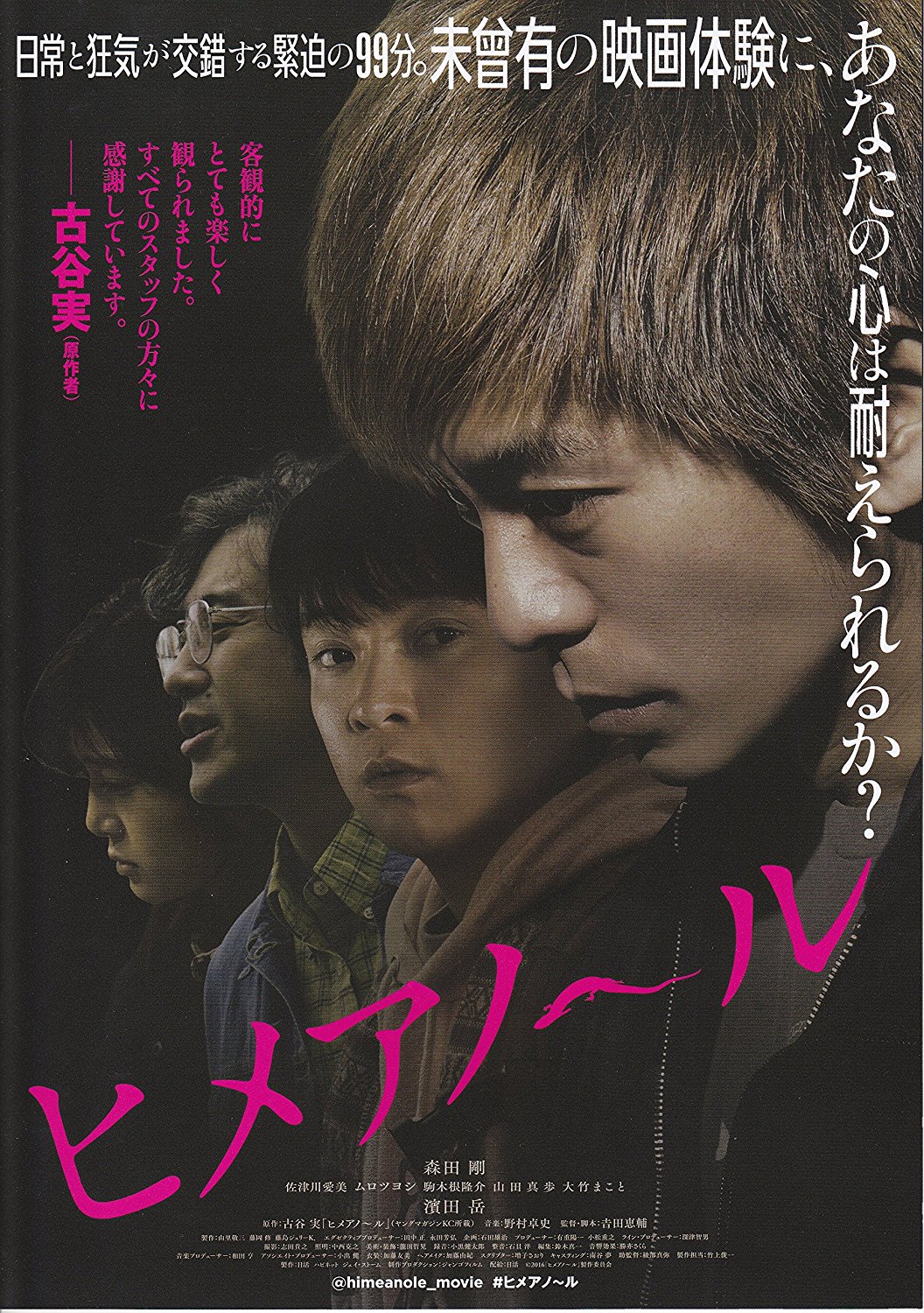
hime-anole posterSome people are odd, and that’s OK. Then there are the people who are odd, but definitely not OK. Hime-anole (ヒメアノ~ル) introduces us to both of these kinds of outsiders, attempting to draw a line between the merely awkward and the actively dangerous but ultimately finding that there is no line and perhaps simple acts of kindness offered at the right time could have prevented a mind snapping or a person descending into spiralling homicidal delusion. To go any further is to say too much, but Hime-anole revels in its reversals, switching rapidly between quirky romantic comedy, gritty Japanese indie, and finally grim social horror. Yet it plants its seeds early with two young men struggling to express their true emotions, trapped and lonely, leading unfulfilling lives. Their dissatisfaction is ordinary, but these same repressed emotions taken to an extreme can produce much more harmful results than two guys eating stale donuts everyday just to ask a pretty girl for the bill.
Okada (Gaku Hamada) is a young man lost. He has a dead end construction job he doesn’t like and isn’t particularly good at, but treading cement all over the finished floors at least helps him bond with his mentor, Ando (Tsuyoshi Muro), who seems to view him as a friend even if constantly referring to him as “Okamura”. Okada takes the opportunity to explain his malaise to Ando – that he feels his life slipping away from him in its emptiness, going through the motions with no real hobbies or girlfriend to give his existence meaning. Ando does not really understand this, he says dissatisfaction is natural and the driving force of all life but, on the other hand, he is not particularly dissatisfied because he lives for love!

Ando has a crush on a girl at the local cafe, Yuka (Aimi Satsukawa), who actually hasn’t noticed him because she’s pre-occupied with the blond guy who got there before Ando and sits outside everyday just staring at her. Luckily or unluckily, the guy in question, Morita (Go Morita), is an old high school acquaintance of Okada’s and so Ando asks him to find out what’s going on with this scary looking guy and his angelic lady love.

So far, so Japanese indie rom-com, but when the title card flashes up about a third of the way in, we’re in very different territory. Suddenly the colour drains from the screen and Yoshida changes his aesthetic and shooting style almost entirely. Gone is the comforting, slightly washed out colour scheme and the static, middle-distance camera of the opening. Now we are the voyeur, held helpless behind Yoshida’s erratic shaky cam, hiding behind the bins as Morita goes about his bloody business. Morita’s world is dark yet realistic, he’s shot and positioned with the arch naturalism familiar to the Japanese indie and the violence he inflicts is not movie violence, it is shocking, sickening, and visceral.

Hime-anole does not shy away from the consequences of its actions. This is, in a way, its point. At one time or another everyone concludes the increasingly surreal events they become engulfed in must be all their fault because they all have at some point acted in a way they do not quite approve of. Guilt is another of the emotions that is hard to express, especially when it’s mixed with humiliation or fear, but left unaddressed it is these corrosive agonies which develop into deep psychoses. Morita, a violent sociopath, was once (or so it would seem) an ordinary young boy who liked video games and had few friends. Perhaps if he hadn’t been the victim of humiliating, sadistic treatment, or if someone had found the courage to stand up for him, none of this might be happening.

Then again, the world is a strange place filled with people who have trouble deciding where the lines are when it comes to appropriate behaviour. Poor Yuka seems to have become something of a nutter magnet, stalked by two guys at the same time and chatted up in the street by persistent suitors who only leave her alone when they realise she’s waiting for another man. Okada is the only man who’s treated her like a regular human being for a very long time so it’s no surprise that she begins to prefer him to his awkward friend. Ando is, it has to be said, odd. Convinced Yuka is the one for him yet completely uninterested in her feelings, he vows to persevere. Yet for all his talk of chainsaws, Ando is basically harmless (to others at least) and just another lonely guy who doesn’t know how to express himself in way in which he will be understood. Morita, by contrast, is instantly creepy and has no interest in connection, he only wants to take and possess in a kind of ongoing vengeance for truly horrific events in his childhood following which something inside him became very broken.

That Hime-anole ends with a Brazil-style fantasy only adds to its strangely melancholy air as it insists on sympathy for the devil even whilst showing each of his sadistic crimes for the ugly, bloody messes they really are. Maybe the reason everybody feels they’re to blame is that in some way they are yet everyone has done things they regret or aren’t proud of, wishing they’d done things differently or managed to find the courage to do what they thought was right rather than choosing to protect themselves or keep their head down when they could have saved someone else pain. Betrayals can be small things, but they fester – like those unspoken emotions which were making our guys so unhappy in the first place. There are no innocents in Hime-anole save perhaps for the ones pushed further than they could endure, but there are those finally facing up to their own flaws and attempting to do things differently now they know better. If that’s not progress, what is?


Original trailer (no subtitles)

Otakus in Love (恋の門, Suzuki Matsuo, 2004)

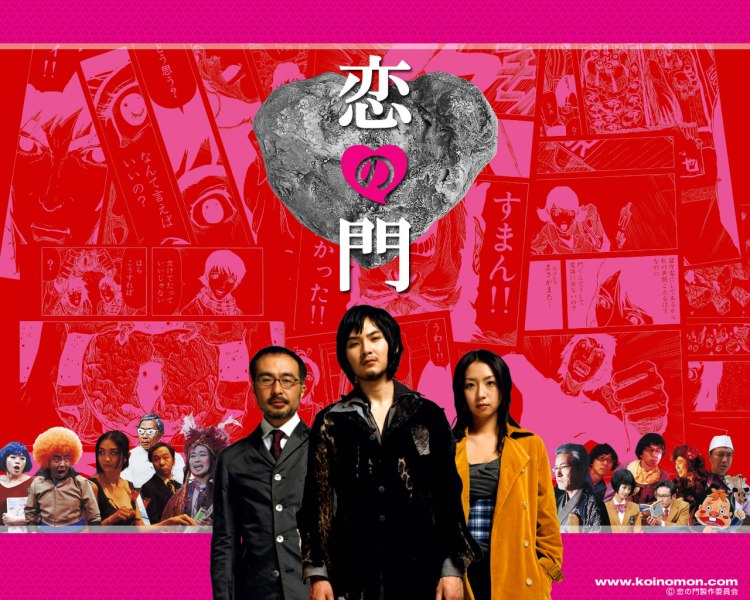
koi no monReview of Suzuki Matsuo’s Otaku’s in Love (恋の門, Koi no Mon) first published on UK Anime Network in February 2014.


The word “otaku” is a difficult one to pin down. In the West, it’s often come to be a badge of pride and respect, a label that many fans of what most people would perceive as a niche subculture actively identify with and eagerly apply to themselves. However, the roots of the term are much darker and in its native Japanese, “otaku” can be far from a nice thing to call another person. Of the central couple in this film perhaps only one can be thought of as a traditional “otaku” the other being more of a “tortured artist” whose eccentric behaviour makes it difficult for him to survive in the real world. Well, to be honest finding a base line for “normal behaviour” in this film is a pretty tall order, we run into bizarre anime conventions, cosplay obsessives, broken hearted ex-mangaka (manga) bar owners and a bizarre cult like office environment where the only rule is you must be “happy!” all the time. Otakus In Love is an endearingly odd film that is jam packed full of in jokes and meta references that knows its audience very well and never fails in the humour stakes as a result.

Mon is a down on his luck, in fact totally broke, manga artist. Well, he calls himself a “manga artist” but his work isn’t exactly what most people would expect. In a touch of the avant garde, Mon makes his manga out of rocks. Mon’s “manga” are, in fact, a collection of rocks painted with a single kanji character and arranged inside a custom made wooden box. Needless to say each of Mon’s works is a one off piece and his sales record is not exactly going to get him on the best seller list. He can’t seem to hold down a part time job either due to his extreme reactions to people not taking his art seriously and his strange appearance which is something like a seventies guru come glam rock god whose ragged clothes have an oddly deliberate look to them. One fateful day he has an interview for Tsugino Happy Inc which turns out to be a cult-like office environment which seems to advocate happiness through total subjugation. He lasts about an hour at this job before punching his new boss in the face for failing to appreciate his artistic qualities.

However, on the way there about to pick up a particularly fine looking rock, he meets Koino who turns out to be a colleague of his at Happy Inc. The two go out for drinks which ends up at Koino’s apartment where upon Mon wakes up the next morning to find out he’s been a victim of forced cosplay! Unwittingly dressed up as Koino’s favourite character from Soul Caliber II, he’s quickly posed by Koino for her cosplay wall and dragged into a world of doujinshi, comiket, cosplay and all things geeky. Koino is an amateur manga artist who claims to have made a small fortune selling her home made manga at conventions and is well and truly an otaku. Can two such different people really find love? There’s only one way to find out!

Otakus in Love is based on Jun Hanyunyuu’s manga Koi no Mon (also the original Japanese title of the film) and as such carries over various extremely clever meta visual references. Directed by well known actor Suzuki Matsuo (Ichi the Killer) the film is often about as close as you could get to being a live action manga as Matsuo manages to make standard manga tropes like reaction shots and surreal action scenes work in a totally believable way. In the course of the film we’re treated to full on musical sections and ridiculous comic motifs that resurface at fairly predictable moments which could all end up just being far too much, but under Matsuo’s steady hand the film comes out on the right side of crazy and is never anything less than totally zany fun.

The film isn’t afraid to wear its otaku badge on its sleeve, either. Jam packed with references from video games, anime, and manga, Otakus in Love gets its audience completely and trusts it to understand all of its allusions and homages without needing to repeatedly bash the viewer over the head with tie-ins. It also takes an affectionate side swipe at fan culture with some bizarre interactions with cosplay, conventions and ani-singers which any anime fan can probably relate to. The film also has a fair few cameos from such well known personages as Hideaki Anno, Shinya Tsukamoto and Takashi Miike to name but a few.

At a 114 minutes it does run a little long and occasionally feels like it’s going to run out of steam but for the vast majority of its running time Otakus in Love is a genuinely hilarious, truly bizarre, romantic comedy. Full of warmth and exuberance, it’s difficult to image anyone not being swept away by its surreal humour and though it’s certainly on the broader side of comedy it never feels particularly over the top (or at least not in a bad way). Otakus in Love is a romanic comedy that no self confessed otaku should miss out on seeing.


Reviewed at the Japan Foundation Touring Film Programme 2014.