
 They say the way to a man’s heart is through his stomach, but for some guys you’ll have to do a whole lot of baking. Based on the popular manga which was also recently adapted into a hit anime (as is the current trend) My Love Story!! (俺物語!!, Ore Monogatari!!) is the classic tale of innocent young love between a pretty young girl and her strapping suitor only both of them are too reticent and have too many issues to be able to come round to the idea that their feelings may actually be requited after all. This is going to be a long courtship but faint heart never won fair maiden.
Takeo (Ryohei Suzuki) has been best friends with next-door neighbour Suna (Kentaro Sakaguchi) ever since they were small and he made a point of becoming his defender when Suna was the new kid in town and the other boys made fun of him. However, Taeko is a big lug of a guy, adored by the his male classmates for his off the charts level of coolness, but often shunned by the ladies thanks to his impulsive nature and booming voice. Suna, by contrast, is massively popular and finds himself surrounded by swooning girls everywhere he goes. Being the big hearted guy he is, when Takeo notices his middle school crush confessing her love to Suna on graduation day, he makes sure Suna lets her down gentle and chooses to break his own heart instead.
You see, being the big guy is not exactly easy. A little slow on the uptake but also extremely sensitive, Takeo has been hearing gorilla jokes his whole life and so has internalised an intense feeling of being completely unloveable. Despite this, he remains an extremely good person who just wants everyone else to be happy even if he’s convinced himself he’s not allowed to be. Thus when he saves timid high school girl Rinko (Mei Nagano) from a persistent street harasser and falls in love at first sight, it doesn’t really occur to him that the same thing might have happened to her. Mistaking Rinko’s attempts to get his attention for a backhanded way to get to his more conventionally handsome friend, Takeo resolves to get the two together no matter what!
It would be difficult to find a romance quite as innocent as My Love Story!! which (successfully) strings out one wilful misunderstanding for around two hours. There are no great scenes of jealous exes or sudden arranged marriages to contend with, just two people entirely incapable of speaking plainly. Takeo is so invested in the idea of his own ugliness that it just doesn’t make sense to him that anyone would choose him over the conventionally handsome Suna. Likewise Rinko is quite a timid girl, bowled over by the cool way Takeo dealt with her street harasser and subsequent acts of heroism throughout the film. Though her friends may crack gorilla jokes behind her back, Rinko can see straight through to Takeo’s giant heart and is always ready to defend him, even if her own diffidence means she can’t just tell Takeo how she really feels in a way he understands.
Meanwhile, Suna is very bored by all of these missed messages as his well meaning buddy tries to foist the girl he himself loves on his obviously disinterested friend. As for why Suna is so disinterested, the film is also a somewhat coy. A little shy and awkward himself, Suna is uncomfortable with all the attention his ridiculous good looks bring him, as well as additional resentment from the other guys and often needing to deflect praise for Takeo’s heroism which people often seem to attribute to him. It may just be that Suna is over the superficial and is waiting for someone to see past his pretty boy face but his refusal to talk about the kind of girl he likes aside from going for “big and strong” perhaps hints at an altogether different reason. In any case, Suna getting fed up with being persistantly gooseberried becomes the final catalyst for finally explaining to Takeo what exactly has been going on these past few months.
Before you know it, enough baked goods to feed a small army have been consumed but Takeo is still having trouble realising that they each had a secret ingredient – love! Sometimes nice guys do get the girl, even if it involves shielding them from a falling coffin in a haunted house that’s on fire which is not as good of a metaphor as you’d think but it’ll do for now. Old fashioned and innocent, My Love Story isn’t going to set the world on fire, but it might just light a flame in your heart.
Original trailer (no subtitles)
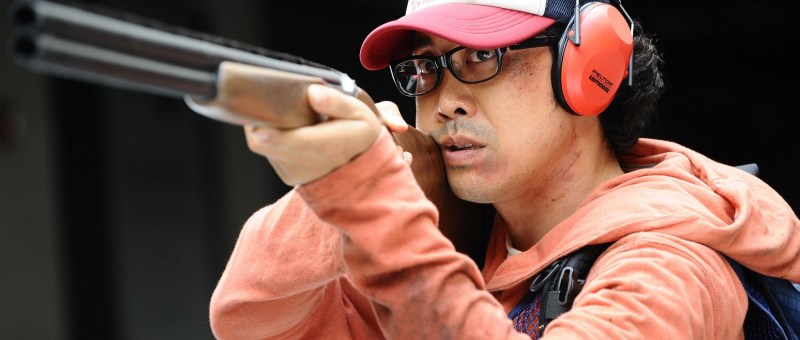
 Japan has never quite got the zombie movie. That’s not to say they haven’t tried, from the arty Miss Zombie to the splatter leaning exploitation fare of Helldriver, zombies have never been far from the scene even if they looked and behaved a littler differently than their American cousins. Shinsuke Sato’s adaptation of Kengo Hanazawa’s manga I Am a Hero (アイアムアヒーロー) is unapologetically married to the Romero universe even if filtered through 28 Days Later and, perhaps more importantly, Shaun of the Dead. These “ZQN” jerk and scuttle like the monsters you always feared were in the darkness, but as much as the undead threat lingers with outstretched hands of dread, Sato mines the situation for all the humour on offer creating that rarest of beasts – a horror comedy that’s both scary and funny but crucially also weighty enough to prove emotionally effective.
 Terra Formars – Terror for Mars? It’s all about terror in the quest for terra and reform in Takashi Miike’s bug hunt extravaganza adaptation of Yu Sasuga and Kenichi Tachibana’s manga. In fact, much of the plot is more or less the same as Aliens, but our motley crew is not a crack team of space marines headed by a recently awoken from stasis super survivor who proves unexpectedly dextrous in a robotic forklift exoskeleton, but a collection of human “bugs”, parasitical criminals who’ve each been made an offer they can’t refuse. High budget and boasting a starry cast, Terra Formars (テラフォーマーズ) definitely falls into the throwaway Miike category and proves curiously dull despite its ridiculous set up, but then if you happen to be into bugs there’s really a lot to like here.
 Based on the contemporary manga by the legendary Fujiko F. Fujio (Doraemon), Future Memories: Last Christmas (未来の想い出 Last Christmas, Mirai no Omoide: Last Christmas) is neither quiet as science fiction or romantically focussed as the title suggests yet perhaps reflects the mood of its 1992 release in which a generation of young people most probably would also have liked to travel back in time ten years just like the film’s heroines. Another up to the minute effort from the prolific Yoshimitsu Morita, Future Memories: Last Christmas is among his most inconsequential works, displaying much less of his experimental tinkering or stylistic variations, but is, perhaps a guide its traumatic, post-bubble era.
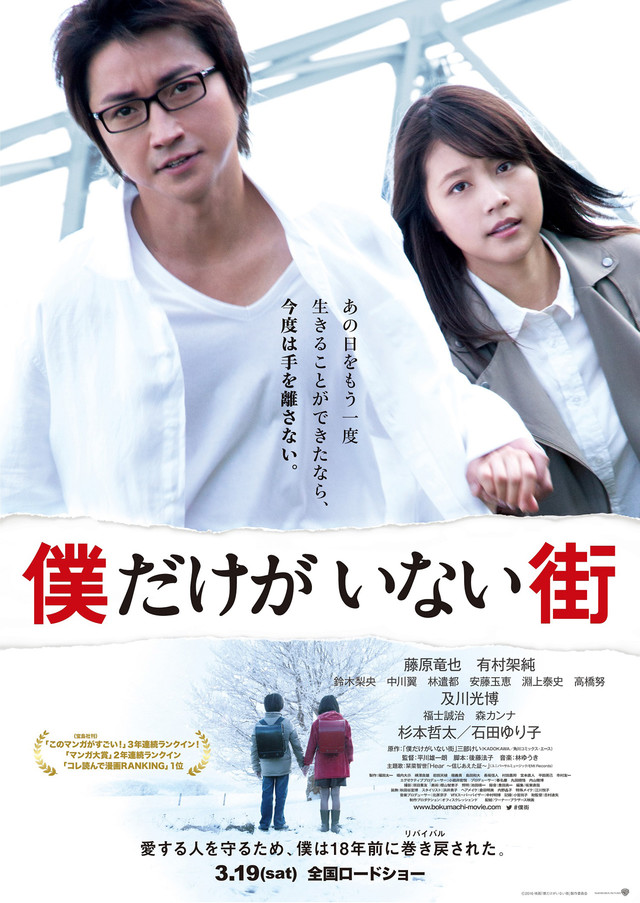 Erased (僕だけがいない街, Boku Dake ga Inai Machi), a best selling manga by Kai Sanbe, has become this year’s big media spectacle with a 12 episode TV anime adaptation and spin-off novel series all preceding the release of this big budget blockbuster movie. Directed by TV drama stalwart Yuichiro Hirakawa, the live action iteration of the admittedly complicated yet ultimately affecting story of a man who decides to sacrifice himself to ensure his friends’ happiness, acquits itself well enough for the most part but changes two crucial details in its concluding section which unwisely undermine its internal logic and make for an unsatisfying conclusion to the ongoing puzzle.
 Ogami (Tomisaburo Wakayama) and his son Daigoro (Akihiro Tomikawa) have been following the Demon Way for five films, chasing the elusive Lord Retsudo (Minoru Oki) of the villainous Yagyu clan who was responsible for the murder of Ogami’s wife and his subsequent framing for treason. The Demon Way is never easy, and Ogami has committed himself to following it to its conclusion, but recent encounters have broadened a conflict in his heart as innocents and seekers of justice have died alongside guilty men and cowards. Lone Wolf and Cub: White Heaven in Hell (子連れ狼 地獄へ行くぞ!大五郎, Kozure Okami: Jigoku e Ikuzo! Daigoro) moves him closer to his target but also further deepens his descent into the underworld as he’s forced to confront the wake of his ongoing quest for vengeance.
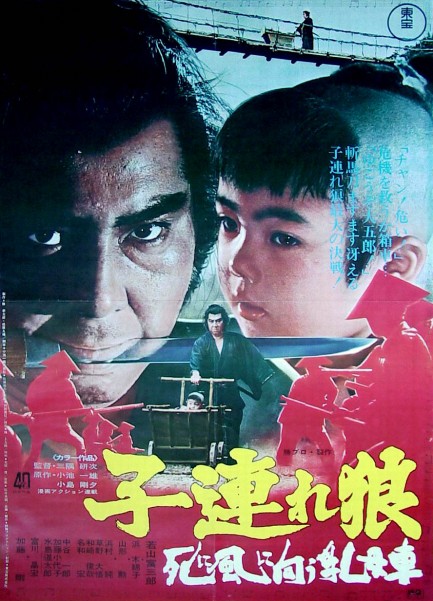 Ogami Itto (Tomisaburo Wakayama) and his (slightly less) young son Daigoro (Akihiro Tomikawa) are going to hell in a baby cart in this third instalment of the six film series, Lone Wolf and Cub: Baby Cart to Hades (子連れ狼 死に風に向う乳母車, Kozure Okami: Shinikazeni Mukau Ubaguruma). The former shogun executioner, framed for treason by the villainous Yagyu clan intent on assuming his position, is still on the “Demon’s Way”, seeking vengeance and the restoration of his clan’s honour with his toddler son safely ensconced within a bamboo cart which also holds its fair share of secrets. In the previous chapter,
 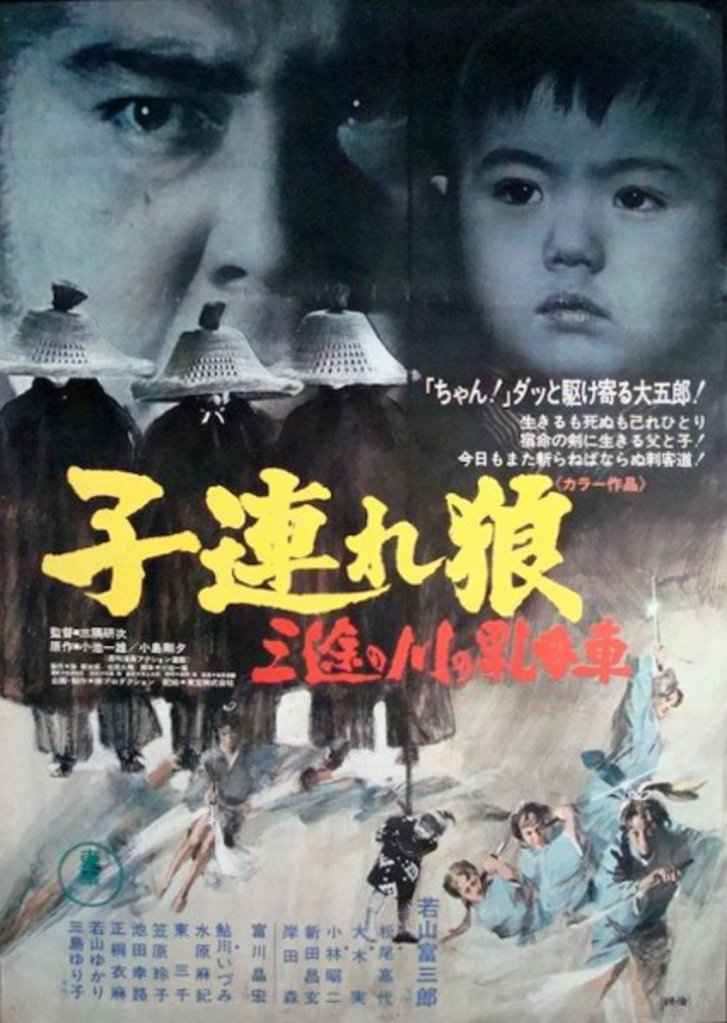 The first instalment of the
 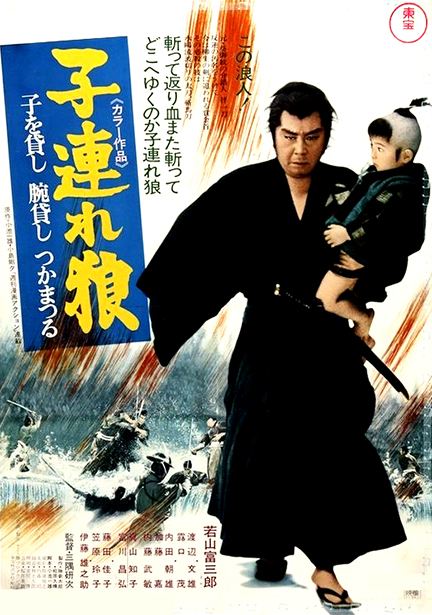 When it comes to period exploitation films of the 1970s, one name looms large – Kazuo Koike. A prolific mangaka, Koike also moved into writing screenplays for the various adaptations of his manga including the much loved Lady Snowblood and an original series in the form of Hanzo the Razor. Lone Wolf and Cub was one of his earliest successes, published between 1970 and 1976 the series spanned 28 volumes and was quickly turned into a movie franchise following the usual pattern of the time which saw six instalments released from 1972 to 1974. Martial arts specialist Tomisaburo Wakayama starred as the ill fated “Lone Wolf”, Ogami, in each of the theatrical movies as the former shogun executioner fights to clear his name and get revenge on the people who framed him for treason and murdered his wife, all with his adorable little son ensconced in a bamboo cart.
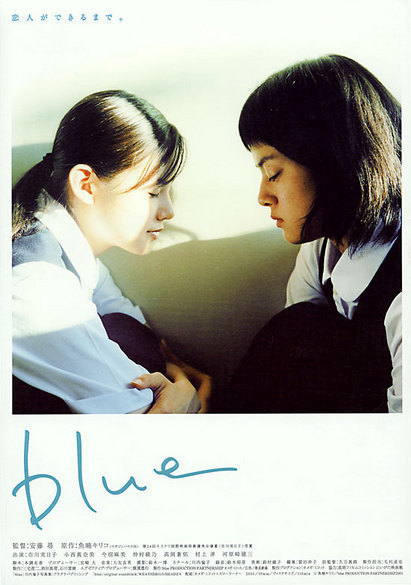 Growing up is hard to do. So it is for the teenage protagonists of Hiroshi Ando’s debut mainstream feature, Blue (ブルー), adapted from the manga by Kiriko Nananan. Like Nananan’s original comic, the cinematic adaptation of Blue is refreshingly angst free in its examination of first love and the burgeoning sexuality of two lonely high school girls. Shot with a chilly stillness which echoes the emptiness of this small town existence, Blue is no nostalgic retreat into cosy teenage dreams but a cold hard look at the messiness and pain of adolescent love.
 Windows on Worlds