Seto and Utsumi (セトウツミ, Tatsushi Omori, 2016)

seto-and-utsumiThere are two very distinct sides to the career of Tatsushi Omori. Brother of the well known actor, Nao, Omori may be best known to certain audiences for his hard hitting, often gloomy and pessimistic dramas of human misery such as festival favourite Ravine of Goodbye or the little seen The Whispering of the Gods which proved so controversial that his only option of screening the film involved erecting a tent where he could show it himself. However, a closer look at his filmography discovers a steady strain of laid-back comedy such as the Tada’s Do It All House series in which two brothers played by Eita and Ryuhei Matsuda act as bumbling handymen-cum-detectives-cum-whatever-you-need-them-to-be. It might be less surprising therefore that his latest effort is an adaptation of Kazuya Konomoto’s comedy manga Seto and Utsumi (セトウツミ, Setoutsumi) which revels in the everyday absurdity of teenage life in Southern Japan.

Seto (Masaki Suda) and Utsumi (Sosuke Ikematsu) are ordinary high school boys heading into their final year with the exam season and the end of their youthful, carefree days looming. Utsumi is a quiet, serious sort who generally doesn’t like a lot of company. Seto, by contrast, is a real live wire and not exactly a top student. Nevertheless, they found each other by a river one day and have been more or less inseparable ever since. Every day after school they meet and hang out in the same spot over looking the water where they shoot the breeze about various ordinary things from a non-argument over a girl to venus fly traps, Buddhist terminology, and ghosts.

Like many teenagers, Seto and Utsumi kill time doing nothing in particular and their conversations are generally inconsequential. Yet for all of their inherent randomness and absurdity, there’s a layer of poignancy underpinning each of them as the boys let slip various aspects of their private, interior lives. Seto’s big life drama involves the possible separation of his parents following the illness of the family cat which everyone in the family decided to indulge seeing as the poor thing didn’t have long left, but against expectation it’s two years later, the cat is still alive and Seto’s father is growing ever more resentful at spending so much money on luxury cat food. Seto’s family are a rowdy bunch, just as prone to drama as he is yet for all their complaining they seem fairly close – close enough for Seto to complain about the constant random text updates from his mother (a trait which Seto seems to have inherited himself).

Utsumi, by contrast, is much more aloof and keeps himself to himself. When Seto complains after his mother spots the boys at the river with bags full of shopping in her hands he remarks sadly that he rarely eats at home, implying it must be nice to have someone cook you a meal everyday. His approach to life is cerebral, calculating odds and planning angles, as he reveals to Seto in a piece of possibly not very helpful dating advice. Utsumi’s unseen parents are, presumably, just as aloof as he is, austere and religious. Nevertheless, in Seto he’s found a true sparring partner and someone he can waste time with amiably.

Utsumi’s parents are useful for one thing, they belong to the temple in which Seto’s crush, Kashimura (Ayami Nakajo), lives. Seto has been secretly trying to brush up on Buddhist terminology to impress her, but predictably she prefers the cool indifference of Utsumi to his friend’s energetic banter. Utsumi isn’t interested in Kashimura in any case, but not even this possible subject of conflict is big enough to seriously risk damaging the two boys’ friendship. As one character remarks towards the end of the film, it really is a once in a lifetime connection.

Omori keeps things simple, mostly sticking to static shots of the boys sitting on the steps near the river but he makes the stillness add to the sense of the absurd running through the quiet backwater town. After beginning with accordion music and ride through the canals, Seto and Utsumi’s first conversation takes place in front of an unintentional audience of a perfectly motionless older man, staring vacantly out at the river. The man turns out to have a valid (if sad) reason for being where he is, but the presence of the balloon animal vending clown from Eastern Europe (called Mr. Balloon) is a little harder to explain given that other than Seto, Utsumi, the aforementioned man, a high school bully, Seto’s mum, and a senile grandpa, no one else comes anywhere near this tranquil spot for the entire film. Using occasional dissolves and superimpositions to create a fleeting, dreamlike atmosphere with a handful of cutaways and flashbacks for comedic context, Seto and Utsumi is a truly charming ode to teenage friendship in all its pleasantly ridiculous absurdity.


Reviewed at Raindance 2016.

Original trailer (English subtitles)

There are also a few bonus web episodes of Seto and Utsumi enjoying even more pointless conversations:

No. 1 – Kendama (a kind of Japanese cup and ball game) (English subtitles)

No. 2: Timing (English subtitles)

3. Standing Ovation (no subtitles but you don’t really need them)
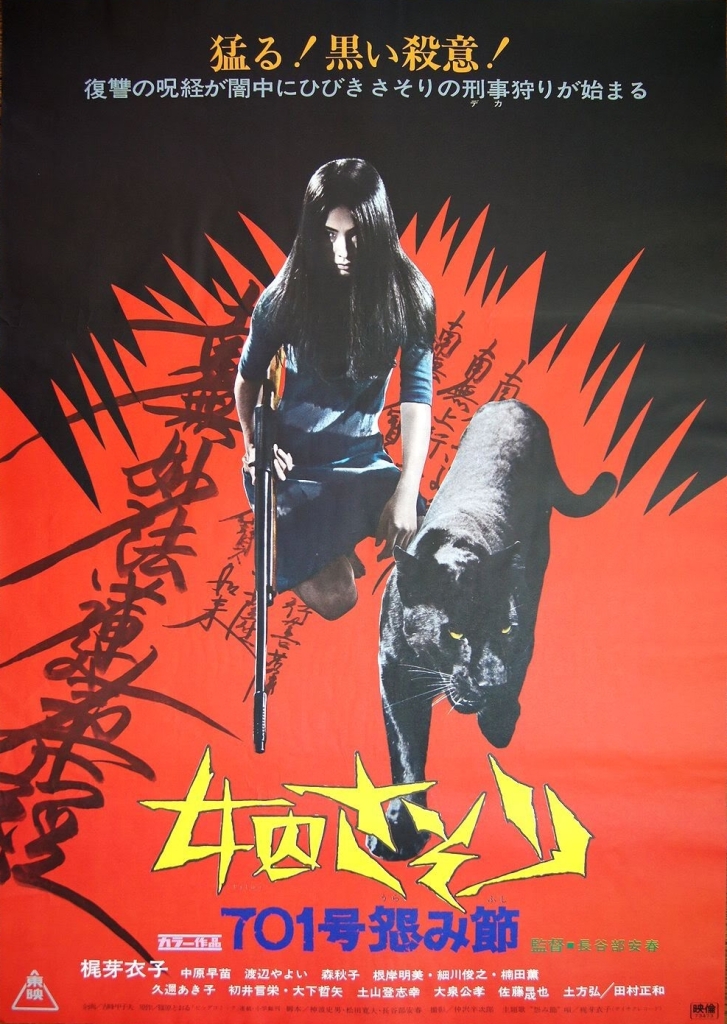
Female Prisoner Scorpion: #701’s Grudge Song (女囚さそり 701号怨み節, Yasuharu Hasebe, 1973)

The saga seemed complete with the end of Beast Stable but inevitably Matsu returns in the bonus instalment, Female Prisoner Scorpion: #701’s Grudge Song (女囚さそり 701号怨み節, Joshu Sasori – 701 Go Urami Bushi). Original director of the series Shunya Ito agreed that the ballad of Matsu was sung through, and so Yasuharu Hasebe reteams with star Meiko Kaji after their previous collaborations on Retaliation and the Stray Cat Rock series during their time at Nikkatsu. Hasebe’s style is the polar opposite of Ito’s arthouse inspired painterly majesty and heavily favours the groovy, ‘70s youth inspired aesthetic he employed in the Stray Cat Rock series. Coming as it does after Ito’s genre rocking visual tour-de-force, Grudge Song can’t help feeling a little regressive and a reminder of what a considered cash grab this fourth instalment really is but that isn’t to deny the fact that it can prove an enjoyable, genre skewing, effort when considered in isolation.
The end of Beast Song told us that Female Prisoner Scorpion served her sentence, was released and disappeared into the ether like the legendary creature she was. However, Grudge Song provides another episode to her history and begins with Matsu (Meiko Kaji) being re-arrested by police during someone else’s wedding (you have to feel sorry for the happy couple – could the police not have done this outside at least?). She fights them off in grand fashion and manages to escape though is gravely injured and not able to run very far. Luckily she is found by a damaged former protester working at a cabaret club who helps her hide out from the police. Soon the pair enter into a kind of romance but it’s not long before Matsu has some names to add to that ever increasing grudge list.

Along with the change of director comes a slight refocusing. Both the original trilogy and this fourth instalment have definite political undercurrents but Grudge Song allows these to be more overt with its constant references to the student protests of the late ‘60s and ’70s as well as to police corruption and brutality. Matsu’s ally and sometime lover, Kudo (Masakazu Tamura), had been a prominent protester picked up and repeatedly tortured by police leaving him with both physical and mental scarring. Obviously distrustful of authority but also made fearful, Kudo has been keeping his head down until he finds a kindred spirit in Matsu and decides to fight back.

The enemy here is the police – as it was to a degree in some of the other films, but Matsu’s concerns are playing second fiddle to her male saviour’s psychological traumas. This is the first film where Matsu has any kind of male help, and she’s essentially in an assisting role as Kudo attempts to defend her from the police (her injuries meaning she can’t exert the same kind of preternatural power as in the other instalments). There may be a kind of spiritual connection between Matsu and Kudo but the fact that she trusts him so quickly is strange given her behaviour throughout the series, though perhaps she has little choice given her physical condition. This is also the first time where Matsu allows an innocent woman to be killed in front of her – ironically another victim of male violence whose life is lost through no fault of her own. The other Matsu would at least find this upsetting, but this new Matsu who’s now more of an accomplice to a borderline terrorist protest cell consisting of one male member, is entirely indifferent.

Though Hasebe mimics some of Ito’s cinematography notably in the opening and his iconography of “Scorpion”, he abandons his stylistic concerns in favour of something very much more directly contemporary. In keeping with his work on the very groovy, youth orientated Stray Cat Rock movies, Hasebe turns Female Prisoner Scorpion into a standard ‘70s exploitation pic complete with gratuitous lesbianism, nudity, and random violence. Zooms, whip pans, and anarchic camera action are accompanied by jazzy electric guitar and a stoner vibe that is designed to appeal to the youth of the day but appears hopelessly dated now unlike Ito’s approach which is still of its era but manages to take on a timeless quality. As an example of ‘70s exploration cinema, Grudge Song pays its dues but as a Female Prisoner Scorpion movie, it falls far short of its predecessors.

Grudge Song marked the last outing for Kaji as the titular Scorpion, though this Matsu is not the Matsu of the rest of the series. Hasebe doesn’t seem so attached to the cult of Scorpion and more or less reboots her for a fairly straightforward genre affair which lacks the subtle intelligence of Ito’s vision. Still, taken alone Grudge Song is not without its charms though it loses the feminist edge of the rest of the series and recasts its heroine as a bit player in a game of revenge against the authorities in the name of vengeance for the death of the student movement.


Original trailer (English subtitles, NSFW)

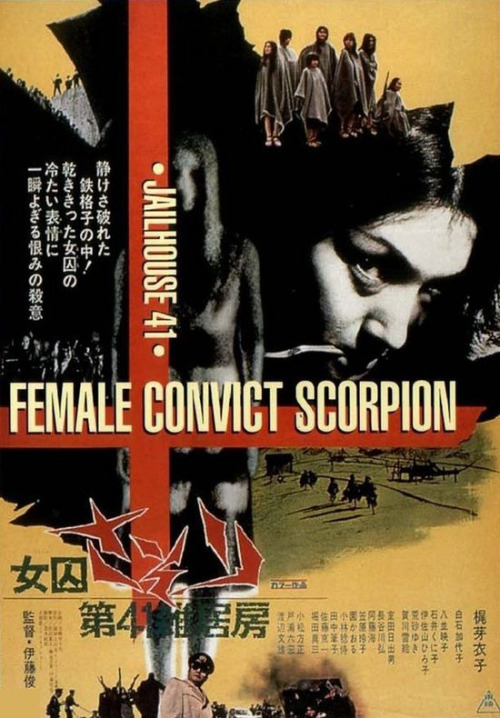
Female Prisoner Scorpion: Jailhouse 41 (女囚さそり第41雑居房, Shunya Ito, 1972)

scorpion-2Female Prisoner Scorpion: Jailhouse 41 (女囚さそり第41雑居房, Joshu Sasori – Dai 41 Zakkyobo) picks up around a year after the end of Female Prisoner #701: Scorpion and finds Matsu (Meiko Kaji) tied up in a dingy prison basement, apparently left bound and in solitary confinement for the entire interval. Once again directed by Shunya Ito, the second instalment in the Female Prisoner Scorpion series is another foray into the women in prison field but Ito resolutely refuses to give in to the exploitative genre norms, overlaying his tale of individualistic rebellion with an arthouse sensibility that has a much wider scope than its ordinary vengeance driven narrative may suggest.

Matsu may have been lying bound and gagged in a dingy underground hole for the best part of a year but today is a special day and sadistic prison warden Goda (Fumio Watanabe) is going to let her out to be shown off in front of a visiting inspector who’s paying a final visit before Goda is promoted to a top job in Tokyo. When Matsu makes a lunge for Goda, the inspector is so afraid that he wets himself, sending the other woman into a frenzy and resulting in a riot. Once again the entirety of the prison is punished, but this time Matsu is singled out for a public punishment gang rape by Goda’s goons. This kind of humiliation is too much for her fellow prisoners who instantly turn on her, but their violence provides an opportunity for escape and before long Matsu is on the run, again.

At the end of the first film, Matsu had accomplished her first round of vengeance – against the man who orchestrated her downfall and the men who secured it, but ultimately she wound up a female prisoner once again. Though Goda may have had her hidden away because of her habitual escapism, Matsu had not given up as we see from her attempts to scrape the floor away with her spoon held tight in her mouth. Barely speaking, Matsu is an unstoppable column of pure rage but an elegant one, supported by her self contained restraint.

Her anger this time is directed towards Goda himself, especially after his despicable organised punishment rape that was designed both to break her own spirit once and for all and also to damage her in the eyes of her fellow inmates who are intended to see her defeated and destroyed. The guards are a stand in for society at large, using sexual dominance and social position to keep their women in line. The visiting prison inspector makes a point of telling Matsu that “they” don’t hate her personally – they’re there for her, to help her “recover” and become a functioning member of society. Which is ironic because Goda does hate her personally as he holds her responsible for the damage to his eye sustained in the previous film. His last act before moving on is one against Mastu – an attempt by the forces of authority to crush her individual rebellion and use their victory as a coercive tool to force others to conform.

In this way, Matsu’s position as a member of a subjugated class is less important than her status as an agitator but these are women who have each suffered at the hands of men. As an extremely theatrical sequence sung in the traditional form informs us, the women who escaped with Matsu committed their crimes out of love or jealousy. Poisoned rivals, dead lovers, even children murdered to get back at their philandering father in some Medea level psychotic rage which ruins the perpetrator even more than the intended victim.

Later while the women are enjoying their brief taste of freedom, one of them is brutally raped and murdered by a troupe of feral men who boast about the wartime atrocities they committed before descending on a lone woman like a pack of rabid dogs. The others take their revenge for their friend, but also for all the women who have met a similar fate inflicted by a male dominated society which sees them as something to be controlled and then made use of, little more that cattle hemmed in and milked until dry.

As in the first film Ito makes use of expressionist techniques and strange angles to give his film a more elevated feeling that might be expected but this time he adds in a surrealist, spiritual dimension as with the old woman who sings the stories of our heroines and then dies only to bury herself in leaves and disappear into the ether, like some forgotten deity of misused women. Likewise, when one of the prisoners is raped and murdered, the men throw her body into a nearby river like an empty beer can but the waterfall behind her suddenly runs with blood as an expression of the violence which pollutes the natural world. A bus suddenly splits in two, separating our subjugated women from the violent men who mentally sentence them, given free reign simply because of their sex. Ironically enough, our last glimpse of of Matsu takes place in the reflection of Goda’s glasses and then in his false eye when she is suddenly rejoined by her compatriots for a triumphant dance of freedom on a city rooftop.

Even stronger than in the original Female Prisoner #701 Scorpion, Jailhouse 41 further advances its ideology of free individuals battling the conformist authority of the state all filtered through the prism of the patriarchy. Matsu’s vengeance is personal, she keeps her distance from the other women who do not seem inclined to band together to oppose the forces which oppress them so much as seek a wary, temporary alliance of necessity, but seeing them all reassembled in spirit at the end brings a larger dimension to Matsu’s victory which now seems much less like solving a practical problem than a deliberate strike at a wall which was solely designed to keep a certain group of people in their place. The jail is broken, all that remains is to choose to escape its restraints.


Original trailer (English subtitles, NSFW/gore)

Female Prisoner #701: Scorpion (女囚701号/さそり, Shunya Ito, 1972)

scorpion-701

Meiko Kaji had already become a familiar face in Nikkatsu’s genre output when she took on the role that would come to define her career at only 25 years of age. Toei’s Female Prisoner #701: Scorpion (女囚701号/さそり, Joshu Nana-maru-ichi Go / Sasori) would launch a series of similarly themed films and create a national pop culture icon in its central character. Based on a manga by Toru Shinohara, Female Prisoner #701 Scorpion is, at heart, a women in prison film and a cornerstone of the pinky violence genre but first time director Shunya Ito has more on his mind than salacious thrills and offers up a noticeably nuanced approach to his material filled with impressive art house flourishes.

701 is the number printed on the back of the prison uniform worn by inmate Nami Matsushima (Meiko Kaji). She makes a valiant escape attempt with a fellow prisoner, Yuki (Yayoi Watanabe), but the pair are caught and put into solitary confinement where they experience torturous treatment both at the hands of the guards and their fellow prisoners. Mostly known as Matsu but also given the nickname of “Scorpion”, Prisoner #701 is not exactly popular with the other ladies in the joint who seem to resent her escape attempts and quiet dignity, annoyed by her above it all demeanour.

Matsu has just one mission in life – vengeance, on the man who wronged her, on the society that allowed her to be wronged, and on the prison system with its sadistic guards and turncoat inmates. Once an ordinary, law abiding woman, Matsu had the misfortune to fall in love with a vice cop who convinced her to go undercover in a yakuza club to get some vital info he needs to bust it. However, Sugima (Isao Natsuyagi) turns out to be the biggest crook of them all and was merely using her to try and take out the local yakuza to get in with a bigger yakuza boss and key into a slice of the drugs trade. Matsu is brutally gang raped after her cover is blown and ends up being sent to prison after making an attempt to ice her former lover with the desire to get out and complete her mission the only thing that’s keeping her going.

Ito begins with an ironic scene in which one of the prison guards is receiving a commendation for his honourable service, Japanese flag flying proudly behind above, until the occasion is interrupted by the escaped prisoner alarm. Later Ito puts the yakuza boss in a building bearing the large banner “Beautiful Soul and Harmony of Japan” and he even adds in an expressive moment as Matsu surrenders her virginity to Sugima, staining her white sheets with a large red circle. Society is corrupt everywhere from Sugima’s bent copper to gang raping yakuza and the prison system itself.

The guards are effectively running their own little empire, cut off from mainstream law enforcement and left to their own “corrective” impulses. Ito gives us salacious shower scenes and women being marched around in the nude but he places us in the place of a voyeur, making it plain that the prison guards are sating their lust for power through humiliating their charges in sexual dominance and violence. Divide and rule is the name of the game as a top tier of prisoners are “employed” in various prison tasks earning them a different colour uniform and a status bump. These ladies are even worse than some of the male guards and are responsible for much of the cruelty inflicted on Matsu and Yuki during their time in solitary.

Inter-prisoner conflict is not the central theme of the film as Matsu continues to plan for her eventual escape and revenge on the man who has ruined her life. A slight spanner is thrown in the works when an inside woman is recruited to take Matsu out, but Matsu is painted as a the ultimate vengeful warrior. Barely speaking (the bulk of her dialogue is actually voice over for her flashback scene), Matsu waits silently, observing and plotting. Biding her time she manages to take an extremely skilful and poetic revenge against her solitary abuser despite her hands and feet being bound, and when a police mole is placed in a cell with her Matsu sees through the ruse straight away. Seducing her new cellmate, Matsu neutralises the threat with ease maintaining her trademark intense elegance all the way through.

Though the synopsis smacks of cheap and nasty exploitation Ito doesn’t see it that way and films with an art house aesthetic rather than a salacious eye. Matsu’s flashback takes a very theatrical form with a rotating set and Matsu remaining present in the corner as she narrates. Her rape scene is grotesque and nightmarish, shot through a see-through floor as her attackers grin and gurn away at her like fairytale monsters. Likewise, when Matsu traps another prisoner in her own scheme, the woman turns into a classic ghost creature, face white and staring, broken glass firmly gripped manically in front. The acting style is broad and absurd. Policeman laugh loudly and for too long, blood is an artificial kind of red, gloopy like paint, and pantomimeish grotesquery is everywhere. Ito’s backgrounds are expressionist rather than realist but always perfectly pitched.

You can tell a lot about a place from the way it treats its prisoners and when its as bad as this, you start to wonder which side of the bars you’re really on. The guards are only a representation of a consistently exploitative society, but they can at least be outsmarted. “To be deceived is a woman’s crime”, says Matsu, but it’s one she fully intends to atone for – in blood, settling not just her own score but those of all her fellow prisoners caught in the patriarchal trap of hollow promises and abused honour.


Original trailer (English subtitles)

Swimming Upstream (バタアシ金魚, Joji Matsuoka, 1990)

Swimming UpstreamSometimes love makes you do crazy things. Some people find themselves accomplishing previously unattainable feats powered only by the sheer force of romance. Unfortunately for the hero of Swimming Upstream (バタアシ金魚, Bataashi Kingyo), Joji’s Matsuoka’s adaptation of Minetaro Mochizuki’s manga, the task he sets for himself is a very lofty one indeed and may actually require him to abandon his love to complete it. Then again, the object of his affections shows little signs of reciprocation in any case.
Love found Kaoru (Michitaka Tsutsui) with a bucket of water. That is, he was hanging around one day when swimsuited beauty Sonoko (Saki Takaoka) soaked him by mistake but far from being annoyed, Kaoru falls in love at first sight and begins to pursue the star of the swim team even if she remains resolutely cold towards him. Kaoru immediately joins up just to be close to her even though he is actually afraid of water and does not know how to swim. Nevertheless he sets himself the task of becoming an olympic swimmer and bringing home a gold medal for his lady love. Needless to day, Sonoko is still not very interested in him.

Assisted by a strange old lady of swimming coach in sporting matters, and with an unlikely ally in Sonoko’s mother when it comes to romance, Kaoru works hard at his twin goals but makes little progress with either. His world is briefly shattered when he spots Sonoko arm in arm with the school’s star swimmer and he also faces a romantic dilemma in the form of his friend Pu whose motorbike he keeps borrowing to try and impress Sonoko despite the fact that Pu obviously has a crush on him. Nevertheless, Kaoru is undeterred until, that is, Sonoko’s actions convince him he may be doing more harm than good.

Matusoka’s film is most clearly concerned with recreating the contemporary high school summer for the presumed target audience of teenagers. Though it loosely adapts a classic sports movie romance format with Kaoru giving it his all in training, it stops short of the triumphant underdog trope as Kaoru never achieves the kind of sporting success one would expect. Though he quickly learns to swim and makes some progress, Kaoru retains a lingering fear of the water and is among the very weakest at the club. Still deluding himself with his Olympian dream, Kaoru even attempts to challenge the champion swimmer of another team (played by a very young Tadanobu Asano in his first film role) in a race for the rights to Kaoru. Needless to say, nothing goes his way.

If duelling over the “rights” to a girl seems like an old fashioned idea, Swimming Upstream is a very old fashioned film in terms of its sexual politics. The film stars popular idol Saki Takaoka as the unattainable Sonoko but is told very much from Kaoru’s point of view in which Sonoko is something to be won rather than another human being with independent will. Sonoko’s behaviour often is hard to categorise but, to borrow a term from the film’s manga roots, could easily be described as tsundere wherein she consistently rejects Kaoru’s advances before warming up to the idea just as he’s beginning to cool off. There may a fine line between persistence and and inappropriate behaviour but Kaoru’s level of devotion is the kind that straddles it. The teenage audience of 1990, however, may have seen things a little differently than that of today.

The audience of 1990 would doubtless also have been shocked by Sonoko’s rebellious lack of compliance with regular social norms. Far from the docile, cute, obedient and polite aura of the traditionally perfect girl next door in which idol movies specialise, Sonoko throws angry looks at everyone and talks back to her mother with extremely harsh words (though her mother wisely refuses to be shocked by them). In fact Sonoko is universally awful to everyone to the extent that it later seems that even one of her closest friends does not actually like her very much, but the worse she gets the more Kaoru refuses to be dissuaded.

Matsuoka mostly chooses to keep things simple with a light hearted, summery atmosphere primed to appeal to his audience of youngsters. Though intended as an innocent romance, contemporary audiences may read more darkness into the relentless war between the icy Sonoko and determined Kaoru but the adolescent intensity of young love does at least ring true. Caught between the quirkiness of its general tone and the heaviness of its themes, Swimming Upstream flounders in making its central connection work, rendering its overworked metaphor of a finale less than successful but does offer strong performances from both of its central stars.


Clip (no subtitles)

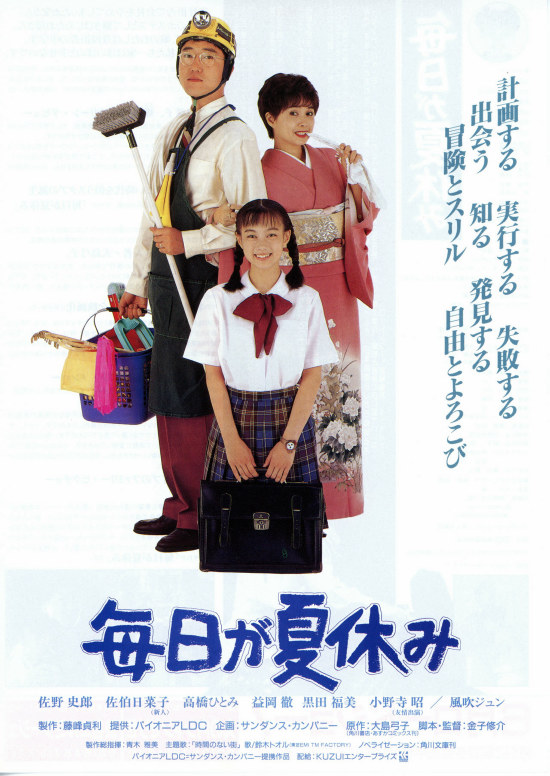
Summer Holiday Everyday (毎日が夏休み, Shusuke Kaneko, 1994)

Summer Holiday EverydaySummer Holiday Everyday – It’s certainly an upbeat way to describe unemployment but then everything is improbably upbeat and cheerful in the always sunny world of Shusuke Kaneko’s adaptation of Yumiko Oshima’s shoujo manga. Published in the mid-bubble era of 1988, Oshima’s world is one in which anything is possible but by the time of the live action movie release in 1994 perhaps this was not so much the case. Nevertheless, Kaneko’s film retains the happy-go-lucky tone and offers note of celebration for the unconventional as a path to success and individual happiness.

Told from the point of view of 14 year old Sugina (Hinako Saeki) who offers us a voiceover guide to her everyday life, Summer Holiday Everyday (毎日が夏休み, Mainichi ga Natsuyasumi) follows the adventures of the slightly unusual Rinkaiji family. Sugina’s mother is divorced from her father and has remarried a successful salary man, himself a divorcee, ten years ago. The family lives in fairly peaceful domesticity and Sugina’s mother, Yoshiko (Jun Fubuki), even remarks how glad she is that her daughter gets on so well with her step-father, Nariyuki (Shiro Sano), though Sugina claims this is largely because she can’t remember actually speaking to him very much over the last ten years.

The pair are about become closer though it risks tearing their perfectly normal family apart. Sugina has been skipping school due to bullying and spends her days in the local park where, unbeknownst to her, her step-father has also been wasting his days after quitting a job he could no longer stand. After getting over the embarrassment of this accidental encounter, Sugina and Nariyuki confess everything to each other and Nariyuki makes a bold decision. Sugina can quit school (seeing as her grades were terrible anyway) and come work with him in his new enterprise – the Rinakaiji Heart Service, helping the community 24/7 with assistance in those difficult to handle odd jobs everyone needs doing.

Quitting a lucrative and secure job for the risk associated with staring a new business is a difficult decision in any society but is more or less unthinkable in Japan. Yoshiko is beyond stunned by her husband’s decision, not to mention the fact that her daughter has been deceiving her by skipping school and faking her report cards to make it look like her grades were much better than they are. Immediately worrying about what the neighbours will think, Yoshiko finds it hard to deal with the embarrassment of her husband and teenage daughter going door-to-door and doing menial work in the community, especially when she overhears the snickers of gossipy housewives in the local supermarket. For Yoshiko, whose sense of self worth was bound up with having a successful husband employed at a top tier company, Nariyuki’s sudden lurch towards individual freedom has destabilised her entire existence. Her world ceases to make sense.

Yoshiko’s sense of displacement is deepened when the fledgling company’s second job offer comes from Nariyuki’s ex-wife. Beniko (Hitomi Takahashi) left Nariyuki for another man because she failed to appreciate Nariyuki’s gentle charms and he was too mild mannered to fight for his wife even if he loved her deeply. What’s more, Nariyuki’s unconventional approach to life has earned him a spot in the papers and brought the family back to the attention of Sugina’s father, Ejima (Akira Onodera).

Early on Nariyuki states that life’s true radiance is only visible through suffering and later says that pain and suffering are essential parts of human existence. Nariyuki, now making a stand for himself for the first time in his life, remains philosophical in the face of hardship though perhaps has more faith in Yoshiko’s ability to follow him down this untrodden path than was wise. As a son and then a husband, Nariyuki may be a methodical sort but he’s unused to the idea of caring for himself as his comical attempts at doing the housework show. After almost burning the house down several times, Nariyuki does indeed figure out an efficient way of managing the household chores and seeing to Sugina’s education whilst also allowing his wife become the family breadwinner. However, Yoshiko’s new line of work is one she finds both unpleasant and degrading and she probably hoped that Nariyuki would strenuously try to stop her doing it so it’s not quite as much of a progressive approach as might be hoped.

After countless setbacks, humorous adventures, and a major fire Nariyuki’s enterprise begins to catch on. Brought together in shared crisis, the family unit only becomes stronger and more committed to their shared destinies. In fact, the family expands as Sugina rebuilds her relationship with birth father and even gains a new aunt figure in the form of her step-father’s youthful ex-wife. When you love what you do everyday is a holiday, and Sugina’s path, unconventional as it is, is one that leads her into the sunlight guided by Nariyuki’s oddly philosophical wisdom.


Original trailer (no subtitles)

Shark Skin Man and Peach Hip Girl (鮫肌男と桃尻女, Katsuhito Ishii, 1999)

Shark_Skin_Man_And_Peach_Hip_Girl_(1998)If you’re going on the run you might as well do it in style. Wait, that’s terrible advice isn’t it? Perhaps there’s something to be said for planning a cunning double bluff by becoming so flamboyant that everyone starts ignoring you out of a mild sense of embarrassment but that’s quite a risk for someone whose original gamble has so obviously gone massively wrong. An adaptation of a manga, Katsuhito Ishii’s debut feature Sharkskin Man and Peach Hip Girl (鮫肌男と桃尻女,  Samehada Otoko to Momojiri Onna) follows a mysterious criminal trying to head off the gang he just stole a bunch of money from whilst also accompanying a strange young girl, also on the run but from her perverted, hotel owning “uncle” who has also sent an equally eccentric hitman after the absconding pair with instructions to bring her back.
Like Ishii’s subsequent efforts, Shark Skin Man and Peach Hip Girl is a riot of full on craziness from the get go, though he largely manages to avoid manga adaptation cliches. The gangster, Samehada (Tadanobu Asano), is pursued by an eccentric set of former gang members – the sanest amongst them being Sawada (Susumu Terajima), his former partner who wants to track him down first to prevent the bloody retribution his guys have in store for him. The gang’s boss (Ittoku Kishibe), lovingly caresses a harpoon, dresses in a gestapo style shiny black leather overcoat, wears one glove, and is on a quest to track down rare vintage posters of much loved Japanese comedian Kon Omura. One of his henchmen is a guy with bleach blond hair who dresses all in white and has an extremely sensitive sense of smell but an intense aversion to water.

The heat coming from the other side is equally strange as the leacherous uncle is apparently friends with Japan’s weirdest hitman, Yamada, who dresses in a retro style and has a unibrow and a high pitched voice. In fact, he’s basically Ken Omura himself, creeping about, being odd in a ridiculous cartoon character way. Unfortunately, Yamada has a weakness and just as he’s about to complete his mission he falls in love with his target! Apparently this is something that happens to him often though you’d think it would be quite a liability given his line of work. In this instance who could really blame him, but his new found romance means he won’t be able to pull the trigger  – and not only that, he can’t bring the girl back either because he doesn’t want to break the beautiful gangster’s heart! Ah, true love!

There is quite a lot going on. Too much, really. For all the craziness which ensues, it’s hard to build up an attachment to any of our strange little gangsters and their petty plots or bids for freedom. Things build to a whirlwind of chaos in the final stretch but when it’s all supposed to calm down for a little spiritual contemplation at the end, the effect begins to fall apart.

There are however a few quieter sections such as a surprisingly maudlin one in which yakuza sons of yakuza fathers lament their unhappy childhoods which saw them bullied and excluded by their law abiding peers. One even says that he thought the tattoos were something which just appeared on everyone when they grew up. Ishii employs some strange jump cuts, moving us ahead a little jerkily as the time passes slowly for this motley crew of veteran bad guys. He later employs a similar technique where he shifts some of his violence into the expressionist realm by cutting on the sound of landing punches.

As the title suggests, Shark Shin Man and Peach Hip Girl is the story of two crazy kids on the run, and the bizarre collection of people who end up chasing them. Ishii could never be accused of subtlety but the punk infused, anarchic and ironic tone are difficult to resist even if the end result is a necessarily slight one. An imperfect, though impressive debut, Shark Skin Man and Peach Hipped Girl is an interesting genre infused tale that uses absurd humour as a foil for the darkness and violence which underpins it.


Original trailer (no English subs – French subs available via settings menu)

Midway through this film someone starts singing a Japanese language cover of Donna Donna which was a surprise! Can’t find a clip so here’s Joan Baez’s version live in Japan in 1967!

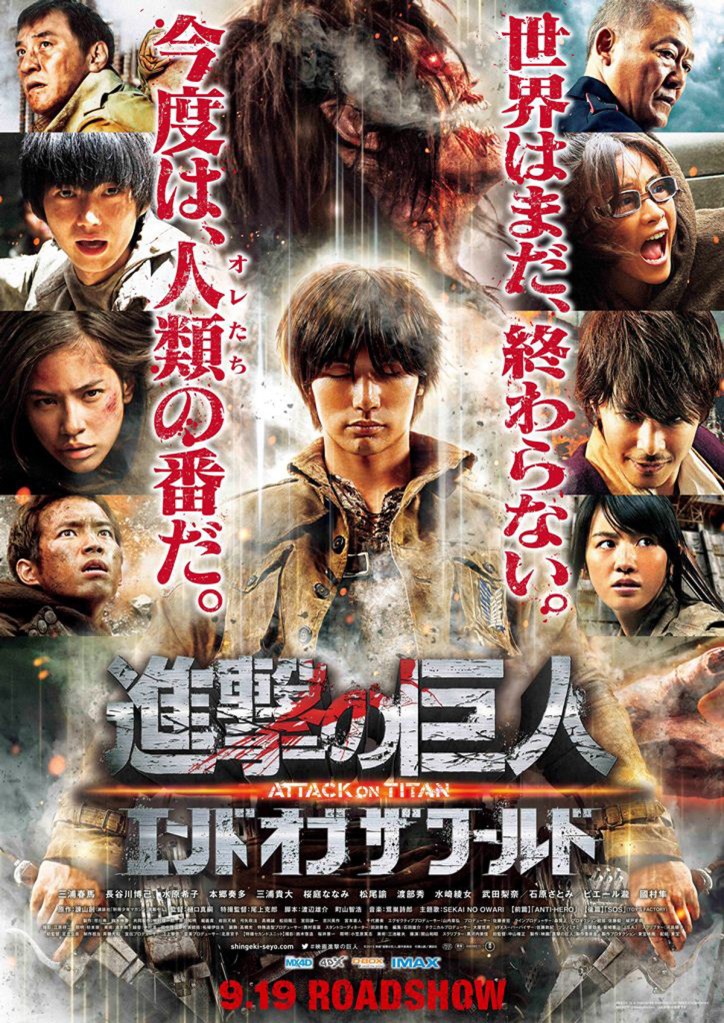
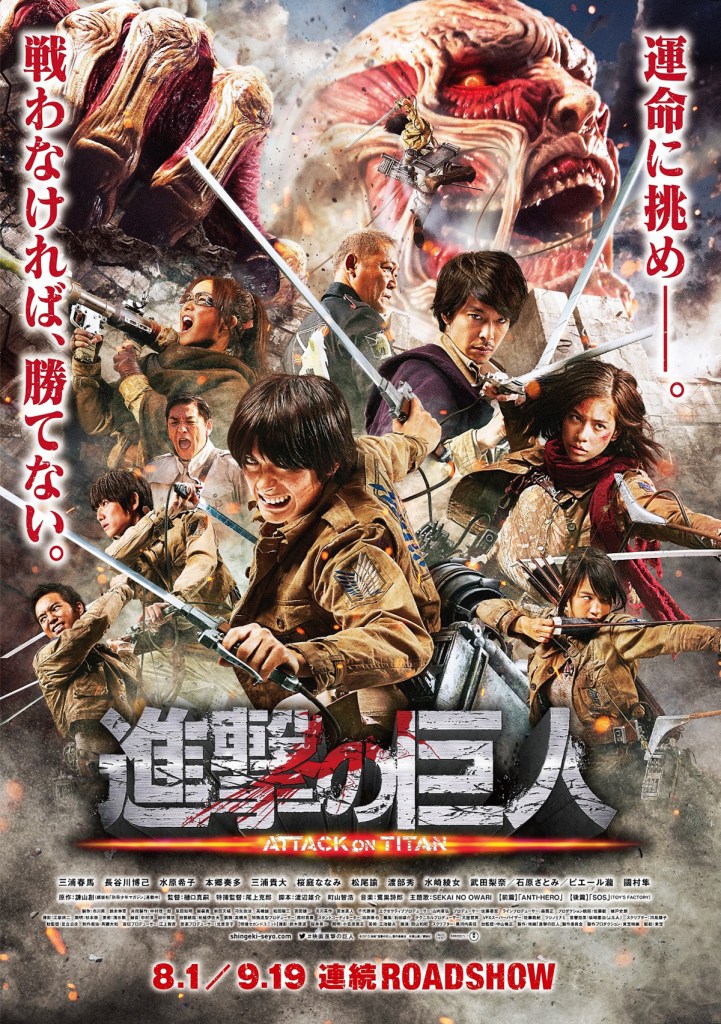
Attack on Titan: The Movie – Part 2: End of the World (進撃の巨人 ATTACK ON TITAN エンド オブ ザ ワールド, Shinji Higuchi, 2015)

166831_02Review of the second Attack on Titan live action movie first published by UK Anime Network.


Attack on Titan: The Movie – Part 1 ended on a humdinger of a cliff hanger, so this concluding half of the two part movie is one  which carries a fair amount of expectation regardless of reactions to the first instalment. Picking up more or less straight after the end of Part 1, the situation continues to be desperate as the mission to acquire explosives to blow the wall closed is an abject failure. Thanks to Eren’s (Haruma Miura) efforts, the Titan onslaught has eased off but he now finds himself in the direct firing line of sinister dictator Kubal (Jun Kunimura). Coming up with an alternative plan to recover the dud bomb we saw in the beginning of the first film, our intrepid band of comrades decide to return to their former home paving the way for the massive Titan on Titan frenzy finale.

Whereas Attack on Titan: The Movie – Part 1 attempted to reframe itself as a monster movie, The End of the World places itself firmly within the comic book genre. Rather than a frightened populace desperately trying to protect itself from the sudden arrival of man eating giants, The End of the World introduces a series of human lead super Titans who will eventually be duking it out during the film’s finale.

Largely, The End of the World eschews the thematic concerns of the first film in favour of large scale action scenes but it does come up with a few new ideas of its own. Towards the beginning, it seems as if The End of the World is about to undercut all the unpleasant fascistic connotations of the previous film by bringing Eren into contact with the Survey Corps who are now the rebel resistance but this turns out to be a hollow offering as the squad is then painted as a renegade militia commanded by a madman.

After his original imprisonment, Eren wakes up in a minimalist, low ceilinged white room which contains a ‘50s style jukebox with a cover version of the old time hit The End of the World already playing. Despite the ban on machines “the government” has apparently stockpiled some of these “artifacts” for their own use which also includes a rather prominent remote control for an Apple TV. At this point we’re shown some archive footage which explains the birth of the Titans and the creation of the “modern” society, the implication being that the Titans are part of an elaborate governmental propaganda scheme designed to keep the unruly populace firmly in line. The Titans reappeared at a political crisis point as the government felt the loyalty of its people waning and also feared that the plan to explore outside of the walls would weaken their authority. Having already instituted authoritarian policies such as limiting access to childbirth, the government used the Titan threat to galvanise support through fear.

This sequence begins to offer an entirely different reading of the film – one which is more fully hinted at in the final post-credit sequence, but is then largely forgotten. Aside from a nasty slice of possible domestic violence and some PTSD End of the World stays away from further character driven drama, leaving Shikishima to ham things up with an increasingly camp performance whilst behaving in a very ambiguous way towards Eren which proves awkward when considering further information provided regarding Eren’s childhood. As a whole, the Attack on Titan movies have a major problem with internal consistency, piling plot holes upon plot holes yet still failing to make any of its central conceits remotely compelling.

However, The End of the World does improve on some aspects of the previous film – notably in its tighter running time and action set piece finale (lengthy exposition sequence and extremely long recap aside). Production values appear a little better, there is far less of the bad CGI which marred the first film, and there’s even some more interesting production design to be found too. The Hollywood style heroic ending with the sun shining and the score soaring might appear less clichéd when considered alongside the alternate reading offered by the post-credits sequence, but then again this may be another red herring just like the resistance group which originally appeared to offer hope but was then summarily discredited.

The two live action Attack on Titan movies come at the original franchise from vastly different angles and are often at odds with each other. Some of these inconsistencies may be explained by the post-credits sequence which is, perhaps, a hook for a putative third film but only adds an additional layer of confusion to what is already an overloaded premise. All of that aside, The End of the World does offer slightly more straightforward, comic book style trial by combat action heading into its finale even if it does lay on the exposition a little thickly. Whilst offering some mild improvements over the first film, End of the World fails to rescue the project as a whole but is likely to provide satisfaction to those left hanging after the curtain fell on part one.


English subtitled trailer:

Attack on Titan: The Movie – Part 1 (進撃の巨人 ATTACK ON TITAN, Shinji Higuchi, 2015)

Attack on Titan p1Review of the first of the two part live action Attack on Titan (進撃の巨人 ATTACK ON TITAN, Shingeki no Kyojin) extravaganza first published by UK Anime Network.


It is a law universally acknowledged that a successful manga must be in want of an anime adaptation. Once this simple aim has been achieved, that same franchise sets its sights on the even loftier goals of the live action movie. This phenomenon is not a new one and has frequently had extremely varied results but fans of the current cross over phenomenon that is Attack on Titan may find themselves wondering if perhaps more time should have been allowed before this much loved series tried its luck in the non animated world.

Throwing in a few changes from the source material, the film begins with the peaceful and prosperous walled city where childhood friends Eren, Armin, and Mikasa are young adults just about to start out on the next phase of their lives. Eren, however, is something of a rebellious lost soul who finds himself gazing at the land beyond the walls rather than on a successful future in the mini city state. However, little does he know that the Titans – a race of man eating giants responsible for the destruction which saw humanity retreat behind the walls in the first place, are about to resurface and wreak havoc again. His dreams of a more exciting life may have been granted but humanity pays a heavy price.

Fans of the manga and anime may well be alarmed by certain elements of the above paragraph. Yes, the film makes slight but significant changes to its source material which may leave fans feeling confused and annoyed as the film continues to grow away from the franchise they know and love so well. For a newcomer, things aren’t much better as characterisation often relies of stereotypes and blunt exposition to get its point across. Attack on Titan actually has a comparatively starry cast with actors who’ve each impressed in other high profile projects including Haruma Miura (Eternal Zero), and Kiko Mizuhara (Norwegian Wood, Helter Skelter) as well as Kanata Hongo (Gantz) but even they can’t bring life to the stilted, melodramatic script. Things take a turn for the worse when Satomi Ishihara turns up having presumably been given the instruction to play Hans as comic relief only with a TV style, huge and bumbling performance.

That said, there are some more interesting ideas raised – notably that even a paradise becomes a prison as soon as you put a wall around it. Indeed, everything seems to have been going pretty well inside the walls until Eren suddenly decides he finds them constraining. Once the Titans break through, the very mechanism which was put in place for humanity’s protection, the walls themselves, become the thing which damns them as they’re trapped like rats unable to escape the Titan onslaught.

Machines are now outlawed following past apocalyptic events – humanity apparently can’t be trusted not to destroy itself and this cheerful, feudal way of life is contrasted with the chaos and pollution which accompanied the technologically advanced era. Unfortunately, a reversion to distinctly old fashioned values also seems to have occurred as we’re told you need permission to get married (as sensible as this may be from a practical standpoint in a military society) and the single mother gets munched just as she’s making the moves on a potential new father for her child. The Titans themselves have also been read as a metaphor for xenophobia which isn’t helped by the almost fascist connotations of the post attack society.

Much of this is really overthinking what appears to be an intentionally silly B-movie about man eating giants running amok in a steampunk influenced post-apocalyptic society but then it does leave you with altogether too much time to do your thinking while you’re waiting for things to happen. The original advent of the Titans is a little overplayed with the deliberately gory chomping continuing far too long. Action scenes fare a little better but suffer from the poor CGI which plagues the rest of the film. This isn’t the Attack on Titan movie you were expecting. This is a monster movie which carries some extremely troubling messages, if you stop to think about them. The best advice would be to refuse to think at all and simply settle back for some kaiju style action but fans of either campy monster movies or any other Attack on Titan incarnation are likely to come away equally disappointed. It only remains to see if Part 2 of this bifurcated tale can finally heal some of the many holes in this particularly weak wall.


US release trailer:

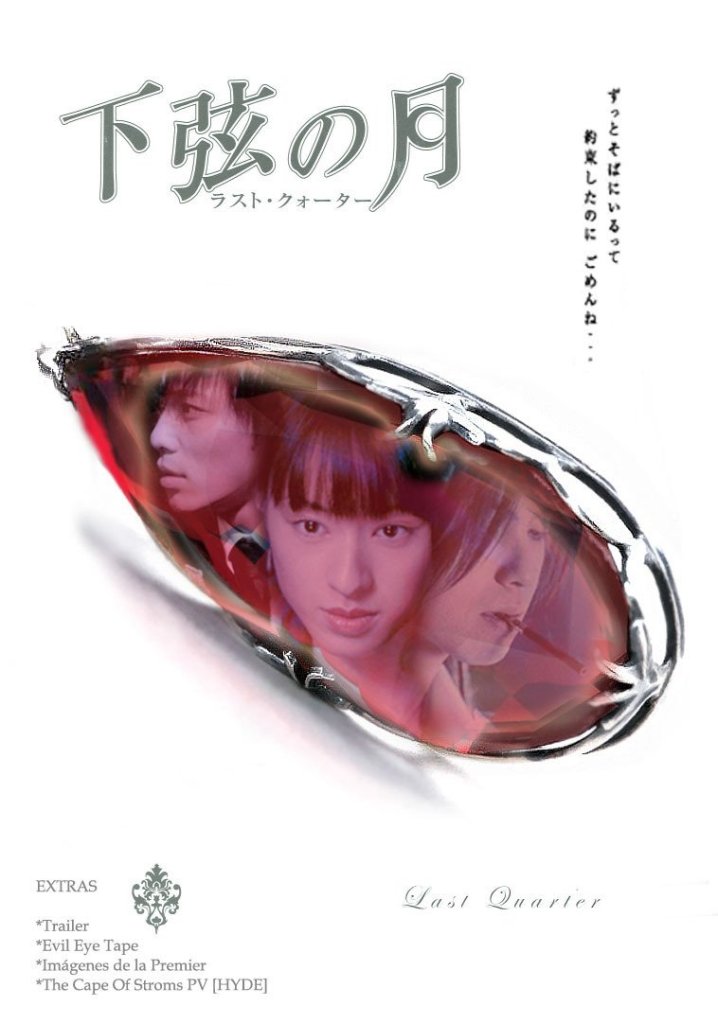
Last Quarter (下弦の月 ラスト・クォーター, Ken Nikai, 2004)

Last Quarter posterTo begin on a cynical note, Last Quarter (下弦の月 ラスト・クォーター, Kagen no tsuki Last Quarter) is a film with a wide variety of marketing hooks. The first being that it’s an adaptation of a much loved short manga series by the well respected mangaka Ai Yazawa (Paradise Kiss) so it has its shoujo pedigree firmly in place. Secondly, pop star HYDE of L’Arc-en-Ciel is central to the production as he both stars in the movie as the ghostly love interest/deathly spirit and repeatedly sings his own songs throughout the film including over the end credits. Thirdly, it also stars actress Chiaki Kuriyama well known to overseas audiences thanks to Kill Bill and Battle Royale. You’d think with all these high quality ingredients first time director Ken Nikai would be able to cook up quite a feast though he does somewhat over egg the pudding.

After a brief dream sequence, the action kicks off at the 19th birthday party of British rock obsessed Mizuki (Chiaki Kuriyama) which takes place in a Mod inspired bar. Unfortunately, her best friend gets very drunk indeed and takes this opportunity to show Mizuki a photo of herself and Mizuki’s boyfriend in a compromising position. Mizuki throws a shoe at the no good philanderer and walks out on her own party ending up at a mysterious Western style mansion occupied by a sad man playing a guitar. She hits it off with “Adam” and decides to jack in her unhappy family life with her father and step-mother to leave for England with him. Sadly, she gets hit by a car on her way home only to wake up trapped inside the house and having lost all memory of who she formerly was. Soon enough, another girl, Hotaru (Tomoka Kurokawa), turns up and, assuming she’s a ghost, decides to help her “cross over” , but it’s all a little more complicated than Hotaru and her team had bargained for.

Last Quarter takes on an oddly imbalanced feel as it veers into star vehicle territory putting HYDE and his title song centerstage at the expense of Mizuki who ought to be the protagonist of the story. Understandably, as she’s fallen under the curse of the house, Mizuki is a mostly passive force throughout the film, entirely reliant on the efforts of the gang of three who are trying to help her by figuring out what’s really going on. The mystery element itself is quite an intriguing one but is often frustrated by the importance placed on the supernatural romance. Stretching plausibility to the limit, the events in question span 30 years and two continents to spin a yarn of pure love enduring beyond the grave. Pure love and grudge movies aren’t usually allowed to mix and they don’t quite here although Last Quarter certainly has elements of both.

Last Quarter’s biggest failing is in its production values which are generally on the low side. Nikai aims for an urban gothic aesthetic and achieves something close to sense of European decadence but opts to avoid the darkness inherent in the genre for a fairytale atmosphere. The effects are very highly stylised and old fashioned but Last Quarter doesn’t even attempt to make that work in its favour so much as offering it at face value.

In essence, Last Quarter often feels like an overblown music video for its rock star actor even if he actually has a relatively small role. Director Nikai has often worked with the band before and (apparently) there is a degree of recurring symbolism here that long time fans will instantly pick up on but will leave the casual viewer a little confused. Very firmly aimed at a younger teen female audience, Last Quarter will play best to fans of non-threatening supernatural romance but even then they’d be best advised to avoid thinking any of this through and simply enjoy the ghostly shenanigans for the ridiculous rag tag narrative they are. An interesting mix of ‘60s mod rocker cool with its parkas and vespas, and full on gothic with byronic heroes sitting in decaying mansions in the middle of creepy forests singing about their broken hearts, Last Quarter is incoherent to say the least but fans of its rockstar leading man will likely find their perseverance rewarded.


Last Quarter is available with English subtitles on R1 DVD in the US courtesy of Geneon.

Unsubtitled trailer: