Cloud (Cloud クラウド, Kiyoshi Kurosawa, 2024)

“We wanted to make easy money,” a down-on-his luck reseller admits, “is life easy now?” Factory worker Ryosuke (Masaki Suda) rebels against capitalism by subverting it through buying low and selling high while repeatedly refusing promotions at his job in a textiles factory. Though it might seem that reselling is just a way to earn an income that seems almost passive but is actually fairly labour-intensive, it’s clear that Ryosuke is a young man dissatisfied with capitalistic realities and lacking direction in his life. 

Reselling has become a kind of game to him and like a gambler who plays to lose he’s hooked on the thrill of making a killing exploiting other people’s misery. He’s at once filled with pride and smugness over his apparent triumph over his society and consumed by self-loathing. His friend and fellow reseller Muraoka (Masataka Kubota) tells him that another acquaintance has been arrested for scalping concert tickets with both of them lamenting his foolishness in getting involved with something so risky. The implication is that their friend, Goto, must have been in real desperation to lower himself to such levels and they each fear they may someday end up in the same position. Muraoka laments that that kind of selling is a young man’s game and neither of them have the time or energy to spend all day queuing to buy stuff just to sell it on cheap. They are each, it seems, beginning to feel the increasing desperation of their age that they are running out of time and have little to show for their efforts nor any prospects for the future. 

But on the other hand, neither of them want to be locked into the grind or join the oppressive but secure world of the salaryman. In many ways, Ryosuke’s factory boss Takimoto (Yoshiyoshi Arakawa) represents the “correct” path of hard and honest work, though his own paternalistic conviction in meritocracy seems outdated in a man of his age whose formative years occurred during an era of economic stagnation. He talks to Ryosuke as if he’s a young man who wants to get on but lacks confidence, telling him that he has leadership potential and is wasted on the shop floor, but his language also has an edge of the uncanny as if he were trying to recruit Ryosuke into his own worker drone revolution. In any case, even if it might be true that Ryosuke lacks confidence and ambition, that isn’t the reason he refuses promotions, which seems to be another way of rebelling against capitalism. When he eventually quits, he suggests it’s because he’s sick of being told what to do and wants more autonomy over his life and finances.

He tells his girlfriend Akiko (Kotone Furukawa) that she should quit her job too, which she’s only too happy to do because, unlike him, she actively doesn’t want to work and only wants to spend money. When she said she was thinking of giving up her apartment, Ryosuke naturally asked her to officially move in but she refused because his place is too small and she has too much stuff. Akiko has already been corrupted by the same consumerist bug that’s driving Ryosuke’s reselling business, but neither of them can really afford this lifestyle in the city. Ryosuke’s bright idea is to move to the remote countryside where he’s able to rent a huge, though ominous-looking, property for a fraction of the price with the idea of also economically supporting Akiko who will revert to traditional gender roles as a housewife in charge of the domestic space and most especially the kitchen.

But freedom cannot be found simply by retreating from urbanity and the couple soon find themselves plagued by a pervasive sense of resentment. The locals are not particularly accepting of people from Tokyo and are also needled by their success which is something they feel they’ve been unfairly denied. When Ryosuke tries to report a smashed window, even the policeman hassles him and says he’s received a tip-off that Ryosuke is breaking trading standards regulations by selling counterfeit goods as the real thing. Reselling in itself is not illegal, if definitely dubious morally and incredibly cynical. Ryosuke doesn’t seem to like to think about that and tells his new assistant, Sano (Daiken Okudaira), that he tries to sell all the items as quickly as possible so he doesn’t have to worry too much about their authenticity. If they’re wanted they’ll sell, Ryosuke justifies but he might as well be talking about himself.

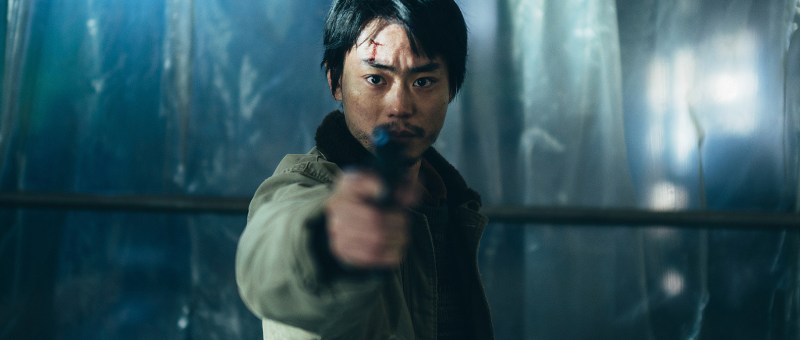
“Being real or fake doesn’t matter?” Sano asks him, just as Ryosuke’s online and offline personas start to blur. He’s unaware that there are people actively hunting him for selling them substandard goods and is later pursued by real life vigilantes acting like online trolls and planning to torture him to death during a livestream. Like many of Kurosawa’s heroes, Ryosuke is completely convinced that he’s the benchmark for normal and it’s everything around him that’s strange or unfair. As the internet once again invades the “real” world, or perhaps it’s more that Ryosuke’s living his online life offline, the increasing unreality of the situation makes us wonder if any of this is “really” happening or product of Ryosuke’s fractured identity as it finally collapses under the twin corruptions of capitalism and social media. “Please keep focusing only on making money,” his new guardian angel Sano tells him, “everything will be obtainable. Whatever you want. Even things that can end the world.” Flying through ironically heavenly clouds, Ryosuke reflects that the path to hell really is paved with gold and his Mephistophelian pact with hyper-capitalism may have damned him beyond all repair.  


Cloud is in cinemas from 25th April courtesy of Blue Finch Film Releasing 

UK trailer (English subtitles)

Mountain Woman (山女, Takeshi Fukunaga, 2022)

A young woman charged with disposing of the corpse of an infant has only a few words to impart as she lowers its body to the river, “Don’t be born human in your next life.” Set in late 18th century Tohoku where famine ravages the land, Takeshi Fukunaga’s bleak fable Mountain Woman (山女, Yama Onna) sees humanity in extremis pushed to its most inhumane but also offers refuge in spirituality and a retreat to a less sophisticated existence. 

Calling this existence sophisticated might be a stretch, but there is more than a little constraint attached to the idea of community in this typical farming village in a feudal society. Bad weather has produced two poor harvests, and the villagers are beginning to feel desperate. As the film opens, a woman goes through a painful and traumatic labour only for the midwife to silently offer a cloth to her husband (Takashi Yamanaka) who ignores her pleas and smothers the child. They have nothing to feed it, and perhaps a part of him thinks it’s kinder this way. A young woman, Rin (Anna Yamada), waits outside for the inevitable and accepts a few coins to spirit the baby’s body away. Rin’s family is shunned by the other villagers because of a crime her ancestors apparently committed, and it’s for this reason that they deal with the dead. 

When it comes to handing out the rice rations, the village chief gives Rin’s father Ihei (Masatoshi Nagase) only half but justifies it as a kindness explaining that he is entitled to nothing because his family owns no land (it was taken from them because of their ancestral crime) but even those tainted with the legacy of criminality are still considered part of the community and so they are doing what they can. It’s this liminal status that begins to eat away at Rin. She’s expected to support a community that as she later says considers her less than human and gives her nothing in return. When her father is caught stealing from the rice reserves, she selflessly claims responsibility and Ihei lets her, savagely beating his daughter in front of the village elders as if he thought that might be enough to settle the matter.

It’s at this point that Rin decides to leave the village, taking off her sandals and leaving them at the gate to imply that she has been “spirited away” though everyone likely knows she has walked into the mountains to die. Several times we see her gazing at Mt. Hayachine which is where locals believe souls go after death, praying to its goddess who was herself apparently a thief and sympathetic to those who find themselves in moments of desperation. As Rin tells her younger brother who is rejected by the community because he is blind, the goddess Hayachine accepts everyone the same, good or bad, rich or poor, unlike the hypocrites from the village desperate to find a scapegoat on whom to blame their plight. There is no longer any space for sentimentality in their lives. Listening only to an old shamaness who claims to be in contact with the gods, they squabble amongst themselves for what little that remains before deciding they must sacrifice a virgin girl to the Weather God to end the bad harvests. 

But what Rin discovers in the mountains is freedom in simplicity. Having broken a taboo in stepping beyond the Mountain God Stone, she is freed from the constraints of “civility” and later tells a man who has come to rescue her that she has no desire to return for only in the mountains has felt herself to be a true human being. She encounters another person there she assumes is the mysterious Mountain Man (Mirai Moriyama) and is kind to him though he never speaks and shows her only silent comfort. It may be this that later saves her life in a fable-like moment that frees her to return to the mountain and the only place she has ever felt alive, but also says something of the inhumanity of so-called civilisation that only in a “savage” land can she find comfort and serenity. Often shot in crushing darkness contrasted with the overwhelming light and beauty of the forest, Fukunaga’s bleak tale of human selfishness implies that only by shaking off the false sophistication of an oppressive “civilisation” can one discover true humanity.


Mountain Woman screened as part of this year’s Nippon Connection.

Original trailer (dialogue free)

Images: ©YAMAONNA FILM COMMITTEE

We Are Little Zombies (ウィーアーリトルゾンビーズ, Makoto Nagahisa, 2019)

Little Zombies poster“Reality’s too stupid to cry over” affirms the deadpan narrator of Makoto Nagahisa’s We Are Little Zombies (ウィーアーリトルゾンビーズ), so why does he feel so strange about feeling nothing much at all? Taking its cues from the French New Wave by way of ‘60s Japanese avant-garde, the first feature from the award winning And So We Put Goldfish in the Pool director is a riotous affair of retro video game nostalgia and deepening ennui, but it’s also a gentle meditation on finding the strength to keep moving forward despite all the pain, emptiness, and disappointment of being alive.

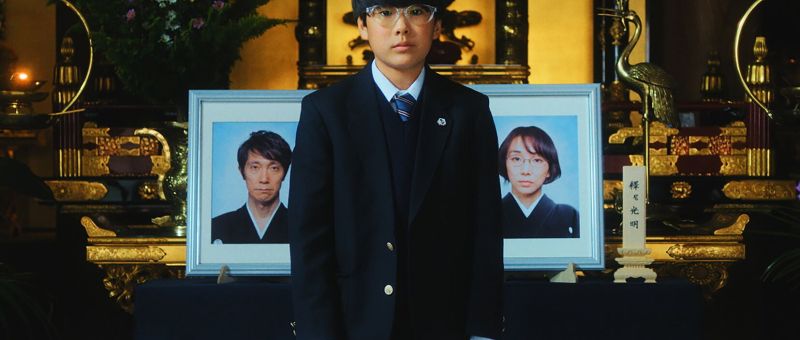
The “Little Zombies”, as we will later discover, are the latest tween viral pop sensation led by bespectacled 13-year-old Hikari (Keita Ninomiya). Recounting his own sorry tale of how his emotionally distant parents died in a freak bus accident, Hikari then teams up with three other similarly bereaved teens after meeting at the local crematorium where each of their parents is also making their final journey. Inspired by a retro RPG with the same title, the gang set off on an adventure to claim their independence by revisiting the sites of all their grief before making themselves intentionally homeless and forming an emo (no one says that anymore, apparently) grunge band to sing about their emotional numbness and general inability to feel.

Very much of the moment, but rooted in nostalgia for ages past, Little Zombies is another in a long line of Japanese movies asking serious questions about the traditional family. The reason Hikari can’t cry is, he says, because crying would be pointless. Babies cry for help, but no one is going to help him. Emotionally neglected by his parents who, when not working, were too wrapped up in their own drama to pay much attention to him, Hikari’s only connection to familial love is buried in the collection of video games they gave him in lieu of physical connection, his spectacles a kind of badge of that love earned through constant eyestrain.

The other kids, meanwhile, have similarly detached backgrounds – Takemura (Mondo Okumura) hated his useless and violent father but can’t forgive his parents for abandoning him in double suicide, Ishii (Satoshi) Mizuno) resented his careless dad but misses the stir-fries his mum cooked for him every day, and Ikuko (Sena Nakaijma) may have actually encouraged the murder of her parents by a creepy stalker while secretly pained over their rejection of her in embarrassment over her tendency to attract unwanted male attention even as child. The kids aren’t upset in the “normal” way because none of their relationships were “normal” and so their homes were never quite the points of comfort and safety one might have assumed them to be.

Orphaned and adrift, they fare little better. The adult world is as untrustworthy as ever and it’s not long before they begin to feel exploited by the powers intent on making them “stars”. Nevertheless, they continue with their deadpan routines as the “soulless” Little Zombies until their emotions, such as they are, begin inconveniently breaking through. “Despair is uncool”, but passion is impossible in a world where nothing really matters and all relationships are built on mutual transaction.

Mimicking Hikari’s retro video game, the Zombies pursue their quest towards the end level boss, passing through several stages and levelling up as they go, but face the continuing question of whether to continue with the game or not. Save and quit seems like a tempting option when there is no hope in sight, but giving in to despair would to be to let the world win. The only prize on offer is life going on “undramatically”, but in many ways that is the best reward one can hope for and who’s to say zombies don’t have feelings too? Dead but alive, the teens continue their adventure with heavy hearts but resolved in the knowledge that it’s probably OK to be numb to the world but also OK not to be. “Life is like a shit game”, but you keep playing anyway because sometimes it’s kind of fun. A visual tour de force and riot of ironic avant-garde post-modernism, We Are Little Zombies is a charmingly nostalgic throwback to the anything goes spirit of the bubble era and a strangely joyous celebration of finding small signs of hope amid the soulless chaos of modern life.


We Are Little Zombies was screened as part of the 2019 Nippon Connection Film Festival.

Original trailer (English subtitles)

Makoto Nagahisa’s short And So We Put Goldfish in the Pool

Music videos for We Are Little Zombies and Zombies But Alive

Birds Without Names (彼女がその名を知らない鳥たち, Kazuya Shiraishi, 2017)

Birds Without Names poster“Human beings are lonely by nature”, a statement offered by someone who could well think he’s lying but accidentally tells the truth in Kazuya Shiraishi’s Birds Without Names (彼女がその名を知らない鳥たち, Kanojo ga Sono Na wo Shiranai Toritachi). Loneliness, of an existential more than physical kind, eats away at the souls of those unable to connect with what it is they truly want until they eventually destroy themselves through explosive acts of irrepressible rage or, perhaps, of love. The bad look good and the good look bad but appearances can be deceptive, as can memory, and when it comes to the truths of emotional connection the sands are always shifting.

Towako (Yu Aoi), an unmarried woman in her 30s, does not work and spends most of her time angrily ringing up customer service departments to complain about things in the hope of getting some kind of compensation. She lives with an older man, Jinji (Sadao Abe) – a construction worker, who is completely devoted to her and provides both financial and emotional support despite Towako’s obvious contempt for him. Referring to him as a “slug”, Towako consistently rejects Jinji’s amorous advances and resents his, in her view, overly controlling behaviour in which he rings her several times a day and keeps general tabs on her whereabouts.

Depressed and on edge, Towako’s life takes a turn when she gets into a dispute with an upscale jewellery store over a watch repair and ends up beginning an affair with the handsome salesman who visits her apartment with a selection of possible replacements. Around the same time, Towako rings an ex-boyfriend’s number in a moment of weakness only to reconsider and hangup right away. The next day a policeman arrives and informs her that they’ve been monitoring her ex’s phone because his wife reported him missing five years ago and he’s not been seen since.

Towako views Jinji’s behaviour as possessive and his continuing devotion pathetic in his eagerness to debase himself for her benefit. Her sister Misuzu (Mukku Akazawa), however, thinks Jinji is good for her and berates Towako for her ill treatment of him. Despite the fact that Towako’s relationship with her ex, Kurosaki (Yutaka Takenouchi), ended eight years previously, Misuzu is paranoid Towako is still seeing him on the sly and will eventually try to get back together with him. Misuzu does not want this to happen because Kurosaki beat Towako so badly she landed in hospital, but despite this and worse, Towako cannot let the spectre of Kurosaki and the happiness promised in their earliest days go. She continues to pine for him, looking for other Kurosakis in the form of other handsome faces selling false promises and empty words.

Mizushima (Mukku Akazawa), the watch salesman, is just Towako’s type – something which Jinji seems to know when he violently pushes a Mizushima look-alike off a busy commuter train just because he saw the way Towako looked at him. Daring to kiss her when she abruptly starts crying while looking at his replacement watches, Mizushima spins her a line about an unhappy marriage and his craving for solitude which he sates through solo travel – most recently to a remote spot in the desert and cave they call an underground womb. Mizushima describes himself as a lonely soul and claims to have found a kindred spirit in Towako whose loneliness it was that first sparked his interest. Like all the men in the picture, Mizushima is not all he seems and there is reason to disbelieve much of what he says but he may well be correct in his assessment of Towako’s need for impossible connections with emotionally unavailable men who only ever cause her pain.

It just so happens that Kurosaki’s apparent disappearance happened around the time Towako began dating Jinji. Seeing as his behaviour is often controlling, paranoid and, as seen in the train incident, occasionally violent, Towako begins to suspect he may be involved in the mysterious absence of her one true love. Then again, Towako may well need protecting from herself and perhaps, as Misuzu seems to think, Jinji is just looking out for her. The deeper Jinji’s devotion descends, the more Towako’s contempt for him grows but the suspicion that he may be capable of something far darker provokes a series of strange and unexpected reactions in the already unsteady Towako.

A dark romance more than noirish mystery,  Birds Without Names takes place in a gloomy Osaka soaked in disappointment and post-industrial grime where the region’s distinctive accent loses its sometimes soft, comedic edge for a relentless bite in which words reject the connection they ultimately seek. Rejection, humiliation, degradation, and a hopeless sense of incurable loneliness push already strained minds towards an abyss but there’s a strange kind of purity in the intensity of selfless love which, uncomfortably enough, offers salvation in a final act of destruction.


 Screened as part of the Japan Foundation Touring Film Programme 2018.

Also screening at:

  • Firstsite (Colchester) 9 February 2018
  • HOME (Manchester) 12 February 2018
  • Watershed (Bristol) – 13 February 2018
  • Exeter Phoenix – 27 February 2018
  • Depot (Lewes) – 6 March 2018
  • Filmhouse (Edinburgh) – 8 March 2018

International trailer (English subtitles)

Journey to the Shore (岸辺の旅, Kiyoshi Kurosawa, 2015)

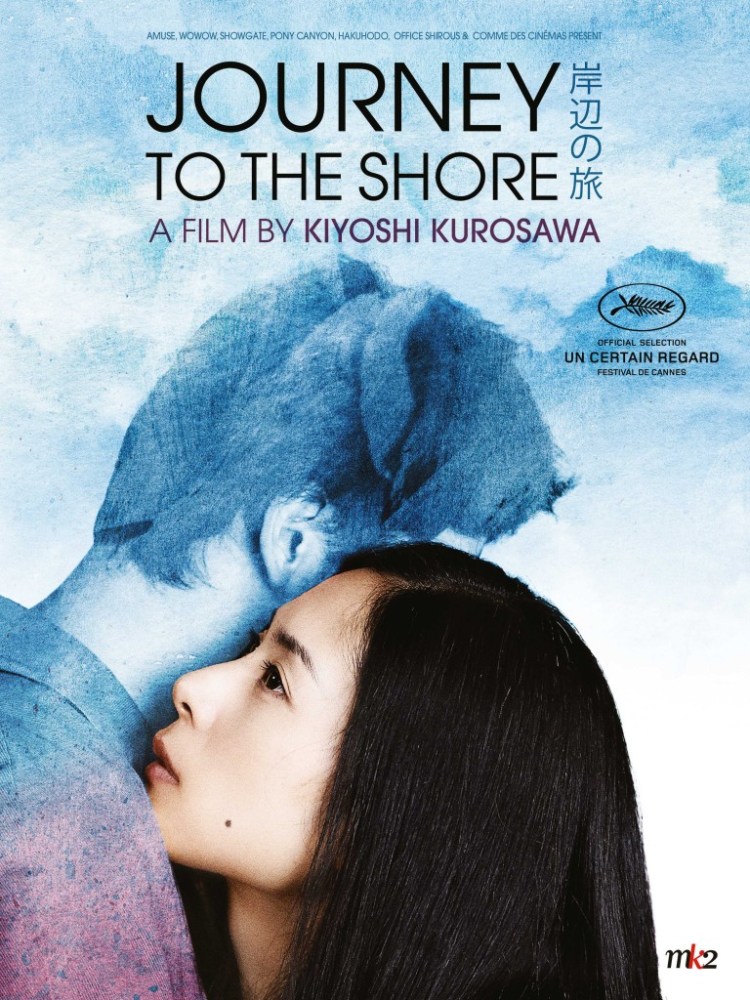
journey to the shoreTime is an ocean, but it ends at the shore. Kiyoshi Kurosawa neatly reverses Dylan’s poetic phrasing as his shoreline is less a place of endings but of beginnings or at least a representation of the idea that every beginning is born from the death of that which preceded it. Adapted from a novel by Kazumi Yumoto, Journey to the Shore (岸辺の旅, Kishibe no Tabi) takes its grief stricken, walking dead heroine on a long journey of the soul until she can finally put to rest a series of wandering ghosts and begin to live once again, albeit at her own tempo.

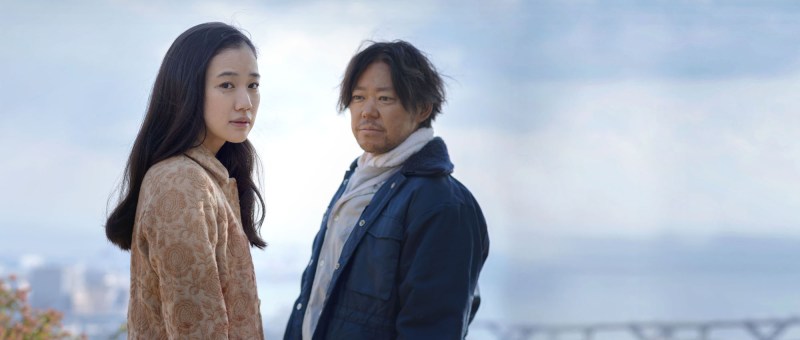
The film begins with three years widowed Mizuki (Eri Fukatsu) giving a piano lesson to a little girl whose mother goes on to enquire about her daughter’s progress. Wouldn’t it be better if she could learn something a little more cheerful once in a while? Reconsidering, the mother reflects that uptempo doesn’t quite suit Mizuki, and she’s right – it doesn’t. After impulse buying some flour and baking a few Japanese sweets at home, Mizuki receives an unexpected visit from her deceased husband, Yusuke (Tadanobu Asano), who drowned himself at sea.

Somehow unsurprised and pausing only to remind him to remove his shoes, Mizuki gives Yusuke some of the dumplings then retires to bed, only to wake up the next morning and wonder if she dreamt the strange events of the night before but, sure enough, Yusuke is still very much present. Promising to show her some of the beautiful places he discovered on his long odyssey home to her, Yusuke takes Mizuki on a reverse honeymoon in celebration and in mourning of all they once were to each other.

In each place they travel to, Mizuki and Yusuke help the people there deal with their own walking ghosts. Yusuke is not the only returnee as they discover with a lonely old newspaper seller who doesn’t appear to be aware that he died a long time ago. Walking dead in a realer sense than Mizuki or some of the other depressives they meet along the way who are still living but not exactly alive, Mr Shimakage is a spirit held in place by an inability to reconcile himself with the actions of his past and has brought his feelings of self loathing and regret with him into the afterlife.

Sometimes it’s the living that pin the dead, holding them close with guilt, regret, love or loneliness. If the film has a central tenet, it’s that the past has its place, and it’s not among the living. At one point Mizuki says that perhaps it’s better to leave some things unresolved. Yusuke asks her if she’s really OK with that, and she seems to reconsider but in the end that’s the way it has to be. There are no final solutions, the answers are not at the back of the book. In the end, the best you can do is try to understand and learn to be OK with everything you do and do not know about yourself and about those who are no longer here to tell their stories. Mizuki also says that she hated to practice piano as a child, but her teacher always told her to pay attention to her own rhythm. The music will always be lifeless, until you learn to hear your own song.

Kurosawa creates a beautifully ethereal world, held in a tension between the spirit realm and the everyday. Playing with lighting levels in extremely interesting ways, he allows the supernatural and natural to flow into each other, jostling and merging like waves and shore. Travelling from the grey, ordered and utilitarian city to the unruly nature of the countryside with its ancient, crashing waterfalls and beautiful, if lonely, coastlines we move from static and lifeless existence to a place of perpetual potential as we let go of one thing so that we might grasp another.

As much as Journey to the Shore is bound up with death, it necessarily speaks of life, too. During one of his strange lessons for the village folk, Yusuke delivers some meditations on science and philosophy to the effect that the world is built of nothingness but that nothingness does not lack meaning. He tells us that we are all dying, the universe was born billions of years ago and will end one day just as our species may end when the planet’s temperature exceeds that which we can endure or galaxies collide and take us down with them. For all of that, the universe is young, still growing, still expanding, and we are so lucky to have been born now when there is still so much ahead of us. This is a time of infinite beginnings. Starting again means letting go, but sooner or later you have to step off the shore of this self imposed purgatory and return to the great ocean which is life.


Journey to the Shore is availble on dual format DVD and blu-ray in the UK courtesty of Eureka Masters of Cinema.