Hold Up Down (ホールドアップダウン, SABU, 2005)

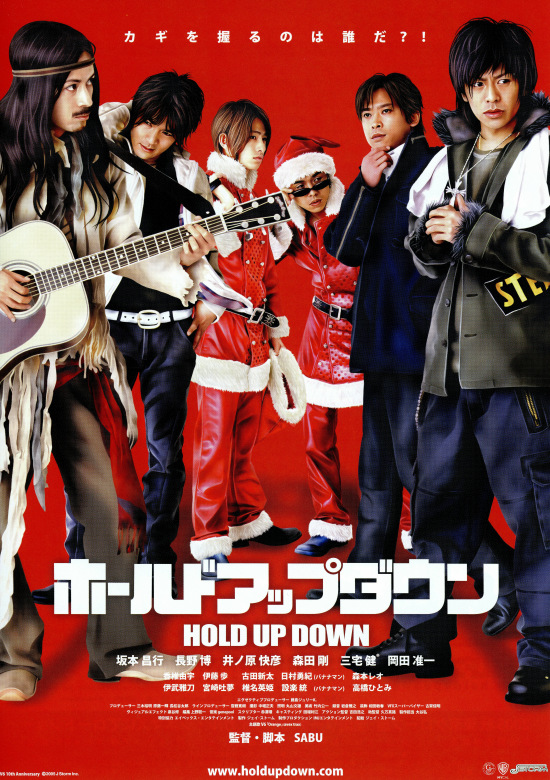
hold-up-downReteaming with popular boy band V6, SABU returns with another madcap caper in the form of surreal farce Hold Up Down (ホールドアップダウン). Holding up is, as usual, not on SABU’s roadmap as he proceeds at a necessarily brisk pace, weaving these disparate plot strands into their inevitable climax. Perhaps a little shallower than the director’s other similarly themed offerings, Hold Up Down mixes everything from reverse Father Christmasing gone wrong, to gun obsessed policemen, train obsessed policewomen, clumsy defrocked priests carrying the cross of frozen Jesus, and a Shining-esque hotel filled with creepy ghosts. Quite a lot to be going on with but if SABU has proved anything it’s that he’s very adept at juggling.

Christmas Eve – two guys hold up a bank whilst cunningly disguised as Santas, but emerging with the money they find their getaway car getting away from them on the back of a tow truck. Still dressed as Father Christmases, the guys head for the subway and decide to stash the cash in a coin locker only neither of them has any change. After robbing a busker at gunpoint for 800 yen, the duo get rid of the loot but the guy chases after them at which point they lose the key which the busker swallows after being hit by a speeding police car. Trying to cover up the crime the two policeman bundle him into the car but crash a short time later at which time the busker gets thrown in a lake and then retrieved by a defrocked priest under the misapprehension that he is Japanese Jesus!

Following SABU’s usual spiralling chase formula, events quickly escalate as one random incident eventually leads to another. Christmas is a time of romance in Japan, though encountering the love of your life during a bank robbery is less than ideal. After a love at first sight moment heralded by a musical cue, the thieves head back on the run with the girl in tow but the course of true love never did run smooth. If romance is one motivator – death is another. On this holiest of days, our defrocked priest is caught in a moment of despair, contemplating the ultimate religious taboo in taking his own life and ending the torment he feels in having failed God so badly. Therefore, when our scruffy hippy busker washes up right nearby he draws the obvious conclusion – Jesus has returned to save him! Attempting to make up for his numerous mistakes, the priest is determined to save and preserve his Lord, but, again, his clumsiness results in more catastrophes.

The situation resolves itself as each of the players winds up at the same abandoned hot springs resort which turns out to be not quite so closed down as everyone thought. Filled with ghostly charm, the gloomy haunted house atmosphere sends everyone over the edge as they thrash out their various issues as if possessed by madness. Culminating in a sequence of extreme slapstick in which everyone fights with everyone else and frozen Jesus plays an unexpectedly active part, Hold Up Down brings all of its surreal goings on to a suitably absurd conclusion in which it seems perfectly reasonable that those wishing to leave limbo land could take a 2.5hr bus trip back to the afterlife.

Pure farce and lacking the heavier themes of other SABU outings, Hold Up Down, can’t help but feel something of a lightweight exercise but that’s not to belittle the extreme intricacy of the plotting or elegance of its resolution. An innovativeIy integrated early fantasy sequence begins the voyage into the surreal which is completed in the strangely spiritual haunted house set piece as the disillusioned priest spends some time with congenial demons before attempting to make his peace with God only for it all to go wrong again. If there is a god here, it’s the Lord of Misrule but thankfully they prove a benevolent one as somehow everything seems to shake itself out with each of our troubled protagonists discovering some kind of inner calm as a result of their strange adventure, as improbable as it seems (in one way or another). Christmas is a time for ghost stories, after all, but you’ll rarely find one as joyful as Hold Up Down.


Scene from the end of the film:
A Stitch of Life (繕い裁つ人, Yukiko Mishima, 2015)

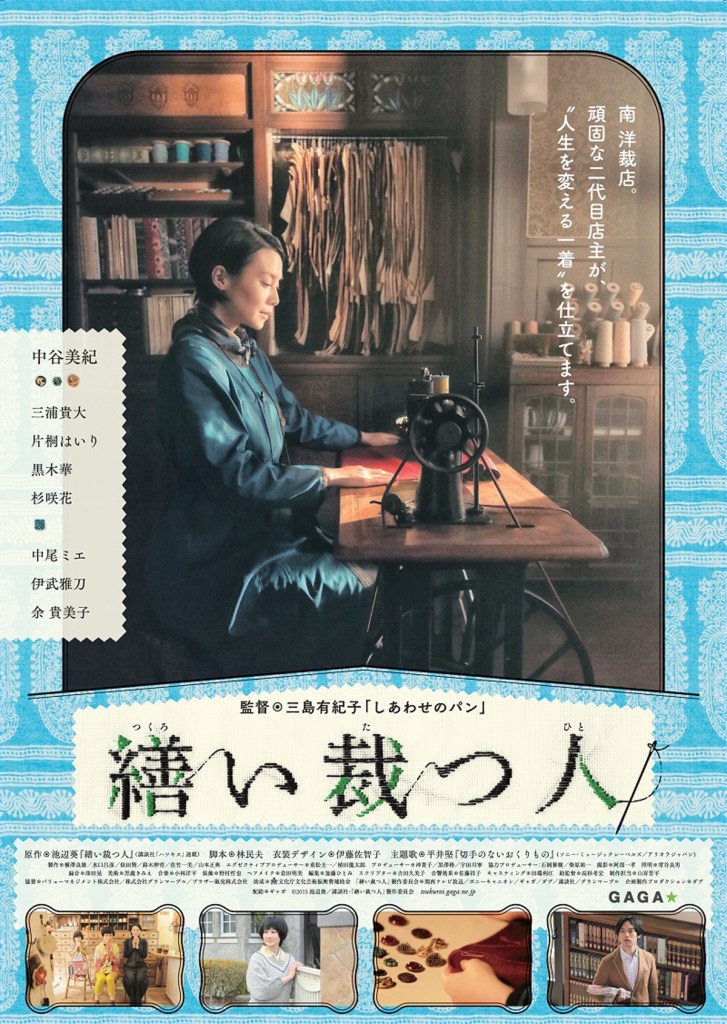
stitch-of-lifeTradition vs modernity is not so much of theme in Japanese cinema as an ever present trope. The characters at the centre of Yukiko Mishima’s adaptation of Aoi Ikebe’s manga, A Stitch of Life (繕い裁つ人, Tsukuroi Tatsu Hito), might as well be frozen in amber, so determined are they to continuing living in the same old way despite whatever personal need for change they may be feeling. The arrival of an unexpected visitor from what might as well be the future begins to loosen some of the perfectly executed stitches which have kept the heroine’s heart constrained all this time but this is less a romance than a gentle blossoming as love of craftsmanship comes to the fore and an artist begins to realise that moving forward does not necessarily entail a betrayal of the past.

Ichie Minami (Miki Nakatani) has taken over the tailoring business started by her grandmother, using her grandmother’s vintage treadle sewing machine and mostly occupying her time by making alterations on her grandmother’s existing patterns. To make ends meet, she’s also been reproducing some of her grandmother’s designs for sale at a local shop which brings her to the attention of department store employee and fashion enthusiast Fujii (Takahiro Miura) who has the idea of getting Ichie to work on some new items for a branded fashion line. Ichie, however, is devoted to her grandmother’s legacy and has committed herself to continuing the work her grandmother started with no deviation from the current model. Undeterred, Fujii continues to visit Ichie while she works, reaching even deeper levels of understanding both of her craft and of her person. Something inside Ichie begins to move too, but the pull back to the past is a strong one and it takes more than just courage to decide to finally embrace all of your hopes and dreams.

When Fujii hands the portfolio pitch he’s designed to his boss at the department store she loves the clothes and exclaims that the person who made them must be nice too, to which Fujii sheepishly admits that Ichie is more like a stubborn old man. Rigid in her habits and a little standoffish, perhaps even austere, Ichie does indeed seem harsh and unforgiving. Yet the irony is that her work requires the opposite of her. The clothes Ichie makes, and those her grandmother made before her, are perfectly tailored to the person in question, not just in terms of their measurements but designed to bring out each person’s personality, to help them become more of themselves and live a little happier in beautifully made outfits. Thus, Ichie must look closely at each person she meets in order to understand them fully and arrange her craft in perfect symbiosis with their individual needs. Perhaps for this reason Ichie finds her solitary time listening to the rhythmical beat of the sewing machine particularly relaxing, but the shop remains somewhere the local people gather in search of something more than just a simple hem repair.

Ichie’s grandmother sought to create clothes that could be worn for a lifetime, remaining long after both she and the person they were made for have disappeared. This approach may seem odd from a modern perspective of wash and wear disposable clothing intended to be replaced in a matter of months, but the idea here was never about the fashionable but one of engineering personal happiness through attire. The clothes make the man, in a sense, but the man also makes the clothes. As she made her alterations, Ichie’s grandmother recorded the various goings on in her customers’ lives in her notebook, allowing the clothes themselves to become the story of someone’s life. As Ichie’s former teacher puts it when trying to explain the art of making tea, it takes more than just heart – it takes experience, and care, and dedication. Ichie’s grandmother was meticulous – a trait which her granddaughter has inherited, with every stitch perfectly placed, each hem perfectly straight, and garment perfectly tailored for its intended wearer.

Ichie may keep herself contained for good reason, but now and then something else comes through such as a love of truly giant cheesecakes or a sudden bout of worry on being asked to craft a funeral dress for a good friend, but Fujii’s gentle prodding does indeed lead her towards a period of self reflection on what exactly it is she wants to do with her grandmother’s legacy. A cynical person might regard the annual “soirees” Ichie’s grandmother began in the small town as an excuse to get people to buy an outfit they’ll only wear once a year but the event, like the clothes, becomes an occasion for the artifice which lays bare the truth. Eventually, her grandmother’s gentle spell works on Ichie too (with a little help from Fujii) as the love of the craft of tailoring helps her to become herself, cast off her grandmother’s shadow whilst honouring her legacy, and learn to take pleasure in doing the things which only she can do.


Screened as part of the Japan Foundation Touring Film Programme 2017.

Original trailer (no subtitles)

Love Hotel (ラブホテル, Shinji Somai, 1985)

love-hotel

Shinji Somai is not particularly well known outside of Japan but where his work is celebrated it’s mostly for his youth films of teen alienation and pop culture cool. Released in the same year as his iconic Typhoon Club, Love Hotel (ラブホテル) seems like something of an aberration in Somai’s career which leans towards the melancholic rather than the passionate. Somai had begun his working life apprenticing with Nikkatsu during their Roman Porno years and Love Hotel is, in someways, a return to this genre but is only accidentally a “pink film”, produced with Director’s Company and later acquired by the pink film giant. As such it contains a number of explicit sex scenes but maintains Somai’s characteristic long takes and contemplative approach rather than adhering to the often formulaic nature of the Roman Porno.

Failed businessman Muraki (Minori Terada) returns one day to find his office full of gangsters in the middle of raping his wife. Distraught, his first thought is suicide but then he decides on a little roundabout revenge before he goes. Dressed in a dark suit and sunglasses like some ‘60s Nikkatsu bad guy, Muraki holes up in a love hotel and calls down for a girl. “Yumi” (Noriko Hayami) arrives not long after. Handing the girl a vast sum of money, Muraki then instructs her to close her eyes because he’s also brought “a present”. He handcuffs her and reveals his true purpose by tearing off her clothes, tying her up and fitting her with a vibrator. He’s going to kill himself tonight, but he doesn’t want to go alone. In the end, he can’t go through with it, something in Yumi’s face changes his mind and he leaves her there, tied up and handcuffed.

Two years later, Muraki has divorced his wife (apparently to keep her safe from the yakuza who are still after him for his debts) and is now living an intentionally dull life as a taxi driver. One fateful day he runs into Yumi again, only she’s no longer “Yumi” but “Nami”, an office lady at a top company. Eventually recognising each other, the pair are each forced to face the circumstances surrounding the traumatic night of two years previously but doing so means risking everything they have now.

Love Hotel is a film of seeing and not seeing, of looking and refusal to look. The film opens with a semi-explicit sexual scene in which Muraki’s wife is raped by a loanshark in which we watch both Muraki’s horrified expression and the act itself by means of a well positioned mirror. Somai repeats the mirroring motif throughout the film both by showing us Nami repeatedly caught in mirrors and by the obvious tripartite glass arrangement of the love hotel’s headboard. Both Muraki and Nami have elements of themselves at which they’d rather not look but the ever present mirrors constantly prompt them into areas of self-reflection, ironically possible only by looking at the other.

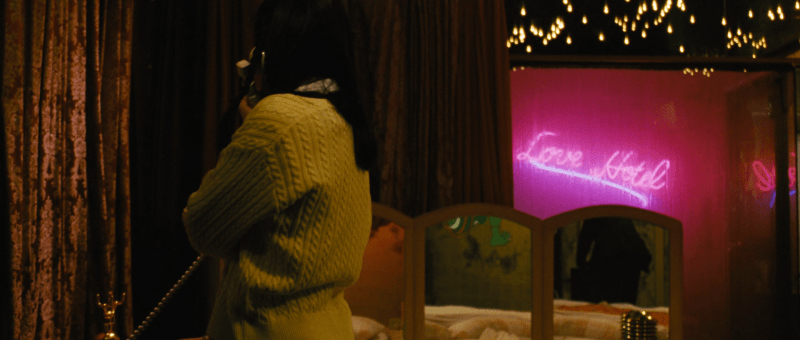
Where Muraki has chosen a life of austerity, separating from his wife who nevertheless continues stopping by to look after him in all of the wifely ways, Nami has tried and failed to put her traumatic past behind her by hopping into the consumerist revolution. Having supported herself through prostitution as a student, she’s managed to swing a pretty good job at top company only to find herself “prostituted” again through an ill-advised affair with her married boss. After his wife finds out and Nami loses her job and the entire life she’d begun to build for herself, she tries to call her former lover for consolation only to have him cruelly hang up on her. Nami continues her lamentations to the alarming trill of the dial tone in a heartbreaking moment of true loneliness.

Left with nothing else, the pair decide to revisit their unfinished love hotel business but their much more normal encounter changes each of them in different ways. It’s clear something has passed between the two, but Muraki’s final glance into the mirror perhaps shows him something he’d rather not have seen. Nami’s face, like Yumi’s face, may well have been “angelic” but cannot “save” Muraki in the same way twice – or at least, not in the way the restored Nami would have liked to save him. Dark, melancholy and fatalistic, Somai’s stab at Roman Porno is a sad tale of frustrated love, destroyed by the use and misuse of bodies speaking against each other and becoming a barrier to true connection. The Love Hotel is a place romance goes to die, and what the pair of damaged lovers at the centre of his noir-tinged tale of despair find there is only emptiness and pain devoid of any sign of hope.


Opening scene (no subtitles)

Masterfully constructed one take final scene (dialogue free)

Swimming Upstream (バタアシ金魚, Joji Matsuoka, 1990)

Swimming UpstreamSometimes love makes you do crazy things. Some people find themselves accomplishing previously unattainable feats powered only by the sheer force of romance. Unfortunately for the hero of Swimming Upstream (バタアシ金魚, Bataashi Kingyo), Joji’s Matsuoka’s adaptation of Minetaro Mochizuki’s manga, the task he sets for himself is a very lofty one indeed and may actually require him to abandon his love to complete it. Then again, the object of his affections shows little signs of reciprocation in any case.
Love found Kaoru (Michitaka Tsutsui) with a bucket of water. That is, he was hanging around one day when swimsuited beauty Sonoko (Saki Takaoka) soaked him by mistake but far from being annoyed, Kaoru falls in love at first sight and begins to pursue the star of the swim team even if she remains resolutely cold towards him. Kaoru immediately joins up just to be close to her even though he is actually afraid of water and does not know how to swim. Nevertheless he sets himself the task of becoming an olympic swimmer and bringing home a gold medal for his lady love. Needless to day, Sonoko is still not very interested in him.

Assisted by a strange old lady of swimming coach in sporting matters, and with an unlikely ally in Sonoko’s mother when it comes to romance, Kaoru works hard at his twin goals but makes little progress with either. His world is briefly shattered when he spots Sonoko arm in arm with the school’s star swimmer and he also faces a romantic dilemma in the form of his friend Pu whose motorbike he keeps borrowing to try and impress Sonoko despite the fact that Pu obviously has a crush on him. Nevertheless, Kaoru is undeterred until, that is, Sonoko’s actions convince him he may be doing more harm than good.

Matusoka’s film is most clearly concerned with recreating the contemporary high school summer for the presumed target audience of teenagers. Though it loosely adapts a classic sports movie romance format with Kaoru giving it his all in training, it stops short of the triumphant underdog trope as Kaoru never achieves the kind of sporting success one would expect. Though he quickly learns to swim and makes some progress, Kaoru retains a lingering fear of the water and is among the very weakest at the club. Still deluding himself with his Olympian dream, Kaoru even attempts to challenge the champion swimmer of another team (played by a very young Tadanobu Asano in his first film role) in a race for the rights to Kaoru. Needless to say, nothing goes his way.

If duelling over the “rights” to a girl seems like an old fashioned idea, Swimming Upstream is a very old fashioned film in terms of its sexual politics. The film stars popular idol Saki Takaoka as the unattainable Sonoko but is told very much from Kaoru’s point of view in which Sonoko is something to be won rather than another human being with independent will. Sonoko’s behaviour often is hard to categorise but, to borrow a term from the film’s manga roots, could easily be described as tsundere wherein she consistently rejects Kaoru’s advances before warming up to the idea just as he’s beginning to cool off. There may a fine line between persistence and and inappropriate behaviour but Kaoru’s level of devotion is the kind that straddles it. The teenage audience of 1990, however, may have seen things a little differently than that of today.

The audience of 1990 would doubtless also have been shocked by Sonoko’s rebellious lack of compliance with regular social norms. Far from the docile, cute, obedient and polite aura of the traditionally perfect girl next door in which idol movies specialise, Sonoko throws angry looks at everyone and talks back to her mother with extremely harsh words (though her mother wisely refuses to be shocked by them). In fact Sonoko is universally awful to everyone to the extent that it later seems that even one of her closest friends does not actually like her very much, but the worse she gets the more Kaoru refuses to be dissuaded.

Matsuoka mostly chooses to keep things simple with a light hearted, summery atmosphere primed to appeal to his audience of youngsters. Though intended as an innocent romance, contemporary audiences may read more darkness into the relentless war between the icy Sonoko and determined Kaoru but the adolescent intensity of young love does at least ring true. Caught between the quirkiness of its general tone and the heaviness of its themes, Swimming Upstream flounders in making its central connection work, rendering its overworked metaphor of a finale less than successful but does offer strong performances from both of its central stars.


Clip (no subtitles)

https://www.youtube.com/watch?v=sQ7SVpXH0JM

Maison Ikkoku: Apartment Fantasy (めぞん一刻, Shinichiro Sawai, 1986)

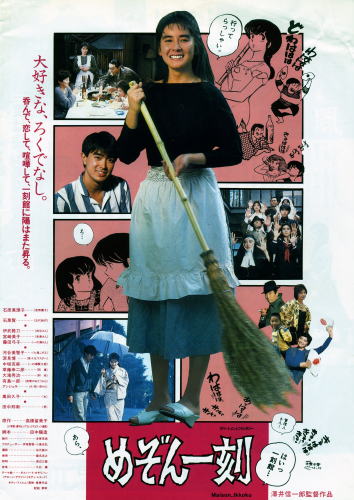
Maison IkkouIf you’ve always fancied a stay at that inn the Katakuris run but aren’t really into zombies and murder etc, you could think about spending some time at Maison Ikkoku (めぞん一刻). Based on the classic 1980s manga by Rumiko Takahashi, the 1986 live action adaptation is every bit as zany as you’d hope. Eccentric tenants, women pulled from ponds, bank robbers, and an all star dog. It’s a pretty full house, but if anything’s for certain it’s the more the merrier over at Maison Ikkoku.

Godai (Ken Ishiguro), a would-be student retaking his university entrance exams, has finally had enough and vowed to move out of Maison Ikkoku for good but just as he’s made his decision, an elegant woman arrives with a big white dog. The beautiful lady, Kyoko (Mariko Ishihara), is their new building manager. Godai falls instantly in love with her and decides to stay, but Kyoko has her own reasons for coming to Maison Ikkoku and isn’t quite ready to engage in a romance with a feckless student.

Kyoko also makes the mistake of reminding the collection of eccentric tenants that they’re behind on their rent. There are currently four residents occupying the apartment building including Godai. He’s joined by the mysterious Yotsuya (Masato Ibu) who seems to have several different jobs and speaks in an overly formal manner, Ichinose (Yumiko Fujita) – a gossipy middle aged housewife, and Akemi (Yoshiko Miyazaki) who works at a nearby bar and is almost always in her underwear. They don’t want to pay so they start coming up with plans to stop Kyoko coming after them for the money – the first one being to drug and assault her so she’ll be too embarrassed to talk to them again! Went dark quickly, didn’t it?

Despite the quirky goings on, the presence of death is constant. Kyoko is an extremely young widow sill mourning the death of her husband and has even named her dog after him. Shinichiro keeps making his ghostly presence known to her by ringing the nearby shrine bells or stealing her umbrella, making it impossible for Kyoko to move on. A non-resident but frequent visitor (played by Kunie Tanaka) recounts that his wife left him and took part in a double suicide with another man, whilst the gang also picks up another member in the form of a woman that Yotsuya claims to have fished out of the lake after she “got caught on his pole” and is now a little obsessed with him thinking that he’s the boyfriend she tried to commit suicide over.

If that all sounds a little heavy, Sawai makes sure to pile on the absurdism to keep things light and even includes a few visual gags such as a floating geisha doll during Yotsuya’s “I regret preventing a woman’s suicide because it turns out she’s quite annoying” speech. About half way through the film the entire gang suddenly decides they’re going to perform an “Ikkoku speciality” in celebration of Godai’s success which turns out to be a full scale song and dance number with everyone dressed in outfits that reflect their personality from Yotsuya in his temple singer garb, Ichinose in her wedding dress, Akemi in a nurses outfit, and Godai and Kyoto both in a school uniform, to the mysterious man dressed as a hardboiled detective the failed suicide woman for some reason dressed as a nun. Just when a big “The End” sign pops up we get yet another song accompanied by glow sticks waving in the background.

The main “drama” revolves around Godai’s attempts to pass his university entrance exams and win the heart of Kyoko though there are also various subplots concerning the odd rivalry between Yotsuya and the mysterious man over a bank robbery as well as their attempts to evade the police. Maison Ikkoku becomes a kind of sanctuary where those with wounded hearts can find a place to heal themselves. Occasionally bleak, such as in the frequent references to death and suicide, Maison Ikkoku is an absurd place filled with larger than life characters acting out their surreal existence in this shared paradise of a rundown boarding house in a quiet backwater. The film ends on another ironic note as the party goes on but the Gilbert O’Sullivan track Alone Again, Naturally plays over the end credits which is, of course, about the singer’s intention to commit suicide after being jilted at the altar. A strange if well crafted film, Maison Ikkoku is in someways ahead of its time in the quirky humour stakes but also makes use of a typically ‘80s kind of absurdism which fuses black humour with innocent, youthful charm.


Original Trailer(s) (No subtitles)

Dr. Akagi (カンゾー先生, Shohei Imamura, 1998)

Dr AkagiA late career entry from socially minded director Shohei Imamura, Dr. Akagi (カンゾー先生, Kanzo Sensei) takes him back to the war years but perhaps to a slightly more bourgeois milieu than his previous work had hitherto focussed on. Based on the book by Ango Sakaguchi, Dr. Akagi is the story of one ordinary “family doctor” in the dying days of World War II.
As Dr. Akagi (Akira Emoto) puts it, much of the the life of a family doctor involves running. If he breaks one leg, he’ll run on the other, if he breaks both legs, he’ll run on his hands, but he’ll do whatever it takes to get to his patients. Some of the villagers have branded him as a quack and nicknamed him “Doctor Liver” because his most frequent diagnosis is for hepatitis. Doctor Akagi is convinced that there really is an epidemic of contagious hepatitis plaguing the population and even has the evidence to back his theory up but with the war in crisis and so much else going on he’s having trouble getting anyone to listen to him. Nevertheless, Akagi fearlessly tries to find out what it is that’s causing this deadly disease to spread and hopefully put an end to it for good.

Imamura strikes an oddly comic tone here. Though the above synopsis may sound overly serious, for the vast majority of its running time Dr. Akagi is the story of a small fishing village going about its everyday life with the war just simply background. The town narrowly escapes being bombed by an American raid because it’s known that there’s prisoner of war camp nearby filled with allied soldiers and red cross personnel and there are certainly a lot of troops on the ground more or less running the show. However, despite the obvious hardships – lack of food being the biggest one, the townspeople are getting on with things in a fairly cheerful way.

Following a spot of pastoral care, Dr. Akagi ends up taking in a local girl as his assistant and housekeeper after her father has died leaving her to support her two younger siblings. Though a married woman with a husband away at the front, Sonoko (Kumiko Aso) has been making ends meet through prostitution with the rather unwelcome result that one of her regular customers wants to marry her (she does not reciprocate and after all already has a husband). Akagi doesn’t necessarily disapprove of the idea of prostitution or of openly expressed sexuality, but accepts that society does object to these ideas and takes Sonoko in so that she won’t have to sell herself (though she actually didn’t really mind very much and still finds herself called upon to provide her “services” even after she’s officially given up).

Akagi’s other supporters include a fellow doctor, Tomomi, who has become addicted to morphine after his wartime service and a drunken and lecherous buddhist monk who proves an essential ally when it comes to body snatching a recently buried corpse. Akagi gets himself into even more trouble when he takes in and treats an escaped Dutch POW who bears the scars of extreme torture by Japanese forces who are paranoid about possible spy action. Imamura is never afraid of raising the spectre of wartime brutality as his soldiers flit between righteous zealots committed to the letter of the law and bumbling idiots who can’t see that each of their actions is entirely counterproductive to their cause.

The most surprising moment comes when Akagi has a dream about his son who is an army doctor serving in Manchuria. After Akagi and his friend have conducted an autopsy to gain a fresh liver sample, Tomomi starts talking about his time in the army and a rumour about a group of doctors doing live dissections and possibly researching chemical weapons. Akagi is aghast and horrified but recounts his dream in which he stood before his son whose bloodied hands are extended towards him with a living patient writhing below. Akagi reminds him that he is a doctor and urges him to stop this barbaric practice but the nightmarish vision of this gloomy, blood-soaked room persists.

At the end of the film Sonoko and Akagi unwittingly end up viewing the giant mushroom cloud which arises after the atomic bomb blast in Hiroshima. Not knowing what it is, Akagi predictably sees it as a giant infected liver and wonders if the donor for his liver sample is angry with him but then thinks again and says the cloud is a representation of everybody’s anger towards this war. Akagi loses himself a little in the quest to solve the hepatitis question and after it leads him to neglect a patient he begins to question himself over his true motives and whether there’s really any point to what he’s trying to do. However, Dr. Akagi is a good and a kind man and eventually remembers what his true calling is – as a family doctor, running from one emergency to the next but always making sure his patients are well looked after. War or no war, life goes on – people get sick and they need to know there are men like Akagi out there that can always be relied upon to do the very best they can.


Dr. Akagi was originally released in the US by Kino Lorber but seems to be out of print. The good news is that the region free Korean disc comes with English subtitles.

Unsubbed trailer:

http://www.youtube.com/watch?v=g40YrQBAm3I

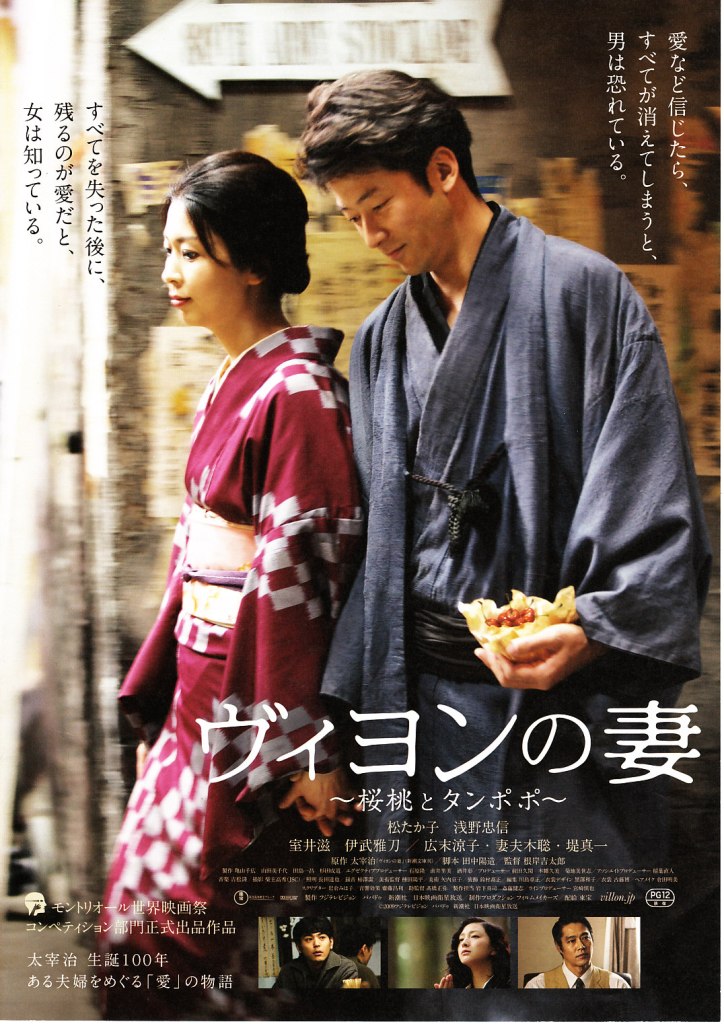
Villon’s Wife (ヴィヨンの妻 〜桜桃とタンポポ, Kichitaro Negishi, 2009)

Villon's Wife2009 marked the centenary year of Osamu Dazai, a hugely important figure in the history of Japanese literature who is known for his melancholic stories of depressed, suicidal and drunken young men in contemporary post-war Japan. Villon’s Wife (ヴィヨンの妻 〜桜桃とタンポポ, Villon no Tsuma: Oto to Tampopo) is a semi-autobiographical look at a wife’s devotion to her husband who causes her nothing but suffering thanks to his intense insecurity and seeming desire for death coupled with an inability to successfully commit suicide.

Beginning in the immediate post-war period of 1946, Sachiko (Takako Matsu) is a fairly ordinary housewife with a young son who generally waits around the house for her husband’s return. Only, she’s married to one of the most brilliant writers of the age, Joji Otani (Tadanobu Asano), whose book on the French poet François Villon is currently a best seller. Despite his obvious literary talents, Otani is a drunkard who spends most of his time (and money) in bars and with other women. When he crashes home one night only to be pursued by two bar owners who reveal that he ran off with their takings (around 5000 yen), Sachiko is not exactly surprised but still embarrassed and eventually takes matters into her own hands by volunteering to offer herself as a “hostage” by working at the bar until the debt is repaid.

“Men and women are equal now, even dogs and horses” says one customer, impressed with this sudden arrival of a beautiful woman in a low life drinking spot. To her own surprise, Sachiko actually enjoys working at the bar, it gives her purpose and proves more interesting than being stuck at home waiting to see what her drunken fool of a husband has got up to next. She’s good at it too – Sachiko is a beautiful and a fundamentally decent and kind person, in short the sort of woman that everyone falls a little bit in love with. That said, she isn’t a saint. She’s perfectly aware of the power she is able to wield over men and is unafraid to make use of it, though only when absolutely necessary.

Otani himself is a fairly pathetic figure. He may be a great artist but he’s a hollow human being. He admits the reason for all of his vices is fear – he’s a afraid to live but he’s also afraid to die. He seems to love his wife, though he’s insecure about losing her and dreads the embarrassment involved in becoming a cuckold. So afraid to face the possibility of failure, Otani satisfies himself in an underground world of drunks and easy women rather than facing his own self loathing as reflected in the faces of his unconditionally loving family.

Perhaps because Villon’s Wife is a commemorative project, the film has been given the prestige picture treatment meaning the darker sides of Dazai’s original novella have been largely excised. The chaos of the post-war city with its starving population, soldiers on the streets and generalised anxiety is all but hidden and some of the more serious travails Sachiko undergoes in devotion to her husband as well as Otani’s tuberculosis (from which Dazai also suffered in real life) have also largely been removed. What remains is the central picture of a self destructive husband and the goodly wife who’s trying to save him from himself but risks her own soul in the process.

The one spot of unseemliness of post-war life that the film lets through is in a brief scene which features a group of pan pan girls hanging around ready to try and snag some passing GIs. Sachiko buys some lipstick from them to use in attempt to convince an ex who is also a top lawyer to try and help her husband after his latest escapade lands him in jail on a possible murder charge. After visiting him, Sachiko wanders out slightly dazed to see the pan pans atop a military jeep cheerfully waving and shouting “goodbye” in English. Sachiko is confused at first but eventually shouts “goodbye” back in a way which is both excited and a little bit sad, perhaps realising she is not so different from them after all. Finally she wipes the lipstick from her face and leaves the small silver tube behind where the pan pans were sitting, hoping to bury this particular incident far in the past.

In actuality the pan pan girls are depicted in a fairly matter of fact way rather than in the negative light in which they are usually shown, just another phenomenon of occupation. At the end of the film Otani calls himself a monster whilst acknowledging that he’s a terrible father who would steal the cherries from his own son’s mouth. Sachiko replies that it’s OK to be a monster – as long as we’re alive, it’ll be alright. Oddly for someone so suicidal, this fits in quite well with Dazai’s tenet of embracing the simple gift of a dandelion. The film ends on an ambiguous note in which there seems to have been some kind of restoration but it’s far from a happy one as the couple remain locked in a perpetual battle between light and darkness albeit with the balance a little more equalised than it perhaps was before.


The R3 Hong Kong DVD release of Villon’s Wife includes English subtitles.