The King of Minami: Ginjiro Manda (難波金融伝 ミナミの帝王1 トイチの萬田銀次郎, Sadaaki Haginiwa, 1992)

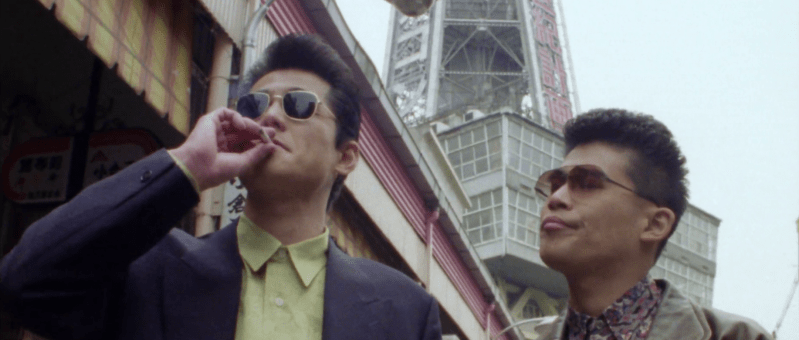
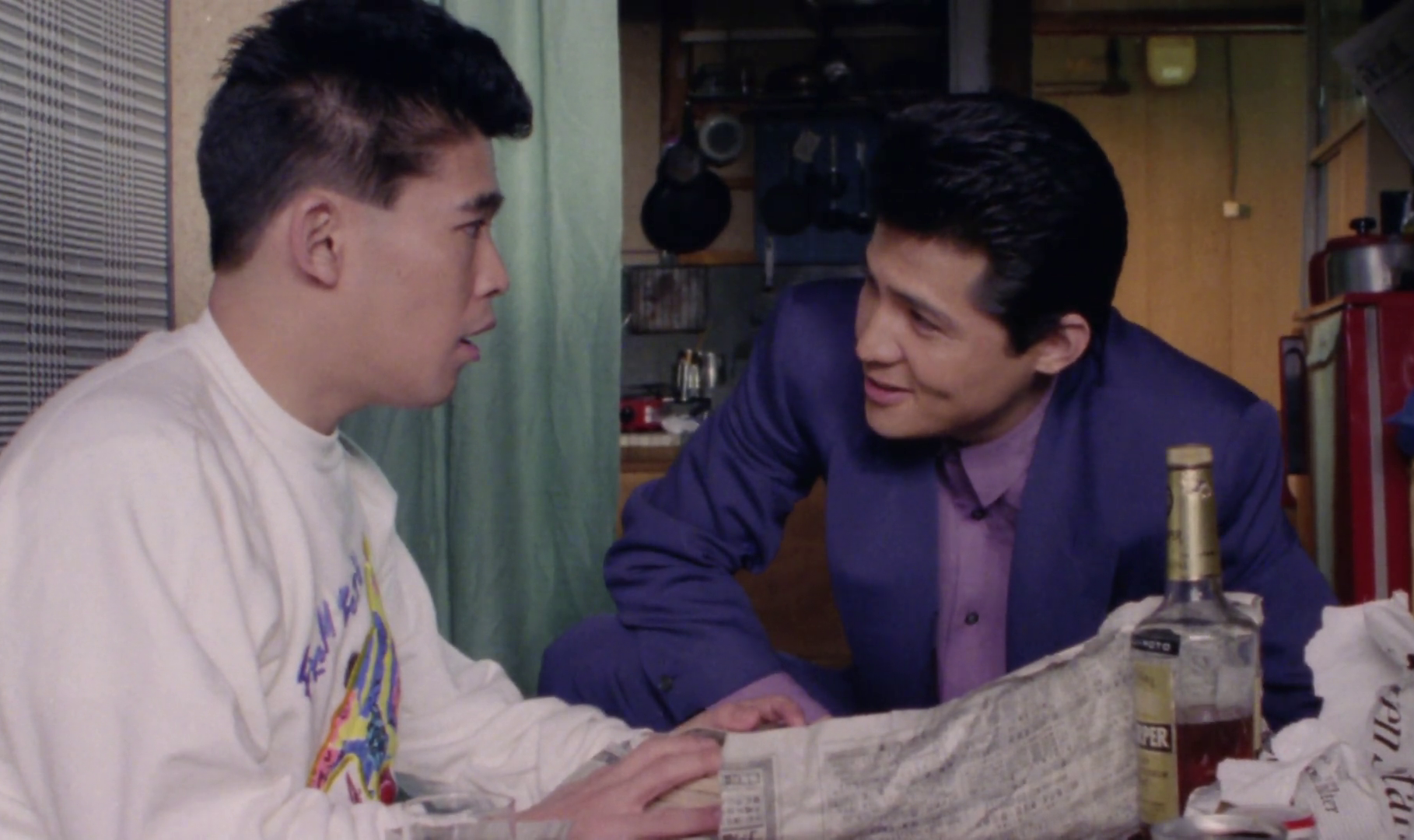
“The one holding the money calls the shots,” according to a particularly sticky debtor in Sadaaki Haginiwa’s The King of Minami, though that turns out not quite to be the case. After all, though the money may be in his possession, technically it belongs to Ginjiro (Riki Takeuchi) and when they don’t return it to him, he begins to feel offended. Reflective of a kind of post-bubble malaise, the film has a rather cynical take on money and finance, but at the same time a weird kind of wholesomeness.

Ginjiro may be the King of Minami, but he sees himself as a saviour of the poor. Questioned by new underling Ryuichi, he brushes off concerns that people can be driven to suicide over debt by claiming that the loans he offers may save their lives. But though Ginjiro may claim to be somehow better than his yakuza counterparts in refusing to resort to violence, he’s ruthless in other ways and certain that debts must be repaid. Once he’s cheated by an old man, Tokugawa, who refuses to pay the interest on his loan, Ginjiro knows theres’s no point pressing him and decides to go after his daughter instead. She, however, has already maxed out all her card trying to save her dad’s business. 

For his righteousness, explaining that he’ll never end up with sometime love interest Asako because a loan shark has no room for relationships, Ginjiro’s world is essentially misogynistic. Sent after a runaway bar hostess, Ginjiro tells Ryuichi that women always have ways of making money with a note of envy in his voice as if he resented this essential unfairness on behalf of impoverished men. Of course, this way of making money is open to them too, though they wouldn’t consider it and no one would put it forward as an option or view their body as a commodity that should be traded away when one has debts. He says something similar to Tokunaga’s schoolteacher daughter Machiko too, agreeing that night work is the way to make a lot of money relatively quickly. Machiko has, however, already been forced into sexual slavery by Narita, a rival yakuza loanshark, who extorts sexual favours in lieu of money. 

Young Ryuichi is quite touched by her story and even falls in love with her a little bot despite Ginjiro’s warnings that a loanshark can’t afford to let his emotions overcome his reason. Even if he remains willing to make Machiko pay for her father’s transgressions, Ginjiro is equally angry with Tokunaga for rejecting this essential law that money should always find its way to its point of origin. Taking him to task for his immoral vices such as a gambling addiction that’s ruined his business, finances, and relationships, Ginjiro tells him that he ought to pay his debts himself rather than push them on his daughter. He seems to have contempt for people who do this to themselves through what he sees as their own poor choices, but less so for those like Machiko who end up needing his services through no fault of their own or an ironic sense of indebtedness to someone else.

In any case, he stands a kind of counter to those like Narita who only want to exploit people’s weaknesses and use violence to get their way. The two of them end up in a financial sparring match as Narita sets Girjio up with a deliberately bad debt, while he, in turn, masterminds a counter scam under the tutelage of his “financial teacher” who knows all sorts of underhanded ways to make money like selling land that doesn’t belong to you. One could say that he’s teaching Ryuichi all the wrong lessons, but then his behaviour is more roguish than dangerous and he’s obviously more morally righteous than the sneering Narita who seems to feed off human pain so it’s satisfying to see him win and humiliate the predatory yakuza. Ginjiro agrees that it’s a sad world in which people die over money, but, at the same time, has a healthy disregard for it. He tells Ryuichi that he should think of money in the same as a greengrocer thinks of vegetables and that he needs to lose his reverence for it if he’s to make it as a loanshark. That might, after all, be how he became the king of Minami, laughing at the ridiculousness of a world in which those with money call the shots while simultaneously holding all the cards himself.

Dreams (夢, Akira Kurosawa, 1990)

dreamsDespite a long and hugely successful career which saw him feted as the man who’d put Japanese cinema on the international map, Akira Kurosawa’s fortunes took a tumble in the late ‘60s with an ill fated attempt to break into Hollywood. Tora! Tora! Tora! was to be a landmark film collaboration detailing the attack on Pearl Harbour from both the American and Japanese sides with Kurosawa directing the Japanese half, and an American director handling the English language content. However, the American director was not someone the prestigious caliber of David Lean as Kurosawa had hoped and his script was constantly picked apart and reduced.

When filming finally began, Kurosawa was fired and replaced with the younger and (then) less internationally regarded Kinji Fukasaku and Toshio Masuda. The film was an unmitigated failure which proved hugely embarrassing to Kurosawa, not least because it exposed improprieties within his own company. Other than the low budget Dodesukaden, Kurosawa continued to find it difficult to secure funding for the sort of films he wanted to make and in 1971 attempted suicide, thankfully unsuccessfully, but subsequently retreated into domestic life leaving a large question mark over his future career in cinema.

American directors who’d been inspired by his golden age work including George Lucas and Martin Scorsese were keen to coax Kurosawa back into the director’s chair, helping to fund and promote his two biggest ‘80s efforts – Ran, and Kagemusha, both large scale, epic jidaigeki more along the line of Seven Samurai than the arthouse leaning smaller scale of his contemporary pictures. The success of these two films and the assistance of Steven Spielberg, allowed him to move in a radically different direction for his next film. Dreams (夢, Yume) is an aberration in Kurosawa’s back catalogue, a collection of thematically linked vignettes featuring surreal, ethereal, noh theatre inspired imagery, it was unlike anything the director had attempted before and a far cry away from the often straightforward naturalism which marked his career up to this point.

Inspired by Kurosawa’s own dreams from childhood to the present day, Dreams is divided into eight different chapters beginning with a solemn wedding and ending in a joyous funeral. Each of the segments takes on a different tone and aesthetic, but lays bare many of the themes which had recurred throughout Kurosawa’s career – namely, man’s relationship with the natural world, and its constant need to tear itself apart all in the name of progress.

Casting his central protagonist simply as “I”, Kurosawa begins with an exact recreation of his childhood home and a little boy who disobeys his mother in leaving the house during a spell of sun streaked rain. Weather like this is perfect for a “kitsune” wedding, only fox spirits do not like their rituals to be witnessed by humans and punishment is extreme if caught, still, the boy has to know. His fate is echoed in the second story in which the still young I is lured to the spot where his family’s orchard once stood to be berated by the spirits of the now departed peach blossoms in the guise of the traditional dolls given to little girls at the Hina Matsuri festival. The spirits are upset with the boy, who starts crying, but not, as the spirits originally think because he’s mourning all of the peaches he’ll never eat but because he truly loved the this place and knows he’ll never see the glory of the full orchard in bloom ever again.

The spirits recognise his grief and contritely agree to put on a display of magic for him so that he may experience the beauty of peach trees in full blossom one last time. However, the illusion is soon over and the boy is left among the stumps where his beloved trees once stood. Later, the adult I finds himself in a monstrous nuclear apocalypse which has now become much harder to watch as the Ishiro Honda inspired horror of the situation has turned mount Fuji and the surrounding sky entirely red with no escape from the invisible radioactive poison. Quickly followed by I traipsing through a dark and arid land in which giant mutant dandelion provide the only sign of life aside from the remnants of post-apocalyptic humanity reduced to devouring itself in scenes worthy of Bruegel, these sequences paint the price of untapped progress as humans burn their world all the while claiming to improve it.

Humans are, in a sense, at war with nature as with themselves. The Tunnel sees an older I return from the war to encounter first an aggressive dog and then the ghosts of men he knew who didn’t make it home. Apologising that he survived and they didn’t, I contrives to send the blue faced ghosts back into the darkness of the tunnel while he himself is plagued by the barking, grenade bearing dog outside. The mountaineers of the blizzard sequence are engaged in a similar battle, albeit a more straightforwardly naturalistic one of human endurance pitted against the sheer force of the natural world. That is, until the natural becomes supernatural in the sudden appearance of the Snow Woman which the mountaineer manages to best in his resilience to the wind and cold.

The better qualities of humanity are to be found in the idyllic closing tale which takes place in a village lost to time. Here there is no electric, no violence, no crime. People live simply, and they die when they’re supposed to, leaving the world in celebration of a life well lived rather than in regret. People, says the old man, are too obsessed with convenience. All those scientists wasting their lives inventing things which only make people miserable as they tinker around trying to “improve” the unimprovable. As the young I says, he could buy himself as many peaches as he wanted, but where can you buy a full orchard in bloom?

Of course, Kurosawa doesn’t let himself off the hook either as the middle aged I finds himself sucked into a van Gogh painting, wandering through the great master’s works until meeting the man himself (played by Martin Scorsese making a rare cameo in another director’s film) who transforms his world through his unique perception but finds himself erased by it as his art consumes him to the point of madness. I wanders back through van Gogh’s landscapes, now broken down to their component parts before eventually extricating himself and arriving back in the gallery as a mere spectator. Even if the work destroyed its creator through its maddening imperfection it lives on, speaking for him and about him as well about a hundred other things for an eternity.

For all of the fear and despair, there is hope – in humanity’s capacity for endurance as in the Blizzard, in its compassion as in The Tunnel, and in its appreciation for the natural world as in The Peach Orchard alongside its need to re-envision its environment through the glorious imperfection of art. There is the hope that mankind may choose to live in The Village of the Water Mills rather than the hellish post apocalyptic world of fear and greed, however small and slim that hope maybe. Creating a living painting filled with hyperreal colour and a misty dreaminess, Kurosawa’s Dreams, like all dreams, speak not only of the past but of the future, not only of what has been but what may come. Equal parts despair and love, Kurosawa’s vision is bleak yet filled with hope and the intense belief in art as a redemptive, creative force countering humanity’s innate capacity for self destruction.


Original international trailer (irritating English language voiceover only)

Ran (乱, Akira Kurosawa, 1985)

ran posterAkira Kurosawa is arguably the most internationally well known Japanese director – after all, Seven Samurai is the one “foreign film” everyone who “doesn’t do subtitles” has seen. Though he’s often thought of as being quintessentially Japanese, his fellow countryman often regarded him as too Western in terms of his filming style. They may have a point when you consider that he made three different movies inspired by the works of Shakespeare (The Bad Sleep Well – Hamlet, Throne of Blood – Macbeth, and Ran – King Lear) though in each case it’s clear that “inspired” is very much the right word for these very liberal treatments.

In the case of Ran (乱) – a loose adaptation of King Lear, Kurosawa moves the story to feudal Japan and an ageing king who this time has three sons rather than three daughters. This leaves Hidetora (Tatsuya Nakadai) with a smaller problem than Lear’s though in his original idea of making his eldest son his heir with the other two inheriting smaller roles it’s clear things aren’t going to end well. Just as in the original play, the oldest two sons Taro and Jiro sing their father’s praises with cynical glee but the youngest and most sincere, Saburo, refuses to play this game as his respect for his father is genuine. Unfortunately, Saburo’s honesty sees him banished from his father’s kingdom and his share of responsibility given over to his treacherous brothers. Predictably, neither is satisfied with what they’ve been given and it’s not long before a familial conflict has sparked into a bloody civil war.

How sharper than a serpent’s tooth it is to have a thankless child….Hidetora is not quite as far gone as Lear in Shakespeare’s original text at the beginning of the film yet he is still unable to see that his oldest two sons have placed personal ambition ahead of filial piety. Hidetora was once a fearsome, if cruel, warrior, famous for burning enemy villages and creating peace only through destruction. He’s old now, and tired and so he proposes to hand over the running of the kingdom to his eldest son, yet – he wants to remain the de facto leader until the very end. Of course, that doesn’t sit well with Taro, or more to the point his ambitious wife Lady Kaede. Hidetora is thrown out of Taro’s castle and then also from Jiro’s before all out war erupts between the two leaving him totally isolated – a king without a kingdom.

Hidetora’s true madness begins when he realises not only how little regard his eldest two sons hold for him, but also that his failure to recognise the true nature of the situation has lead to the deaths of the people in his care that have remained loyal to him to the very end. As the enemy begin to engulf the castle, concubines begin helping each other to commit suicide in order to avoid ravishment while others try to escape but are cut down by arrow fire. This is all his own fault – his ruthless cruelty has been filtered down to his two oldest sons who, as he did, will stop at nothing in the pursuit of power. What is a king if not the father of a nation, and as a father he has failed. Neither Taro or Jiro are worthy of the offices afforded to them and lack both basic humanity and the princely power one needs to become the unifying force of a people.

Only too late does Hidetora see the wisdom in Saburo’s words and finally understand that he has alienated the only one of his children that truly loved him. From this point on his madness increases and Nakaidai’s performance becomes increasingly mannered and theatrical as if Hidetora himself is acting in another play which only he can see. Wandering and lonely, the once great king is reduced to the estate of a beggar led only by his fool and sheltered by the ruins of a castle which he himself burned down.

However, as great as Nakadai is (and he always is), he’s very nearly upstaged by the young Mieko Harada as one of the all time great screen villainesses with the Lady Macbeth a-like Lady Kaede. Filled with a vengeful fury, Kaede is unafraid to use every weapon at her disposal to achieve her goal. No sooner is she brought the news of her first plan’s failure in the death of her husband than she’s embarking on a plot to seduce his brother which includes getting him to execute his wife. Vile as Kaede’s actions often are, her desire for revenge is an understandable one when you consider that Hidetora was responsible for the deaths of her family leaving her to become a trophy bride for the son of the man that killed them. Viewed from another angle, it would be easy to sympathise with Kaede’s desire to rid the world of these cruel and tyrannical lords were it not for her insistence on the death of Lady Sue – a woman in exactly the same position as herself whose death would not actually advance her cause very much at all.

Kurosawa films all of this from a distance. We, the audience, almost become the gods he speaks of – the ones who weep for us, watching silent and helpless, unable to save us from ourselves. We see the world for what it is – chaos, horses and men and blood. The battles aren’t glorious, they are frenetic, frightening and ultimately pointless. Though for all that there is a beauty to it too and the sheer scale of the production with its colour coded princes and immense armies is one the like of which we will never see again.

Ran presents us with a prognosis which is even more pessimistic than that of Lear. At the end of Shakespeare’s play, as profoundly tragic as it is, there is at least the glimmer of hope. There is a new, rightful king and the idea that something has been restored. Here there is no such resolution, we are the blind man casting a stick around the edge of a precipice, entirely alone and unable to see the gaping chasm which extends before us into which we may plunge headlong driven only by the chaos in our own hearts. In the end, Kurosawa’s message is not so different from Shakespeare’s – all the weight of this sad time we must obey, speak what we feel, not what we ought to say. Fathers and sons must strive to understand each other, and themselves, lest we fall into the eternal chaos which leads us to build our very own hell here on Earth.


Ran is currently playing in UK cinemas in a brand new 4K restoration courtesy of StudioCanal!