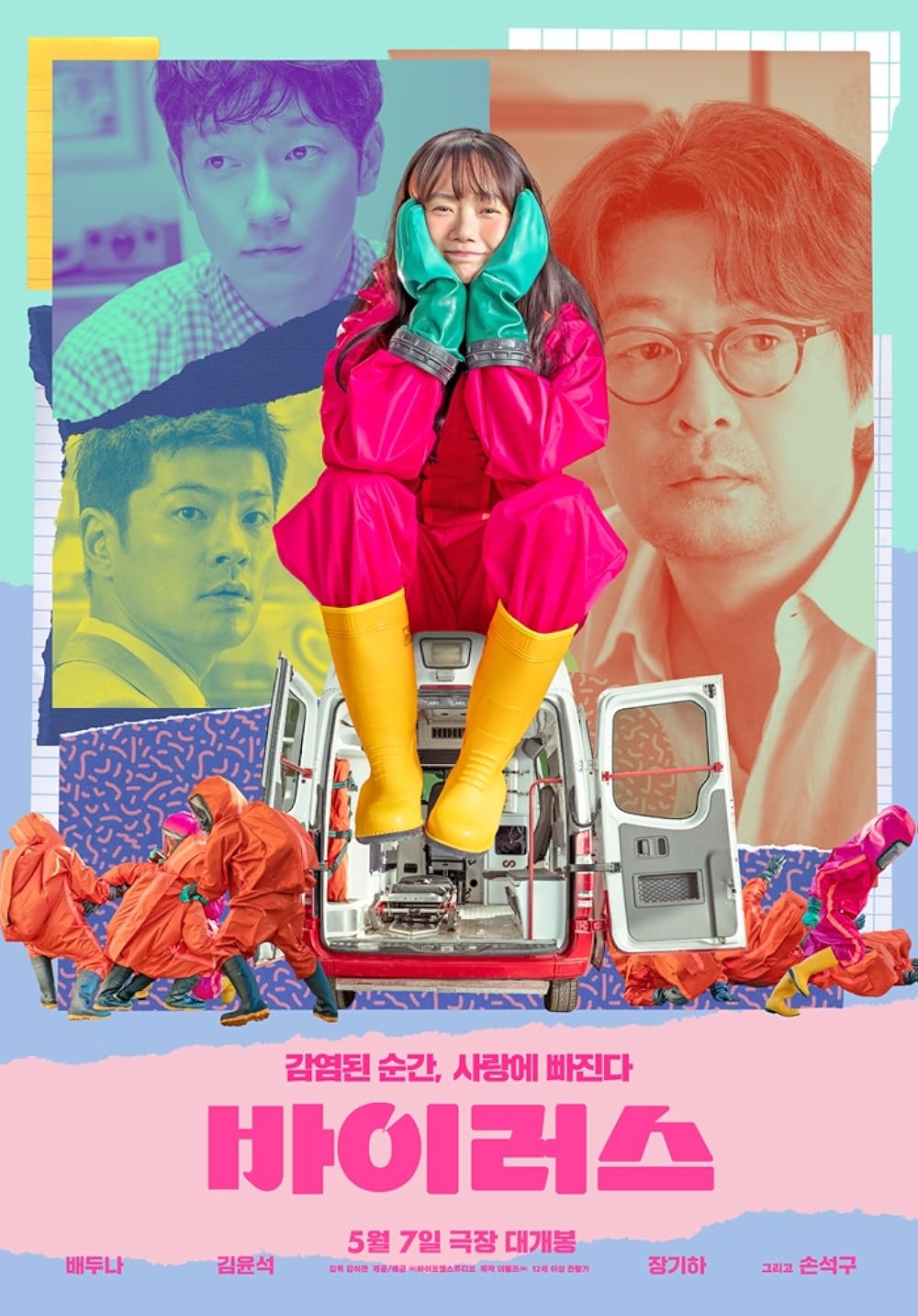
Virus (바이러스, Kang Yi-kwan, 2025)

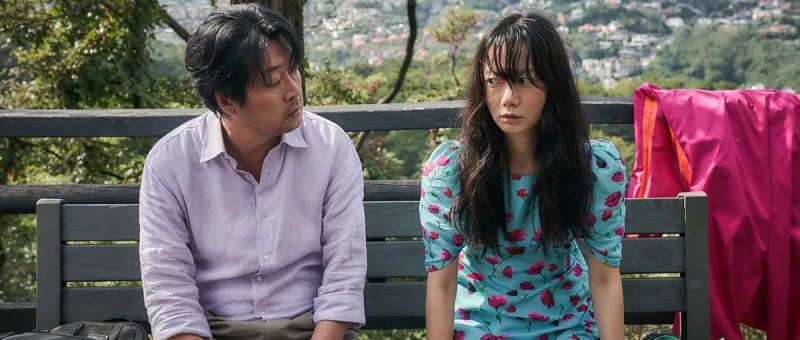
Falling in love is like catching a virus, according to lonely scientist Gyun (Kim Yoon-seok), but how can you know if your feelings are “real” or just part of a crazy fever dream you won’t even remember as soon as the infection leaves your system? “There are no fake feelings,” lovelorn translator Taek-seon (Bae Doona) counters, which is true, but sometimes people do things they don’t recognise or later understand because they weren’t in their right mind, whether because of the sickness called love or a more literal kind of contagion. 

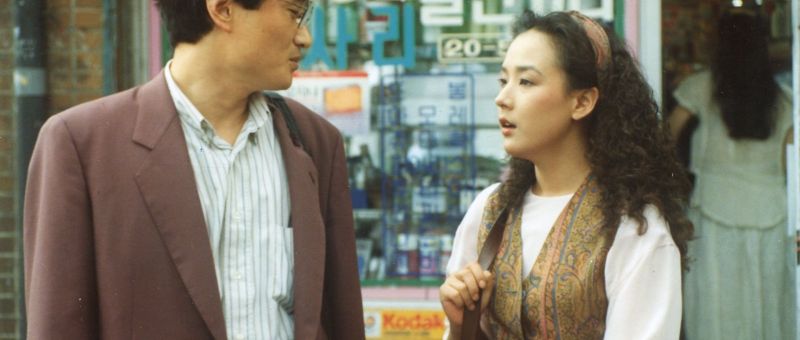
Anyway, this particular virus makes people incredibly happy for the short period time before they die and was developed as part of a project to create an anti-depressant with no side effects. Taek-Seon gets infected after a disastrous date her sister forces her to go on with socially awkward scientist Su-pil (Son Suk-ku). Su-pil is overly attached to the mice in his lab and is still mourning the death of Masako who appeared to him in a dream and told him to make sure her death wasn’t in vain. In retrospect, perhaps these are symptoms of the infection bubbling away in his body as much as they are of his loneliness, but it’s understandable that Taek-seon wasn’t really considering seeing him again only she’s forced into it when her mother and sister invite Taek-seon over to her apartment as a kind of enforced date. The mother and sister’s insistence on Taek-seon meeting someone and getting married is itself a reflection of a patriarchal society in which being unattached is taboo, while Taek-seon’s sister snaps back that translators won’t be needed soon because of AI implying she should find a husband to support her financially.

But then again, though she might claim to be, it does seem that Taek-Seon isn’t all that happy with her life and later confesses to being “always depressed”. She rarely leaves her apartment and lives a dull and unstimulating existence. Infected with the virus, she suddenly becomes sunnier, more confident, and independent, while chasing romance by approaching a childhood crush she seemingly never had the courage to pursue before. Yeon-u (Chang Kiha) is now a car salesman, and Taek-seon now suddenly has the urge to buy a Mini though she’s never actually driven outside the test centre despite having a license. In one sense, yes, it’s Yeon-u she’s after but the car also represents her latent desires for freedom and a more active life. 

Nevertheless, the corrupting aspects of the virus are all too present as Taek-seon begins to act in ways she may be embarrassed by if she could remember them once she’s better. Her memories seem to have remade themselves more to her liking. She’s forgotten that Yeon-u wasn’t quite the hero she thought he was in her overly idealised vision of the innocent childhood sweetheart that she never had the courage to pursue. On the run from “evil” scientists from the lab where Su-pil worked, she starts to fall for Gyun, the expert that’s helping her, but who’s to say whether her feelings are just a product of the virus, an attachment born of their relationship as doctor and patient, or something deeper. 

For his part, Gyun starts to fall in love with her seemingly before he himself is infected while knowing that she likely won’t remember any of this once she’s been cured. He too is still dealing with the romantic fallout of an improperly ended relationship in which he apparently stepped back because one of his friends liked his girlfriend more. The now-divorced girlfriend seems resentful that he didn’t put up more of a fight for her, and perhaps it’s true that he’s just a romantic coward and it’s a combination of the virus, a sense of responsibility, and the fact that Taek-seon’s natural immunity could hold the key to unlocking his own research that pushes him to try so hard to find a cure for her.

But his research goals are at least altruistic in his desire to find a depression cure without side effects to help people like his brother who took his own life. Dr Seong’s (Moon Sung-keun) lab, however, is entirely focussed on profit and protecting its own reputation. They’re mostly interested in Taek-seon because of her usefulness to them and are prepared to endanger her life if necessary. Even Gyun admits he acted unethically in agreeing to bypass animal testing but otherwise draws the line at anything that puts lives additionally at risk. Taek-seon, meanwhile, later signs over her antibodies so they can be used for free worldwide for the good of all. Even after the fever has cooled, the virus does seem to have made her a happier, more outgoing person who has the courage to pursue her dreams rather than living in lonely defeat. Whether her feelings were ”real” or merely part of her “sickness” and if the distinction really matters either way is up for debate, but that’s not to say she might not catch the love bug again from a less compromised position and actively in the driving seat of her own life.


Trailer (Korean subtitles only)
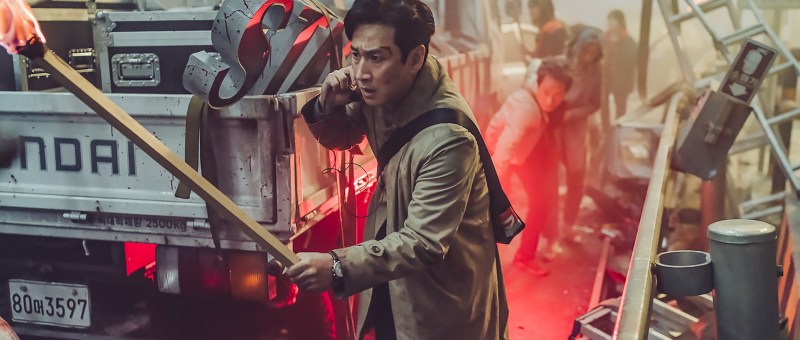
Project Silence (탈출: 프로젝트 사일런스, Kim Tae-gon, 2023)

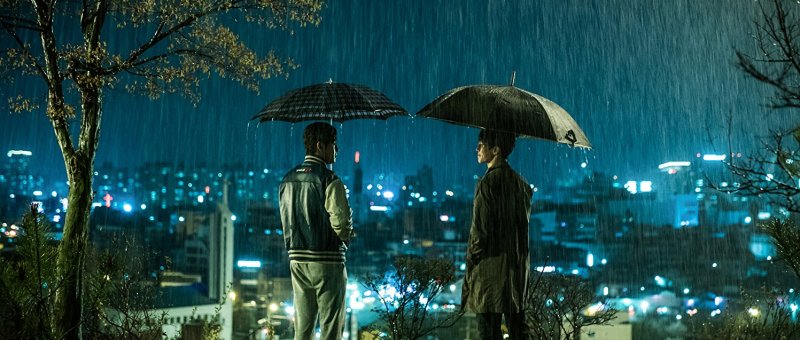
“It’s a nation’s duty to protect its citizens wherever they are,” according to a more earnest politician, though Blue House security advisor Jung-won (Lee Sun-kyun) counters him that actually their duty only extends to those who voted for them, and they expect wise political judgment. Jung-won is a classic political lackey in that he’s intensely cynical and his every living thought is about how best to spin any given circumstances so that his boss, Hyun-baek (Kim Tae-woo), will become Korea’s next president.

There’s something quite remarkable about the extent to which Jung-won has erased himself from this equation and dedicated his life to making Hyun-baek’s a success while otherwise leaving conventional human morality at the door and pursuing a doctrine of doing only that which is most politically expedient. Some of his detachment might be explained by the fact he lost his wife some time ago to a lengthy illness and is about to send his daughter, who views him with contempt, to study abroad in Australia thanks to a few strings pulled by Hyun-baek. 

But as he later says, if Hyun-baek were actually there and seeing this for himself, he would make a different decision. Despite his cynicism, Jung-won eventually becomes a voice of authority during a moment of crisis and determines to set about rescuing the survivors rather than communicating with Hyun-baek about how best to turn this situation to their advantage. Paradoxically, he redeems the government in the eyes of those stranded on a bridge after a multi-car pileup in the middle of a particularly thick fog who come to realise that the authorities are not all that invested in rescuing them and may even be partly responsible for putting them in danger.

The Project Silence of the film’s title turns out to be one of creating genetically enhanced attack dogs who can chase a target with a specific voice. Apparently developed originally by the US and EU, the project is being researched in Korea but rendered a failure with the current batch of dogs set for “disposal”. That is, if they hadn’t been set loose by the accident and the possibly malicious actions of their handler who claims he was researching rescue dogs but was forced to reprogramme them to kill on the orders of the military. As he points out, the leader of the dogs, who has a head injury suggesting their programming has been disrupted, is only taking their revenge for their constant mistreatment at the hands of humans.

Then again, one of the ironies of Project Silence is that there is quite a lot going on from the unusually thick fog, the multi-car pileup caused by a live streamer driving recklessly for views, the toxic gas flowing from a crashed lorry, to the fact the bridge itself may collapse after the military helicopter sent to retrieve the dogs crashes and damages the support cables. All things considered, it is too much all at once considering the outlandishness of the evil dog plot. Though there are an assortment of survivors to become invested in as is usual in these kinds of films, we don’t always get to know them well enough with a series of subplots left unresolved such as the creepy behaviour of a Buffalo Bill-esque trucker who nevertheless becomes a kind of comic relief figure and eventual saviour of the group while becoming a reluctant buddy to Jung-won. Similarly, the dementia of an elderly woman (Ye Soo-jung) is intermittently brought up but never for any real reason nor is it ever fully explored, not even in her relationship with her husband who is responsible for her care. The younger of two bickering sister’s golf career does however turn out to have a practical application.

The conflict between Jung-won and his daughter, meanwhile, is largely mediated through her contempt for his callousness and resentment towards him for failing to address her mother’s death. Of course, saving the passengers is also a way to redeem himself in Kyoung-min’s (Kim Su-an) eyes much like the father in the similarly themed Train to Busan, though the awakening that Jung-won undergoes is more like the fog gradually lifting as he realises he is also being played by political manipulators while it is as he said different if you’re actually there and much harder to make the “sensible” decision to let the bridge collapse and take the potentially embarrassing evidence of their rogue science experiment with it. Perhaps that’s the real meaning of “project silence,” making sure there’s no one left to speak. But Jung-won is used to playing this game from the other side so he’s a few steps ahead and knows his best weapon is noise, tell everyone and do it right away so they don’t have time to shut you down nor can they deny it later. He may have been party to lingering authoritarianism, but has now realised that a nation’s primary duty is to protect its citizens after all, even if they voted for the other guy. 


Project Silence is available in the UK on 4K UHD courtesy of Altitude.

Trailer (English subtitles)

The Road to the Racetrack (경마장 가는 길, Jang Sun-woo, 1991)

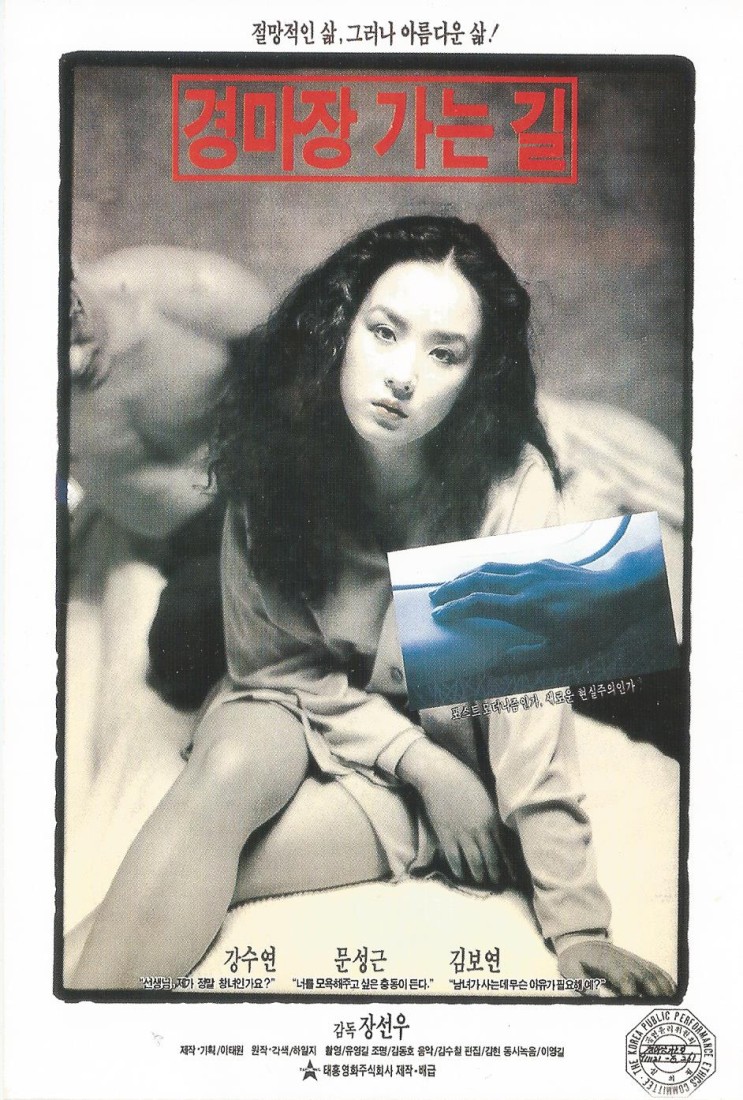
A pompous scholar returning home after five years living abroad in France struggles to adapt himself to a changed Korea in Jang Sun-woo’s literary drama, Road to the Racetrack (경마장 가는 길, Gyeongmajang Ganeun Kil). Hoping to rekindle an affair with a fellow student with whom he lived for three and a half years, the man known only as R (Moon Sung-Keun) finds himself frustrated by the same patriarchal norms which he manipulates in an attempt to dominate and control his former lover while little realising that it is she who truly has the upper hand as he pathetically follows and entreats while begging her to sleep with him. 

J (강수연), as the woman is known, shows little desire to pick up where they left off and roundly refuses to sleep with R who can speak of little else. She tells him that things are different in Korea and hints that the cause of her reluctance is that R is still married and in fact has two children. While J had (seemingly) been content to live with R as his “wife” in France, in Korea she feels a need to be married herself and obviously cannot marry R as his wife will not divorce him. Old-fashioned in her thinking, R’s wife (Kim Bo-yeon) assumes the cause of the discord in their marriage is that she was not a virgin when they married though it seems clear that since obtaining his PhD in France, R has begun to look down on his humble family and no longer wishes to associate with his uneducated spouse. An ironic soap opera scene precedes one of their conversations in which a husband cooly tells his wife that he will do as he pleases and has no intention of granting her a divorce fully highlighting R’s hypocrisy though his own wife is depicted more or less like the one on screen eventually screaming at him and refusing his demands to end their marriage. 

Though R had told his wife that the fact she had lovers before they married is not a factor in his desire for a legal separation, discovering that J has met someone else and is thinking of marrying him sends R into a tailspin of jealously. Badgering J into sex, he is ultimately unable to perform and complains that the “shadow” of the other man is putting him off his stride. He demands that she makes a choice and encourages her to tell her new man all about their time in France whereupon he might like R abruptly dump her for being an impure woman. Meanwhile, R complains that she’s treating him “like a rapist”, which is ironic because that is exactly how he is behaving. She cries and refuses, asking him if they “really have to” and still he pushes on violently pulling at her clothes until she gives in. He can’t seem to understand why it’s “different in Korea” when they lived together for three years in France, as if a single instance of consent has eternal permanence. 

J always returns to him if for unclear reasons in the increasing toxicity of their relationship. She addresses him as “doctor”, while he repeatedly insults her and calls her stupid, mocks her middle-class background in an attempt to deflect the class difference between them, implies she’s useless without him and that all her achievements are really his own. He claims to have written her PhD thesis for her, and is irritated that she’s had some success since returning to Korea having completed her studies a year before him. He reads an essay she’s written and while he may have a point about an ambiguous turn of phrase, further insults her by claiming that the only good bits are the bits she ripped from an old essay of his, but is clearly annoyed that she’s managed to get an essay published after showing it to another man who further edited it for her. Suddenly he explodes in rage and claims he feels exploited, insisting that J pay him monetary compensation for his emotional pain. 

The relationship only begins to work again once it becomes transactional perhaps hinting at a societal change in an increasingly capitalistic society. As J is unable to pay the sum he asked for, R insists she work off the amount by becoming his personal prostitute. Though effectively constrained by his wife’s refusal to divorce him, he thinks that he controls J and is reasserting his patriarchal authority. But then he is clearly the one in thrall to J following her around and refusing to let her go while her decision to continue meeting with him seems like it may partly be born of fear and a sense of inadequacy if also a delight in wielding her power. His contribution to J’s PhD leaves her feeling underconfident and a fraud, fearing he’s right and she’s not much of a scholar just a girl with rich parents who could send her France to study. But she’s also tied to him in service to outdated patriarchal social codes that were not in play in France in which he is both husband and not. When he strikes her, she immediately apologises.

The contrast between the two cultures is clear on R’s arrival as he wonders at the thousands of neon crosses that now colour the nighttime skyline of Seoul, remarking that’s as if he’d found himself in a European war cemetery. Both he and J seem to be adrift in a new society, aimless and with no particular place to go. Hoping to rekindle their love, R tries to force J to go abroad again but she refuses and declines to give an explanation. Incredibly frank in its sexual language, the file presents an otherwise bleak view of the toxic relationship between the former lovers who inhabit a series of seedy motels and are seemingly unable to escape the destructive cycle of their love while the pompous hero can only comment on his inability to orient himself in a changing city by recording the number of steps from each direction to the racetrack as if trying to reassure himself of the geographical integrity of the landscape of his memory.


The Road to the Racetrack screened as part of this year’s London Korean Film Festival.

A Single Spark (아름다운 청년 전태일, Park Kwang-su, 1995)

In the present day, South Korea has become a prosperous society and leading world economy, but the miracle of its modernisation came at a heavy price. Socially committed filmmaker Park Kwang-su’s A Single Spark (아름다운 청년 전태일, Areumdaun cheongnyeon Jeon Tae-il) takes a trip back to the “truly dark days” of the Park Chung-hee dictatorship to expose the exploitation on which the modern society was, and in fact still is, founded, enabled largely by the wilful misuse of a fear of “communism” as manifested in the problematic presence of threat from “the North”.

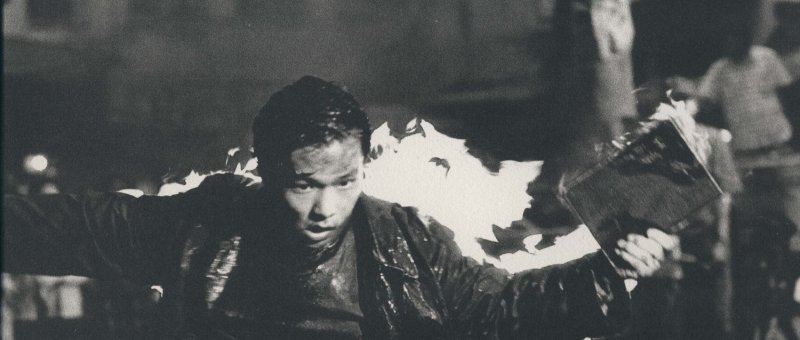
Park filters his true life tale through the figure of a fictionalised author and activist, Kim (Moon Sung-Keun), who finds himself on the run from the authorities in 1975. Hiding out in a small town in a backroom rented by his pregnant factory worker girlfriend Jung-soon (Kim Sunjae), Kim is working on a biography of a labour rights activist, Jeon Tae-il, who self-immolated in order to protest the failure to properly enforce existing workers’ rights five years’ earlier in 1970.

Switching to crisp black and white, Park paints a bleak picture of working class life in the late 1960s as the oppressive Park Chung-hee regime imposed extreme export goals designed to boost the local economy. We first meet Jeon (Hong Kyeong-in), who was only 22 at the time of his death, selling umbrellas on the street before he is “lucky” enough to get a job in a tailoring factory. Committing himself to working hard and getting on, he is quickly disillusioned with conditions at the plant which has little light or ventilation and often forces its employees to work through the night without adequate breaks for food. When the young woman next to him begins vomiting blood and is sent home but subsequently fired, Jeon becomes radicalised. Told that there are no laws which protect workers, he is surprised to discover that there are but their existence has been wilfully kept from him. The law is written in a language which is almost impossible for him to understand, in highly formal text using Chinese characters which most ordinary Koreans, never mind those like Jeon denied a proper education, struggle to read.

Jeon begins agitating. He takes a copy of the statutes and a series of violations at the factory to those in charge, but no one is interested. Even when he convinces some of the other workers to come with him, the boss is eventually forced to make a token concession of listening to them but ultimately rolls his eyes and says it’s all very well but not good for business. Jeon isn’t asking for anything radical (save the later addition of provision for menstrual leave), only for better ventilation and for the existing laws to be obeyed.

Meanwhile, Kim meditates on his legacy in the dark days of 1975 where anti-communist sentiment runs high in the wake of the end of the Vietnam War. “Anti-communism” and the demonisation of the North were a central part of Park Chung-hee’s right-wing, nationalist military dictatorship and any attempts to form things like unions or left-leaning political associations were quickly decried as “communist”. Kim’s girlfriend Jung-soon is currently involved in trying to set up a union at her factory to combat many of the same kinds of issues that Jeon was fighting five years’ earlier, but she too is under a lot of pressure. Afraid of the authorities and of losing their jobs, many workers refuse to join and even after she reaches her quota the request for recognition is denied. She and the other activists are harassed by factory management beginning with a “friendly” meeting outside her home in which they try to bribe her with money and expensive fruits, and ending with a raid on the building in which some of the workers are holding a protest during which a woman falls ill and the others are badly beaten when they try to get her to a hospital.

Jeon and the others are lectured by management that they should try to feel more “patriotic” and be willing to suffer in order to raise the economy, bribed with false promises that they’ll all be driving luxury cars in 10 years’ time. Meanwhile, a woman coming to collect money from Jeon’s mother angrily exclaims that debtors should take rat poison and die (which seems counterproductive when they owe you money), and the managers dismiss workers’ concerns with the rationale that they obviously “aren’t hungry enough” to put up with starvation wages and poor working conditions. From the vantage point of 1975, Kim meditates on Jeon’s sacrifice as he witnesses the suicide of another young man, Kim Sang-jin – a student who quoted Thomas Jefferson’s words that democracy is an outcome of struggle at a rally at Seoul National University before publicly slashing his belly. He sees the tragedy of Jeon’s death as the “single spark” which lit a fire under the democracy movement, a torch he wants to pick up and keep aflame to guide them towards a better future.

20 years later, Park may be acknowledging that some battles have been won in a newly democratised Korea as Kim looks on with satisfaction in a peaceful marketplace while a student carries the book he has written about Jeon Tae-il under his arm, but implicitly suggests that not enough has changed and the same battles Jeon was fighting are still being fought. A melancholy meditation on political martyrdom, art, and legacy, A Single Spark pays tribute to those who gave their lives for a fairer world but is equally intent that their sacrifice must not be forgotten.


A Single Spark was screened as part of the 2019 London Korean Film Festival.

Black Republic (그들도 우리처럼, Park Kwang-su, 1990)

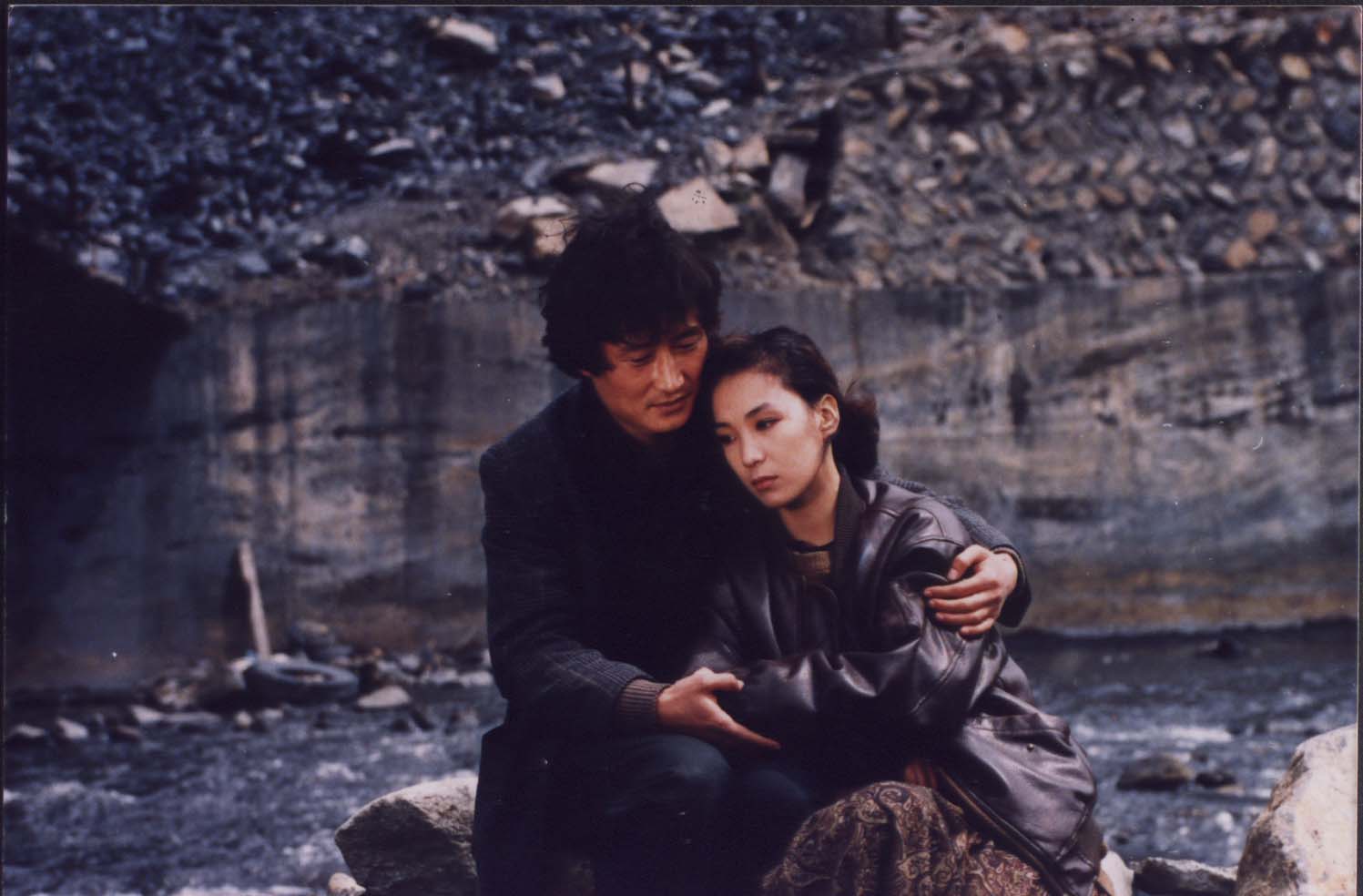
Black Republic still 1In the Korea of 1990, a revolution had been fought, won, and then betrayed by its people. Successfully petitioning for democracy, the newly minted Korean electorate went ahead and voted for the chosen successor of the dictator they’d just spent so long trying to oust. Change comes slow, but it comes even if not quite the way you wanted it. Park Kwang-su’s first film Chilsu and Mansu, released in 1988 and set in the contemporary Seoul running to catch up to its Olympic aspirations, had made its own quiet protest about a hypocritical society’s rising social inequality. His follow up, Black Republic (그들도 우리처럼, Keduldo Urichurum), takes a journey back in time while keeping one foot in the present to show us a nation engulfed by a darkness that crushes love, dreams, and possibility all while dangling the shining hope of a better future that seems impossibly far away.

Tae-hun (Moon Sung-keun), a student protestor wanted by the police, heads into the mountains under an assumed name hoping to get a job in a mine. However, this is a period of intense economic volatility and the mining industry is collapsing. When his attempts to find work as a miner fail, Tae-hun (going under the name Gi-yeong) overhears a conversation in a cafe and manages to get a job in a local briquette factory.

Park opens in darkness as Tae-hun makes a phone call to his mother in which he never speaks and she reassures him that everything will be OK while the sound of a train gradually gathers in the background. When Tae-hun arrives at his destination, he finds himself in a barren, blackened land where everything is quite literally falling apart. The mines are closing and the landscape, desolate as it is, is peppered with derelict buildings and the modest, makeshift homes of the rural poor at the constant mercy of their greedy masters. As a newcomer, Tae-hun is not privy to the town’s secrets, but quickly comes to understand that though he may have escaped Seoul, the struggle is inescapable, because the struggle is Korea. The owner of the briquette factory is also some kind of loanshark involved in a suspiciously close arrangement with the local mine owner who is in the middle of a labour dispute with the miners who are petitioning for fair pay and better conditions. Haunted by the memories of his protest days, Tae-hun finds himself looking on at another candlelight procession calling for workers rights but rendered impotent, forced to remain silent or risk attracting the attention of the police.

Meanwhile, Tae-hun’s silence sees him unwittingly pulled into the orbit of those he would usually oppose. Seong-cheol (Park Joong-hoon), the illegitimate son of the factory boss, takes his own sense of crushing impossibility out on the entire town. Technically the “vice-president” of the factory, Seong-cheol is a sometime enforcer for his father’s greedy loan sharking business and thinks nothing of striding in and helping himself to the petty cash to spend on women and booze while gazing at the photo of his long absent mother. An invitation to dine with Seong-cheol and pals brings Tae-hun into contact with melancholy sex worker Yeong-sook (Shim Hye-Jin) who begins to fall for him when he skips out on her after Seong-cheol has pulled one of his usual tricks in giving her away in an attempt to buy friendship through influence.

Like Tae-hun, Yeong-sook is also trapped, running, and living under an assumed identity. Through her exposure to Tae-hun who is, after all, so different from the other men in the mountains, she begins to rediscover a sense of hope and possibility. Yeong-sook quits the illegal part of her job as a “coffee girl” and deepens her bond with Tae-hun through nursing him after he is arrested and beaten by the police who seem to harbour an innate suspicion towards him despite little evidence, but their love will require another act of faith and flight and the world in which they live may not let them to escape.

Everyone here is trapped, lying to themselves or others, wishing things were different than they are but has long since given up the hope they ever could be. While Tae-hun attempts to ride out the storm by burying his head in the coal dust, feeling it fill his lungs, struggling to breathe, Seong-cheol opposes his order with chaos, laying waste to half the town in a self destructive venting of his rage and resentment towards his selfish, unfeeling father, and a society he feels has already rejected him. Impossibility and hopelessness are the defining qualities of this world of corruption and exploitation in which there can be no escape or salvation, only crushing futility. Park closes with an ironic coda of swapped fates and tragic promise which places Tae-hun right where he was when we first met him, defeated by hope but still in motion, if for an uncertain direction.


Black Republic was screened as part of the Korean Cultural Centre’s Korean Film Nights 2018: Rebels With a Cause screening series. It is also available to stream online via the Korean Film Archive’s YouTube Channel.

Forgotten (기억의 밤, Jang Hang-jun, 2017)

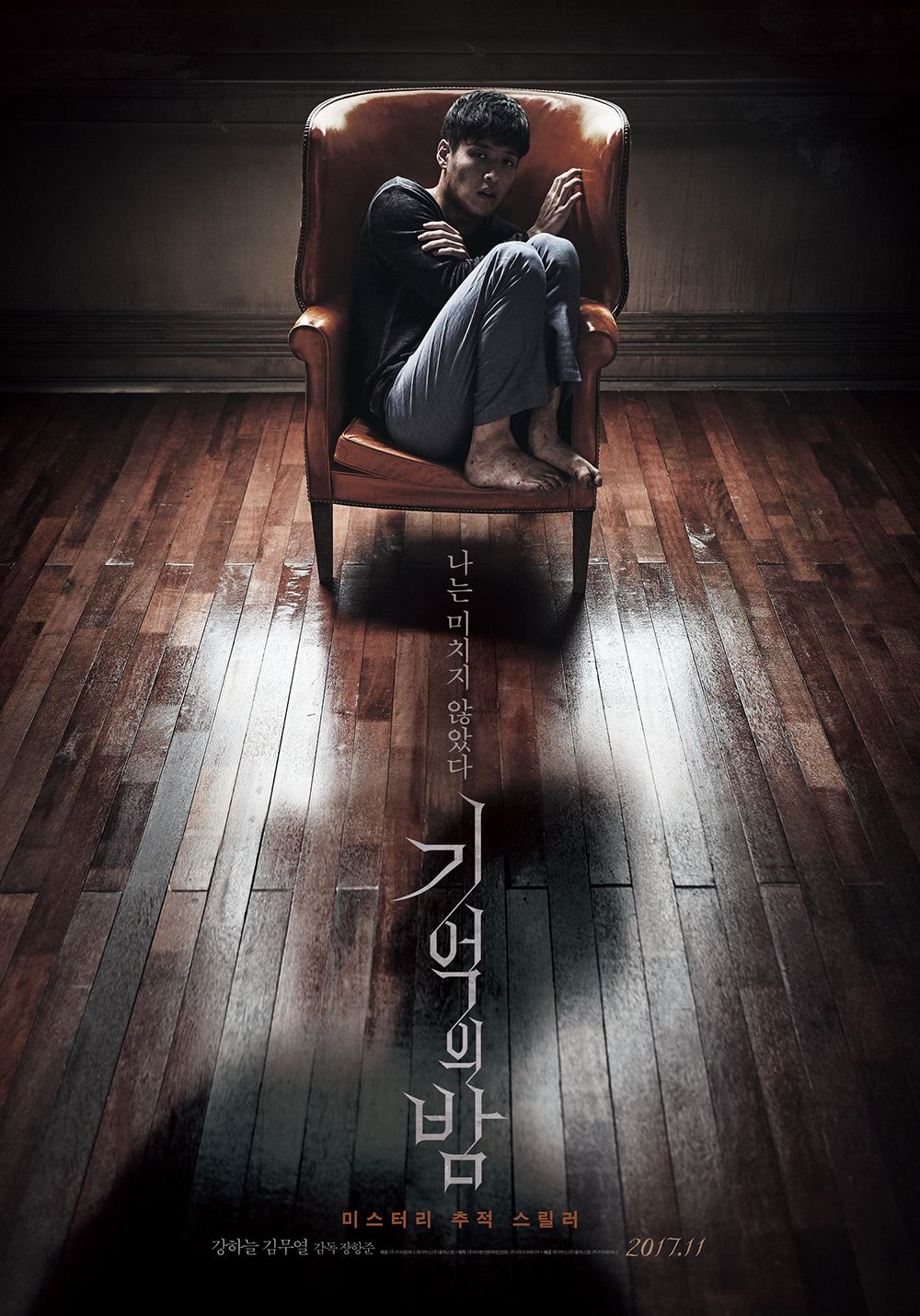
forgotten posterEver wondered if you’re living in a simulacrum? Strangely, the thought isn’t one which occurs to the hero of Jang Hang-jun’s Forgotten (기억의 밤, Gieokui Bam) despite his sense of déjà vu and the uncanny eeriness of his world. Then again, perhaps that’s because he is wilfully complicit in his own life lie, afraid to open the door and confront the ghosts trapped inside his psyche seemingly desperate get out. A tense psychological thriller, Forgotten is also a symbolist drama in which Jin-seok, a man literally trapped in the past, is forced to free himself from a locked room mystery only to discover his own dark truths.

Following some distressed sounds from someone who claims not to be able to remember whatever it is they’re being interrogated about, we find a young man, Jin-seok (Kang Ha-neul), peacefully asleep on his mother’s shoulder as his family drive to their new home. Jin-seok is an anxious young man under a lot of stress studying to retake university exams while his brother, Yoo-seok (Kim Mu-yeol), is the archetypal good Korean son. He is handsome (if a little geeky looking), clever, good at sports, patient and kind. In short Yoo-seok is everyone’s hero, not least his little brother’s, while Jin-seok is a nervous wreck who rarely leaves the house and makes sure to have his discman with him when he does to block out the noise and fury of city life. According to the prominently displayed calendar, it is May 1997.

Things start to go awry when Jin-seok finds out that the house’s previous owner has left some property in the upstairs room which he will collect at a later date. The family aren’t supposed to go in there ’til he does and so the brothers will be sharing a room. Jin-seok is however fascinated by the locked door and the strange noises he thinks he can hear coming from upstairs. Things go from bad to worse when Jin-seok witnesses Yoo-seok being kidnapped in the street only to return 19 days later with no memory of where he’s been. Little by little, Jin-seok comes to doubt that the man who has returned is really his brother, but if he isn’t, then who is he and why is any of this happening?

Like all good gothic mysteries, the first problem is Jin-seok’s supposedly fragile mental state. His family repeatedly check he’s taking his medication and take care to ensure his life is as stress free as possible, apparently afraid that he will relapse into some kind of breakdown the cause of which may be partly the reason that the family has moved to a quieter area. Thus neither he nor we can be sure if everything he experiences is real, a product of his strained mind, or a problem with his medication.

Wedded to this story is the coded past of Korea in 1997 struck by the Asian economic crisis which, the film seems to say, provoked a kind of paranoid madness generalised across society. In this difficult climate in which jobs were scarce and even those in professional occupations faced a significant drop in living standards, extreme solutions began to seem attractive. A young woman and her daughter are murdered and the killer never caught, a little boy orphaned and abandoned by his relatives who keep his family’s money for themselves, a young man resolves to commit a terrible transgression in the hope of saving a loved one, and all because of a tragic accident and some random numbers on a screen. 

Jang Hang-jun turns the relatively low budget to his advantage in creating a world of intense uncanniness, somehow realer than real but never quite right. Gradually peeling back the layers of Jin-seok’s existence to expose the wires below, Jang’s artistry becomes apparent as the world comes into focus albeit presenting a different kind of mystery. Anchored by the impressive performance of a deglammed Kang Ha-neul, Forgotten is as bleak a tragedy as they come. The truth may set one free, but not quite in the way the saying implies and there are some things with which is it impossible to live. The unseen legacy of a traumatic era sends its invisible shockwaves through the present and out into the future, and perhaps the only way to survive them is to avoid opening the door.


Streaming worldwide via Netflix.

Original trailer (no subtitles)

Green Fish (초록 물고기, Lee Chang-dong, 1997)

Green Fish poster

You can never go home again. Lee Chang-dong’s debut, Green Fish (초록 물고기, Chorok Mulgogi), is as much a chronicle of his rapidly modernising nation’s gradual loss of innocence as it is that of its melancholy hero, Makdong (Han Suk-kyu), whose simple dream of family harmony is destroyed by the forces of desire and oppression. Perpetually someone’s little brother, Makdong struggles but finds no schoolyard protectors in his ongoing quest for leadership and direction from someone or something external to himself. All he finds is a gradual descent into darkness and criminality in which misplaced loyalties eventually carry the heaviest of penalties.

Returning home from his mandatory military service, still dressed in his warm weather combats, Makdong inhales a taste of freedom by hanging out of the open train doorway. He notices a woman doing the same thing a few doors down. Her red scarf floats away on the breeze and hits Makdong in the face. Later he notices the same woman being hassled by a gang of louts and decides to intervene. Despite his military uniform, Makdong is no great warrior and he’s quickly beaten up and humiliated, retreating to the bathroom where he soaks the woman’s scarf in water and puts it over his bloodied face, inhaling her scent through the fabric as it somehow expresses his otherwise repressed scream.

Vowing revenge for his humiliation Makdong jumps off the train and attacks the louts with a heavy stone trophy, but he mistimes his attack and ends up running after the departing carriages before being forced to abandon all hope of catching up and concentrate on evading the louts who are once again on his tail. On his arrival home, Makdong discovers nothing is as he left it. His family is scattered – father dead, mother going mad, one brother married and a policeman though apparently also a drunk, other brother a wideboy punk, little sister working as a hostess, where there were fields now there are apartment blocks as far as the eye can see, only his older brother with developmental disabilities remains the same. Unable to find work, Makdong chases the scent of the woman on the train, eventually encountering her in the city. Miae (Shim Hye-jin) is a nightclub singer involved with petty gangster Bae Tae-gon (Moon Sung-keun). Remaining close to her, Makdong finds himself drawn ever further into Maie’s self destructive spiral of desire and darkness.

Makdong, whose name literally means “youngest sibling”, is perpetually looking for a family. Turned away from the chaos of his childhood home, he looks for it in the traditional place of the dispossessed male – the gang. Desperate to prove himself and be accepted, Makdong is willing to undergo any kind of pain and humiliation. Given his first job, he sings a snatch of the karaoke song playing in the bar about a prodigal son who disappoints his parents, looks himself in the mirror then hesitates before slamming the stall door shut across his fingers, leaving them swollen and bloodied. He then picks a fight with a rival gangster to give Bae Tae-gon an excuse to settle a score. Bae, solicitous, expresses irritation with Makdong’s act of self-harm but also gives him a leg up into the organisation, something which does not prove universally popular with the already established crew.

Bae’s decision to make Makdong his latest “little brother” (a sort of pun on his name and Bae’s position as the gang’s “big brother”), is mirrored in Bae’s own turbulent relationship with his superior/rival, Yang-gil (Myung Gye-nam). Yang-gil, setting up shop right across from Bae’s establishment, describes Bae disparagingly as a scrappy puppy dog biting at his master’s heels. Much as he feels humiliated by Yang-gil’s authoritative disdain, he refuses to move against him, ordering his guys to back off even though it makes him look weak and diminishes him in the eyes of his followers. Just as Makdong has placed his faith in Bae, Bae’s is already installed in Yang-gil, something which Makdong tragically fails to understand.

Makdong’s loyalty to Bae also presents a conflict in his desire for Miae. A much stereotyped gangster’s moll, Miae is the melancholy nightclub singer familiar from classic noir. Her world is just as ruined and broken as Makdong’s. She wants to leave Bae and his life of violent chaos in which she’s often pimped out to serve his interests, but she’s looking for someone to help her, just as Makdong is looking for someone to defend him. A long train journey brings the pair together in a moment of innocent tenderness, but presented with a choice Makdong choses Bae and his new world of male chivalry over his original act of white knight rescue which brought him to Miae’s attention in the first place. Later he makes another, more final choice, burning Miae’s scarf which he’d been carrying like a talisman all along. The flames reflected in his sunglasses give him eyes of fire, but behind the frames there are tears too as he bids goodbye to one dream in the mistaken belief of buying himself another.

Facing his end, Makdong rings home and reminisces about a story of idealised childhood innocence in which he spent a day at the river with his siblings, trying to catch the green fish of the title from under a railway bridge. Earlier on the family had another picnic in a similar spot which quickly degenerated into a chaotic family spat with the trains passing ominously behind them. The world that Makdong wants is already fading, he is, in some sense, already its ghost and the future has no place for him. His dreams were small – a modest family restaurant, and a return to the warmth and security he felt as a child surrounded by unconditional love. His family, however, no longer support him, he is alone and unloved. The world has moved past him like a train leaving the station, Makdong runs but he can’t catch up. The future belongs to those who can move fast enough to adapt to the new reality of modern Korean life, not to old romantics like Makdong who still believe in archaic ideals of family and brotherhood. Yet, there is something of that old world remaining in the posthumous fulfilment of Makdong’s only wish, even if he himself is not permitted to witness it.


Screened at London Korean Film Festival 2017.

Cabaret scene (no subtitles)