Frosted Window (흐린 창문 너머의 누군가, Kim Jong-kwan, 2025)

The title Frosted Window (흐린 창문 너머의 누군가, heulin changmun neomeoui nugunga) refers to the film’s final segment, a meta meditation on grief and loss, but, on the other hand, it’s true enough that we sometimes look at the world through a blurred lens and meet each other through an imperfect abstraction. A three-part portmanteau film, each of the segments takes place in a different season, with the opening titles perhaps standing in for an otherwise unseen spring, and reflect the director’s flights of fancy in imagining the lives of those living in the quiet backstreets of Seochon in Seoul, which is known for its literary associations and historical architecture.

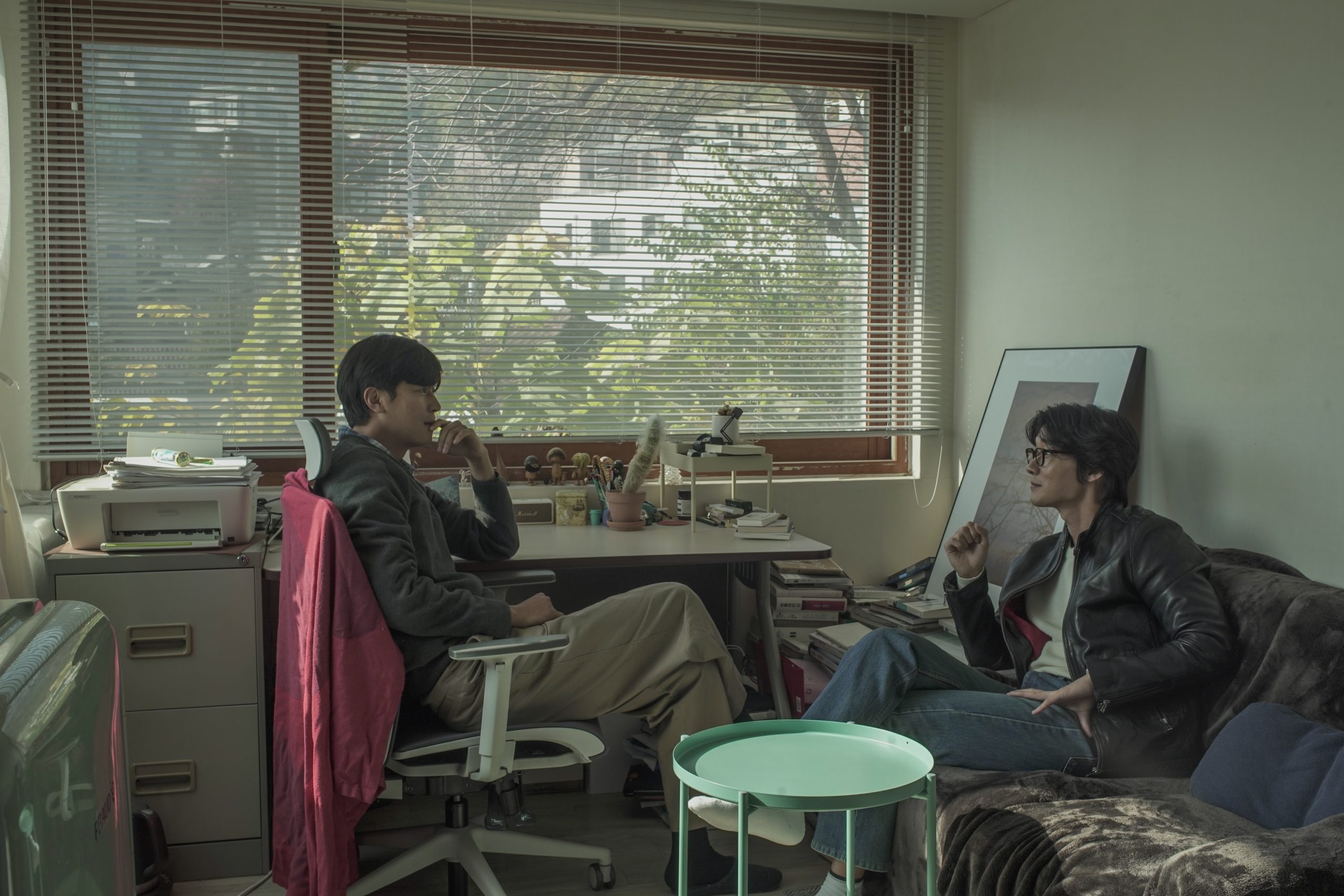
It may be its maze-like quality that gives rise to so many differing tales, but in the first segment, at least, it stands in as another place as a lovelorn artist tries to pick up various women by bothering them while they are minding their own business in public places. The first is in a German coffee shop, where he speaks to a woman in English assuming her to be a foreigner because she has international vibes and is reading a book in German, but she is actually Korean, if having lived abroad for many years, which is awkward. Nevertheless, he carries on trying to chat her up while she tolerates him. Eventually he gets the message and leaves, trying to pick up another foreign woman in the street before backing off when she’s joined by a foreign man. The artist seems to a romantic who finds inspiration in these quests for love and advises his friend, a blocked writer, to go for a walk in search of romance in order to reawaken his creativity.

But a man who is also a blocked writer played by the same actor turns up in the second part where he is both an observer and an object. A woman calls a man to an upscale bar and drinks expensive whisky with him. The man is clearly interested in her, though he has a girlfriend he’s become tired of but won’t break up with, but she seems uninterested in him even as she continues to behave flirtatiously. There’s obviously something else going on, but it’s not originally clear if she wanted to toy with him a while, is making fun of him by exploiting his attraction to her to get him to make a fool of himself (to which he gladly obliges), or has something against his unseen girlfriend, on whom this is all very unfair no matter which way you look at it. It is, however, a performance for the barman, who watches silently until the woman comes back later to ask him what he thought.

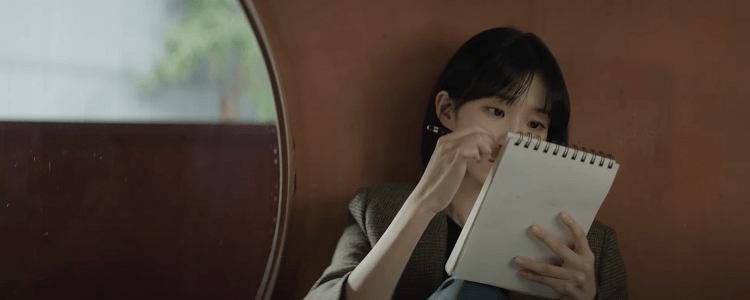
The woman, a local beautician, along with another from the florist’s who reunites with the artist in the October-set first tale, reappear in the last one echoing the sense of a fictional world that begins to take over as one story gives way to another. This time we have two artists, an actress who has been taking some time out, and a female film director she has worked with previously, who meet by chance in a cafe of which this area seems to have a lot considering its size. As the director outlines the story, we see the actress playing her role blurring the lines between the layers of “reality” present in this segment and the film as a whole. We have been, in some ways, like the barman passive observers with each of these tales performed for our benefit, but this last meta segment allows the actress to begin processing the weight of a loss which may be her own.

She is saved, in a way, by the friendly atmosphere of Seochon and the kindness of strangers that restore her sense of self-worth, both as an actress and person. The actress tells the director that though she had taken only a small break, people had already forgotten her and so her return to acting has been more difficult than anticipated with no offers of major roles, only smallish, walk-on parts. The encounter with a fan shows her that she had been missed and there are those who are waiting to see her again on screen, so her life and career had not been pointless and there is a path forward for her in the wake of her loss. This is perhaps testament to the frosty window of Seochon, home to a thousand stories, and a gentle warmth that seems to emanate even in the depths of winter. 


Frosted Window screened as part of this year’s London Korean Film Festival.

Trailer (English subtitles)

The Old Woman with the Knife (파과, Min Kyu-dong, 2025)

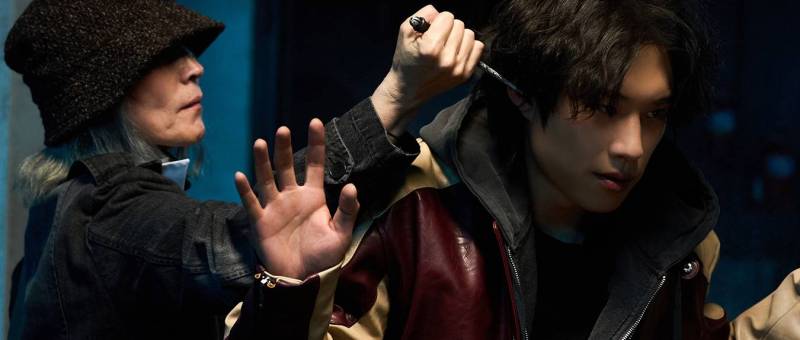
There’s an acute vulnerability that comes with ageing. It’s not vanity or mortality so much as your body betraying you as even once simple tasks become increasingly more difficult. When you’re an assassin, a loss of speed or dexterity is cause for concern and Hornclaw (Lee Hye-young) is beginning to feel her age. Her hands have begun to shake uncontrollably and as she admits to a stray dog she finds herself taking in, you forget things when you’re old. There are those in the office who have begun to notice that Hornclaw is not quite as she was and view her as a thorn in their side, a relic of an earlier era preventing them from moving on into a hyper-capitalistic future.

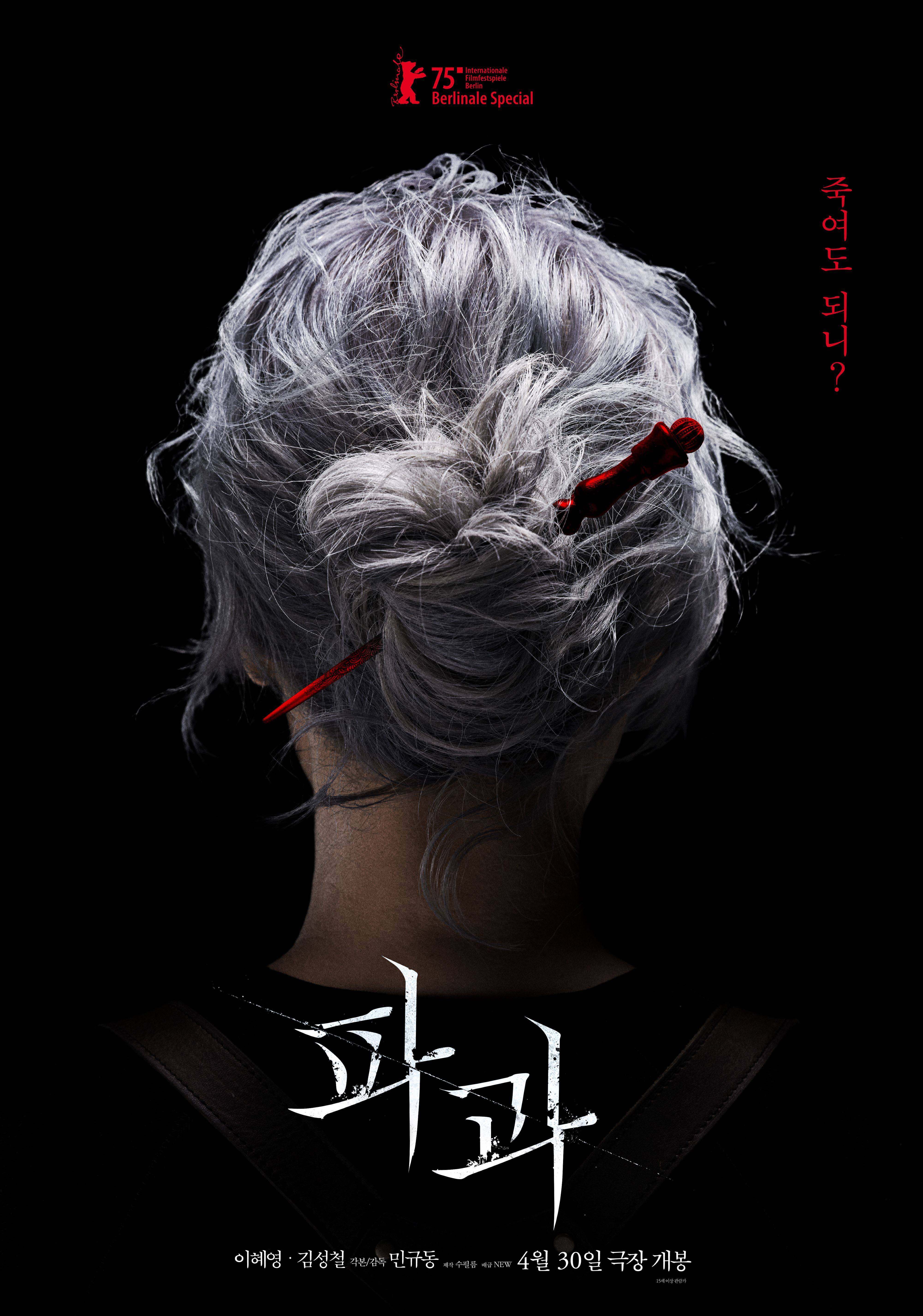
The original Korean title of Min Kyu-dong’s The Old Woman with the Knife (파과 Pagwa) is “bruised fruit”. An old woman working at a greengrocers throws in an extra peach for free because it’s damaged and people won’t buy them, which is silly, in her view, because they’re the best ones and always taste the sweetest. On that level, the film is about ageism and the ways older people are often written off as past their prime, but on another also about Hornclaw’s bruised but not quite buried heart and the hidden empathy that defines her life even as a contract killer. It may also in its way refer to her opposite number, Bullfight (Kim Sung-cheol), a hotshot young assassin recruited by her less ethically minded boss Sohn (Kim Kang-woo) who despite his sadistic cruelty is really just a hurt little boy looking for a maternal figure in the legend that surrounds Hornclaw. 

She was a stray dog herself until someone took her in and gave her a home, much as Bullfight is now looking for a place to belong. Hornclaw comes to identify with the dog she rescues, Braveheart, because as the vet says it’s awful to be abandoned when you’re old and sick, but perhaps also when you’re young and lonely. As her mentor taught her, having something to protect also makes you vulnerable while as you age the people you’ve lost return. Like her underling Gadget who sees visions of his late daughter, Hornclaw too is drawn back towards the past in seeing echoes of Ryu (Kim Mu-yeol), the man who saved her, in altruistic vet Dr Kang (Yeon Woo-jin).

There may be something disingenuous in the insistence that each of us must save the world coming from a band of supposedly ethical hitmen who only knock off “bugs” that are actively harmful for society. After all, who is making those decisions as to what constitutes “harmfulness”? Everyone Hornclaw takes out is indeed morally indefensible, but as she cautions Bullfight, when you start seeing people as insects you become an insect yourself. Sohn wants to reform the agency to take on more lucrative contract killing jobs such as taking out a wealthy man whose only crime appears to be being a cheating louse, while Hornclaw insists on sticking to their principles and only carrying out missions of justice which are the cases Sohn keeps turning down like that of a religious leader who has been abusing his followers. 

The vision of Hornclaw as a resentful avenger echoes that of Meiko Kaji in the Female Prisoner Scorpion series. Often caught in silhouette, she too wears a wide-brimmed hat that hides her eyes and aids anonymity, while she at one point gives her real name as “Seol-hwa” which means “snow flower” and hints at Lady Snowblood but also to her own moment of rebirth after being discovered half-dead in the snow and rescued by Ryu who gave her a purpose and sense of self-worth, not to mention a home. The irony is that Hornclaw ends up creating a monster because of her own repressed emotionality and is then unable to understand why this figure from the past has returned to her because her way of seeing the world only allows her to interpret it in terms of vengeance.

But what her new mission tells her is that having something to protect is in many ways the point and the very thing that gives her an edge over those who have nothing left to lose. Wresting back control over the agency, she vows to continue their mission as it’s always been rather than allow Sohn’s amoral capitalism to win out over justice and righteousness. Truth be told, the superhuman quality of Hornclaw’s movements is slightly at odds with the otherwise realistic tone of the rest of the film in which, as the secretary puts it, the weight of all the years is beginning to take its toll. But ironically it’s in closing her escape route that she finds true liberation in putting her ideas into practice in a more direct way while opening herself up to the world around her. There’s still life in the woman with the knife yet, and there are still plenty of bad guys out there along with a stack of files in need of attention, which is all to say retirement is going to have to wait.


International trailer (English subtitles)

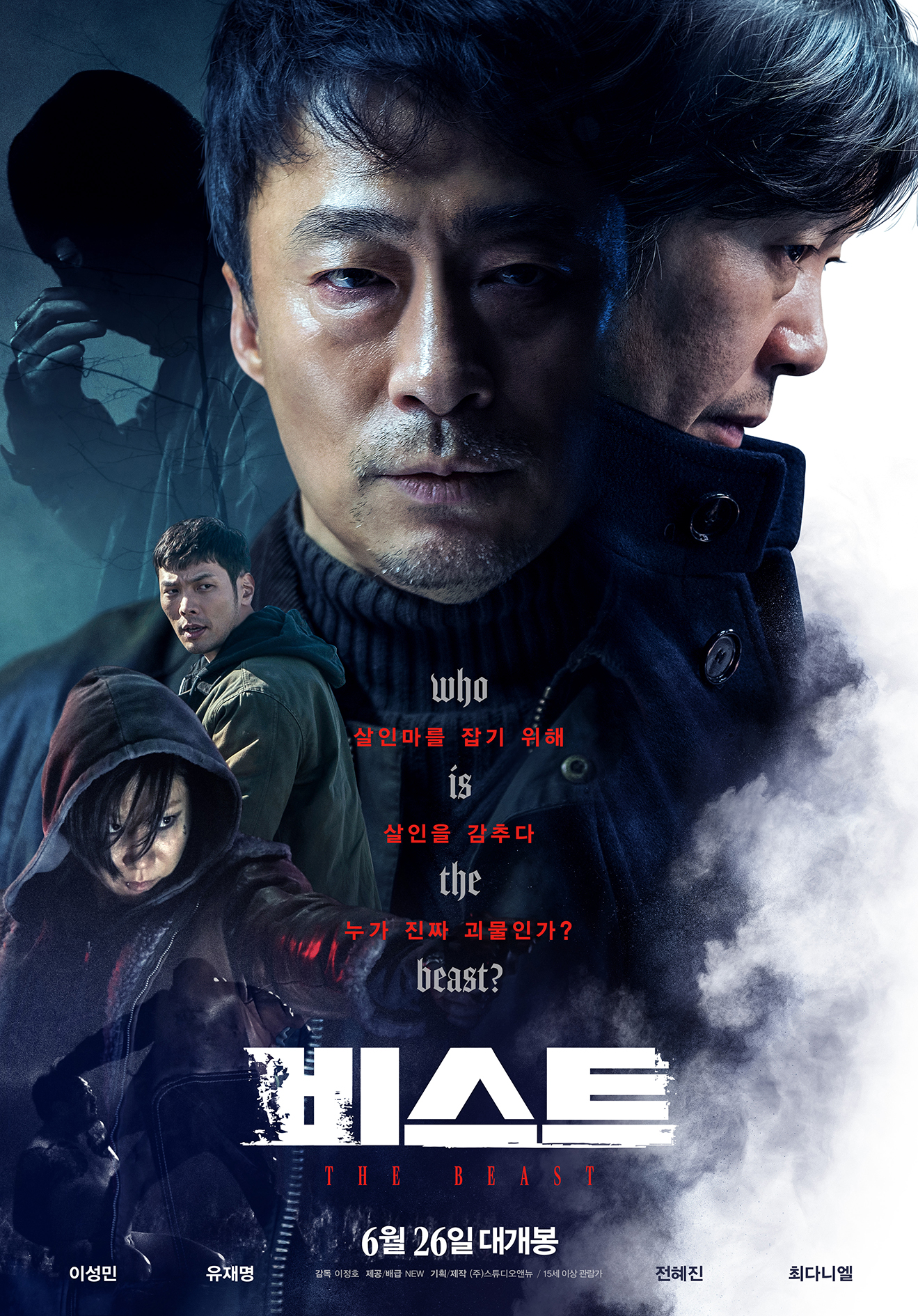
The Beast (비스트, Lee Jung-ho, 2019)

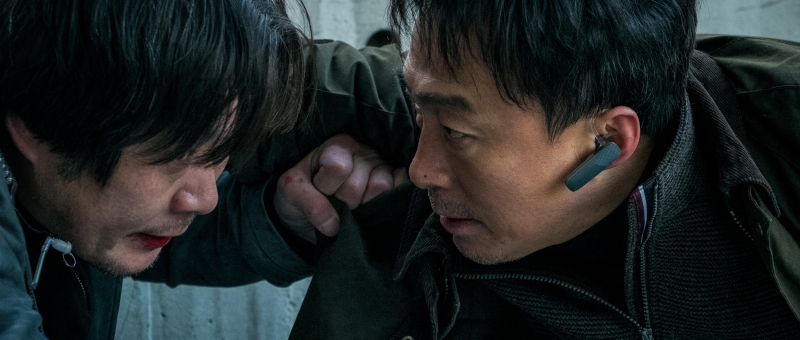
Internal police politics frustrate the hunt for a potential serial killer in Lee Jung-ho’s dark social thriller, The Beast (비스트) inspired by Oliver Marchal’s 36 Quai des Orfèvres. As a pathologist suggests, we all may have a hidden beast and it’s certainly true of the film’s conflicted protagonist, thuggish policeman Inspector Jung (Lee Sung-Min) who finds himself dragged ever deeper into a mire of corruption as a natural result of a series of bad decisions that started long ago, while his rival, Captain Han (Yoo Jae-Myung), presents the facade of efficient modern policing but inevitably turns out to be little better. 

As the film opens, Jung and his subordinate Yang are each wearing balaclavas while driving a heavily tattooed man out into the middle of nowhere though only for the purposes of frightening him so that he’ll back off their informant, local bar owner Madame Oh (Kim Ho-jung). Jung’s inner conflict is palpable as stares at his bloodied, shaking hands asking himself how it is it’s come to this while Yang later reminds him not to become too attached to his sources because once they’ve exceeded their usefulness they’ll simply be arrested. While all of this is going on, the police force is under immense pressure and receiving a lot of negative press over their handling of the case of a missing teenage girl, Mi-jin. Unfortunately, the girl later turns up dead with the murder enquiry split between two teams, those of Jung and Han each of whom are in the running to take over from the superintendent who before all of this happened was about to be promoted which is why he is desperate to solve the case as soon as possible. 

It might at first be tempting to read Jung and Han as representatives of different kinds of policing with their rivalry representing a battle for the soul of the police force only as it turns out each is merely corrupt in their own way. Jung is very much of the jaded veteran cop school, wanting to shift the case off his books as soon as possible by pushing the most likely suspect to confess. In this case that’s a shady pastor at a church Mi-jin used to frequent who was found in possession of her underwear and a series of photos of very young girls. Jung pushes the pastor to “confess” by selling him a story that a woman he was accused of assaulting in university took her own life as did her mother while her father later developed cancer as a result of all the stress and tragedy. Of course the pastor breaks down insisting that he killed her and it’s all his fault, only he’s talking about the other girl not that Jung cares too much about that. Han meanwhile quickly exonerates him by doing actual investigating, but only really so that he’ll still be in the running to solve the case and get the big promotion thereby besting his former partner turned rival. Jung had been the first to mention the possibility of an active serial killer only to be shut down because that would mean they’d lose the case to Major Crimes and therefore the personal opportunities for career advancement solving it would present. 

Both men eventually end up at the showdown by each of their respective routes implying there’s little practical difference between them. Han jeers that he can’t tell anymore if Jung is a bad guy or a cop but all he can answer is that it might be a matter of perspective, while he is also aware of Han’s backdoor deals and willingness to compromise himself in order to win advancement. In the midst of all this jockeying for power, it gets forgotten that a young woman lost her life in the most heinous of ways while whoever really did it may still be out there looking for the next girl to torture and kill. Everyone may indeed have a beast inside them, Jung already acquainted with his in his morally compromised soul while Han battles his internal ambition but the real beast may be the contemporary city and the infinitely corrupt hierarchies of the modern Korea along with the toxic masculinity that forces these men to betray their ideals simply not to be accounted a failure trapped at the bottom of the pyramid by their own problematic righteousness. When they’ve served their usefulness, the system chews them up and spits them out but until then it’s only hanging on as long as they can in the utter futility of a morally bankrupt existence. 


International trailer (English subtitles)

Alienoid (외계+인 1부, Choi Dong-hoon, 2022)

According to the strangely warmhearted AI robot at the centre of Choi Dong-hoon’s Alienoid (외계+인 1부), the universe is already finished, destined only to tear itself apart in destructive instability. According to him, his society evolved, became compassionate and forgiving, yet like many others sought to avoid a problem it did not want to deal with in exiling its most dangerous prisoners to the minds of oblivious Earthlings who apparently rarely realise they’re sharing body and soul with an alien killing machine until that is one decides to escape. 

Thunder (Kim Dae-myung), an AI unit accompanying the sullen Guard (Kim Woo-bin) who is also a kind of guardian, paints the aliens as dangerous mutants who live only for violence yet it might be worth considering that their rebellion may be justified as members of an oppressed minority apparently considered harmful to mainstream society were it not for the fact their plan involves poisoning the Earth’s atmosphere to free their brethren while suffocating humanity in the process. Guard is fond of saying that he cares nothing for humans and does not involve himself in human affairs, yet it’s obvious that as much as his duty is to ensure the aliens stay captive he feels a responsibility to protect humanity, coming to care for an infant child Thunder spirited away in compassion after its mother died when the alien hosted inside her tried to escape. 

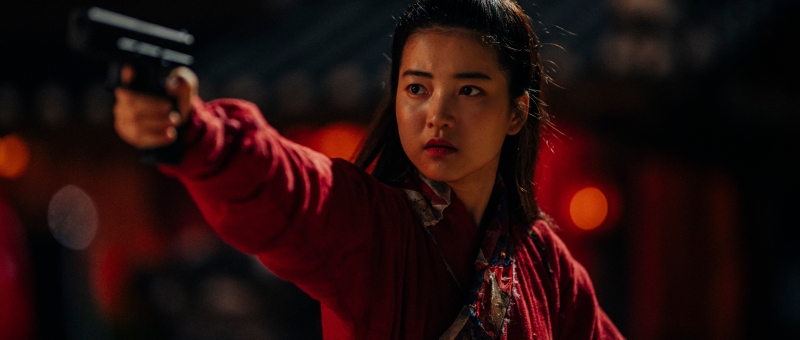
There is something a little curious in the fact these alien beings have chosen to live in what is our present day when according to them time is not linear but happening all at once and they appear to have the ability to travel through it at will, even stashing mutant criminals back in the 14th century where a Taoist dosa magician, “The Marvellous Muruk” (Ryu Jun-yeol) is on the hunt for the Divine Blade and a young woman who “shoots thunder” (Kim Tae-ri). Alien technology may seem like magic even if rooted in “science”, but feudal Korea is a place of majestic fantasy in which wizardry is apparently very real to the extent that a pair of powerful sorcerers tour the land hawking magical supplies such as random sutra stickers and mirrors that enlarge whatever passes through them to mysteriously masked warrior monks. Yet as we can see the girl who shoots thunder is merely welding a pistol, a kind of halfway house of technology which seems like strange magic to the people of Goryeo but nothing more than a child’s toy to the laser-wielding robotic aliens. 

In any case, Choi eventually connects these two worlds bridged by temporal conspiracy as if implying that the future’s salvation lies only in the past. Guard is forced to reflect that their strange act of colonial imperialism in secretly implanting alien prisoners in human minds may have been misguided when challenged by his plucky little girl (Choi Yu-ri) who has already realised there’s something a little different about her distant dad while the fact she’s effectively being raised by two men passes as incidental detail even as the Guard is stalked by her best friend’s apparently smitten aunt (Lee Honey). 

This being the first instalment in a two part film, there is a notable lack of resolution in its closing moments though Choi excels in world building running from hard sci-fi to feudalistic fantasy imbued with the strange magic of technology and underpinned by an interrogation humanity as the heroes battle through time looking for a way to repair an “unstable” world ruled by greed and violence and largely find it in each other. While the chief thrill may come from the incongruity of a young woman firing a pistol in the age of the crossbow (not to mention blasting her way out of a coffin), Choi packs in a series of innovative action sequences shot with a knowing irony as Muruk faces off against the masked monks in the past while the Guard and Thunder try their best to keep the aliens at bay with their high tech weaponry, shooting electric pulses from their palms and dodging lasers but still making a last ditch attempt by leaping at the enemy spaceship and trying to stab it in the heart. Whether this disordered world can be stabilised through a moment of cosmic connection will have to wait for part two, but this opening instalment at least is quite literally a charming affair.


Alienoid is in US cinemas from Aug. 26 courtesy of Well Go USA.

US trailer (English subtitles)

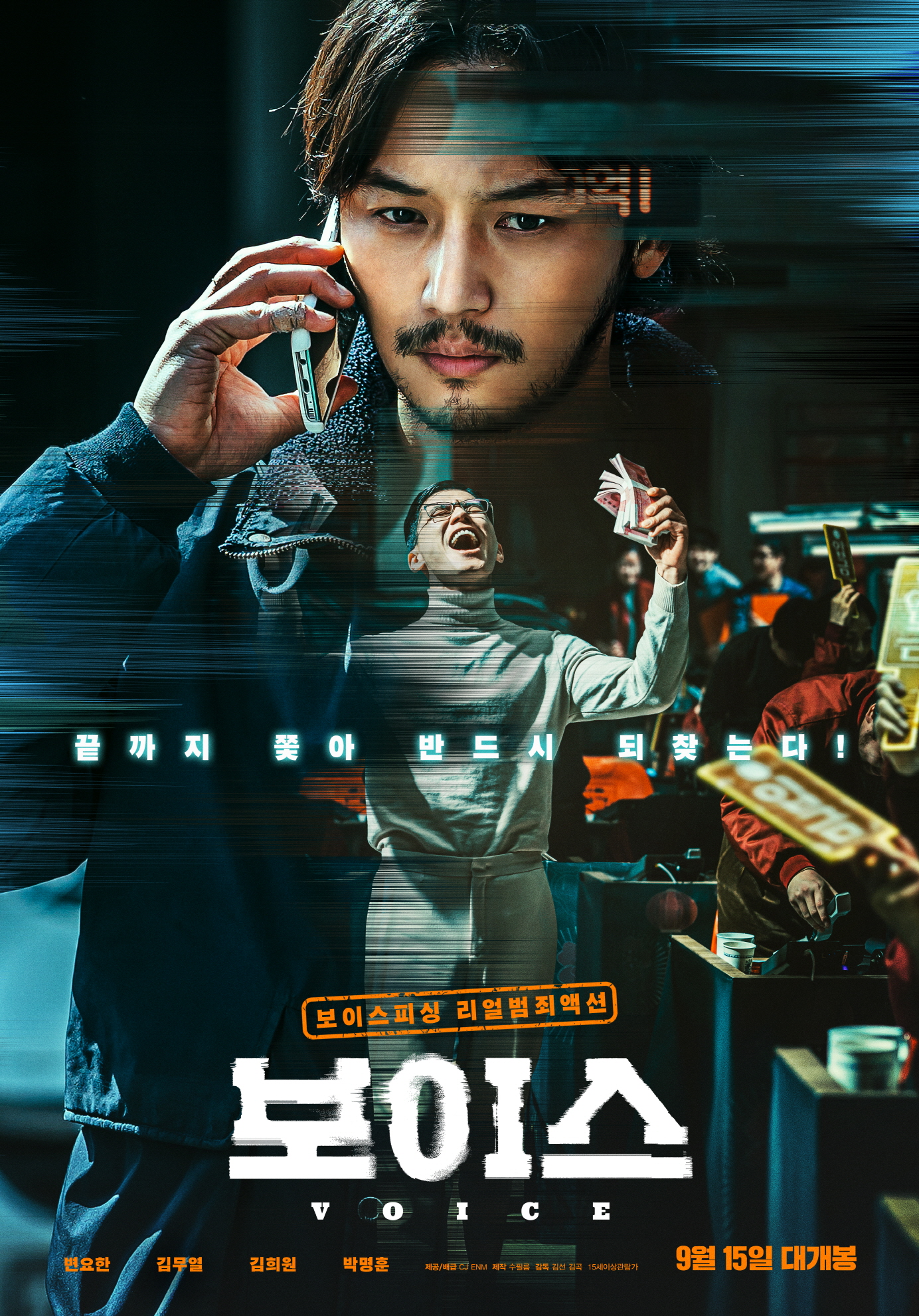
On the Line (보이스, Kim Gok & Kim Sun, 2021)

“Voice phishing is all about empathy” according to the sociopathic villain at the centre of Kim Gok & Kim Sun’s crime thriller On the Line (보이스, Voice), ironically hinting at his heartless greed leveraging as he admits people’s fear and hope against them and actively revelling in their misery. The Korean title, Voice, hints at the nebulous quality of the scam that in the end a reassuring voice is all people fall for but at the same time there is indeed a lot on the line not least for the embattled hero fighting back against the corruptions of contemporary capitalism.

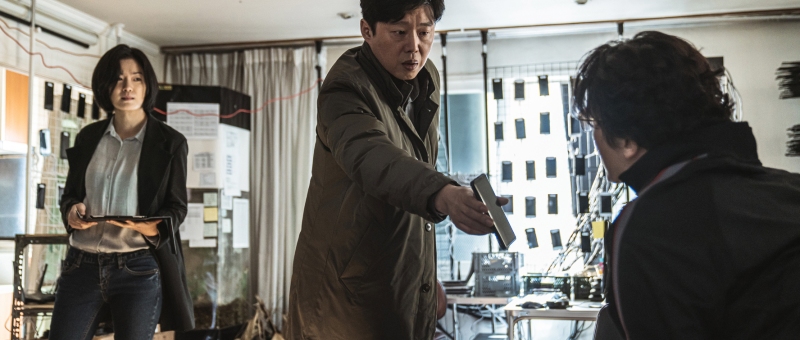
Former policeman Seo-joon (Byun Yo-han) is currently working a job in construction after being forced out of the police when one of his investigations implicated the son of a prominent person. Finally starting to get back on his feet, he’s offered a big promotion by his supportive boss and is about to buy a house with his wife Miyeon (Won Jin-A) but then everything starts to go wrong. A potential accident threatens Seo-joon’s new sense of success while unbeknownst to him, Miyeon is currently on the phone with a man claiming to be a lawyer friend of his who tells her that he’s been arrested because of a fatality on site but if she sends the lawyer money for a “settlement” Seo-joon will be released with no further consequences. Unable to get in touch with her husband and fooled by number spoofing when she tries to call the site, Miyeon takes out the money intended to pay the deposit on the house and hands it over only realising her mistake when the scammers turn off the jammers they’d hidden at the construction site and Seo-joon rings her back to find out what’s wrong. So shocked is she that gets hit by a car and is in hospital in a coma when Seo-joon learns that his boss got scammed too and has taken his own life in shame in having lost so much money meant for his employees. 

As the open intertitles relate, voice phishing telephone fraud is a rising problem which aside from landing its victims in inescapable debt can ruin lives and relationships not to mention cause intense feelings of humiliation which lead those affected to consider harming themselves. Using vast data sets often fraudulently obtained, the scammers are able to perfectly profile their victims who as the villainous Gwak (Kim Mu-yeol) points out are already living in the “hell” of the contemporary society amid employment and financial crises that leave them feeling desperate enough for help that they don’t ask too many questions of a friendly voice on the phone. The workers at the vast call centre in China operated by gangster Cheon (Park Myung-hoon) are all Korean and many of them pressed by debts some of them even scam victims themselves so damaged by the internecine assault of contemporary capitalism as to have given in and agreed to ruin others just as they have already been ruined.

Seo-joon’s primary goal is to get his money back with a little revenge on the side as he takes the police to task and then leads them by the nose to the gang’s base in China, all that time in construction standing him in good stead as he climbs through lift shafts and ventilation ducts trying to expose the scammers and bring them to justice. The police force is first seen to be hamstrung by the high-tech nature of the case while their hands are tied because the gang is operating out of a foreign sovereign nation but are then kicked into gear by super cop Seo-joon who ironically can act with less restraint for no longer being an official law enforcement officer. 

Even so, it becomes clear this kind of crime isn’t going away even if this particular gang is taken down because the most valuable commodity in the world of today is personal data and there’s more and more of that available with every passing second. There is indeed a lot on the line not least the nature of the contemporary society dragged ever further into a spiralling race to the bottom, the effects of an exploitative social system from the abuse of migrant workers to the anxiety of high unemployment rates and poor working conditions simply more tools to be manipulated by scammers promising a helping hand with a reassuring voice on the phone telling you they have the solution to all your problems but this too involves a small fee, just a tiny investment in your future you’d be foolish not to make. A timely condemnation of the amoral venality of contemporary capitalism, Kim & Kim’s steely thriller sends its hero on a quest for justice both personal and societal while pursuing the duplicitous voices all the way to the end of the line. 


On the Line screens at UltraStar Cinemas Mission Valley, San Diego April 22 & 25 as part of this year’s SDAFF Spring Showcase.

International trailer (English subtitles)