No Grave for Us (俺達に墓はない, Yukihiro Sawada, 1979)

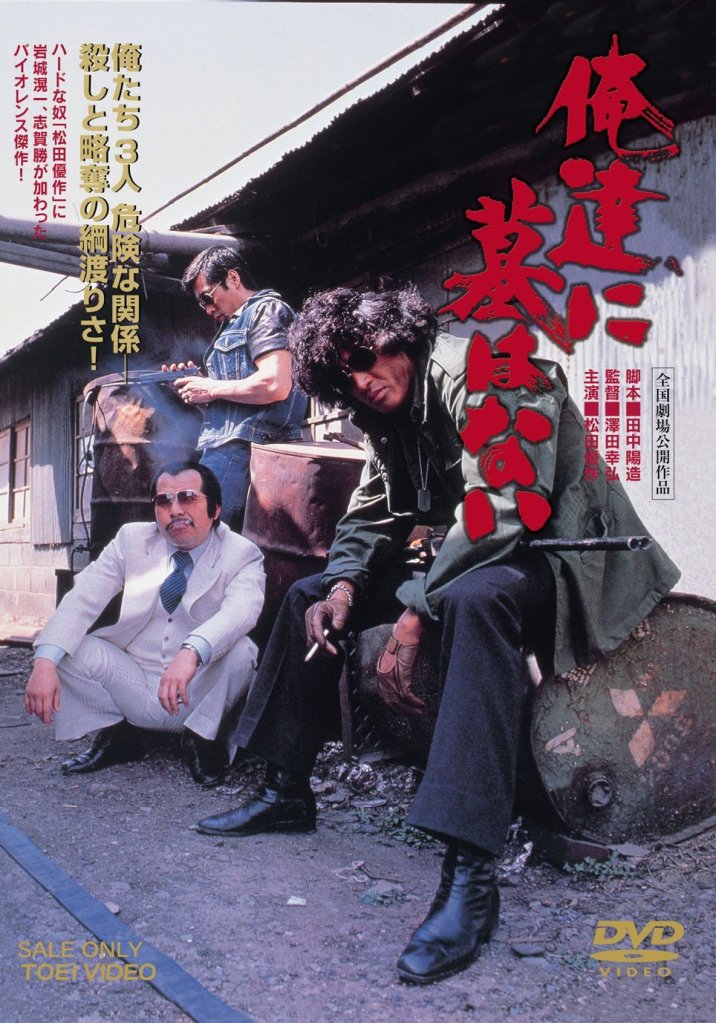
No Grave for Us posterThough he might not exactly be a household name outside of Japan, the late Yusaku Matsuda was one of the most important mainstream stars of the ‘70s and ‘80s. Had he not died at the tragically young age of 40 after refusing chemotherapy for bladder cancer to star in what would become his final film, Ridley Scott’s Black Rain, he’d undoubtedly have continued to move on from the action genre in which he’d made his name. No Grave For Us (俺達に墓はない, Oretachi ni Haka wa Nai) is fairly typical of the kinds of films he was making in the late ‘70s as he once again plays a cool, streetwise hoodlum mixed up in a crazy crime world where no one can be trusted.

The film begins with a humorous incident in which a man sets fire to a small parcel in the ladies’ area of a department store and loudly starts shouting about a bomb before using the resulting panic and chaos to calmly extract the money from the nearby tills. His plan is going perfectly except for one cashier who’s rooted to the spot, confused by the rat who lives under the counter who isn’t perturbed by the presence of a “bomb”. Shima makes off with his money and starts planning a new job which he plans to carry out with his longtime friend and brother in arms Ishikawa. The pair carry out a robbery on a rival gang but an ex-yakuza, Takita, tries to make off with the loot. Shima and Takita bond and agree to split the money but Ishikawa gets captured and subjected to humiliating treatment by the gangsters. The intrusion of Takita and of the resurfacing problematic shopgirl, Michi, slowly drive a wedge between the previously inseparable Shima and Ishikawa.

No Grave for Us is, as the title suggests, a noir inflected B-movie in which the lowlife punk Shima contends with the various trials and tribulations associated with a life of petty crime. Child of an uncaring society, he’s been in and out of trouble since adolescence. He met Ishikawa when the pair were both in reform school together, Shima for assault and Ishikawa for drug related offences. Shima is not a drug user and seems to disapprove of his friend’s habit but makes no great protest against it. When Michi turns up at Ishikawa’s bar (just by coincidence) she’s lost her job at the department store after being accused of taking the money that Shima stole. It turns out that she too is a junkie and has been living a life of dissipation since being picked up for prostitution during middle school. She fits right in with Shima and Ishikawa but, predictably, begins to prefer the more assured Shima to the loose cannon Ishikawa which begins to present something of a problem for the pair.

Shima and Takita originally reach an understanding based on a gangster code of honour which they both understand. Ishikawa aside, the pair would make a good team but their growing comradeship only adds to Ishikawa’s sense of insecurity causing him to take matters into his own hands with fairly disastrous consequences. A misunderstanding makes Takita and Shima mortal enemies putting an end to any kind of alliance that might have been possible. There’s no comradeship here, no true friendship. Every relationship is a possible betrayal waiting to take place, every warmth a weakness.

Director Yukihiro Sawada had mostly worked in Nikkatsu’s Roman Porno line other than co-helming Sogo Ishii’s first feature, Panic High School, the previous year but No Grave for Us is refreshingly light on exploitative content. There is some brief nudity but nothing particularly out of keeping for a regular studio picture of the time. Likewise, the fights are of a more realistic nature and bloodshed kept to a minimum. The look of the film is also very typical of its era though Sawada only rarely uses the extreme zooms which are the hallmark of ‘70s cinema opting for a more straightforward, often static, approach. The film’s jazz inspired score also helps to bring out its noir undertones as these three guys who could have been allies find themselves turning on each other for the most trivial of reasons.

In many ways there’s nothing particularly special about No Grave for Us save for being an excellent example of mainstream action cinema in the late ‘70s. The film is full of knowing references to other recent genre hits as well as popular culture of the time including a lengthy tribute to top idol group Pink Lady whose song Zipangu also features on the soundtrack, and has an all round “cool” sensibility to it that was no doubt very popular at the time of its original release. An enjoyable enough genre effort, No Grave for Us is an impressively handled slice of late ‘70s noir inspired B-movie action but perhaps has little else to recommend it.


Unsubtitled trailer:

and a clip of Pink Lady performing Zipangu, just because


Audition (オーディション, Takashi Miike, 1999)

audition-posterReview of Takashi Miike’s Audition (オーディション) – first published by UK Anime Network.


The world was a much more innocent place back in 1999. Takashi Miike already had 34 films to his name before Audition became his breakout hit even whilst seeing him branded “sick” by a disgusted audience member at the film’s otherwise successful screening at the Rotterdam film festival. Based on the book of the same name by Japan’s master of the nasty psychological thriller Ryu Murakami, Audition is the twisted romantic nightmare to end all twisted romantic nightmares.

Aoyama is a widower with an almost grown-up child. Now that his parental responsibilities are changing, and spurred on by his encouraging son, Aoyama perhaps feels ready to move into another phase of his life by considering the idea of getting married again. However, Aoyama is a sensitive and romantic man who’s actually a little naive when it comes to matters of the heart and obviously hasn’t had much experience in the dating world in the last twenty years. He turns to an old friend who happens to be a casting director and comes up with the novel (if somewhat inappropriate) idea of letting Aoyama sit in on an audition to look for a new wife.

In glancing over the headshot resumés, one catches his eye – that of a former ballet dancer who equates having had to abandon her dream of becoming a professional dancer because of an injury with a sort of spiritual death. This deep sense of loss strikes a chord in the widowed Aoyama and despite his friend’s warnings that she gives him the creeps, Asami is the one he’s set his heart on. However, Asami is not the sweet and innocent girl she first appears to be…

In the intervening 15 years since its original release, Audition has amassed something of a reputation which is to say that viewers will almost certainly be aware of its “extreme” nature. However, Audition arguably works best when seen blind as it begins as a fairly straightforward romantic drama in which a broken hearted widower begins to live again thanks to the attentions of a shy young woman. Of course, Miike is peppering the otherwise anodyne love story with subtle (and not so subtle) clues all the way through, planting doubts in our minds right away. Is Aoyama just an old fool who’s lost his head over a young beauty or is he right to grow suspicious in the face of the ever increasing, yet circumstantial, evidence of Asami’s strangeness?

Is Asami hiding a dark secret, or is Aoyama projecting his fears of romantic entanglements onto her  silhouette and therefore creating, in some sense, a villainess worthy of his anxieties? According to Miike himself, Audition is not a horror movie (Japanese horror movies are linked with the supernatural and Audition’s terrors are very much of the real world) – Murakami in fact wrote the book as a strange kind of “love letter” to a woman he had wronged. Miike sought to envisage her reply and gives her an opportunity to offer a series of extremely dark explanations of her own. Neither Aoyama or Asami have been honest with themselves or each other. Aoyama is looking for a cookie cutter ideal to fit into the pre-made box marked “wife”, and well, it would be better not to go into all the various ways Asami has misrepresented herself but she does have a point when she calls Aoyama on how easy it was to make him fall for her meek and feeble innocent act.

Asami and Aoyama are always working at cross purposes to each other, engaged in a macabre dance where Asami leads by stealth, waltzing Aoyama into her spider’s web of vengeance by neatly subverting his ideas of femininity. However, this is not to cast Asami as a vile temptress or the predatory female born of male fears of emasculation (though these ideas are definitely in play), nor is she an avenging feminist warrior so much as a lonely, damaged woman. At the very end of the film the pair have perhaps reached a kind of understanding as, according to Asami, only in extreme pain does one understand one’s own mind. Left maimed and helpless, each is scarred and broken but alive and, perhaps, at peace at last.


Audition is now re-released on blu-ray in the UK from Arrow Films in a significantly better transfer than the previous US blu-ray from Shout Factory.


Poppoya (鉄道員, Yasuo Furuhata, 1999)

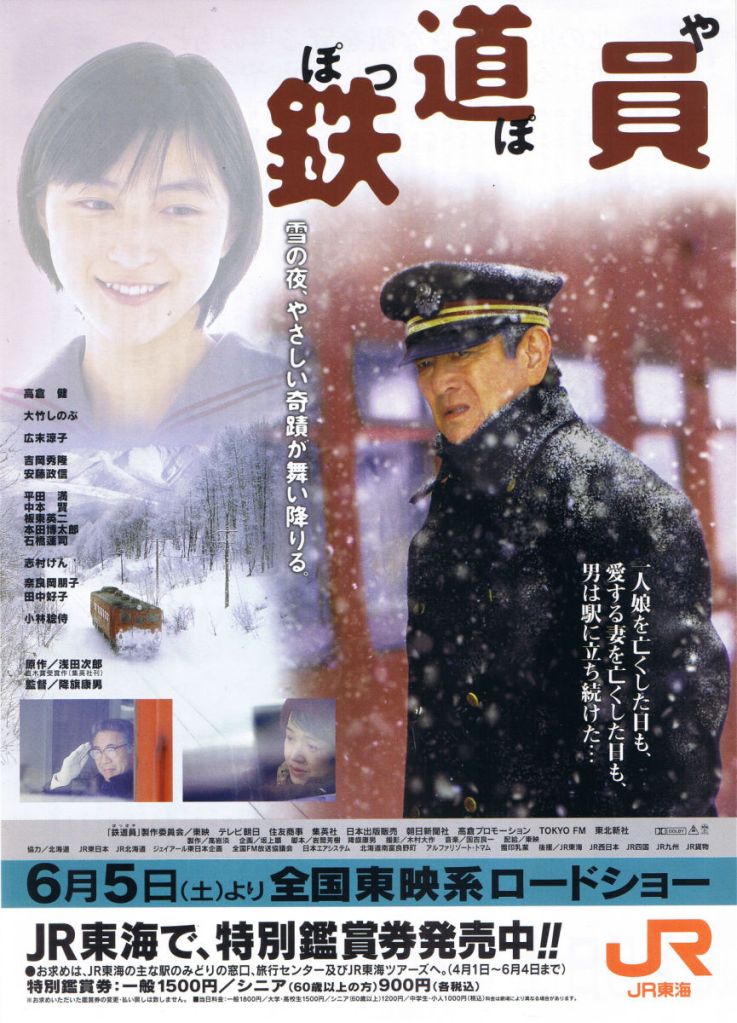
img_0The late Ken Takakura is best remembered as cinema’s original hard man but when the occasion arose he could provoke the odd tear or two just the same. 1999’s Poppoya (鉄道員) directed by frequent collaborator Yasuo Furuhata sees him once again playing the tough guy with a battered heart only this time he’s an ageing station master of a small town in deepest snow country which was once a prosperous mining village but is now a rural backwater.

Otomatsu Sato has spent his life in service to the railway. Like his father before him who believed the key to the modernisation of Japan after its defeat in the second world war was in its transportation network, Sato started as an engineer before being promoted to station master. Morning and evening in the freezing cold he bid in and sent out each passenger and freight train travelling through his one track station. However, though he clearly loves his job Sato has experienced a great deal of personal tragedy in pursuit of his career. He wasn’t there when his baby daughter died, nor was he there when his wife lay dying in hospital. He was where he always is, on the platform until the last train goes out. Now, however, the mine has closed, the town is full of old people and there are no passengers on the train so the line will be closing. Having given his life to something which will be so unceremoniously erased, what is a man like Sato to do now?

In true Takakura fashion, Sato appears tough and fairly unapproachable on the outside but actually he’s quite well respected in the town and even if some of the other residents bemoan his rigid ways, they grudgingly respect him for being the way he is. He takes his duties seriously and would never countenance breaching them for something as trivial as personal concerns, even when those concerns are something as understandable as the death of a family member. The way he sees things, this is his duty and must be fulfilled, properly each day no matter what. This may seem a little obsequious in Western eyes, though many of the other (particularly female) characters also agree Sato takes things much further than he needs to, but dedication to one’s duty is, after all, an admirable trait.

However, now it’s all been for nowt. The railway line is to be closed, the land will engulf it once again erasing the years of Sato’s work just as if he were never there. He’s sacrificed final moments with his wife and child – not even that, just sacrificed moments. He’s given all to the railway and now there’s no place left there for him. His best friend, the father of a son also in the railway business, is to take another job at a hotel complex but Sato is a railwayman through and through – he’ll work on the tracks or not at all.

Around this time Sato also starts seeing some strange new children around. He assumes they’ve come to stay with grandparents in the village, this being the time of the New Year holiday. The little one has a strangely old fashioned looking doll that reminds Sato of one he bought for his infant daughter only she never really had the chance to enjoy it. Then he meets an older sister who’s kind of a live wire before meeting the oldest – a high school student dressed in an old fashioned looking uniform who really reminds him of someone he used to know. All these strange encounters force Sato to further re-examine his past, reliving old regrets and assessing a life lived in service to an ideal at the expense of the joy he might have felt as a happy family man.

Beautifully photographed with picturesque shots of trains against the deep snows of Northern Japan, Poppoya was Japan’s submission for the 1999 Oscars and does have all the trappings of a prestige melodrama. It unabashedly pulls at the hearts strings and even if the rather sentimental score takes things too far, Poppoya does nevertheless manage to draw the odd tear for Sato’s lonely, regretful old age. Sentimental yet genuinely affecting, Poppoya is an effectively crafted weepy which serves as a timely reminder to embrace the things which are most important to you while there’s still time.


The Hong Kong blu-ray release of Poppoya includes English subtitles (though they are a little “imperfect”).

Only trailer I can find has Korean subs: