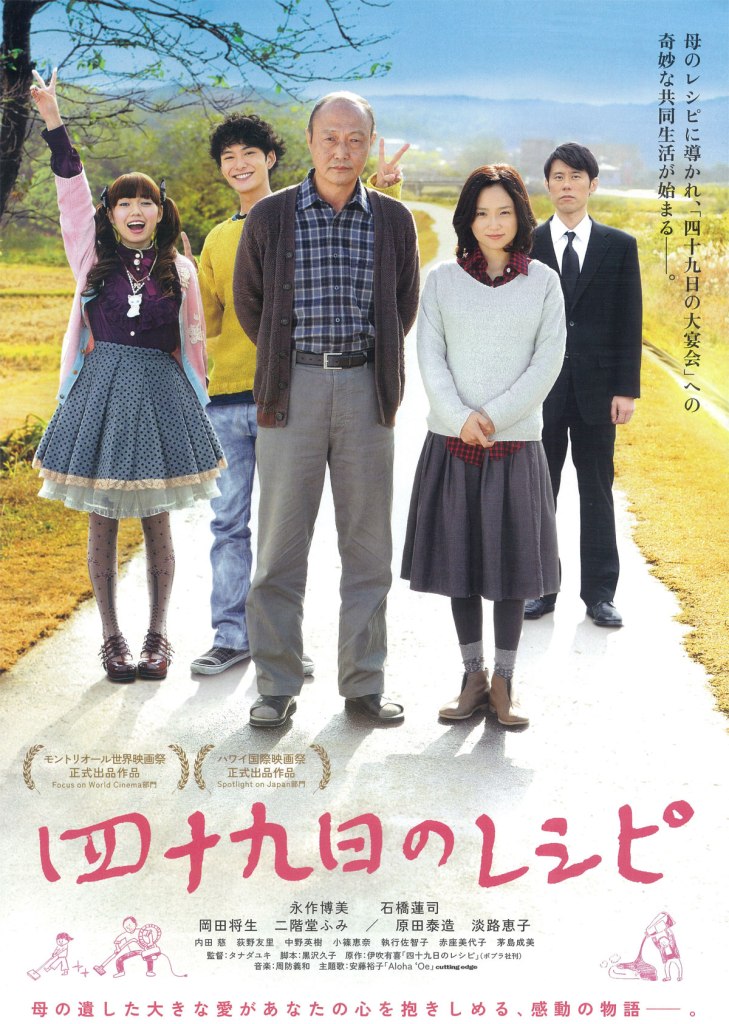
 When everything goes wrong you go home, but Yuriko, the protagonist of Yuki Tanada’s adaptation of Yuki Ibuki’s novel might feel justified in wondering if she’s made a series of huge mistakes considering the strange situation she now finds herself in. Far from the schmaltzy cooking movie the title might suggest, Mourning Recipe (四十九日のレシピ, Shijuukunichi no Recipe) is a trail of breadcrumbs left by the recently deceased family matriarch, still thinking of others before herself as she tries to help everyone move on after she is no longer there to guide them. Approaching the often difficult circumstances with her characteristic warmth and compassion, Tanada takes what could have become a trite treatise on the healing power of grief into a nuanced character study as each of the left behind now has to seek their own path in deciding how to live the rest of their lives.
Beginning in pitch darkness, housewife Yuriko (Hiromi Nagasaku) answers the phone to the voice of another woman requesting that she separate from her husband who is apparently the father of her unborn child. This double sting hits Yuriko hardest as the couple had been trying for a baby for quite sometime with little success. Thinking a divorce is for the best, Yuriko packs her bags, leaves the papers and her ring on the table, and heads for her father’s house. When she gets there she finds an oddly bubbly young girl, Imoto (Fumi Nikaido), washing her father’s back. Apparently, Imoto has been charged with looking after the house during the 49 day mourning period for Yuriko’s step-mother, Otomi – the upcoming memorial service something Yuriko had forgotten all about in the midst of her personal crisis. When Imoto presents the pair with a book that Otomi illustrated before she died listing everything they should do to prepare for the big party she wants everyone to enjoy rather than solemnly chanting sutras for her 49th day memorial, it prompts Yuriko and her father into a reconsideration of themselves, their pasts and futures, and who exactly should be making those decisions for them.
Yuriko’s position may seem like a straightforward one, betrayed by her husband her decision to leave seems inevitable but it’s complicated by the intricate web of duties and obligations Yuriko feels herself to be a part of. Reconsidering various turning points of her life, Yuriko makes plain that her marriage to the mild mannered salaryman Hiroyuki (Taizo Harada) had been under considerable strain due to the couple’s difficulty conceiving a child. Owing to the intense pressure placed on women to bear children, Yuriko internalises a sense of shame at having failed in this most basic of wifely tasks, leading her husband (she believes) to replace her with a model more fit for purpose. This point of view is rammed home by Yuriko’s insensitive aunt who continues to interrogate her about her lack of children and encourage her to return home to her husband and fix the problem rather than “giving up” and settling for the “shameful” option of divorce as young people are want to do. Aunt Tamako (Keiko Awaji) also points out that neither of her daughters bothered with university or work or any of that nonsense and now have fulfilled their duties by bearing bright and bonny grandchildren with no trouble at all. Heartbroken and blaming herself, Yuriko has to listen to the ongoing lecture whilst keeping her composure right until its gloomy conclusion.
Motherhood becomes the film’s biggest theme as mothers, non-mothers, and bad mothers swirl around the childless Yuriko, still trying to find her place in the world if the path society seems determined to set her on has been well and truly blocked off. Yuriko’s biological mother died when she was only little but happily her father fell in love with and married Otomi – a truly good woman who, like Yuriko, had no children of her own, but lived her life trying to make a difference and help other people to be happy. Little Yuriko didn’t always see it that way and found it difficult to bond with her new mother, settling for the nickname “Okka” – a combination of Otomi’s name and the word for mother, rather than straightforward “mum”.
Reinvestigating Otomi’s life in order to plan for her 49th day memorial, Yuriko truly gets to know her step-mother for the first time, discovering just how big of a difference she made in the lives of those around her. Imoto is just one of the young people Otomi went out on a limb for volunteering at a local rehabilitation centre for young people experiencing problems with addition. She then introduces them to a young Brazilian/Japanese migrant (Masaki Okada) who found himself feeling all alone in a foreign land until Otomi handed him the keys to her car and insisted he get out and about and meet new people. Otomi might not have had children of her own, but she became a mother to the world, reaching out and helping those who most needed it, becoming the springboard so that they could fly far away from her happier and healthier than before.
In learning from Otomi’s book, Yuriko regains her sense of self and a desire to find her purpose, knowing that the ability to bear children is not the be all and end all of a woman’s existence. Indeed even if a woman can give birth to a child, that’s not to say she’ll be a good mother as Imoto points out in reference to the toxic relationship she has with hers which feeds back into the insensitive way Hiroyuki’s mistress talks about her plans in front of her young son.
Given all of these epiphanies and mini realisations, Yuriko’s final decision may seem like an odd one, sending her back into a conservative world bound by all of the same duties and obligations the film spent so long undermining. Nevertheless, Yuriko emerges from her 49 days of mourning with a better understanding of herself and the way she should be living her life. Filled with wit and warm humour, Mourning Recipe neatly skirts its melodramatic nature to present a genuinely moving examination of the true nature of family, motherhood, and the necessity of individual freedom. Otomi’s final springboard action was for the ones she left behind, even if, once again, she won’t be able to see them fly.
Original trailer (English subtitles)
 Looking at the poster and its “A Most “Oshare” Movie” tagline, you’d assume Cats in Park Avenue (公園通りの猫たち, Koendori no Nekotachi) to be a very stylish story about some fashionable felines living on an uptown street comparable to the famous New York landmark but the title is entirely coincidental as it’s a literal translation of the Japanese and just means the cats live on a street near the park. These cats are full on alley cats, scrappy and free, roaming the rooftops of Shibuya and not giving a damn about whatever it is cats are supposed to do. Ostensibly a throw away young adult movie about a group of dance students and their obsession with a gang of local street cats, Cats in Park Avenue takes on a surprisingly individualist message as the virtues of freedom and validity of life outside the mainstream are resolutely reinforced through cute animation and nonsensical musical sequences.
 Ogami (Tomisaburo Wakayama) and his son Daigoro (Akihiro Tomikawa) have been following the Demon Way for five films, chasing the elusive Lord Retsudo (Minoru Oki) of the villainous Yagyu clan who was responsible for the murder of Ogami’s wife and his subsequent framing for treason. The Demon Way is never easy, and Ogami has committed himself to following it to its conclusion, but recent encounters have broadened a conflict in his heart as innocents and seekers of justice have died alongside guilty men and cowards. Lone Wolf and Cub: White Heaven in Hell (子連れ狼 地獄へ行くぞ!大五郎, Kozure Okami: Jigoku e Ikuzo! Daigoro) moves him closer to his target but also further deepens his descent into the underworld as he’s forced to confront the wake of his ongoing quest for vengeance.
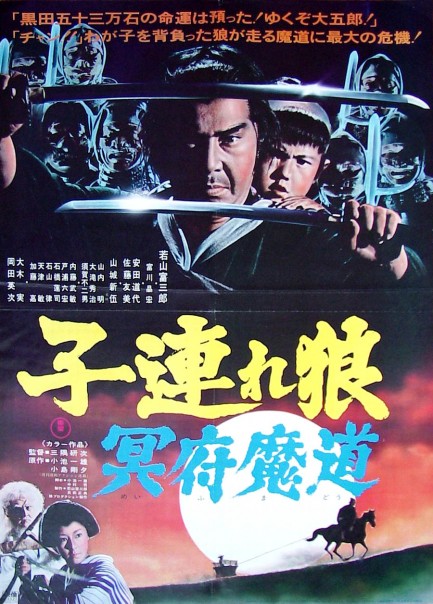 Ogami (Tomisaburo Wakayama), former Shogun executioner now a fugitive in search of justice after being framed for treason by the villainous Yagyu clan who are also responsible for the death of his wife, is still on the Demon’s Way with his young son Daigoro (Akihiro Tomikawa). Five films into this six film cycle, the pair are edging closer to their goal as the evil Lord Retsudo continues to make shadowy appearances at the corners of their world. However, the Demon’s Way carries a heavy toll, littered with corpses of unlucky challengers, the road has, of late, begun to claim the lives of the virtuous along with the venal. Conflicted as he was in his execution of a contract to assassinate the tragic Oyuki in the previous instalment,
 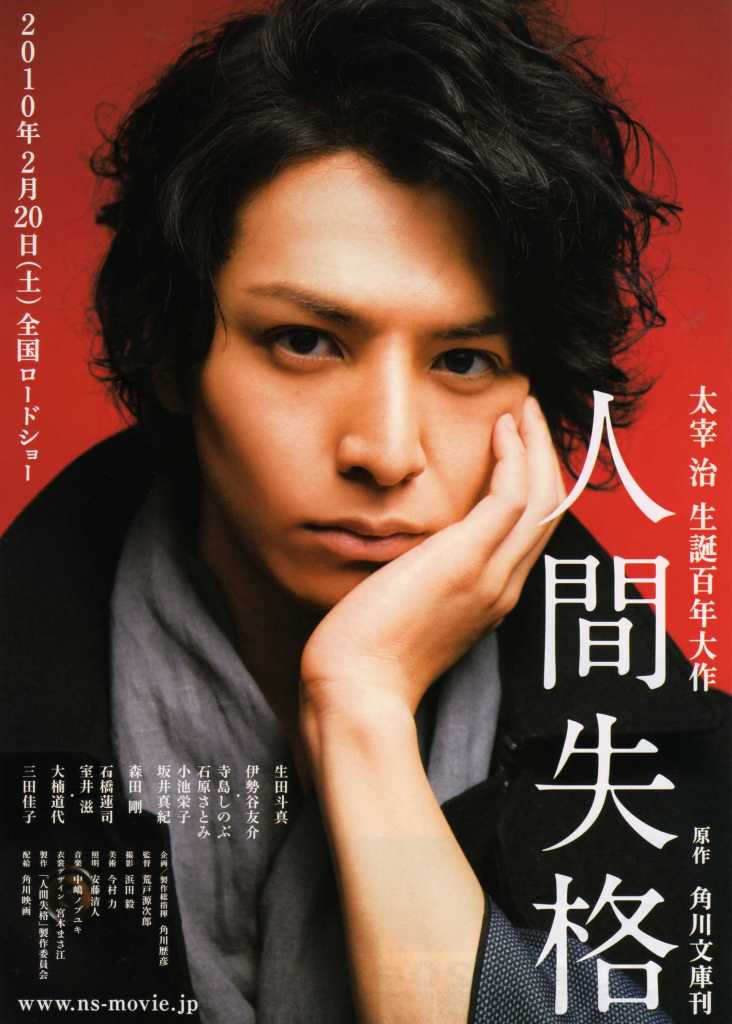 The Fallen Angel (人間失格, Ningen Shikkaku), based on one of the best known works of Japanese literary giant Osamu Dazai – No Longer Human, was the last in a series of commemorative film projects marking the 100th anniversary of the author’s birth in 2009. Like much of Dazai’s work, No Longer Human is semi-autobiographical, fixated on the idea of suicide, and charts the course of its protagonist as he becomes hopelessly lost in a life of dissipation, alcohol, drugs, and overwhelming depression.
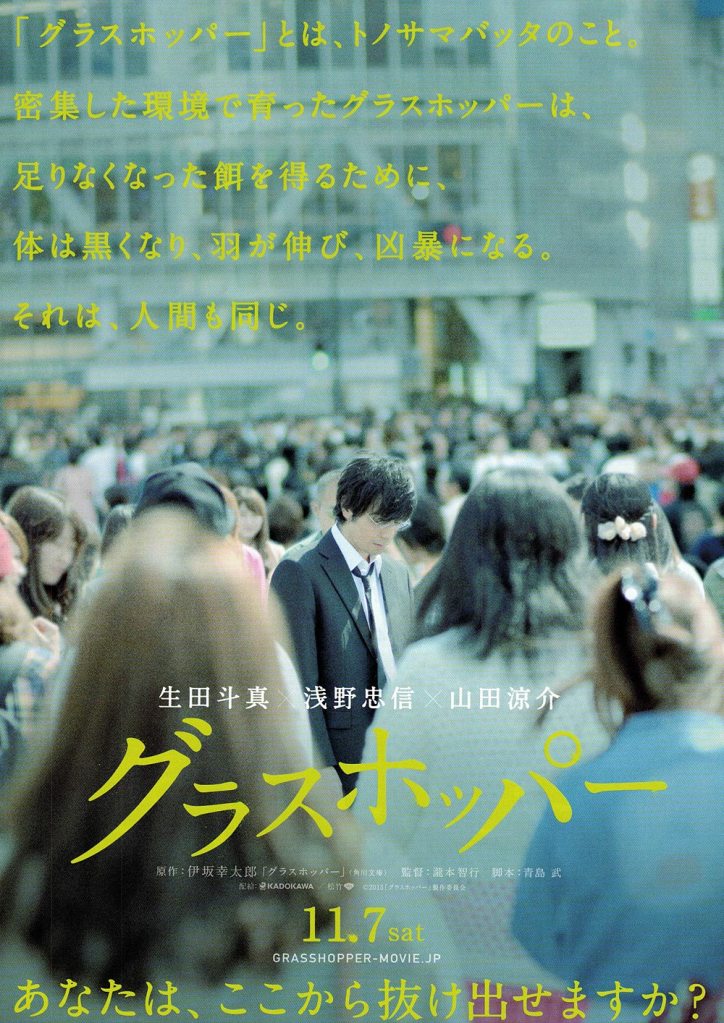 The best revenge is living well, but the three damaged individuals at the centre of Tomoyuki Takimoto’s Grasshopper (グラスホッパー) might need some space before they can figure that out. Reuniting with
 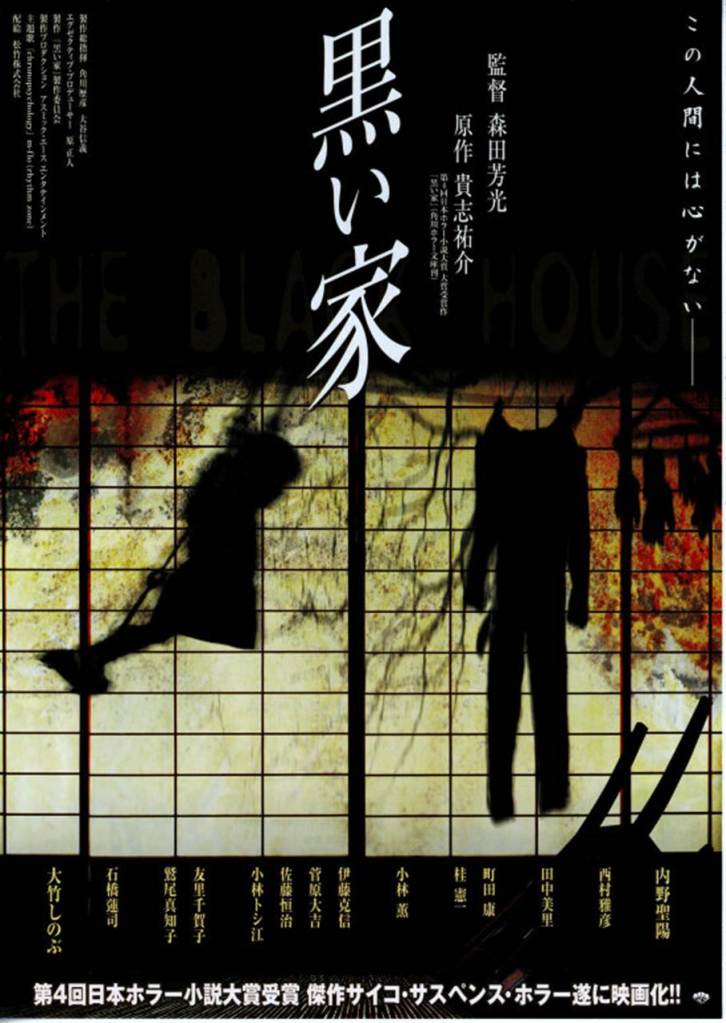 Yoshimitsu Morita, though committed to commercial filmmaking, also enjoyed trying on different kinds of directorial hats from from purveyor of smart social satires to teen idol movies, high art literary adaptations and just about everything else in-between. It’s no surprise then that at the height of the J-horror boom, he too got in on the action with an adaptation of Yusuke Kishi’s novel of the same name, The Black House (黒い家, Kuroi Ie). Though tagged as “J-horror” you’ll find no long haired ghosts here and, in fact, barely anything supernatural as the true horror on show is the slow descent into madness taking place inside the protagonist’s mind.
 Akira Kurosawa’s later career was marred by personal crises related to his inability to obtain the kind of recognition for his films he’d been used to in his heyday during the golden age of Japanese cinema. His greatest dream was to die on the set, but after suffering a nasty accident in 1995 he was no longer able to realise his ambition of directing again. However, shortly after he died, the idea was floated of filming some of the scripts Kurosawa had written but never proceed with to the production stage including The Sea is Watching (海は見ていた, Umi wa Miteita) which he wrote in 1993. Based on a couple of short stories by Shugoro Yamamoto, The Sea is Watching would have been quite an interesting entry in Kurosawa’s back catalogue as it’s a rare female led story focussing on the lives of two geisha in Edo era Japan.
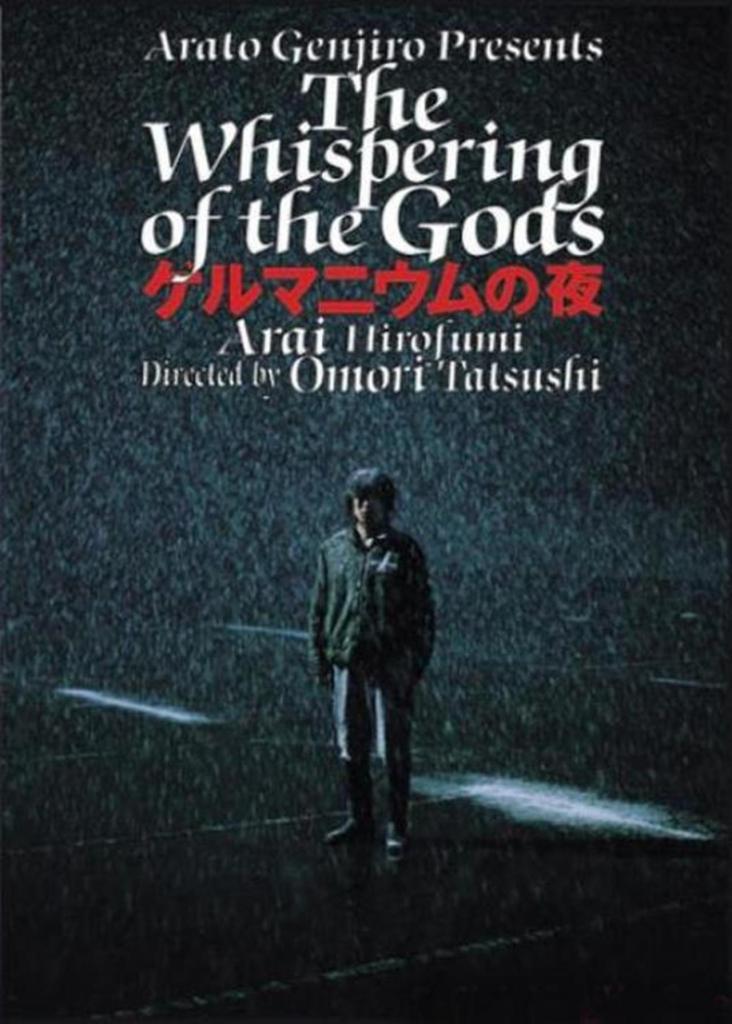 If you’ve ever wondered what it’s like to live in hell, you could enjoy this fascinating promotional video which recounts events set in an isolated rural monastery somewhere in snow covered Japan. A debut feature from Tatsushi Omori (younger brother of actor Nao Omori who also plays a small part in the film), The Whispering of the Gods (ゲルマニウムの夜, Germanium no Yoru) adapted from the 1998 novel by Mangetsu Hanamura, paints an increasingly bleak picture of human nature as the lines between man and beast become hopelessly blurred in world filled with existential despair.
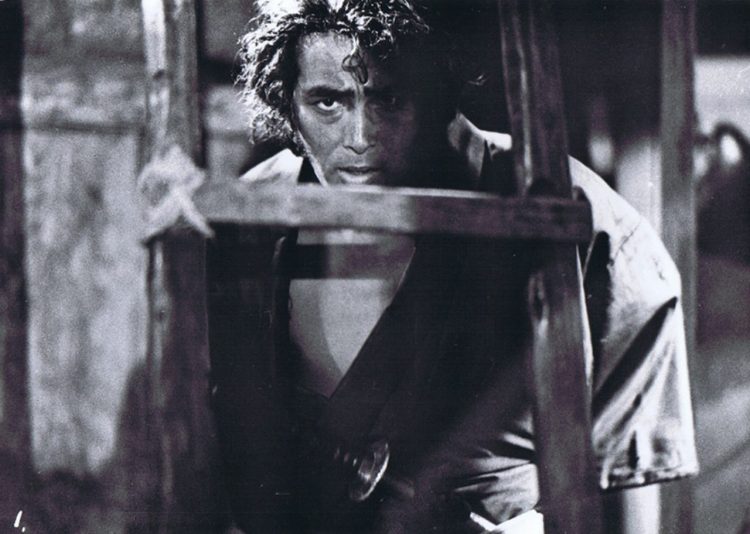 Sakamoto Ryoma is a legendary revolutionary of Japan’s Bakumatsu period which encompasses the chaos that ensued after Japan was forced open after centuries of self imposed isolation. Ryoma was a low level samurai from a small town who resented the unjust treated of the arrogant true samurai above him and skipped out on his clan without the proper permission to go study sword fighting in the city. After the arrival of the Americans and witnessing their far superior technologies, Ryoma was one of several men who became convinced that Japan needed to modernise quickly or become a slave to more advanced cultures. However, this was a turbulent era and there was general infighting among all factions and all sides and Ryoma was mysteriously assassinated in 1867 along with his friend and ally Nakaoka Shintaro.
