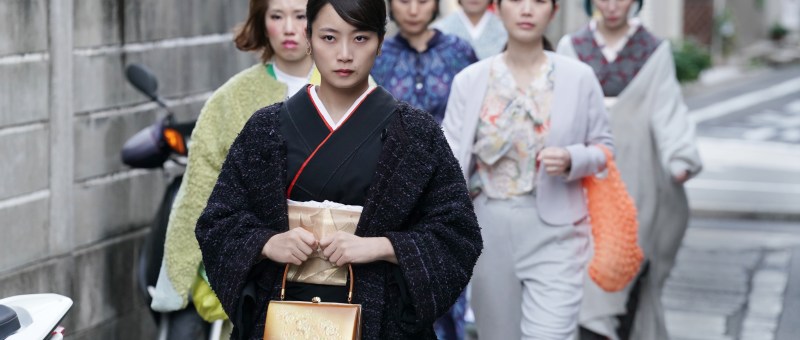
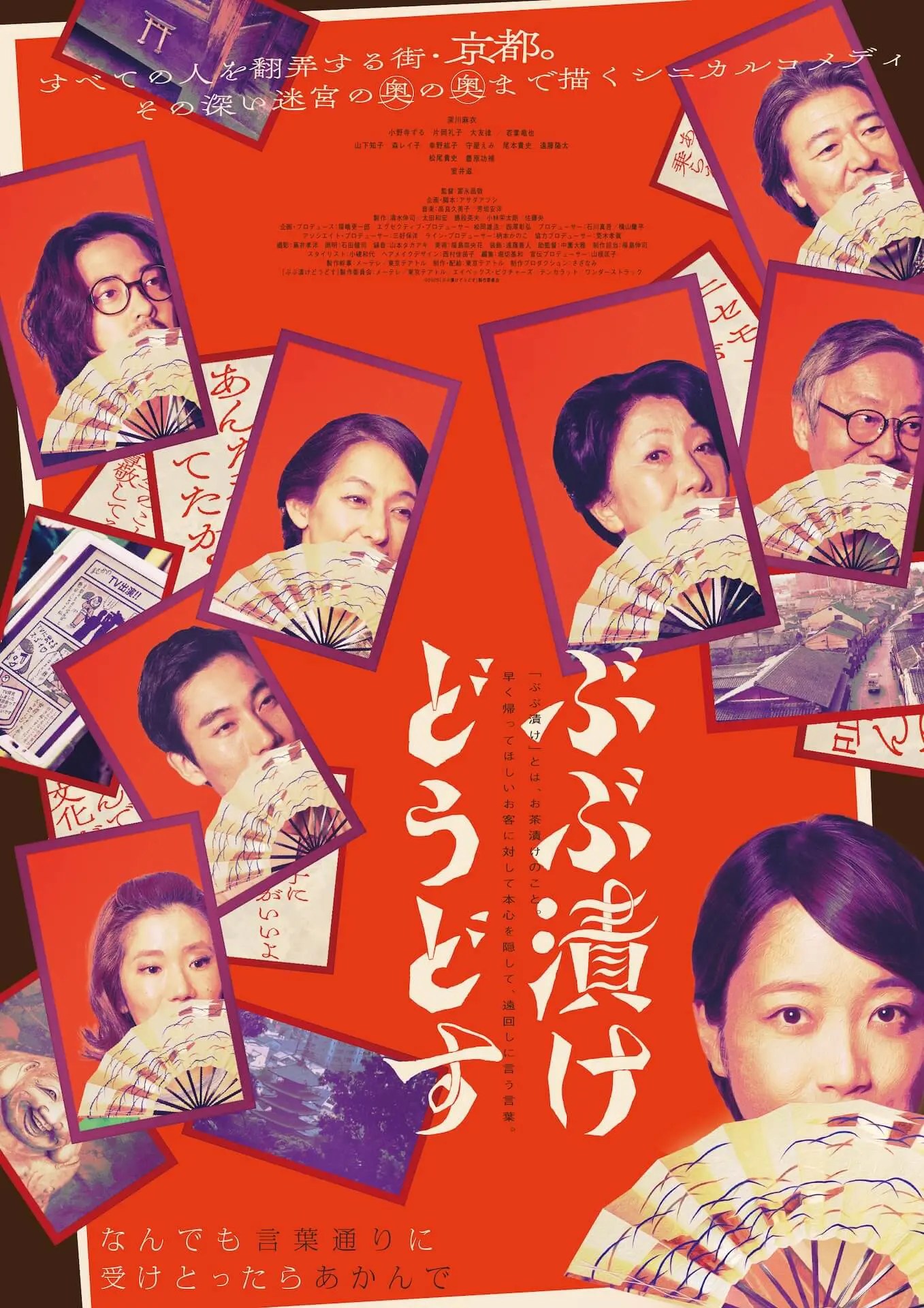
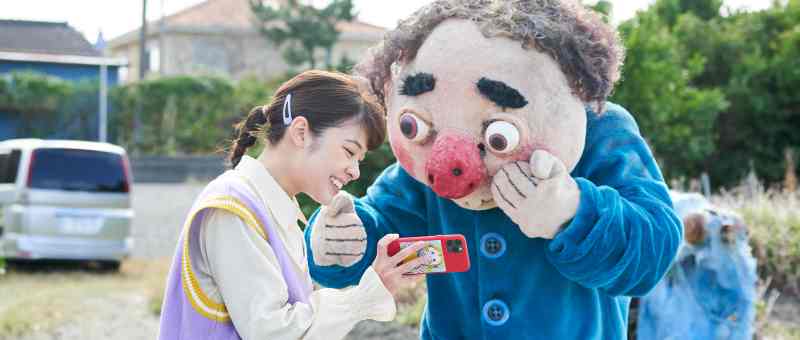
A former capital city, Kyoto is renowned as a historical centre and seat of tradition. But on the other hand, no one wants to live in a museum and while some of these old-fashioned ways of life might seem quaint or comforting, they’re also burdensome and for some an unwelcome imposition. Madoka (Mai Fukagawa), the wife of the 14th heir to a Kyoto fan seller is full of earnest wonder, but she’s also an outsider here and bringing with her own preconceptions and anxieties.
To begin with, she’s come as a kind of cultural anthropologist directly interviewing local people to gain material for the manga she’s drawing with a friend. When one of the ladies she’s talking to explains that she runs a cafe in a former bathhouse that’s been sensitively adapted so that his traditional space can find new purpose in the modern world, Madoka is visibly disappointed which of course causes offence to her interviewee. Something similar happens when she interviews a woman running a traditional sweet shop who explains that their top-selling items are their halloween specials. They no longer sell anything that would have been on sale when the shop opened a few centuries ago.
Madoka, who is not from Kyoto, is obsessed with preserving the city’s “true face” and fails to see that these businesses have survived because they’ve been able to adapt to the times when others could not. Repurposing old buildings to house modern businesses is one way of keeping the city alive. Meanwhile, she idolises her mother-in-law’s traditional lifestyle, but is after all experiencing it from the perspective of a guest. It may very well be much nicer to eat rice cooked over an open flame, but she’s not the one who’s got to get up early to stoke the fire or spend hours stirring the pot. She takes her responsibility as the wife of the 14th heir so seriously in part because she doesn’t understand what it entails. Her husband, Mario, meanwhile is keen to remind his mother that he has a life in Tokyo and won’t be returning to take over the shop, at least as long as his father is alive.
Mario tries to warn Madoka about the complex nature of Kyoto social etiquette, but she fails to understand and makes a series of embarrassing faux pas that gradually destabilise the local equilibrium. In Kyoto, a particular brand of politeness rules in which one’s true feelings are never expressed openly but only through barbed comments that everyone nevertheless understands. So, when someone wants you to know that the party’s over and it’s time you went home, they’ll politely ask if you want any green tea over rice. This level of subtlety is lost on Madoka who comes from a city where size of the community means you have to be explicit.
It never really dawns on her that mother-in-law might have become so fed up with her that it’s easier just to sell the house and end 450 years of tradition than to tell her go home. Then again, it seems like she may be missing some social cues in Tokyo too, while it’s also fairly obvious in any culture that putting her awkward interactions into the manga could end up upsetting those around her. They do, after all, have a point that it’s inappropriate for her to make herself the self-appointed guardian of a place she’s isn’t from and doesn’t live in, disregarding the thoughts and feelings of those who do (not that they really told her what they were).
Perhaps as she said she’s beginning to understand Kyoto in this regard by fighting back passive aggressively to claim her right to take over the fan shop. She might have a point about the comparatively ugly and utilitarian apartment blocks taking over the city as old buildings are bulldozed to make way for the new, but on the other hand it may not be possible to continue this business as it is and simply bringing in more tourists who’ll just clutter up the place and not buy anything may not be the answer. What the answer is may not be clear, but Madoka at least seems to have found her little niche in the heart of Kyoto, even if it is no longer so polite as to keep its irritation to itself.
Strangers in Kyoto screens as part of this year’s Japan Foundation Touring Film Programme.
Trailer (English subtitles)
Images: ©2025 Strangers in Kyoto Film Partners





 Windows on Worlds