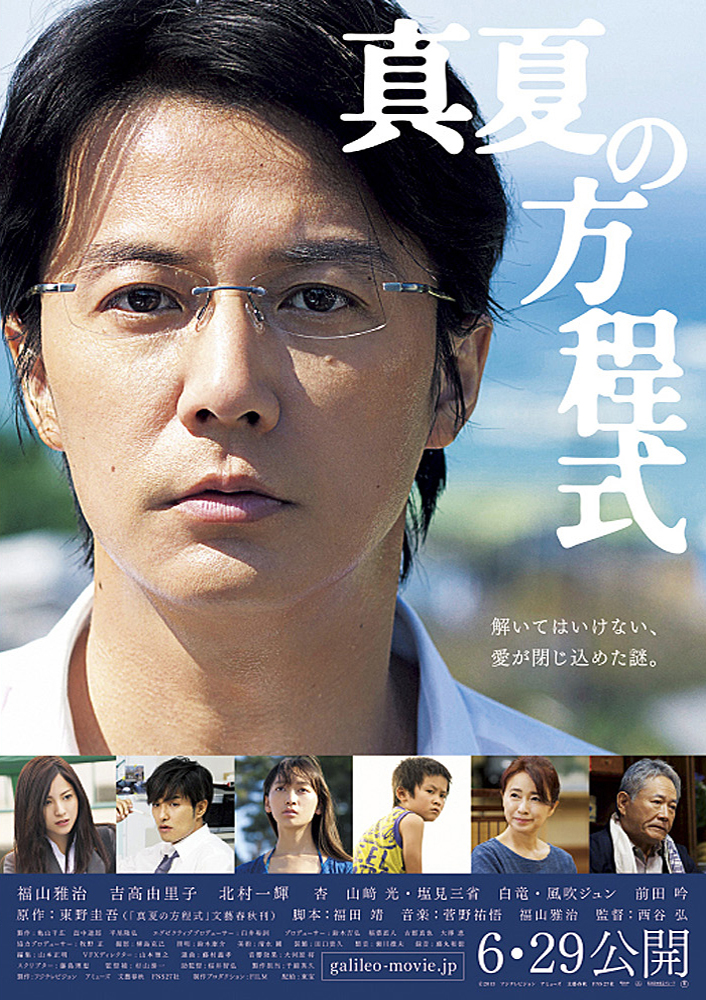
 Sometimes it’s handy to know an omniscient genius detective, but then again sometimes it’s not. You have to wonder why people keep inviting famous detectives to their parties given what’s obviously going to unfold – they do rather seem to be a magnet for murders. Anyhow, the famous physicist and sometime consultant to Japan’s police force, “Galileo”, is about to have another busman’s holiday as he travels to a small coastal town which is currently holding a mediation between an offshore mining company and the local residents who are worried about the development’s effects on the area’s sea life.
As fans of the series will know, Manabu Yukawa is a fastidious and difficult man who likes things just so. On the train he ends up encountering a small boy who annoys the other passengers by answering his phone. Apparently he can’t turn it off because all sorts of notifications will be sent to his parents and they’ll go into panic overdrive. The old man across from him doesn’t believe this and grabs the phone away from the small boy after an undignified tussle. In an uncharacteristic move, Yukawa comes to the boy’s rescue by taking back the phone and wrapping it in foil so it won’t go off again – problem solved.
The boy, Kyohei, turns out to be the nephew of the inn owners at the place where Yukawa is staying. After another guest is found dead in mysterious and suspicious circumstances, little Kyohei immediately raises several doubts of his own which endears him to Yukawa who is sad to hear that the boy hates science classes at school. Still, Yukawa concedes there are some odd details in this case especially as the dead man is an ex-Tokyo policeman. Before long Detective Kishitani has been dispatched to assist in the investigation of another strange mystery.
Again based on a novel by Keigo Higashino, the fourth in his Galileo series, Midsummer’s Equation (真夏の方程式, Manatsu no Houteishiki) is something of a departure as it takes place in an idyllic summer seaside town and is more like some of Higashino’s other mysteries as it places secrets of the heart at its core. Yukawa is generally a difficult man who can’t stand children, in fact they bring him out in a rash. However, for some reason Kyohei doesn’t seem to have this effect on him and he becomes determined to teach the boy the joy of science through a series of experiments while also investigating the central mystery. The incurably curious little tike becomes almost like a mini deputy to Yukawa as he begins to piece together what exactly has happened but it turns out Kyohei may have a different part to play than had originally been suspected.
In the usual mode, it’s not so much a whodunnit as a whydunnit and a how will they catch them. The mystery’s solution is heavily signposted from the beginning and there aren’t a lot in the way of twists. In contrast with some of the other Yukawa mysteries, particularly those from the TV drama, there aren’t a lot of clever scientific shenanigans either and though the central murder is plotted in quite an elaborate way, it’s also a panicked adaptation to circumstances which could be enacted by anyone, anywhere.
Long term series director Hiroshi Nishitani pulls out all the stops here and leaves the small screen far behind as he creates a surprisingly artistic take on a fairly run of the mill murder mystery. Beginning with the repeated motif of the falling red umbrella, he takes care to create a nuanced visual poetry which is quite different in approach both to the construction of the TV series and the other big screen outing which adapted Higashino’s most famous novel, The Devotion of Suspect X. Suspect X never quite managed to marry its roots as the theatrical adaptation of a TV drama and as an adaptation of a hugely popular and award winning book into something which was convincing on both levels. Midsummer’s Equation has an easier time with this as it’s slightly separated from the TV drama series and largely succeeds in becoming a standalone adventure for its famous detective.
Masaharu Fukuyama returns to the role with which he’s become most closely associated and once again captures Yukawa’s detached, though not necessarily uncaring, exterior with ease. He’s ably assisted by a fairly starry supporting cast which includes veteran actress Jun Fubuki, Tora-san’s Gin Maeda and the relatively young actress Anne (Watanabe) as well as the returning Yuriko Yoshitaka as the reluctant Detective Kishitani and cameo appearances from Kazuki Kitamura and Tetsushi Tanaka as Kyohei’s father.
Midsummer’s Equation is Higashino in a more forgiving mood as his hardline moralism never really kicks in and he’s content to merely be sorry for this rather complicated mess of affairs. Here, there’s hope for the future and the possibility of a path forward now that long buried secrets have been uncovered and the truth set out to bloom in the sunlight. He makes it plain that secrets are the root of all evil and that only by embracing the truth, and all of the truth, can you ever be able to make informed choices about your future. This is a lesson that Yukawa wants to pass on to little Kyohei who might be too young to understand the exact implications of his role in the affair (though he seems to have figured some of it out), but will undoubtedly have a few questions as he grows up. A well crafted addition to the series, Midsummer’s Equation proves another enjoyable excursion for Yukawa which succeeds not only in terms of its intricately plotted mystery but also as an intriguing and emotionally satisfying character drama.
The Hong Kong release of Midsummer’s Equation includes English subtitles.
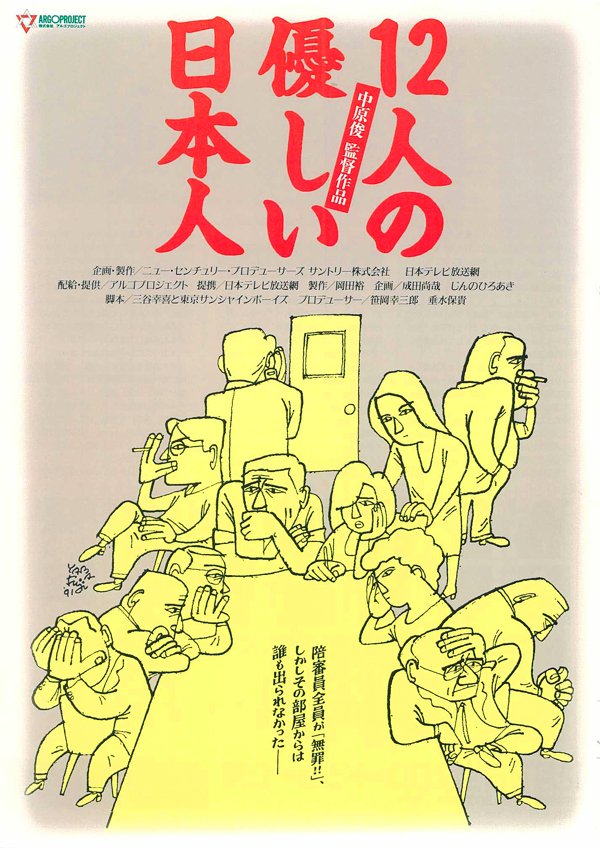 As you might be able to tell from its title, Gentle 12 (12人の優しい日本人, Juninin no Yasashii Nihonjin) is a loose Japanese parody of the stage play 12 Angry Men notably filmed by Sidney Lumet back in 1957. The Japanese title literally translates as “12 Kindly Japanese Guys” and the film takes the same premise of twelve jurors debating the verdict in a murder case which was previously thought fairly straightforward. This time our jury is a little more balanced as it’s not just guys in the room and even the men are of a more diverse background.
