
Gone with the Light (被光抓走的人, Dong Runnian, 2019)

What is love, and in the end does it really matter? It’s a question the mostly middle-aged couples of Gone with the Light (被光抓走的人, Bèi Guāng Zhuāzǒu de Rén) who perhaps assumed they were past such existential questioning find themselves contemplating after an unprecedented event causes the disappearance of seemingly random people from all over the world giving rise to the rumour that those taken were those truly in love. But if that’s so, what does it mean for the overwhelming majority left behind, suddenly lonely and uncertain wondering if they’ve been spared or judged and found wanting for their lack of emotional fulfilment. 

At 10am one spring morning, a brief flash of light creates a slight temporal disturbance causing a small percentage of the population to simply vanish. No one knows what happened or where they’ve gone, but the connection is later made that many seem to have been taken in pairs giving rise to the theory that the disappeared are the only true lovers. This is a minor problem for some of the left behind who have lost spouses twice over, not only literally but emotionally in realising that their loved one was in real, deep love with someone else. Meanwhile, those not taken begin to wonder why, questioning the validity of their relationships, doubting that their loved ones really love them but not quite daring to ask the same question in reverse. 

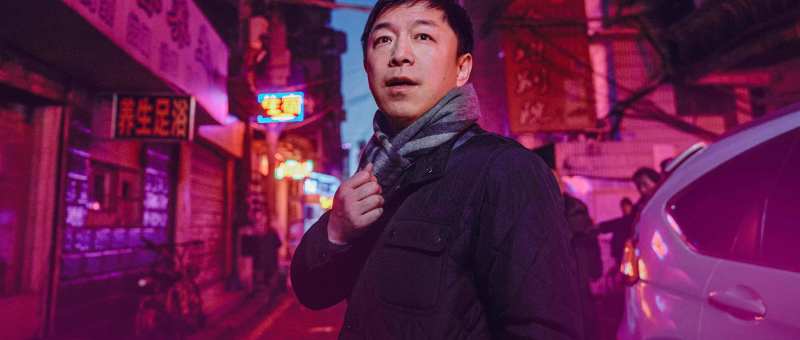
Dong opens the film with a vox pop session questioning several people about the nature of love, some of whom we’ll get to know better and others not. Our hero, school teacher, Wenxue (Huang Bo), unconvincingly claims that he does not put any stock in the admittedly unscientific theory that only true lovers were taken and that the rumours have not affected him or his wife but as we later see they have profoundly unsettled his unexceptional, middle-class family life which was at least superficially happy or perhaps merely unhappy in the most ordinary of ways. Before the light, we see him annoy his wife by waking her up smoking in bed before they have perfunctory, routine sex over which they discuss Wenxue’s hopes for promotion and whether or not it’s appropriate to schmooze with the headmaster to smooth the path. The fact they weren’t chosen eventually becomes a kind of embarrassment, the promotion going to a man whose wife disappeared on him for the slightly strange reason that being betrayed in love somehow grants him the moral high ground. Wenxue, like many, goes to great lengths to excuse himself, getting a fixer to photoshop pictures of his wife along with train tickets to make out she was in another town when the light descended.

Meanwhile, Li Nan (Wang Luodan), a woman who was in the middle of trying to divorce her husband when the light struck finds herself accosted by his mistress (Huang Lu) demanding to know where he is seeing as he did not ascend with her. The obvious conclusion is that he had another woman, but the quest forces each of them to reassess their true feelings towards the missing man, the mistress desperate to prove she wasn’t just an “adulteress” but a woman in love, and the wife that she really is ready to let him go. A young woman (Li Jiaqi) who threatened to commit suicide by jumping off a roof when her parents tried to stop her marrying her boyfriend (Ding Xihe) suddenly doubts her feelings when her parents disappear together while she and the man she thought she loved are left behind. A petty thug (Bai-ke), in the only subtle implication of a same sex love, becomes obsessed with the idea that his friend has been murdered by a TV presenter who had been bothering him and his death has been covered up to look like one of the disappearances, perhaps again hoping to find evidence against a romantic rejection. 

Talking to another man in a similar situation Wenxue is given a dressing-down, reminded that he’s been extremely self-involved and that the problems he’s now able to see in his marriage thanks to the light were there all along, only now he’s refusing to face them in a much more direct way. He couldn’t or chose not to see that his wife was lonely and filled with despair while flirting with an equally lonely woman at work. His confrontation with her provokes his only real moment of emotional reckoning as they each reflect on the fantasy of romance and its capacity to dissipate when realised. Walking in on his teenage daughter getting dumped for the first time he’s perhaps in the best position to offer advice, even if it’s of the fairly prosaic kind to the effect that she’ll get over it in time. “Your lies make me ashamed” she’d fired back at her parents’ middle-aged hypocrisy, a very ordinary marriage in which perhaps the “love” has gone, in one sense, but equally might be succeeded by something else. “It’s alright, you will know it in the future” Wenxue tells his heartbroken daughter but might as well be talking to himself, beginning to feel the love after love in conceding that perhaps this is what “love” is rather than any kind of “rapture” literal or otherwise. A beautifully pitched meditation on the consequences of love, the madness, violence, and loss, Gone with the Light finds its release in stillness and a gentle contemplation of that which remains when everything else is burned away. 


Gone with the Light streamed as part of this year’s New York Asian Film Festival.

Original trailer (Simplified Chinese subtitles only)
The Wandering Earth (流浪地球, Frant Gwo, 2019)

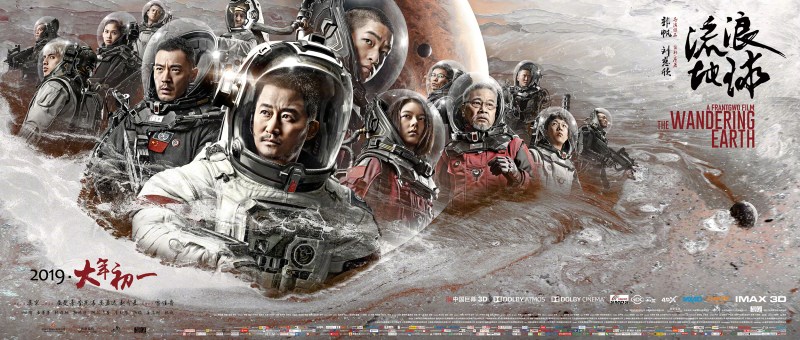
Wandering Earth poster 5Chinese cinema has not been as averse to science fiction as some would have it, but it’s true enough that The Wandering Earth (流浪地球, Liúlàng Dìqiú) marks a bold new chapter in its ambitious attempt to take Hollywood on at its own game. Adapting the novel by China’s premier sci-fi author Liu Cixin, Frant Gwo’s third feature is an interesting take on the New Year movie in which new beginnings are sought and families desperately try to reunite to see them in, only this time they do so against the backdrop of impending apocalypse as the universe threatens to swallow us whole.

Far in the future, the vast expansion of the sun will soon consume the Earth. The Wandering Earth project aims to save humanity by attaching jet thrusters to the Earth’s surface to push it out of harm’s way yet this safety measure has also had grave effects on the planet’s climate rendering the surface uninhabitable. 17 years previously, astronaut Liu Peiqiang (Wu Jing) left his 4-year-old son behind in the care of his father (Ng Man-tat) to take up a position on the space station intended to safeguard the Earth’s future. Now 21, Liu Qi (Qu Chuxiao) has grown up into a resentful, rebellious young man intent on seeing the surface for himself if only not to be home when Peiqiang finally returns to Earth. A natural disaster, however, leaves him stranded with his adopted teenage sister, Duoduo (Zhao Jinmai), just as the Earth is inconveniently drawn into a fatal collision course with Jupiter.

As much about fatherhood as it is about survival of a species, The Wandering Earth centres itself on the angry figure of Liu Qi who has been forced to live his entire adolescence underground and has come to deeply resent the memory of the father who allowed his sickly mother to die and then abandoned him. Peiqiang, meanwhile, has spent 17 years on the space station solely in order to save his son’s future, dreaming of the day they will finally be reunited. He cares little for his own life and has already spiritually handed the baton on to the next generation whose descendants, he hopes, may finally see a kinder sun rise over a new Earth.

This kind of selflessness is also reflected in the film’s refreshingly globalist outlook in which the world, no longer divided, has learned to act as one in order to combat the extreme threat from its own sun. The resistance may be China led, but depends on common endeavour and personal sacrifice. When a last ditch effort is required, the government cannot order its forces away from their families but can offer them the individual choice to keep fighting for survival, bringing teams from all corners of the Earth together as they descend on Indonesia where there just might be a one in a million chance to strike back at Jupiter and escape its gravitational pull.

Meanwhile, Peiqiang is up still up on the space station all alone and powerless while the annoyingly efficient operating system MOSS attempts to frustrate his efforts to save the Earth in service of its own mission to preserve humanity’s legacy. MOSS has made a series of calculations and given up, but giving up is not a very human trait and Peiqiang won’t do it. He makes impassioned speeches to the French-accented global authorities and ponders the best way to ensure his son’s survival even at the cost of his own but finally can only resist by literally attacking the system in overruling MOSS and acting on his own initiative.

A New Year tale through and through, The Wandering Earth is a celebration of family, togetherness, and home but is careful to dial down the patriotism for an insistence on the importance of mutual cooperation between peoples in order to combat existential threat with the spectre of climate change always on the horizon. The point, however, is that it is important to keep hope alive, if not for yourself then at least for others rather than give in to nihilistic despair. The Wandering Earth, grand and ambitious in scale, marks a new dawn of its own in terms of Chinese blockbuster sci-fi and does so with refreshing positivity as it places its hopes in human solidarity and individual sacrifice over jingoism and self-interest.


Currently available to stream on Netflix in the UK and possibly other territories.

Netflix trailer (English subtitles)

My Tomorrow, Your Yesterday (ぼくは明日、昨日のきみとデートする, Takahiro Miki, 2016)

Tomorrow I will date with yeaterday's you posterLike the Earth and the Moon, are lovers destined to move past and away from each other, sharing the same space only for a cosmic instant yet forever connected by the arc of their existences? It’s a heavier question than you’d expect from your average romantic melodrama. My Tomorrow, Your Yesterday (ぼくは明日、昨日のきみとデートする, Boku wa Asu, Kino no Kimi to Date Suru), another finely crafted tragic romance from genre master Takahiro Miki, is a kind of sci-fi “junai” in which the barriers to romantic fulfilment aren’t cultural or societal or medical, but cosmic in that our star-crossed lovers occupy opposing temporal realms which conspire against their union while also carving it into the arc of the spacetime continuum like a cruel existential joke.

At 20, art student Takatoshi (Sota Fukushi) spots the beautiful Emi (Nana Komatsu) on his morning commute. Hit by a thunderbolt, he falls for her instantly but is shy and diffident. Despite himself, Takatoshi decides that if she alights at the same station as him then it’s really meant to be and he can’t not at least try talking to her. Alight she does and he chases after her as best he can only for his cheerful attempt to ask for a phone number to be rebuffed by the ultimate excuse that she doesn’t have one. Surprisingly, Emi’s claim turns out to be the truth rather than an attempt to politely decline his attentions, though Takatoshi is surprised that his attempts at romance eventually provoke a few tears from the visibly moved Emi. The pair eventually start dating and are well into the world of young love when Emi reveals her secret – she is from a parallel universe where time runs in the opposite direction. Takatoshi’s future is her past, and her past his future. Their universes only overlap every five years for a maximum of 30 days and so this is their one and only shot at true love.

Miki begins in true romantic fashion as Takatoshi giddily pursues his first, idealised romance only latterly beginning to see signs of trouble on the horizon in Emi’s sometimes quirky behaviour and strange ability to predict the future. They walk through the usual steps towards becoming a committed couple, finally dropping the honourifics in  mutual recognition of their deepening bond, but every decisive step reduces Emi to tears in a fashion that runs beyond the merely cute or girlish. Takatoshi, young, naive, and in love, finds his mild suspicion vindicated when he discovers Emi’s diary which seems to run in reverse order and mainly contains entries for dates which have not yet happened.

Gradually, Takatoshi begins to realise that he and Emi exist on opposing planes, destined forever to orbit each other with only this brief moment of connection to sustain them. He muses on whether moving past each other is the natural path of a romance before learning to accept the transitory nature of love so that he might appreciate this brief gift he’s been given even in the knowledge that it will soon be over. Briefly petulant, he resents Emi’s dependence on the diary, filled as it is with “facts” from his 25-year-old self gleaned during a “previous” meeting, wondering if she is merely going through the motions of their predetermined romance and spoiling his vision of easy, serendipitous love in the process.

Privileging his own perspective, Takatoshi comes late to the realisation that Emi has been making a series of sacrifices on his behalf and that their strange romance is likely to prove much more painful for her than it will for him. Their relationship is built not on “shared” memories, but only in their brief moments of togetherness as they actively forge a present for themselves which is distinct from their two worlds of past and future. Like the diverging points which heralded their meeting, they are travelling in different directions – every first for him is a last for her as their moments of joy and pain become strange mirrors of their eventual heartbreak. Nevertheless, each eventually comes to the realisation that their love is worth enduring despite its inevitably sad end and that something of it is destined to remain even in the entropic melancholy of their love story. An old fashioned romance in every sense, My Tomorrow, Your Yesterday offers a surprisingly deep appreciation of true love anchored by mutual understanding and emotional equality even if it acknowledges that the world is cruel and that love is unlikely to survive as anything more than a bittersweet memory.


Original trailer (no subtitles)

Yocho (Foreboding) (予兆 散歩する侵略者, Kiyoshi Kurosawa, 2017)

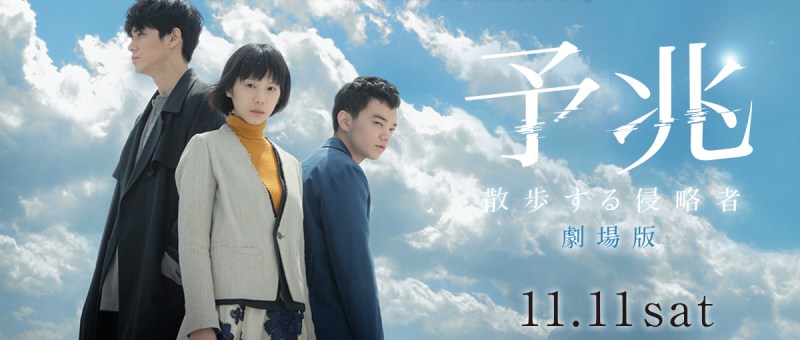
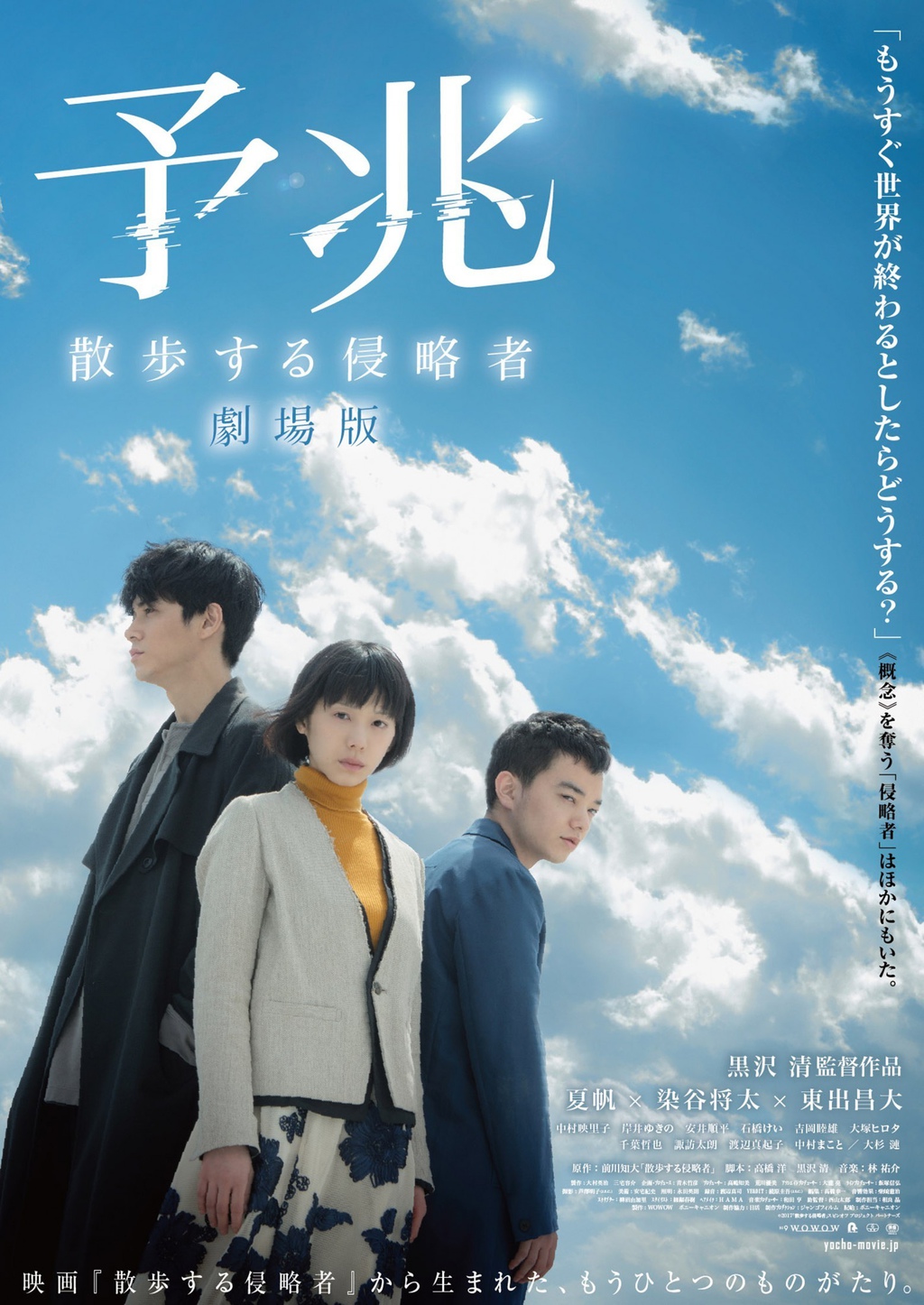
Yocho posterBefore We Vanish, Kiyoshi Kurosawa’s take on the alien invasion drama, was an oddly romantic affair which made a case for the ineffability of love as the only possible form of human salvation. Meanwhile, cheating on cinema with television, Kurosawa tells us a different story. Yocho (Foreboding) (予兆 散歩する侵略者, Yocho: Sanpo Suru Shinryakusha) was first conceived as a TV drama running as a companion piece to the big screen experience but its canvas is noticeably darker. At heart, we have the same story with a slight variation as a bold wife attempts to save her weak willed husband from alien manipulation, risking all to keep him safe him while the world burns around her. What we see this time is less the enduring power of love as a force for good, than yet another form of human weakness which encourages selfishness and creates a space into which nefarious forces may move.

In contrast to Masami Nagasawa’s conflicted, wounded wife of Before we Vanish, Etsuko (Kaho) is happily married to Tatsuo (Shota Sometani) who works at the local hospital. As she loves her husband so much, Etsuko is quick to realise there’s something not quite right in the way he’s been silently gazing off into space and walking around like a man possessed. Meanwhile, she’s accosted by a friend at work who asks to stay over because she’s too afraid to go home on account of “the ghost”. Eventually Etsuko goes investigating and discovers “the ghost” is really just her friend’s dad only her friend seems to have forgotten all about him and doesn’t quite understand what a “father” is anymore. Fearing the worst, Etsuko arranges to take her to the hospital, which is where she comes into contact with the strange and intimidating Dr. Makabe (Masahiro Higashide).

Dr. Makabe is one of the alien invaders seen in Before We Vanish who have come to Earth on a scouting mission ahead of its destruction. His mission is to steal “concepts” from people’s heads so the aliens can catalogue soon to be extinct humanity. Makabe has recruited Tatsuo to be his guide but this is a very different arrangement to that Shinji makes with his “wife” Narumi. Tatsuo is not so much an interpreter as an informant. His “job” is to select Makabe’s “victims” in return for preferential treatment when the apocalypse arrives. Increasingly conflicted in betraying his own species, Tatsuo is going slowly off the rails while the world disintegrates all around around him.

Etsuko, meanwhile, has a kind of superpower of her own in that she is apparently “immune” to alien interference. They can’t take concepts from her, they can’t manipulate her will, and they can’t break her bond with her beloved (if slightly useless) husband. The power of love still reigns supreme but this time it’s not entirely a good thing as Etsuko, who has the means to resist the evil invaders, focusses on rescuing her one true love rather than defending humanity. Love is her weakness, whereas Tatsuo’s seems to be a low lying resentment of his lack of authority. A showdown with Makabe sees him offer a grim prognosis, as long as humans lust for power there will be no escape.

Makabe, meanwhile, has experienced the opposite revelation to his Before we Vanish counterpart in learning about death and human fear of mortality. Suddenly knowing what it means to die, he understands something of human existence, realising that death is forever beside you. Love maybe be the cure for “eternal loneliness”, but Makabe’s enlightenment is born of fear and darkness rather than human warmth.

Yocho, in a sense, mirrors Before We Vanish but in a darker hue. Etsuko and Tatsuo maybe a “happier” couple than Shinji and Narumi, but Tatsuo has already crossed to the dark side, abandoning his humanity and committing heinous and unthinkable acts on behalf of his alien master out of fear and desire. Makabe, taking Tatsuo to task, points out his weakness in his need for painkilling drugs to overcome the punishment Makabe has handed down for his betrayal. Humans, he says, always choose the comforting lie over the painful truth, swallowing pain killers rather than killing the pain by dealing with its root cause. This is in a way what Etsuko has chosen to do in her quest to save Tatsuo rather than using her skills to resist the alien invasion, though Makabe remains oddly fascinated by her various unusual qualities. Foreboding fills the frame as Etsuko meditates on the various oddities of her world while the skies thunder behind her, sending curtains billowing ominously in the absence of wind. A wounded Makabe ironically remarks that he has “underestimated the power of love”, reminding us that the greatest of human strengths is also its weakness, promising destruction as much as salvation.


Screened at the 20th Udine Far East Film Festival.

Original trailer (English subtitles)

https://www.youtube.com/watch?v=9_vEqvtUdxM

Reset (逆时营救, Chang, 2017)

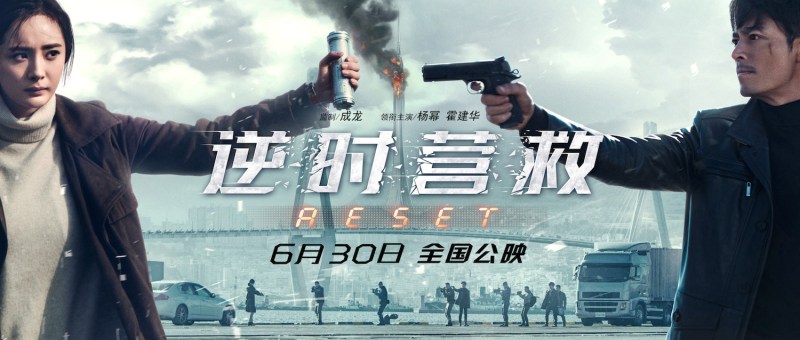
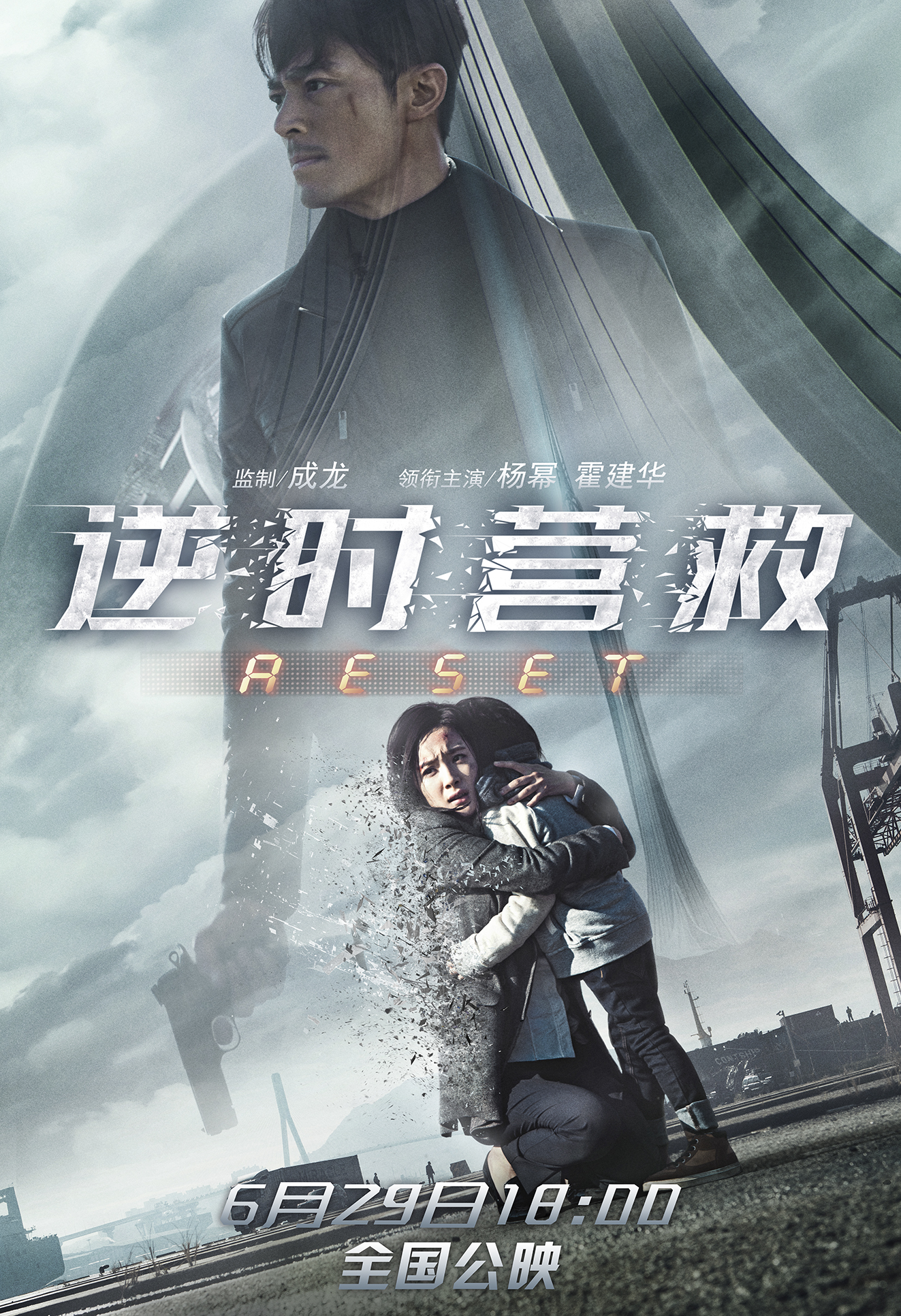
reset posterTime travel – the solution to all one’s problems. Or is it? Chinese thriller Reset (逆时营救, Nì shí yíngjiù) is helmed by Korean director Chang (AKA Yoon Hong-seung) but it’s also produced by Jackie Chan and is very much in the vein of his recent projects in its non-sensical sci-fi setup and troubling conservative messages. Reset casts a female scientist as its heroine but uses the crisis to explore her ongoing guilt as a single mother with an intense workload who has chosen to dedicate herself to both her work and her son without remarrying. Despite the action packed drama in which Xia Tian plots, shoots, and stabs her way back to her son, the message which is ultimately delivered is that you can’t go back in time and mothers should just give up everything to be with their kids 24/7.

In the near future, the existence of parallel worlds has been confirmed but early research into time travel has been derailed after test subjects transported between universes descended into mindless violence destroying each other and valuable data. Xia Tian (Yang Mi) works for one of the big companies still investigating parallel world theory and has just made a major breakthrough in “projecting” test subjects into the recent past. In order to steal her research for a rival company, Xia Tian’s young son Doudou is kidnapped by mysterious men who give her a limited amount of time to hand over the top secret documents. Xia Tian’s first attempt to rescue her son fails, leading her to make personal use of her findings and travel into the past to change the future.

Reset starts as it means to go on with Xia Tian having a heart to heart with her boss and mentor (King Shih-Chieh) who reminds her that it’s been ages since she broke up with Doudou’s dad and its high time she find someone new. Xia Tian, embarrassed, says she’s dedicating herself entirely to Doudou and doesn’t need anyone else. The bond between mother and son is the focus of the film (though Xia Tian’s clinginess may become an ongoing problem as Doudou grows up) as Xia Tian travels through time to ensure the survival of her little boy no matter how morally compromised she may eventually become.

Use of the time machine apparently has certain side effects, as the first experimenters discovered. The original Xia Tian was a sweet, innocent woman way out of her depth with these fearsome, amoral gangsters but Xia Tian 2 is much more savvy, chloroforming the “nice” version of herself and taking over with the power of hindsight to help her get out of the building before all hell breaks loose. Xia Tian 3, however, has taken things too far, acting without any kind of concession to morality and suddenly becoming some kind of major action star with special forces training for no given reason. There might be a clever point about Xia Tian’s various conflicting roles but Reset doesn’t want to make it so much as have Xia Tian help/hinder herself in a selfish tug of love to save little Doudou who just wants to go home to his mum.

Non-sensical as it is, Reset picks up when it hits its action heavy final third in which Yang Mi, more often seen in sweetly romantic roles, acquits herself well enough as a fiery action star filled with maternal rage. The various layers of the resets generally hang together as the three Xia Tians cross each other’s paths to get Doudou to safety, only to belatedly realise that only one of them can really stay with him forever.

Maternal love is the machine which drives the story forward but it’s also the most problematic element in its partial insistence than Doudou’s fate is somehow Xia Tian’s fault for daring to use her finely tuned brain for the common good rather than just staying home and reading comics with her little boy like a mother should. It’s difficult to escape the conclusion that the lesson is women shouldn’t work, rather than corporations are inherently untrustworthy and that time travel creates problems for everyone (not least editors and scriptwriters) and should generally be avoided. Despite high production values, interesting production design, and an impressive (or is that three impressive) performance(s) from Yang Mi, Reset’s strong action credentials cannot compensate for its unpalatable conservative message and non-sensical science fiction narrative.


Screened at the London East Asia Film Festival 2017.

International trailer (English subtitles)

Junk Head (Takahide Hori, 2017)

junhead still 2“God is Dead! We Killed Him!” exclaim some funny little mole/penguin people in Takahide Hori’s Junk Head, only to follow it up seconds later when a giant worm spits out the divine visitor from above with “He Hath Risen”.  An extreme feat of technical prowess, Junk Head is a marvel of cyberpunk production design tempered with wry humour and a weary exasperation as regards “humanity” and its children. A man loses his head, literally and figuratively, and finds himself on a journey into the deepest darkest underground filled with mutant clones and terrifying monsters, searching for salvation while groping for identity.

Far in the future, humanity thought it had it made – abnegating their responsibilities to a crowd of lowly clones and living a life of ease, but the clones rebelled and took themselves underground leaving humanity to fend for itself on the surface. Immortal through gene replacement therapy, humanity has also lost the ability to reproduce naturally and now that a disease has wiped out around 20% of the remaining population with no sign of stopping, there is urgent need to rebuild the species.

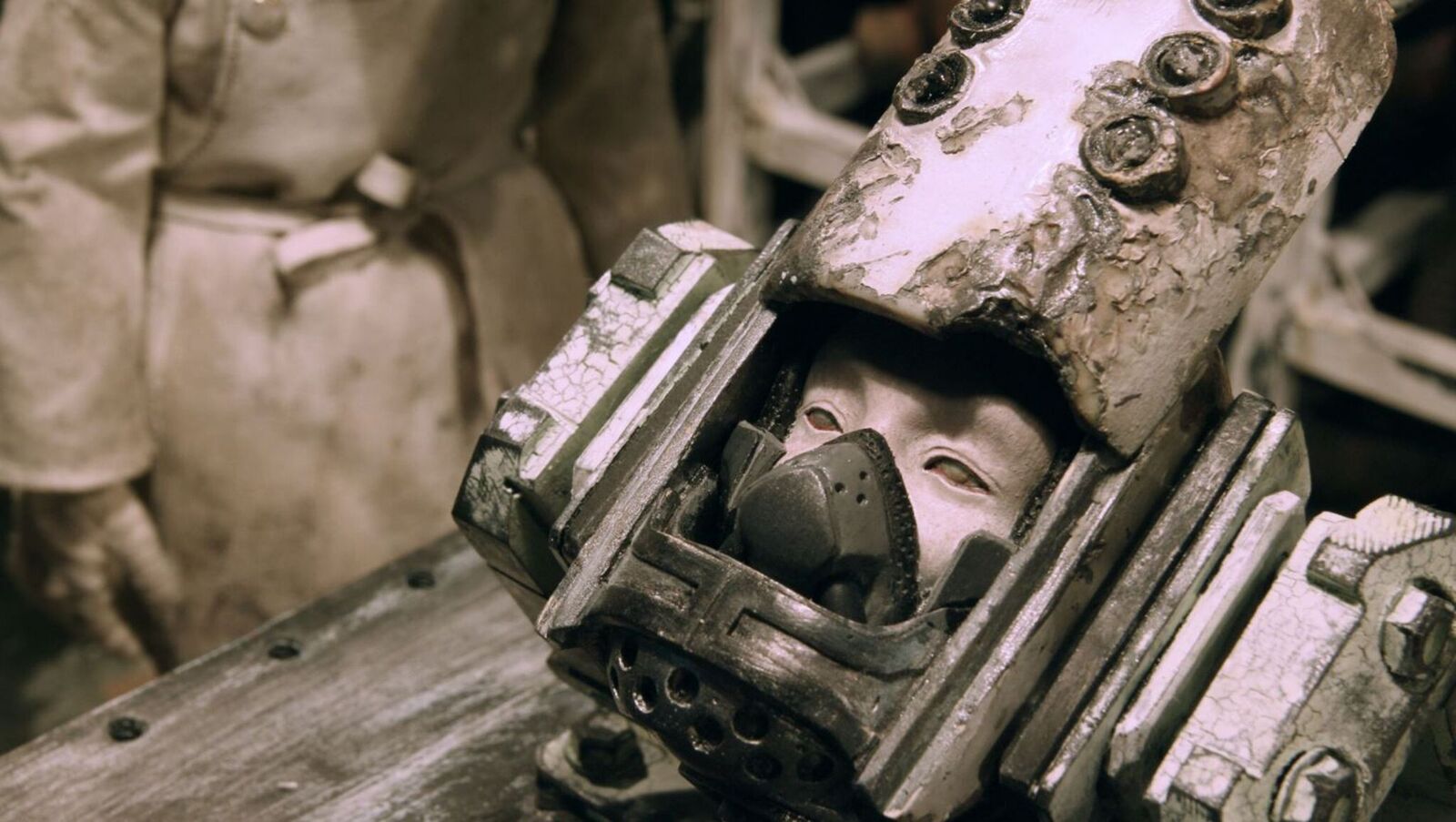
Hoping to find an answer in the world below, humanity sends one cyborg researcher on a desperate mission. Sadly, the capsule carrying the robot is shot down by wary humanoids living on the higher levels. His head continues to fall until it’s found by a scavenger party who take it to a doctor who “recognises” the head inside the helmet as “human”. Seeing as humanity is, in a sense, their creator, the clones stand back in awe of their new “God”. Now placed into an adorable little white stormtrooper-meets-I-Robot body, God can remember nothing of his past life and spends most of his new one trying to get to grips with his tiny hands and unwittingly walking into certain death only to be saved when the various evil creatures remember they don’t like the taste of metal.

As time moves on God takes on many forms as he falls further through the underground universe, swapping his cute round body for a blocky makeshift one without a voice but with a bigger heart. Having regained some of his memories immediately before his first transformation, the second God is not such a nice guy but “Junkers” is the type to whip up chairs for old ladies and walk miles to gather “Mashrooms” for his new masters, not to mention leaving some food behind for a hungry mutant girl. Once his memories are fully restored (through repeated blows to the head), God thinks back on his soulless life on the surface and realises he’s never felt so alive as he does 600 feet under. The sky might be pretty, but it’s cold up top.

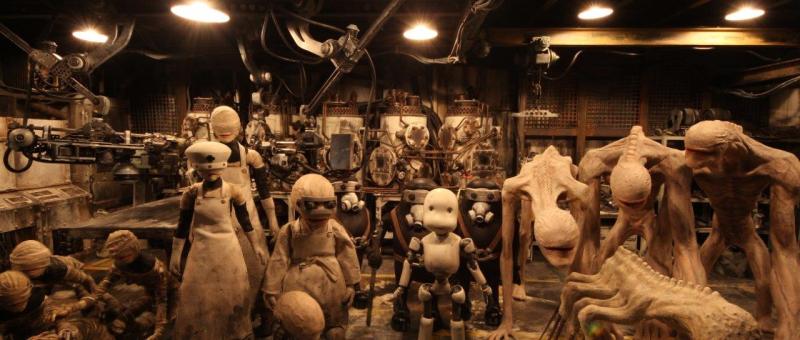
As cute as God is (in all his incarnations), Junk Head’s world of basement horrors is surreal and terrifying. Some monsters are more harmful than others, but the major peril of the middle layers is persistent wormholes from which giant, toothy creatures emerge to devour unsuspecting travellers. Fleshy spiders hang from the ceiling and “Mashrooms” appear to be fleshy protuberances grown on humanoid backs imprisoned within walls. The post-apocalyptic underground city is a perfectly designed mix of makeshift and industrial architecture, covered in dust, grime, and scratches. God’s first body is appropriately worn before he even gets it, a true tribute to the depth of Hori’s conceptual design.

Drawing inspiration from Giger and Kubrik, the world which most comes to mind is, perhaps unexpectedly, David Lynch’s Dune. From the strange mole/penguin people and their rubbery suits to the torpedo shaped, bright red big busted women the underground is an industrial fantasy zone where tiny dinosaur-like snake worms waddle around adorably before being picked off for dinner. Hori brings scope to the claustrophobic world of tunnels and ducts by shooting at a distance with painterly compositions echoing German expressionism. He echoes Lynch again in the constant, dream-like use of dissolves and montage while the punk soundtrack and quick fire swapping from one empty corridor to another is reminiscent of Shinya Tsukamoto or Sogo Ishii. Despite its rather abrupt ending (which does at least tease further adventures for God in the wilderness), Junk Head is a charming, surreal odyssey through a post-apocalyptic wasteland filled with zany humour and rich in character detail. Hopefully the second coming of God will not be too far off.


Screened at Raindance 2017.

Original trailer (dialogue free)

BLAME! (ブラム!, Hiroyuki Seshita, 2017)

blame posterCities. The pinnacle of human achievement and an almost living monument to civilisation. Does the same principle of human collective settlement also relate to the digital realm or will increasing interconnectedness eventually destroy everything we’ve built? Following their landmark CGI adaptation of Tsutomu Nihei’s Knights of Sidonia, Polygon Pictures return to source by adapting the author’s debut work BLAME! into a feature length animated movie. Like Sidonia, BLAME! (ブラム!) takes place many years after a climactic event has led to the fall of human civilisation – an event so long in the past as to have become mere myth to the small number of humans still clinging on to life in a now inhospitable terrain, but BLAME!’s dystopia is very much one created by man, losing control of its technology in its ever advancing hubris.

As the young girl who offers the opening monologue tells us, no one knows how all of this happened. Once, a long time ago, humans lived in a city but a virus came and they lost the ability to communicate with the environment in which they lived. The city began to grow, and the “Safeguard” system decided that humans were “illegal immigrants” in their own land. The exterminators swooped in to wipe them out but a small band of humans has managed to survive a few hundred years in a kind of safe zone protected by a perimeter wall the city’s systems are prevented from monitoring.

The rapid expansion of the city has also meant a reduction in vegetation and the surviving humans are running low on food. An intrepid team of children ventures out into the wasteland in search of sustenance, but they’re spotted and targeted for elimination. A mysterious figure appears on the horizon and saves them. The man calls himself a “human” and is disappointed to realise none of the children are carriers of the “Net Terminal Gene” which he is seeking. Killy (Takahiro Sakurai) claims that the Net Terminal Gene will enable the humans to take back control of the city’s systems, halt the excessive building program and call off the Safeguard attack dogs.

Killy’s appearance brings new hope to the villagers, trapped within their perimeter stronghold but facing the prospect of staying and starving or taking their chances with Safeguard. Concentrating on action rather than philosophising little time is given over to considering how humanity lives though it’s certainly puzzling that there is so little reaction when the band of children returns home much depleted in numbers. Indeed, aside from Pops (Kazuhiro Yamaji), the de facto leader of the community, no other “adults” appear.

Using Killy as a kind of deflective shield, the gang press on until they find an abandoned robot, Cibo (Kana Hanazawa), who tells them about an “Automated Factory” in which she can generate both an abundant food source and a synthetic tablet which will allow them to get back into the city’s systems. What ensues is a deadly firefight as the system fights back. Cibo pleads with The Authority in the digital realm while Killy and the villagers hold back the forces of order with firepower from the outside.

Killy remains a man of few words, his language dulled through inactivity and his expression inscrutable, but the villagers, perhaps lulled into a false sense of security thanks to long years of isolation, never question his motives or reliability. Likewise, Cibo clearly knows more than she lets on but offers the only lead so far on a way back to a less precarious way of life. Killy’s sudden appearance becomes a mythic event, a point of transition in the history of the post-apocalyptic world, but also seems to be without resolution as the closing coda implies.

Like Sidonia, the animation quality is at times variable but often excels in its highly detailed backgrounds, allowing production design to smooth over any narrative gaps. What BLAME! lacks in terms of plot and character complexity it makes up for in world building though it is difficult to ignore the feeling of the loss born of condensing something far larger into an easily digestible whole. Nevertheless, BLAME! does what it sets out to do with quiet brilliance in detailing what might be the first of many adventures of the wanderer known as Killy as he explores a world ruined beyond repair looking for the key to unlock a brighter future.


Netflix trailer (Japanese with English subtitles/captions)

Lucid Dream (루시드 드림, Kim Joon-sung, 2017)

lucid dream posterA relatively rare phenomenon, a lucid dream is one in which the dreamer is aware they are asleep and “awake” enough to influence the outcome. Rather than using the ability to probe some kind of existential question, Korean science fiction thriller Lucid Dream (루시드 드림) focusses on the evidence gathering possibilities, going one step further than hypnotic regression to revisit old memories and zoom in on previously missed details.
Dae-ho (Ko Soo) is an investigative reporter currently in hot water over a controversial story. He’s also a doting single father to a little boy, Min-woo (Kim Kang-Hoon), who resolves to put his work aside for a day to take his son to an amusement park. Tragedy strikes as Dae-ho is busy having words with a paparazzo and then notices Min-woo has disappeared from his horse on the carousel. Catching sight of Min-woo walking off with another man, Dae-ho collapses, a tranquilliser dart sticking out of his leg. Dae-ho searches for his son with no concrete leads until, three years later, he hears about the possibilities of lucid dreaming and attempts to figure out exactly what happened that day by reliving it in his sleep.

Lucid Dream begins in true conspiracy thriller mode by introducing Dae-ho’s past as a controversial journalist responsible for ruining prominent businessmen by exposing their corruptions and manipulations of the laws everyone else is expected to abide by, but this potentially rich seam of social commentary is cut off in full flow as paternal concerns take centrestage.

Dae-ho is a single dad raising Min-woo alone with the help of a friendly nanny. Although he tells Min-woo his mother is “in America” no concrete information is given regarding her whereabouts though the fact that she is never heard from after Min-woo’s disappearance suggests she may be somewhere further away. Apparently a devoted and good father from the very beginning, Dae-ho will stop at nothing to find out what’s happened to his son. Three years on he remains distraught and desperate, willing to try anything that might help him uncover the truth. He finds an ally in the policeman handling his case who is in a similar predicament as his own daughter lies in a hospital bed, born with serious medical abnormalities. The true paternal love, determination, and sacrifice of men who are already good and devoted fathers raising pleasant, uncomplicated children define the drama as others attempt to subvert that same love in choosing to sacrifice one child in favour of another.

Though Dae-ho originally assumes the plot is directed at him alone, possibly revenge for his exposés, the truth is darker and moves towards child trafficking and the trade in illicitly harvested organs though this too is mostly glossed over in favour of competing parental needs. The men who’ve taken Min-woo veer between amoral gangsters and those who can’t stomach the outcome of their actions ultimately deciding to rebel against their own side, and even if the real perpetrator turns out to be someone not so different from Dae-ho, there can be little justification in this dark flip side to Dae-ho’s all encompassing paternal love.

The central premise of dreams and memory is an interesting one, but largely squandered by the increasingly dull narrative progression in which Dae-ho moves from clue to clue in linear fashion and along predictable genre lines. Most viewers even remotely familiar with similarly themed films will have correctly identified the villain right away thanks to the heavily signposted script, and will necessarily be disappointed by the rather predictable yet action packed finale.

Dae-ho travels through dream states, eventually learning to invade the dreams of others thanks to the guidance of a mysterious shared dreamer but the application is inconsistent and relegated to plot device only. The finale takes place within a dream and with the stakes heightened as it becomes clear death inside someone else’s mind results in death outside it, but the imagery remains clichéd as Dae-ho battles the villain inside a rapidly disintegrating building before being forced into a literal leap of faith. Despite the surface level grimness of the story, Lucid Dream remains firmly in mainstream thriller territory with under developed characters, dead end sub plots, and a satisfying if not entirely earned moment of final closure. It is, however, also a rare example of a broadly happy ending in a Korean procedural, in which a father’s love can and does save the day, if not the film.


Original trailer (English subtitles)

https://www.youtube.com/watch?v=ylJzvTgv3-Q

Genocidal Organ (虐殺器官, Shuko Murase, 2017)

genocidal organHistory books make for the grimmest reading, subjective as they often are. Science fiction can rarely improve upon the already existing evidence of humanity’s dark side, but Genocidal Organ (虐殺器官, Gyakusatsu Kikan) has good go anyway, extrapolating a long line of political manipulations into the near future which neatly straddles a utopian/dystopian divide. Plagued by production delays and studio bankruptcy, Genocidal Organ is the third of three films adapted from the novels of late sci-fi author Project Itoh, arriving nearly two years after previous instalments Harmony and Empire of Corpses. Sadly, its message has only become more timely as the world finds itself on the brink of a geo-political recalibration where fear and division rule the roost.

Set in 2022, the world of Genocidal Organ is one of intense “security”. Following the detonation of a nuclear bomb in Sarajevo in 2017, developed nations have once again become jumpy. As the world weary narrative voice over informs us, Americans have sacrificed their freedoms for an illusion of safety which decreases the burden of living under the threat of terrorism. This brave new world is a surveillance state where citizens are chipped and monitored, even the simple act of buying pizza requires an identity check.

Less developed nations, however, have descended into a hellish cycle of internecine wars and large scale atrocities. American special forces have identified a pattern which puts one of their own, mysterious linguistics professor John Paul (Takahiro Sakurai), at the centre of a vast conspiracy. Army Intelligence officer Clavis Shepherd (Yuichi Nakamura) is despatched to track the master criminal down through his sometime girlfriend Lucia (Sanae Kobayashi), a Czech national and former MIT linguistics researcher now teaching Czech to foreigners in Prague.

Clavis, like the best film noir heroes, finds himself falling down a rabbit hole into an increasingly uncertain world. A top soldier, he has been “engineered” to decrease emotionality and limit pain response to make him a “better” soldier. His world is first shaken when one of his comrades goes rogue, kills a valuable mark, and then turns a gun on him. The top brass blame PTSD but not only that, PTSD that was in fact induced by the very processes the soldiers undergo to ensure than PTSD is impossible. He has always believed that his actions, and those of his superiors have been for the greater good, but he has rarely stopped to think what that greater good may be.

Clavis’ missions see him jumping into a coffin-like landing pod and parachuting into street battles in which many of the combatants are children who have been drugged “to make them better soldiers”. Just as you’re starting to wonder who exactly is perpetrating the genocide, Clavis is asked the relevant question by a captive John. He replies that it’s just his job. John reminds Clavis that that particular justification has a long and terrifying history and so perhaps he ought to ask himself why he chooses to do this particular job and do it so blindly.

John’s big theory is that violence has its own grammar, a secret code buried in language which can be engineered to provoke political instability but then conveniently contained within its own language group. Essentially, he posits the idea of sicking the “terrorists” onto each other and letting them fight it out amongst themselves in those far off places which no one really cares about. The citizens of the developed world might frown at their morning papers, but they’ll soon file it under “terrible things happening far away” and go back to enjoying their lives of peace and security. John’s plan, he claims, is the opposite of vengeance, a means of keeping his side safe by ensuring that the terrible things stay far away, contained.

The “genocidal organ” is the heart hardened towards the suffering of others. John has some grand theories about this, about the survival instinct, fear, suspicion and desperation, but he also has a few on the trade offs between freedom and security. Itoh’s vision is bleak, and the prognosis bleaker but its logic cannot be denied, even if its execution is occasionally imperfect.


Currently on limited theatrical release throughout the UK courtesy of All the Anime.

Original trailer (English subtitles)

Real (リアル 完全なる首長竜の日, Kiyoshi Kurosawa, 2013)

real posterKiyoshi Kurosawa has taken a turn for the romantic in his later career. Both 2013’s Real (リアル 完全なる首長竜の日, Real: Kanzen Naru Kubinagaryu no Hi) and Journey to the Shore follow an Orpheus into the underworld searching for a lost love stolen by death, but where Journey to the Shore is a tale of letting go, Real is very much the opposite (or so it would seem). Taking on much more of a science-fiction bent than Kurosawa’s previous work, Real adapts the Rokuro Inui novel A Perfect Day for a Pleisiosaur in which the boyfriend of a woman in a coma journeys into her subconscious through a process known as “sensing” in order to help her face up to whatever it is that’s keeping her asleep and lead her back towards the living world (or so we think). Strange and surreal, Real is a meditation on love, trauma, and the nature of consciousness in which “reality” itself is constantly in shift.

Koichi (Takeru Satoh) and Atsumi (Haruka Ayase) are childhood friends now living together as a couple. Despite their apparent happiness, one year after we see them enjoying a cheerful breakfast Atsumi is in a coma following a suicide attempt and Koichi is about to undergo an experimental procedure known as “sensing” to try and venture inside her consciousness to find out why she did it and possibly help her wake up.

Koichi makes contact and finds Atsumi living more or less as she had before, inhabiting their shared apartment and hard at work on a manga series, Roomi, which is now on hiatus following her indisposition. Roomi, like much of Atsumi’s work, is dark and macabre – the story of a serial killer who murders people in increasingly violent and disturbing ways. The brief flashes of bloody victims Koichi begins to notice in his peripheral vision soon give way to “philosophical zombies” or the NPCs of of the subconscious which take the form of badly animated third parties peopling Atsumi’s mind. What Atsumi wants from Koichi is to find a drawing of a Pleisiosaur she drew for him when they were children, because it was “perfect” and will help restore her faith in herself as an artist.

The Pleisiosaur turns out to be a little more significant than it first seems, taking Koichi and Atsumi back to the remote island where they first met. Almost like Stalker’s “The Zone” the island is a place of ruined dreams and frustrated inertia where some kind of accident related to the construction of a resort Koichi’s father was involved in building has permanently destroyed any idea of progress. This frozen, rubble strewn landscape perfectly reflects the lost world of the trapped dreamers as they battle the ghost of a shared yet half forgotten childhood trauma.

Though less obviously disturbing than some of Kurosawa’s previous forays into eerie psychological horror, Real has its share of typically J-horror tropes including a dripping wet ghost albeit this time one of a little boy popping up in unexpected places. Kurosawa opts for a hyperreal aesthetic, filming with harsh digital cameras which make little concession to the obviously cinematic, adding to the appropriately lifeless atmosphere of Koichi’s “real” world life and the surreal dreamworld of Atsumi. Koichi’s oddly pyjama-like clothing adds to the ongoing uncertainty as the two worlds blur into each other, becoming indistinct as the screen texture suddenly changes or the camera rolls to an unusual angle.

Shifting from Tarkovsky’s landscapes of desolation to Antonioni’s fog filled confusion, Kurosawa peels back the layers of repressed trauma to finally get to the core of what’s trapping the protagonist’s psyche within its frozen state. Childhood friends as they are, Koichi and Atsumi are trapped by a sense of guilt for something that they were both witness to all those years ago and so to overcome it, they will need to face it together. This time Orpheus descends but refuses to leave alone, battling literal dinosaurs from the distant past which must be placated with tokens of affection and, finally, heartfelt apologies. The “real” remains obscure, but Kurosawa does, at least, demonstrate his faith in love as salvation in a climax that echoes A Matter of Life and Death even if in a surreal and not altogether successful way.


International trailer (English subtitles)