Tokarev (トカレフ, Junji Sakamoto, 1994)

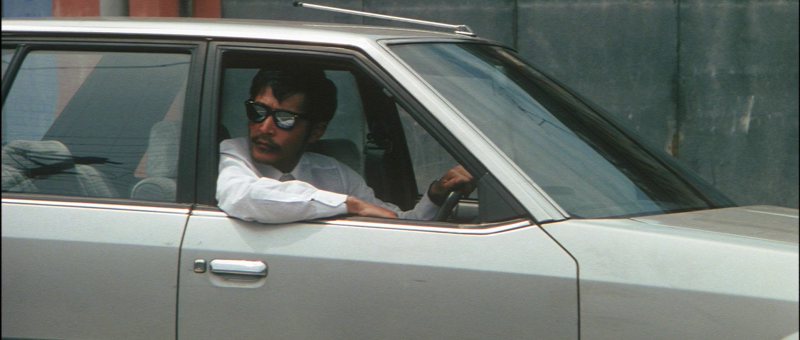
The discovery of a pistol concealed under a vending machine provokes a prolonged crisis of power and masculinity in Junji Sakamoto’s tense psychological drama, Tokarev (トカレフ). So named for the guns at its centre, the film roots itself in post-Bubble anxiety in the push and pull between two very different men mediated through the kidnapping of an innocent child who in the end pays a very heavy price for the anxieties and resentments that drive his parents’ generation.

That said, the kidnappers are actually very nice to little Takashi who looks strangely happy in the videotaped ransom note as the friendly voice of a youngish man encourages him to look towards the camera. They take him to an amusement park, buy him new shoes and ice cream, and even let him wave the gun around during the money drop but are it seems otherwise callously indifferent to his fate.

The boy’s father, Nishiumi (Takeshi Yamato), has just moved onto a danchi housing estate with his wife Ayako (Yumi Nishiyama). They seem very excited to start their new life, yet the danchi itself speaks of a post-war aspiration which now seems dated and largely absent in the contemporary society. Nishiumi drives the bus to the local kindergarten picking up the surprisingly large number of children from their block each morning. Meanwhile, their neighbour, Matsumura (Koichi Sato) seems irritated by their presence perhaps jealous of their happy family life as he returns home alone and angrily flips the cover over his motorbike before opening the door. 

On the morning in question, Matsumura has trouble kickstarting his bike yet Ayako seems strangely drawn to him perhaps attracted by a different and older kind of masculinity. Unlike her husband, Matsumura wears a suit to work everyday and carries a little salaryman-style purse yet he works a job that could be considered manual in a printing press where they produce newspapers. He later excitedly tells Ayako that he gets to read the news before anyone else, though his hands glide over notices of violent crimes including a shooting which may seem additionally exciting to him given that he is the man who discovered a gun under a vending machine in Christmas-set opening sequence. His cluttered home otherwise at odds with the sense of order he projects is full of old newspapers while he seems to listen to the same weather broadcast every day. 

The gun is later used by another man who fires it at Nishiumi before abducting Takashi from the kindergarten bus. It takes Nishiumi a few seconds to realise it’s Takashi who’s been taken, suddenly taking off at speed after him endangering the lives of the other kids. The sense of guilt and inadequacy slowly consumes him. “Takashi must be so disappointed,” he later laments to Ayako over the phone in his failure to live up to the socially defined codes of masculinity. His son was taken from him in front of his eyes yet he couldn’t do anything to save him. Matsumura meanwhile turns up near the crime scene having been shot in the shoulder claiming the kidnapper stole his bike. 

Perhaps it’s this uncanny proximity along with his odd expression and obvious effect on Ayako that leads Nishiumi to believe that Matsumura was somehow involved in the crime. In another instance of mid-90s technophobia, the clue is once again discovered via videotape as a guiltridden Nishiumi spots Matsumura in the crowd at his son’s sports day which is odd considering he has no children of his own and no reason to be there. The kidnapper also films the random drop on camcorder, black and white images capturing a crowded Shibuya presumably as some kind of insurance plan.

After being attacked and seriously injured, Nishiumi ends up in hospital where he ironically discovers a gun of his own stashed in the restroom by a visiting yakuza. As it had Matsumura, the gun gives him a new sense of power but also drives him into a frenzied obsession, dressing like a yakuza himself in a suit and dark glasses having alienated Ayako who eventually leaves him for Matsumura who has by this point usurped him as a man and patriarch, taking everything he ever had. No longer wishing to live, he embarks on a suicide mission to get his revenge on Matsumura. The pair of them essentially trade places, Matsumura now in check shirt and jeans while Nishiumi approaches in a suit each of them corrupted by the illusionary power of the gun. 

It later transpires that the kidnapper was also facing a crisis of masculinity in that his business was about to go bust, though Nishiumi was not a wealthy man or particularly good candidate for a ransom. The police, who are in fact completely useless, bungling their only opportunity to retrieve Takashi because they were caught off guard by the kidnapper giving him the gun, keep asking him if there’s anyone who might have held a grudge but as he points out there must have been thousands of incidents of petty annoyance that may have pushed someone over the edge dating all the way back to his childhood. The battle he finds himself in is one of vengeance to reclaim his wounded sense of masculinity while Matsumura in turn is determined to defend the new life he’s bought for himself or perhaps stolen from Nishiumi as a happy family man. Sakamoto keeps the tension high through the near wordless closing sequence in which the two men square off against each other with the intention of meeting their endgame each victims of the pervading sense of futility of the post-Bubble era.
Let Him Rest in Peace (友よ、静かに瞑れ, Yoichi Sai, 1985)

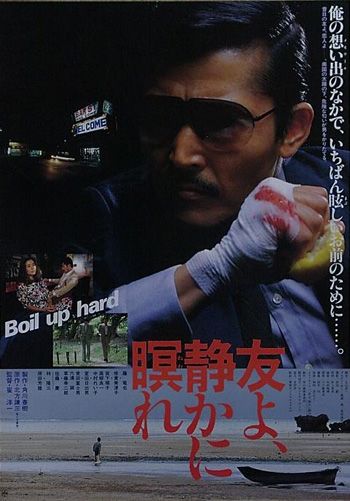
“There are times when you need to stand for something” according to an ultra masculine avenger giving a few lessons in manliness to the already defeated teenage son of a friend. A noirish, stranger in town affair, Yoichi Sai’s Let Him Rest in Peace (友よ、静かに瞑れ, Tomo yo, Shizukani Nemure) locates itself in an awkward frontier landscape, moribund small-town Okinawa seemingly devoid of life now that the Americans have pulled out and moved on. The Americans have, however, been “replaced” by beefed up corporate thugs backed by yakuza muscle and corrupt police. Sometimes you have to take a stand, if only to show them that you won’t be pushed around because if you give in once you’ll never be free. 

Disgraced doctor Shindo (Tatsuya Fuji) has come to Okinawa in search of the Freein, but every time he tries to ask someone for directions, he is met with intense hostility, the last man even telling him “You shouldn’t go there, that place is no good”. This is not because the Freein is mostly home to a collection of brassy sex workers, but because its owner and Shindo’s old friend whom he has come to help has become a local pariah. Sakaguchi (Ryuzo Hayashi) is currently in jail because he apparently went crazy and started waving a knife around at construction magnate Shimoyama (Kei Sato). As Shindo quickly finds out, Shimoyama is in the process of buying up the whole town and Sakaguchi is the last remaining hold out. As such, he is hated by most of the other residents and the subject of persistent harassment by Shimoyama goons who have not only thrown bricks through the windows but gone so far as to kill his son’s dog, later kidnapping the boy to put pressure on the pair of them. 

What’s not lost on Shindo is the extent to which Shimoyama’s corruption has already seeped into the town. Meeting Sakaguchi’s son Ryuta (Makoto Mutsuura) by chance, Shindo takes the boy to see his dad but is again met with hostility by the local bobby, Tokuda (Hideo Murota), who tells him that “Shimoyama Construction is the savour of this town”. “There’s no other company that is so giving”, he goes on, “to have the employees of a company like that working here, I can’t have a wild man like Sakaguchi running about”. According to Tokuda, Sakaguchi is the odd man out, an inconvenience to all those around him who believe in Shimoyama and are trying to save the town. Tokuda looks sheepish when Shindo asks him why he’s so into Shimoyama, confirming the mild suspicion aroused by his improbably fancy watch. 

Tokuda’s warning is however borne out by the townspeople who continue to shun and ignore Shindo while the other kids mercilessly bully Ryuta, calling him the “craziest kid in Japan” and calling for his dad to get the death penalty despite the fact that all he seems to have done is aggressively wave a fruit knife at the wrong person. The local cafe owner describes him as an embarrassment and accuses him of holding out to get more money. After all there’s no future in this tinpot town which seems to exist in the ruins of the post-war era and Shimoyama is already offering triple the going rate so Sakaguchi is only being greedy and selfish. Komiya (Ryoichi Takayanagi), the bellboy, if you could call him that, at Freein, spins it slightly differently, explaining that no one supported Shimoyama in the beginning but they’ve all been harassed themselves and have long since given in. Shindo convinces Ryuta to talk about his kidnapping, but Ryuta tells him that on his return he told his father they should leave, that it was pointless to resist. Shindo asks him if he’s ever been in a fight, but the boy asks what the point is if you know you’re going to lose, “the strong are always strong”. 

That kind of defeatist thinking is anathema to Shindo’s conception of manhood. Despite his father’s incarceration, Ryuta is too afraid of being kidnapped again to go to school. Trying to be nice about it, Shindo calls him a coward for telling his father to leave even though he wants to stay because he allowed himself to be threatened into sumbmission. He tells him that he has to stand up for himself, report his kidnapping to the police. Ryuta tells him he’s crazy, the police are in on it, but Shindo counters that it’s worth trying to get his father out of jail because if they don’t they’ll never know. Ryuta snaps back that he knows already, and indeed bottles his chance when Shindo manipulates Tokuda into “helping” him oppose Shimoyama’s cult-like hold over the town.  

Shindo might not be that much better, he’s prepared to fight dirty, getting hard evidence of Tokuda’s corruption and trying to use it against him but even these methods prove ineffective against such a vast and entrenched mechanism of control. Shindo also realises that Shimoyama’s minion Takahata (Yoshio Harada) is another old university classmate, a member of the boxing club, bringing this widening drama down to the level of three men who went to the same prestigious university but all ended up here, pretty much at rock bottom. Though ironically enough Shindo’s broody silence and dedication to his friend have a few of the women wondering if he might be gay, his preoccupation is with a failure of masculinity. He doesn’t think Shindo was actually capable of threatening anyone, and knows that he had reasons that he might have wanted to try and sort this out sooner rather than later. His son’s words pushed him over the edge. He used his body as a weapon, tried to make Shimoyama damn himself, but his efforts were frustrated. Shindo acknowledges that “saving” his friend might look quite different than one might think, inadvertently teaching young Ryuta a few problematic lessons about what it means to be a man. Still, the town might have been “saved” in one sense at least in being freed of this particular oppressor. A stand has been taken, and a man’s self worth restored, but as Sakaguchi’s wife (Mitsuko Baisho) points out even while fully understanding the codes by which the men around her live, what is to become of those left behind?


TV spots (no subtitles)

Someday, Someone Will Be Killed (いつか誰かが殺される, Yoichi Sai, 1984)

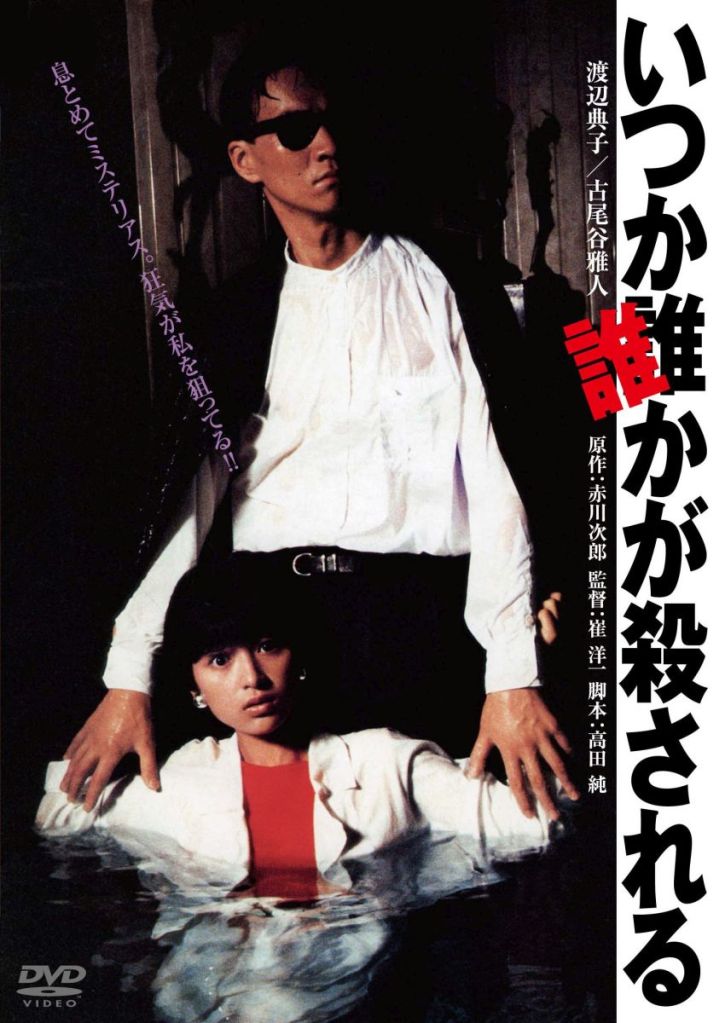
Haruki Kadokawa dominated much of mainstream 1980s cinema with his all encompassing media empire perpetuated by a constant cycle of movies, books, and songs all used to sell the other. 1984’s Someday, Someone Will be Killed (いつか誰かが殺される, Itsuka Dareka ga Korosareru) is another in this familiar pattern adapting the Kadokawa teen novel by Jiro Akagawa and starring lesser idol Noriko Watanabe in one of her rare leading performances in which she also sings the similarly titled theme song. The third film from Korean/Japanese director Yoichi Sai, Someday, Someone Will be Killed is an impressive mix of everything which makes the world Kadokawa idol movies so enticing as the heroine finds herself unexpectedly at the centre of an ongoing international conspiracy protected only by a selection of underground drop outs but faces her adversity with typical perkiness and determination safe in the knowledge that nothing really all that bad is going to happen.
The film opens with a strange, often forgotten subplot as an eccentric elderly lady, apparently loathed by her children who are taking bets on when she will die, celebrates her birthday by announcing a new game – taking the first syllables of her children’s names she comes up with that of our heroine – Atsuko Moriya (Noriko Watanabe), whom she intends to invite to her party. Approaching the end of high school, Atsuko is an ordinary girl of the time which is to say her interests are studying, shopping, and boys. Her father is a reporter for a newspaper who is often away but has returned to take her on a rare shopping trip. Revealing that he was actually born abroad, her father slips a floppy disc into her handbag and disappears after going to make a phonecall while Atsuko is occupied in the fitting room. Striking up a friendship with the store assistant, Cola (Masato Furuoya), Atsuko is taken in by a collection of fake fashion peddling drop outs from society while she tries to work out what’s going on with her dad and what she’s supposed to do with the much sought after floppy disk.

Like many a Kadokawa heroine, Atsuko is quickly plunged into a dark and complicated world she is ill equipped to understand but in keeping with the nature of the genre the atmosphere is largely dictated by her typically teenage outlook. Despite the increasingly high stakes, the film remains bright and cheerful as Atsuko continues in her quest without fear or danger. Her main allies are a computer nerd (Toshinori Omi) who has such a crush on her he’s created his own 8-bit Atsuko operating system complete with palm reader door lock for his base of operations, and the guys from the fashion store who, it transpires, are a gang of counterfeiting squatters. A thoroughly middle class girl, Atsuko reacts negatively to her new found friends and their unusual domestic arrangements but quickly warms to them as they show her nothing but kindness and acceptance, even risking their own existence in an attempt to help her uncover the circumstances surrounding her father’s disappearance.

Fathers become something of a running theme as Atsuko’s solid relationship with hers is contrasted both with Cola’s disconnection from his family and his new found role as a kind of surrogate father for a little girl at the commune. Later the same theme resurfaces as Atsuko uncovers the truth behind her father’s birth which explains the dreams she often has of a bright red sun setting over a wide river. These circumstances are echoed in the strange atmosphere of the mansion at which the film begins as its eccentric, regency dressing older lady engages with her seemingly resentful children in a cold and severe manner. An insert song playing as Atsuko and Cola take a drive wonders what the point of family is, but Atsuko’s concern is less than with the nature of familial bonds than with her own identity as filtered through that of her father and her discoveries of his apparently mysterious birth and career. Thus her final decision becomes one which sets her on a course of growing up in a quest for self knowledge and the creation of an identity which is both of her own making and takes into account her new found family history.

Making room for a musical sequence in which Atsuko picks up a guitar and embarks on a rendition of Summertime as well a few insert songs alongside the title track, Someday, Someone Will be Killed is pure Kadokawa idol movie but Sai makes sure to up the stakes with some genuinely exciting action sequences and mounting tension as Atsuko finds herself in way over her head. Of course there are a few comic moments too including the unfortunate detective charged with locating Atsuko to give her the invitation to the old lady’s ball who often finds himself beaten up by mistake by one side or the other. Very much of its time with its cold war paranoia coupled with up to the minute technology, Someday, Someone Will be Killed is among the darker of the idol dramas Kadokawa had to offer but nevertheless remains rosy and innocent in terms of outlook right up until Atsuko takes off on her motorbike in search of the woman she’ll eventually become.


Title track sung by Noriko Watanabe Itsuka Dareka ga…

https://www.youtube.com/watch?v=CDkCVdkxfBk

Sorekara (それから, AKA And Then, Yoshimitsu Morita, 1985)

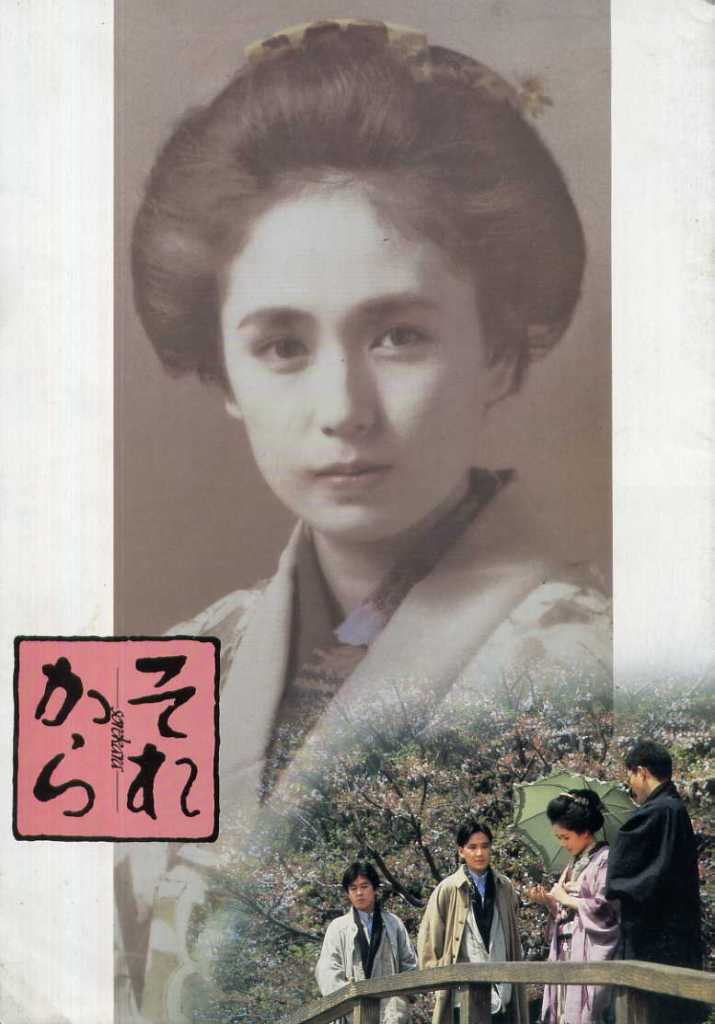
Sorekara PosterYoshimitsu Morita had a long and varied career (even if it was packed into a relatively short time) which encompassed throwaway teen idol dramas and award winning art house movies but even so tackling one of the great novels by one of Japan’s most highly regarded authors might be thought an unusual move. Like a lot of his work, Natsume Soseki’s Sorekara (And Then…) deals with the massive culture clash which reverberated through Japan during the late Meiji era and, once again, he uses the idea of frustrated romance to explore the way in which the past and future often work against each other.

Daisuke (Yusaku Matsuda) is a youngish man approaching early middle age. Thirty years old and a “gentleman” of leisure, he lives in a world of perpetual ennui where he even has to hold his hand to his chest to check that his heart is indeed still beating. His days might have gone on aimlessly had it not been for the unexpected return of an old friend from university, Hiraoka (Kaoru Kobayashi), who has been dismissed from his job following a series of problems with his superiors which has also landed him with a considerable debt to repay and no prospects of further employment. Adding to his sorrows, Hiraoka and his wife, Michiyo (Miwako Fujitani), have recently lost their infant child and have been told that due to Michiyo’s poor health they may not be able to have any more. Daisuke wants to help them, but he’s also facing a lot of pressure from his family to accept an arranged marriage which will further his father and brother’s prospects and is becoming conscious of the relative lack of freedom his life of dependent idleness entails.

Men of Daisuke’s era have perhaps had it hardest coming of age during a period of massive social change which is incomprehensible to the older generation. He’s a well educated man, an intellectual, who can speak several languages and is given to introspective contemplation, but he’s also inherited the worst of European classism as he’s come to believe that working for money is beneath his dignity as a gentleman. He’s completely unable to identify with his friend who needs to work to eat and enjoys none of the various safety nets which are provided by his own wealth and privilege. Nevertheless, he does want to try and help Hiraoka and is dismayed to discover just how little power he has do anything for him.

Hiraoka and Daisuke were part of a group of friends at university which also included another boy who, sadly, died of an illness and his sister – Michiyo, who eventually married Hiraoka. At the time, Daisuke himself had fallen in love with Michiyo but out of a misconceived idea of “chivalry” – another unnecessary adoption of European romanticism, he stepped aside in favour of his friend. This has proved to be a disaster all round and Michiyo and Hiraoka are trapped in an unhappy union which has made Michiyo physically weak and caused Hiraoka to spend the money he should be using to pay back his massive debts on drink and geisha so he can avoid going home. Daisuke’s adherence to a code of morality which is more affectation than anything else is shown up to be cowardice, another way of avoiding adulthood, as he uses his intellectual ideas to mask what is really a fear of rejection.

Daisuke later comes to believe what he did in not acknowledging his own feelings towards Michiyo was “a crime against nature”. He now finds himself at another crossroads as he faces the choice between conforming to the rigidity of his upperclass life in marrying the woman his father has chosen for him and continuing to be financially dependent, or embracing his individuality and striking out on his own to finally claim the woman he’s always loved (and, tragically, has always loved him). In choosing to make a life with Michiyo, Daisuke would be taking several transgressive actions – firstly acting against his own self image by entering the world of working men and secondly by stealing a married woman away from her husband which is no simple matter in the still relatively conservative Meiji era society.

Ultimately, the film is much more a story of Daisuke’s journey of self realisation than it is a melodrama with a love triangle at its centre though Sorekora certainly embraces these aspects too. Morita opts for a more classical tone here with a number of long, unbroken takes and static camera shots yet he also affects a strange, dreamlike tone in which the present and the past seem to co-exist, each drifting one into the other. He intercuts scenes which echo the film’s ending into the main body of the action as well as showing us the early days of Daisuke and Michiyo’s unresolved romantic connection which is poignantly brought out by an experimental technique in which the foreground appears almost like a freeze frame while the rain carries on falling behind them. At certain points there are also some surreal sequences in which Daisuke is travelling on a train but is surrounded by fellow passengers who suddenly each pull out a large sparkler or another where a gaggle of men all dressed just like him are crowded into the the other end of the train and looking at the moon through the open roof of the carriage.

A prestige picture, but one with a healthy dose of strangeness, Sorekara is an inexpressibly sad film full of the tragedy of wasted time and the regret that comes with not having acted in way which satisfies your authentic self. In order to live a life that’s true to himself Daisuke must finally learn to risk losing everything but the film’s ambiguous ending may ask whether the cost of following your heart may not be too heavy a one to pay.


Unsubtitled trailer: