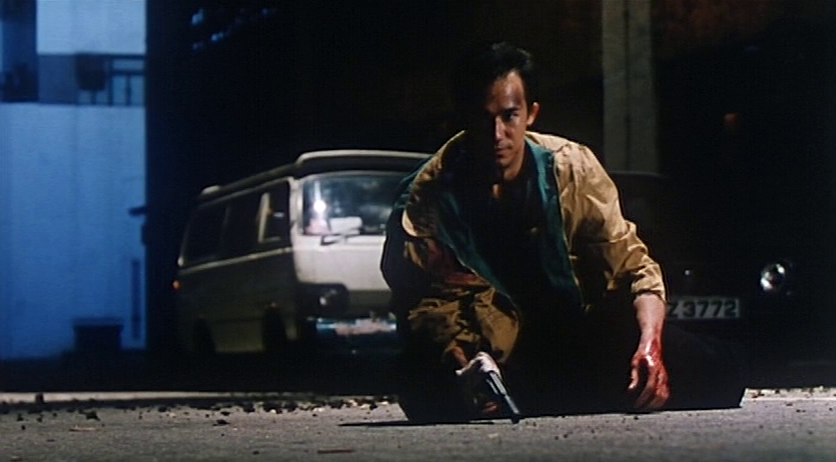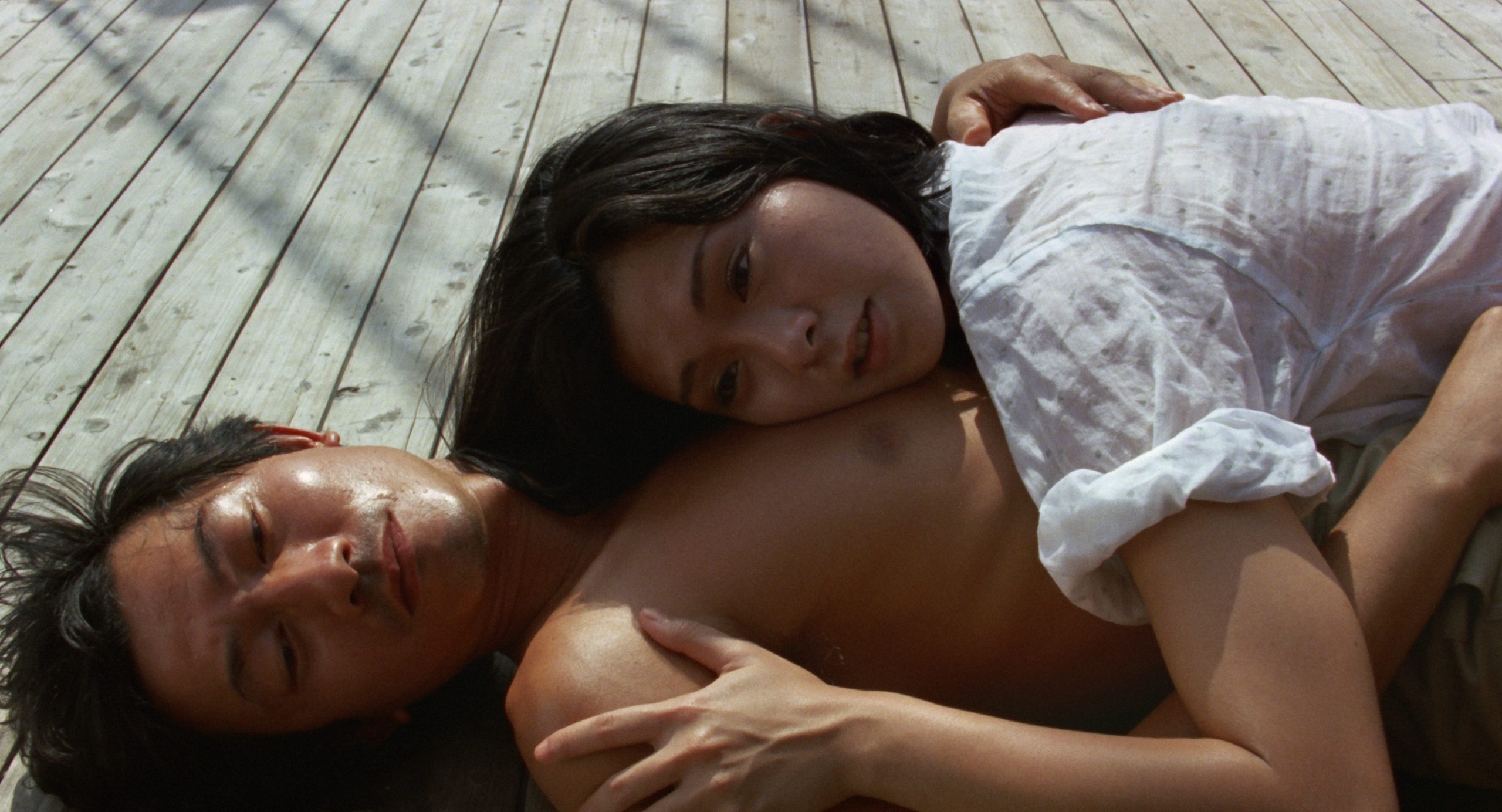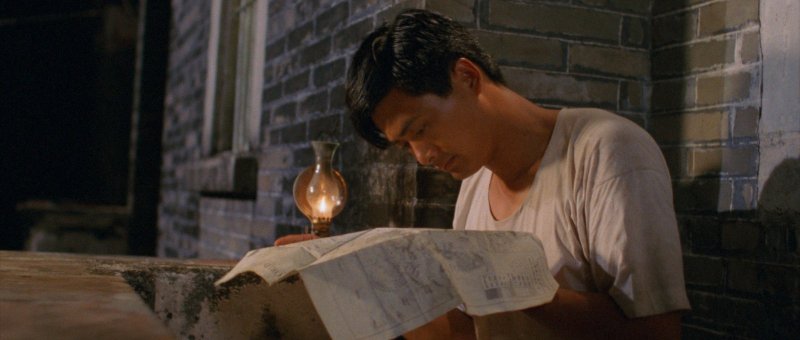
Hong Kong 1941 (等待黎明, Leong Po-Chih, 1984)

“Britain has reassured the people that it will not give up Hong Kong,” according to a radio broadcast at the beginning of Leong Po-Chih’s Hong Kong 1941 (等待黎明). The words have a kind of irony to them and not only because Britain did abandon the people following the Japanese invasion, but because the film was released on the eve of the Sino-British Joint Declaration in which it said something quite similar. 

But then again, the opening scenes are themselves quite critical of British rule as they, on the one hand, insist they aren’t going anywhere and, on the other, start evacuating women and children to “safer” areas of the commonwealth such as Australia. Out of work actor Fei (Chow Yun-fat) fled the Japanese incursion on the Mainland and came to Hong Kong, but now tries to stowaway abroad a boat going to Australia. He’s caught by a little British girl who speaks fluent Cantonese yet refers to him as her “slave” and insists that he “kowtow to me, now.” But then the girl suddenly adopts the persona of the Empress Dowager Cixi and demands the same. Fei makes the first of his many jumps into the water around Hong Kong, as if only in this liminal space can he be free. Anticipating the wave of migration occurring before and after the Handover, and also that of the present day, he and his friends Keung (Alexander Man Chi-leung) and Nam (Cecilia Yip Tung) set their sights on leaving to find Gold Mountain in Australia or America.

But they’re one day too late because the date of their departure is that the Japanese arrive in Hong Kong. Their haste to leave was in part caused by the fact that Nam’s father, Ha Chung-sun (Shih Kien), was trying to force her to go through with an arranged marriage her prospective groom didn’t want either. Nam is never really free as, as she points out, even after her father relents and allows Keung to marry her after she is raped by a police officer emboldened by the chaos and therefore worthless to him as currency, Keung never actually asked her and she’s in effect forced into a marriage with him instead. In fact, she returns to the shrine Keung lives in two find the two men constructing her marital bed for her with the double helix symbol of happiness already placed above it in an ironic expression of patriarchal oppression.

Indeed, her position is more precarious than either of the men and we see other families roughly cutting their daughters’ long hair to make them look like boys in fear of a rapacious Japanese army. But it largely turns out that it wasn’t so much the Japanese they needed to be worried about as the local population, experiencing a temporary limbo in which the social order has been suspended. Police officer Fa Wing (Paul Chun) who had acted as a lackey for Ha Chung-sun while constantly eying up Nam leads a gang of looters to Ha’s house to take their own revenge against his capitalistic oppression of them. Ha had largely made his money through rice profiteering and exploiting the local workforce. Recent layoffs at the warehouse had led to a labour riot, while Keung and his friends had been running a sideline skimming sacks of rice to sell on the black market. 

Ha and his henchmen anxiously await the arrival of the Japanese hoping that they will protect them from retribution, but the Japanese do not arrive fast enough. When they do, Ha collaborates and attempts to ingratiate himself with the Japanese officer in charge of the colony who once again takes a liking to Nam. General Kanezawa (Stuart Ong) also uses their poverty to starve them into submission, promising rice to anyone who will come and sing with him. The song he chooses is “Shina no Yoru” by Li Hsiang-lan, whom he describes as “their very own”, yet was actually a Japanese woman, Yoshiko Yamaguchi, groomed for stardom in Manchuria and marketed a Chinese star in propaganda films. Another song of hers, Ieraishan, can be heard earlier on the soundtrack as if heralding Japanese arrival. 

Though Nam tries to resist, Fei raises the trio’s arms in a cry of “banzai” in a moment of ostensible collaboration designed to buy them temporary safety. His philosophy and that of many others is to take the rice and deal with the rest later, which Fei does by becoming an enforcement officer with the Japanese to get papers that will allow all of them leave. He uses his position to help a gang of Mainlanders who are resisting the Japanese, and are, in fact, the last ones to stay behind and defend the colony, as well as well as save Keung when his attempt to rescue two friends who have been sold out for forced labour on another Japanese-controlled island by a local gangster backfires and he’s captured himself. 

Ironically enough, Fei had been the first one to try to leave and described himself as “selfish” after jumping back into the water to return to Nam and Keung who didn’t make the boat on time because they were trying to save a local eccentric everyone calls “emperor” played by the director himself. Fei is quite obviously in love with Nam, and she gradually falls for him in return though symbolically wedded to Keung, if not in the legal sense. Again, she has no say over her romantic future which is sorted out between the two men with Fei abiding to a code of honour in continuing to protect the relationship between Keung and Nam. Perhaps this echoes the way in which the Hong Kong people of 1941 or 1984 have little say in their future either as their fate is decided by two distant powers. Nevertheless, it leaves Keung feeling awkward and inadequate, realising that Nam likely prefers the smart and dynamic Fei over his constant failures and inability to protect her, though he is never jealous or resentful towards him only knowing that he is continually indebted. Yet it’s Nam who eventually strikes back for Hong Kong and for her own freedom while Fei looks on as children in the street play at beheadings as if they were Japanese soldiers. She embodies the spirit of Hong and carries it with her, and as the Chinese title of the film suggests, waits for a new dawn while accepting that just like old memories it will be replaced by what is to come. She speaks from a perspective that is both historical and uncertain, mourning the past while fearful of the future, but all the while continuing to live as one new dawn replaces another.


Hong Kong 1941 screened as part of this year’s Focus Hong Kong.

Trailer

The Big Heat (城巿特警, Andrew Kam & Johnnie To, 1988)

A Hong Kong cop struggles with his sense of responsibility when faced with the fatalistic existential threat of the imminent Handover in Johnnie To’s first foray into the genre with which he would later become most closely associated outside of Hong Kong, the action crime drama. After a handful of Cinema City comedies, To is credited as a co-director along with Andrew Kam Yeung Wah though the production of The Big Heat (城巿特警), loosely inspired by the Fritz Lang film of the same name, was notoriously complicated passing through several hands over its unusually long gestation of almost two years, according to an interview with screenwriter Gordon Chan Kar-Seung, with producer Tsui Hark also heavily involved in the shooting. 

Tsui’s involvement is apparently responsible for the unusual level of explicit violence more usually found in horror exploitation rather than gangster noir, though there is perhaps something in the constant bodily destruction that aligns with the pre-Handover setting in which the “big heat” hanging over the city is an increasing existential panic which has created the maddening environment in which this surreal violence can occur as revealed in the opening dream sequence which features a drill piercing a man’s hand with small pieces of flesh speeding off it. The dream will turn out to be a prophecy foreshadowing the final shootout in which Inspector Wong (Waise Lee Chi-Hung) is shot thought the hand though at this point it signals both a psychological and physical fracturing. Owing to a neurological condition, Wong has lost full control over his right hand which leads him to question his ability to protect his city if he is unable to pull the trigger when needed which might also explain why he is frequently seen practicing his marksmanship at the firing range. 

Because of this anxiety, Wong had planned to resign but changes his mind on learning that his former partner who sustained an injury that Wong felt himself responsible for has been brutally murdered by Hong Kong gangsters in Malaysia after coming across a secret folder “by chance” containing photos used to blackmail a shipping magnate over his his homosexuality and an incriminating invoice. To do the right thing, Wong also temporarily breaks up with his forensic scientist girlfriend Maggie (Betty Mak Chui-Han) whom he was due to marry in a fortnight’s time suggesting that they not see each other until he’s solved his friend’s murder and then presumably plans to retire from law enforcement. 

Essentially, he deprioritises his personal, romantic relationships in favour of the homosocial brotherhood of the police both avenging his friend and dedicating himself to protecting Hong Kong from an oncoming threat represented by gangster Han (Paul Chu Kong) who is later revealed to be in cahoots with Russian mafia who ironically have a large portrait of Lenin on their boat and hammer and sickle flags everywhere while vowing to continue “selling drugs and capitalism” in the seemingly lawless environment of pre-Handover Hong Kong where everyone apparently wants to make enough money to be able to leave if the situation declines, “communist” Russians perhaps standing in for looming Mainland authoritarianism. Han even offers to sell “everything including Hong Kong” passing a list of names of “important people in the government” he apparently has access to in vast network of corruption. “Cheers to 1997” they ironically toast for their burgeoning business opportunity. 

It’s this corruption that is the source of Wong’s anxiety, fearing he doesn’t have the strength to stop it while his compromised hand is a symbol of both fate and an impotence that is later exorcised when he receives the corresponding physical injury yet is saved by a crucifix necklace that previously belonged to his girlfriend while in another instance of foreshadowing the corrupt policeman is eventually taken out by his own malfunctioning gun backfiring just like that which ruined an assailant’s hand in the drug bust in which Wong’s partner was injured. Having regained mastery over his hand, Wong is therefore more assured in his ability to protect Hong Kong from whatever it is that’s coming remaining within the police force while those who pay the heaviest price are an idealistic young rookie unable to adapt to the morally compromised world of pre-Handover Hong Kong, and Wong’s fiancée who becomes a symbol of that which he could not protect having prioritised his role as a police officer. Though somewhat disjointed having passed through so many hands, there are some typically To flourishes in the fluidity of the camerawork in the early stretches along with a gloomy romanticism in the fatalistic noir of the pre-Handover society even as he continues to find his feet as a purveyor of moody policier. 


Trailer (no subtitles)

Nomad (烈火青春, Patrick Tam, 1982)

In his 1982 New Wave classic Nomad (烈火青春), director Patrick Tam had intended to reflect on Nietzsche’s Joyful Wisdom along with the concept of the wanderer, a heroic ideal of the emancipated mind which necessitates permanent exile in which it is no longer possible to call any place “home”. It was also he claims a critique of the “mindless embrace of foreign culture” by Hong Kong youth then obsessed with David Bowie and Japan. 

The film’s English title refers to the boat owned by the hero’s father which becomes a symbol of the yearning for escape and for the foreign among the young, but is also imbued with an essential irony thanks to its design which recalls the “black ships” that sailed into the bay of Edo and forced Japan to reopen its doors to the world after 200 years of isolation. The original Chinese title, meanwhile, translates as something like “Burning Youth” and strongly recalls Japan’s Sun Tribe movies of the late 1950s which similarly critiqued aimless post-war youth and the corruptions of pervasive American pop culture as embodied by Coca-Cola and jazz music. Tam makes frequent visual reference to Japanese New Wave youth movies such as Nagisa Oshima’s Cruel Story of Youth while the shocking ending (which was not shot by Tam who had envisioned a bloodier showdown aboard the Nomad) also has shades of Ko Nakahira’s seminal chronicle of post-war ennui, Crazed Fruit. 

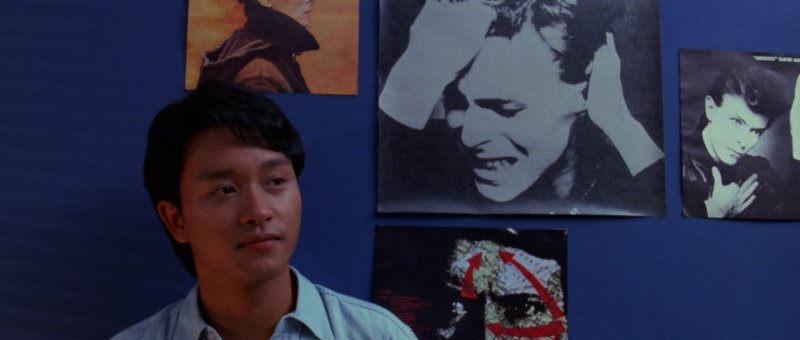
Nomad similarly focusses on a collection of aimless youngsters struggling to find direction in pre-Handover Hong Kong. Louis (Leslie Cheung Kwok-Wing) continues to long for his absent mother and often listens to recordings she once made introducing classical music on the radio while a model of the Nomad sits prominently on a shelf in his room. He has posters of David Bowie on the wall, while his cousin Kathy (Pat Ha Man-Jik) puts on the robes of a Japanese Miko and performs a traditional fan dance. Louis is one of the few young people who does not speak the language, but is later fascinated by the work of a Japanese fashion designer featuring swords and samurai armour that he says, in a moment of foreshadowing, only make him think of ritual suicide. 

His life is directly contrasted with that of Pong (Kent Tong Chun-Yip), a young man from a poor family who works as a lifeguard at the local pool which is how he ends up meeting Kathy who in turn fascinates him with her rich girl sense of confidence and invincibility. The desire to find a place of their own is emphasised by the constant frustration their repeated attempts to make love in Pong’s family apartment which everyone has generously agreed to vacate so he can bring a girl home only for his younger brother to prank him and his dad to come home early inviting half the neighbourhood over for mahjong. The couple eventually have sex on the empty top deck of a tram, another symbol of transience, and then repeatedly in several other public locations until the relationship is disrupted by the return of Kathy’s former boyfriend, Shinsuke (Yung Sai-Kit), who has deserted the Japanese Red Army and is now a fugitive ironically looking for safe harbour while on the run.

The Japanese Red Army was a far-left terrorist organisation most active in the Middle East though Shinsuke’s decision to leave it seems to be less to do with a disillusionment with communism than a reawakening of his humanity in which he has decided he can no longer be a part of its bloodiness and violence. Nevertheless, while holed up aboard the Nomad, he explains that he cannot join the other youngsters in their romantic dream of sailing to Arabia because he has rejected exile and is determined to return home and meet his certain death in Japan. The destructive forces have however followed him in the form of an assassin posing as an assistant to a fashion designer, which seems to be allusion a little too on the nose even if it quickly descends into a strange pastiche of samurai ideology otherwise at odds with that of the JRA in which they track Shinsuke down and then instruct him to commit seppuku with the sword he has been carrying all along. 

In an earlier fight that led Pong and Louis becoming friends, some young women had needled him that he should try to protect Kathy though she needed no protection in this situation and he was unable to provide it anyway. Something similar happens on the beach though he turns out to be surprisingly adept with a samurai sword when he’s unexpectedly rescued by Tomato (Cecilia Yip Tung), a young woman he met in a cafe after he overheard her desperately trying to dump one boyfriend and not be be dumped by another over two different telephones, who suddenly reemerges with a harpoon gun. It’s Tomato, who had kept a copy of Nietzsche’s The Antichrist given to her by a boyfriend but apparently not read it, that finally remarks on their aimlessness, “we do nothing for society”, only to be countered by Louis who answers, “what society? We are society.”

Briefly at the beach they may find the kind of utopia they’re looking for, lighting the cottage with lanterns and sleeping piled one on top of another under a communal mosquito net in the open air, but just as quickly find that dream shattered by the intrusion of a political reality. This nomadic youth finds itself exiled from its home, dreaming of an impossible escape, caught between the colonial present and a colonial future with half an eye on an old coloniser and fast losing sight of its own identity. Abandoned on a blood-soaked shore, all youth can do is look out in shock and confusion bereft even of hope in a liminal space at once transient and permanent. 


Nomad screens at the BFI Southbank on 15th July in its new 4K Director’s Cut as part of Focus Hong Kong.