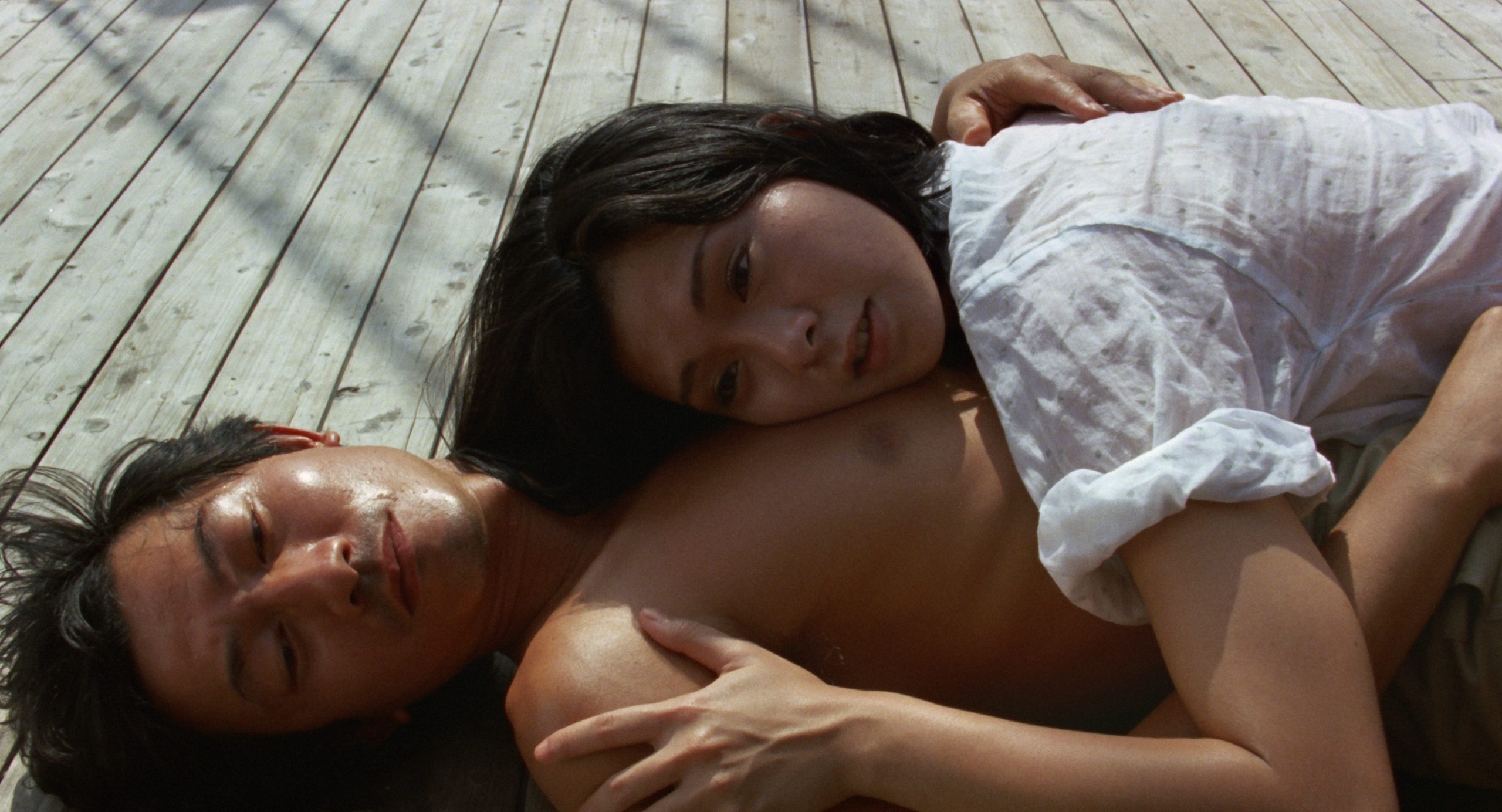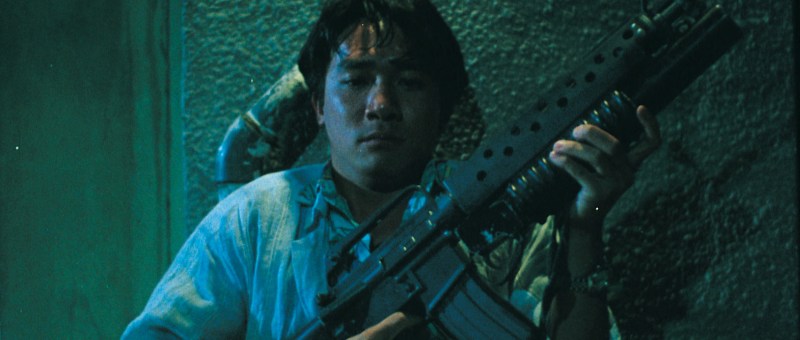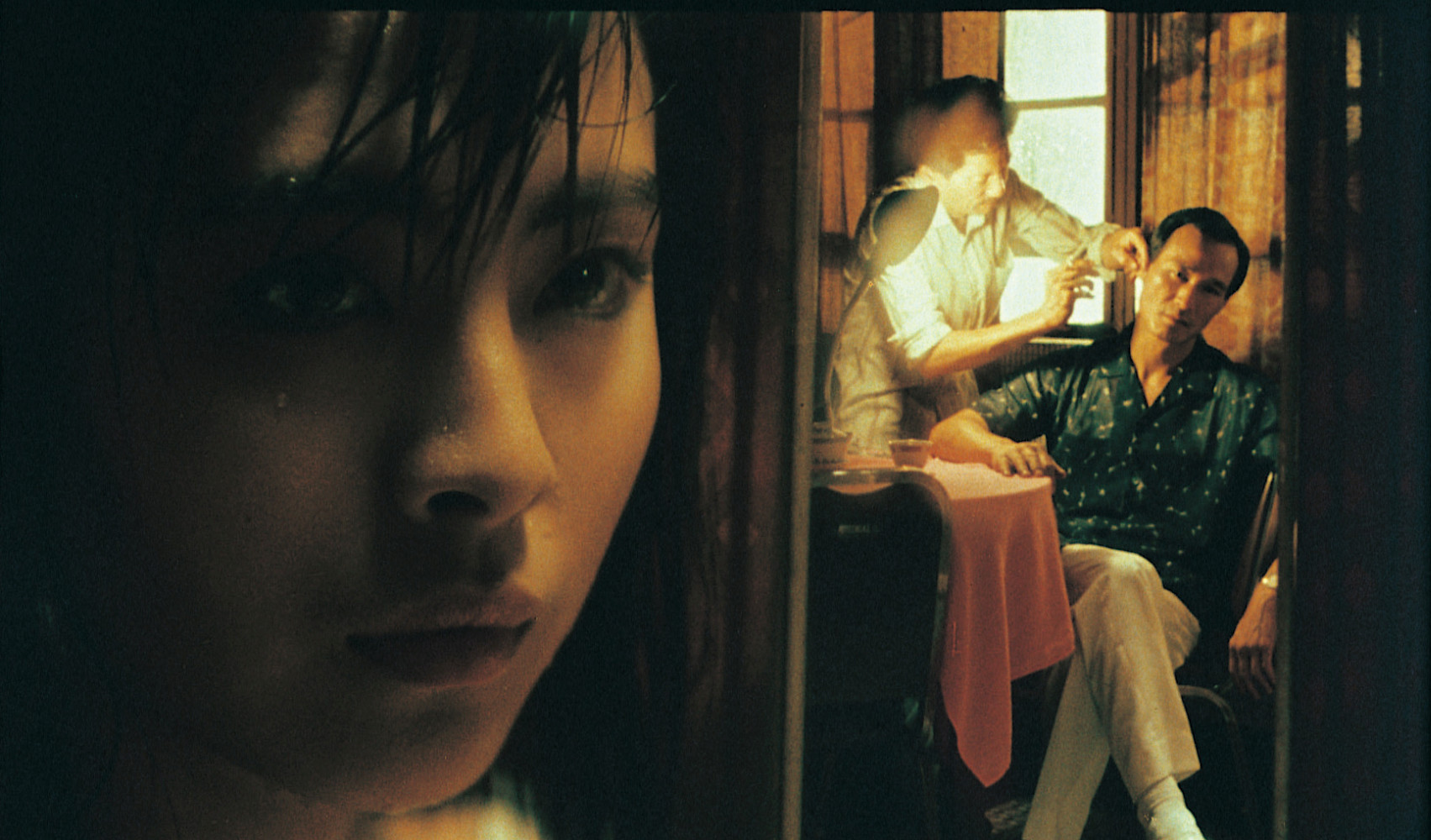

Love Massacre (愛殺, Patrick Tam Kar-Ming, 1981)

Is Love Massacre a massacre of love, a massacre for love, or is it love itself that inevitably leads to death? Patrick Tam’s second film draws inspiration from European and Hollywood cinema along with the French New Wave including the films of Godard, most obviously in its screen composition and bold use of reds and blues echoing Pierrot le Fou, while also leaning into Antonin Artaud’s Theatre of Cruelty in focusing on a sensory experience rather than expository dialogue.

Shot mainly in the US on account of star Brigitte Lin’s schedule, the film takes place in an uncanny space of another Hong Kong peopled by overseas students in San Francisco. Ivy (Brigitte Lin) has become good friends with Joy (Tina Lau), an emotionally fragile young woman uncertain in her relationship with boyfriend Louie (Charlie Chin) who plans to move to New York. Feeling abandoned, she attempts to take her own life by slashing her wrists, but survives. Not knowing what to do, Ivy calls Joy’s brother Chu Chung (Chang Kuo-chu) for further support, but he insists that his sister is fine and resists their efforts to get Joy to see a doctor. Meanwhile, he and Ivy begin a passionate affair.

Up to this point, Lin had mostly starred in romantic melodramas and Tam plays with this cinematic baggage in beginning the film in the same vein only to later change direction as it descends into madness and violence. Chu Chung appears to be living with a mental health condition of his own which informs his reluctance to get help for Joy. Joy, meanwhile, appears to be worried both about the latent attraction between Louie and Ivy, and Ivy’s relationship with her brother. Joy tells Louie that she doesn’t like Ivy dating Chu Chung, leading Ivy to wonder if Joy may have had an incestuous obsession with her brother, though it may equally have been because she knew of his paranoia and violence and feared for her safety. 

At any rate, Chu Chung did not disclose to Ivy that he was already married to a woman in Hong Kong (Deanie Ip) whom he appears to resent because she tries to constrain him by medicating his mental health condition. He ends up killing her to free himself so that he can pursue his relationship with Ivy, but soon becomes dangerously obsessed with the implication that his madness is caused by an excess of primal emotion that he is unable to control as symbolised by the violent intensity of the Mark Rothko paintings seen frequently throughout the film. 

Ivy had felt herself conflicted on coming to know of Chu Chung’s marriage accidentally and feeling both deceived and abandoned by him. She lived in a kind of fantasy of idealised romance that has now been compromised by her uncertainty after reading about a man with the same name in the paper who has apparently killed his wife in Hong Kong and gone on the run. When Chu Chung returns, his behaviour is strange and obsessive. He insists on marrying Ivy while claiming to have dealt with his wife, later confessing in detail about how he disposed of the body and ominously adding that he’ll have to think of a better way to do it next time because it was altogether too much bother. 

Yet despite the intensity of Chu Chung’s romantic obsession, Tam depicts his violence with extreme detachment. Chu Chung’s killing is matter of fact and motivated by resentment in that he mistakenly believes they are deliberately preventing him from being with Ivy, who has ironically sought out Louie after running away from Chu Chung in fear. In the earlier stages of their affair, Ivy had often been seen in a vivid red dress given to her by Chu Chung which symbolised her passionate emotion, but on Chu Chung’s return she is mainly seen in white which is a colour more closely associated with death. Chu Chung is also dressed entirely in white, which, on the one hand, is designed for maximum impact as his clothes become stained with blood, but also marks him out as a figure who represents destruction.

To that extent, he comes to embody the violent intensity of romantic obsession suggesting that love itself is a kind of madness that can only result in death just as it does for Joy when her love for Louie is not met with the same degree of passion. In confronting Chu Chung, Ivy is also directly confronting the emotions she was otherwise afraid to face and perhaps conquering them in being forced to make a choice how best to “help” Chu Chung while his obsession threatens to consume her. Using Hitchcockian music cues and conjuring a sense of dread in a city that seems isolated and empty, almost an imaginary backdrop with its de Chirico-inspired murals, Tam subverts genre tropes to spin a tale of love and madness. In the end, the “love killing” of the Chinese title might not be the ones perpetrated by Chu Chung but the final decision taken by Ivy motivated either by mercy or a desire for liberation.


Trailer (English subtitles)
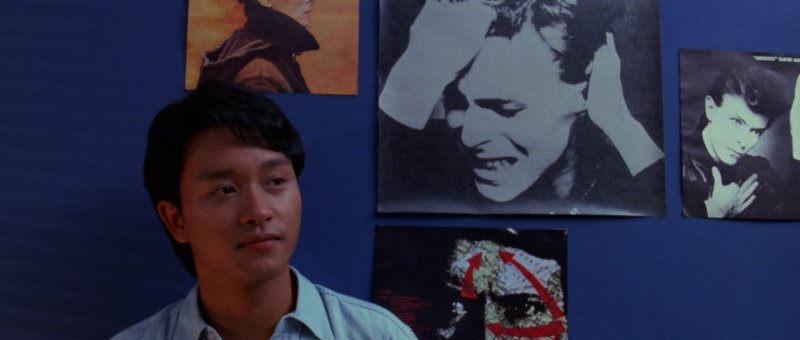
Nomad (烈火青春, Patrick Tam, 1982)

In his 1982 New Wave classic Nomad (烈火青春), director Patrick Tam had intended to reflect on Nietzsche’s Joyful Wisdom along with the concept of the wanderer, a heroic ideal of the emancipated mind which necessitates permanent exile in which it is no longer possible to call any place “home”. It was also he claims a critique of the “mindless embrace of foreign culture” by Hong Kong youth then obsessed with David Bowie and Japan. 

The film’s English title refers to the boat owned by the hero’s father which becomes a symbol of the yearning for escape and for the foreign among the young, but is also imbued with an essential irony thanks to its design which recalls the “black ships” that sailed into the bay of Edo and forced Japan to reopen its doors to the world after 200 years of isolation. The original Chinese title, meanwhile, translates as something like “Burning Youth” and strongly recalls Japan’s Sun Tribe movies of the late 1950s which similarly critiqued aimless post-war youth and the corruptions of pervasive American pop culture as embodied by Coca-Cola and jazz music. Tam makes frequent visual reference to Japanese New Wave youth movies such as Nagisa Oshima’s Cruel Story of Youth while the shocking ending (which was not shot by Tam who had envisioned a bloodier showdown aboard the Nomad) also has shades of Ko Nakahira’s seminal chronicle of post-war ennui, Crazed Fruit. 

Nomad similarly focusses on a collection of aimless youngsters struggling to find direction in pre-Handover Hong Kong. Louis (Leslie Cheung Kwok-Wing) continues to long for his absent mother and often listens to recordings she once made introducing classical music on the radio while a model of the Nomad sits prominently on a shelf in his room. He has posters of David Bowie on the wall, while his cousin Kathy (Pat Ha Man-Jik) puts on the robes of a Japanese Miko and performs a traditional fan dance. Louis is one of the few young people who does not speak the language, but is later fascinated by the work of a Japanese fashion designer featuring swords and samurai armour that he says, in a moment of foreshadowing, only make him think of ritual suicide. 

His life is directly contrasted with that of Pong (Kent Tong Chun-Yip), a young man from a poor family who works as a lifeguard at the local pool which is how he ends up meeting Kathy who in turn fascinates him with her rich girl sense of confidence and invincibility. The desire to find a place of their own is emphasised by the constant frustration their repeated attempts to make love in Pong’s family apartment which everyone has generously agreed to vacate so he can bring a girl home only for his younger brother to prank him and his dad to come home early inviting half the neighbourhood over for mahjong. The couple eventually have sex on the empty top deck of a tram, another symbol of transience, and then repeatedly in several other public locations until the relationship is disrupted by the return of Kathy’s former boyfriend, Shinsuke (Yung Sai-Kit), who has deserted the Japanese Red Army and is now a fugitive ironically looking for safe harbour while on the run.

The Japanese Red Army was a far-left terrorist organisation most active in the Middle East though Shinsuke’s decision to leave it seems to be less to do with a disillusionment with communism than a reawakening of his humanity in which he has decided he can no longer be a part of its bloodiness and violence. Nevertheless, while holed up aboard the Nomad, he explains that he cannot join the other youngsters in their romantic dream of sailing to Arabia because he has rejected exile and is determined to return home and meet his certain death in Japan. The destructive forces have however followed him in the form of an assassin posing as an assistant to a fashion designer, which seems to be allusion a little too on the nose even if it quickly descends into a strange pastiche of samurai ideology otherwise at odds with that of the JRA in which they track Shinsuke down and then instruct him to commit seppuku with the sword he has been carrying all along. 

In an earlier fight that led Pong and Louis becoming friends, some young women had needled him that he should try to protect Kathy though she needed no protection in this situation and he was unable to provide it anyway. Something similar happens on the beach though he turns out to be surprisingly adept with a samurai sword when he’s unexpectedly rescued by Tomato (Cecilia Yip Tung), a young woman he met in a cafe after he overheard her desperately trying to dump one boyfriend and not be be dumped by another over two different telephones, who suddenly reemerges with a harpoon gun. It’s Tomato, who had kept a copy of Nietzsche’s The Antichrist given to her by a boyfriend but apparently not read it, that finally remarks on their aimlessness, “we do nothing for society”, only to be countered by Louis who answers, “what society? We are society.”

Briefly at the beach they may find the kind of utopia they’re looking for, lighting the cottage with lanterns and sleeping piled one on top of another under a communal mosquito net in the open air, but just as quickly find that dream shattered by the intrusion of a political reality. This nomadic youth finds itself exiled from its home, dreaming of an impossible escape, caught between the colonial present and a colonial future with half an eye on an old coloniser and fast losing sight of its own identity. Abandoned on a blood-soaked shore, all youth can do is look out in shock and confusion bereft even of hope in a liminal space at once transient and permanent. 


Nomad screens at the BFI Southbank on 15th July in its new 4K Director’s Cut as part of Focus Hong Kong.

My Heart Is That Eternal Rose (殺手蝴蝶夢, Patrick Tam Kar-Ming, 1989)

“Now no one owes anything to anyone” a petty gangster ironically states on completing an errand for a friend in Patrick Tam’s heroic bloodshed off-shoot My Heart is that Eternal Rose (殺手蝴蝶夢). As the name perhaps implies, Tam’s film is less brotherhood than tragic romance as the fatalism of the noirish gangster world ruled by debt if not by honour conspires against love, not only romantic but filial and brotherly, in its infinite web of violence and futility.

Pinching a classic noir narrative, the picture opens in a cheerful waterside tavern run by former gangster Uncle Cheung (Kwan Hoi-Shan) where carefree gambler Rick (Kenny Bee) is in love with the old man’s daughter Lap (Joey Wong Cho-Yee) who works behind the bar. Uncle Cheung thinks he’s escaped the triad world, but the past is not done with him. Approached by local tough guy Law (Gam Lui), Uncle Cheung is made an offer he can’t refuse to help smuggle Law’s son (Cheung Tat-ming) to Hong Kong from the mainland. He asks Rick to pitch in as the driver and recruits corrupt cop Tang (Ng Man-tat) to help him get past the checkpoints. But Law’s kid is a chatterbox, excited to be in Hong Kong and eagerly boring everyone with his future plans to become a famous singer. Unwisely he drops his father’s name and rouses Tang’s interest. Tang makes the gang pull off at a rest stop so he can strong arm Uncle Cheung into ringing Law to up his pay, but the loudmouth kid jumps the gun, literally, and gets himself killed. Tang turns on Rick and Uncle Cheung to clear up loose ends but Rick kills him, escaping with Uncle Cheung and leaving the old lady at the rest stop to clean up the mess. Left with no choice but to flee, the trio arrange passage to the Philippines but Uncle Cheung is snatched by Law before they can leave. Lap is forced to make a deal with rival kingpin Godfather Shen (Michael Chan Wai-man) to save her dad, putting Rick on the boat with a promise to meet him later but knowing that she will likely never escape Shen’s grasp.

Six years pass, during which Lap becomes Shen’s right-hand woman entertaining wealthy Japanese businessmen in his swanky club as a singer and hostess. Consumed by guilt and remorse in knowing his daughter continues to pay the price for his mistake, Uncle Cheung has become a drunken liability while Lap is lost in romantic melancholy, mooning over the ruined love of her youth and dreaming that some day Rick may return and take her away from all this. Meanwhile, innocent rookie (confusingly also named) Cheung (Tony Leung Chiu-Wai) has fallen in love with her, captivated by her sadness and the futility of her life with Shen. Of course, Rick, having become a hit man, eventually returns leading to a confrontation not just with Shen but with the triad world itself. 

In the gangster universe, everyone owes something to someone. Debt is a kind of currency, and every bargain accrues its particular kind of interest. Lap is forced to sacrifice herself to save the men she loves by trading the only currency she has, her body, knowing that in doing so she destroys the possibility of a happy romantic future with Rick in order to keep him safe. Six years later she thinks she’s paid her debt to Shen, he has plenty of other women what difference can keeping her captive make? But that’s not the way the gangster world works. Shen merely gifts her to the psychotic underling who propositioned her on their first meeting and moments earlier had tried to betray his boss by raping her. Only Cheung, pure hearted and naive, is uncorrupted by the venal cruelty of the triad world, consumed by a truly selfless love that sees him determined to help Lap escape and save her future with Rick. 

This selfless love, however, eventually creates another debt in the moral dilemma faced by the lovers who know that if they escape alone they leave Cheung at the mercy of Shen while to return spells certain death. Co-shot by Christopher Doyle, Tam’s moral universe is lit by the red-tinted glow of the neo-noir, a dizzying yet melancholy world of violence and futility in which freeze frames and ethereal dissolves hint at the transient meaninglessness of the triad life where love and death go hand in hand while betrayal is an ever present companion. Only those sufficiently uncorrupted by the moral duplicities of an increasingly bankrupt existence are permitted to survive, but even so emerge beaten, wounded, and pale with loss literally at sea perpetual exiles without home or harbour.


Original trailer (Dialogue free, contains major spoilers)