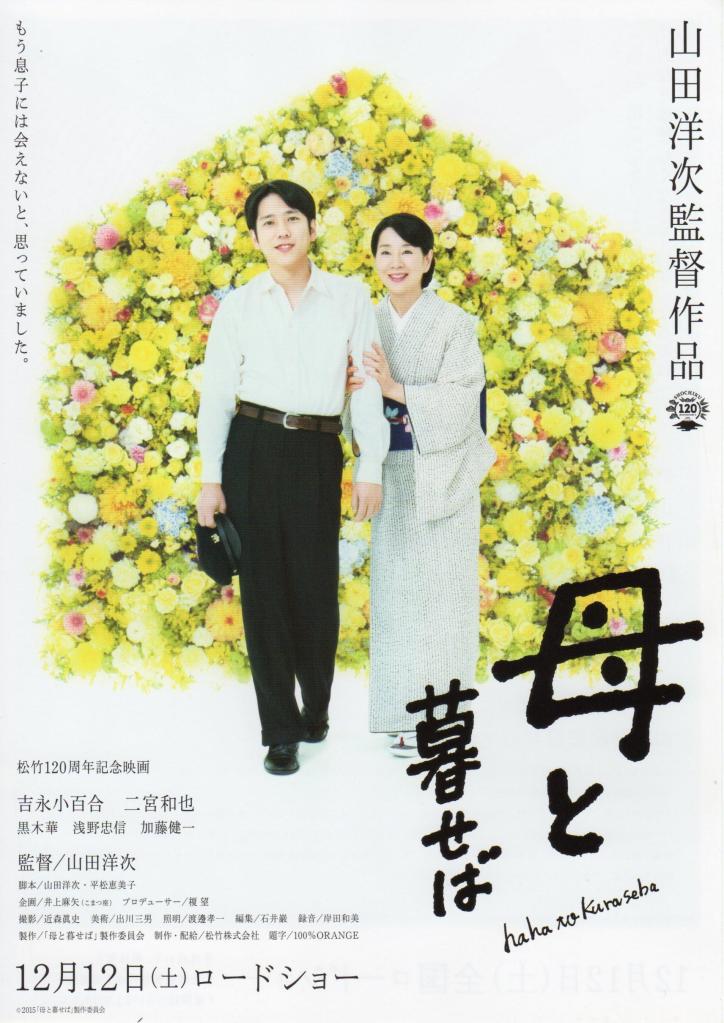
Nagasaki: Memories of My Son (母と暮せば, Yoji Yamada, 2015)

nagasaki-memories-of-my-sonAfter such a long and successful career, Yoji Yamada has perhaps earned the right to a little retrospection. Offering a smattering of cinematic throwbacks in homages to both Yasujiro Ozu and Kon Ichikawa, Yamada then turned his attention to the years of militarism and warfare in the tales of a struggling mother, Kabei, and a young a woman finding herself a haven from the ongoing political storm inside The Little House. Nagasaki: Memories of My Son (母と暮せば, Haha to Kuraseba) unites both of these impulses in its examination of maternal grief set amidst the mass tragedy of the atomic bomb and in the obvious reference hidden inside Japanese title (another Yamada trend) to the 2004 Kazuo Kuroki film The Face of Jizo (父と暮せば, Chichi to Kuroseba), itself based on a play by Hisashi Inoe. Whereas the young woman of Hiroshima found herself literally haunted by the image of her father to the extent that she was unable to continue living in the present, the mother at the centre of Nagasaki is approaching the end of her life but only now, three years after the bombing, is she ready to allow the idea of her son’s death to cement itself within her mind.

Nobuko’s (Sayuri Yoshinaga) son Koji (Kazunari Ninomiya) left as normal on that fateful morning, in a hurry as always, leaping onto the outside of a crowded bus that would take him to the university for a lecture on anatomy. That was three years ago and now it’s August again but in the absence of a body Nobuko has never been able to accept the death of her son, despite the picture on the altar and the two previous trips she’s made to the family grave on this date along with Koji’s girlfriend, Machiko (Haru Kuroki). Finally, Nobuko is beginning to feel it’s time to accept the inevitable, that her son is not lost somewhere and unable to find his way home but in some other world. This grudging acceptance of Koji’s death is the thing which returns him to her as the prodigal son suddenly appears one evening in spirit form to reminisce with his mother about the carefree pre-war days.

Kazunari Ninomiya’s Koji is, appropriately enough, a larger than life presence. A cheerful chatterbox, Koji blusters in to his old family home with the same kind of amusing energy he’d always lent it, laughing raucously to his mother’s polite but strange under the circumstances greeting of “have you been well?”. Reminiscences generally lean towards happier times but each time Koji becomes upset he suddenly disappears again, leaving his mother alone with all her sorrows. Nobuko lost both her sons to the war and her husband to TB and so she is quite alone now save for the kindhearted attentions of Machiko who continues to stop by and help her with house work or just keep her company.

The two women share an intense bond in their shared grief. Almost like mother and daughter Nobuko and Machiko help each other to bear the weight of their loneliness in the wake of such overwhelming tragedy. However, Nobuko is beginning to feel guilty in monopolising the life of this young woman who might have been her daughter-in-law or the mother of her grandchildren by now if things were different. Can she really ask her to sacrifice the rest of her life to a memory? Machiko swears that she has no desire to ever marry, preferring to remain loyal to her true love. “Shanghai Uncle” a black marketeer who brings Nobuko all the hard to find items not available through the normal channels, offers to set up an arranged marriage for the young woman but Nobuko is quick to turn it down on her behalf. In this new age of democracy, she says, young women ought to have the right to choose their own path whatever that may be. Nobuko respects Machiko’s choice, but after talking things over with Koji, urges her to consider letting the past go and honouring Koji’s memory by living fully while there is still time.

Interestingly enough, Machiko’s potential suitor, Kuroda – an injured war veteran and fellow teacher at the school where she teaches, is played by Tadanobu Asano who also played the shy researcher who began to reawaken the heart of the daughter at the centre of The Face of Jizo, Mitsue. Mitsue’s problem was more obviously one of survivor’s guilt, literally haunted by the friendly spirit of her genial father who continually urges her to embrace this last opportunity for happiness, to go on living even whilst others can’t. Nobuko’s journey is almost the reverse as she, essentially, attempts to cleave herself away from her life by ensuring Machiko is taken care of and knows that she has nothing to feel guilty about in seeking happiness even if it can’t be with Koji.

Despite the innovative opening sequence featuring the cockpit and targeting system of the plane which eventually dropped the bomb and the chilling effects sequence as it takes hold, Yamada then reverts to a kind of classical stateliness which is never as effective as Kuroki’s eerie magical realism. Adding in the Christian imagery associated with Nagasaki, the film takes a turn for the mawkish during the final sequence which descends into a series of heavenly cliches from fluffy white clouds to angelic choirs. Warm and melancholy, Nagasaki: Memories of My Son is a poignant exploration of life in the aftermath of preventable tragedy but one which also makes the case for moving on, honouring the legacy of the past with a life lived richly and to the full.


Original trailer (English subtitles)
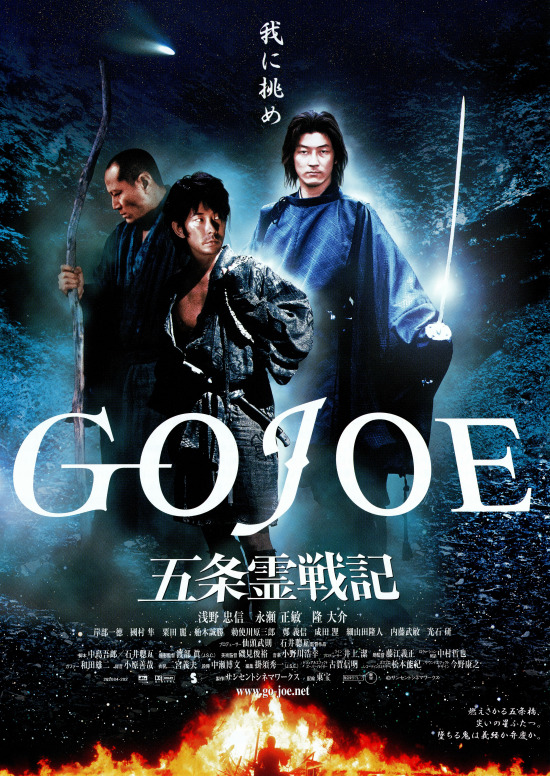
Gojoe (五条霊戦記, Sogo Ishii, 2000)

gojoe-2Not your mama’s jidaigeki – the punk messiah who brought us such landmarks of energetic, surreal filmmaking as Crazy Family and Burst City casts himself back to the Middle Ages for an experimental take on the samurai genre. In Gojoe (五条霊戦記, Gojo reisenki), Sogo Ishii remains a radical even within this often most conservative of genres through reinterpreting one of the best loved Japanese historical legends – the battle at Kyoto’s Gojoe Bridge . Far from the firm friends of the legends, this Benkei and this Shanao (Yoshitsune in waiting) are mortal enemies, bound to each other by cosmic fate but locked in combat.

Following a war between the Heike and Genji clans, the Heike have assumed power sending the Genji into retreat and exile. All should be well, but a mysterious force is taking the lives of Heike guardsmen. Around this time, former bloody warrior turned Buddhist monk Benkei (Daisuke Ryu) has received a prophecy that his path to enlightenment lies in vanquishing the “demon” which is killing soldiers in needlessly bloodthirsty ways. The Heike are not so much afraid of a supernatural threat as they are of a predictable one – the first son of the Genji whom they intended to murder as a child but later set free. Shanao (Tadanobu Asano ), only just come of age, wants his right and just revenge to restore his clan to its rightful place, but this is a dark time and there are more powerful forces at play than traumatised monks and disinherited princes.

The world of the jidaigeki, though often violent, has its own degree of careful order – rules which must be followed, pledges which must be honoured, and causes which must be seen through at any cost. The world of Gojoe is a necessarily chaotic one in which a fragile peace has been forged through violence and trickery but the sins of the past weigh heavy on those trying to forge ahead in the new era.

The Benkei of the legends is fiercely loyal to his lord, but this Benkei is very much a lone wolf, standing apart in his desire to expiate his sins. Though his fellow monk tries to convince him that the prophecy he’s been given is nothing but a delusion, Benkei is determined to find his peace through killing a literal demon rather than tackle the ones inside his mind. Nevertheless, the past is ever present through flashbacks, even at one point revisiting one of the darker elements of the Benkei story – the killing of a child who might be his own.

The “demon” which Benkei seeks turns out to be three orphaned children who have been trained by the remnants of their clan to seek nothing other than revenge. Shanao is more killing machine than man, thinking of nothing other than assuming his rightful role as the head of the Genji and restoring his family honour. When the two meet, each regards the other as “demonic” but Shanao has a point when he asks Benkei if it’s not his own heart which is unquiet. Where Benkei is contained rage, Shanao is calmness and refinement personified.

Benkei is joined for some of his journey by the comparatively more everyman presence of Tetsukichi (Masatoshi Nagase), formerly a master sword maker who’s taken to robbing corpses after growing disillusioned with his craft which often saw his beautiful handiwork in the hands of hypocritical warrior monks. “What’s so great about being alive anyway?” he asks at one point, not long after reminding Benkei that “this hell” is all of his making. Hell this is, Ishii’s world is bathed in fire and blood as petty clan conflict burns the villages of ordinary peasants who are so far removed from this sword bearing society as to be otherwise unaware of it. The peasants have their own problems to deal with as a shaman calls for the brutal beating to death of a pregnant woman supposedly infected by a “demon” and about to give birth to a “demon child”, but even if Benkei is moved to counter this instance of injustice, he is not willing to follow through when it comes to the larger implications of his decision.

The supernatural elements are more a means of cosmological explanation than they are of real threat yet Ishii conjures a dark and creepy world of ominous shadows and ever present danger. Fantasy tinged action allows for giant blood sprays as heads come off with abandon, but the sword fights themselves are both beautifully choreographed and filled with intensity. The final battle between Shanao and Benkei heads off in an unexpectedly experimental direction as swords spark against a starless sky until a cosmic event allows their fierce conflict to erupt into a raging fire, destroying the bridge and everything it stands for. There is no resolution here, only a passage of one state to the next as Benkei and Shanao live on in altered forms. Conducted to the pulsing, warlike drumbeats of a typically exhilarating Ishii score (composed by Ishii’s own band, Mach 1.67), Gojoe is jidaigeki reimagined for the modern era bringing all of the genre’s anxiety and spiritual conflict with it.


Original trailer (no subtitles)

Harmonium (淵に立つ, Koji Fukada, 2016)

harmoniumKoji Fukada first ventured into the family drama arena with the darkly comic satire Hospitalité in 2010 in which frequent collaborator Kanji Furutachi played the decidedly odd “family friend” who quickly took over the household and exposed all of its weaknesses before departing as mysteriously as he arrived. This time Furutachi plays the man of the house, though like his counterpart in Hospitalité, has not been telling the whole truth. Unlike much of Fukada’s previous work, Harmonium (淵に立つ, Fuchi ni Tatsu) abandons the comedy overtones for a truly bleak and tragic atmosphere which seems to speak of the death of the family unit itself.
On a morning just like any other, Toshio (Kanji Furutachi), Akie (Mariko Tsutsui), and their small daughter Hotaru (Momone Shinokawa), take breakfast together around the kitchen table. Akie leads grace while Toshio reads his paper before Hotaru moves on to a story about the baby spiders in the garden and how they collectively eat their mother. After his wife and daughter have left for the day, Toshio lifts the shutter on his workshop only to see a familiar, if long forgotten, face standing behind it.

The two men talk and it’s clear they’re old friends but have not seen each other in a long time. Fresh out of prison, Yasaka (Tadanobu Asano) is dressed in an odd looking suit without a jacket, the top button of his pristine white shirt neatly buttoned up. Toshio offers Yasaka a job in his workshop and a room in his house – all without a word to Akie, but somehow there’s something other than an altruistic desire to help an old friend who’s fallen on hard times at play.

Yasaka moves in and is permanently on his best behaviour but it isn’t until it’s discovered that he has a talent for the harmonium and begins to help Hotaru improve her playing that Akie starts to warm to him. It also helps that he’s interested in her spiritual life at the local protestant church, unlike her husband, and is generally around and available to her. Learning how Yasaka ended up in prison and how he now feels about his crime, Akie comes to feel this melancholy man must be especially worthy to God, and sure enough a mutual attraction begins to arise between the pair.

There’s a kind of debt implied in the relationship between Yasaka and Toshio which has Toshio running scared, trying to keep his old friend sweet lest he call it in. Yasaka’s intentions remain unclear, has he come for revenge or for comfort, to restart his life or to rehash the past? There’s something inescapably odd about his presence with his identical black suit trousered, white shirted figure which simultaneously makes him look like someone who just came out of prison and has been given one outfit to help them get a job, and like a dodgy TV evangelist or cult leader – ever so slightly too buttoned down and contained. At one point he tells Toshio he’s starting to wonder why Toshio has all of this ordinary success and he doesn’t, he could take it if he wanted to. Toshio, it has to be said, is not trying very hard to protect his place at the head of the table.

Like Yoshimitsu Morita in that other landmark of the family drama turned inside out by an unscheduled visitor, The Family Game, Fukada also makes the dinner table the centre of the conversation. We can see right away that this is not a “harmonious” household through the unbalanced seating arrangements – Toshio on one side, barely speaking and reading his paper, while Akie and Hotaru sit together opposite him reciting grace before they eat. There’s an ugly, empty space at the expected fourth position which is soon to be filled by Yasaka, but his presence does little to alleviate the anxiety of three people sitting at a table meant for four. Notably, after an unexpected tragedy occurs in the second part of the film the table itself has been rotated ninety degrees and only half of it is ever used as the lower part is cut off with a small TV showing live footage from another room. The family no longer take meals together, the kitchen is no longer a warm and organised place but a cold and chaotic one.

The sins of the father are visited upon the child. Everyone thinks they’re guilty of something, and that someone else is paying for their wrongdoing (and by implication forcing them to suffer by proxy). The presence of the harmonium – a staple in small churches and parlours of the 19th century, has a strangely religious resonance that perfectly tallies with Akie’s adherence to her Protestant faith which infuses the house even in the absence of crosses or other forms of iconography. Yasaka carries with him a sense of malevolence, like a visiting demon tempting and provoking as he goes, though it ultimately remains unclear if he is even to blame for the tragedy which befalls the family or is simply another victim of it.

Retaining his elegantly composed, static camera, Fukada makes use of unusual and high impact cuts as well as a daring, unannounced jump forward in time. Red becomes a recurrent theme as it alarmingly cuts through the otherwise subdued colour scheme whether as a T-shirt hidden behind a calm white boiler suit, or the reflections of a car window as a particularly dark thought passes through a passenger’s mind. Filled with mismatched pairs and asymmetrical setups, the family find themselves locked into a wheel of repetitions until the final scene which sees them recreate a “happy” family photo in a kind of grim tableau as neglectful father Toshio desperately fights to revive his family. Darker in tone and filled with an almost supernatural malevolence, Harmonium is a tense and unpredictable drama probing at the status of the traditional family in an increasingly uncertain world.


Reviewed at the 2016 London East Asia Film Festival.

UK release trailer (English subtitles)

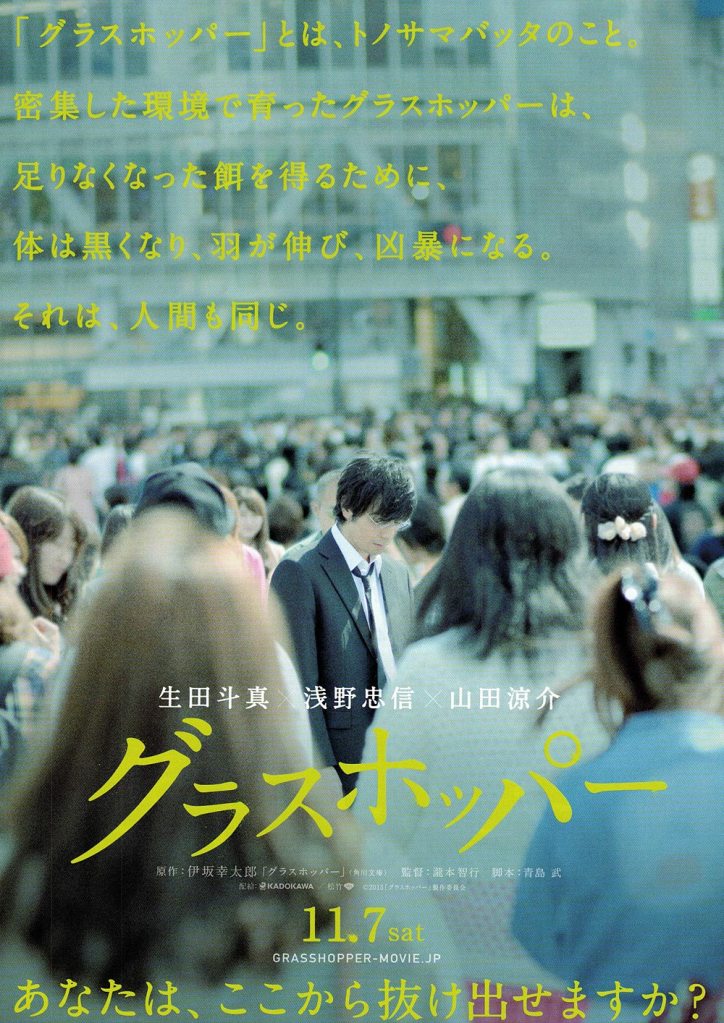
Grasshopper (グラスホッパー, Tomoyuki Takimoto, 2015)

grasshopperThe best revenge is living well, but the three damaged individuals at the centre of Tomoyuki Takimoto’s Grasshopper (グラスホッパー) might need some space before they can figure that out. Reuniting with Brain Man star Toma Ikuta, Takimoto moves away from the more overtly sci-fi elements but maintains a level of everyday strangeness that adds weight to this standard B-movie affair. A revenge thriller in which revenge itself is shown to be a fallacy, Grasshopper manages to mix its grimy grind house violence aesthetic with an oddly hopeful view of human nature.

One tragedy connects three very different people. Halloween, Shibuya – a crazed man at the wheel of a 4×4 receives a phone call instructing him to “crush all those bugs”, because he’s “the saviour”. The man obeys and plows into the holiday revellers crushing them like insects under his wheels. One victim, Yuriko (Haru), who died pushing a child out of harm’s way happened to be the fiancée of middle school science teacher, Suzuki (Toma Ikuta). Revisiting the spot where she fell, Suzuki unexpectedly receives a letter informing him that the events which occurred at Halloween were not as straightforward as the media asserts and he should set about investigating the father and son working at “Fraulein”. His mind burning with thoughts of vengeance, Suzuki abandons his old life and launches himself headlong into the criminal underworld in search of answers.

Meanwhile, the evil kingpins at the centre of things have sent their ace hitman with a difference, Kujira (Tadanobu Asano), to silence a troublesome reporter. Kujira’s unusual assassination method involves a kind of hypnosis in which he forces his victims to acknowledge their darkest sins and eventually commit suicide. Though this sounds like the ideal plan for evading detection, the gangsters are nervous that Kujira has learned to much through his near death conversations with his targets and send a duo of slightly less competent killers on his trail. This leads us to our third strand – sociopathic blade wielding killer, Semi (Ryosuke Yamada), and his stray cat rescuing handler, Iwanishi (Jun Murakami).

Suzuki finds himself out of his depth in the murky, crime ridden underworld. Talking to yet another hitman he crosses paths with, Suzuki is offered the grasshopper analogy which lies at the centre of the film. Pusher (Hidetaka Yoshioka) tells him that unlike regular migratory locusts which are generally green, there is a mutant breed which undergoes a “swarm phase” in which their wings grown darker and longer, becoming ever more destructive in the quest to feed themselves in a crowded environment. People, Pusher claims, are no different. The film is filled with these mutant insects, crushing their fellow humans like roaches under boots, yet there’s something to be said for the migratory guys who keep moving and oppose the mutant breed through stealth and cunning.

Each of the three men is looking for a kind of revenge even if it’s ultimately self inflicted. Unusual hitman Kujira has hit the assassin’s version of angel wings in that he can see the faces of all the men and women he has killed, quite literally haunting his every move and offering a running commentary on his life. Setting out for vengeance against the men who’ve ordered his death, Kujira knows he’s nearing the end of his path yet before he gets there he will have to face off against Semi with whom he has no particular quarrel despite having just given Semi a reason to seek vengeance against him. Semi’s quest for revenge is pointed at Kujira but their mutual need for satisfaction will destroy each of them whilst also bringing them together as equals.

Everything prior to the fateful Halloween is bathed in golden light where warm colours predominate in Suzuki’s fond memories of his fiancée, but everything after is dark, reds and blacks tinged with insect green as grasshoppers swarm like harbingers of a great evil. Revenge itself is constantly frustrated and ultimately swept away from each party by shadowy forces secretly working against the darkness. Nothing is quite as it seems, no one is quite telling the truth. Yet as deep as the original conspiracy goes, the counter conspiracy consistently exceeds it.

Filled with impressive action sequences from Semi’s well choreographed balletic knife displays to large scale crowd scenes and good old fashioned fist fights, Grasshopper owns its down and dirty origins but reinvigorates them with a degree of modern sophistication. Yuriko, a soup chef, insists that the true secret ingredient in her cooking is genuine emotion – that this is what’s left behind when everything else is gone. Suzuki could choose to dive inside his cocoon of unresolved vengeance for the rest of his life but that would not have been what Yuriko wanted for him. In this anti-revenge drama, vengeance is the fallacy that detracts from the truth – that the ultimate form of revenge is learning to live with the past rather than wasting time settling scores.


Original trailer (no subtitles)

Swimming Upstream (バタアシ金魚, Joji Matsuoka, 1990)

Swimming UpstreamSometimes love makes you do crazy things. Some people find themselves accomplishing previously unattainable feats powered only by the sheer force of romance. Unfortunately for the hero of Swimming Upstream (バタアシ金魚, Bataashi Kingyo), Joji’s Matsuoka’s adaptation of Minetaro Mochizuki’s manga, the task he sets for himself is a very lofty one indeed and may actually require him to abandon his love to complete it. Then again, the object of his affections shows little signs of reciprocation in any case.

Love found Kaoru (Michitaka Tsutsui) with a bucket of water. That is, he was hanging around one day when swimsuited beauty Sonoko (Saki Takaoka) soaked him by mistake but far from being annoyed, Kaoru falls in love at first sight and begins to pursue the star of the swim team even if she remains resolutely cold towards him. Kaoru immediately joins up just to be close to her even though he is actually afraid of water and does not know how to swim. Nevertheless he sets himself the task of becoming an olympic swimmer and bringing home a gold medal for his lady love. Needless to day, Sonoko is still not very interested in him.

Assisted by a strange old lady of swimming coach in sporting matters, and with an unlikely ally in Sonoko’s mother when it comes to romance, Kaoru works hard at his twin goals but makes little progress with either. His world is briefly shattered when he spots Sonoko arm in arm with the school’s star swimmer and he also faces a romantic dilemma in the form of his friend Pu whose motorbike he keeps borrowing to try and impress Sonoko despite the fact that Pu obviously has a crush on him. Nevertheless, Kaoru is undeterred until, that is, Sonoko’s actions convince him he may be doing more harm than good.

Matusoka’s film is most clearly concerned with recreating the contemporary high school summer for the presumed target audience of teenagers. Though it loosely adapts a classic sports movie romance format with Kaoru giving it his all in training, it stops short of the triumphant underdog trope as Kaoru never achieves the kind of sporting success one would expect. Though he quickly learns to swim and makes some progress, Kaoru retains a lingering fear of the water and is among the very weakest at the club. Still deluding himself with his Olympian dream, Kaoru even attempts to challenge the champion swimmer of another team (played by a very young Tadanobu Asano in his first film role) in a race for the rights to Kaoru. Needless to say, nothing goes his way.

If duelling over the “rights” to a girl seems like an old fashioned idea, Swimming Upstream is a very old fashioned film in terms of its sexual politics. The film stars popular idol Saki Takaoka as the unattainable Sonoko but is told very much from Kaoru’s point of view in which Sonoko is something to be won rather than another human being with independent will. Sonoko’s behaviour often is hard to categorise but, to borrow a term from the film’s manga roots, could easily be described as tsundere wherein she consistently rejects Kaoru’s advances before warming up to the idea just as he’s beginning to cool off. There may a fine line between persistence and and inappropriate behaviour but Kaoru’s level of devotion is the kind that straddles it. The teenage audience of 1990, however, may have seen things a little differently than that of today.

The audience of 1990 would doubtless also have been shocked by Sonoko’s rebellious lack of compliance with regular social norms. Far from the docile, cute, obedient and polite aura of the traditionally perfect girl next door in which idol movies specialise, Sonoko throws angry looks at everyone and talks back to her mother with extremely harsh words (though her mother wisely refuses to be shocked by them). In fact Sonoko is universally awful to everyone to the extent that it later seems that even one of her closest friends does not actually like her very much, but the worse she gets the more Kaoru refuses to be dissuaded.

Matsuoka mostly chooses to keep things simple with a light hearted, summery atmosphere primed to appeal to his audience of youngsters. Though intended as an innocent romance, contemporary audiences may read more darkness into the relentless war between the icy Sonoko and determined Kaoru but the adolescent intensity of young love does at least ring true. Caught between the quirkiness of its general tone and the heaviness of its themes, Swimming Upstream flounders in making its central connection work, rendering its overworked metaphor of a finale less than successful but does offer strong performances from both of its central stars.


Clip (no subtitles)

Shark Skin Man and Peach Hip Girl (鮫肌男と桃尻女, Katsuhito Ishii, 1999)

Shark_Skin_Man_And_Peach_Hip_Girl_(1998)If you’re going on the run you might as well do it in style. Wait, that’s terrible advice isn’t it? Perhaps there’s something to be said for planning a cunning double bluff by becoming so flamboyant that everyone starts ignoring you out of a mild sense of embarrassment but that’s quite a risk for someone whose original gamble has so obviously gone massively wrong. An adaptation of a manga, Katsuhito Ishii’s debut feature Sharkskin Man and Peach Hip Girl (鮫肌男と桃尻女,  Samehada Otoko to Momojiri Onna) follows a mysterious criminal trying to head off the gang he just stole a bunch of money from whilst also accompanying a strange young girl, also on the run but from her perverted, hotel owning “uncle” who has also sent an equally eccentric hitman after the absconding pair with instructions to bring her back.
Like Ishii’s subsequent efforts, Shark Skin Man and Peach Hip Girl is a riot of full on craziness from the get go, though he largely manages to avoid manga adaptation cliches. The gangster, Samehada (Tadanobu Asano), is pursued by an eccentric set of former gang members – the sanest amongst them being Sawada (Susumu Terajima), his former partner who wants to track him down first to prevent the bloody retribution his guys have in store for him. The gang’s boss (Ittoku Kishibe), lovingly caresses a harpoon, dresses in a gestapo style shiny black leather overcoat, wears one glove, and is on a quest to track down rare vintage posters of much loved Japanese comedian Kon Omura. One of his henchmen is a guy with bleach blond hair who dresses all in white and has an extremely sensitive sense of smell but an intense aversion to water.

The heat coming from the other side is equally strange as the leacherous uncle is apparently friends with Japan’s weirdest hitman, Yamada, who dresses in a retro style and has a unibrow and a high pitched voice. In fact, he’s basically Ken Omura himself, creeping about, being odd in a ridiculous cartoon character way. Unfortunately, Yamada has a weakness and just as he’s about to complete his mission he falls in love with his target! Apparently this is something that happens to him often though you’d think it would be quite a liability given his line of work. In this instance who could really blame him, but his new found romance means he won’t be able to pull the trigger  – and not only that, he can’t bring the girl back either because he doesn’t want to break the beautiful gangster’s heart! Ah, true love!

There is quite a lot going on. Too much, really. For all the craziness which ensues, it’s hard to build up an attachment to any of our strange little gangsters and their petty plots or bids for freedom. Things build to a whirlwind of chaos in the final stretch but when it’s all supposed to calm down for a little spiritual contemplation at the end, the effect begins to fall apart.

There are however a few quieter sections such as a surprisingly maudlin one in which yakuza sons of yakuza fathers lament their unhappy childhoods which saw them bullied and excluded by their law abiding peers. One even says that he thought the tattoos were something which just appeared on everyone when they grew up. Ishii employs some strange jump cuts, moving us ahead a little jerkily as the time passes slowly for this motley crew of veteran bad guys. He later employs a similar technique where he shifts some of his violence into the expressionist realm by cutting on the sound of landing punches.

As the title suggests, Shark Shin Man and Peach Hip Girl is the story of two crazy kids on the run, and the bizarre collection of people who end up chasing them. Ishii could never be accused of subtlety but the punk infused, anarchic and ironic tone are difficult to resist even if the end result is a necessarily slight one. An imperfect, though impressive debut, Shark Skin Man and Peach Hipped Girl is an interesting genre infused tale that uses absurd humour as a foil for the darkness and violence which underpins it.


Original trailer (no English subs – French subs available via settings menu)

Midway through this film someone starts singing a Japanese language cover of Donna Donna which was a surprise! Can’t find a clip so here’s Joan Baez’s version live in Japan in 1967!

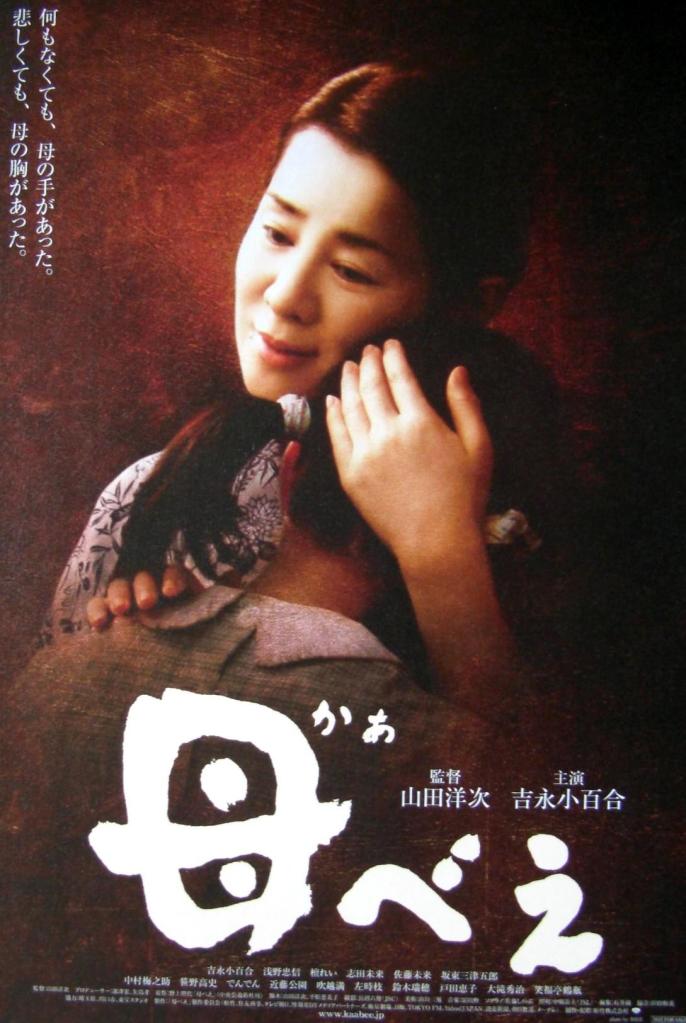
Kabei: Our Mother (母べえ, Yoji Yamada, 2008)

KabeiYoji Yamada’s films have an almost Pavlovian effect in that they send even the most hard hearted of viewers out for tissues even before the title screen has landed. Kabei (母べえ), based on the real life memoirs of script supervisor and frequent Kurosawa collaborator Teruyo Nogami, is a scathing indictment of war, militarism and the madness of nationalist fervour masquerading as a “hahamono”. As such it is engineered to break the hearts of the world, both in its tale of a self sacrificing mother slowly losing everything through no fault of her own but still doing her best for her daughters, and in the crushing inevitably of its ever increasing tragedy.
Summer, 1940. The Nogamis are a happy family who each refer to each other by adding the cute suffix of “bei” to their names. The father, Tobei (Bando Mitsugoro X), is a writer and an intellectual opposed to Japan’s increasing militarism and consequently has found himself in both political and financial difficulties as his writing is continually rejected by the censors. Eventually, the secret police come for him, dragging him away from his home in front of his terrified wife and daughters. After Tobei is thrown into jail for his “thought crimes”, the mother, Kabei (Sayuri Yoshinaga), is left alone with her two young girls Hatsuko and Teruyo (Hatsubei and Terubei in family parlance).

Though devastated, Kabei does not give up and continues to try and visit her husband, urging his release and defending his reputation but all to no avail. Thankfully, she does receive assistance from some of her neighbours who, at this point at least, are sympathetic to her plight and even help her get a teaching job to support herself and the children in the absence of her husband. She also finds an ally in the bumbling former student, Yamazaki (Tadanobu Asano), as well as her husband’s sister Hisako (Rei Dan), and her brother (Tsurube Shofukutei) who joins them for a brief spell but ultimately proves a little too earthy for the two young middle class daughters of a dissident professor.

The time passes and life goes on. The war intensifies as do the attitudes of Kabei’s friends and neighbours though the family continues its individual struggle, sticking to their principles but also keeping their heads down. By the war’s end, Kabei has lost almost everything but managed to survive whilst also ensuring her children are fed and healthy. A voice over from the older Teryuo calmly announces the end of the conflict to us in such a matter of fact way that it’s impossible not wonder what all of this was for? All of this suffering, death and loss and what has it led to – even more suffering, death and loss. A senseless waste of lives young and old, futures ruined and families broken.

Yet for all that, and to return to the hahamono, the Nogami girls turned out OK. Successful lives built in the precarious post-war world with careers, husbands and families. Unlike many of the children in the typical mother centric movie, Hatsuko and Teruyo are perfectly aware of the degree to which their mother suffered on their behalf and they are both humbled and grateful for it. Kabei was careful and she kept moving to protect her children in uncertain times. Seen through the eyes of a child, the wartime years are ones of mounting terror as fanatical nationalism takes hold. Bowler hatted men seem to rule everything from the shadows and former friends and neighbours are primed to denounce each other for such crimes as having the audacity to wear lipstick in such austere times. In one notable scene, the neighbourhood committee begins its meeting by bowing at the Imperial Palace, until someone remembers the paper said the Emperor was in a different palace entirely and they all have to bow the other way just in case.

Though the tale is unabashedly sentimental, Yamada mitigates much of the melodrama with his firmly domestic setting. We see the soldiers massing in the background and feel the inevitable march of history but the sense of tragedies both personal and national, overwhelming as it is, is only background to a testament to the strength of ordinary people in trying times. An intense condemnation of the folly of war and the collective madness that is nationalism, Kabei is the story of three women but it’s also the story of a nation which suffered and survived. Now more than ever, the lessons of the past and the sorrow which can only be voiced on the deathbed are the ones which must be heeded, lest more death and loss and suffering will surely follow.


Original trailer (English subtitles)

Journey to the Shore (岸辺の旅, Kiyoshi Kurosawa, 2015)

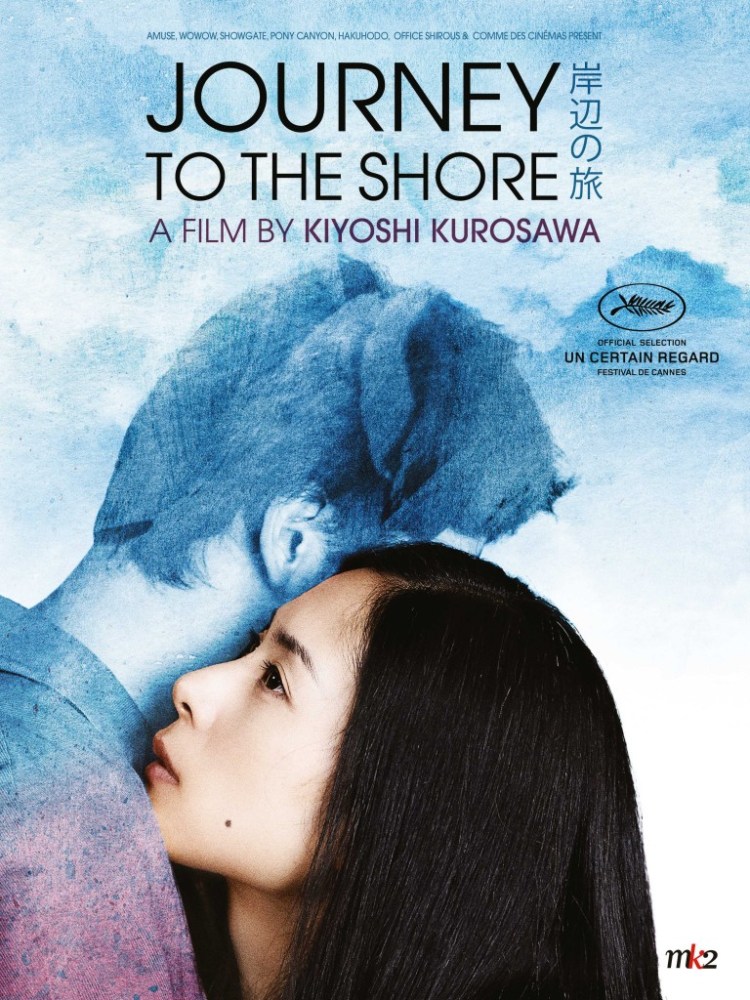
journey to the shoreTime is an ocean, but it ends at the shore. Kiyoshi Kurosawa neatly reverses Dylan’s poetic phrasing as his shoreline is less a place of endings but of beginnings or at least a representation of the idea that every beginning is born from the death of that which preceded it. Adapted from a novel by Kazumi Yumoto, Journey to the Shore (岸辺の旅, Kishibe no Tabi) takes its grief stricken, walking dead heroine on a long journey of the soul until she can finally put to rest a series of wandering ghosts and begin to live once again, albeit at her own tempo.
The film begins with three years widowed Mizuki (Eri Fukatsu) giving a piano lesson to a little girl whose mother goes on to enquire about her daughter’s progress. Wouldn’t it be better if she could learn something a little more cheerful once in a while? Reconsidering, the mother reflects that uptempo doesn’t quite suit Mizuki, and she’s right – it doesn’t. After impulse buying some flour and baking a few Japanese sweets at home, Mizuki receives an unexpected visit from her deceased husband, Yusuke (Tadanobu Asano), who drowned himself at sea.

Somehow unsurprised and pausing only to remind him to remove his shoes, Mizuki gives Yusuke some of the dumplings then retires to bed, only to wake up the next morning and wonder if she dreamt the strange events of the night before but, sure enough, Yusuke is still very much present. Promising to show her some of the beautiful places he discovered on his long odyssey home to her, Yusuke takes Mizuki on a reverse honeymoon in celebration and in mourning of all they once were to each other.

In each place they travel to, Mizuki and Yusuke help the people there deal with their own walking ghosts. Yusuke is not the only returnee as they discover with a lonely old newspaper seller who doesn’t appear to be aware that he died a long time ago. Walking dead in a realer sense than Mizuki or some of the other depressives they meet along the way who are still living but not exactly alive, Mr Shimakage is a spirit held in place by an inability to reconcile himself with the actions of his past and has brought his feelings of self loathing and regret with him into the afterlife.

Sometimes it’s the living that pin the dead, holding them close with guilt, regret, love or loneliness. If the film has a central tenet, it’s that the past has its place, and it’s not among the living. At one point Mizuki says that perhaps it’s better to leave some things unresolved. Yusuke asks her if she’s really OK with that, and she seems to reconsider but in the end that’s the way it has to be. There are no final solutions, the answers are not at the back of the book. In the end, the best you can do is try to understand and learn to be OK with everything you do and do not know about yourself and about those who are no longer here to tell their stories. Mizuki also says that she hated to practice piano as a child, but her teacher always told her to pay attention to her own rhythm. The music will always be lifeless, until you learn to hear your own song.

Kurosawa creates a beautifully ethereal world, held in a tension between the spirit realm and the everyday. Playing with lighting levels in extremely interesting ways, he allows the supernatural and natural to flow into each other, jostling and merging like waves and shore. Travelling from the grey, ordered and utilitarian city to the unruly nature of the countryside with its ancient, crashing waterfalls and beautiful, if lonely, coastlines we move from static and lifeless existence to a place of perpetual potential as we let go of one thing so that we might grasp another.

As much as Journey to the Shore is bound up with death, it necessarily speaks of life, too. During one of his strange lessons for the village folk, Yusuke delivers some meditations on science and philosophy to the effect that the world is built of nothingness but that nothingness does not lack meaning. He tells us that we are all dying, the universe was born billions of years ago and will end one day just as our species may end when the planet’s temperature exceeds that which we can endure or galaxies collide and take us down with them. For all of that, the universe is young, still growing, still expanding, and we are so lucky to have been born now when there is still so much ahead of us. This is a time of infinite beginnings. Starting again means letting go, but sooner or later you have to step off the shore of this self imposed purgatory and return to the great ocean which is life.


Journey to the Shore is availble on dual format DVD and blu-ray in the UK courtesty of Eureka Masters of Cinema.

Parasyte The Movie Part 2 (寄生獣 完結編, Takashi Yamazaki, 2015)

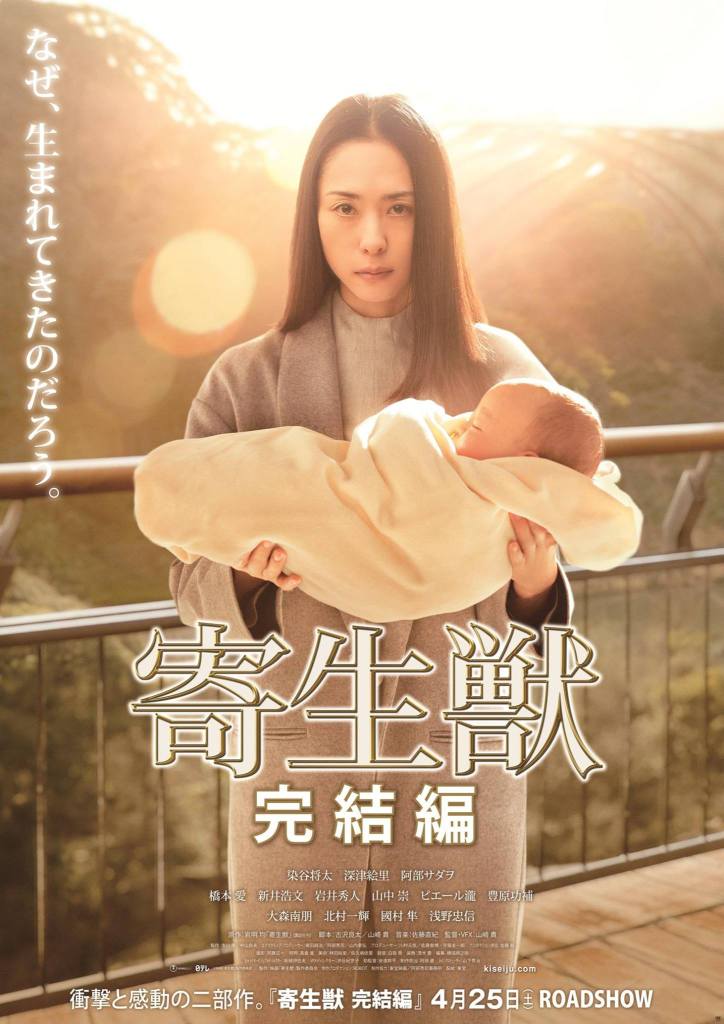
parasyte part 2Review the concluding chapter of Takashi Yamazaki’s Parasyte live action movie (寄生獣 完結編, Kiseiju Kanketsu Hen) first published by UK Anime Network.

So, at the end of Part 1, Shinichi and Migi had successfully dispatched their creepy fellow student enemy in the midst of high school carnage but if they thought it was over their troubles were only just beginning. While Shinichi and Migi struggle to define what it is that they are, Ryoko Tamiya’s network is also showing cracks as her increasing levels of humanity contrast with her fellow Parasytes’ ambivalent attitudes to their host species. Ryoko may regard humans as the best hope for the survival of her kind, but you can’t argue with the fact that humanity is often the biggest threat to its own survival. The Parasytes may have a point when they describe us as a pestilence, blighting the planet with our lack of interest in our own living environment. Parasytes, dispassionate as they are, are better equipped to take the long view and ensure the survival of the Earth if only so that they may live in it.

Diverging slightly from the sci-fi movie norm, the police have cottoned on to the Parasyte threat and even uncovered the city hall based conspiracy though they haven’t quite got it all figured out yet. They are also completely unprepared to deal with the big bad that is Goto – a super Parasyte introduced in a Hannibal Lecter inspired cameo at the end of the previous film. Goto also has a minion, Miki, intent on making trouble whereas Ryoko still has various “experiments” on the go including her recently born son and a blackmail scam involving a low rent photojournalist. Add to the mix a dangerous serial killer who can ID Parasytes and the end of mankind seems like a very real possibility.

By this point, Shinichi and Migi have developed a symbiotic relationship which includes endearing little episodes like cooking dinner together with Migi using his unique capabilities to chop veg and make the ultimate miso soup. Ryoko has now given birth to her son and finds herself unexpectedly attached to her experimental offspring. After playing peekaboo with him one evening, she mimics the baby boy by laughing out loud and observing her reflection. Her human disguise has begun to feel good – what she wants now is less colonisation than peaceful co-existence. If Parasytes and humans could truly become one, embracing both the dispassionate Parasyte capacity to plan for their survival and the human capacity for compassion, perhaps both could achieve mutual salvation.

However, Ryoko’s comparatively hippy trippy viewpoint won’t play city hall and the new mayoral stooge is not as well disposed to humanity as his co-conspirator. In attempting to remove Ryoko’s various irons from the fire, the local government gang do nothing so much as invite their own destruction both at the hands of Ryoko herself and at those of the police. However, the police have not banked on Goto who has already become more powerful than they could possibly imagine. The series’ big bad, Goto isn’t given much of an opportunity play the mastermind card but is allowed to expound on his philosophy during the final fight. He says he hears a voice which instructs him to devour the whole of humanity but, after thinking about who this voice might belong to, he concluded that it belongs to humanity itself, begging to be released from its cycle of self destruction.

Less than subtle philosophising aside, Yamazaki maintains the approach and aesthetic from the first film though Part 2 is a little more serious in tone and more given over to meaningful speechifying than its gore filled predecessor. The body horror shenanigans are much less prevalent until the quite gruesome practical effects based final fight, though we’ve already seen enough Parasyte carnage by this point to know the score. That said, the Terminator 2 inspired car sequence and Goto’s unexpected superhero metamorphosis more than satisfy the craving for explosive action.

Parasyte plays with dualities to the max as Ryoko and Shinichi travel the same path from opposite directions ending by meeting somewhere in the middle and parting on a note of understanding rather than one of conflict. In the end, the film’s major message seems to be a plea for harmony in all things. One of Ryoko’s final thoughts casts grief as another kind of parasite – invading the soul, corrupting it and transforming a once rational person into a creature of fear and rage. She eventually finds an answer to all of her questions in the most human of things, emotional connection becomes her salvation and her final hope was that this union of pragmatism and passion could serve as a plan for the salvation of both species.

Even if Parasyte is a little blunt in delivering its well worn messages about the mankind’s negative effect on the planet, the essential baseness of the human spirit, and that desire for survival in one form or another is the driving force of all life, it does so in an interesting fashion and generally avoids falling into the cod philosophy trap of more seriously minded science fiction adventure. Once again Yamazaki marshals all his powers to create a well produced genre-hybrid of a blockbuster movie which takes its cues from 80s genre classics and is well anchored by a series of committed, nuanced performances from its admittedly starry cast.


Parasyte The Movie: Part 2 is available on DVD and blu-ray in the UK from Animatsu Entertainment.

English subtitled trailer:

Vengeance Can Wait (乱暴と待機, Masanori Tominaga, 2010)

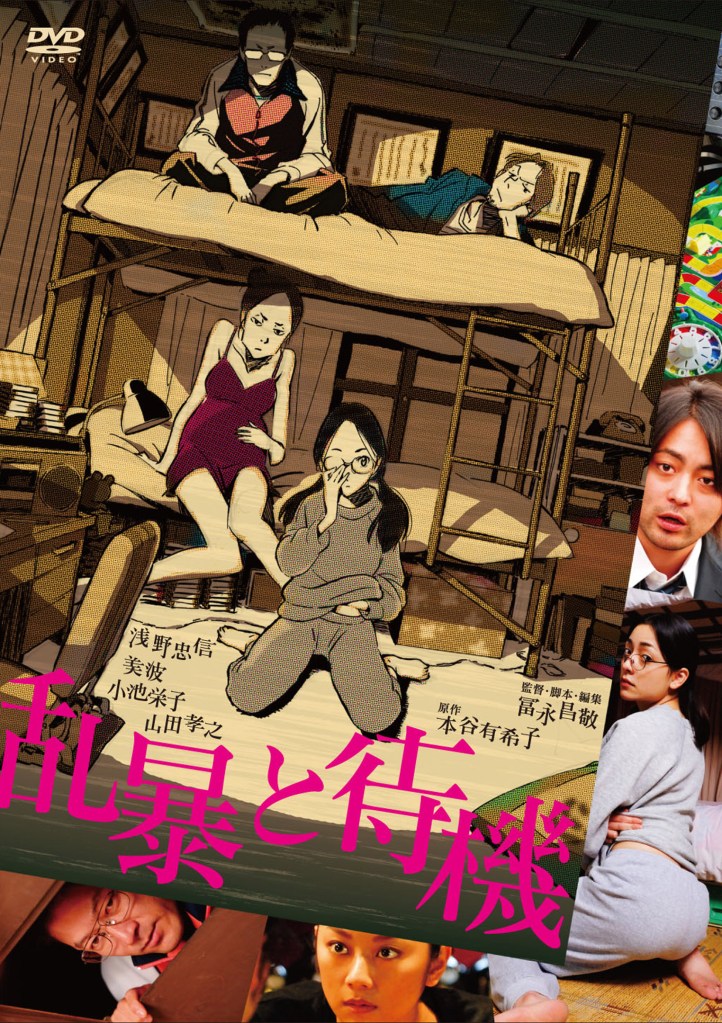
MFBDm_Tallcase_sell_CS3Vengeance is a dish best served cold, but then if you’re going to wait a while perhaps you should make sure to add plenty of salt and spice to the mix to disguise its rather rancid odour. Adapted from a play by Yukiko Motoya, Masanori Tominaga’s Vengeance Can Wait (乱暴と待機, Ranbou to Taiki) is the strange tale of four interconnected people who each become ensnared in a bizarre circle of violent revenge!

Asuka (Eiko Koike) and Banjo (Takayuki Yamada) are currently expecting a baby and have moved back to Azusa’s hometown where she is working in a bar and he is currently seeking employment (somewhat half heartedly). Whilst Azusa heads off to work, Banjo goes to introduce himself to the neighbours and surprises Nanase (Minami) during a lengthy sutra reading session. Nanase is a very strange woman indeed – dressed in a grey tracksuit, glasses, and generally looking odd, she immediately jumps to the conclusion that she’s annoyed Banjo with her weirdness and tries to give him money to make up for it, such is her intense fear of being disliked. Things get even weirder when Azusa realises Nanase is an old high school classmate towards whom she’s still nursing an ancient grudge. This also means that Azusa knows the man Nanase is living with and addresses as “big brother” is not her actual brother at all…..

Nanase becomes the plot’s essential “object” in a sense with Azusa acting as its subject and the two men more or less relegated to the status of adverbs. Azusa’s personality changes dramatically in the presence of Nanase – seemingly perfectly pleasant and ordinary in other circumstances, her tone takes on an extremely harsh quality, almost yanki-ish in its coarseness. However, Nanase’s need to be liked, or at least not disliked, has her immediately acquiesce to whatever it is she thinks other people want of her. She’s completely incapable of saying what she might actually think or doing what she would like to do but only thinks about how others are viewing her which is both extraordinarily masochistic and actually a little bit selfish.

The relationship between Nanase and her “big brother” Mr. Yamane (Tadanobu Asano) is the perfect culmination of this strange dynamic. Nanase philosophises at one point about the certainty of hate and the mysterious quality of love – that it’s impossible to say exactly why you love someone but you can usually point to a concrete reason for hating them. She and Yamane are bound by a common event in their pasts and, she reasons, perhaps this is enough of a reason for fate to keep them together. Yamane keeps her around because he’s plotting an elaborate revenge plot for a grudge he holds against her but at five years and counting he still hasn’t figured it out yet. During this time, he’s also started pretending to go out “marathon running” but has really been crawling into the attic space to spy on Nanase while she gets on with normal household tasks throughout the day.

Things come to a head when the feckless Banjo develops an attraction for Nanase despite her deliberately slovenly appearance which she affects for the express purpose of avoiding male interest. Using her inability to say no against her, he convinces her to start an affair with him whilst also blackmailing her that if she doesn’t he’ll mistreat his wife, Azusa, whom Nananse is still keen on making up with despite the long held high school era hurt which continues to come between them.

It’s a fairly light and absurd if darkly comic set up which is more about the pointlessness of grudges, violence, and lying about yourself to please others, than it is about a grander mediation on the fruitlessness of revenge – the desire for which, strangely, does end up building an otherwise elusive connection between two people who seem to have been unable to form one in any other way. Tominaga opts for a fairly simple and straightforward approach but does a great job of avoiding the often overly theatrical feeling of many stage to screen adaptations. However, it has to be said that perhaps some of the more unusual elements play better in the enclosed, less “realistic” theatre environment than they do on screen.

That is to say, Vengeance Can Wait has the feeling of slightly throwaway fringe theatre which is partly based on the frisson of mocking supposedly bourgeois values with a series of comically absurd episodes. This approach feels much more fun over a claustrophobic 90 minutes trapped in a tiny performance space which ends up covered in the physical manifestation of a deteriorating situation, but fares a little less well when you open it up into a larger filmic world. However, the film’s odd comments on accidentally sado-masochistic relationships and its absurd black comedy provide enough quirky diversion to build an appropriately amusing atmosphere.


Interestingly enough, Vengeance Can Wait is one of the few Japanese plays which has been translated and performed in English (it’s also unusual because it seems to be a direct translation whereas most English adaptations of foreign plays are “rewritten” by an established playwright from a literal translation) – performance rights with Samuel French. There’s also a review of the run of the play in New York in 2008 from Village Voice.

unsubtitled trailer: