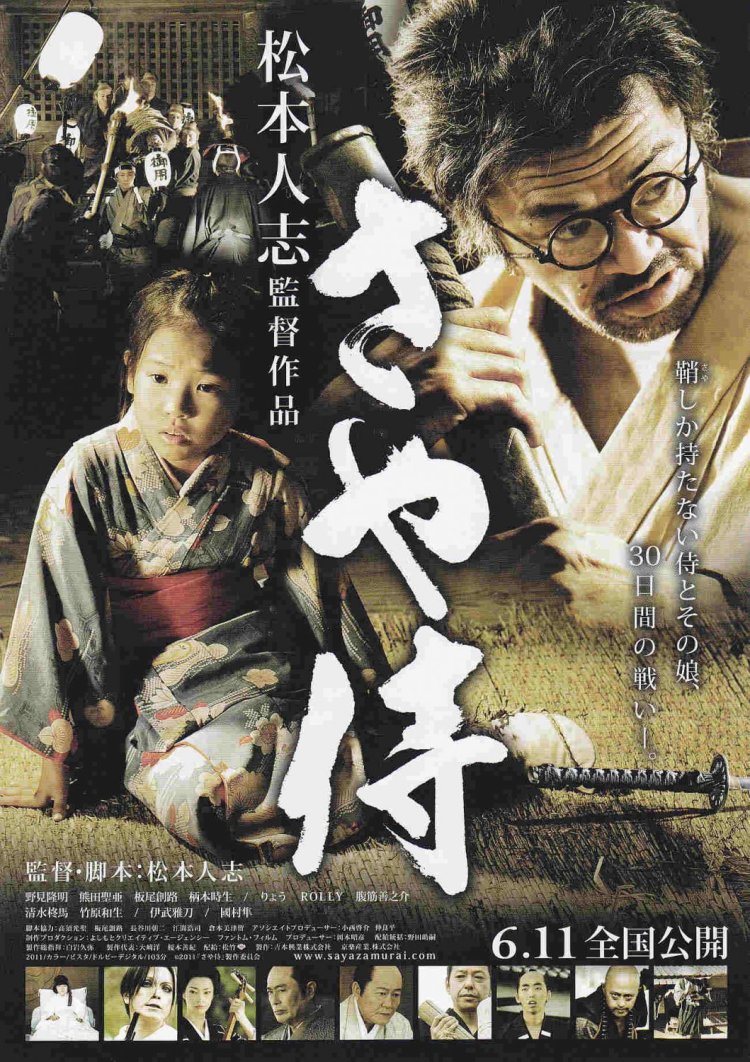
 A samurai’s soul in his sword, so they say. What is a samurai once he’s been reduced to selling the symbol of his status? According to Scabbard Samurai (さや侍, Sayazamurai) not much of anything at all, yet perhaps there’s another way of defining yourself in keeping with the established code even when robbed of your equipment. Hitoshi Matsumoto, one of Japan’s best known comedians, made a name for himself with the surreal comedies Big Man Japan and Symbol but takes a low-key turn in Scabbard Samurai, stepping back in time but also in comedic tastes as the hero tests his mettle as a showman in a high stakes game of life and death.
Nomi Kanjuro (Takaaki Nomi) is a samurai on the run. Wandering with an empty scabbard hanging at his side, he pushes on into the wilderness with his nine year old daughter Tae (Sea Kumada) grumpily traipsing behind him. Eventually, Nomi is attacked by a series of assassins but rather than heroically fighting back as any other jidaigeki hero might, he runs off into the bushes screaming hysterically. Nomi and Tae are then captured by a local lord but rather than the usual punishment for escapee retainers, Nomi is given an opportunity to earn his freedom if only he can make the lord’s sad little boy smile again before the time is up.
Nomi is not exactly a natural comedian. He’s as sullen and passive as the little lord he’s supposed to entertain yet he does try to come up with the kind of ideas which might amuse bored children. Given one opportunity to impress every day for a period of thirty days, Nomi starts off with the regular dad stuff like sticking oranges on his eyes or dancing around with a face drawn on his chest but the melancholy child remains impassive. By turns, Nomi’s ideas become more complex as the guards (Itsuji Itao and Tokio Emoto) begin to take an interest and help him plan his next attempts. Before long Nomi is jumping naked through flaming barrels, being shot out of cannons, and performing as a human firework but all to no avail.
Meanwhile, Tae looks on with contempt as her useless father continues to embarrass them both on an increasingly large stage. Tae’s harsh words express her disappointment with in Nomi, berating him for running away, abandoning his sword and with it his samurai honour, and exposing him as a failure by the code in which she has been raised. She watches her father’s attempts at humour with exasperation, unsurprised that he’s failed once again. Later striking up a friendship with the guards Tae begins to get more involved, finally becoming an ally and ringmaster for her father’s newfound career as an artist.
Tae and the orphaned little boy share the same sorrow in having lost their mothers to illness and it’s her contribution that perhaps begins to reawaken his talent for joy. Nomi’s attempts at comedy largely fall flat but the nature of his battle turns out to be a different one than anyone expected. Tae eventually comes around to her father’s fecklessness thanks to his determination, realising that he’s been fighting on without a sword for all this time and if that’s not samurai spirit, what is? Nomi makes a decision to save his honour, sending a heartfelt letter to his little girl instructing her to live her life to the fullest, delivering a message he was unable to express in words but only in his deeds.
Matsumoto’s approach is less surreal here and his comedy more of a vaudeville than an absurd kind, cannons and mechanical horses notwithstanding. The story of a scabbard samurai is the story of an empty man whose soul followed his wife, leaving his vacant body to wander aimlessly looking for an exit. Intentionally flat comedy gives way to an oddly moving finale in which a man finds his redemption and his release in the most unexpected of ways but makes sure to pass that same liberation on to his daughter who has come to realise that her father embodies the true samurai spirit in his righteous perseverance. Laughter and tears, Scabbard Samurai states the case for the interdependence of joy and sorrow, yet even if it makes plain that kindness and understanding are worth more than superficial attempts at humour it also allows that comedy can be the bridge that spans a chasm of despair, even if accidentally.
Currently streaming on Mubi
Original trailer (no subtitles)

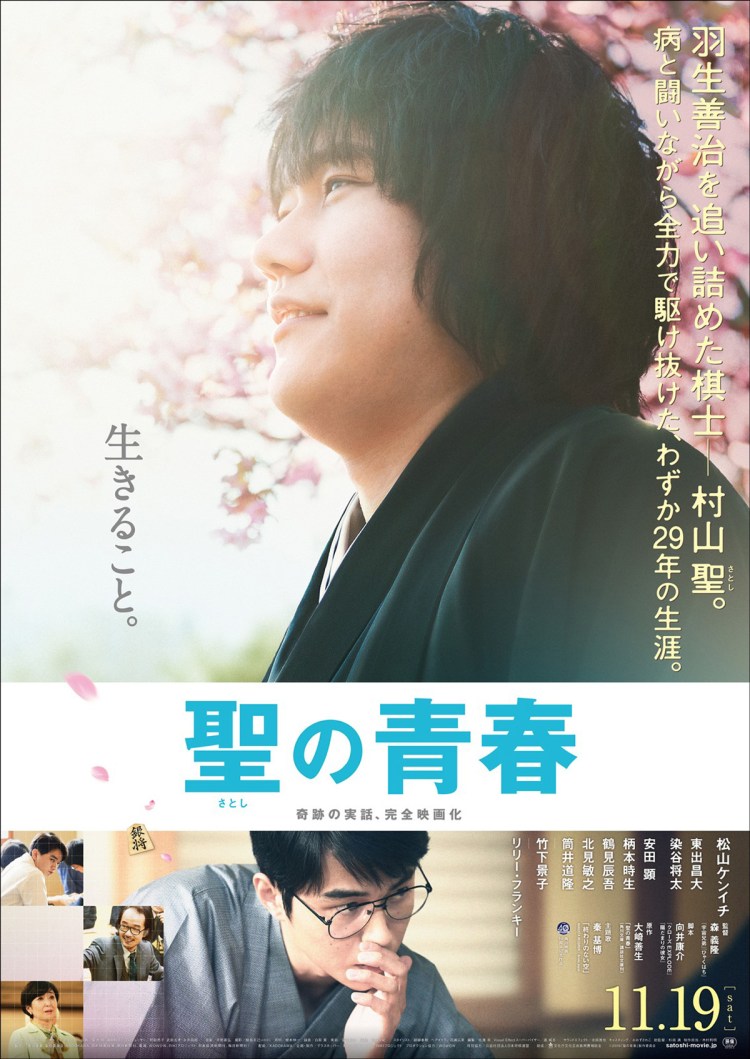 There’s a slight irony in the English title of Yoshitaka Mori’s tragic shogi star biopic, Satoshi: A Move For Tomorrow (聖の青春, Satoshi no Seishun). The Japanese title does something similar with the simple “Satoshi’s Youth” but both undercut the fact that Satoshi (Kenichi Matsuyama) was a man who only ever had his youth and knew there was no future for him to consider. The fact that he devoted his short life to a game that’s all about thinking ahead is another wry irony but one it seems the man himself may have enjoyed. Satoshi Murayama, a household name in Japan, died at only 29 years old after denying chemotherapy treatment for bladder cancer in fear that it would interfere with his thought process and set him back on his quest to conquer the world of shogi. Less a story of triumph over adversity than of noble perseverance, Satoshi lacks the classic underdog beats the odds narrative so central to the sports drama but never quite manages to replace it with something deeper.
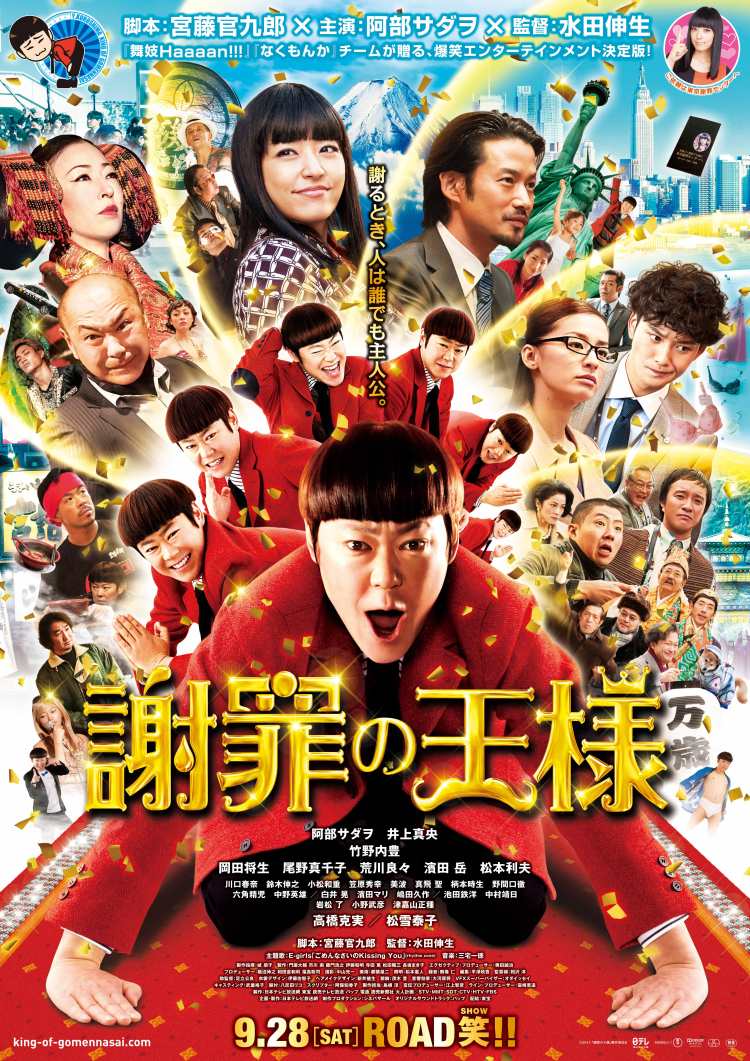 There are few things in life which cannot at least be improved by a full and frank apology. Sometimes that apology will need to go beyond a simple, if heart felt, “I’m Sorry” to truly make amends but as long as there’s a genuine desire to make things right, it can be done. Some people do, however, need help in navigating this complex series of culturally defined rituals which is where the enterprising hero of Nobuo Mizuta’s The Apology King (謝罪の王様, Shazai no Ousama), Ryoro Kurojima (Sadao Abe), comes in. As head of the Tokyo Apology Centre, Kurojima is on hand to save the needy who find themselves requiring extrication from all kinds of sticky situations such as accidentally getting sold into prostitution by the yakuza or causing small diplomatic incidents with a tiny yet very angry foreign country.
 No names, no strings. That’s the idea at the centre of Daisuke Miura’s adaptation of his own stage play, Love’s Whirlpool (愛の渦, Koi no Uzu). Love is an odd word here as it’s the one thing that isn’t allowed to exist in this purpose built safe space where like minded people can come together to experience the one thing they all crave – anonymous sex. From midnight to 5am this group of four guys and four girls have total freedom to indulge themselves with total discretion guaranteed.
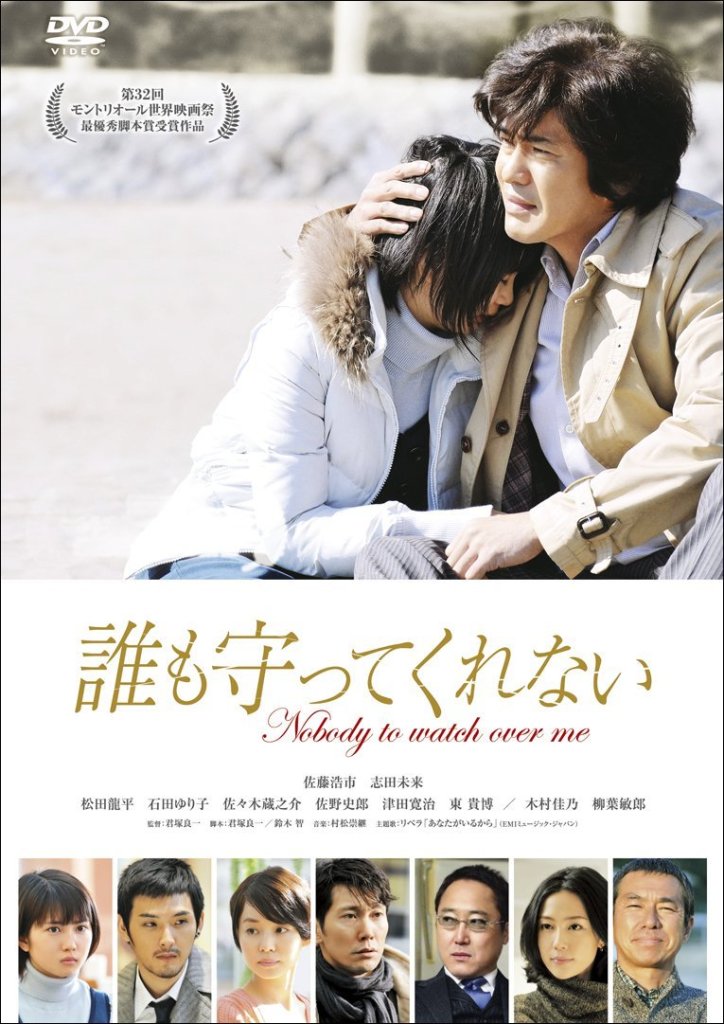 When a crime has been committed, it’s important to remember that there may be secondary victims whose lives will be destroyed even if they themselves had no direct involvement in the case itself. This is even more true in the tragic case that person who is responsible is themselves a child with parents and siblings still intent on looking forward to a life that their son or daughter will now never lead. This isn’t to place them on the same level as bereaved relatives, but simply to point out the killer’s family have also lost a child who they have every right to grieve for, though their grief will also be tinged with guilt and shame.
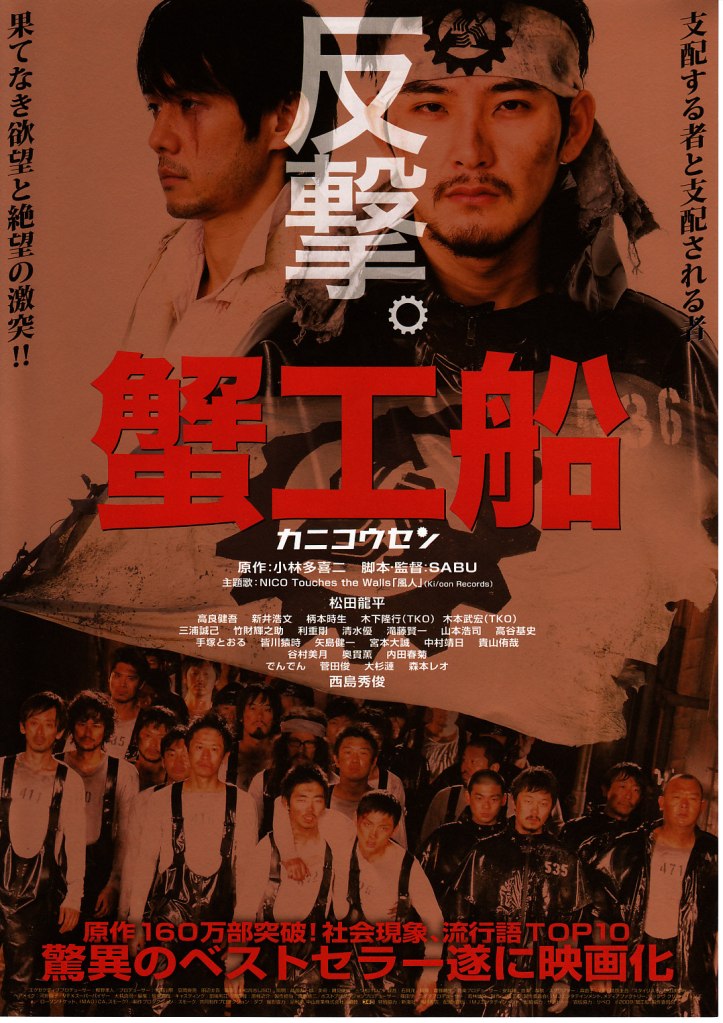 Back in 2008 as the financial crisis took hold, a left leaning early Showa novel from Takiji Kobayashi, Kanikosen (蟹工船), became a surprise best seller following an advertising campaign which linked the struggles of its historical proletarian workers with the put upon working classes of the day. The book had previously been adapted for the screen in 1953 in a version directed by So Yamamura but bolstered by its unexpected resurgence, another adaptation directed by SABU arrived in 2009.
 Yaro Abe’s manga Midnight Diner (深夜食堂, Shinya Shokudo) was first adapted as 10 episode TV drama back in 2009 with a second series in 2011 and a third in 2014. With a Korean adaptation in between, the series now finds itself back for second helpings in the form of a big screen adaptation.
 Windows on Worlds