Strangers (Kenta Ikeda, 2024)

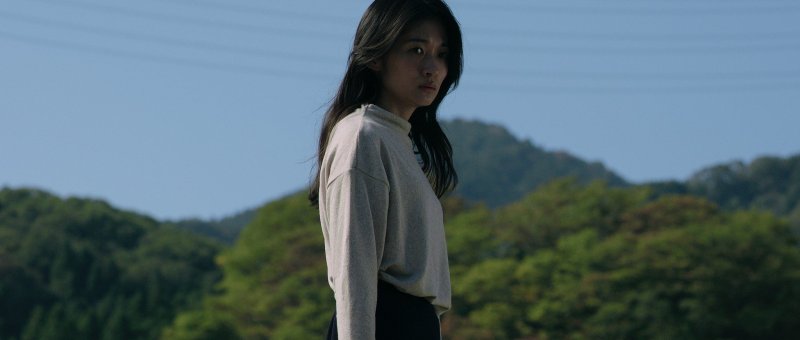
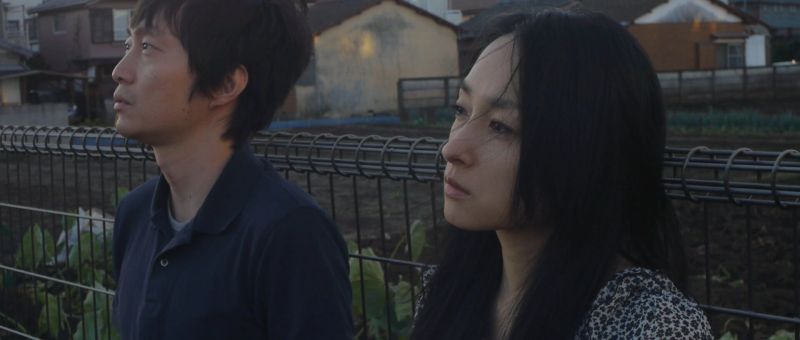
Naoko, the heroine of Kenta Ikeda’s Strangers, says she’s been pretending all her life. She’s been pretending to be what everyone wanted her to without really knowing or thinking about what it was she wanted to be or who she really is. On a baseline level, Ikeda suggests that we are and remain strangers to ourselves while equally confused about those around us, seeing what we want or expect to see rather than who they really are.

In part that may explain why Naoko has stayed with her unfaithful fiancé Takeo who got a colleague pregnant and then seemingly abandoned her. Shimizu then began harassing Naoko, stalking her and making silent calls. To make matters worse, Takeo is often away on “business trips”. He’s not currently responding to her phone calls or messages and has just embarrassed her by not turning up to a family event. Naoko’s sister thinks she should leave him and doesn’t understand why she hasn’t already. But Naoko just sighs that she’s decided not to expect too much from life and seems prepared to put up with this degradation because she doesn’t think she deserves anything better. 

That might be why she’s so drawn to her enigmatic colleague Yamaguchi who waltzes in past noon wearing a distinctive blue dress that floats in the air behind her. The other ladies at work gossip that their bullying boss Satome, who is married with two children, got her the job after picking her up on a dating app and the reason why she can get away with such unprofessional behaviour is because she’s sleeping with him. But Naoko later discovers that Yamaguchi’s dating app activities are a kind of side hustle in which she participates in idealised dating scenarios pretending to be the lover of lonely men who pay her handsomely for a few hours of fantasy romance.

Or as Yamaguchi describes it, the opportunity to experience only the good parts of love before you get sick of each other and run out of things to say. It sounds more than a little like the logic of someone who’s decided not to expect too much from life, and while it seems Yamaguchi may be trying to avoid her own grief and loneliness, it’s true that she otherwise remains a cypher. After losing contact with Yamaguchi and being left with her smartphone, Naoko receives a call from her handler who tells her that it doesn’t matter who she is or why she has “Yamaguchi’s” phone, all that matters is turning up at the appointment and never letting it slip that it’s all just role-play.

On her dating app profile, Yamaguchi’s face is blurred so that you only really see the image of her in her distinctive blue dress which Naoko too later starts wearing. The people around Naoko are often shot in soft focus so that we can’t really be sure of their identity beyond using their clothing to infer who they are. Men in particular are often shot from behind or with their faces out of frame as if they were all just a much of a muchness. We never even meet Takeo, who apparently does not return from his “business trip”. In any case, in agreeing to the fantasy date, Naoko is gradually taken over by the Yamaguchi persona. The spread of the graze she sustained at the beginning of the film seems to indicate the gradual erasure of her identity, yet in another sense becoming Yamaguchi also gives Naoko an excuse to stop pretending and accept herself or at least to start expecting more from life. She becomes more assertive, flirtatious, and confident in confronting Shimizu only to realise that she may not have been the mysterious force she felt watching her after all. 

In her Yamaguchi persona, Shimizu describes Naoko as a like a colourless and doorless detergent, but she replies she’s been hiding all her life. She ran ran away from her problems, refused confronting Takeo or Shimizu, avoided being honest with her family and simply played up to the image they had of her of a shy and obedient woman. There might be something in the fact that Yamaguchi kisses her suggesting that Naoko may have been running away from her sexuality, but equally it could just be that this is how the Yamaguchi curse is passed from woman to woman. Having once assumed it, Naoko now must try to shake it off but that too might not be as easy as she might assume. Meanwhile, those around her also have their own secret lives and faces they keep hidden from others. Ikeda creates a atmosphere of eeriness and hovering violence amid the faceless city where it doesn’t matter who you are so long as you show up and everyone is to some extent participating in a temporary fantasy in order to overcome the disappointment of life in which as Naoko had told herself it seems better not to expect too much.


Faraway Family (彼方の家族, Taro Kawasaki & Eisuke Sakauchi, 2023)

It may be a truism to say that you never really know what’s going on in other people’s lives, but even if a family looks superficially happy and gives the impression everything is going just perfectly for them that might not actually be the case. The title of Taro Kawasaki & Eisuke Sakauchi’s Faraway Family (彼方の家族, Kanata no Kazoku) has a double meaning in that in the Japanese title can be also read as “Kanata’s Family” which is the name of the hero and also a word meaning “somewhere in the distance” which is in fact how both of the boys feel their fathers to exist. 

Kanata may feel it more closely in that he lost his father in the 2011 tsunami and has never really dealt with the grief having moved to Yamagata with his mother. Kanata’s father also had quite a difficult relationship with his fisherman grandfather who was intent on railroading him to take over the boat and seemingly never had a good word for anyone yet his father lost his life after heading to the harbour to look for him explaining only that he was family. Now the only breadwinner in the family, his mother has to work to support them and is therefore often absent, leaving him money to buy dinner from a convenience store which he usually eats alone. 

Having become withdrawn and fearful of making new relationships that may end suddenly, Kanata also has the added stigma of being someone from Fukushima in the wake of the nuclear disaster. His new teacher, Yoshikazu, makes a well-meaning faux pas in telling Kanata to consider him a father figure yet as it turns out Yoshikazu is a fairly compromised one. On being introduced to his classmate Riku who is also Yoshikazu’s son he thinks he’s had his face rubbed in it with this picture of the perfect family.

But what he discovers is that Riku has many of the same problems as himself seeing as he also fears he does not really fit in his family and wonders if they’d be happier and better off if he weren’t in it. Unlike Riku, Kanata doesn’t seem to be overly burdened by parental expectation and despite the problems between his father and grandfather his early childhood seems to have been happy and filled with love and cheerfulness. His problem is more to do with what he’s lost and the resulting sense of absence it’s left behind as he finds himself eternally missing his father. 

For Riku meanwhile, it’s the connection itself which is painfully absent. The more he tries to connect with Yoshikazu the more it seems to backfire while Yoshikazu seems obsessed with the idea of his getting into Japan’s most prestigious university mostly for his own gratification as double proof of what a great teacher and father he is. Or else, to mask his own sense of inadequacy in that he would feel embarrassed professionally if his own son turned out not to be academically inclined. Riku’s family don’t celebrate birthdays and he can’t ever remember getting a present but when he decides to try and buy one for Yoshikazu it’s a reminder of a happier memory when he simply played with him as a loving father rather than a hard taskmaster driving him on to a vicarious goal as evidence of his controlling nature. 

Kanata seems to have had more than his share of tragedy in life and is painfully aware of the things just our of reach but also increasingly that not all of them are and if you’re not careful you can in fact be the one to push them away. Shooting in the icy snow of a Yamagata winter, Kawasaki and Sakauchi capture the frostiness of the boys’ emotional isolation but also the quickening warmth of their friendship as they bond over their shared loneliness in pining for an absent father. What Kanata learns is to embrace the things that seem somewhere far away for they do at least exist there, even if no longer present in a physical sense, and that the memory of them can be warm and comforting rather than painful or lonely. 


Faraway Family screened as part of this year’s Osaka Asian Film Festival.

Original trailer (no subtitles)

Love Will Tear Us Apart (ラヴ・ウィル・テア・アス・アパート, Kenichi Ugana, 2023)

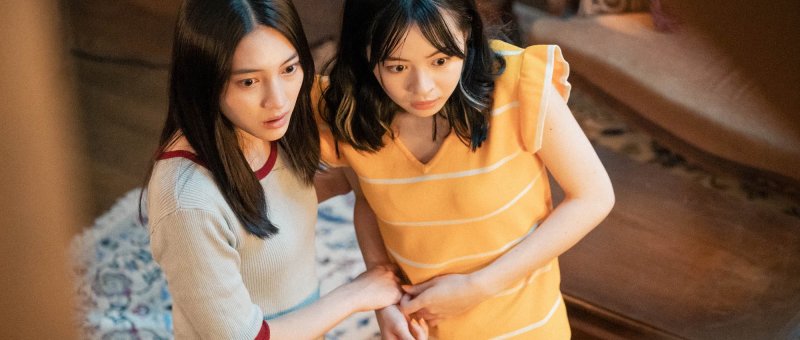
“This film depicts a pure and genuine love between an awkward boy and a girl with a pure heart,” according to a pop idol starring in a film called “garbage love”, but it’s a true enough description of Kenichi Ugana’s genre-crossing slasher romance, Love Will Tear Us Apart (ラヴ・ウィル・テア・アス・アパート). Co-scripted by Hirobumi Watanabe, the film has a deadpan, surreal sensibility but has a lot to say about entrenched patriarchy and a bullying culture. 

As the film begins, Wakaba is a cheerful little girl who has an all encompassing obsession with a handsome pop idol, but is secretly enduring an oppressive atmosphere of domestic violence in her family home at the hands of her cruel and violent father. In this she might have found a kindred spirit in classmate Koki who is enduring physical abuse at the hands of his mother who openly tells him how much happier she’d be if only he’d never been born. Koki is also being bullied by a pair of mean kids at school and meekly takes it, unable to stand up for himself. When Wakaba steps up and tries to help him, the bullies turn on her too and their teacher (Atsuko Maeda) seemingly does nothing. After the pair bond through a screaming session at a local river, the bullies mysteriously fall out of a window which Koki is then seen ominously staring out of. 

The film jumps on seven years to a teenage Wakaba (Sayu Kubota) who discovers the world is not a safe place for women, repeatedly encountering a series of skeevy guys beginning with her favourite pop band who lure her to a cabin in the woods where they openly talk about getting her drunk to take advantage of her or spiking her drinks. One of the chief victimisers is another woman, Moeka, whose apparent “job” it is to recruit girls for the guys to have fun with. Wakaba’s friend Kanna (Riko) wants to leave, sensing that there’s something not quite right but Wakaba is naive and unable to see the danger. A similar thing happens when she visits Tokyo alone and has a meet cute with a guy who spills coffee on her shirt and offers to buy her a new one, then to show her around, takes her for sushi, declares his love and makes a proposal of marriage. 

As might be expected, many of these men end up dead at the hands of a vicious, chainsaw-wielding serial killer in a white hazmat suit, gas mask, and goggles. You can’t quite blame him for his crimes because everyone he kills is so irrediambly awful while it really does seem that he might be trying to protect Wakaba in some way from the hidden dangers she remains unable to see because of her pure heartedness. While her own father had been cruel and violent, she discovers that Moeka’s, police detective Kamiyama (Mitsuru Fukikoshi), is the opposite but worse in his unsettling obsession with his daughter, whom he believed to “pure and earnest” little knowing that she had been procuring young girls to serve up to the sleazy band members.

In a strange way, the serial killer turns out to be Wakaba’s healthiest relationship even if he’s basically stalking her not to mention murdering people with chainsaws because they threatened her happiness. The film runs through a series of genres from the cute childhood romance that soon turns ominous and the cabin in the woods slasher movie complete with creepy monkey and trainset, to martial arts epic as Wakaba abandons her life to train with a YouTube serial killer catching guru in a tropical resort town but retains its sense of anarchic innocence and internal integrity. As the pop star had implied, it really is a tale of genuine love between an awkward boy and a pure hearted girl in which they gradually realise that they each have a right to be happy and can be so together despite all violence and mayhem around them which includes killing a guy by shoving a grapefruit blender on his head. Strange and absurd the film nevertheless has a heartwarming romantic sensibility along with a desire for a less destructive world defined more by kindness and compassion than bullying and violence. 


Love Will Tear Us Apart screened as part of this year’s Camera Japan.

International trailer (English subtitles)

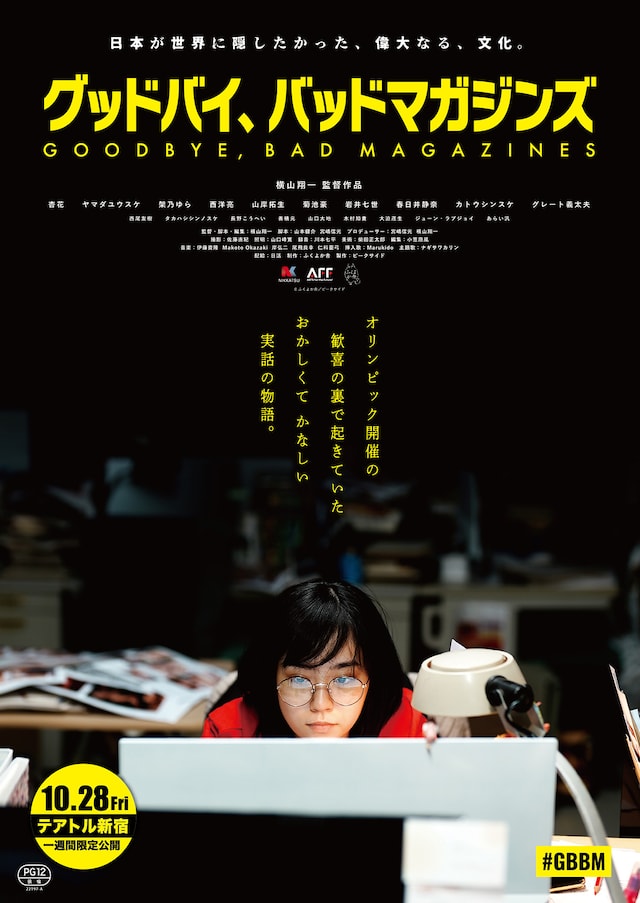
Goodbye, Bad Magazines (グッドバイ、バッドマガジンズ, Shoichi Yokoyama, 2022)

With the 2020 Olympics on the horizon, Japan began looking for ways to tidy up its image expecting an influx of foreign visitors which for obvious reasons never actually materialised. As part of this campaign, leading chains of convenience stores announced that they would stop selling pornographic magazines in order to create a more wholesome environment for children and families along with tourists who might be surprised to see such material openly displayed in an ordinary shop. Then again, given the ease of access to pornography online sales had fast been falling and the Olympics was perhaps merely a convenient excuse and effective PR opportunity to cut a product line that was no longer selling. 

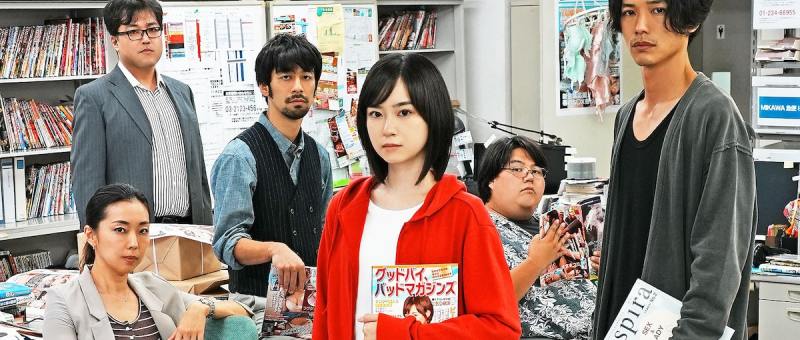
Based on actual events, Shoichi Yokoyama’s Goodbye, Bad Magazines (グッドバイ、バッドマガジンズ) explores the print industry crisis from the inside perspective of the adult magazine division at a major publisher which has just announced the closure of a long running and well respected cultural magazine, Garu. Firstly told they don’t hire right out of college, recent graduate Shiori (Kyoka Shibata) who had dreamed of working in cultural criticism is offered a job working on adult erotica and ends up taking it partly in defiance and encouraged by female editor Sawaki (Seina Kasugai) who tells that if she can make a porn mag she can make anything and be on her way to working on something more suited to her interests with a little experience under her belt. 

Her first job, however, consists entirely of shredding voided pages filled with pictures of nude women which is slightly better than the veteran middle-aged man who joined with her after being transferred from Garu who is responsible for adding mosaics to the porn DVDs they give away with the magazines to ensure they conform to Japan’s strict obscenity laws. Later a mistake is made and mosaics are omitted placing the publishing company bosses at risk of arrest and the magazine closure. Aside from being one of two women in an office full of sleazy men and sex toys, Shiori’s main problem is that she struggles to get a handle on the nature of the erotic at least of the kind that has been commodified before eventually falling into a kind of automatic rhythm. “It’s easy when it does’t mean anything” she explains to sex columnist and former porn star Haru (Yura Kano) who is much franker in her expression but perhaps no more certain than Shiori when it comes to the question asked in her column, why people have sex. 

Shiori asks her sympathetic colleague Mukai (Yusuke Yamada) for advice and he tells her that what’s erotic to him is relationships, but it seems his work has placed a strain on his marriage while his wife wants a baby and he has trouble separating the simple act of meaningless sex with that which has an explicit purpose such as an expression love or conceiving a child. According to Shiori’s editor Isezaki (Shinsuke Kato), the future of erotica will come from women with their boss finally agreeing to an old idea of Sawaki’s to create an adult magazine aimed at a female audience in the hope of opening a new market while handing a progressive opportunity to Sawaki and Shiori to explore female desire, but at the same time magazines are folding one after the other with major retailers canceling their orders and leaving them to ring elderly customers who’ve been subscribing for 30 years but don’t have the internet to let them know the paper edition is going out of circulation. 

The editorial team have an ambivalent attitude to their work, at once proud of what they’ve achieved and viewing it as meaningless and a little embarrassing. Not much more than a few months after working there, Shiori has become a seasoned pro training a new recruit who’s just as nervous and confused as she was but offering little more guidance was than she was given while becoming ever more jaded. When handed evidence that her boss has been embezzling money, she just ignores it though perhaps realising that when he’s found out it means the end for all of them too. Like everyone else, he’d wanted to start his own publishing company but the editor who left to do just that ended up taking his own life when the business failed. Yet, on visiting a small independent family-run convince store near the sea, Shiori hears of an old man who visits specifically to buy the magazines she once published because he can’t get them anywhere else while they have steady trade from fishermen who need paper copies to takes out to sea. The message seems to be there’s a desire and a demand for print media yet, even if it’s not quite enough to satisfy the bottom line. A sympathetic and sometimes humorous take on grim tale of industrial decline, Goodbye, Bad Magazines sees its steely heroine travel from naive idealist to jaded cynic but simultaneously grants her the full freedom of her artistic expression along with solidarity with her similarly burdened colleagues.  


Goodbye, Bad Magazines streamed as part of the 2022 Yubari International Fantastic Film Festival.

Teaser trailer (English subtitles)

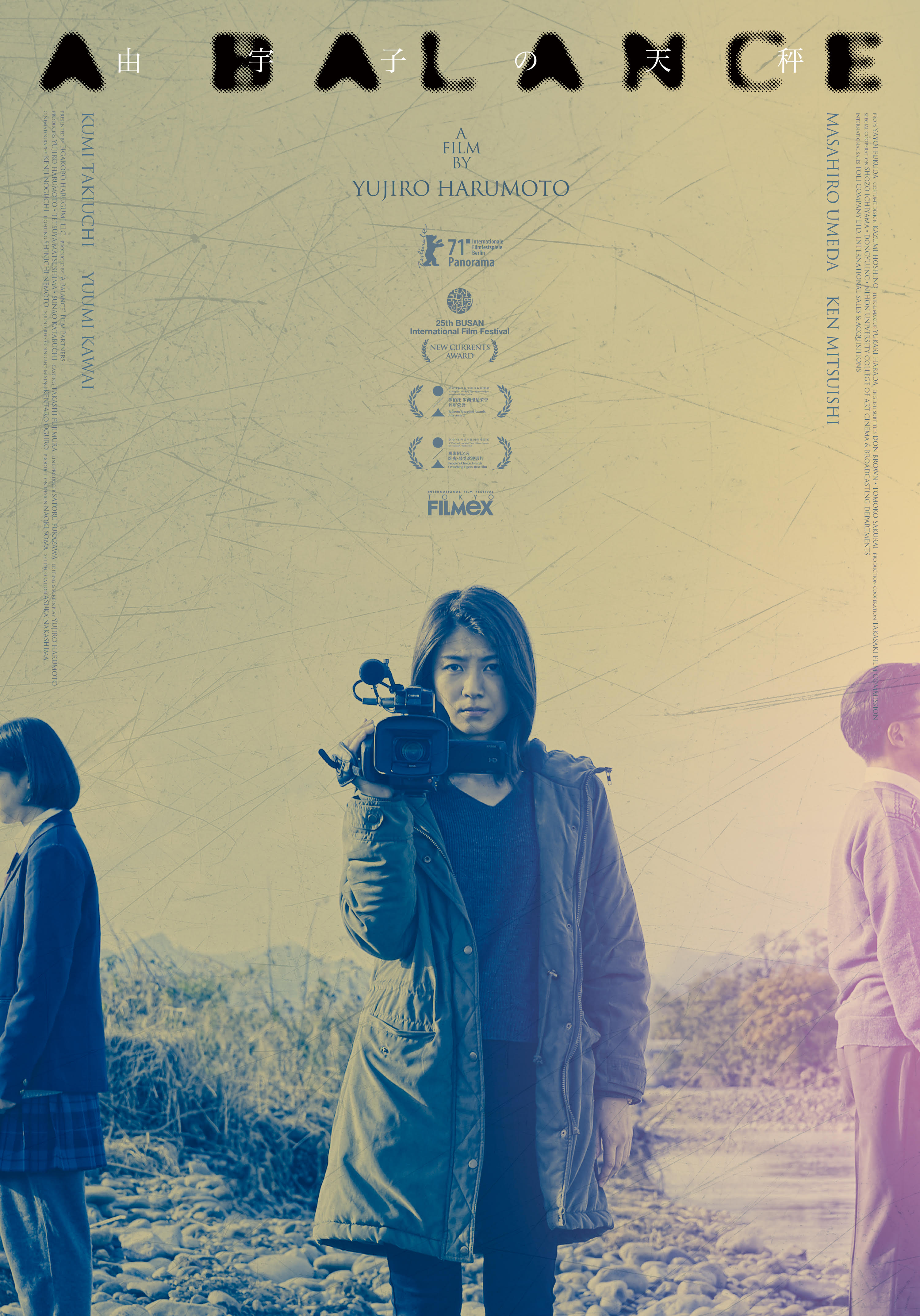
A Balance (由宇子の天秤, Yujiro Harumoto, 2020)

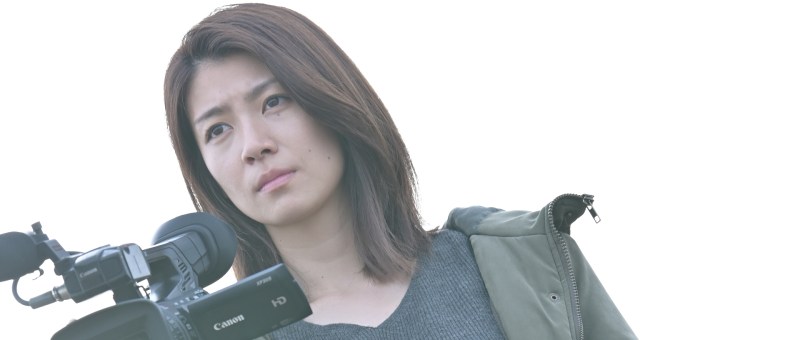
“What’s moral isn’t always what’s best” according to the morally compromised heroine at the centre of Yujiro Harumoto’s A Balance (由宇子の天秤, Yuko no Tenbin). To Yuko (Kumi Takiuchi), a balance is what a documentarian should strike, not taking one side or another but shining a light on hidden truths. The irony is that in seeking to expose one truth she accidentally stumbles on another uncomfortably close to home and although her job is to highlight injustice finds herself making the decision to do the opposite concluding that in this case, and perhaps many others, keeping quiet may actually be what’s best for victims, victimisers, and everyone in-between. 

As the film opens, Yuko is shooting a potentially manipulative interview with the grieving father of a young woman, Hiromi, who took her own life after becoming the subject of scandal and rumour when it was revealed she may have been involved in an inappropriate “relationship” with a teacher. The teacher, Mr. Yano, eventually took his own life too leaving behind him a note proclaiming his innocence and explaining that death is the manner he has chosen for his resistance. Yuko is sympathetic to Mr. Hasebe (Yuya Matsuura), but also perhaps verging on the unethical in the depth of the questions she asks him of his daughter’s death. Soon enough a conflict emerges between the nature of the documentary Yuko would like to make which is more contemplative than polemical, and the “routine piece on bullying” the TV studio think they’ve commissioned. Consequently, we see the suits redacting problematic lines in Yuko’s scripts in editorial meetings, misrepresenting Mr. Hasebe’s words in removing his criticism of mass media which he blames for hounding Mr. Yano to his death and thereby depriving him of answers. 

Yuko remains determined to provide “a balance” in interviewing Yano’s surviving family members including his mother Toshiko (Mitsuko Oka) and sister Shiho (Misa Wada), but discovers them tyrannised by the treatment they’ve received at the hands of the media and a vindictive society. Toshiko near collapses towards the end of the interview when asked if there was anything the family could have done to prevent this tragedy happening, inviting Yuko to visit her at home whereupon she discovers her living in near total darkness, afraid to go out lest she be recognised and explaining that she has few possessions in case she has to move again in a hurry because someone has exposed her address online. This little old lady is living in terror because of something her son was accused of which later caused him to take his own life and even that did not end the torment for his family. 

Meanwhile, in an ironic touch, Yuko discovers that a young woman, Mei (Yumi Kawai), attending the cram school owned by her father where she also teaches part-time has become pregnant and claims her father, Mr. Kinoshita (Ken Mitsuishi), is responsible having accepted sex in lieu of her overdue fees. Yuko does not want to disbelieve her and confronts her father, holding up her iPhone as a record, who admits that what Mei has said is true. Yuko tells herself she’s doing what’s best for Mei, bonding with her as two women who lost their mothers young (as did Hiromi), understanding that she may not want to go to the authorities because of the lingering stigma of being involved such a scandal. But she also can’t deny that her actions are self-interested in that she doesn’t want her doc pulled or her career messed up by her father’s transgression, something which gets harder to ignore when she discovers Mei’s pregnancy may be high risk and requires immediate medical treatment from a proper hospital to ensure her safety. 

The lines become ever more blurred, Yuko developing a quasi-maternal relationship with the motherless Mei which is in its way perfectly genuine even as she pays their overdue gas bill and worries about her potentially abusive father (Masahiro Umeda), but is nevertheless coloured by her desire both to cover up this harmful secret and to atone for her father’s wrongdoing. For his part, Mr. Kinoshita wants to confess but as Yuko points out he’d be doing it to unburden himself which in effect would merely shift the burden onto others including Mei but also Yuko herself, her documentary team, the other students at the cram school, and in effect everyone else they’ve ever known. 

Yet can Yuko be an effective arbiter of the truth especially when, as it turns out, neither she nor anyone else is being entirely honest? Her job is to present information in such a way that conclusions can be drawn, but she is herself making decisions in selecting the information she presents and the manner in which she presents it. She may resent the interference of the studio, but in reality they aren’t doing anything she hasn’t already done even if they are acting less out of a sense of integrity than commercial concern. “Whatever we put together is the truth” as her exasperated producer (Yota Kawase) finally insists. It’s in this same conflict that she begins to lose her sense of balance, trying to help those victimised by an unforgiving society while attempting to protect herself from unwelcome consequences of social scandal aided and abetted by the industry in which she herself works. “Ask them who is the real victimiser” Toshiko asks of Yuko taking aim at the mass media who have shamed her into a life of total darkness, but all Yuko can in the end do is turn her camera back on herself in contemplation of her shattered integrity.  


A Balance screens Aug. 12 as part of this year’s New York Asian Film Festival.

Original trailer (English subtitles)

Beyond the Night (夜のそと, Natsuki Nakagawa, 2019)

“I’m leaving this place” a traumatised woman declares, trying to free herself from an oppressive environment but discovering that escape is not necessarily synonymous with freedom. Completed at Tokyo University of the Arts’ Graduate School of Film and New Media, Department of Film Production, Natsuki Nakagawa’s Beyond the Night (夜のそと, Yoru no Soto) locates itself somewhere between Wuthering Heights and The Postman Always Rings Twice as its traumatised heroine struggles to assert herself, trapped in the black hole of incestuous small-town life while yearning for a return to a more wholesome existence.

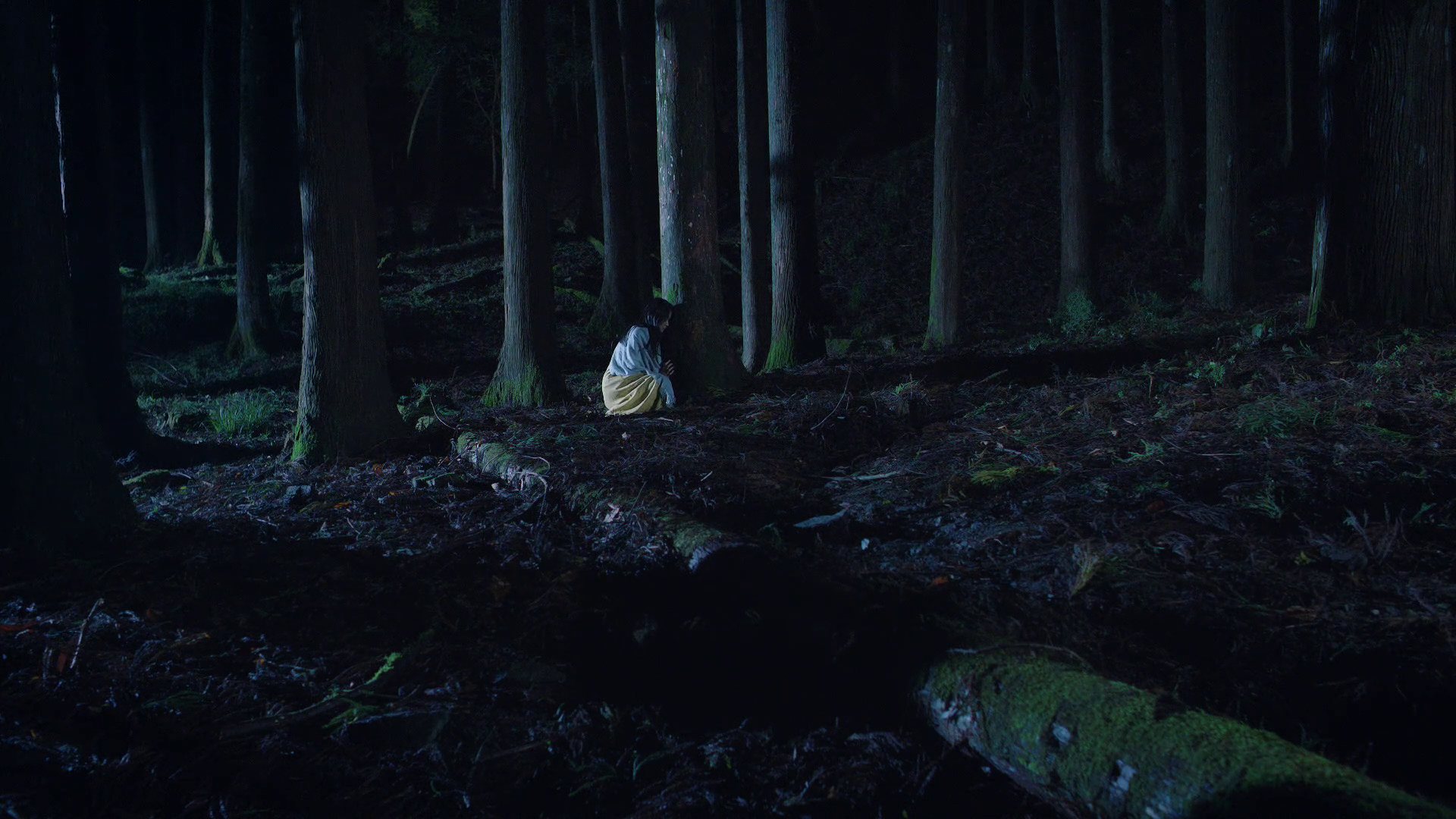
When we first meet Sotoko (Saki Tanaka), she is trying to run away only to stumble in the forest and be dragged back by her husband, Atsuya (Yasuhiro Isobe), whom she was presumably trying to escape. At work the next day, she’s wearing a large bandage on her cheek, but her colleague, Yuki (Haruka Konishi), has little sympathy for her. It’s at that point that she encounters mysterious drifter Mikiro (Kenta Yamagishi) on a delivery job to the office. Taken by her melancholy, Mikiro begins watching over her, concerned that no one else in the town seems to care that Sotoko is a victim of domestic violence. He learns from an old man that Atsuya is from the village’s most powerful family and therefore can do whatever he likes, while Sotoko, according to Yuki, is a “worthless” woman, an orphan who lost her family in a mysterious car accident. In addition to beating her, Atsuya has been pimping Sotoko out for money and influence, forcing her to sleep with a dirty old man, Tokyo-based politician Ishikawa (Hiroaki Kono), who later turns up dead in extremely suspicious circumstances. 

Atsuya claims that he treats Sotoko the way he does because he’s responding to her desires, pointing out that she’s tried to leave many times but has never been able to move beyond the forest. She lives surrounded by memories of the family she has lost, pictures drawn by her little brother Shota tacked on the wall, hugging his fluffy teddy for emotional support. Atsuya however wants to be her only family, destroying his totemic rivals in order to dominate her more completely while also taking from her the hope of forming a more complete family of her own. We learn that Atsuya has been shielding her from the consequences of involvement with a previous crime which is one reason she can’t leave him, but another is her battered psyche as she tries and fails to convince herself that she has the right to a better life or to her freedom. 

Mikiro, meanwhile, seems like an unlikely saviour, carrying a dark secret of his own as he plays the benevolent stalker wandering around Sotoko’s home when no one’s around and leaving little calling cards to remind her of his presence. Where Sotoko wants freedom, Mikiro wants love and is willing to go to great lengths to get it. “If I kill him will you love me?” he asks, while Sotoko explains to Yuki that she cannot simply leave Atsuya because their souls are entwined and someone needs to cut her free. “You can’t go anywhere, I’m the only one who can protect you” Atsuya counters, “She’ll never love you” he adds to Mikiro, “You’ll end up like me, you’re my replacement”. 

“We can’t change anything” a friend of Mikiro’s insists deepening the sense of fatalism, “one rotten person dies and nothing changes” echoing his own assertion that “there are bad people everywhere”. Sotoko declares her love for Mikiro as a symbol of the freedom she now desires, but at the same time reveals that there is nowhere she wants to go. To her Mikiro seems like a visitor from another world come to take her away from all this, but her salvation is not another perhaps equally problematic man but an awakening to her own agency, finally choosing a clear destination in the fullness of her “freedom”.

Nakagawa shoots her noirish tale with deadpan realism and a healthy respect for the ancient borders of the natural world, amping up the Lynchian sense of dread with ominous musical cues as Sotoko attempts to navigate her life in this strange little town where misogyny rules that seems to stand in for the prison of her trauma. Literally named “child of beyond”, she looks for the new world somewhere on the outside but struggles to extricate herself from an internalised sense of shame and worthlessness in order to find it. “Wherever you go you won’t be satisfied” a threatening policeman (Tomoki Kimura) had told her, but if you never leave the village then how would you ever know?


Beyond the Night streamed as part of this year’s Japan Cuts.

Trailer (English subtitles)

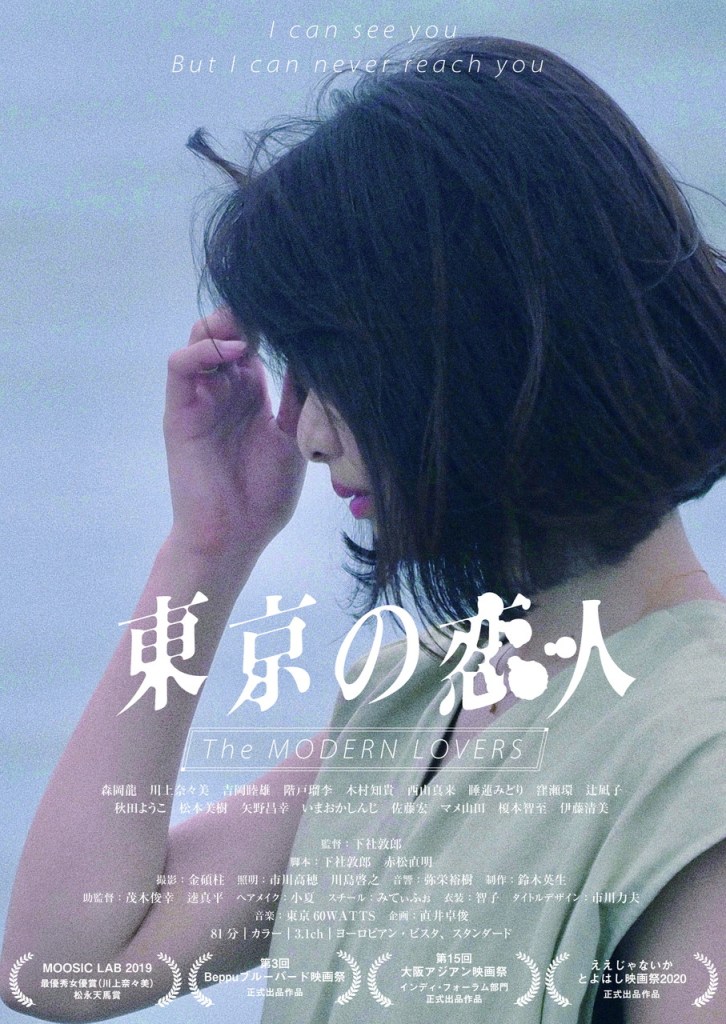
The Modern Lovers (東京の恋人, Atsuro Shimoyashiro, 2019)

Where now the dreams of youth? It may be impossible to escape a regretful middle age, wondering what might have been if only you knew then what you know now, but for the heroes of Atsuro Shimoyashiro’s The Modern Lovers (東京の恋人, Tokyo no Koibito) the pain seems all the more acute. “Today’s the day our youth ends” a brokenhearted woman laments, trying to make peace with her choices but finding that her return to the past may have done more harm than good. 

Tatsuo (Ryu Morioka) is a 31-year-old salaryman, married with a baby on the way and living in provincial Gunma. With the anxiety of impending fatherhood on his mind, he’s surprised to receive a message from his university girlfriend, Marina (Nanami Kawakami), who wants to reconnect. Telling his wife he’s going on a business trip, Tatsuo decides to spend the weekend in Tokyo, staying with another friend from uni before meeting up with Marina for a Sunday in the city reminiscing about old times. 

Like Tatsuo, his old college friend Komazawa (Tomoki Kimura) has long since given up the dream of becoming a filmmaker. A breakdown at 27 has apparently led to a diagnosis of bipolar disorder leaving him unable to hold down a job and dependent on his wife, Seiko (Maki Nishiyama), who supports both him and his step-daughter Shizuko through sex work while Komazawa has become an idle alcoholic. Despite his disappointment, Tatsuo spends the evening bonding with the local bar lady who claims to be able to see the future before leaving early in the morning to meet Marina who suggests revisiting the seaside they went to years before. 

Very much ready to step back into the more innocent past, Tatsuo has brought with him a tape of a song they used to listen to way back when and wastes no time in reassuming the poses of his 20-year-old self, sunshades and all. Marina, by contrast is self-consciously cute but mature, if perhaps sad. Tatsuo starts to tell her that he gave up his filmmaking dreams, married a good woman, and took a regular salaryman job at the family firm, but fails to complete the thought. Marina meanwhile casually remarks that she married a wealthy man but hints that she did so largely for convenience and material comfort rather than love. 

“We never get to marry the woman we love the most” Tatsuo’s strangely boys will be boys brother-in-law (Mutsuo Yoshioka) sighs, commiserating with Tatsuo’s lament for his disappointed youth and failure to make his filmmaking dreams a reality. We discover that an early success in a scriptwriting competition gave him an inflated sense of possibility, and that his desire for success was largely a desire to impress his girlfriend. Wounded male pride in his sense of artistic failure eventually convinced him he had to break things off while she silently cursed him, jokingly sentencing him to 18 years of solitude in a playful reference to a Tai Kato film. Now he realises his foolishness and is filled with regret in having settled for a conventional middle-class life as a husband and father.

Marina, meanwhile, is feeling something much the same in trying to achieve closure on the past before she becomes a mother. After breaking up with Tatsuo, she drifted through nude modelling and ended up the trophy wife of a wealthy man she doesn’t love, pegging her hopes on material comfort and hoping that love will come later. “I’m glad you’re happy now” a bar owner and former Instagram fan tries to congratulate her, but all Marina can do is smile sadly and ask her similarly troubled companion if happy is what she looks.    

“I’m not young anymore, I can’t live for a dream” Tatsuo accepts, but living on a dream is all they’re doing, recalling the time when they were “modern lovers” in Tokyo kidding themselves that they were urban sophisticates when perhaps all they did were the kinds of things unsophisticated suburbanites do like hang out at batting cages and go to barbecue restaurants. It’s too late to turn back now, but the past is a difficult trap to escape and perhaps what they long for is not so much the love cut off in its prime but a return to the possibilities of youth. Meeting again reawakens the desire for something more out of life than life may now have to give them, but this is day that youth ends, hitting the end of the road in a slow car crash of realisation that regret is the price of age.


The Modern Lovers was screened as part of this year’s Osaka Asian Film Festival.

Original trailer (no subtitles)

Retro hit Love You, Tokyo by Akira Kurosawa (not that one!) & Los Primos which recurs frequently throughout the film

The Chrysanthemum and the Guillotine (菊とギロチン 女相撲とアナキスト, Takahisa Zeze, 2018)

Chrysanthemum and the Guillotine poster 1“I see it now, we can’t change anything” a despondent would-be-revolutionary decries in a moment of despair. Almost 100 years later, you might have to concede they have a point when the world finds itself on a tipping point once again and the same old prejudices refuse to disappear. Takahisa Zeze’s The Chrysanthemum and the Guillotine (菊とギロチン 女相撲とアナキスト, Kiku to Guillotine Onna Zumo to Anarchism) casts an unflinching eye back towards the Japan of 1923 caught in the aftermath of a devastating natural disaster which followed on from a chaotic era of rapid social change and bewildering modernisation during which a series of battles were being fought for the future direction of a nation still trying to define itself in world dominated by empires.

When the Great Kanto Earthquake struck claiming mass loss of life and extreme damage to infrastructure, the ensuing chaos gave rise to a vicious rumour that Koreans were taking advantage of the situation to foment the independence movement by poisoning wells and committing arson leading to a pogrom against anyone who failed to prove themselves Japanese enough to satisfy the mob. Meanwhile, the same forces also turned on political opponents whose influence they perceived as destructive to their own aims culminating in the murder of prominent anarchist Sanae Osugi along with his feminist wife Noe Ito and their six-year-old nephew.

We begin, however, with a different band of outsiders in the Tamaiwa itinerant female sumo wrestler troupe many of whom have taken refuge in an isolated world of female solidarity in order to escape abusive relationships. Kiku (Mai Kiryu) is one such woman who found the courage to run away from a violent husband on catching sight of the powerful female wrestlers who made her realise that she too could become strong like them. Having accepted that “weak people can’t change anything”, Kiku has vowed to become “strong” in order to claim her own agency and ensure that she can’t be pushed around ever again.

Meanwhile, an anarchist sect known as the Guillotines are fomenting a more general kind of revolution but have not been very successful and are now on the run from the authorities which is how they end up running into the female wrestlers and more or less bringing them into the struggle. Led by libertine and (as yet) unpublished poet Tetsu Nakahama (Masahiro Higashide), the Guillotines are more romantic bandits with high ideals than serious revolutionaries. They rob the rich to fund their “activism” but spend most of the money on sex and drink while plotting revenge for the murder of Osugi with various schemes which imply that at heart they aren’t so different from that which they hate.

Nevertheless, the forces of darkness are rising and history tells us that, temporally at least, they will win. The vigilante militias which carried out the massacres were largely made-up of farmer soldiers who’d served in Russia and experienced terrible hardship. Unable to bear the idea that their traumatic wartime experiences had been a senseless waste, they doubled down on militarist ideology and insisted on their nationalistic superiority. This led them to hate, to regard anything that lay outside of their code as inferior and dangerous. Though the massacres were condemned by the government and the perpetrators prosecuted for their crimes, the convictions were largely quashed a short time later which is why we see our major villains rewarded by the state and our revolutionary “heroes” imprisoned for their resistance towards state oppression and desire to create a fairer, more equal society.

Ironically enough, Nakahama’s big utopian idea is an overly idealistic vision for a future Manchuria which in hindsight proves extremely uncomfortable but is perhaps an indication of the naivety of the times. Even so, the Guillotines for all their romanticism are essentially progressive in their thinking and in full support of sexual equality, insisting on the necessity of the wrestlers to embrace their physical capabilities in order to defend themselves against an oppressive and patriarchal society fuelled by male violence. Though this in itself might be mildly problematic in implying that in order to become “equal” women must learn to be more like men, it also plays into the film’s subtle sense of irony in which the tools of militarism are being subverted in order to oppose it. The “intellectual” Guillotines find their revolutions failing, while fighting fire with fire may be the only surefire way to win even if it legitimises the problematic act of violence in the process. Then again, as another of the Guillotines puts it, the truly strong are those who have no need of killing. 

In any case, the Tamaiwa stable becomes a tiny enclave of progressive values built on female solidarity though they ultimately discover that solidarity is not quite enough and they cannot protect each other from the ravages of the times without external assistance. Even so, they attempt to hold the line, literally pushing back against the fascist incursion while insisting on their right to resist as human beings with will and agency. The prognosis seems bleak. 100 years later the same battles are still being fought and the same tensions rising in the wake of new disasters yet there are also those who will continue to resist and like the Tamaiwa wrestlers refuse to give in to those who threaten to restrict their freedom.


The Chrysanthemum and the Guillotine was screened as part of the 2019 Nippon Connection Film Festival.

Original trailer (no subtitles)

The Limit of Sleeping Beauty (リミット・オブ・スリーピング・ビューティー, Ken Ninomiya, 2017)

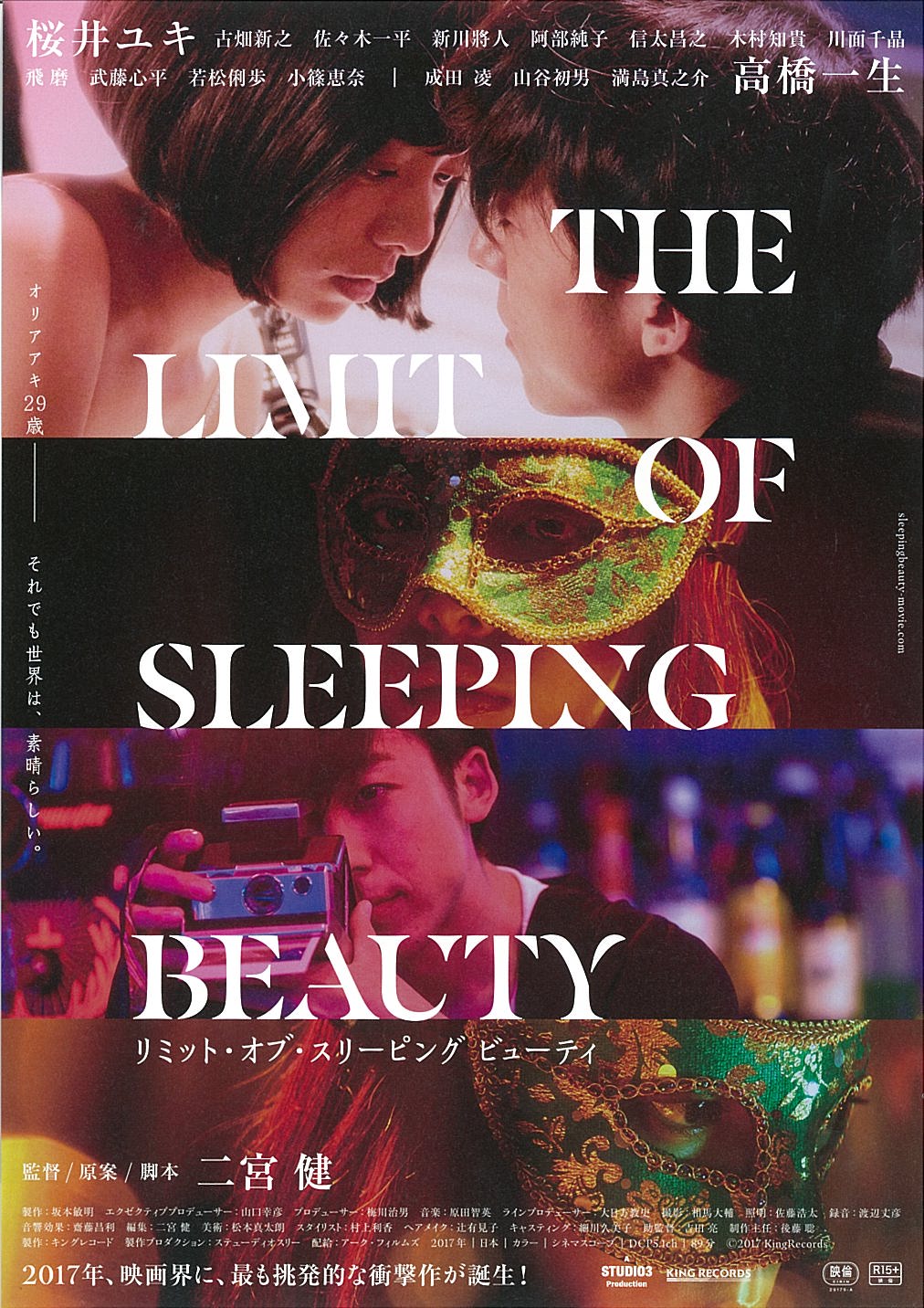
the limit of sleeping beauty posterCan you escape the past by evading it? The heroine of Ken Ninomiya’s The Limit of Sleeping Beauty (リミット・オブ・スリーピング・ビューティー) does her best to find out as she approaches the point at which she can no longer bear the weight of all her sorrows. A rising star of the Japanese indie scene, Ken Ninomiya had some minor festival exposure with his first film, post-apocalyptic cyberpunk drama Slum-polis, back in 2015 before making a complete about turn in releasing a terse mockumentary about a resilient actor hammering on the door of Japanese show business. Sleeping Beauty was, apparently, originally conceived as a mid-length picture before producers suggested expanding it into a full length feature and in many ways marries the twin concerns of Ninomiya’s earlier films in its high concept examination of a fracturing psyche unable to let the past go and move on from trauma and disappointment.

At 19, Aki (Yuki Sakurai) ran away from a bad family situation and ended up in Tokyo with the hope of becoming an actress. With nowhere else to go she wandered into a random bar which is where she met the love of her life, Kaito (Issey Takahashi) – a melancholy photographer and owner of cabaret club Aurora. Kaito takes her in and she begins working at Aurora as a magician’s assistant but ten years pass and, as a TV presenter later put it, it’s unheard of for a Japanese actress to make it in her 30s.

Her mind fracturing, Aki is often accompanied by “Butch” (Nino Furuhata), a strange clown with a scary white face who appears alternately supportive and enabling. Complaining that she feels unstuck in time, Butch reminds her that the idea of time as linear flow is a misconception and that all moments are indeed one moment which is one reason Aki never quite knows “when” she is. Accepting this fact she asks to be taken to the time at which she was happiest, only to be told that emotional time is not necessarily in sync with one’s perception of temporality. Nevertheless, her mind flies back to her first meeting with Kaito who we later surmise is no longer in her life but continues to define it all the same.

The picture we get of Aki is of a woman attempting to bury herself and her disappointments by revelling in a pleasant memory and then using it as raw material to read herself into an idealised version of her current life only one which is still marred by the tragedy of losing Kaito. Ninomiya opens with an orgy in dingy sex club where everyone is wearing creepy carnival masks and the older Aki is sporting a nasty bruise on her chin. The bruise, we later discover, was earned in a nasty encounter with a lascivious producer engineered by a soulless manager who promised her a career but in effect sold her to a man who assaulted and humiliated her. This final humiliation is only one of many acts of degradation that Aki suffers in her quest to make it as an actress – one of only two things Kaito urged her to do before disappearing from her life forever.

Unable to cope with the weight of lost love, defeated dreams, and a wasted youth Aki’s mind splinters into fragments, creating the strange entity known as Butch whom she seems to want to get rid of but cannot bear to be without. Aki’s quest is one of reintegration in which she must find the strength to put herself back together again and finally set light to the past, waking up from her self imposed slumber.

Kaito wants her to know the world is still wonderful, but his message seems curiously perverse considering his final course of action and Aki’s continuing descent into a spiral of depression, exploitation, and mental instability. Fantasy and reality remain hopelessly blurred, only gradually separating and becoming distinct as Aki begins to put herself back together. Ninomiya improves on Slum-Polis with similarly detailed production design and world building but occasionally allows his taste for music video aesthetics to slide into the indulgent with the success of such sequences depending on the viewer’s taste for the overused main titles song, Hummingbird by Kyla La Grange. Nevertheless there’s no disputing Ninomiya’s ambition and originality even if there is something unsettling in his urgency to inhabit the world he seems to be critiquing.


Original trailer (no subtitles)

Breath of Rokkasho (息衝く, Bunyo Kimura, 2017)

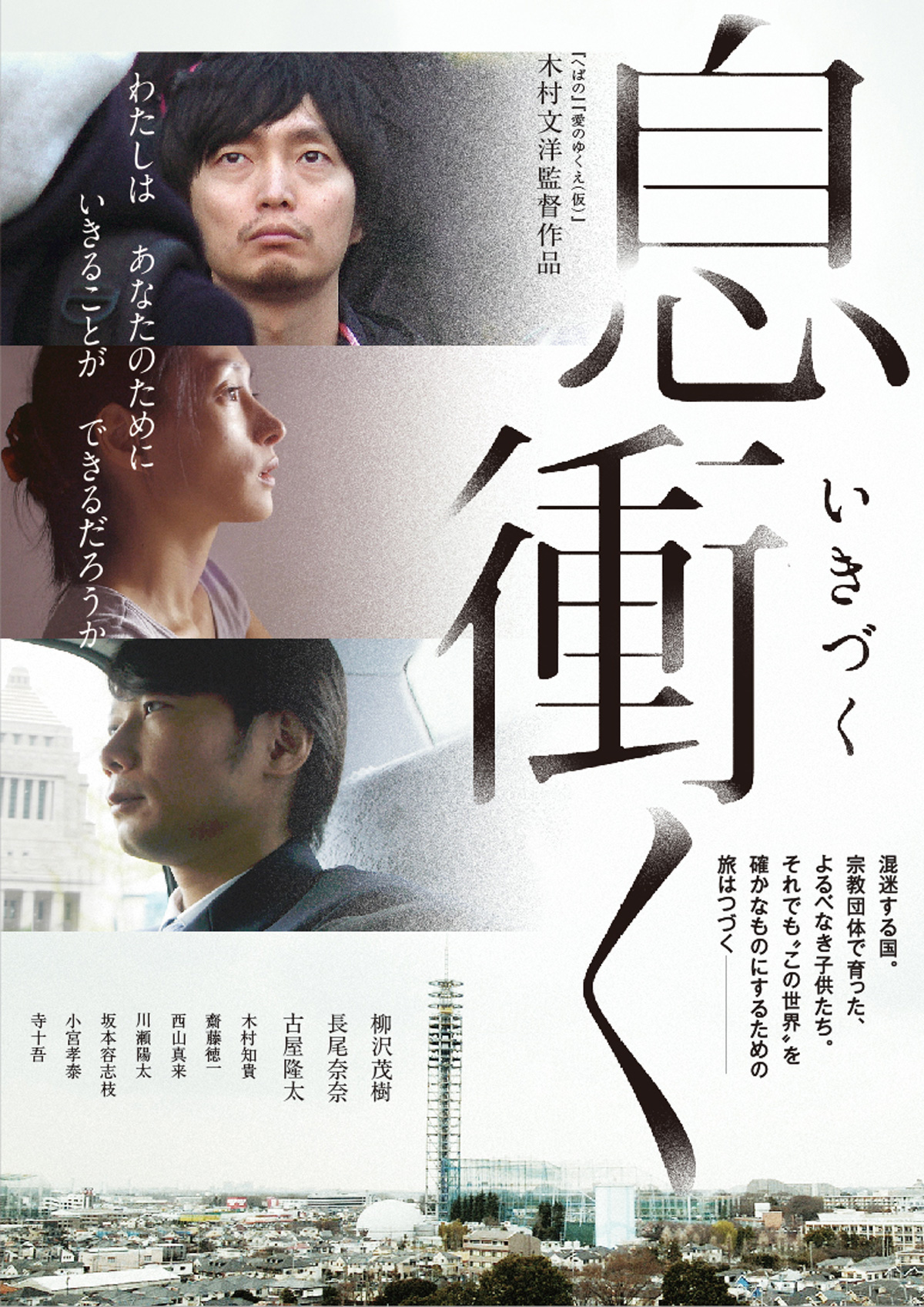
Breath of Rokkasho posterIndividual desire versus responsibility to the collective is something of a major theme in Japanese cinema. The fallible ideologue at the centre of Breath of Rokkasho (息衝く, Ikizuku) believes individualism is the key to world happiness, implying that a collection of fulfilled individuals would amount to a fulfilled society, but then again his logic is perhaps hard to follow when he cares so little for other people’s freedom. Taking place in the post-Fukushima world, Rokkasho wants to extend this idea through examining the complexity of the anti-nuclear movement and the political forces which advocate for it while ordinary people largely sit back in silent disapproval. The ideal society, if there even is such a thing, will probably not be built by those in power but by those who manage shake off the problematic legacy of the past in order to embrace their “individual” wills but with the collective good in mind.

Norio (Shigeki Yanagisawa), Yasuyuki (Ryuta Furuya), and Yoshi (Nana Nagao) were raised in a politicised Buddhist cult, The Seed Association, which has a strong interest in ecological affairs and therefore the anti-nuclear movement. Each lacking fatherly input, the three youngsters fell under the spell of the cult’s most prominent member, Mr. M (Satoru Jitsunashi). Mr. M however abruptly upped and left them, abandoned without hope or answers. 20 years later, Norio is a civil servant also working for the Seed Association on political campaigns while Yasuyuki has become the new golden boy whom many tout as the natural successor to Mr. M. Yoshi left the sect at a much younger age and is now a single mother in the middle of what seems to be a fairly messy divorce.

Looking up at the Tanashi Tower (also known as Sky Tower West Tokyo) – a “state of the art” radio tower completed in 1989 midway through a period of unprecedented economic prosperity and named after the town which used to stand here the name of which literally means “no rice”, the three kids ask Mr. M if it’s possible to see the Nighthawk Star from down below. He tells them he doesn’t know, but they can look for it together. Mr. M did not help them, he disappeared and left them with only more questions and an even shakier relationship with their familial pasts. Each badly let down by parental figures who either abandoned their families to join the cult out of nuclear fear, committed suicide, or were simply distant and neglectful, neither Norio, Yasuyuki, or Yoshi has been able to step into the adult world with any degree of confidence or faith in its teachings.

Only by confronting their difficult pasts can the trio begin to unblock their individual paths. A visit to the long absent Mr. M who has apparently embraced full individualism as a hermit farmer who dresses in a comical baby chick’s costume complete with squeaky claw-shaped slippers, begins to show them that their faith in his teachings may have been misplaced. Mr. M claims that the human race is not yet strong enough to live only by thinking of its own happiness, something that he feels would bring the greatest happiness to all mankind. Refusing to recognise the “selfishness” of his philosophy, Mr. M has withdrawn from society and made himself the centre of a happy nation of one.

Parental betrayal becomes a major theme, eventually extending to the paternity of the state in its repeated failures to protect and care for its children. The English title of the film references the Rokkasho nuclear reprocessing facility which has become an ongoing scandal in its 20-year series of construction delays with 23 postponements issued since its original 1997 projected date for completion. Norio, the melancholy civil servant, hails from the town himself – in fact his mother took him away from it precisely because she feared a nuclear disaster. Yet The Seed Association, or anyone else for that matter, has not been able to solve the nuclear issue even in the post-Fukushima era. Engaged in the business of “politics” the sect’s intentions have become blurred as they contemplate their survival in an ever shrinking society, subject to the same political games of manipulation and backbiting as any other party. Gradually disillusioned with the cult’s hypocrisy and didacticism, Norio considers forging his own path – something which sets him at odds with Yasuyuki whose faith is also shaken only he’s invested far too much to allow himself to acknowledge it.

The Japanese title, by contrast, simply means to gasp for air. Trapped fast in society filled with corrupt, conflicting values each of the three struggles to find a foothold for themselves as they flounder wildly without guidance or aim. Yet in being forced to confront themselves and their pasts there is a movement towards progress, or at least a strong desire to find it. They, like their nation, have been betrayed and struggled to deal with their betrayal, but have managed to find their own essential truth even so and along with it the ability breathe deeply even when the air is thickening.


Screened at Nippon Connection 2018.

Original trailer (no subtitles)