
BAKA’s Identity (愚か者の身分, Koto Nagata, 2025)

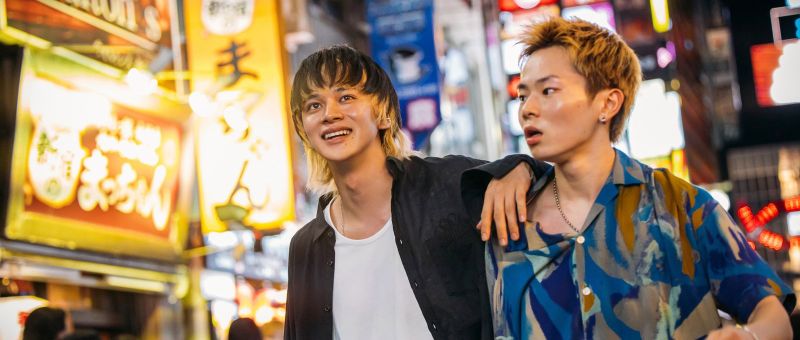
What does a name really mean? Can you really start over just by swapping your current identity for a new one, and what would that actually mean for the rest of your new life? Two young men who’ve been failed by adults and authority figures become involved with yahoo boy-style cyber crime, only in this case the aim of their romance fraud is to trap men they already know are poor and desperate and convince them they can turn their lives around by lending their identities to “someone in trouble”. 

It’ll only be for two years, they say. Just lie low, try not attract attention from the authorities. Though the targets also get a new identity in the form of a driving license with another name, they’re told not to use it for driving because the police will run checks on it if they have an accident. But the truth is that despite the widespread believe that it’s easy to disappear in Japan, it’s actually quite hard to live without a formal proof of identity through the family register system. You can’t rent an apartment or get a regular job, because on paper you don’t exist. The fake ID they’ve been given is only good enough to pass as proof of age. It’s not going to stand up if someone actually does more than glance at it.

But even if the idea of being able to wipe everything clean and start again might be attractive, the reality it not quite so easy. You can’t just wipe away your existing fears and traumas, and they’ll follow you even into your new life. Takuya (Takumi Kitamura), who’s been doing this sort of thing longer, is conflicted on realising their latest mark, Egawa (Yuma Yamoto), is a broken man who can’t get over the death of his daughter at the hands of his wife. Though Takuya, and the young woman they have assisting them with the scam, don’t want to do something like this to someone who’s already suffered so much, this world is pretty brutal and in reality they no longer have much choice.

Kisara (Mizuki Yamashita) is only involved in the scam because her mother stole her scholarship fund and she needed money for university, but she’s since dropped out and seems to be doing this kind of thing full-time. Takuya too seemingly had no parental support and sold his own identity to pay for medical treatment he hoped would save his brother, but he died anyway. That might be why he feels so protective of Mamoru (Yuta Hayashi), a young man he met in a homeless shelter run by the yakuza for the purpose of getting them to apply for benefits and then stealing them all. Mamoru was also abandoned by his mother and suffered physical abuse in his familial environment. Takuya brings Mamoru in on the scam and his life in the criminal underworld thinking it would help him, only to later feel guilty when events spiral out of control.

Takuya may look to his boss, Sato (Goichi Mine), as a kind of big brother figure, but also knows that he most likely plans to throw him under the bus while plotting to rob gangland kingpin Joji (Kazuya Tanabe) of a windfall gained through gold smuggling. Various people warn Takuya that it’s best to get out now, because if you go too deep you never will, but Takuya knows his bid for escape is likely to fail even when he turns to former mentor Kajitani who convinced him to sell his identity in the first place. The irony is that Takuya sold his name without a second thought and doesn’t really think his identity’s worth anything, which might be why he thought it was worth rolling the dice just to see if he could change his situation. The film’s Japanese title might ask us who we thought was being “fooled,” the men whom Takuya scammed who convinced to give up their identities for what seemed to them at the time a lot of money, or Takuya and Mamoru deluded both by the opportunities of a life of crime and by the allure of escape. In the all end, all any of them really have is each other and the unexpectedly genuine connections that arise between them in opposition to a society that has already discarded them and a hellish underworld in which an identity is just another commodity to be bought, sold, or sacrificed at will.


Trailer (no subtitles)

37 Seconds (Hikari, 2019)

37 Seconds poster“We’re just like everybody else” the heroine of Hikari’s debut feature 37 Seconds replies in bemusement when a prospective date confesses he never thought he’d feel comfortable with “someone like” her. Quietly meditating on societal prejudice against disability, 37 Seconds takes its heroine on a journey of self discovery as a series of disappointments pushes her towards embracing a new side of herself as an individual in defiance of those who might feel they know what is best, or perhaps just most “appropriate”, for “someone like” her without bothering to consider how she might feel.

Softly spoken, 23-year-old Yuma (Mei Kayama) has cerebral palsy and uses a motorised wheelchair to get around. Although she has a degree of independence with a job as an assistant to a manga artist, her friend Sayaka now a giant YouTube star, to which she travels alone by train, Yuma otherwise has little life outside the home she shares with her increasingly overprotective mother Kyoko (Misuzu Kanno). Yuma’s dreams of becoming a manga artist in her own right are dealt a blow when she’s told that her style is too close to Sayaka’s, only Sayaka’s style is Yuma’s because Yuma is doing all the work while her friend steals the credit and gleefully gives interviews claiming she is 100% indie and has no assistants. Beginning to realise she’s being exploited, Yuma gets an idea when she spots some erotic manga abandoned in the park and starts ringing up magazines for work. One bites and likes her stuff but worries that her sex scenes lack authenticity because of her lack of experience. 

Though previously unbothered, Yuma decides to embrace her sexuality in the name of art but finds a series of obstacles in her way, not least among them her mother who continues to infantilise her claiming that she is too vulnerable to be allowed out alone because there are too many strange people in the world. Kyoko won’t let Yuma wear pretty dresses, or makeup, or go out in the same way other girls her age might, refusing to accept that her little girl has grown up and has the same desires as any other young woman including that to be independent. Unable to escape her mother’s control, Yuma begins lying to her to meet prospective dates but finds them all unsuitable until finally trying to hire a sex worker only for that to go horribly wrong too. It does however introduce her to the people who will change her life – empathetic sex worker Mai (Makiko Watanabe), and her assistant Toshiya (Shunsuke Daito), whom she meets in a love hotel corridor while waiting for a broken lift.

When Yuma first meets Mai, she’s in the company of another man with cerebral palsy using a wheelchair, Kuma – played by Yoshihiko Kumashiro, a real life activist raising awareness about sexuality in the disabled community whose life inspired Junpei Matsumoto’s 2017 feature Perfect Revolution. Seeing the warm and genuine relationship between Mai and Kuma gives Yuma a new hope that a different kind of life is possible, especially as Mai offers to take her under her wing. Having an older woman to confide in about things she could never discuss with her mother allows Yuma to explore her newfound desires with confidence knowing that there are people looking out for her and always ready to offer advice.

Not everyone, however, is quite so enlightened and Yuma’s problems are largely to do with the persistent social stigma she faces from the world around her as well as a resultant sense of internalised inferiority. Sayaka, her “friend”, views her as a kind of cash cow, taking advantage of her skills but denying her existence while Sayaka’s agent swings in the other direction by telling her she should go public because she’d get a lot of press once people know she employs a disabled woman as an assistant. The first place Yuma gets any kind of respect is the office of the erotic manga magazine where the boss treats her like any other prospective hire and offers her constructive advice. From the awful dates and bad faith friends to her mother’s well-meaning yet problematic attempts to trap her in childhood, Yuma struggles to find a sense of self-worth when everyone is telling her that her life is limited and she must conform to their stereotypical ideas of how “someone like” her should live.

Thanks to Mai and Toshiya, Yuma eventually gains the confidence to assert herself, but also the ability to accept that her mother’s actions, however misguided, came from a place of love tempered by regret and sadness she was unable to understand without engaging with her mother’s history. A beautifully empathetic exploration of a young woman’s gradual blossoming under the light of genuine connection, 37 Seconds is a unsubtle rebuke of a fiercely conformist society unwilling to accommodate difference but also a quiet hymn to defiance as its heroine learns to shake off the labels placed on her and claim her independence no matter what anyone else might have to say about it.


37 Seconds was screened as part of the 2019 BFI London Film Festival.

Festival trailer (English subtitles)

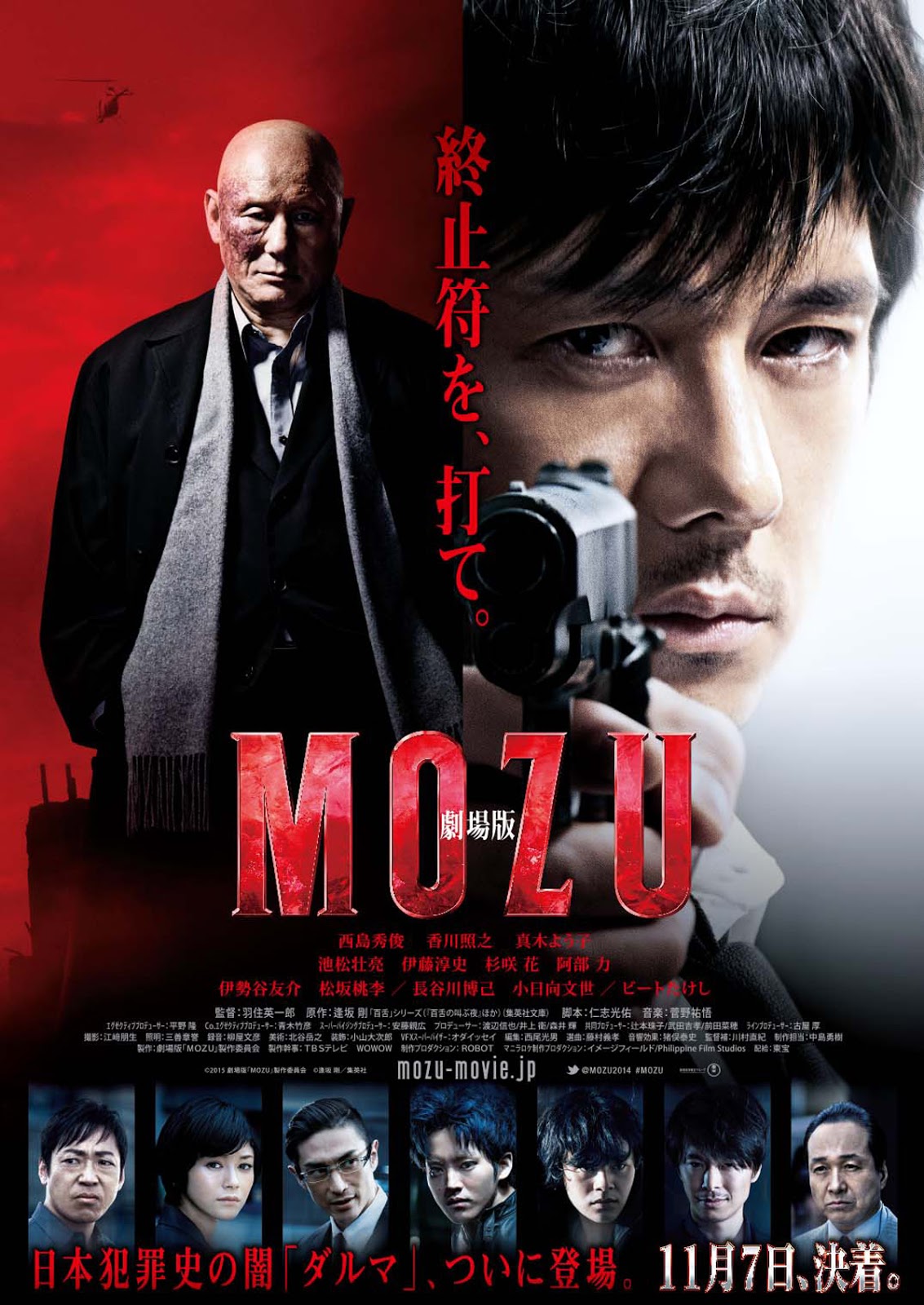
Mozu the Movie (劇場版MOZU, Eiichiro Hasumi, 2015)

mozu-posterThe criticism levelled most often against Japanese cinema is its readiness to send established franchises to the big screen. Manga adaptations make up a significant proportion of mainstream films, but most adaptations are constructed from scratch for maximum accessibility to a general audience – sometimes to the irritation of the franchise’s fans. When it comes to the cinematic instalments of popular TV shows the question is more difficult but most attempt to make some concession to those who are not familiar with the already established universe. Mozu (劇場版MOZU) does not do this. It makes no attempt to recap or explain itself, it simply continues from the end of the second series of the TV drama in which the “Mozu” or shrike of the title was resolved leaving the shady spectre of “Daruma” hanging for the inevitable conclusion.

Six months on from the climatic events at the end of season two, Kuraki (Hidetoshi Nishijima) has become a drunk, Ohsugi (Teruyuki Kagawa) has left the force for the private sector, while Akeboshi (Yoko Maki) is still preoccupied with the strange phone calls she sometimes receives and the fate of her long lost father last seen on the deck of a sinking submarine. The dreams of the citizens of Tokyo are being haunted by the mysterious face of “Daruma”, but this is quickly superseded by an explosion in an office building which turns out to be a diversionary exercise as the autistic daughter of a refugee with diplomatic immunity is kidnapped by terrorists.

At this point, Kuraki appears at the scene, beats the bad guys into submission and rescues the girl, Elena, and her mother who are then taken into protective custody. However, things go south when Ohsugi’s daughter and Akeboshi are taken by the bad guys in the hope of an exchange forcing the gang to take Elena to a neighbouring Asian nation.

Mozu the movie suffers from many of the same problems which plagued the generally impressive TV series in its wildly inconsistent tone and increasingly convoluted, often bizarre plot twists. Assuming the audience will be familiar with the TV series, the film provides no recap, leaving the casual viewer completely lost amongst the numerous numbers of subplots held together by Kuraki’s need to find the answers behind the death of his wife at the site of a suicide bombing and the drowning of his daughter a year or so before. Likewise, Akeboshi’s familial concerns – her absentee father whose dark past was hinted at in the previous series and her close relationship with her two neices, is glossed over, as is Ohsugi’s ongoing battle to win back the respect of his teenage daughter. When a key character suddenly and quite unexpectedly appears to save the day (and then disappears again), the casual viewer has a right to be utterly baffled.

Where the central tone is one of cool noir supported by occasionally poetic camera work, Nishijima’s laid back minimalism gives way to broad, over the top villainy from Hasegawa’s Higashi as well as the punkish Mozu copycat who kickstarts the action. Kuraki remains an unbeatable super agent, taking out bad guys with well placed kicks to the chest and enduring numerous acts of torture whilst remaining doggedly fixed on his quest to find out the truth about his wife and a possible conspiracy plaguing Japanese society. Ohsugi is still the bumbling cop but equally committed to protecting his daughter while Akeboshi is underused, her slow burn romance with Kuraki simmering away in the background.

What remains is a collection of impressive action scenes and mysterious conversations offered with portentous seriousness. The purpose of Elena’s kidnapping is predictably grim yet reduced to a single sentence shortly before Kuraki apparently saves the day once again through undisclosed means. The central conspiracy in this conspiracy thriller, that Japan has been manipulated by a shadowy figure literally cannibalising his own children, fades into the background as Kuraki is left to affirm that all that remains now is chaos. Mozu the movie is season three with all the important bit stripped out – strange, confusing, and ultimately hollow. Yet for those well versed in the Mozu universe, it may provide a degree of closure to its ongoing mysteries, even if ultimately unsatisfying.


Original trailer (no subtitles)