Policeman (警察官, Tomu Uchida, 1933)

“No one knows what will happen to us in this world of illusion” muses a conflicted villain in Tomu Uchida’s seminal proto-procedural, Policeman (警察官, Keisatsukan, AKA Police Officer). Forever an enigma, Uchida had made his name through a series of broadly progressive, left-wing films featuring strong social critique, yet he also made this mildly authoritarian, overtly pro-police piece of militarist propaganda long before it became necessary to do so. But then, look a little closer and you’ll find him subtly undercutting the messaging, reconfiguring his tale of a courageous policeman who sets aside his personal feelings in the pursuit of justice as one of tragedy in which a man ultimately imprisons himself by doing so. 

The hero, earnest policeman Itami (Isamu Kosugi), was once as he later reveals a wayward young man. “The world was against me, I thought. I was young then” he sighs, explaining that he owes his life to his boss and mentor, Sgt. Miyabe (Taisuke Matsumoto), who became a second father and set him on the right path which he now of course follows. His long lost childhood friend Tetsuo (Eiji Nakano), with whom he reconnects during a routine vehicle check, apparently experienced something similar having fallen out with his wealthy industrialist father but claims that he’s become an elite layabout spending all his time at the golf course and asking his dad for money every time he runs out which seems nothing if not contradictory but then familial relationships can be complex. In any case, a repeated motif sees the two men taking diverging paths, literally, the implication being that they’ve each chosen different directions in response in to the same adolescent crisis when in a sense “orphaned” through parental disconnection. 

On hearing Tetsuo’s story, Itami asks him with thinly veiled horror if he hasn’t become a communist, that being a fairly common and fashionable way for a young man from a wealthy family to fall out with his father. Tetsuo laughs it off, wishing it were political but claiming somewhat vaguely that it was a matter of feeling. The exchange is revealing in that screenwriter Eizo Yamauchi had apparently been instructed to portray the criminal gang at the film’s centre, of which Tetsuo is later revealed to be a member, as “communist” though no political ideology or identity is ever directly stated. Nevertheless, the central drama is clearly inspired by the Omori Bank Robbery (1932) in which a three members of the Communist Party robbed the Kawasaki Daiichi Bank without the knowledge or authority of party officials in order to gain funding for the movement. The incident backfired, badly discrediting the Communist Party (illegal at the time) and thereby imploding the most viable source of opposition to rising militarism. Armed bank robbery not being a common occurrence in Japan, most viewers would necessarily associate this brand of criminality with “communism”, killing two birds with one stone as the film does its intended job of making the world seem more dangerous than it is while reinforcing an authoritarian message that the police will protect. 

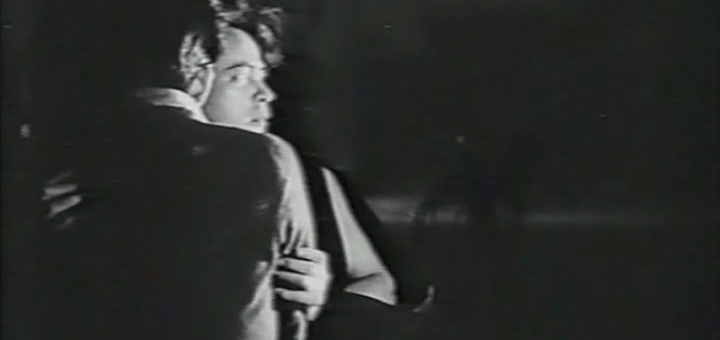
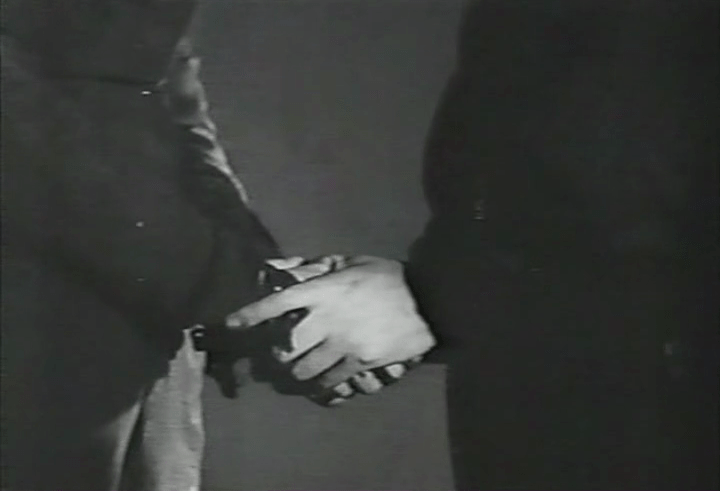
Yet, on the other hand, perhaps it really was “feeling” after all. The relationship between the two men has an intensely homoerotic quality with frequent flashbacks to their carefree high school days during which they read each other romantic German poetry, played rugby, and frolicked on a beach in the company of a very large dog. Itami largely ignores his potential love interest in Miyabe’s pretty daughter, save for briefly thinking about her while on a three-day stakeout of the robbers’ den, while constantly chasing Tetsuo after becoming suspicious that he may be the man responsible for shooting Miyabe and fleeing the scene after a robbery. His inner torment lies partly in the conflict between his responsibilities to friendship and the law, but also perhaps in his unresolved feelings for Tetsuo. Driven half out of his mind, his final epiphany crying out “I am a policeman” is as much a rejection of an identity as a claiming of one, entirely sublimating himself within the image of the role that he has chosen to play in society shedding his personal feeling and desires as he does so. In “saving” Tetsuo, shooting him in the hand to prevent his suicide, tenderly cuffing and then embracing him, he evokes both a sense of return and forgiveness and another of goodbye further enhanced by the abruptness of the transition which follows. 

Taken in this light, the late and extremely jarring slide into overt propaganda through a series of title cards loudly proclaiming the virtue of the police takes on a differing kind of anxiety in its authoritarian dimensions as a force which destroys rather than protects in its capacity to erase individual identity. Nevertheless, Uchida also includes numerous shots of heroic policemen in their dashing uniforms as they assemble for drill or show up en masse on their bikes ready to fight crime. Tetsuo’s final appearance, meanwhile, is extremely sinister dressed as he is in an outfit which would later become associated with fascism, his meticulous uniformity in strong contrast to the then crazed and dishevelled Itami still in his crumpled kimono with messy hair and three days’ worth of beard growth from his stakeout. Yet there’s nothing but pain and fear in his eyes as he realises that his friend has seen through him, Itami rather ostentatiously bundling Tetsuo’s lighter into a handkerchief almost as if he meant to him let know. 

Shooting mainly on location, Uchida’s camera is rarely at rest even employing a series of complicated vehicle tracking shots one of which eventually resolves itself into a first person perspective while the final sequence is tense in the extreme with its gunfire, search lights, and complex choreography. His use of flashback is precise and unusual, far ahead of its time in its acuity as if we actually see Itami’s thought process on screen jumping from one idea to another, while the meeting of the two men on the desolate docks seems to be drenched in loneliness and a sense of futility even while free of the oppressive shadows from the buildings which seemed to dwarf them in the city. Somehow desperately sad despite the catharsis of its final scene, Policeman subtly implies there might not be much difference between hero and villain, or between communist and militarist, save walking one way and not another as two men find their friendship frustrated by time and circumstance coming together only to be driven apart. 


Ringu (リング, Hideo Nakata, 1998)

As the investigative duo at the centre of Hideo Nakata’s eerie supernatural horror Ringu (リング) begin to unlock the mystery of Sadako, we’re told that a strange woman who may have had some kind of psychic powers was loathed by those around her in part because of her habit of sitting and staring at the sea. Nakata opens the film with waves and often returns to them as if suggesting in this millennial horror that what we fear is a transmission we cannot see. In the end there may not be so much difference between the magic of an analogue TV broadcast and a message from another plane. 

In any case, perhaps the central message is that one should pay more attention to the words of those whose warnings are often dismissed on the grounds of their age and gender. Journalist Reiko (Nanako Matsushima), for example, doesn’t seem too invested in a video she’s making about a cursed video related by a trio of high school girls in a cafe who explain that they don’t personally know anyone who’s died after watching it but have been reliably informed by friends of friends who apparently do. As will later be discovered, the girls actually give Reiko crucial information but for whatever reason she does not remember it until coming to the same conclusion herself. In any case, it’s not until her own niece, Tomoko (Yuko Takeuchi), dies in mysterious circumstances that Reiko starts to wonder if this is more than a spooky story elevating the chain letter to new technological heights.

According to the urban legend, if you watch the cursed tape you’ll immediately get a phone call telling you you’ll die in seven days. The supernatural entity now synonymous with the film, Sadako, is manipulating these still analogue waves for herself. Sending her messages via television and telephone she is a literal ghost of the airwaves and as Reiko’s ex-husband Ryuji later puts it radiating her sense of rage in her own mistreatment, insisting that her story be known and that those who refuse to acknowledge it should not be allowed to survive. Just as Reiko should have listened to the high school girls, someone should have listened to Sadako and because they didn’t others now have no choice. 

In a sense Sadako represents this nascent fear of technological advancement. When Reiko answers her flip phone, it’s a reminder that there’s no escape from unwanted communication even if you can in theory try to switch it off. The girl with Tomoko when she died was driven out of her mind and now won’t venture anywhere near a television, as if you could escape Sadako’s wrath by merely keeping your distance from the portal. The two teenagers who died around the same time as Tomoko were in a car in the middle of nowhere, but cars have radios which receive radio waves. Sadako travels through the air, invisible until she chooses not to be. She may only have a direct line, but it is in one sense a call for help she’s issuing only in the very inefficient manner of a vengeful ghost whose rage has become indiscriminate or at least directed towards the society that wronged her and everyone in it rather than a single guilty party. 

In a certain sense, you can cure the curse only by spreading it. If everyone everywhere suddenly understood, learned Sadako’s painful history, then the curse would wither and die with no new hosts to go to which is perhaps what Sadako wants. Yet it leaves Reiko with a dilemma, knowing that to save the lives of those closest to her she may have to ask someone else to risk their life or even expose them without their consent. Throughout the film she’s been depicted as an imperfect mother, divorced and often leaving her small son Yoichi to fend for himself at home while the boy at one point walks past his own father in the street and does not seem to recognise him so absent had he been in his life. Through their shared quest to undo the curse, the pair in a sense reclaim their parental roles and repair their familial ties in working together to save their son’s life in contrast to the parental figures surrounding Sadako who may have done the reverse. Sadako frightens us because of her transgressive qualities, quite literally transgressing the barriers between ourselves and the stories we tell by crawling out of them and finding us here, on the other side of the screen, where we thought we were safe to remind us not to look away and to listen to those whose voices are all too often ignored. 


Ringu screens at Japan Society New York on Oct. 7 as part of the Monthly Classics series.

20th anniversary trailer (English subtitles)

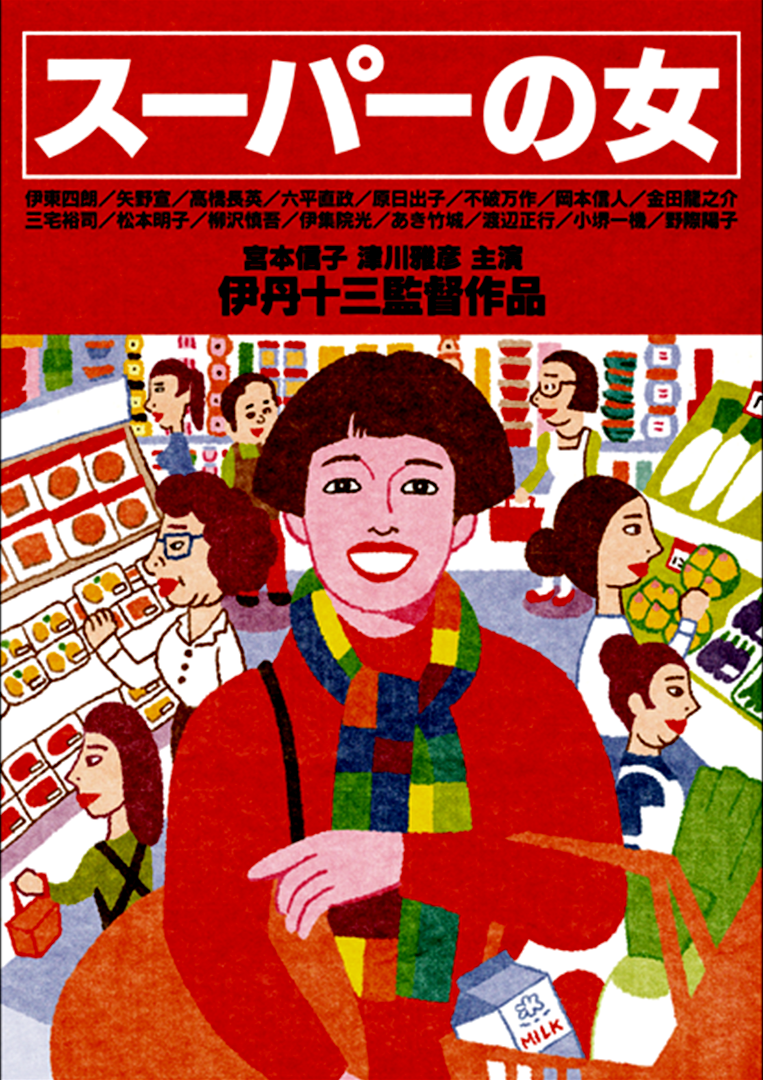
Supermarket Woman (スーパーの女, Juzo Itami, 1996)

By 1996 Japan had entered an extended period of economic stagnation which signalled the end of post-war aspiration but for many at least the false promises of the Bubble era proved hard to dispel. In what would be his penultimate film, Supermarket Woman (スーパーの女, Supa no Onna), Juzo Itami turns his attentions to the insular world of the nation’s family-held, independent supermarkets to ask a few questions about integrity in business which cut straight to the heart of what kind of society post-Bubble Japan intended to be given yet another opportunity to make itself anew. 

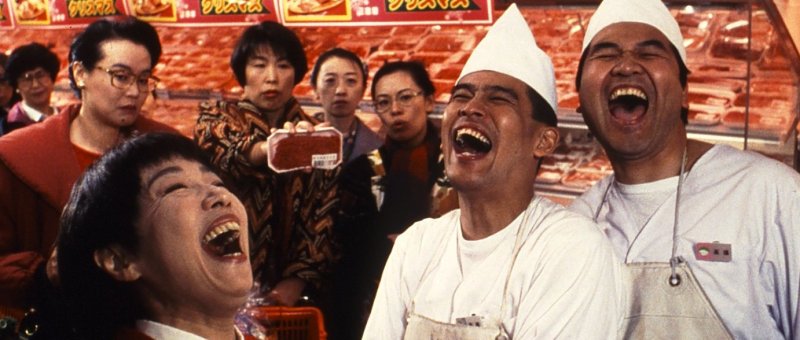
As the opening text crawl explains, this is a story not about giant supermarket chains but your friendly indie local. “Honest Mart” is a family-owned, mid-range supermarket in a declining industrial area nominally run by absentee CEO Goro (Masahiko Tsugawa) who was bequeathed the place by his father but is a melancholy drunkard delegating responsibility to his manager. The store has a huge problem in that a rival has recently re-opened under the new name “Discount Demon” and seems primed to steal all their business. On a stakeout of the new place, Goro runs into a childhood friend, Hanako (Nobuko Miyamoto), who is now a widow returning to the area. With her lifelong experience as a veteran housewife, Hanako knows a few things about supermarkets and she’s not very impressed with Discount Demon, doing a few quick calculations to realise the supposed discounts aren’t as enticing as they seem while common gimmicks like the all pervasive red glow that makes their meat look fresher than it really is only irritate her. Goro asks her for a “professional” opinion on Honest Mart without telling her who he is, only to discover she’s even less impressed with them, certain that his place is on the way out thanks to its dated decor, uninviting atmosphere, and low quality produce. 

The irony is Honest Mart is not much better than Discount Demon, both stores are subject to the same industry standards in which a certain degree of obfuscation is permissible. “In business honesty doesn’t pay” Hanako is told by the onsite butcher after she questions his tendency to mix meats to pass them off as more expensive cuts, while she later discovers that the store engages in the practice of repackaging unsold meat and fish with new expiration dates and is not very particular about its suppliers when it comes to buying in ready-made products. Brought on board to save the store, Hanako breezes in with a new mission to win the hearts and minds of her customers, and she can’t do that if she can’t have confidence in her stock. In any case, her the customer is always right policy quickly brings her into conflict with the store manager, an older more conservative man who actively resists innovation and resents having his authority undercut by an interloping woman. 

Meanwhile, we can also see that customer attitudes have changed. There’s a problem with availability of trolleys because, perhaps unusually for Japan, customers are just abandoning them willy-nilly in the carpark instead of retuning them to the trolley point like responsible shoppers. One man is even for some reason intent on stealing a large number of shopping baskets, caught by Hanako loading them into his car. Everybody wants cheap, which is understandable especially given the economic situation, and they might even be a little underhanded when it comes to getting it, but they also expect a reasonable level of quality and to be able to trust that the food they’re buying is safe to feed their families. Hanako is most alarmed that the ladies who work in the kitchen area, who are obviously wives and mothers themselves, do not shop at Honest Mart because they know what goes on at the store and they don’t trust it. 

“A housewife knows” Hanako is fond is saying. Her revolution is in essence a vindication of “the housewife”, perhaps the most maligned and dismissed figure of the mid-90s society, putting to good use all of her veteran experience both of running a home and of working a series of part-time jobs including those in supermarkets which she claims to love. Approaching the problem from the point of view of a consumer, she attempts to help Goro achieve his dream of making Honest Mart number one in Japan not through making it the most financially successful but the most loved by listening to women like her in the form of a focus group of local aunties some of whom had previously been serial complainers. 

Then again, some of her decisions are in a sense contradictory as she attempts to streamline the business along classically capitalistic lines in suggesting that the store doesn’t really need its overqualified butcher and fishmonger because the part-timers could be trained to do a “good enough” job. “Good enough” is in a sense her business philosophy, only not in the sense that somewhere like Discount Demon which falsely advertises regular steak as discount Wagyu means it, rather that her customers are after an everyday level of produce and so it’s not surprising that premium meats don’t sell. She wants to get rid of the butcher, who turns out to be on the fiddle, and the melancholy fishmonger disappointed no one wants his top quality seafood, because their “artistic temperament” is disruptive to the flow of the store and their presence is perhaps emblematic of the bloated, pretentious management style which is holding it back. 

Positioning the “housewife’s choice” as the ultimate seal of approval, Supermarket Woman advocates for a return to wholesome, small-town values, prioritising a sense of integrity as Honest Mart projects itself as a corporate force their customers can trust, perhaps anticipating a trend in dedicating itself to providing good quality fresh produce at fair prices in direct opposition to Discount Demon and its underhanded trickery. “Honest Mart keeps its word” Goro assures, pledging to honour a mistaken ad which promised eggs at prices so good it caused minor riot. In the end, it’s all about trust and integrity. If you don’t have that, you don’t have anything and the housewives of post-Bubble Japan will it seems vote with their feet. 


Currently available to stream in the US via Criterion Channel.

Original trailer (no subtitles)