Ghost Stories of Wanderer at Honjo (怪談本所七不思議, Kaidan Nana Fushigi) seems to have become mistitled somewhere along the line seeing as the Japanese is something more like The Seven Wonders of Honjo, an area of Tokyo that had a reputation for gloominess during the Edo era. The “seven wonders” are a collective name for a series of local ghost stories, of which there may actually be more than seven, which were popular fare for rakugo tales and other forms of storytelling. Though the film opens with a brief rundown of the seven wonders which it weaves into the tale, it is more of a revenge drama that throws in the appearance of popular yokai such as Rokurokubi, Kasa-obake, and Hitotsume-kozo.
The yokai emerge to scare a pair of fishermen who were about to ignore a ghostly voice telling them to leave the fish they’d just caught in the river behind, but what the fishermen really seem to object to is the presence of a tanuki who makes a habit of tricking the local people. After becoming fed up with them, the locals hunt down the tanuki and are about to turn it into soup when a wealthy nobleman, Komiyama (Hiroshi Hayashi), arrives and buys the tanuki from them which he then frees. Komiyama tells the tanuki to stop bothering the villagers in return and continues home after marking the anniversary of his wife’s passing and the departure of his son who is going out into the world.
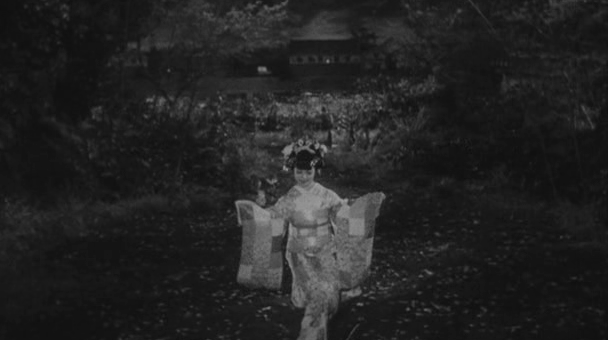
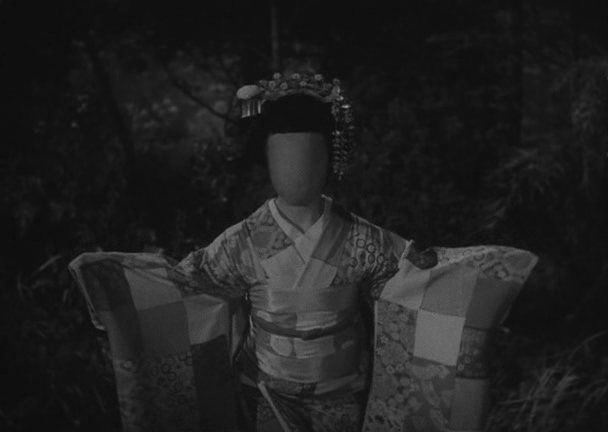
The tanuki later appears in the form of a beautiful young woman to tell Komiyama that she is grateful for his saving her life and will always protect him. Unfortunately, however, Komiyama gets into trouble on the night of a tanuki ritual, so she doesn’t make it in time to save him from a dastardly plot by his disinherited nephew to murder him for his money. She can, however, help his son Yumenosuke (Juzaburo Akechi) exact revenge and put a stop to the amoral Gonkuro’s (regular Shintoho villain Shigeru Amachi) reign of terror.
As in many tales like these, it’s Gonkuro who is real terror threatening chaos in the ordered Edo society while being unable to conform to his proper role in life. Before the film begins, Komiya has already disowned his nephew for being a wastrel. Gonkuro says that he’s come to pay his respects to his late aunt, but Komiyama suspects he’s after money again which he’ll spend on drink, women, and gambling. There is a direct contrast being drawn between the good son Yumenosuke and Gonkuro, though it’s Yumenosuke who apparently becomes seriously ill while on his travels preventing his speedy return until his desire for revenge enables him to overcome his illness.
Meanwhile, Komiyama has recently married again to a younger woman, Sawa (Akiko Yamashita), who turns out to be a former lover of Gonkuro’s. Though she at first resists, she’s bullied into resuming a sexual relationship with him which she then carries on enthusiastically. She and Gonkuro seem to be symbols of the evils of the age in their lack of properness and humanity. Not only does Sawa cheat on her husband, but even goes along with Gonkuro’s murder plot to kill him and inherit his money.
Though the tanuki fails to save Komiyama and is generally depicted as an untrustworthy trickster, it is a kind of guardian of these virtues in standing behind Yumenosuke as a source of righteousness. Komiyama’s act of kindness will eventually be repaid, while Gonkuro’s attempt to triumph over the moral order represented by Komiyama will be denied. Having dispatched Komiyama, Gonkuro occupies an awkward class status as a usurping lord and even tries to rape Yumenosuke’s betrothed Yae during an expressionist storm as a means of asserting his triumph over his cousin. Sawa meanwhile does something similar by flirting with and then potentially entering a sexual relationship with their servant Gosuke (Saburo Sawai) in full contravention of the social order. Their attempts to get rid of the tanuki by praying her away are a means of reasserting control and dissolving the rules of human morality that they feel constrain them.
In that sense, the tanuki and yokai are not particularly frightening but a constant presence that enforces a moral order defined by humanity and compassion. The two fishermen are only spooked because they ignore the disembodied voice telling them to leave the fish, not because they heard it in the first place. The tanuki, meanwhile, are mainly seen dancing as part of their ritual rendered as ghostly figures not quite of this world. They appear not to do anything that could be considered more than irritating even when messing with locals and definitely don’t deserve to get made into soup. The message seems to be that being good and kind might not save you personally, but it will eventually pay off, and is after all, the right thing to do as man can only thrive when living in harmony with nature and the supernatural world rather than attempting to transcend it through immorality like the selfish and thoughtless Gonkuro.

