Ghost Stories of Wanderer at Honjo (怪談本所七不思議, Goro Kadono, 1957)

Ghost Stories of Wanderer at Honjo (怪談本所七不思議, Kaidan Nana Fushigi) seems to have become mistitled somewhere along the line seeing as the Japanese is something more like The Seven Wonders of Honjo, an area of Tokyo that had a reputation for gloominess during the Edo era. The “seven wonders” are a collective name for a series of local ghost stories, of which there may actually be more than seven, which were popular fare for rakugo tales and other forms of storytelling. Though the film opens with a brief rundown of the seven wonders which it weaves into the tale, it is more of a revenge drama that throws in the appearance of popular yokai such as Rokurokubi, Kasa-obake, and Hitotsume-kozo.

The yokai emerge to scare a pair of fishermen who were about to ignore a ghostly voice telling them to leave the fish they’d just caught in the river behind, but what the fishermen really seem to object to is the presence of a tanuki who makes a habit of tricking the local people. After becoming fed up with them, the locals hunt down the tanuki and are about to turn it into soup when a wealthy nobleman, Komiyama (Hiroshi Hayashi), arrives and buys the tanuki from them which he then frees. Komiyama tells the tanuki to stop bothering the villagers in return and continues home after marking the anniversary of his wife’s passing and the departure of his son who is going out into the world.

The tanuki later appears in the form of a beautiful young woman to tell Komiyama that she is grateful for his saving her life and will always protect him. Unfortunately, however, Komiyama gets into trouble on the night of a tanuki ritual, so she doesn’t make it in time to save him from a dastardly plot by his disinherited nephew to murder him for his money. She can, however, help his son Yumenosuke (Juzaburo Akechi) exact revenge and put a stop to the amoral Gonkuro’s (regular Shintoho villain Shigeru Amachi) reign of terror.

As in many tales like these, it’s Gonkuro who is real terror threatening chaos in the ordered Edo society while being unable to conform to his proper role in life. Before the film begins, Komiya has already disowned his nephew for being a wastrel. Gonkuro says that he’s come to pay his respects to his late aunt, but Komiyama suspects he’s after money again which he’ll spend on drink, women, and gambling. There is a direct contrast being drawn between the good son Yumenosuke and Gonkuro, though it’s Yumenosuke who apparently becomes seriously ill while on his travels preventing his speedy return until his desire for revenge enables him to overcome his illness. 

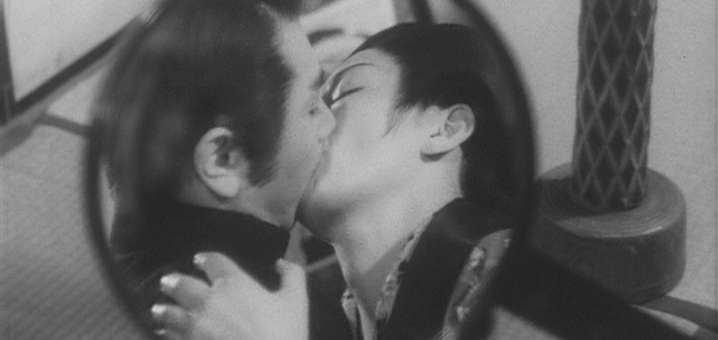
Meanwhile, Komiyama has recently married again to a younger woman, Sawa (Akiko Yamashita), who turns out to be a former lover of Gonkuro’s. Though she at first resists, she’s bullied into resuming a sexual relationship with him which she then carries on enthusiastically. She and Gonkuro seem to be symbols of the evils of the age in their lack of properness and humanity. Not only does Sawa cheat on her husband, but even goes along with Gonkuro’s murder plot to kill him and inherit his money.

Though the tanuki fails to save Komiyama and is generally depicted as an untrustworthy trickster, it is a kind of guardian of these virtues in standing behind Yumenosuke as a source of righteousness. Komiyama’s act of kindness will eventually be repaid, while Gonkuro’s attempt to triumph over the moral order represented by Komiyama will be denied. Having dispatched Komiyama, Gonkuro occupies an awkward class status as a usurping lord and even tries to rape Yumenosuke’s betrothed Yae during an expressionist storm as a means of asserting his triumph over his cousin. Sawa meanwhile does something similar by flirting with and then potentially entering a sexual relationship with their servant Gosuke (Saburo Sawai) in full contravention of the social order. Their attempts to get rid of the tanuki by praying her away are a means of reasserting control and dissolving the rules of human morality that they feel constrain them.

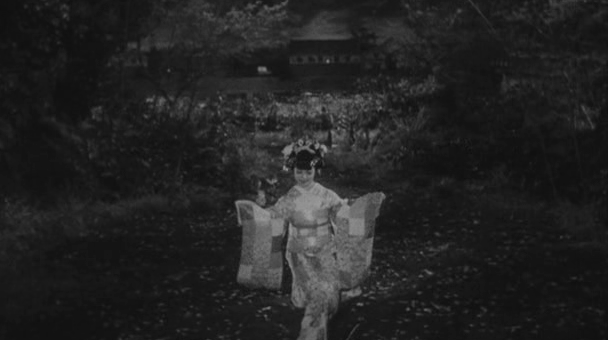
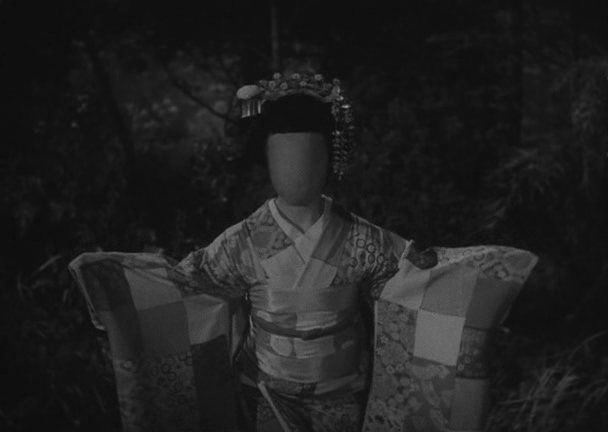
In that sense, the tanuki and yokai are not particularly frightening but a constant presence that enforces a moral order defined by humanity and compassion. The two fishermen are only spooked because they ignore the disembodied voice telling them to leave the fish, not because they heard it in the first place. The tanuki, meanwhile, are mainly seen dancing as part of their ritual rendered as ghostly figures not quite of this world. They appear not to do anything that could be considered more than irritating even when messing with locals and definitely don’t deserve to get made into soup. The message seems to be that being good and kind might not save you personally, but it will eventually pay off, and is after all, the right thing to do as man can only thrive when living in harmony with nature and the supernatural world rather than attempting to transcend it through immorality like the selfish and thoughtless Gonkuro.
A Wicked Woman (毒婦高橋お伝, Nobuo Nakagawa, 1958)

The term “dokufu” or “poisonous woman” dates back to the Edo era, but rose to prominence once again in the turbulent society of late Meiji in which such women became fodder for the growing penny dreadful industry. Unlike the later “bad girl” or contemporary examples of “bad women” from elsewhere, the problem with “poisonous women” is that they pollute society as a whole, corrupting those around them through their unbridled transgressions. These notions are of course as much about contemporary notions of femininity and a desire to preserve the social order at all costs as they are about conventional morality and the rule of law, but there are reasons that tales of such independent women incited such a frenzy among both men and women who found themselves floundering in a confusing and rapidly changing society.

Nobuo Nakagawa’s A Wicked Woman (毒婦高橋お伝, Dokufu Takahashi Oden) is inspired by the real life tale one particular “dokufu”, Oden Takahashi, who was in fact the last woman to be beheaded in Japan after being convicted of murdering her lover while suspected of poisoning her husband. Nakagawa does not particularly pay attention to the “real” details of her life but to her pulp persona, somewhat reclaiming her image as an ultra cool revenger who refused to be bound by the restrictive mores of her times or suffer at the hands of the feckless men she nevertheless falls victim to. 

When we first meet Oden (Katsuko Wakasugi), she is being pursued by a large number of policemen whom she manages to outrun, eventually tricking them and escaping by getting a lift from a passing rickshaw driver. The ride is tense, and we worry that Oden will encounter an accident that will bring her to the attention of the police, but the crisis is something quite different. In a staggering coincidence, the rickshaw driver is none other than Oden’s estranged first husband, Jinjuro (Akira Nakamura), once a samurai but now reduced to pulling a cab after ruining himself through drink and debauchery (apparently why Oden eventually left him). Though it’s not exactly a happy reunion, the pair part on good terms while he laments that their small daughter Omitsu still misses her mother, managing to extract a few notes from Oden supposedly for her upkeep.  

Oden meanwhile goes home to husband no. 2, Ryosuke (Asao Matsumoto), who is bedridden with TB and increasingly paranoid about what Oden does outside the house to keep them fed. Operating out of a remote cottage, she puts on a ridiculously elaborate Western outfit and heads to a jewellers where she pretends to look at precious stones for a ring, dropping one on the floor while the salesman’s back is turned and spiking it with the point of her parasol knowing that no-one is going to think of looking there. The assistants aren’t stupid, they know a stone is missing and Oden must have pocketed it but all they can do is search her person, calling in the local bobby, Kazuma. (Juzaburo Akechi), who thinks they may be going too far in forcing this upperclass lady to strip off to prove she’s not a thief. The owner of the store, Osawa (Tetsuro Tanba), looks on knowingly but is intrigued more than anything else, eventually content to let Oden go despite knowing she has the jewel concealed somewhere about her person. 

Disaster strikes, however, when Oden runs into Kazuma in the street and he spots her parasol sparkling. He tries to arrest her, but she pleads with him to let her change out of her extremely silly outfit first, playing the poor widow card and eventually seducing the naive policeman. What Oden didn’t quite bank on was actually falling for him for real, drawn in a sense to order and goodness, longing to be caught and restored to the rightful condition of womanliness but fearing she has lost all right to conventional happiness. 

Oden’s relationship with Kazuma is an example of the effects of her “poison” on society at large. Kazuma as we first meet him is earnest and good, a naive young rookie with a strong sense of justice who leaps to defend Oden thinking she is a maligned noble woman unfairly accused of thievery. His superior Kakunosuke (Gen Funabashi), has set him up with his innocent little sister Kozue (Minako Yamada) and it seems the pair will soon marry, but Kazuma is apparently not so much interested in sweetness as he is in Oden’s complicated darkness. He falls obsessively in love with her, perhaps partly out of a desire to save her from her criminal life by bringing her to justice, but also in attraction to all of her transgressive qualities which contradict everything he stands for. 

Nakagawa reframes Oden’s poisonousness as a consequence of her frustrated maternity and a continual failure of masculinity. After re-encountering Jinjuro, Oden finds it increasingly difficult to justify the act of abandoning her child and leaving her with a man she knew to be a violent and feckless drunk. Though Jinjuro appears to have reformed himself through the time-honoured devices of humbleness and hard work, we later find him extorting money from Oden to pay for Omitsu’s medical care only to drink it all himself. Oden tries to visit her daughter, but is after all a stranger in her life. Her attempt to reclaim her maternity, escape the trap of criminality and leave the city with her little girl is the primary motivator for all of her subsequent actions which culminate in an intense desire for revenge against Jinjuro, the architect of all her misfortune. 

All of Oden’s earlier crimes were in some way permissible, taking from those who could afford to lose and doing it with a degree of style. The botched job at the jewellers, however, sees her fall into the hands of Osawa, who turns out to be a violent and sadistic gang boss. Osawa keeps women captive in his basement and whips them for his own enjoyment, forcing Oden to become a procurer tricking vulnerable women into becoming sex slaves. Oden thinks nothing of this, smirking that there must be good money in selling women, willingly complicit in the oppression of those just like her. To free herself from Osawa, she uses Jinjuro, attempting to kill two birds with one stone and finding partial success only for the plan to fall apart when confronted by the face of order in the reappearance of a ruined Kazuma. 

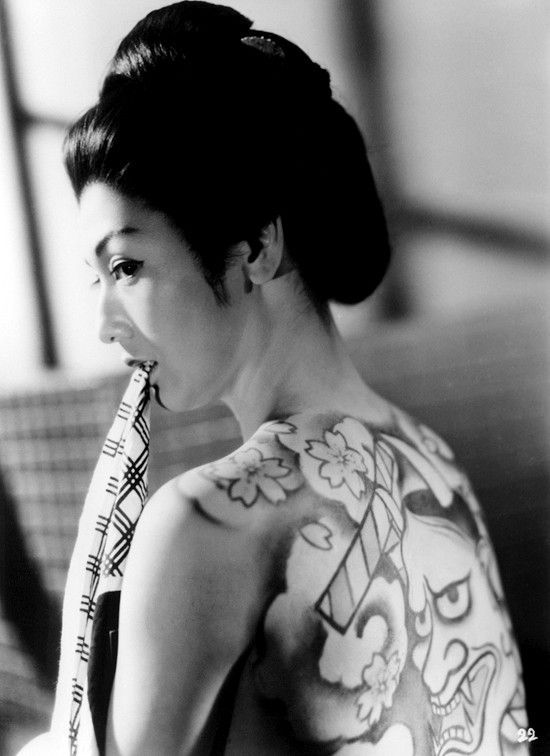
Oden ends her journey in Yokohama, a bustling international port, where she’s the tattooed madame of the Osawa’s Chinese bar and a familiar face at the gaming tables. The suggestion is that this corruption is foreign in origin, Osawa’s top hat and smart suit not to mention plush Western-style bed, suggesting that his savagery is a facet of his seduction by Chinese hedonism and Western individualism. Individualism is again painted as Oden’s sin when she leaves the women locked in a jail cell to escape a fire while cradling her ill-gotten gains, only to tell Kazuma to man up and that money is what she truly loves. But Oden is also victim of her times, betrayed by a failure of masculinity in a patriarchal system. Jinjuro the drunken samurai, Ryonosuke the impotent consumptive, and Kazuma the conflicted young man. The last of these she refuses to “ruin”, setting him free because she truly loves him and does not want to see him dragged into her life of crime, intent on reclaiming her goodness by reassuming the role of a conventional mother living an honest life with her daughter somewhere far away. Her “wickedness” is only really her desire to survive but an independent woman, good or bad, is always a threat to the social order and so she must be stopped lest her inconvenient desire to live a life free of male control become a “poisonous” example to those around her.