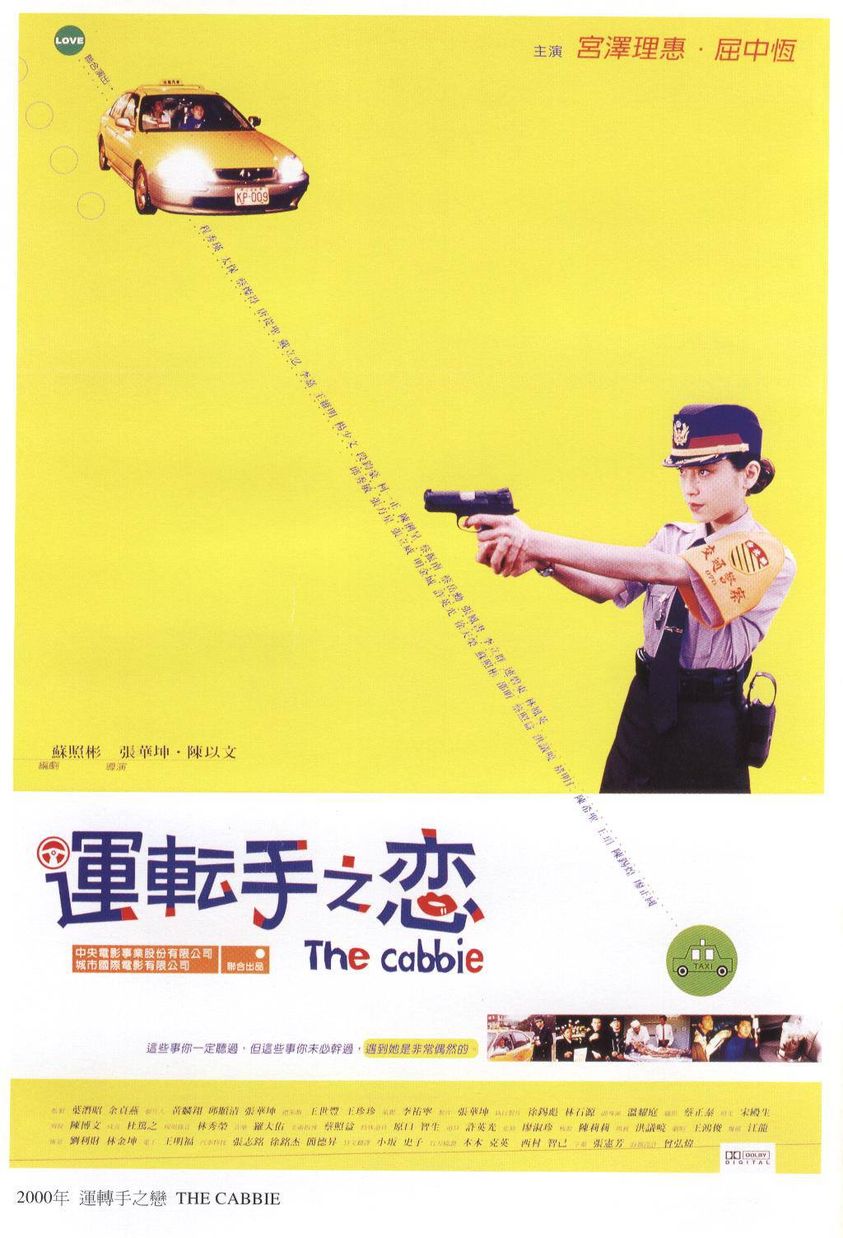
The Cabbie (運転手之戀, Chen Yi-wen & Chang Hwa-kun, 2000)

The crazy freewheeling life of a lovestruck taxi driver eventually takes a turn for the contemplative in Chen Yi-wen & Chang Hwa-kun’s infinitely charming comedy, The Cabbie (運転手之戀, yùn zhuǎn shǒu zhī liàn). Despite the film’s sunny atmosphere, darkness does indeed hang around the edges in the frequent references to car accidents and dismemberment yet it seems to be something that the affable hero can live with as he narrates a series of strange incidents from his ordinary life while meditating on his zany family when faced with mortal anxiety. 

As taxi driver Quan (Chu Chung-heng) points out, life can be pretty strange. His taxi can sometimes act as an unofficial confessional as his fares take the opportunity to unburden themselves to a complete stranger in a confined space, confessing the embarrassing details of their lives and even at one point seemingly confessing to a murder. Quan takes it in his stride, feeling as if he is one with his cab, Ah Di, and duty-bound to deliver his charges to their rightful destinations physical and emotional. Yet in an odd way it’s almost as if we’ve become the driver in this story and Quan is our fare, breaking the the fourth wall to speak to us directly of his strange life and the circumstances which led to this present turn of events. 

Quan is however unusual in that he tells his mother and father quite directly that he has no intention of marrying, giving a fairly logical reasoning based on the fact he believes women do not like him and he is not apparently much interested in them. This is of course a source of anxiety for his parents, his taxi driver father also turning fare in ranting at an old lady at the convenience store about his wayward son before trying to awaken something within him by gifting him porn. His mother meanwhile, the local coroner, decides to give up on him while ordering Quan to freeze his sperm so she can have a grandchild with or without his direct involvement at some point down the line. 

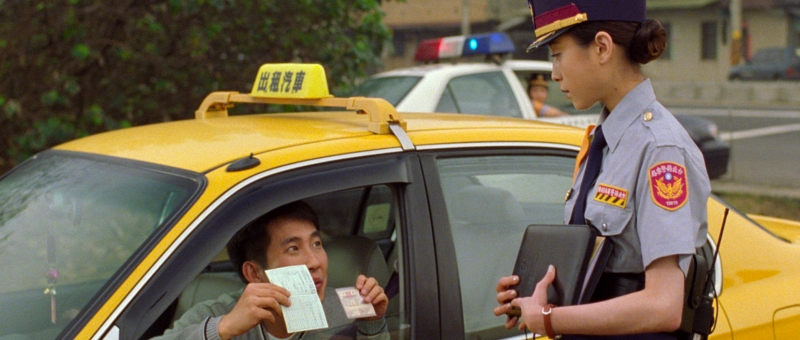
In any case, Quan changes his mind on falling in love at first sight with grumpy policewoman Jingwen (Japanese actress Rie Miyazawa, dubbed into Mandarin). Taking his mother’s advice about making an impression (not necessarily a good one) to heart, Quan decides the best way to woo his crush is to get fined by her as many times as possible. Even so there’s an undeniable Romeo and Juliet vibe to their relationship given the natural animosity between taxi drivers and traffic cops, along with a sense of cosmic irony that feeds directly back into the film’s darker themes. So much of life for Quan is coincidence, an act of cosmic collision not unlike the car crashes that occur so frequently outside the taxi depot. Quan encounters Jingwen by chance and then continues to push his luck by meeting her again in similar circumstances until she gives in to his unusual ardour. Yet not all of these accidents end well. One of Quan’s neighbours earns extra cash turning up at crash sites and making sure that the family gets all of the deceased’s body parts, reaching under twisted metal to retrieve pieces of severed flesh while his mother is indeed a coroner with a severed head in a jar sitting proudly in her office. 

In the end it might be that Quan is a mere passenger of fate, relating his life to us as it flashes before his eyes while threatened by a weird fare. What begins as absurd nonsense comedy as Quan tells us about his crazy family and the strangers who climb into his cab eventually takes an unexpected, poignant turn for the existential even as Quan continues to closely identify himself with Ah Di which might beg the question of who is driving who. Madcap and anarchic, there is something genuinely cheerful in Quan’s often simple existence governed both by chance and the rules of the road lending a fatalistic pall to all of his otherwise freewheeling adventures. Things don’t always always go right for him, but even when they go wrong it’s generally in the right way. Fast-forwarding though the “boring bits”, Quan races us through his life in the cab before taking us where we need to go keeping it cheerful while preparing for the inevitable collision with cosmic irony. 


The Cabbie screens 20th October as part of this year’s Taiwan Film Festival Edinburgh.

Original trailer (Traditional Chinese / English subtitles)
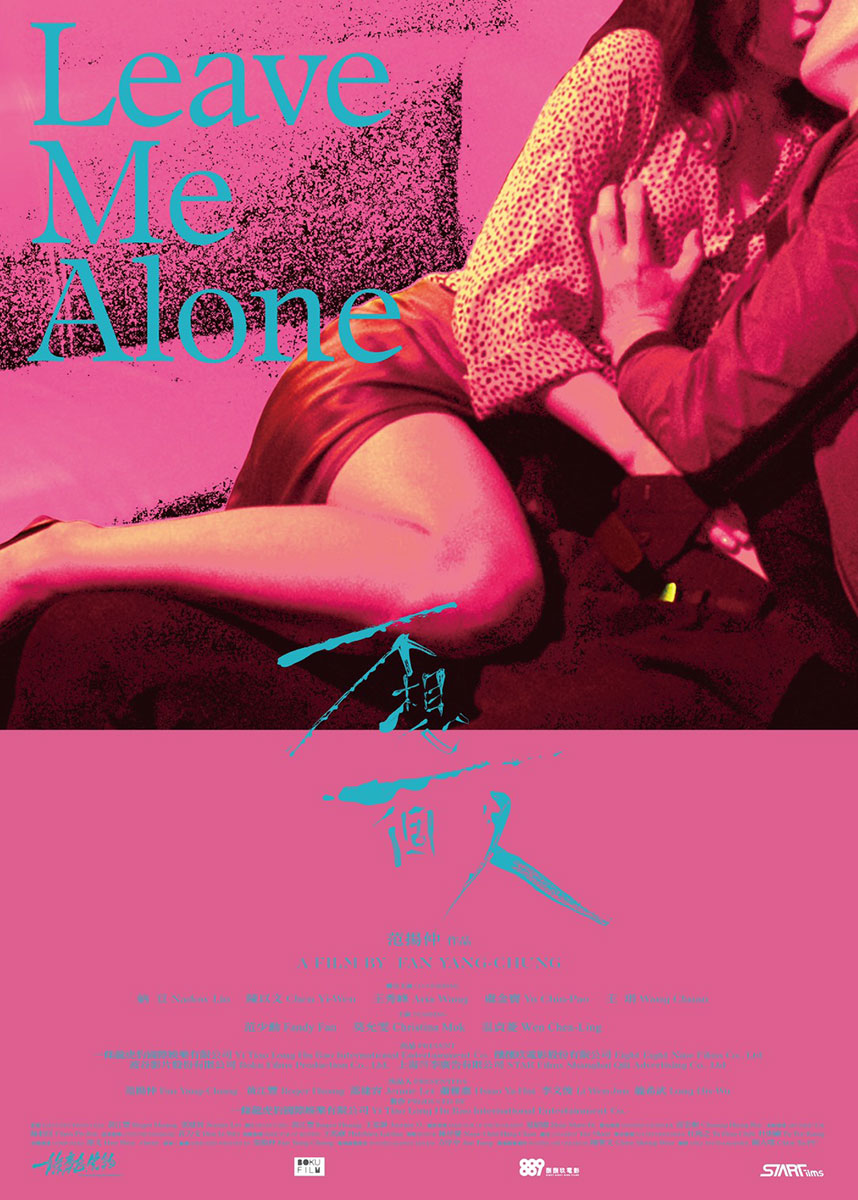
Leave Me Alone (不想一個人, Fan Yang-chung, 2021)

Lonely souls seek impossible connection in a rapidly disintegrating world in Fan Yang-Chung’s steamy urban drama, Leave Me Alone (不想一個人, bùxiǎng yīgèrén). The title may in its way be misleading, the original Chinese meaning something more like “I don’t want to be alone” hinting at the misdirected longing that informs all of the relationships in play, but is in another way the thing each of them fear – that they are being left behind while everything around them seems to be on the brink of collapse. 

Petty street pimp Loong (Fandy Fan Shao Hsun) literally lives in a disused building that’s about to be torn down, while his side gig involves working with a local gangster to pressure residents of an old-fashioned apartment block to sell up so the land can be redeveloped. Loong has a rather unsentimental, amoral approach to his work in finding the body of an old man and pressing his finger on the documents to make it look like he changed his mind right before died, something which seems all the colder on realising that his own father lives in the building. His gangster boss Brother Chao ominously reminds him that’s something he’ll need to take care of. 

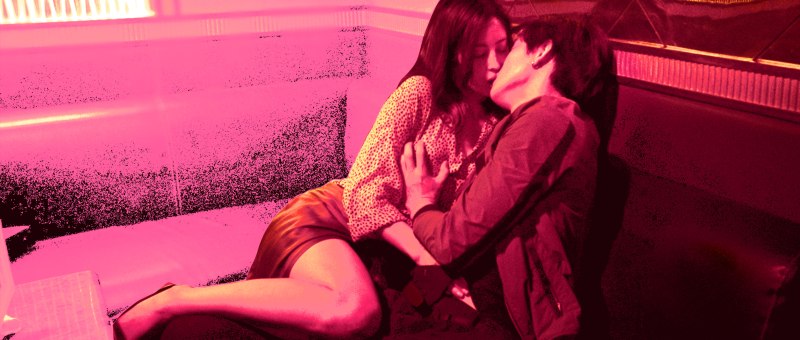
In other ways eager to please, Loong’s involvement with Brother Chao is part of his aspirational desire to live a better life which also in part explains his fascination with beautiful gallery owner Olivia (Christina Mok) who is also in her own way lonely having discovered that she’s carrying the child of her married lover whom she’d believed was ignoring her only to discover the reason he’s not been answering her calls is that he’s in hospital in a coma and unlikely to wake up. Both Loong and and Olivia are repeatedly blocked from getting what they want, she prevented from entering her lover’s hospital room on the orders of his wife and he later rejected from a fancy apartment block by the same set of security guards instructing him to take the back stairs as if reminding him of his status and the class difference between himself and Olivia even if he’s smartened himself up while continuing to exploit other women for his living.

He does perhaps undergo a minor pang of conscience when Olivia tells him not to treat her like one of his sex workers, but later seems to have given up on achieving a more mainstream success after overplaying his hand with Brother Chao and paying a heavy price for his hubris. Olivia meanwhile entertains other men in an attempt to overcome her loneliness, sending each of them away with the excuse that her friend is coming over though of course he isn’t and doesn’t respond to her messages. As she and Loong drift into an affair, Oliva becomes a kind of tourist in his world raising eyebrows at the karaoke bar where the girls entertain Brother Chao’s guys, but Loong is hopelessly out of place in her upperclass society hovering in the background at a swanky party and eventually alienating another guest he felt was belittling him by offering to set him up with one of his girls. While he longs for Olivia as a symbol of the high life he feels is denied to him, so Chin-shah (Wen Chen-ling) his casual squeeze longs for him looking perhaps for protection or uncomfortably for the familial while he largely thinks only of himself. 

In any case, they each live in a world set to disappear. In one of the earliest scenes, Olivia watches as workmen dismantle the current installation in preparation for the next, her own image shattering as a mirror is smashed by a workman’s hammer, while the disused apartments and obsolete housing complexes familiar to Loong must too eventually come down leaving him forever displaced in a rapidly gentrifying city. “You’re too poor and you can’t handle me” Olivia eventually reflects after asking Loong if he’d always be there to take care of her making it plain that they occupy two different worlds while temporarily trapped in the same liminal space by their shared loneliness and a longing for something else that they don’t think they can have. They must try to find a way to move on but are otherwise forced deeper onto the paths they’d already chosen while trapped together bound by their shared yet opposing desires. In Fan’s stratified city of frustrated longing, love may not be so much the cure for loneliness as its ultimate expression. 


Leave Me Alone screened as part of Osaka Asian Film Festival 2022

Original trailer (English subtitles)

Nina Wu (灼人秘密, Midi Z, 2019)

Nina Wu poster 1“They’re not just destroying my body but my soul” complains an exploited woman in a film within a film, “I’ll do something you’ll all regret” she adds, only the actress never will. Penned by leading actress Wu Ke-xi, Nina Wu (灼人秘密, Zhuó Rén Mì) provides a timely exploration of the gradual erasure of the self the pursuit of a dream can entail in a fiercely patriarchal, intensely conservative culture. Arriving in the wake of the #metoo scandal the film goes in hard for industry exploitation but never tries to pretend that these are issues relating to the film industry alone or deny the various ways it informs and is informed by prevailing social conservatism.

Originally from the country, the titular Nina Wu (Wu Ke-xi) has been in Taipei for eight years trying to make it as an actress but is still awaiting that big break. Aside from some small bit parts and commercial jobs, she supports herself by working in restaurants with a side career as a live-streaming webcam star. Then, just as she’s starting to think it’s too late, a call comes through – she’s in the running for the lead in a high profile period spy thriller. The only snag is that the part requires full frontal nudity and explicit sex scenes.

Nina is understandably conflicted. Aside from the potential discomfort, taking a part in the kind of film this could turn out to be is a huge gamble that could either make or break her career (just look at what happened to Tang Wei after Lust Caution, itself a period thriller about a female assassin who falls for her target). Nina’s unsympathetic agent skirts around the fact this might be her last chance while promising to respect her decision, implying it’s this or nothing. Of course, neither he nor the sleazy director inviting parades of identically dressed hopefuls up to his hotel room where he forces them to engage in dubious acts of degradation for his own enjoyment will admit that the reason they want a “fresh face” isn’t for any artistic motivation but that no well established actress with a proper agent would ever take a role like this (and even if she did, she couldn’t be pushed around in the same way).

Convincing herself to do whatever it takes, Nina takes the part but goes on to suffer at the hands of a controlling and tyrannical director who psychologically tortures and physically abuses her supposedly in order to get the performance he wants rather than the one she chooses to give him. A repeated motif sees hands continually around Nina’s throat as if she were being permanently strangled, unable to speak or express herself, permitted breath only when compliant with the desires of men.

Subsuming herself into the part, Nina avoids having to think about the various ways her offscreen life is also a performance or of her own complicity in the erosion of her emotional authenticity. A visit home reveals a difficult family environment with a father (Cheng Ping-chun) losing out in the precarious modern economy, while she, now the “famous actress”, wonders if she was happier as an am dram bit player staging inspirational plays for children. The secret she seems so desperate to conceal seems to be her same sex love, sacrificed for a career in Taipei and now perhaps unsalvageable. Her lover has moved on, preparing to marry a man and embark on a socially conventional life. If she too has made her peace with sacrificing a part of her true self, she does at least seem superficially “happy” in contrast to Nina’s gradually fracturing psyche.

Meanwhile, Nina becomes paranoid that a mysterious woman is stalking her. Apparently another hopeful also driven mad by the demands of an exploitative industry, the woman is convinced Nina has taken what was rightfully hers and done so by selling her body for career advancement. Yet as time goes on we begin to wonder if the film ever happened at all or is only a part of Nina’s fabricated delusion sparked Marienbad-style by the single traumatic event on which the film ends, filled as it is with a lingering sense of tragic defeat. Nina Wu never takes her longed for revenge, even if she (perhaps) gains it in a kind of success, but silently endures as the misuse of her body begins to destroy her soul and leaves her nothing more than an empty vessel on which the desires of others are projected.


Nina Wu was screened as part of the 2019 London East Asia Film Festival.

Original trailer (English subtitles)