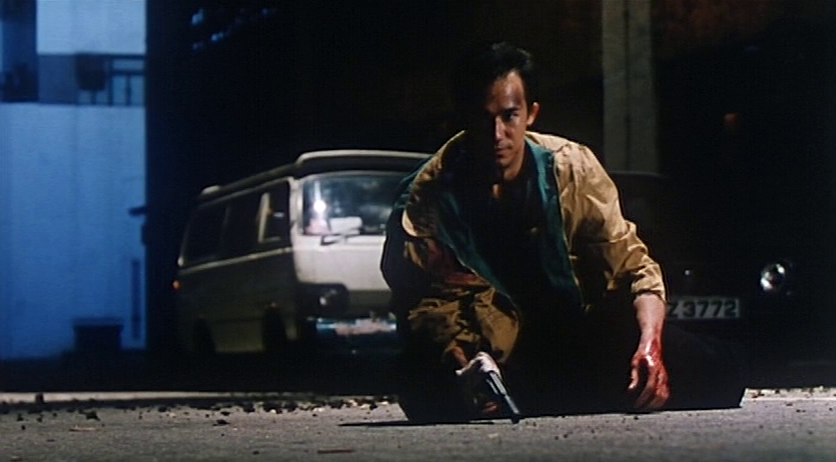
The Big Heat (城巿特警, Andrew Kam & Johnnie To, 1988)

A Hong Kong cop struggles with his sense of responsibility when faced with the fatalistic existential threat of the imminent Handover in Johnnie To’s first foray into the genre with which he would later become most closely associated outside of Hong Kong, the action crime drama. After a handful of Cinema City comedies, To is credited as a co-director along with Andrew Kam Yeung Wah though the production of The Big Heat (城巿特警), loosely inspired by the Fritz Lang film of the same name, was notoriously complicated passing through several hands over its unusually long gestation of almost two years, according to an interview with screenwriter Gordon Chan Kar-Seung, with producer Tsui Hark also heavily involved in the shooting. 

Tsui’s involvement is apparently responsible for the unusual level of explicit violence more usually found in horror exploitation rather than gangster noir, though there is perhaps something in the constant bodily destruction that aligns with the pre-Handover setting in which the “big heat” hanging over the city is an increasing existential panic which has created the maddening environment in which this surreal violence can occur as revealed in the opening dream sequence which features a drill piercing a man’s hand with small pieces of flesh speeding off it. The dream will turn out to be a prophecy foreshadowing the final shootout in which Inspector Wong (Waise Lee Chi-Hung) is shot thought the hand though at this point it signals both a psychological and physical fracturing. Owing to a neurological condition, Wong has lost full control over his right hand which leads him to question his ability to protect his city if he is unable to pull the trigger when needed which might also explain why he is frequently seen practicing his marksmanship at the firing range. 

Because of this anxiety, Wong had planned to resign but changes his mind on learning that his former partner who sustained an injury that Wong felt himself responsible for has been brutally murdered by Hong Kong gangsters in Malaysia after coming across a secret folder “by chance” containing photos used to blackmail a shipping magnate over his his homosexuality and an incriminating invoice. To do the right thing, Wong also temporarily breaks up with his forensic scientist girlfriend Maggie (Betty Mak Chui-Han) whom he was due to marry in a fortnight’s time suggesting that they not see each other until he’s solved his friend’s murder and then presumably plans to retire from law enforcement. 

Essentially, he deprioritises his personal, romantic relationships in favour of the homosocial brotherhood of the police both avenging his friend and dedicating himself to protecting Hong Kong from an oncoming threat represented by gangster Han (Paul Chu Kong) who is later revealed to be in cahoots with Russian mafia who ironically have a large portrait of Lenin on their boat and hammer and sickle flags everywhere while vowing to continue “selling drugs and capitalism” in the seemingly lawless environment of pre-Handover Hong Kong where everyone apparently wants to make enough money to be able to leave if the situation declines, “communist” Russians perhaps standing in for looming Mainland authoritarianism. Han even offers to sell “everything including Hong Kong” passing a list of names of “important people in the government” he apparently has access to in vast network of corruption. “Cheers to 1997” they ironically toast for their burgeoning business opportunity. 

It’s this corruption that is the source of Wong’s anxiety, fearing he doesn’t have the strength to stop it while his compromised hand is a symbol of both fate and an impotence that is later exorcised when he receives the corresponding physical injury yet is saved by a crucifix necklace that previously belonged to his girlfriend while in another instance of foreshadowing the corrupt policeman is eventually taken out by his own malfunctioning gun backfiring just like that which ruined an assailant’s hand in the drug bust in which Wong’s partner was injured. Having regained mastery over his hand, Wong is therefore more assured in his ability to protect Hong Kong from whatever it is that’s coming remaining within the police force while those who pay the heaviest price are an idealistic young rookie unable to adapt to the morally compromised world of pre-Handover Hong Kong, and Wong’s fiancée who becomes a symbol of that which he could not protect having prioritised his role as a police officer. Though somewhat disjointed having passed through so many hands, there are some typically To flourishes in the fluidity of the camerawork in the early stretches along with a gloomy romanticism in the fatalistic noir of the pre-Handover society even as he continues to find his feet as a purveyor of moody policier. 


Trailer (no subtitles)
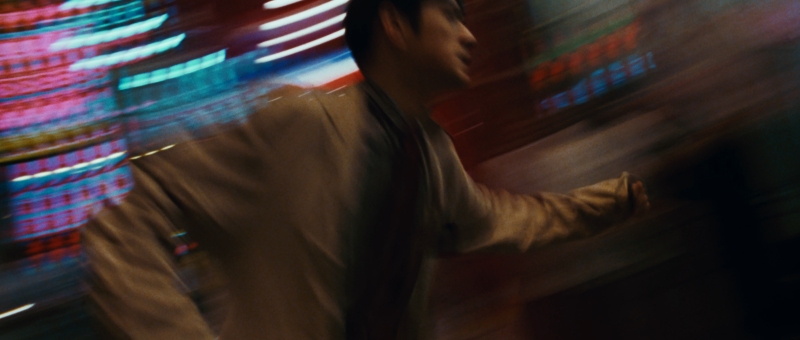
Chungking Express (重慶森林, Wong Kar Wai, 1994)

4K

Despite scoring an early success with his debut film As Tears Go By, an atmospheric gangster picture starring some of the most popular actors of the day, Wong Kar Wai’s second feature Days of Being Wild, a melancholy arthouse drama of loneliness and longing set in the heady 1960s, proved disappointing at the box office and divisive with domestic critics. Unable to secure funding for a planned sequel, Wong founded production company Jet Tone Films and agreed to a studio offer to direct a wuxia adventure which was at that time an extremely popular genre. The shoot on Ashes of Time was however notoriously difficult (Wong eventually extensively revised the film for its 2008 “Redux” re-issue), and during a short break from its various demands he shot Chungking Express (重慶森林), an extremely vibrant, zeitgeisty journey through pre-Handover Hong Kong in which a lovelorn policeman is preoccupied with expiration dates while another reflects on new possibilities when his stewardess girlfriend rediscovers her right to make her own choice. 

Lovelorn policeman He Qiwu (Takeshi Kaneshiro), badge number 223, has just been dumped by his girlfriend of five years but as she chose April 1 to break the news, he assumed it was a joke. To go along with it, he’s been buying tins of pineapple which expire on May 1, firstly because his girlfriend May loves pineapple and secondly because May 1 happens to be his birthday. If she hasn’t got back with him by then, he’ll accept that their love has “expired”. A rather melancholy young man, Qiwu gets his emotional release through jogging in the rain, avowing that while running your body sheds water so you don’t cry as much and in the rain no one can see you anyway. The password for his answering service is “love you for 10,000 years”, but his attempts to hook up with old flames from his little black book are a series of embarrassing misfires, the first having turned in early, another already married with two children, and the last not even remembering him. Nevertheless, despite his melancholy he lives in a constant state of possibility as his opening monologue reminds us in his defence of the city as a place in which one may brush past a hundred people a day some of whom may later become friends or lovers. 

Nevertheless, the Hong Kong he inhabits is one of infinite nostalgia. He tells us that his girlfriend is often likened to ‘70s Japanese pop star Momoe Yamaguchi, only to lament that he was never quite her Tomokazu Miura, Yamaguchi’s frequent co-star whom she later married and thereafter left showbiz to become the ideal housewife and mother. The woman that he falls for, a mysterious drug trafficker (Brigitte Lin Ching-hsia) hot on the trail of a group of Indian tailors she’d hired as mules who absconded at the airport, wears a trench coat, blonde wig, and sunglasses seemingly modelled on Gena Rowlands in Gloria. She too however is caught in a moment of crisis, admitting that the sunglasses and raincoat are in a sense an attempt to hedge her bets while the expiry date on an abandoned can reminds her that time is running out. The conclusion Qiwu comes to is that to May he is no different to a can of pineapple, past his best and fit to be abandoned, while the mysterious woman eventually implodes her assumed identity by taking her revenge and thereafter shedding her trademark wig to recede back into the crowd pausing only to send Qiwu a happy birthday message via his pager in another act of distanced communication.  

The irony of Qiwu’s seeming obliviousness to his proximity to crime is never touched upon despite his apparently deep, essential connection with this slightly older mysterious woman whom he manages to woo despite his awkward opening gambit of asking if she likes pineapple in four different languages. Nor does he seem to be familiar with fellow officer badge 663 (Tony Leung Chiu-Wai) who frequents the same late night food stand as he does, while neither of them apparently know the mysterious “Richard” who seems to have beaten them both to win the heart of previous assistant also coincidentally named May who has now been replaced by proprietor’s cousin, Faye (Faye Wong). Obsessively listening to California Dreamin’ at high volume because it stops her thinking too much, Faye falls for 663 who is apparently unceremoniously dumped by his air hostess girlfriend (Valerie Chow Kar-Ling) after being persuaded to alter his regular order of Chef’s Salad for Fish and Chips introduces a new element of choice into their relationship. 

In a kind of meta, expressionistic irony, 663 becomes obsessed with his sadness gently consoling the inanimate objects of his apartment in his girlfriend’s absence, lamenting that his soap bar has grown thin while his dish cloth weeps until finally the whole place floods. This last incident is partly down to the ministrations of Faye who has been, in the nicest possible way, semi-stalking him, using the keys which were returned to the food stand along with a letter 663 refuses to read to break into his flat and literally breathe life back into it by tidying up and replacing the fish in his fish tank. 663 appears not to notice as her distanced care seemingly nurses him back to health even as they begin in a sense to swap roles, he shedding the policeman’s uniform his ex mistakenly thought suited him better for the flannel shirts left by Faye which reflect perhaps his authentic self as observed by the woman who truly loves him. 

Even so she remains restless and bound for (temporary) exile while 663 once again refuses to open correspondence which may prove hurtful or unpleasant, getting a second chance at a fated love only thanks to the magical coincidences of the forever buzzing streets of Hong Kong. At once frenetic and anxious, Christopher Doyle’s swooping, mobile photography with frequent alteration in frame rate and transitions to slow motion capturing a sense of nervous energy, Wong’s take on the pre-Handover society is more positive than most as his neurotic, lovelorn protagonists breeze through their melancholia ultimately discovering a sense of forward motion in hope for the future born of chance connection in an ever moving city. 


Transfer: The 4K restoration is presented in the original 1.66:1 aspect ratio and in keeping with new the house style, has shifted slightly towards the green in terms of colour grading which is overall darker and richer than the previous Criterion release.


Chungking Express is currently available to stream in the UK via BFI Player in its newly restored edition as part of the World Of Wong Kar Wai season.

Restoration trailer (English subtitles)