

Okinawa Rendez-vous (戀戰沖繩, Gordon Chan, 2000)

Romantic confusion ensues when a collection of Hong Kongers and Japanese gangsters meet in Okinawa in Gordon Chan’s breezy rom-com Okinawa Rendez-vous (戀戰沖繩). Set in the picturesque environment of a seaside resort, the film takes on the trappings of a heist caper but is really about misdirected romanic attraction brokered by some missing money and more than a few acts of wilful deception as master thief and mailroom cop become locked in a game of cat and mouse.

Hong Kong cop Dat (Tony Leung Ka-fai) is on holiday in Okinawa with his girlfriend Sandy (Gigi Lai Chi) whom he plans to break up with and her friend Cookie (Stephanie Che) whom he hates. His trip is brightened when he spots Jimmy (Leslie Cheung Kwok-wing), a master thief he remembers from his police files but is not actually wanted for anything right at this moment. Meanwhile, Jimmy is in Okinawa trying to blackmail a yakuza by threatening to expose his diary. The yakuza, Sato (Masaya Kato), was all set to pay him, but his Hong Kong girlfriend, Jenny (Faye Wong), runs off with the money and beings living a simple life working at a seaside bar while living with the owner (Asuka Higuchi) who is so obsessed with Hong Kong hitman movies that she’s picked up fluent Cantonese through osmosis. Dat takes a liking to Jenny while using her in his plot to catch Jimmy through entrapment by plotting to a rob local bank, while Sandy draws closer to Sato who cared less about getting the money back than he did about Jenny but is learning to let go of both of them.

Apparently on a tight deadline, Chan assembled the cast in Okinawa with only a vague plot outline and no script hoping to improvise the rest. The main thread is the competition between Jimmy and Dat for the affections of Jenny, along with the obvious contrasts between the cop and the thief. Ironically named “Mr. Law”, policeman Dat is not especially sympathetic and seemingly oblivious to the fact that he is actually involved in plotting a robbery that would take him down as well Jimmy if actually went ahead. For reasons best known to himself, he’s brought his girlfriend on holiday with the idea of breaking up with her, which seems like an awkward scenario begin with, but perhaps sped up by his attraction to Jenny whom he mistakenly assumes to be some kind of pure woman at the centre of intrigue rather than a thief herself.

Jenny tells Sato that she just fell out of love with him and was looking for an exit, while Dat also says something similar about his relationship with Sandy, hinting at the transient nature of love and along with it its meaninglessness. Nevertheless, even as playboy Jimmy strings along other local women and pretends he’s only interested in conquest, he seems to develop genuine feelings for Jenny while she strings Dat along and uses both men to protect her money but is secretly trying to help Jimmy. After being dumped by Dat with a plagiarised poem he probably gives to all his girlfriends, Sandy finds love with Sato and plans to stay in Okinawa, while romance may be blossoming between Cookie and Dat and Jimmy’s right-hand man takes up with the recently dumped bar owner who finally gets the Hong Kong “killer” she’d always dreamed of.

Which is all to say that Dat was right when he said that life is unpredictable, but maybe that’s not such a bad thing. Despite the potentially dangerous nature of this situation, no one ends up getting (physically) hurt, and everyone eventually finds their way to where they’re supposed to be, positioned for maximum happiness. Making the most of its picturesque Okinawa setting, the film, in the end, comes down on the side of love. The stolen money is reduced to a MacGuffin, while the blackmail and entrapment plots fall by the wayside as each begins to discover new and unexpected romantic possibilities in this otherwise transient place. Light, breezy, and filled with gentle humour, there is, however, a genuine sense of poignancy in the final scene as the lovelorn Jimmy discovers his romantic destiny just might work out after all.


Trailer (no subtitles)
Chungking Express (重慶森林, Wong Kar Wai, 1994)

4K

Despite scoring an early success with his debut film As Tears Go By, an atmospheric gangster picture starring some of the most popular actors of the day, Wong Kar Wai’s second feature Days of Being Wild, a melancholy arthouse drama of loneliness and longing set in the heady 1960s, proved disappointing at the box office and divisive with domestic critics. Unable to secure funding for a planned sequel, Wong founded production company Jet Tone Films and agreed to a studio offer to direct a wuxia adventure which was at that time an extremely popular genre. The shoot on Ashes of Time was however notoriously difficult (Wong eventually extensively revised the film for its 2008 “Redux” re-issue), and during a short break from its various demands he shot Chungking Express (重慶森林), an extremely vibrant, zeitgeisty journey through pre-Handover Hong Kong in which a lovelorn policeman is preoccupied with expiration dates while another reflects on new possibilities when his stewardess girlfriend rediscovers her right to make her own choice. 

Lovelorn policeman He Qiwu (Takeshi Kaneshiro), badge number 223, has just been dumped by his girlfriend of five years but as she chose April 1 to break the news, he assumed it was a joke. To go along with it, he’s been buying tins of pineapple which expire on May 1, firstly because his girlfriend May loves pineapple and secondly because May 1 happens to be his birthday. If she hasn’t got back with him by then, he’ll accept that their love has “expired”. A rather melancholy young man, Qiwu gets his emotional release through jogging in the rain, avowing that while running your body sheds water so you don’t cry as much and in the rain no one can see you anyway. The password for his answering service is “love you for 10,000 years”, but his attempts to hook up with old flames from his little black book are a series of embarrassing misfires, the first having turned in early, another already married with two children, and the last not even remembering him. Nevertheless, despite his melancholy he lives in a constant state of possibility as his opening monologue reminds us in his defence of the city as a place in which one may brush past a hundred people a day some of whom may later become friends or lovers. 

Nevertheless, the Hong Kong he inhabits is one of infinite nostalgia. He tells us that his girlfriend is often likened to ‘70s Japanese pop star Momoe Yamaguchi, only to lament that he was never quite her Tomokazu Miura, Yamaguchi’s frequent co-star whom she later married and thereafter left showbiz to become the ideal housewife and mother. The woman that he falls for, a mysterious drug trafficker (Brigitte Lin Ching-hsia) hot on the trail of a group of Indian tailors she’d hired as mules who absconded at the airport, wears a trench coat, blonde wig, and sunglasses seemingly modelled on Gena Rowlands in Gloria. She too however is caught in a moment of crisis, admitting that the sunglasses and raincoat are in a sense an attempt to hedge her bets while the expiry date on an abandoned can reminds her that time is running out. The conclusion Qiwu comes to is that to May he is no different to a can of pineapple, past his best and fit to be abandoned, while the mysterious woman eventually implodes her assumed identity by taking her revenge and thereafter shedding her trademark wig to recede back into the crowd pausing only to send Qiwu a happy birthday message via his pager in another act of distanced communication.  

The irony of Qiwu’s seeming obliviousness to his proximity to crime is never touched upon despite his apparently deep, essential connection with this slightly older mysterious woman whom he manages to woo despite his awkward opening gambit of asking if she likes pineapple in four different languages. Nor does he seem to be familiar with fellow officer badge 663 (Tony Leung Chiu-Wai) who frequents the same late night food stand as he does, while neither of them apparently know the mysterious “Richard” who seems to have beaten them both to win the heart of previous assistant also coincidentally named May who has now been replaced by proprietor’s cousin, Faye (Faye Wong). Obsessively listening to California Dreamin’ at high volume because it stops her thinking too much, Faye falls for 663 who is apparently unceremoniously dumped by his air hostess girlfriend (Valerie Chow Kar-Ling) after being persuaded to alter his regular order of Chef’s Salad for Fish and Chips introduces a new element of choice into their relationship. 

In a kind of meta, expressionistic irony, 663 becomes obsessed with his sadness gently consoling the inanimate objects of his apartment in his girlfriend’s absence, lamenting that his soap bar has grown thin while his dish cloth weeps until finally the whole place floods. This last incident is partly down to the ministrations of Faye who has been, in the nicest possible way, semi-stalking him, using the keys which were returned to the food stand along with a letter 663 refuses to read to break into his flat and literally breathe life back into it by tidying up and replacing the fish in his fish tank. 663 appears not to notice as her distanced care seemingly nurses him back to health even as they begin in a sense to swap roles, he shedding the policeman’s uniform his ex mistakenly thought suited him better for the flannel shirts left by Faye which reflect perhaps his authentic self as observed by the woman who truly loves him. 

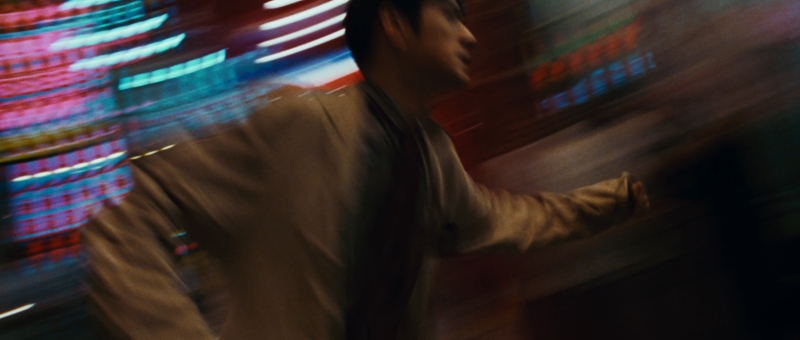
Even so she remains restless and bound for (temporary) exile while 663 once again refuses to open correspondence which may prove hurtful or unpleasant, getting a second chance at a fated love only thanks to the magical coincidences of the forever buzzing streets of Hong Kong. At once frenetic and anxious, Christopher Doyle’s swooping, mobile photography with frequent alteration in frame rate and transitions to slow motion capturing a sense of nervous energy, Wong’s take on the pre-Handover society is more positive than most as his neurotic, lovelorn protagonists breeze through their melancholia ultimately discovering a sense of forward motion in hope for the future born of chance connection in an ever moving city. 


Transfer: The 4K restoration is presented in the original 1.66:1 aspect ratio and in keeping with new the house style, has shifted slightly towards the green in terms of colour grading which is overall darker and richer than the previous Criterion release.


Chungking Express is currently available to stream in the UK via BFI Player in its newly restored edition as part of the World Of Wong Kar Wai season.

Restoration trailer (English subtitles)