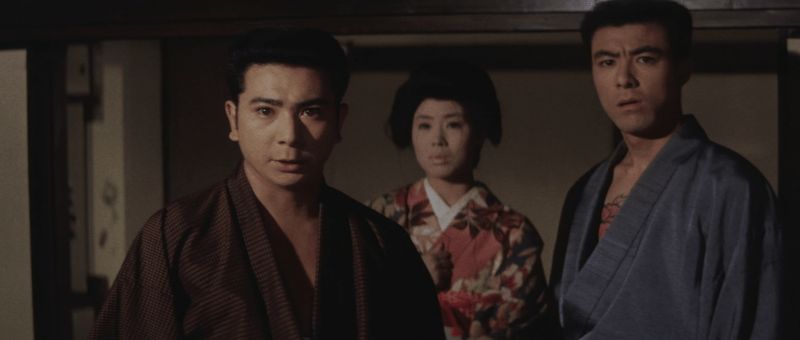
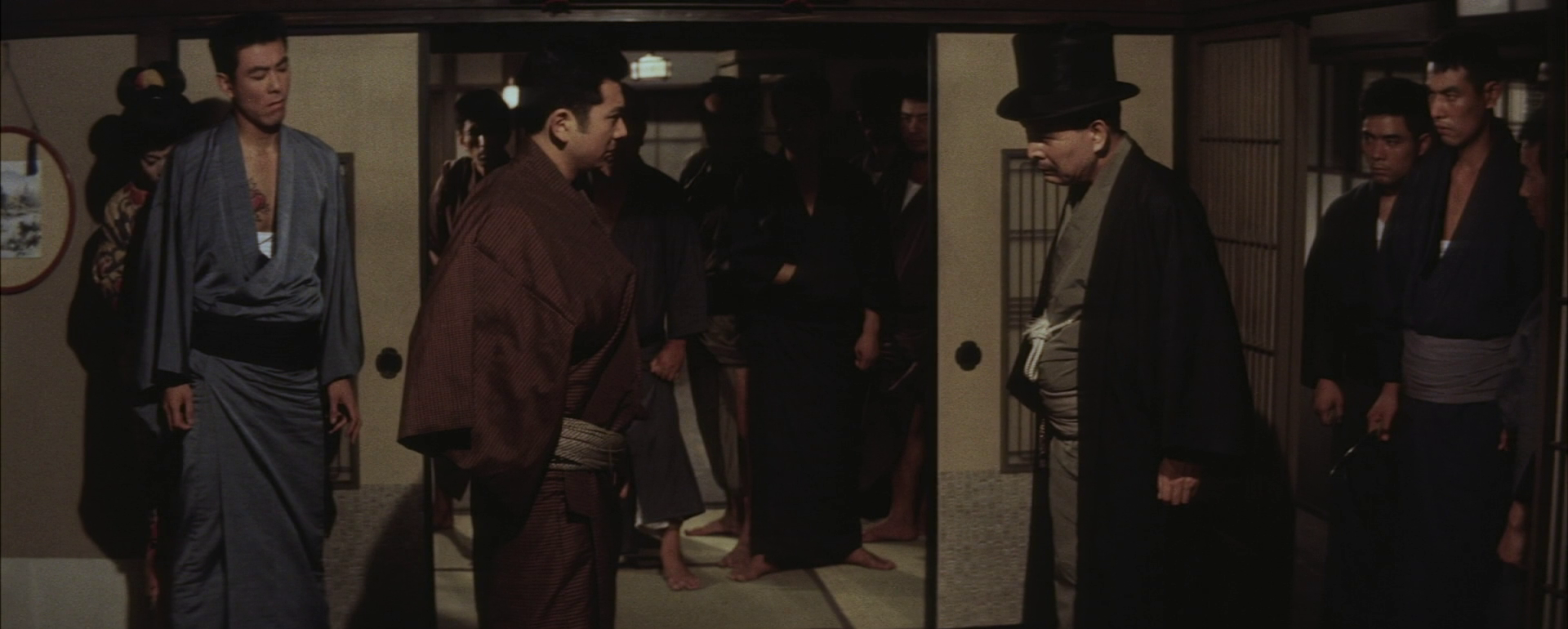
Tough Guy (悪名, Tokuzo Tanaka, 1961)

Starring a baby-faced Shintaro Katsu, Tokuzo Tanaka’s adaptation of a popular novel by Toko Kon, Tough Guy (悪名, Akumyo), went on to spawn a 17-film “Akumyo” or “Bad Reputation” series. Asakichi (Shintaro Katsu) is certainly the “tough guy” of the title and fulfilling a certain vision of post-war masculinity in this early Showa tale, yet getting a “bad reputation” is something he ultimately rejects in the film’s closing moments as he continues to straddle a line, not quite the “yakuza” he claims to hate but a noble rogue all the same. 

Asakichi is a small-town boy from rural Kawauchi. Despite the nobility which later comes to define his character, he’s disowned by his family after stealing a chicken from a yakuza-affiliated farmer to use in a cock fight. Originally, he skips town, with the farmer’s apparently married sister Kiyo who tells him that she’s pregnant though is probably not telling the truth. In any case, when they get to the next town he discovers she’s been engaging in sex work and breaks up with her, but Kiyo is only one element of his increasingly complicated love life. While staying in the town, Asakichi ends up developing a relationship with besotted former geisha Kotoito (Yaeko Mizutani) whom he eventually agrees to help rescue through another elopement. Meanwhile, he also becomes a “guest” of the local Yoshioka yakuza group and sworn brother of former enemy Sada.(Jiro Tamiya). 

The problem is that the Yoshioka gang is small potatoes in the town and does not have the resources to stand up against the hired thugs of the Matsushima red light district who eventually turn up to reclaim Kotoito. While she manages to escape on her own, Asakichi ends up randomly marrying a completely different woman, Okinu (Tamao Nakamura), who cannily makes him sign a contract saying they’re married before she’ll sleep with him. Nevertheless, when he hears that Kotoito came back to look for him and was recaptured, he springs into action and heads to Innoshima to battle agains the Silk Hat Boss and a wily yet fair-minded female yakuza who turns out to be the one really in charge of the island. 

Asakichi is, in many ways, an embodiment of a certain kind of masculinity in his determination to do what he sees as right even when others don’t agree with him. Consequently, his moral code seems inconsistent and difficult to define. He was fine with stealing the chicken, but doesn’t like the idea of cheating at gambling (though later does it to get money to rescue Kotoito) despite proving himself an expert at bluff and trickery. Similarly, he hates “yakuza” and refuses to become one, but is willing to stay as their “guest” and to help out when they need extra bodies for a fight. The only thing that certain is that he hates those who abuse their power to oppress the weak, which explains his objection to the yakuza, while otherwise doing what they claim to do but in reality do not in defending the interests of those who cannot defend themselves such as Kotoito who has been sold into the sex trade by a feckless father. 

Her position is mirrored in that of the female gang boss, Ito (Chieko Naniwa) , who eventually assumes control over Kotoito’s fate, an ice-cold and fearless leader who nevertheless respects Asakichi’s earnestness and brands him the tough guy of the title after he decides to return alone and accept punishment for freeing Kotoito. In giving them a week’s grace to have a kind of non-honeymoon (on which Okinu actually also comes along), she may not have expected the pair to return and is surprised that Asakichi insists on bringing the matter to a formal close. Eventually he defeats her by refusing to give in, insisting that they see which is stronger, his body or her cane, rather than begging for mercy and thereby accepting her authority. Having defeated her, he breaks the cane in two and throws it in the ocean to stand by his strength alone while crying out that he has won, yet suggesting that he does not want the kind of life that leads to a “bad reputation”. Tanaka makes fantastic use of lighting not least in the final shot of the shining sea that leaves Asakichi alone on the shore, a tiny figure in an expanding landscape.


Trailer (no subtitles)

Snow Country (雪国, Shiro Toyoda, 1957)

Closely associated with literary adaptation, Shiro Toyoda had been wanting to adapt Yasunari Kawabata’s Snow Country (雪国) since its serialisation and apparently spent four years preparing his treatment ahead of the 1957 film starring Ryo Ikebe as the solipsistic aesthete at the novel’s centre. Characteristically, however, he takes several liberties with the source material, notably introducing an entirely different conclusion which perhaps helps in re-centring the tale away from the hero Shimamura to the melancholy geisha who apparently falls for him because of his intense loneliness. 

A brief reference to a failed military insurrection in Manchuria sets us firmly in the mid-1930s as do repeated mentions of the ongoing depression which causes additional anxiety to local business owners in a small holiday resort town. Mimicking the novel’s famous opening, Toyoda opens with a POV shot of a train exiting a tunnel into the snow-covered landscape, the hero Shimamura (Ryo Ikebe) sitting sadly gazing out of a window and eventually captivated by the reflection of a young woman devotedly caring for a young man who appears to be in poor health. Meanwhile, another young woman, Komako (Keiko Kishi), gazes at her own reflection in a train station window, waiting once again as if unable to depart. As we discover, Shimamura has returned with the intention of seeing Komako with whom he’d struck up a relationship during a summer trip but is somewhat disappointed to learn that she has since become a geisha.

In a flashback to their first meeting, Komako asks Shimamura if he has come for “escape”, a question he doesn’t exactly answer while petulantly complaining about his lack of artistic success as someone who paints pictures apparently out of step with his times. When the head of the local commerce association tries to involve him in conversation about the failed insurrection, he bluntly tells him that he’s an artist and as such has no interest in such things, but it does indeed seem that he is looking for some kind of escape from the turbulent times, expressing that here the war seems very far away as does “the depression”. Komako, a more modern and perhaps prophetic figure than it might at first seem, is the only one to bring up the war directly speculating that it may be about to intensify while the frustrated affair between the two seems to be informed by the mounting tensions against which they are attempting to live their lives. 

Rather self-absorbed, Shimamura in a sense may even identify with Komako explaining that he too has a “patron” and implying that his flight is perhaps a response to his sense of powerlessness, that he feels constrained by his financial dependency presumably on his father-in-law though his relative economic superiority which leads Komako to frequently remark on his “extravagance” obviously affords him the freedom to make these random solo trips to ski resorts and indulge his career as a painter regardless of its capacity to support himself and his family. Komako must know on some level that the relationship is a fantasy, yet she believes in it enough to end her connection with an elderly patron on suspecting that she is carrying Shimamura’s child only to have her hopes dashed when he does not turn up for a local festival as promised with the consequence that all of her dependents are turfed out of the home he had provided for her. 

Komako is not “free” in the same way that Shimamura evidently is, her entire life dictated by the fact that she is poor and female. Fostered by a shamisen teacher, she may have been technically engaged to the young man, Yukio (Akira Nakamura), Shimamura saw on the train being cared for by Yoko (Kaoru Yachigusa), Komako’s foster sister in love with him herself, but intensely resents the burdens she is expected to bear quite literally with her body. She later tells Shimamura that she didn’t become a geisha for Yukio in order to pay his medical bills but out of a sense of obligation, while she is also responsible for her birth family, the now bedridden shamisen teacher, and Yoko who intensely resents her for her callous treatment of Yukio and generally “dissolute”, selfish way of living. During the famous fire in a cinema that closes the novel (but not the film), Komako even exclaims that her life would be easier if Yoko burned to death, but on witnessing her either fall or jump from the burning building she can do nothing other than run to her side. 

Indeed, the novel’s climax finds Shimaura standing alone indifferent to the fate of Yoko, a young woman he had come to admire if only for her contrary qualities, admiring instead the beauty of the night sky. In Toyoda’s characterisation, Yoko is in one sense the conventionally good woman whose selfless devotion to the sickly Yukio so captivates Shimamura, but her goodness is nevertheless undercut by the degree of her animosity towards Komako even as the two women remain trapped in a complex web of frustrated affection and intense resentment, each perhaps knowing they neither can have the man they want and are condemned to an eternal unhappiness as the snow mounts all around them in this perpetually cold and depressing moribund resort town. Switching between studio matte paintings ironically mimicking Shimamura’s art and on-location footage of the deepening snows, Toyoda’s sense of near nihilistic melancholy evoking the atmosphere of Japan in the mid-1930s hints at grand tragedy but finds resolution only in stoicism as the heroine picks up her shamisen and trudges onward amid the quickening blizzard.