Okuni and Gohei (お國と五平, Mikio Naruse, 1952)

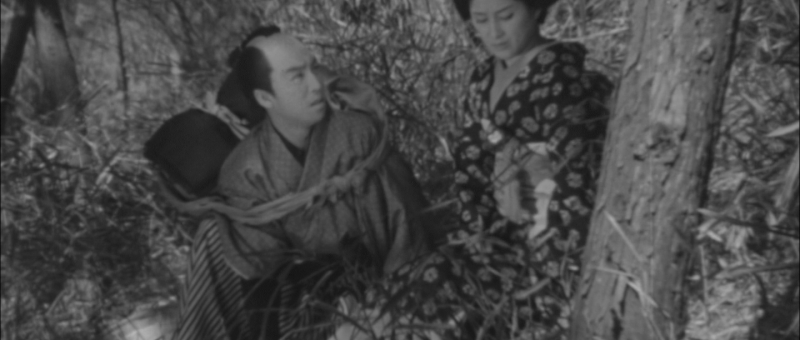
“It’s a rough and difficult road.” The heroes of Mikio Naruse’s Okuni and Gohei (お國と五平, Okuni to Gohei), adapted from a kabuki play by Junichiro Tanizaki, are two displaced between the old world and the possibility of a new one if only they were brave enough to step away from the beaten path. Unbeknownst to them, they are being followed by the man they are seeking whose shakuhachi playing haunts them wherever they go as if taunting them with its presence. 

In this iteration of the tale, Tomonojo (So Yamamura) takes on a slippery quality almost if he were some supernatural devil sent to torment Okuni (Michiyo Kogure) and Gohei (Tomoemon Otani) leading them either towards or away from their salvation or damnation. In Okuni’s flashback, which is obviously coloured with her own nostalgia and regret, he’s a sensitive young man who promised himself in marriage to Okuni. But she is forced to refuse him. Her father rejects Tomonojo because he is without standing or prospects, and instead demands she marry a wellborn man of his choosing, Iori (Jun Tazaki). Iori is then killed in the street, uttering only Tomonojo’s name before he dies. It could then be that this is Tomonojo’s revenge on a society that has rejected him and robbed him of his love, yet the Tomonojo we later meet is much different than this idealised version in Okuni’s memory. He never denies killing Iori and offers no justification for it, but corners Okuni when she’s alone to tell her to free herself by dropping her quest for revenge. He’s also subtly blackmailing her, implying he heard her having sex with her manservant Gohei the previous night and in reality wheedling away pleading for his life.

For her part, Okuni seems torn in her motivations, uncertain whether she’s looking for Tomonojo to reunite with him or kill him, or perhaps is deliberately avoiding finding him at all. She was not married to Iori for very long and he was at the very least an insensitive and emotionally distant husband who spent most of his time at his friend’s house, claiming that it was “boring” to stay home with her. She has no great emotional desire for revenge, but has been told she must accomplish it in order to return to the samurai world, having been condemned to a kind of limbo as the widow of a murdered man. Even so, she has tired of her quest and asks herself what’s to become of them if Tomonojo is already dead. She repeatedly hints to Gohei that they should give up on finding him and on returning home, instead contenting themselves with their life on the road or else find somewhere to settle together in a new world in which a lady and her retainer could live as man and wife.

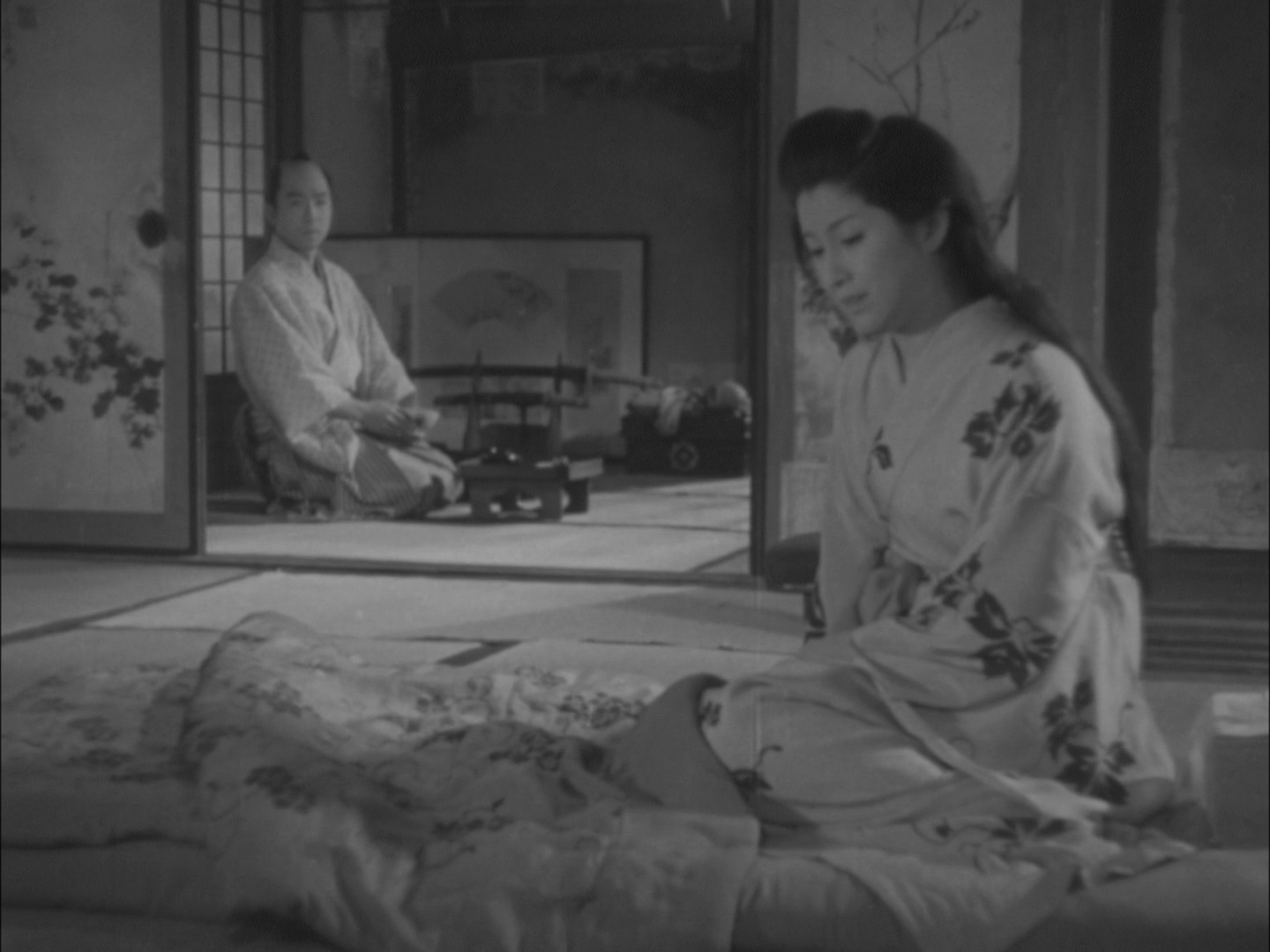
The film is both coy and somewhat transgressive in its depiction of the growing sexual tension between Okuni and Gohei from his taking hold of her injured foot and tender care for her when she falls ill, to the way they draw closer and then instinctively move apart. Passion later gets the better of them and it’s heavily implied that they sleep together, but Gohei instantly regrets it and cannot accept his class transgression. Given this development in their relationship, Okuni asks him to stop calling her “madam” but as she does so she is on one side of the fusuma and he on the other, so they remain in separate rooms divided by the ridge in the tatami. Gohei cannot let go of the old ways and is desperate to complete their quest so that his debt to Iori will be repaid and he can return in glory to be rewarded with position and the esteem of being a true samurai. Even if he tells Okuni that this quest has been his happiness in being on the road with her and knows that killing Tomonojo will end it, he does not turn back.

But the implication is that they can never escape Tomonojo who will, in fact, forever be following them. He taunts the pair with his shakuhachi and visits them in disguise. When they catch up to him, he tries again to convince them to give up their quest and live quietly together in a place free from the constraints of the samurai world, but Gohei cannot do it. Okuni first picks up her dagger and one wonders whether she about to use it on herself, but then turns on Tomonojo though it’s uncertain whether she now does so out of resentment or as revenge of herself for the way Tomonojo has again ruined her life. Just as she was a pawn of her father married off against her will to an indifferent man, she is further imprisoned by patriarchal social codes as Tomonojo needles Gohei that he had slept with her before her marriage. She has in fact already confessed to this to Gohei who transgressed by asking her what exactly Tomonojo was doing with his “shakuhachi” when they were courting, though she did so obliquely in telling him to remember his place and that he should “forget about the past.” Nevertheless she denies it now, but Gohei continues to see her as a “loose” woman with Tomonojo’s words ringing in his ears as a final revenge on the morally compromised lovers.

Their inability to let go of the quest, to do as Okuni suggests and continue on as they are along the rough and difficult path to a more egalitarian future spells their damnation. You can’t go back again. Their “home” is already lost to them. As a pedlar tells the pair along the way, they’ve already been forgotten and the village is filled with other gossip, but now they really have nowhere to go. The message may be for the coming post-occupation era that they shouldn’t try to turn back but keep moving forward into the new Japan or else risk becoming lost in a purgatorial world of confusion like Okuni and Gohei haunted by the choice to betray love for the outdated ideal of samurai honour. Haunted alternately by Tomonojo’s shakuhachi and the words of the villagers who told them they couldn’t be accepted until they fulfilled this quest, they find themselves displaced, unbalanced and uncertain amid the shifting power dynamics of class and gender, their duty and their feelings, but ultimately trapped by their cowardice in their unwillingness to cross the threshold to claim their freedom and happiness.


Husband and Wife (夫婦, Mikio Naruse, 1953)

Kikuko (Yoko Sugi) climbs the stairs to the roof of a department store and pauses at the top looking down on her friends below, but they appear to be looking down on her. They’re disappointed. She looks so “provincial”, even though she has no children and therefore more time to spend on herself. They’re envious of her “freedom” to return home late while they have to get back to their husbands or in-laws, but Kikuno isn’t really free at all while trapped in a stifling marriage to the incredibly dull and petulant Isaku (Ken Uehara). 

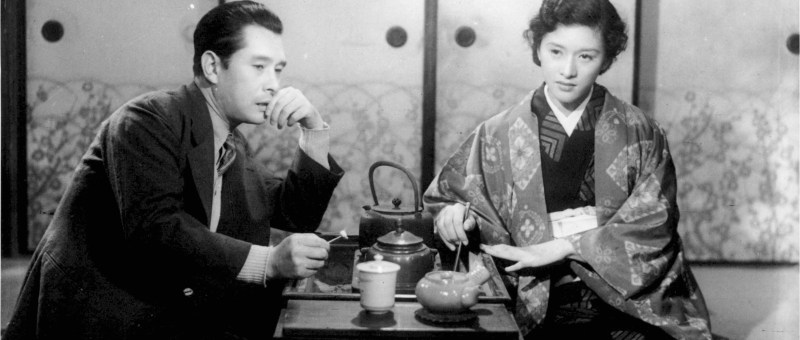
One of a series of films about marriage and originally envisaged as a sequel to Repast until Setsuko Hara fell ill, Husband and Wife (夫婦, Fufu) paints a rather bleak picture of married life even by Naruse’s standards. The couple are quite literally but also spiritually “homeless” in that they cannot find a home to share, while the absence of a domestic space to call their own prevents them from solidifying their marriage. They’re pushed out of Kikuko’s parents’ home because her brother’s getting married and they need the space, but Isaku drags his feet over finding somewhere else and leaves much of the legwork to Kikuko alone. The main problem seems to be that Isaku can’t afford anything decent, which places a strain on his male pride, but in a repeated motif, rather than confront the situation, he ignores it completely and then crassly presses his recently widowed colleague to let them rent a room in his now much emptier house. 

It’s a mystery why Isaku has so many financial problems when he and Takemura (Rentaro Mikuni) work for the same company, save that Isaku had evidently spent some time working in the provinces, and his colleague had already bought a home with no apparent money worries, but it further sets the two men apart and fuels Isaku’s sense of inadequacy. Having returned from a leave of absence following his wife’s death, Takemura is grief-stricken and apparently uxorious. He complains that he’ll never find another woman like his late wife, all while Isaku won’t shut up about the house and others relentlessly encourage him to remarry. Nevertheless, after the couple move in with him, a natural connection arises between Kikuko and Takemura who is Isaku’s total opposite, both in his treatment of Kikuko and general personality. Where Isaku is sullen and resentful, Takemura is cheerful despite his grief and generous of spirit. Kikuko effectively becomes a wife to both men, taking care of each of them by cooking and cleaning, but while Takemura goes out of his way to thank her, all Isaku does is run her down and humiliate her in front of company.

Then again, having fallen in love with Kikuko precisely because she is a “proper wife,” Takemura then runs his own late wife down by complaining that she wasn’t very pretty and couldn’t cook. The only thing she had going for her was her health, and then she died. He says got a bum deal, and that Kikuko has shown him a different side of womanhood. When two colleagues come to the house and compliment Kikuko’s cooking but are surprised when she eats nothing herself (because they have no money), Isaku responds to their assertion that it’s difficult to be a housewife by replying that men work hard all day while women “only” have to look after the house. For her part, Kikuko says that she was happier when she was working. Men can fall in love several times, but once a woman’s married her romantic life is over. As her friend tells her, men soon get bored of their wives and hers has already taken a mistress at work. 

At several points and with the women in earshot, the men warn each other about the pitfalls of marriage. Irritated that Kikuko has returned to their home on New Year’s Eve after becoming fed up with Isaku, her father advises her brother that women show their true faces after six or seven years and it’s going to horrify him. Isaku tells him not to be too nice or obedient during the early days because his wife will get used to it, while Kikuko counters that men are overgrown children and as long as you make sure to cradle them like babies everything will be fine. Neither of them seem to have a very positive idea of what marriage should be and frame it almost in terms of a war in which they are continually at odds with each other. Isaku describes a husband and wife as a pair of scissors, intending it as a positive metaphor about how one half can’t cut alone, before reframing it as two knives coming together. He becomes unpleasant and chauvinistic, blaming Kikuko for everything by complaining that it’s her fault that he wears a torn up old coat that causes him some embarrassment in front of his boss and a tactless geisha, while criticising her for not having the bath ready when he comes home tired from working all day. Kikuko points out that men seem to assume they’re the only ones who get tired while her loved up brother swears he’ll be different and even if they’re in the honeymoon phase, they do seem much happier and more suited than the already resentful Kikuko and Isaku.

It’s the sister-in-law who throws them a lifeline by introducing them to a relative looking to rent a vacant room, allowing them a means to save their marriage by leaving Takemura’s house. Increasingly resentful of the growing attachment between Kikuko and Takemura, Isaku starts avoiding coming home and hanging out with a young woman at the office with, at least, the danger of a burgeoning affair for which he’s taken to task by Takemura. As Takemura says, it’s not much of a marriage if Isaku can’t trust his wife while Kikuko is eventually so sick of the cold shoulder and constant denigration that she considers leaving him. The new apartment finally gives them a domestic space they can call their own, but it comes with the caveat. The landlady doesn’t allow children because the tenant next door is an ikebana teacher who demands peace and quiet, but Kikuko is in fact already pregnant which might present another means of saving their marriage by becoming a family but Isaku immediately rejects it. He complains he doesn’t have any more money to move again and tells Kikuko to get an abortion, strong-arming her when she refuses. Kikuko can’t go through with it and the nicest thing Isaku says to her in the entire picture is that they can go home, he’s giving in and will raise the child even if it’s difficult. But even this bittersweet moment seems more like condemning them to marriage rather than repairing their relationship with Isaku only grudgingly accepting, most likely because he realises that his marriage is dead anyway if he forces Kikuko to give up their child against her wishes. Despite the changing season, the air between them remains frosty, and marriage is exposed for the prison that it is trapping each of them in loneliness and resentment rather than bringing them together in joy as they prepare to become a family rather than just husband and wife.


Husband and Wife  screened at Japan Society New York as part of Mikio Naruse: The World Betrays Us – Part I.

365 Nights (三百六十五夜, Kon Ichikawa, 1948)

For his second film at Shintoho, Kon Ichikawa had wanted to adapt a story by Ryunosuke Akutagawa that later inspired Rashomon, but was handed a standard melodrama to direct first. Ichikawa apparently did not think much of the novel the film was to be based on nor the script by Kennosuke Tateoka which he subsequently brushed up with the help of his new wife Natto Wada, and it’s not difficult to see why he might have felt he had an uphill battle. Melodrama is after all a genre that is founded on coincidence, though 365 Nights (三百六十五夜, Sambyaku-rokujugo ya) quickly strains credulity with the sheer number of unlikely events and surprise reappearances along with its rather strange take on the contemporary post-war society which is undoubtedly influenced by the demands of the Occupation censorship regime. 

Indeed, the setting itself seems reminiscent of 1930s cinema following the dashing hero Koroku, played by the equally dashing Ken Uehara, an architect who has walked away from his privileged upbringing as the son of a successful construction magnate. His problem is that he’s being aggressively courted by the haughty Ranko (Hideko Takamine), also the daughter of a successful but shady businessman, who to modern eyes is basically stalking him. Grinning with an evil glint in her eye, she tells her minion Tsugawa (Yuji Hori) that she’ll have seduced Koroku within 365 days which by melodrama standards seems to give her quite a lot of leeway.

Clueing us up to her villainy, Ranko is always seen wearing incredibly stylish Western outfits but otherwise behaves in a transgressively masculine fashion ordering her male employees about while set on the sexual conquest of Koroku who despises her for everything she is. It’s difficult not to see an inherent criticism of the new post-war woman and an anxiety regarding the power that comes with wealth being wielded by someone who is not a man. The contrast between Ranko and traditional femininity is rammed home by the fact that Teruko (Hisako Yamane), the daughter of the landlady in the house where Koroku finds new lodging after moving home to escape Ranko, is always dressed in kimono and otherwise naive and innocent. 

This positions Ranko, and her minion Tsugawa who is also in love with her, as the villains who are rebelling against the kind of earnestness expressed by Koroku and Teruko. From more humble origins, Tsugawa is deeply resentful of Kokoku’s class privilege and feels that he looks down on him which is one reason he seeks revenge by destroying his life along with his sexual jealously that Ranko pays him no attention yet is fixated on Kokoku perhaps precisely because he is entirely uninterested in her though it remains mystery why you’d want to be married to someone who strongly dislikes you. 

Yet for all his own earnestness, Koroku is almost betrayed by the capitalist father of whom he also seems to disapprove when he asks him to consent to an arranged marriage with Ranko to save his business. Meanwhile, it also transpires that Teruko’s father has been absent from her life because he two has a criminal past further tainting the legacy each of them bear. Ichikawa stages each evolution of their relationship at the same, noirish street corner that seems to exist as a kind of border between the illicit underworld that seeps out from Tsugawa’s bar into the post-war society, and the geniality represented by Teruko’s otherwise nice, middle-class home. 

It’s the this transgressive quality, of being caught between these two worlds, that starts to eat away at Koroku leaving him a broken and shabby man little better than a tramp. In a break with melodrama norms, though he is aware that he has led Teruko into Tsugawa’s trap he comes to believe that she has betrayed him while she clings fiercely to her love and in the end attempts to sacrifice it basically giving Koroku to Ranko whom she believes can better care for him in his now corrupted state. Though events become grim with a wedding that is staged like a funeral and takes place at a death bed, there is also the sense that something must come right that seems a little incongruous and perhaps a concession to the censors board as may be the coda implying that Ranko, despite having undergone a kind of redemption, will also have to pay for all her dodgy dealings. Though clearly hampered by the material, Ichikawa crafts some stunning images such as the final scene at Tsugawa’s bar along with a surprisingly energetic action sequence during which Koroku fights off burglars at Teruko’s home and wins her heart with his manliness. In any case despite the hints at redemption the implication remains that this is a world dark at its core in which not even the earnest can escape its creeping corruption. 


Ghost Cat of Nabeshima (鍋島怪猫伝, Kunio Watanabe, 1949)

When is a ghost cat not a ghost cat? Drawing inspiration from classic folklore and kabuki theatre, the ghost cat movie had been a popular genre of pre-war cinema yet thereafter fell out of favour before a brief resurgence in the 50s and 60s. Inspired by the classic vampire cat legend, 1949’s Ghost Cat of Nabeshima (鍋島怪猫伝, Nabeshima Kaibyo-den) was part of a wave of post-war kaibyo yet in a slightly meta touch features no actual “ghost cat” leveraging instead the superstitious fear of their existence along with a mild prejudice towards otherwise supernaturally cute kitties. 

Set in the feudal era, the central drama revolves around a weakened lord, a supposedly cursed Go board, and local hysteria about a dangerous ghost cat lurking round the palace that has the townspeople nervous enough to have organised a patrol on the look out for suspicious-looking felines. A store owner has recently taken in an ornate Go board which has sent his wife into a minor frenzy because it looks just like the one from the local temple which she knows to be haunted by the vengeful spirit of a man who was killed during a dispute over a particularly heated game. As such, she pushes him to sell it as quickly as possible which he does to a lower level samurai whose gaming companion is so weirded out by the bad vibes emanating from the board that he gives it away to villainous retainer Tanuma (Ureo Egawa). Tanuma then gifts it to the rather effete lord ignoring the advice of his noble rival Komori (Denjiro Okochi) that Go is bad for the lord’s health both mental and physical. 

Komori may in a sense be proved right when, lacking a companion, the lord decides to summon Matashichiro (Haruo Tanaka) who is reputed to be a good player. Matashichiro is something of a Go obsessive and had been planning to leave for Edo in order to train with a true master partly it seems because he is carrying a chip on his shoulder as his family has been reduced in circumstances leaving him with few opportunities. On seeing the board, however, he appears to have something of an episode repeating the earlier tragedy in insisting the lord is playing “unfairly” before starting a fight during which the lord accidentally kills him, Matashichiro’s adorable black kitten Kuro leaving tiny bloody footprints as he scuttles away to relative safety glaring at the lord as he goes.

The lord thereafter develops an intense fear of cats, half-believing Kuro has become a bakeneko out to get him. All of this plays directly into the hands of Tanuma who is secretly plotting against the lord and hopes to capitalise on the ghost cat rumours while simultaneously making the lord seem mad in order to usurp and manipulate him. Tanuma had rejected concern over the cursed nature of the board insisting that “supernatural things don’t exist” while suggesting “weak government” is the reason such rumours were allowed to arise in the first place though it later becomes clear he too is manipulating them later sending out one of his minions in a ghost cat outfit with the instruction to cause trouble to keep the townspeople afraid. Komori, meanwhile, the good samurai later reminds the lord that he brought some of this on himself in his selfishness, failing to properly care for his subjects such as the rebellious Sanpei (Yataro Kurokawa) who openly disparages him while encouraging a peasant revolt in the face of samurai indifference. 

In this, there is perhaps a message for the immediate post-war world in the peasants’ frequent mistaken assertion that greed is good and a necessary tool for survival, Sanpei and the others half-heartedly taking part in a cat cull ordered by the increasingly paranoid lord which creates further animosity towards the samurai authorities from local people who love their cats and won’t stand for their beloved pets being sold off and killed because of a bizarre rumour about a vengeful feline spirit. One of the reasons cited for the decline in popularity of the ghost cat film is that post-war audiences simply no longer took such things seriously and some of that flippancy is indeed seen in the attitudes of some of the townspeople who are quick to dismiss such ridiculous superstition. Yet there are ghostly apparitions only they’re very much human if perhaps mildly linked to feline activity, a dishevelled Matashichiro appearing in front of the lord to remind him of his crime while Tanuma does his best to cover it up. Here more than most, there’s a heavy implication that the spirits of the deceased are mere hallucinations of a guilty mind, but could the Go board really be responsible, it did provoke a violent rage in the otherwise dejected Matashichiro after all?

Then again, when the townspeople regain it, they realise the Go board is just a Go board experiencing very few supernatural incidents despite having it in their possession for over two months and as any cat owner knows, footprints on the tatami are hardly an unusual occurrence. “Did anyone actually see the ghost that everyone was fussing about?” a woman asks to confused silence before someone jokingly points at Matashichiro’s former girlfriend Otoyo (Michiyo Kogure) now guardian to the adorable Kuro looking like butter wound’t melt. Order has in any case been restored, the disruptive Tanuma’s schemes unmasked, the lord reminded of his proper responsibilities whether by supernatural intervention or not, and the townspeople laying aside their “greed” while rediscovering a sense of mutual solidarity not to mention affection for their feline companions. Playful to the last, Watanabe closes with a handheld zoom into the cute kitten sitting innocently atop the cursed board while the drunken townsmen snooze all around him in ominous tranquility. 


Mother (おかあさん, Mikio Naruse, 1952)

The hahamono or mother movie is a mainstay of post-war cinema, obsessed as it is with self-sacrificing maternity. Mikio Naruse, however, is not a name you’d expect to see associating itself with the genre and his 1952 film Mother (おかあさん, Okaasan), adapted from a child’s essay, is indeed subtly subversive, transgressively questioning the institution of motherhood itself while ostensibly remaining faithful to genre norms even as it makes an accidental villain of its teenage heroine who closes the film plaintively praying for her mother’s happiness having not so long ago shut down perhaps her only real hope of achieving it. 

The Fukuhara family ran a successful laundry before the war, but these days father Ryosuke (Masao Mishima) works at a factory and is nicknamed Papa Popeye by his kids because of his finely tuned muscles born of a lifetime training the iron. Matriarch Masako (Kinuyo Tanaka) and 18-year-old daughter Toshiko (Kyoko Kagawa), our narrator, help the family finances by running street food stalls, while oldest son Susumu (Akihiko Katayama) has become ill with a lung complaint caused by poor conditions at the wool factory where he was working. In addition to youngest daughter Chako who is still in school, the family has also taken in little Tetsu (Takashi Ito) the son of Masako’s sister Noriko (Chieko Nakakita) who is now a widow recently repatriated from Manchuria. 

Like many films of the occupation period, the family at the centre of Mother is determined to rebuild, pinning all their hopes on being able to renovate their home in order to be able to reopen the laundry. The war is very much a background presence but its influence is still deeply felt not least in the ruins and devastation glimpsed around the house and the constant references to loss and widowhood which seem to plague Masako, so many women having lost sons and husbands in the conflict. The tragedy is that Masako will eventually in one sense or another lose all her children by the end of the picture, Susumu succumbing to his illness after having discharged himself from hospital out of guilt and loneliness missing his mother, Chako eventually taken in by wealthier relatives who lost their son in the war, Tetsu soon to be retrieved by his mother, and Toshiko herself clearly heading towards marriage with the cheerful and surprisingly progressive baker Shinjiro (Eiji Okada) with whom she has become close. 

Perhaps surprisingly Toshiko seems remarkably immature for her age, her voiceover taken as it is from a child’s essay has a slightly stilted quality that nevertheless makes plain her poor grasp of the adult world and most particularly the reality of her mother’s life. Masako later tells us that she started working at 14 and continued until she married at not so much older than Toshiko is now despite later stating that Toshiko is too young to marry only to find her self shocked when confronted by the sight of her in a wedding dress stifling a brief wave of despair that her daughter may soon be a wife. Originally complaining about not being able to take dressmaking classes like some of the other girls, Toshiko belatedly swears to help support the family firstly to prevent Chako going to stay with relatives and secondly because her boyfriend inadvertently gives her the impression there’s truth in a local rumour that her mother plans to remarry following her husband’s death from overwork and poverty with a friend of their father’s who’s been helping them out in the shop, “Uncle POW” Mr. Kimura (Daisuke Kato). 

Shinjiro is quick to tell her that she’s being unreasonable. In the modern world parents shouldn’t be expected to sacrifice their personal desires for their children, her mother is also a woman and has the right to pursue happiness in marrying again if she chooses. On the other hand, there is nothing particularly concrete between Masako and Mr. Kimura besides a genial domesticity, the rumour is partly local wishful thinking in knowing that remarriage is sensible economic choice and the pair seem well suited. Toshiko objects strongly to the idea out of fear, jealousy, and outdated moralising resenting her mother for betraying her father’s memory but also fearing further changes in her familial relationships in an already uncertain world. 

In this her otherwise saccharine closing monologue in which she looks on as her mother plays with Tetsu and wonders if she’s really “happy” achieves its final irony, transgressively undercutting the primacy of the self-sacrificing mother to question the ideology of motherhood itself when it requires women to sacrifice their lives and desires in service of an ideal of “family”. Nevertheless, Mother is among the most ostensibly cheerful of Narusean dramas in the gentle comedy and naturalistic depiction of a warm and loving family committed to compassion, kindness, and mutual support as pathways towards a better post-war future.  


Mother is currently available to stream in the US via Criterion Channel

Mr. Shosuke Ohara (小原庄助さん, AKA Ohara Shosuke-san, Hiroshi Shimizu, 1949)

vlcsnap-2016-09-25-01h34m07s636Ohara Shousuke-san (小原庄助さん) is the name of a character from a popular folk song intended to teach children how not to live their lives. The Ohara Shosuke-san of Aizu Bandaisan has lost all his fortune but no one feels very sorry for him because it’s his own fault – he spent his days in idleness, drinking, sleeping in, and bathing in the morning. The central character of Hiroshi Shimizu’s 1937 film has earned this nickname for himself because he also enjoys a drink or too and doesn’t actually do very much else, but unlike the character in the song this a goodhearted man much loved by the community because he’s a soft touch and just can’t refuse when asked for a favour. An acknowledgement of the changing times, Shimizu’s Mr. Shousuke Ohara is a tribute to the soft hearted but also an argument for action over passivity.

If you turn up one day and ask for directions to the Sugimoto household, everyone will look at you with confusion but if you ask for Mr. Shousuke Ohara everyone will gladly walk you over and introduce you. Saheita Sugimoto (Denjiro Okochi) is the head of a once proud samurai household but his fortunes are far from those of his ancestors. Despite his pecuniary difficulties, Sugimoto is good hearted man who wants to help everyone that he can (out of a sense of altruism rather than duty or vanity). Consequently he is deeply in debt and nearing bankruptcy yet he can’t give up any of his three vices – drinking, gambling, and generosity.

The nature of the changing times is at the centre of this 1949 film. As Sugimoto is fond of telling people, his noble house used to stand for something but all of that historical influence is next to meaningless now. Though Western dress is not uncommon, the village is pretty much as it’s always been – children play in the fields and Sugimoto travels everywhere by donkey. Other than the tale of Sugimoto’s fall from grace, the central narrative concerns an election for a new village chief. Yoshida, a youngish man, wants Sugimoto’s support for his election campaign. His main campaign policy is modernisation – the introduction of electricity, modern transportation and communications, as well as greater cultural involvement starting with opening Western style ballroom dance classes for the children. Unfortunately his policies are not that firm and his motto seems to be “I’ll do that first!” to all aspects of his plan which is not very encouraging but still the desire is very much to move away from old fashioned village life towards a more sophisticated urbanism.

This of course also means an end to the inherited influence of idle nobleman such as Sugimoto. Though he’s a kind man who likes nothing other than helping other people, Sugimoto has been a passive steward, more consumed with his own idle pursuits than with making an active attempt at leading the village. This passivity has contributed to his downfall as he’s neglected the business of maintaining his own fortune. After taking out numerous loans which he only ever uses to help the villagers, Sugimoto has let the estate which ancestors founded, and which he was supposed to look after in the names of all that have gone before and all were to come after him, slip away. The ultimate failure and a disgrace to his ancestors, this loss of the ancestral home is an unforgivable betrayal yet there is something in Sugimoto which seems to regard it as right and proper that it should go.

Change is coming to the village, even if it isn’t coming with the speed that a young man like Yoshida may be hoping for. Change is also coming to Japan which is in the progress of rebuilding itself anew following long years of folly followed by confusion. There is no room for genial idleness anymore. “If you can work honestly with your hands you can make a living”, Sugimoto tells two would-be-burglars that he invites in for a drink as a apology for not having anything left for them to steal, but means the advice more for himself than anyone else. It’s time to say goodbye to Shousuke Ohara and the burden of inherited privilege and chart a new course as Seihata Sugimoto. Finishing on another of Shimizu’s much loved road shots, Sugimoto, like his nation, walks confidently along the road to an uncertain future yet he is not alone as he goes and may make something of himself yet.