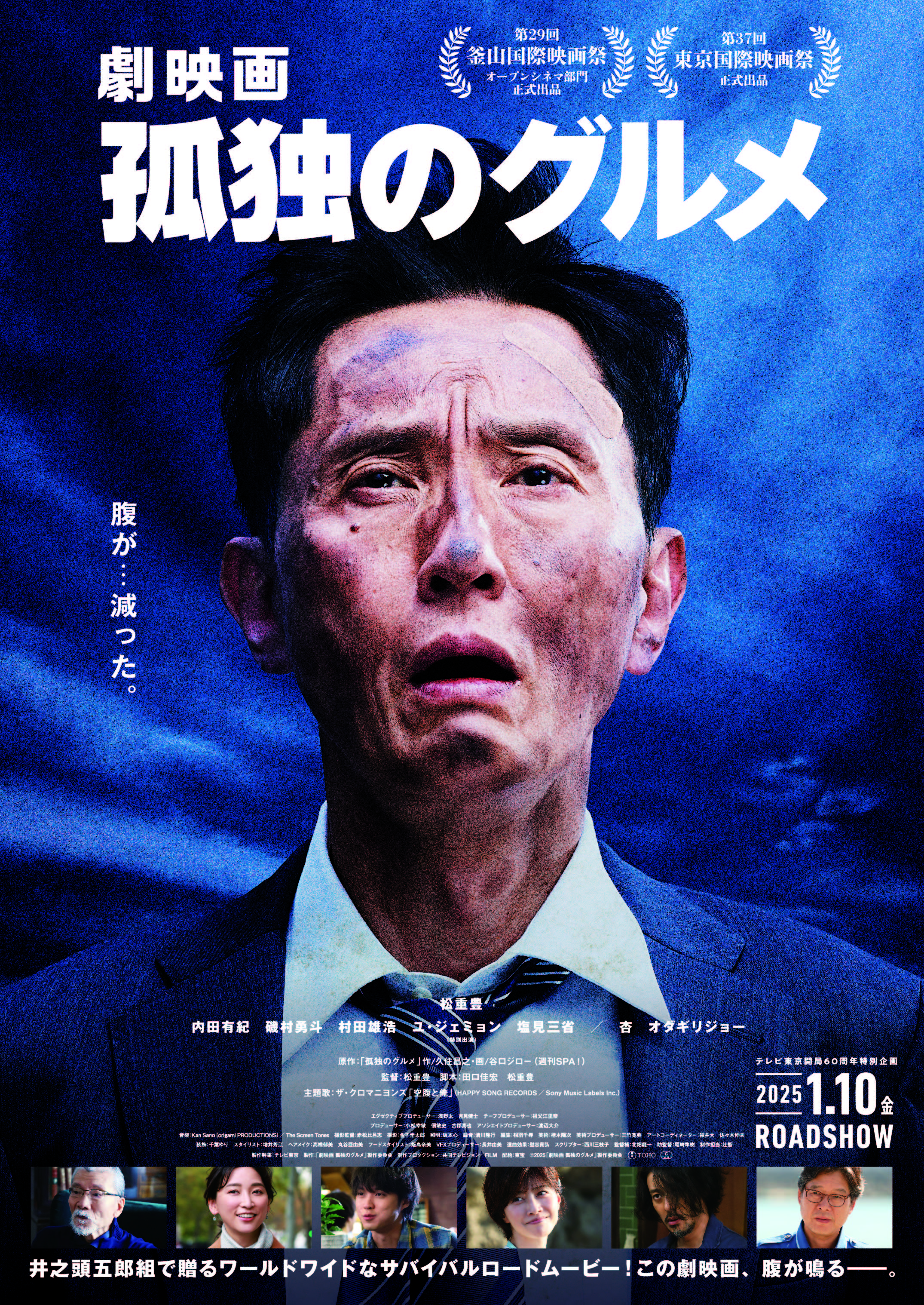
The Solitary Gourmet (劇映画 孤独のグルメ, Yutaka Matsushige, 2024)

Isn’t it funny how a good bowl of soup can make everything better? Based on the manga written by Masayuki Qusumi and illustrated by Jiro Taniguchi, the feature-length edition of the long-running series has a distinctly soupy feel as salaryman Goro (Yutaka Matsushige) finds himself travelling Japan and abroad in search for the ingredients of a soup an old man ate as a child. Airing since 2012, The Solitary Gourmet TV series was a trendsetter for Japanese comfort foodie cinema and has given rise to several other similarly themed shows in which the protagonist visits a real life establishment and enjoys whatever they have to offer from food to sake, sweets, and even traditional bathhouses.

In fact, there’s even a meta joke towards the end of Solitary Gourmet (劇映画 孤独のグルメ, Geki Eiga: Kodoku no Gourmet) in which one of the restaurants Goro goes to is featured in a show about a foodie salaryman while he plays a fellow customer. The newly international setting reflects the increased budget of a theatrical feature and also helps to expand the series’ episodic format in leading Goro on a crazy chase that begins with the daughter of an old friend in Paris (Anne Watanabe) who enlists him to hunt down the ingredients for her grandfather’s cherished soup. Of course, this provides an excuse for Goro to go to the remote Goto Islands and learn about the local cuisine while running around collecting random samples like he’s on a side quest in an RPG. 

Then again, it also offers him the chance for some surreal adventures, including getting cast away on an uninhabited island before being rescued by the Korean-speaking residents of a food research institute. It’s there that he meets Shiho (Yuki Uchida), a Japanese woman living on “an island for women who are fed up with men,” and a former restaurant worker retreating from a marriage fracturing under the pressures of trying to run a restaurant in the post-COVID society. When Goro later catches up with her husband (Joe Odagiri), he too is a depressed, broken figure who now only serves fried rice in his incredibly unwelcoming restaurant. But being talked into helping Goro recreate the old man’s beloved soup seems to reactivate his creative juices and give him the desire to get back on his feet. 

Star Yutaka Matsushige directing for the first time throws in a brief homage to Tampopo but what the film is most interested in is the universality and healing power of a tasty broth from the onion soup Goro eats in Paris to the Haejangguk, or hangover soup, that he orders in Korea while being watched over by an exasperated immigration officer (Yoo Jae-myung). That Goro’s quest takes him so far hints at the shared history of the two nations and the various culinary influences and universalities running between them with soup a means of healing and friendship. Exchanging a few words of Korean, Goro tries to ask what the name of the fish in his soup is, only to come to an understanding when the immigration officer writes it down for him in Chinese characters. 

All this food really does bring people together, as Goro gets pretty much everyone he meets roped into his quest to recreate the old man’s childhood dish as his deathbed request. Matsushige recreates the zany humour of the TV series including his familiar “I’m hungry” catchphrase, followed by the camera taking three steps back and picturing Goro in front of some notable landmark. He also doesn’t seem to be getting much work done while running around trying to figure out this soup even he’s never actually tasted it and is reliant on the old man’s fragile recollections. Goro had been in Paris to deliver a painting of somewhere he once lived and the old man remarked that photographs are records of time but painting turns them into memories. Food, or more specifically soup, might do something similar, at least according to the old man who is desperately trying to reclaim something of the home comforts of his youth. Of course, the old man is the only one who knows what the soup tastes like, so perhaps Goro is on a fool’s errand, but as he later says, soup does seem to be the water of life and thanks to its healing qualities a universal symbol of peace and harmony not to mention friendship and kindness.


The Solitary Gourmet screens 29th May as part of this year’s Nippon Connection.

Trailer (English subtitles)

Images: ©2025 “Solitary Gourmet” Film Partners
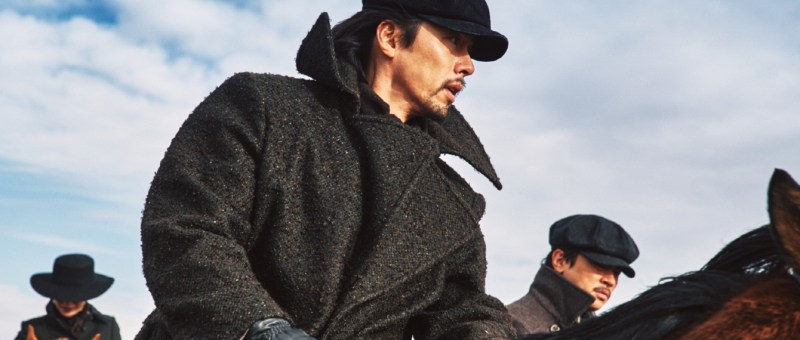
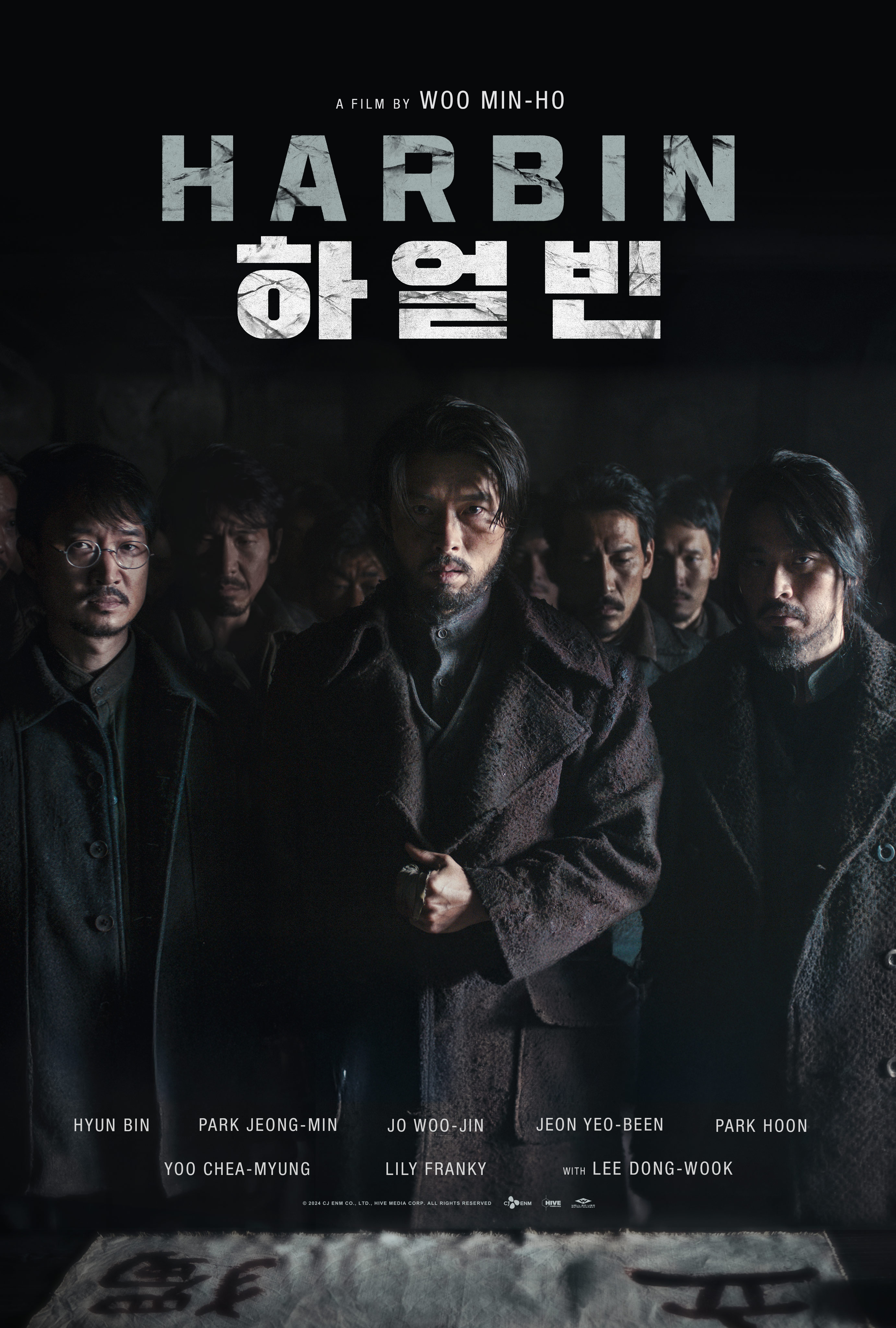
Harbin (하얼빈, Woo Min-ho, 2024)

Ahn Jung-geun is one of the most well-known figures of modern Korean history and his story has indeed been dramatised several times before, but what’s unusual about Woo Min-ho’s espionage thriller Harbin (하얼빈) is the way it tries to sublimate Jung-geun the individual in favour of making him an emblem of the common man. As such, the film is more egalitarian than might be assumed and ultimately praises the integrity and resilience of the Korean people who save their country and their culture in a more spiritual than literal sense.

Indeed, Ito Hirobumi (played by Japanese actor Lily Franky), former prime minister of Japan and the first Resident General of Korea after it became a Japanese protectorate, remarks that he has always been sceptical of the annexation because though they have been ruled by “foolish kings and corrupt officials” the Korean people will continue to be a thorn in his side. Toyotomi Hideyoshi’s attempt to invade Korea was defeated by a volunteer army and a charismatic admiral, Yi Sun-sin. Then again, a Japanese soldier remarks that it will be difficult to find such a hero in the Korea of today, a pointed comment that implies Ahn Jung-geun is just such a hero through the film skirts around the fact his assassination of Ito did not in the end prevent Korea’s annexation which was completed in 1910, while the Independence Movement did not succeed in liberating in Korea which regained its independence when the Japanese Empire collapsed at the end of the war and even then was subjected to a period of occupation by US forces before its sovereignty was restored. 

What Jung-geun becomes is a kind of torch bearer for another Korea serving as a moral compass and preventing those around him from becoming just as bad as the Japanese whose cruelty they resist. As the film opens, Jung-geun’s comrades are awaiting his return after going missing following a disastrous encounter with Japanese forces. Despite having won the initial battle while heavily outnumbered, Jung-geun’s decision to release the Japanese commander, Mori (Park Hoon), as a prisoner of war results in a counterstrike in which his forces are all but wiped out. His comrades had been against the decision and now doubt his abilities and judgement along with a new suspicion that should he return he may have been captured and turned by the Japanese to spy on them. But Jung-geun’s decision signals his righteousness and refusal to give in to the cruelties of war. He releases Mori because it is the right thing to do. Executing prisoners of war is immoral by commonly held standards of war, and he pities Mori as a husband and father. He perhaps also hopes that it is a gesture of good will that shows him the Independence fighters are just and reasonable. 

But just and reasonable the Japanese are not, and so Mori betrays his trust. Deluded by the death cult of militarism, Mori is humiliated by Jung-geun’s magnanimity which is after all a show of power and that he has overturned the dynamics by granting Mori his life. Mori asks to die as as loyal soldier of Japan by committing ritual suicide but is denied in this both by Jung-geun who tells him he must live and by Chang-sup (Lee Dong-wook) who wants to execute him. This deep sense of humiliation and shame in remaining alive after defeat spurs Mori into a personal vendetta against Jung-geun to reclaim his honour and that of Japan which leaves him almost indifferent to Ito’s fate though nominally in charge of preventing his assassination at the hands of Jung-geun. Jung-geun is also trying to redeem himself for the loss of his men’s lives and has in a sense declared himself already dead in that he lives only for the souls of dead men and has embarked on what is in effect a suicide mission to kill “the old wolf” as a means of atonement and the eventual liberation of his country. 

But then his comrades are already weary and some are already beginning to ask themselves if it’s really worth it. How many more men will have to die before they win their freedom? Sang-hyun (Lee Dong-wook) laments that if the Japanese write their history, his name will be forgotten and he will have left no mark upon the world. They are grieving what they’ve lost in more personal terms aside from their lost nation. In order to get the dynamite to blow up Ito as a backup plan, the gang have to make contact with a former comrade who has since abandoned the cause to become a bandit (Jung Woo-sung). Having lost his eye and his brother, who was also the husband of another committed revolutionary Ms. Gong (Jeon Yeo-been), he decided it wasn’t worth it anymore and chose a different kind of freedom. “If we all die like dogs, no one will remember us,” Sang-hyun later laments. But Jung-geun, who will be remembered, is less concerned with his legacy insisting that even those who may have betrayed them should be given a second chance for they will eventually see the light. Like Ito, he believes in the Korean people and that they will come together to carry the light into the darkness. 

What he does is light the way, and as the closing scenes imply pass the torch to others who will each keep it alight until the dawn of liberation. Nevertheless, Jung-geun does have an unfortunate habit of getting those around him killed while the horror of the battle scenes, the grimness of decapitated and limbless bodies along with the constant sense of loss and defeat seem to imply that perhaps it isn’t worth fighting in this way lending further justification to Jung-geun’s conviction that taking out the leadership is the only way to turn the tide of this war of attrition. In sacrificing his own life, he becomes a kind of martyr, wearing traditional Korean white clothing as he goes to his death knowing that others will come after him. Rich with period detail and tense in its sense of intrigue, the film ultimately argues for a more compassionate sense of revolution governed by righteousness in opposition to the rather cynical justifications made by Ito for the cruelties of Japanese imperialism.


Harbin is released in the US on on 4K Ultra HD, Blu-ray™ and DVD courtesy of Well Go USA.

International trailer (English subtitles)

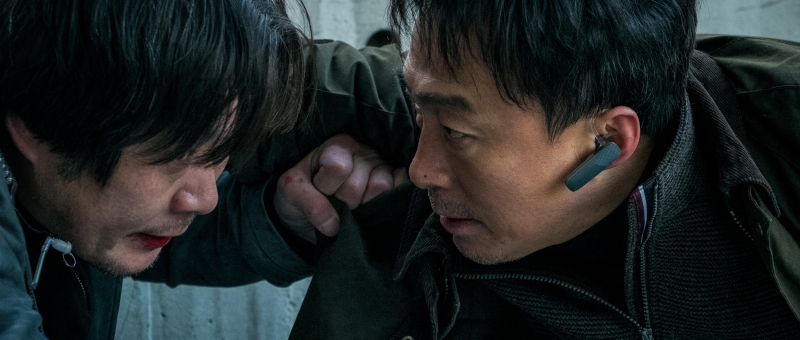
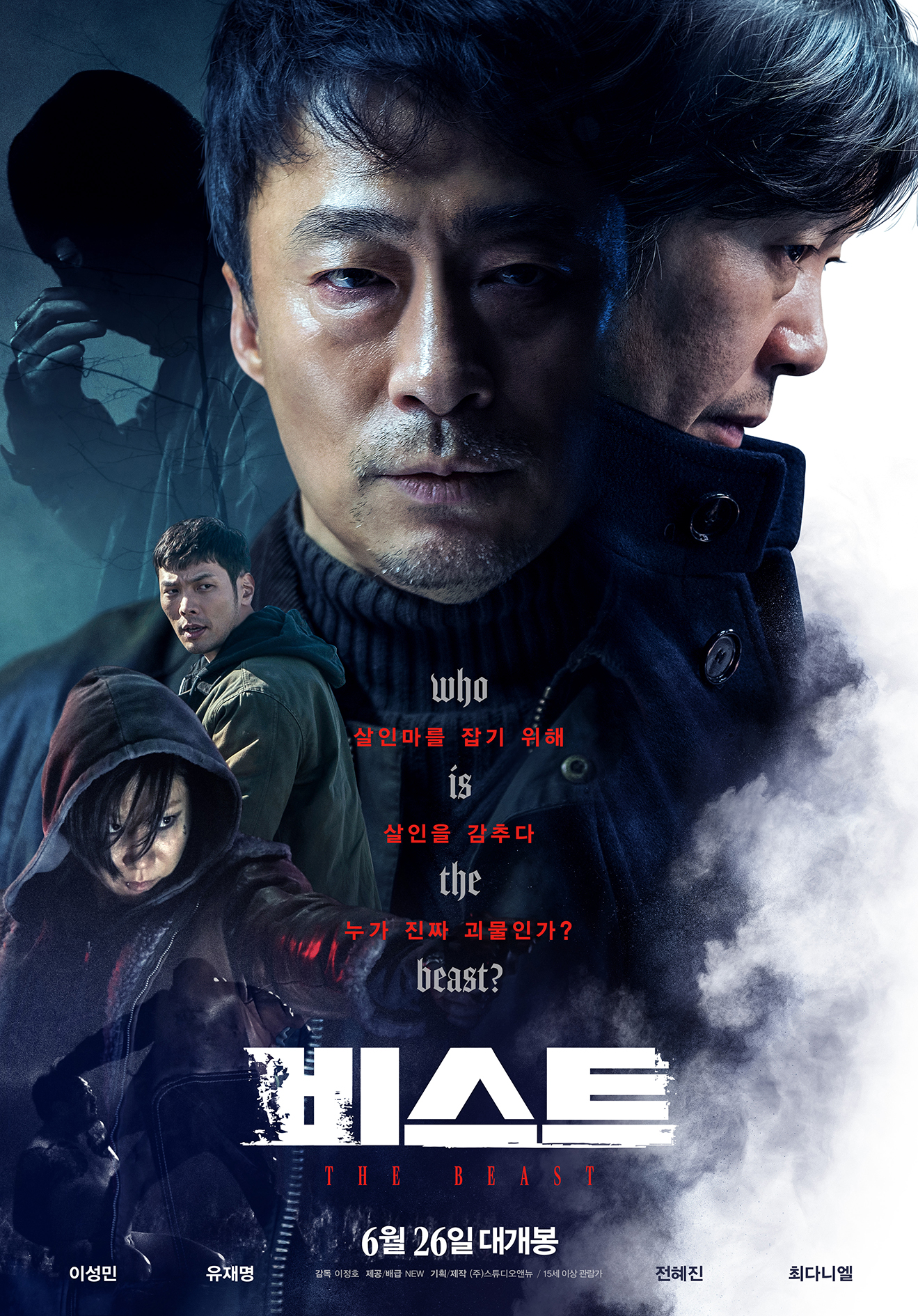
The Beast (비스트, Lee Jung-ho, 2019)

Internal police politics frustrate the hunt for a potential serial killer in Lee Jung-ho’s dark social thriller, The Beast (비스트) inspired by Oliver Marchal’s 36 Quai des Orfèvres. As a pathologist suggests, we all may have a hidden beast and it’s certainly true of the film’s conflicted protagonist, thuggish policeman Inspector Jung (Lee Sung-Min) who finds himself dragged ever deeper into a mire of corruption as a natural result of a series of bad decisions that started long ago, while his rival, Captain Han (Yoo Jae-Myung), presents the facade of efficient modern policing but inevitably turns out to be little better. 

As the film opens, Jung and his subordinate Yang are each wearing balaclavas while driving a heavily tattooed man out into the middle of nowhere though only for the purposes of frightening him so that he’ll back off their informant, local bar owner Madame Oh (Kim Ho-jung). Jung’s inner conflict is palpable as stares at his bloodied, shaking hands asking himself how it is it’s come to this while Yang later reminds him not to become too attached to his sources because once they’ve exceeded their usefulness they’ll simply be arrested. While all of this is going on, the police force is under immense pressure and receiving a lot of negative press over their handling of the case of a missing teenage girl, Mi-jin. Unfortunately, the girl later turns up dead with the murder enquiry split between two teams, those of Jung and Han each of whom are in the running to take over from the superintendent who before all of this happened was about to be promoted which is why he is desperate to solve the case as soon as possible. 

It might at first be tempting to read Jung and Han as representatives of different kinds of policing with their rivalry representing a battle for the soul of the police force only as it turns out each is merely corrupt in their own way. Jung is very much of the jaded veteran cop school, wanting to shift the case off his books as soon as possible by pushing the most likely suspect to confess. In this case that’s a shady pastor at a church Mi-jin used to frequent who was found in possession of her underwear and a series of photos of very young girls. Jung pushes the pastor to “confess” by selling him a story that a woman he was accused of assaulting in university took her own life as did her mother while her father later developed cancer as a result of all the stress and tragedy. Of course the pastor breaks down insisting that he killed her and it’s all his fault, only he’s talking about the other girl not that Jung cares too much about that. Han meanwhile quickly exonerates him by doing actual investigating, but only really so that he’ll still be in the running to solve the case and get the big promotion thereby besting his former partner turned rival. Jung had been the first to mention the possibility of an active serial killer only to be shut down because that would mean they’d lose the case to Major Crimes and therefore the personal opportunities for career advancement solving it would present. 

Both men eventually end up at the showdown by each of their respective routes implying there’s little practical difference between them. Han jeers that he can’t tell anymore if Jung is a bad guy or a cop but all he can answer is that it might be a matter of perspective, while he is also aware of Han’s backdoor deals and willingness to compromise himself in order to win advancement. In the midst of all this jockeying for power, it gets forgotten that a young woman lost her life in the most heinous of ways while whoever really did it may still be out there looking for the next girl to torture and kill. Everyone may indeed have a beast inside them, Jung already acquainted with his in his morally compromised soul while Han battles his internal ambition but the real beast may be the contemporary city and the infinitely corrupt hierarchies of the modern Korea along with the toxic masculinity that forces these men to betray their ideals simply not to be accounted a failure trapped at the bottom of the pyramid by their own problematic righteousness. When they’ve served their usefulness, the system chews them up and spits them out but until then it’s only hanging on as long as they can in the utter futility of a morally bankrupt existence. 


International trailer (English subtitles)

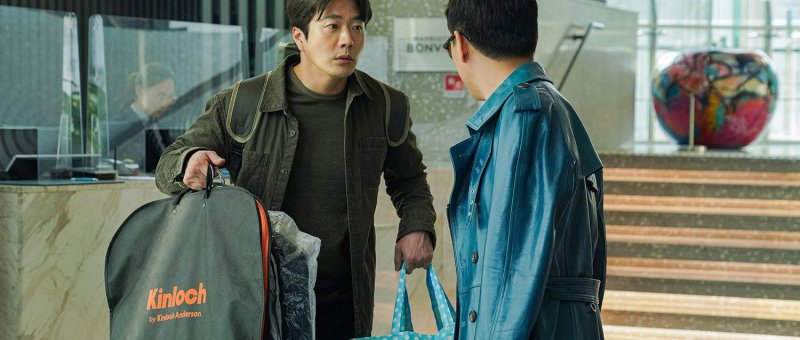
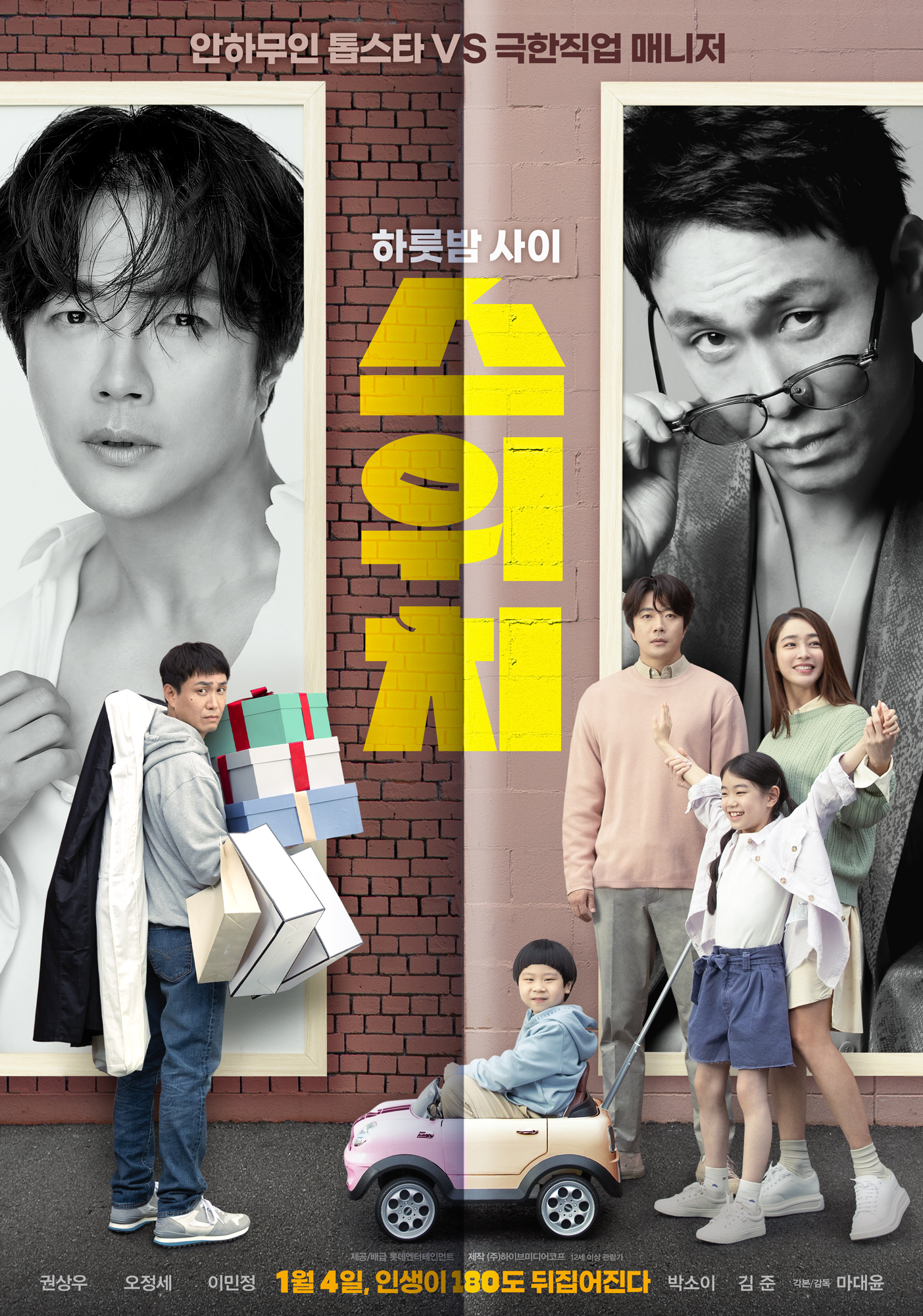
Switch (스위치, Ma Dae-yun, 2023)

An egotistical actor is given an unexpected lesson in what it is that makes life worth living when he’s suddenly transported to a parallel world in Ma Dae-yun’s charming Christmas dramedy, Switch (스위치). Rather than the body swap comedy the title might suggest, Ma’s warmhearted morality tale is a more a meditation on what might have been and may be again while contemplating the emptiness of a life of fame and riches when there’s no one to share it with. 

“What matters more than money?” top star Park Kang (Kwon Sang-Woo) chuckles after telling his manager he’ll accept a job he just described in quite insulting terms after being informed it comes with a hefty paycheque. Kang is currently riding high. He’s become enormously successful and even a recent sex scandal involving his co-star in a TV drama has only boosted his profile. Yet he tells his analyst that he can’t sleep and attributes it to “depression and anxiety”. He treats those around him poorly and most particularly his long suffering best friend from his fringe theatre days, Joe Yoon (Oh Jung-Se) who now works as his manager, while struggling to accept his loneliness and meditating on lost love in the memory of the woman he broke up with in order to chase stardom. 

After getting into a weird taxi one Christmas Eve, he’s suddenly granted the “wish” of getting to find out what would have happened if he’d made a different choice. After waking up in an unfamiliar house he discovers that he’s married with two children and slumming it fringe theatre while Joe Yoon is now the superstar having aced the audition Kang ran out on to chase Soo-hyun (Lee Min-Jung) to the airport and convince her not to leave. Of course, Kang is originally quite unhappy about all of this. He doesn’t understand why no one recognises him anymore and resents that he’s suddenly subject to the rules of “ordinary” people again after a decade as a pampered star. In his acceptance speech after winning an award, he’d stated his intention to “forget” his roots as a humble actor and embrace his new role as a member of the showbiz elite fully demonstrating his sense of alienation and insecurity along with his intense loneliness. As the taxi driver had said, Kang has “everything”. He’s achieved his dreams and lives the high life he’d always dreamed of, yet he’s deeply unhappy.

But his “new” life immediately challenges his sense of masculinity in realising that he has little power without money and is in fact financially dependent on Soo-hyun whom he may also have robbed of a bright future by preventing her from studying abroad and achieving success as an artist. Meanwhile he looks down on himself for continuing to follow his artistic dreams in fringe theatre when his plays attract few audiences members and make little money. Just as Joe Yoon had become his manager, so he ends up getting a taste of what it’s like trying to manage a “star” while coming to appreciate that Joe Yoon may be feeling just as lonely and unfulfilled as he once had. 

Yet even as Kang settles into his new life as a husband and father while slowly rebuilding his acting career though a combination of talent, supportive friendship, and good luck, he fails to learn the right lessons continuing to yearn for external validation through material success. He spends money on fancy dinners and tries to move the family into a swanky apartment in Seoul without realising that he’s already got a “home” in the quaint little provincial house he and Soo-hyun set up together filled with memories (that admittedly he doesn’t actually have) of the children when they were small. Slowly, he begins to look beyond himself while developing a new sense of security that means he doesn’t need to chase status-based affirmation in empty materialism but now has a new sense of what’s really important. A charming season morality tale with a little more than a hint of A Christmas Carol, Ma’s gentle drama never suggests that success itself is wrong or that Kang must give up his movie star persona to become a happy everyman but only insists that true happiness is brokered by treating others well and being treated well in return much more than it is by consumerist success.


Switch screens at UltraStar Cinemas Mission Valley April 22/24 as part of this year’s San Diego Asian Film Festival Spring Showcase.

International trailer (English subtitles)

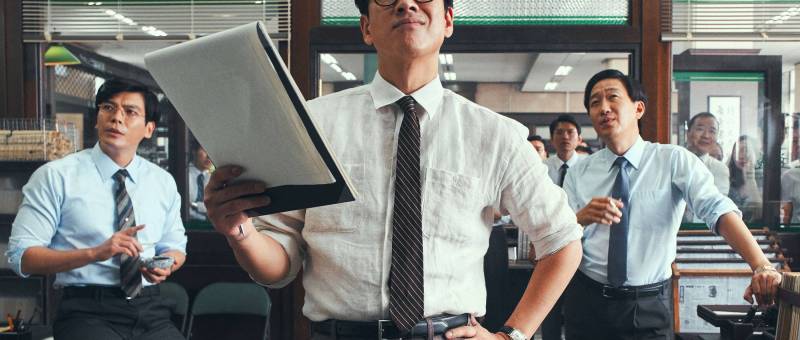
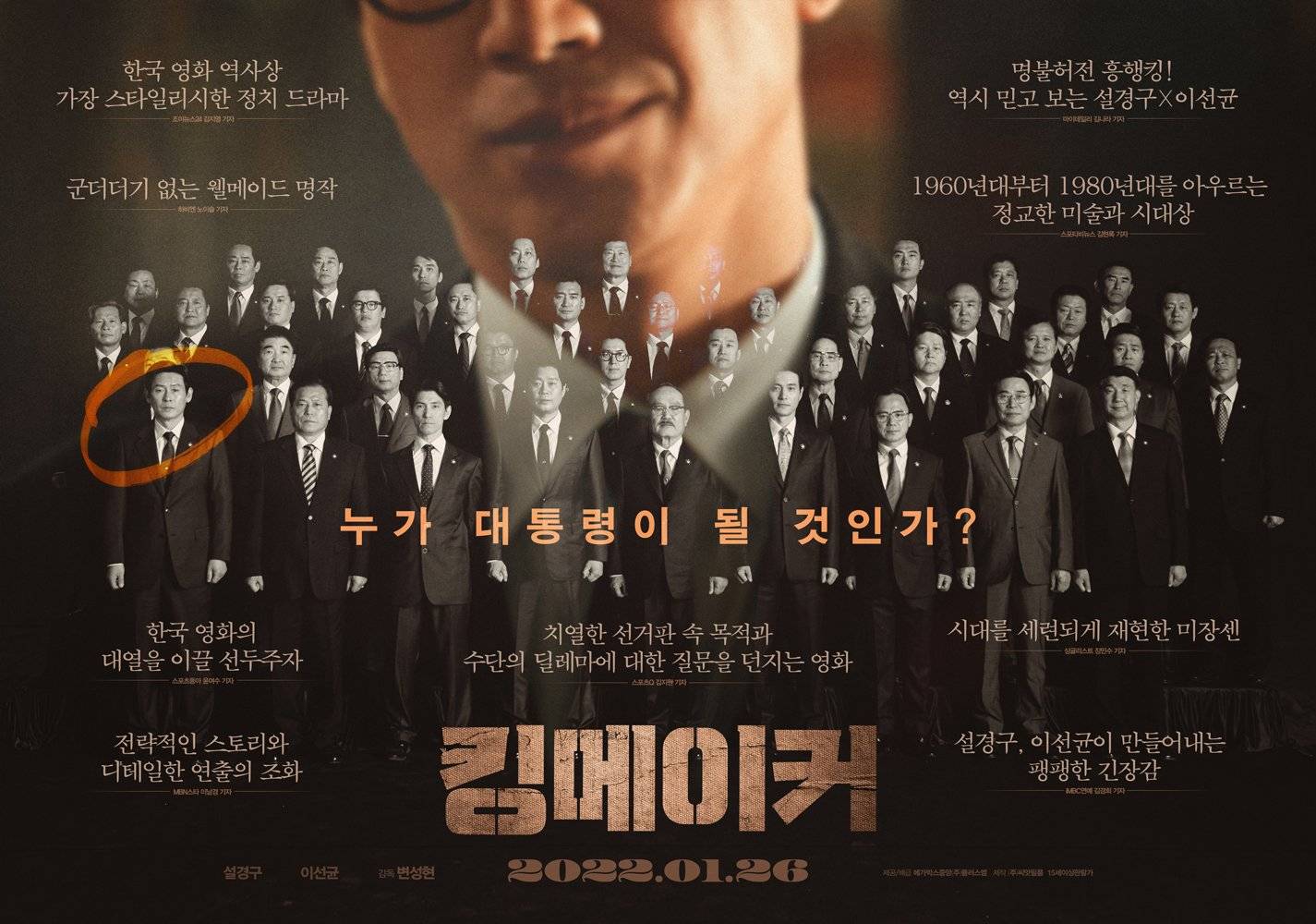
Kingmaker (킹메이커, Byun Sung-hyun, 2022)

It’s the political paradox. You can’t do anything without getting elected but to get elected you might have to abandon whatever it was you wanted to do in the first place. Loosely based on the real life figures of Kim Dae-jung and his political strategist Eom Chang-rok, the heroes of Byun Sung-hyun’s Kingmaker (킹메이커) are obsessed with the question of whether the ends justify the means and if it’s possible to maintain integrity in politics when the game itself is crooked while the film suggests that in the end you will have to live with your choices and your compromises either way and if it’s a better world you want to build perhaps you can’t get there by cheating your way to paradise.

The son of a North Korean migrant, Seo Chang-dae (Lee Sun-kyun) is an embittered and frustrated pharmacist with a talent for spin. When his friend complains about a neighbour stealing his eggs from his chicken coop and denying all knowledge because he’s well connected and knows he can get away with it, Chang-dae’s advice is to plant one of his own chickens in the other guy’s coop and catch him red handed. Impressed by the impassioned political speechmaking of labour activist Kim Woon-bum (Sol Kyung-gu), he writes him a letter offering his services and then marches down to his office to convince him that he is the guy to break his losing streak and finally get him elected so they can “change the damned world”. 

The problem is that all of Chang-dae’s ideas are like the chicken scam, built on the manipulation of the truth, but you can’t deny that they work. He plays the other side, the increasingly authoritarian regime of Park Chung-hee, at their own game, getting some of their guys to dress up as the opposing party and then set about offending a bunch of farmers by being generally condescending and entitled. They stage fights and perform thuggish violence to leave the impression that Park’s guys are oppressive fascists while asking for the “gifts” the Park regime had given out to curry favour back to further infuriate potential voters. Later some of their own guys turn up with the same gifts to send the message that they’re making up for all Park’s mistakes. At one point, Chang-dae even suggests staging an attack on Woon-bum’s person to gain voter sympathy, an idea which is met with total disdain by Woon-bum and his team many of whom are at least conflicted with Chang-dae’s underhanded tactics. 

But then as he points out, if they want to create a better, freer Korea in which people can speak their minds without fear then they have to get elected first. It may be naive to assume that you can behave like this and then give it all up when finally in office, but Chang-dae at least is committed to the idea that the ends justify the means. Woon-bum meanwhile is worried that Chang-dae has lost sight of what the ends are and is solely focussed on winning at any cost. He has an opposing number in slimy intelligence agent Lee (Jo Woo-Jin) who serves Park in much the same way Chang-dae serves Woon-bum, but Chang-dae fatally misunderstands him, failing to appreciate that for Lee Park’s “revolution” is also a just cause for which he is fighting just as Chang-dae is fighting for freedom and democracy. In an uncomfortable touch, Lee seems to be coded as gay with his slightly effeminate manner and tendency towards intimate physical contact adding an additional layer to his gradual seduction of Chang-dae whose friendship with Woon-bum also has its homoerotoic qualities in its quiet intensity. 

The final dilemma lies in asking whether or not Woon-bum could have won the pivotal election of 1971, preventing Park from further altering the constitution to cement his dictatorship and eventually declaring himself president for life, if he had not parted ways with Chang-dae and tried to win more “honestly”. If so, would they have set Korea on a path towards the better world they envisaged or would they have proved little different, their integrity already compromised by everything they did to get there poisoning their vision for the future? The fact that history repeats itself, Woon-bum and his former rival Young-ho (Yoo Jae-myung) splitting the vote during the first “democratic” presidential election and allowing Chun Doo-hwan’s chosen successor to win, perhaps suggests the latter. In any case, it’s Chang-dae who has to live with his choices in having betrayed himself, as Woon-bum had feared too obsessed with winning to remember why he was playing in the first place. “All my ideas about justice were brought down by my own hand” he’s forced to admit, left only with self-loathing defeat in his supposed victory. Some things don’t change, there is intrigue in the court, but “putting ambition before integrity will get you nowhere” as Chang-dae learns to his cost. 


Kingmaker screened as part of this year’s London Korean Film Festival.

International trailer (English subtitles)

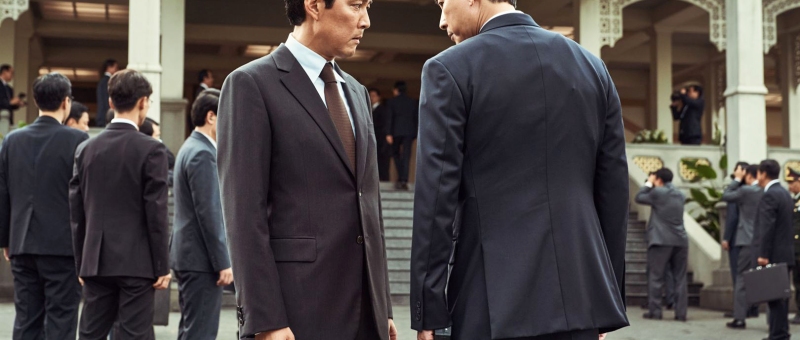
Hunt (헌트, Lee Jung-jae, 2022)

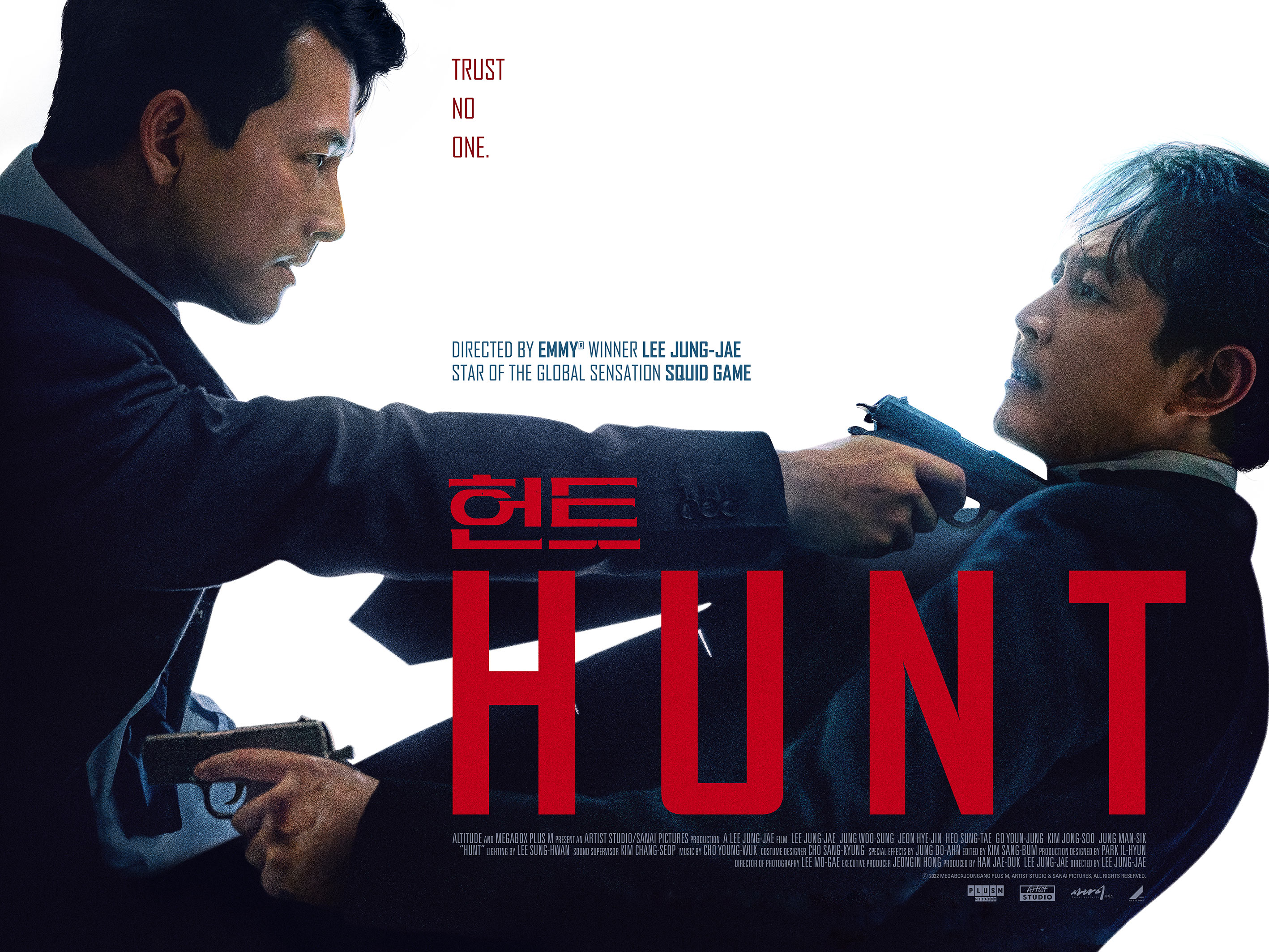
“How long can you fight violence with violence?” one accidental ally asks another towards the conclusion of actor and star Lee Jung-jae’s 80s-set directorial debut, Hunt (헌트). As the title implies, this is a story of two men stalking each other but also each ironic representatives of an ideological divide both seeking a better future while torn between violent overthrow and peaceful revolution in the dying days of a Cold War in what could be termed its ground zero. 

As the film opens, the South Korean president, a stand-in for an unnamed Chun Doo-hwan, faces mass protest from local Korean-American democracy activists on return to his hotel while on a diplomatic visit to Washington. His security team is itself somewhat compromised in that it is a joint operation between foreign and domestic intelligence teams neither of which have must trust in the other. When it’s discovered that a plot is underway to assassinate the president, foreign intelligence chief Park (Lee Jung-jae) is taken hostage but insists on capturing the suspect only for domestic chief Kim (Jung Woo-sung) to abruptly shoot him, leading Park to wonder if Kim did it to keep him quiet rather than simply to neutralise an immediate threat. Assuming North Korea is most likely behind the plot, each begins to suspect the other is a mysterious double agent known as Donglim. 

What soon becomes apparent is that the two men, the domestic and the foreign, are being pitted against each other by the questionable authority that is the Chun regime. Recently promoted from the military, Kim had in fact instigated Park’s torture in the immediate aftermath of the assassination of the previous president, also a military dictator, Park Chung-hee. Both men appear to be conflicted in their association with an authoritarian government in the wake of widespread state violence including the brutal suppression of the Gwangju Uprising in May 1980. Nevertheless, both are party to acts of torture many of them enacted on teenage democracy activists they routinely smear as communists. 

In short, no one could really blame anyone who wanted to overthrow this brutal regime but as oppressive as it is, it’s also backed by the Americans who would rather keep Chun in power than risk the students’ wishes that the American military pull out of Korea coming to fruition lest it lead to a similar situation in Okinawa, which had only returned to Japanese sovereignty a decade earlier, undermining their ongoing foreign policy goals in Asia. If there is one clear villain, aside from Chun, it’s the shady the international order that is content to watch authoritarian leaders enact violence on their people when it supports their own interests. Nevertheless, it’s also true that Park and Kim’s personal vendetta sparks major diplomatic incidents in two sovereign nations which in any other case would seem primed to turn this cold war hot.

What emerges is a cat and mouse game in which each attempts to unmask the other while on increasingly unstable ground unable even to rely on support from their superiors who in any case answer directly to Chun. It seems there are several factions who would like to unseat him even if they do not necessarily object to authoritarian rule only to persistent state violence against citizens who are more often than not mere children. The differences between Park and Kim are ideological in more ways than one, torn between the belief that only violence can free them from violence and the desire to seek a better solution but each agreeing that assassination is the only viable path to deposing Chun and ushering in a better future despite the failure of the assassination of the previous president to do the same . 

Anchored by strong performances from veteran actors Lee Jung-jae and Jung Woo-sung, the film also features a host of cameos from some of the nation’s top stars including Hwang Jung-min as a manic North Korean airforce defector and Lee Sung-min in a small but pivotal role as a Korean-Japanese asset. With notably high production values and truly astonishing action sequences, Lee excels in capturing the paranoid atmosphere of the conspiracy thriller and an almost unbearable tension between its twin protagonists who will later discover that they are quite literally on the same bus even if they have very different destinations in mind. 


Hunt screened as the opening night gala of this year’s London East Asian Film Festival and arrives in UK cinemas/digital on 4th November courtesy of Altitude Films.

UK release trailer (English subtitles)

Alienoid (외계+인 1부, Choi Dong-hoon, 2022)

According to the strangely warmhearted AI robot at the centre of Choi Dong-hoon’s Alienoid (외계+인 1부), the universe is already finished, destined only to tear itself apart in destructive instability. According to him, his society evolved, became compassionate and forgiving, yet like many others sought to avoid a problem it did not want to deal with in exiling its most dangerous prisoners to the minds of oblivious Earthlings who apparently rarely realise they’re sharing body and soul with an alien killing machine until that is one decides to escape. 

Thunder (Kim Dae-myung), an AI unit accompanying the sullen Guard (Kim Woo-bin) who is also a kind of guardian, paints the aliens as dangerous mutants who live only for violence yet it might be worth considering that their rebellion may be justified as members of an oppressed minority apparently considered harmful to mainstream society were it not for the fact their plan involves poisoning the Earth’s atmosphere to free their brethren while suffocating humanity in the process. Guard is fond of saying that he cares nothing for humans and does not involve himself in human affairs, yet it’s obvious that as much as his duty is to ensure the aliens stay captive he feels a responsibility to protect humanity, coming to care for an infant child Thunder spirited away in compassion after its mother died when the alien hosted inside her tried to escape. 

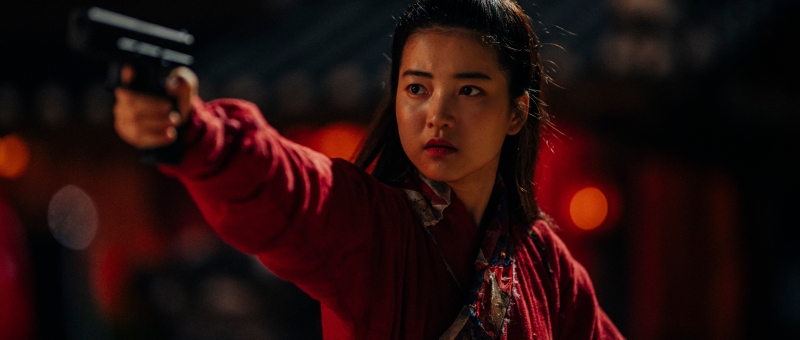
There is something a little curious in the fact these alien beings have chosen to live in what is our present day when according to them time is not linear but happening all at once and they appear to have the ability to travel through it at will, even stashing mutant criminals back in the 14th century where a Taoist dosa magician, “The Marvellous Muruk” (Ryu Jun-yeol) is on the hunt for the Divine Blade and a young woman who “shoots thunder” (Kim Tae-ri). Alien technology may seem like magic even if rooted in “science”, but feudal Korea is a place of majestic fantasy in which wizardry is apparently very real to the extent that a pair of powerful sorcerers tour the land hawking magical supplies such as random sutra stickers and mirrors that enlarge whatever passes through them to mysteriously masked warrior monks. Yet as we can see the girl who shoots thunder is merely welding a pistol, a kind of halfway house of technology which seems like strange magic to the people of Goryeo but nothing more than a child’s toy to the laser-wielding robotic aliens. 

In any case, Choi eventually connects these two worlds bridged by temporal conspiracy as if implying that the future’s salvation lies only in the past. Guard is forced to reflect that their strange act of colonial imperialism in secretly implanting alien prisoners in human minds may have been misguided when challenged by his plucky little girl (Choi Yu-ri) who has already realised there’s something a little different about her distant dad while the fact she’s effectively being raised by two men passes as incidental detail even as the Guard is stalked by her best friend’s apparently smitten aunt (Lee Honey). 

This being the first instalment in a two part film, there is a notable lack of resolution in its closing moments though Choi excels in world building running from hard sci-fi to feudalistic fantasy imbued with the strange magic of technology and underpinned by an interrogation humanity as the heroes battle through time looking for a way to repair an “unstable” world ruled by greed and violence and largely find it in each other. While the chief thrill may come from the incongruity of a young woman firing a pistol in the age of the crossbow (not to mention blasting her way out of a coffin), Choi packs in a series of innovative action sequences shot with a knowing irony as Muruk faces off against the masked monks in the past while the Guard and Thunder try their best to keep the aliens at bay with their high tech weaponry, shooting electric pulses from their palms and dodging lasers but still making a last ditch attempt by leaping at the enemy spaceship and trying to stab it in the heart. Whether this disordered world can be stabilised through a moment of cosmic connection will have to wait for part two, but this opening instalment at least is quite literally a charming affair.


Alienoid is in US cinemas from Aug. 26 courtesy of Well Go USA.

US trailer (English subtitles)

Voice of Silence (소리도 없이, Hong Eui-jeong, 2020)

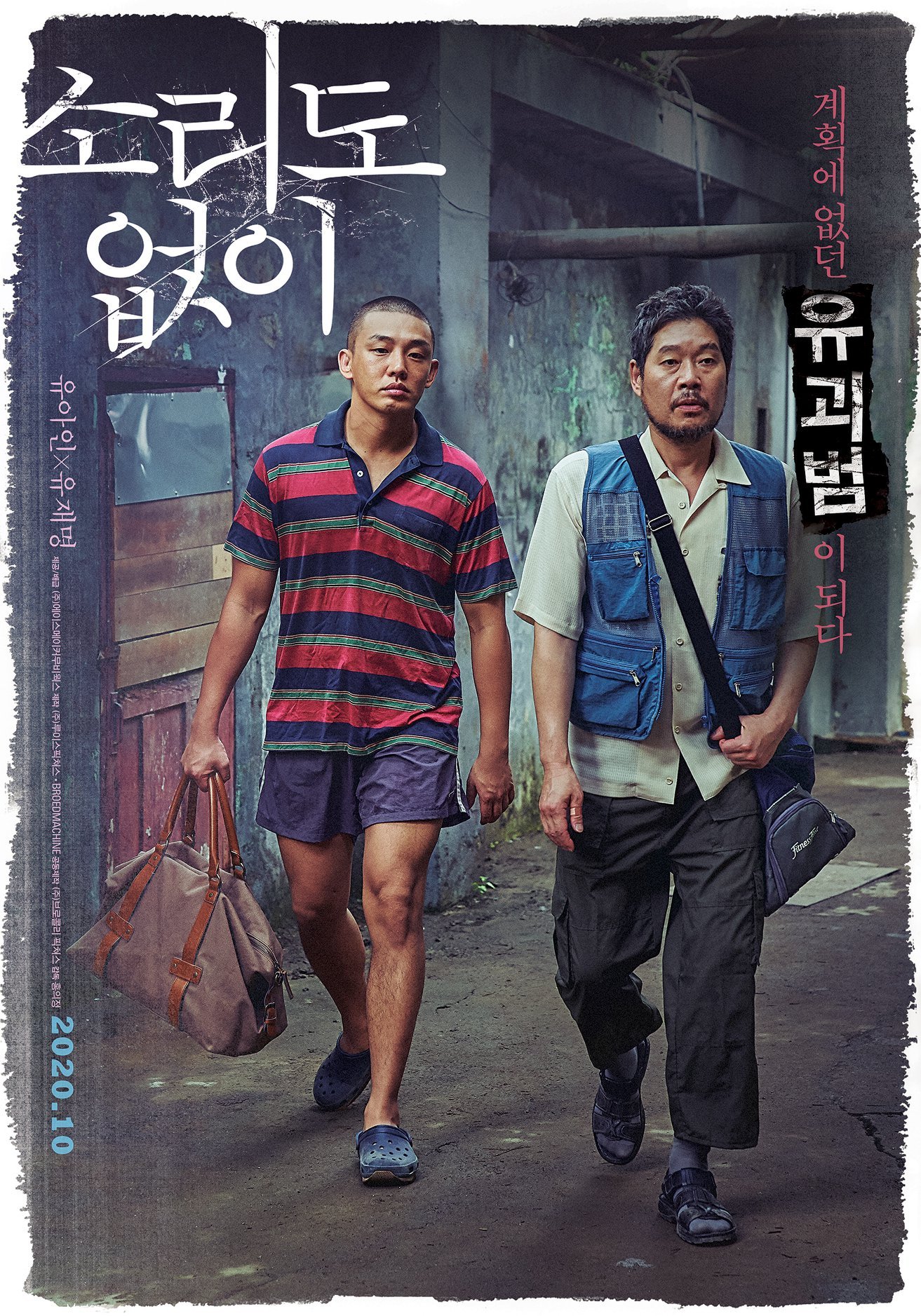
“Once you join a family, you have to pitch in, right?” the aphorism-loving protagonist of Hong Eui-jeong’s disturbingly warmhearted crime caper Voice of Silence (소리도 없이, Sorido Eopsi) explains to a little girl who has recently come into his “care” as she dutifully begins massaging the earth towards a half-buried body. Partly an exploration of the family bond and its propensity to arise even in the most duplicitous of circumstances, Hong’s ironically cheerful drama is also a mild condemnation of the modern society and its capacity to push good people to do bad things in its infinite oppressions. 

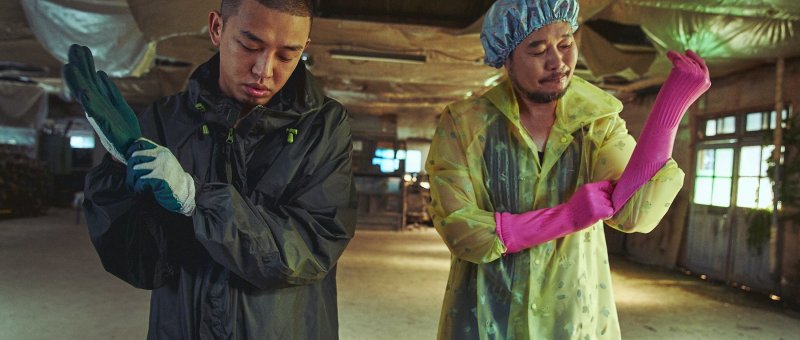
Egg farmer Chang-bok (Yoo Jae-myung), for example, is a man of faith who places great stock in protestant virtues of hard work and humility. Yet he sees no irony in the sign reading “Today’s honest sweat is tomorrow’s happiness” on the wall of a disused barn where he carries out his second job preparing torture victims for gangsters and then disposing of the bodies even going so far as to say a little prayer for them, bible in hand, as he places them into shallow graves in the forest. He and his mute partner Tae-in (Yoo Ah-in) dutifully wait outside as the violence takes place, rejecting entirely their sense of complicity with the corruption of the gangster world viewing themselves only as providing a service and taking pride in providing it well.

Nevertheless, when their “manager” pays them an unexpected visit and gives them an unusual assignment of “looking after” a person for a few days they can hardly refuse even as Chang-bok reminds him it’s not in their job description. Contrary to expectation, however, the “person” turns out not to be sequestered gangster but an 11-year-old girl, Cho-hee (Moon Seung-ah), whose father is haggling over a ransom payment. When the manager is consumed by the same system he previously operated, it leaves them with a problem. They can’t simply let the girl go because the kidnappers want their cut, but the father won’t pay up and so the only other option is handing her over to child traffickers. Chang-bok and more particularly Tae-in would rather that didn’t happen, but on the other hand they aren’t really doing too much to actively prevent it. 

Just as Chang-bok and and Tae-in are “egg farmers”, the child traffickers run their business out of a moribund chicken farm. The rural economy is apparently not faring so well in the modern society. Yet Hong’s countryside vistas are presented as an idyllic paradise with bluer than blue, cloudless skies and fields of verdant green. Then again those who live off the land are perhaps most aware of its compromises and of the price of survival. Chang-bok is fond of spouting vaguely religious aphorisms such as “whatever you do, do your best and be humble. Always be thankful for what you have”, later blaming his predicament on his recent laxity in attending church, but evidently sees no contradiction between his creed and way of life. He doesn’t want to hand Cho-hee over the child traffickers, but he won’t resist it either merely seeing it as an inevitable consequence of events already in play in which he is but a passive participant. 

Tae-in, meanwhile, though literally voiceless is beginning to reject his passivity. Apparently raised by Chang-bok from infancy, he is currently a guardian to a mysterious “sister”, Moon-joo (Lee Ga-eun) around 15 years younger than he is though no mention is made of their parents or what might have happened to them. Charged with taking care of Cho-hee he finds himself developing a paternal fondness for her while she quite unexpectedly slides neatly into his home, bringing a strangely maternal if perhaps in its own way problematic order in tidying the place up and giving Tae-il a more concrete sense of familial rootedness. When the pair picked her up, they wondered if Cho-hee’s father was haggling over the ransom amount because the kidnappers took his daughter when they meant to take his son. Chang-bok is morally outraged, believing sons and daughters should be treated the same and shocked a father would’t immediately do everything he could to protect his little girl. But Cho-hee knows only too well that they value her brother more and in fact doubts her father will help her. She carries these old fashioned patriarchal values into Tae-in’s village home, brushing Moon-joo’s rather feral hair, teaching her to fold clothes away neatly, instructing her to speak more politely to her brother and not to start eating until he has taken his first bite. 

Despite themselves, the four become an accidental family cheerfully enjoying ice lollies on a hot summer’s day trying to figure out a polaroid camera which has been bought for a slightly less happy purpose. There is perhaps an idea that Cho-hee might simply not return to her wealthy, urban family in which she feels unwanted and inferior but stay here in the more “innocent” countryside where the people are “honest”, value their daughters the same as their sons (even the child traffickers apparently charge the same discriminating only by age and blood type), and bury their bodies together. Chang-bok and Tae-in aren’t bad people, just members of a corrupt society who’ve internalised a sense of powerlessness that encourages them to be “humble” and complicit doing what they can to survive. Each marginalised by disability, Chang-bok walking with a pronounced limp and Tae-in rendered impotent by his inability to speak, they do not want to turn to “crime” but are trapped at the bottom of the social hierarchy and dependent on the illicit economy. Is Cho-hee any worse off with them than with the father who wouldn’t pay to get her back? The jury is most definitely out. 


Voice of Silence streamed as part of the Glasgow Film Festival.

Original trailer (English subtitles)

Baseball Girl (야구소녀, Choi Yun-tae, 2019)

According to the title card which opens Choi Yun-tae’s Baseball Girl (야구소녀, Yagoosonyeo), an obscure regulation in the founding principles of the Korean Baseball League placed a bar on players who were “biologically non-male”, a ban which was struck down in 1996 allowing women to play professionally though attitudes it seems are much harder to change than regulations. In contrast to the grand tradition of Korean sports dramas, the contest is not a game but the right to play in one and the opposing team not talented rivals but sneering sexism and a conformist society. 

Joo Soo-in (Lee Joo-young) made the papers as the first girl to play in her high school team in over 20 years. Casting an eye around her room we see her trophies and discover that she is a talented pitcher known for top speed fastballs, but then as others seem to put it her balls are only fast “for a girl”. All she’s ever dreamed of is playing professionally and, after all, there’s nothing in the rulebook to say she can’t but that’s all anyone ever tells her. Why can’t I? she asks them, but the only answer they have for her is that it simply isn’t done. Lined up with her teammates following a meeting with a scout from the big leagues, Soo-in watches as only one of her friends, Jeong-ho (Kwak Dong-yeon), is picked. The others all walk off with resignation, accepting that they’ll need to find alternate careers but Soo-in doesn’t back down. 

Soo-in’s determination places her at odds with her working class family, her harried mother (Yum Hye-ran) continually insisting that she’s being childish and unreasonable and should give up her dreams to do something more practical with her life or risk becoming like her father (Song Young-Kyu) who is perpetually unemployed, unable to provide for the family while repeatedly failing the exam to become a licensed estate agent. There’s no shame in giving up when there’s no chance of success, her mother tells her, aligning her quest with her father’s as an egotistical act of prideful selfishness. As a teenage girl, however, Soo-in cannot help but feel the slight of her parents’ lack of support, resenting her mother’s understandable prioritisation of the ability to earn as she pushes Soo-in towards taking an office job in the factory where she works right out of high school in the belief that she’s helping her towards an economically stable life. 

Meanwhile, the new coach on the team, Jin-tae (Lee Joon-Hyuk), is quick to sideline her, viewing her as ridiculous and deluded. It’s not because you’re a girl, he tells her, it’s that you aren’t good enough, paradoxically insisting that she never could be because of the “limitations” of her female body which make it impossible for her to compete with men who also, as he points out, are extremely unlikely to make it as professional players. She tells him that he’s wrong, vowing to pitch at a speed unheard of, certain that if achieved the leagues would have to take her. Jin-tae has problems of his own, a never was player who wasted his youth trying to turn pro, became an alcoholic, and ruined his marriage. It’s understandable that his experiences have turned him cynical and mean, but something about Jin-soo’s determination, along with her strong skillset, begins to move him. Maybe he thinks it’s hopeless too, but it would be wrong to deny her the right to try. 

The biggest battle Soo-in faces, however, is from other players. Jeong-ho relates how in their little league days she was the only girl on the team and the kids mercilessly bullied her in part because the coach told them having a woman around was bad luck and made them all do intensive training to encourage her to quit. Jin-tae tries to get his scout friend to get her a tryout for a professional team, but he makes no secret of his distaste for the idea, exasperatedly complaining that Soo-in doesn’t look like a ball player (i.e., not a man, small and slight) only to later offer her an insulting token job as a figurehead for a “Woman’s Baseball Project” designed to make his big league team look more progressive than it really is. At her big try out, the guys in the dug out snigger and laugh, making fun of the batter who was struck out by “a girl” while the other coach congratulates her suggesting that she must have “trained with the boys” before giving her some unsolicited advice. 

As she tells the director of the big league team, baseball is for everyone. Her femininity is not a strength or a weakness, it simply is. She might not be as fast or as strong, but she’s smart, and brute force is not the point of the game. Some tell to her give up, that she should just play in the women’s leagues as a “hobby”, and perhaps at times Soo-in doubts herself but as Jin-tae tells her, other girls can dream because she showed them it was possible when she overcame huge prejudice to play on her high school team. Yet for Soo-in with every success it will only get harder. Even so she won’t give in, playing hardball with a relentlessly patriarchal society as she insists on the right to follow her dreams wherever they may take her.


Baseball Girl streams in the US via the Smart Cinema app until Sept.12 as part of this year’s New York Asian Film Festival.

Original trailer (English subtitles)

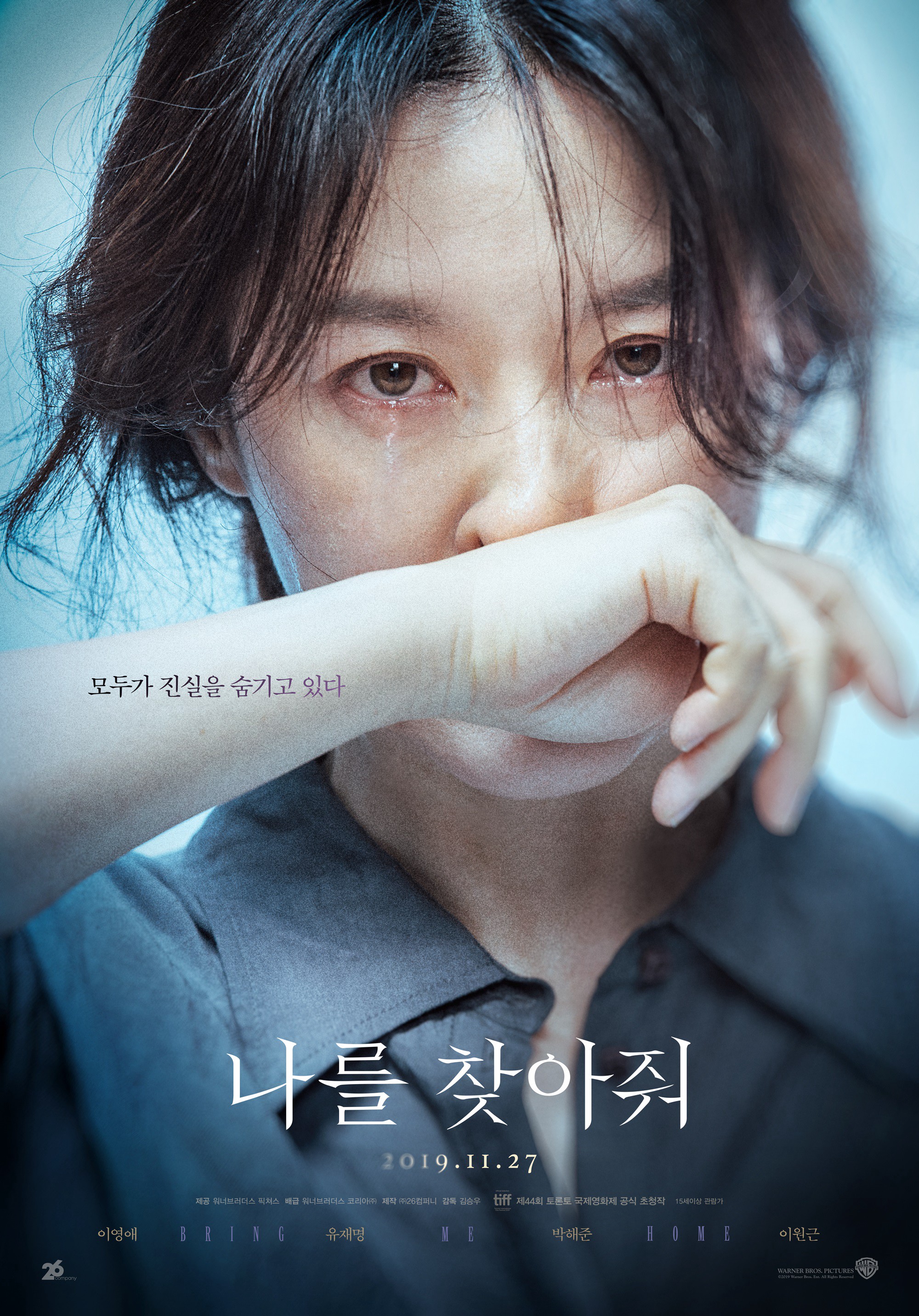
Bring Me Home (나를 찾아줘, Kim Seung-woo, 2019) [Fantasia 2020]

“They were all like me” a drowning man exclaims, trying to justify his inhumanity but gaining only poetic retribution as he finds himself shackled, quite literally, to his crimes. Kim Seung-woo’s debut feature Bring Me Home (나를 찾아줘, Nareul Chajajwo) stars Lady Vengeance herself, Lee Young-ae, in her first big screen leading role since Park Chan-wook’s seminal thriller once again cast as a figure of wounded maternity coming for systemic societal corruption and the savagery born of hopeless desperation in her singleminded determination to retrieve her son and take him with her even if with a dark destination in mind. 

Six years previously, Jung-yeon’s (Lee Young-ae) son Yoon-su vanished from a playground at six years old. Since then, her husband (Park Hae-joon), formerly a teacher, has spent every waking moment looking for him while she works as a hospital nurse where her colleagues describe her as a cool, infinitely professional presence. She continually berates herself for a vague memory of wanting a break from her child, exhausted by the act of caring for him as if she somehow brought this on herself or at any rate gave the universe her permission to take him away. Just when the conditions of her life seemed as if they were about to improve with her husband agreeing to return to work, he is killed in a car accident while pursuing a lead which turned out to be useless anyway, a cruel prank played by insensitive children. Left so totally alone, Jung-yeon begins to consider suicide only to receive another promising lead. A boy who looks like Yoon-su and has a burn on his back and a birthmark behind his ear, is working at a fishing pool in a rural town.

The sad truth is Yoon-su or not, the “family” running the fishing pool have “adopted” two displaced children which they use for slave labour, cruelly abusing them both physically and sexually. It’s this essential act of inhumanity which alerts the corrupted community to the danger presented by Jung-yeon. They could give the boy back, claim the reward, and hope she asks no more questions, but the likelihood is all their dirty dealings would be exposed and then they’d have to replace him. Corrupt policeman Sgt. Hong (Yoo Jae-myung) who for some reason seems to be in charge of the fishing pool is confident he can make all of this go away, pretending to be sympathetic to Jung-yeon’s search but insisting that there is no such boy while introducing her to the landlady’s “son” , keeping “Minsu” chained up in the shed. 

Sgt. Hong is fond of reminding people that he works for the government, a symbol of corrupt and oppressive authority obsessed with maintaining his own status as the man in charge apparently insecure in his sense of control. He claims that he was only able to do the things that he has done because no one really cared. Hundreds of people came through and saw Minsu, none of them said anything until another officer noticed that he looked quite like the boy on the news and was struck by the large reward on offer. The same officer accepted a pay off not to say anything, but apparently took the money and talked anyway. Even Jung-yeon’s brother-in-law tries to get money out of her and then comes up with an elaborate ruse to get his hands on the reward after accidentally being given the tip-off. The only one of the gang to treat Minsu with any sort of compassion eventually turns against Jung-yeon out of fear, citing the economic precariousness of the town. He’s worried that their business will be ruined, more shops will close, and as an ex-con he’ll never find another job which is a problem because he wants money to make sure his son goes to university so he doesn’t end up like him. 

“The living must go on living” another of the gang agrees, indifferent to the costs or the consequences of their actions through it’s difficult to see how their desire to save the town could ever justify their treatment of these displaced children, dehumanising Minsu because of his learning difficulties. Jung-yeon finds one of her fliers pasted on a pillar partially covered by another one for missing dog while the gang’s most deranged member keeps his own wanted poster listing rape and murder on the wall of his shack as if it were some kind of commendation. Hinting at a dark history of missing children as evidenced in one young man’s (Lee Won-geun) recollections of being adopted abroad mistakenly believing that his parents had abandoned him, Bring Me Home eventually descends into archetypal pulp for its misty finale, returning to the mythic vistas of desolation in which it began with the dishevelled Jung-yeon walking the shore of life and death consumed by futility in the depths of her maternal guilt, but does perhaps offer a glimmer of hope in the crushing irony of its final revelations. 


Bring Me Home streamed as part of this year’s online edition of Fantasia International Film Festival.

International trailer (English subtitles)