The Target (표적, Chang, 2014)

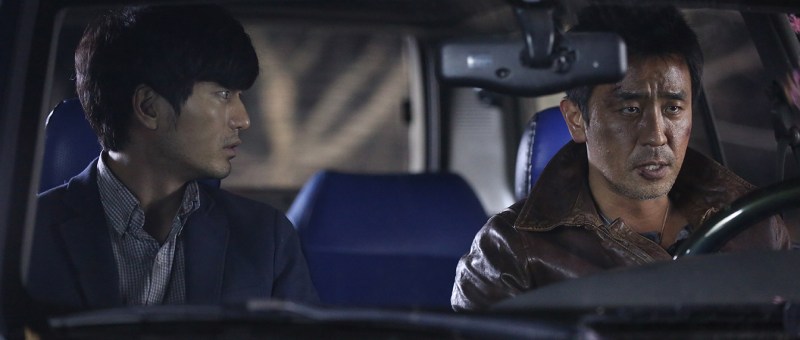
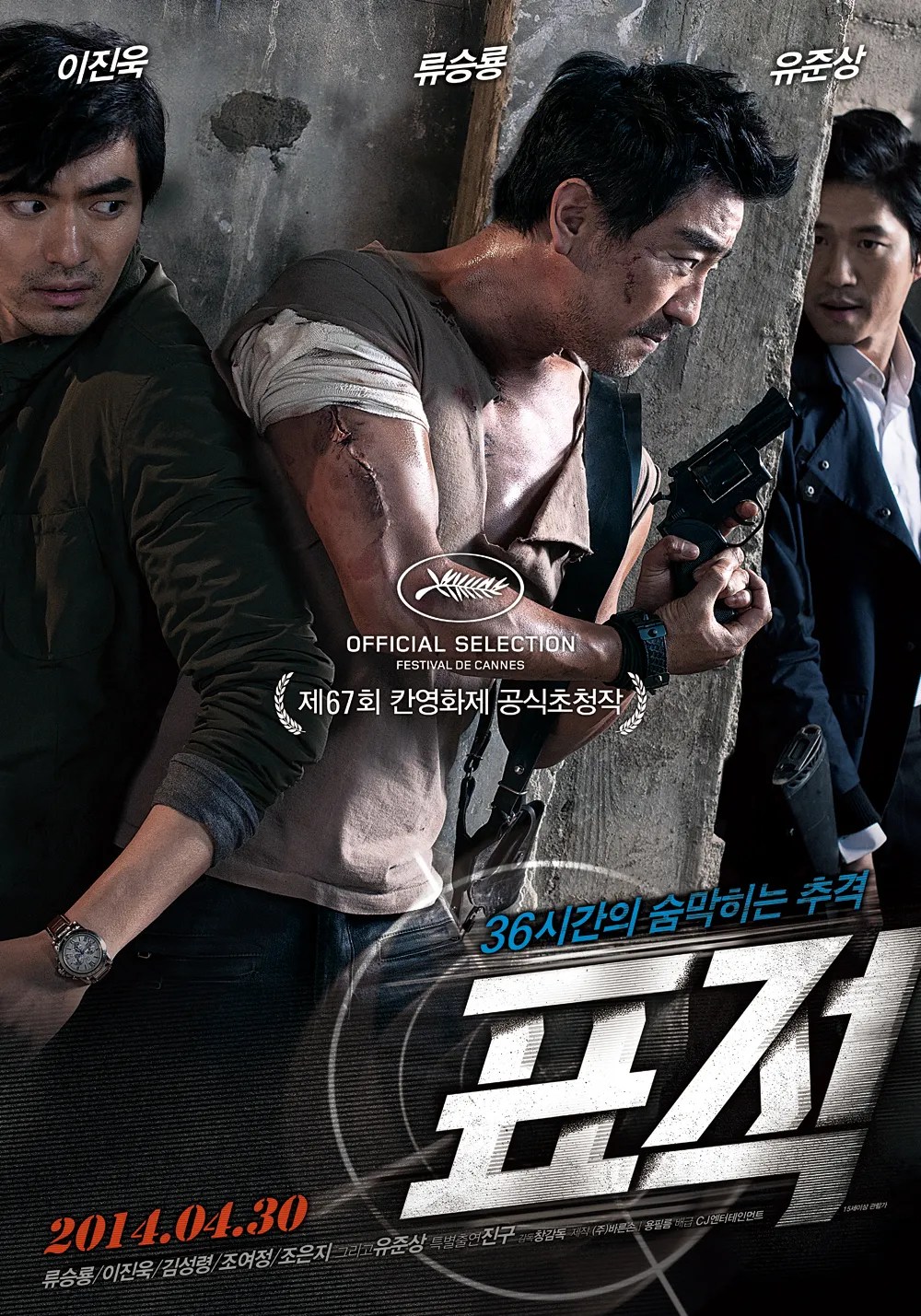
A doctor finds himself dragged into conspiracy after saving the life of a man framed for murder in Chang’s South Korean remake of the French action thriller Point Blank (표적, Pyojeok). Despite having seen off an assassin, Tae-jun (Lee Jin-wook) doesn’t take too long wrestling with his medical ethics when his pregnant wife is kidnapped and immediately decides to give up his patient to whoever is looking for him, but just like the bad guys, he’s picked the wrong man to mess with because Yeo-hoon is a former mercenary with nothing but revenge on his mind.

Tae-jun’s determination does however make it clear the extent to which people are prepared to compromise their morals when something important to them is threatened. The person that kidnapped his wife thought he no choice either and is only trying to protect someone close to him. They are all at the mercy of a corrupt system. It turns out that Yeo-hoon has been framed for murdering a businessman who manipulated the market to buy an apartment building at a cheaper price, but his partner would rather have all the money for himself so decided to knock him off. Corrupt police officer Song (Yoo Jun-sang) has been running a side business as a hitman aided by his team of equally compromised subordinates and decided that Yeo-hoon’s brother, who has learning difficulties, would make a good fall guy because they assumed he was an orphan with no family to go asking questions. What they didn’t bargain for was dealing with a ruthless and highly trained opponent like Yeo-hoon.

Tae-jun didn’t really bargain on that either and is originally unsure how far he can trust Yeo-hoon (Ryu Seung-ryong) though technically, they’re on the same side. The loyal police officers have the same issue, resentful of Song because he’s pinched their case rather than realising he’s only done so to cover up his own corruption. Nevertheless, like Tae-jun and Yeo-hoon, policewoman Soo-jin (Jo Eun-ji) is also after revenge for the loss of someone close to her. In truth, her tearful distress and inability to dispose of female superior’s belongings hints at a deeper connection than simple loyalty to her fallen comrade. Her need for revenge is as hot as Yeo-hoon’s, though she too originally believes Song’s version of events and is only motivated to look deeper precisely because it matters to her how her friend died.

There is then a theme of frustrated familial reunions that runs under that of the overriding corruption that surrounds them. Yeo-hoon returned home to reunite with his brother but is too late to stop him being drawn into Song’s web, while Soo-jin wants vengeance for her friend, and Tae-jun to save his wife and unborn child. Though not everything can be repaired, there is a final restoration of the family in the closing scenes in which Yeo-hoon is reunited with his dog and is symbolically adopted as a brother to Tae-jun and a new member of his family. To that extent, the film suggests that familial bonds are the ultimate defence and rebellion against the corruption of men like Song whom, one of his subordinate says, would even sell his parents for money.

Nevertheless, the real focus is propulsive action and Chang keeps the tension high as Ryu Seung-ryong shows off his skills as an action with several high-octane hand-to-hand combat scenes, along with shootouts and explosions even before the police station finale in which Yeo-hoon must attack the very structure of law enforcement to clear out its inherent corruption. Tae-jun, meanwhile, is more of a hapless stooge left with little other choice than to follow along behind Yeo-hoon while trying to weaponise the righteousness of the good police officers to locate and rescue his wife before the bad guys can take care of what they see as a loose end. For her part, Hee-joo (Cho Yeo-jeong) is mostly reduced to a damsel in distress, but at the same time in her role as a psychologist and is able to extend sympathy to Sang-hoon helping him see the error of his ways and further emphasising the film’s familial themes. Though incomplete, justice of a kind at least is served in the exposure of the corruption and the final moment of healing which exists outside the system in the reinforcing of the simple bonds between people.


Trailer (English subtitles)

The Boys (소년들, Chung Ji-young, 2022)

A “mad dog” policeman uncovers a miscarriage of justice but finds that his faith in his institution may have been misplaced in Chung Ji-young’s pressing judicial drama, The Boys (소년들, Sonyeondeul). Like much of Chung’s previous work critiquing the power imbalances of the contemporary society, the film is one of several recent dramas taking aim at the justice system and the utter contempt of those in power for those without most notably for the titular boys exploited by a failure of the system.

In 1999, a trio of teenagers is picked up and arrested for the robbery of a convenience store in which an old woman died. Newly transferred to the district, “mad dog” policeman Joon-cheol (Sol Kyung-gu) receives a tip off that actually someone else did it. The informant says he’d previously told the investigating officer, Choi (Yoo Jun-sang), but was ignored. Joon-cheol might assume that’s because he didn’t think there was anything in it and didn’t find the informant credible, but something nags at him and he begins to look at the case only to realise too much of it doesn’t make sense. He soon discovers that Choi and his underlings beat the suspects, who were terrified and naive due to their youth, into a false confession in order to get a promotion by solving a prominent case.

Chung switches back and fore between 1999 and 2016 when the boys’ retrial finally takes place and discovers Joon-cheol a somewhat broken, defeated man who has served out the past few years on a peaceful rural island never receiving any further promotions. With his retirement looming, he’s been offered a return to the mainland, but apparently only thanks to Choi which leaves a sour taste in Joon-cheol’s mouth. Like pretty much everyone else, he is haunted by a sense of guilt that in the end despite his promises he was powerless to help these innocent young men escape their false imprisonment. 

Then again, Joon-cheol is also a product of the system. The “mad dog” beat suspects too, and there’s something chilling in his justification that he only beat the “guilty” and never the “innocent”. He got his promotion after being stabbed on the job, a strange sacrifice that seems the inversion of Choi’s greedy venality. Choi really thought nothing of these boys, one whom had learning difficulties and was illiterate so could not have written his statement on his own, because they were poor and defenceless and is unrepentant even when confronted with the truth. He himself could have caught the real culprits but simply chose not to because it was easier and more convenient to him to destroy the lives of three innocent boys instead. 

Choi’s reach seems to be eerily extensive though the police force’s reluctance to correct a miscarriage of justice because it would make them look bad is obviously an institutional flaw along with the use of violence to elicit confessions. The older version of Choi with slick backed hair and an arrogant manner behaves as if he’s untouchable, giving an answer for everything and leaving no room to be challenged while others are only too keen to support his version of events with equally smug manipulations of the law. 

The boys find themselves powerless. They cannot challenge Choi and though they’ve served their sentences and paid a debt to society that was never theirs to begin with cannot move on with their lives because they are still branded murderers meaning no one will hire them. Meanwhile, at least one of the real killers has had to opportunity to start again and is reluctant to help because they do not want their new family to find out about their past. Everyone is harbouring some kind of guilt or desire to bury the truth for a quiet life, Joon-cheol too not wanting to get involved and cautioning the boys against applying for a retrial because it will only cause them further pain. 

Though the truth is eventually revealed and the boys’ names cleared, the overwhelming implication is that you cannot really win against men like Choi. The sentiment is rammed home by a final title card explaining that nothing happened to any of the policemen involved in framing the boys while Joon-cheol only has the satisfaction of having helped to free them neither vindicated as a police officer or successful in undercutting the corruption inherent in the police force and embedded in the society itself. Nevertheless, Joon-cheol’s righteousness and the the unexpected support he receives from those around him for doing the right thing add an inspirational quality that simultaneously suggests justice is a distant dream but also that it can be achieved if enough people can be persuaded to chase it even while against their own interests.


The Boys screened as part of this year’s London East Asia Film Festival.

Original trailer (no subtitles)