The Beast Must Die (野獣死すべし, Toru Murakawa, 1980)

LP Soundrack record cover

Yusaku Matsuda was the action icon of the ‘70s, well known for his counter cultural, rebellious performances as maverick detectives or unlucky criminals. By the early 1980s he was ready to shed his action star image for more challenging character roles as his performances for Yoshimitsu Morita in The Family Game and Sorekara or in Seijun Suzuki’s Kagero-za demonstrate. The Beast Must Die (野獣死すべし, Yaju Shisubeshi, AKA Beast to Die) is among his earliest attempts to break out of the action movie cage and reunites him with director Toru Murakawa with whom he’d previously worked on Resurrection of the Golden Wolf also adapted from a novel by the author of The Beast Must Die, Haruhiko Oyabu. A strange and surreal experience which owes a large amount to the  “New Hollywood” movement of the previous decade, The Beast Must Die also represents a possible new direction for its all powerful producer, Haruki Kadokawa, in making space for smaller, art house inspired mainstream films.

Shedding 25 pounds and having four of his molars removed to play the role, Matsuda inhabits the figure of former war zone photo journalist Kazuhiro Date whose experiences have reduced him to state of living death. After getting into a fight with a policeman he seems to know, Date kills him, steals his gun, and heads to a local casino where he goes on a shooting rampage and takes off with the takings. Date, now working as a translator, does not seem to need or even want the money though if he had a particular grudge against the casino or the men who gather there the reasons are far from clear.

Remaining inscrutable, Date spends much of his time alone at home listening to classical music. Attending a concert, he runs into a woman he used to know who seems to have fond feelings for him, but Date is being pulled in another direction as his experiences in war zones have left him with a need for release through physical violence. Eventually meeting up with a similarly disaffected young man, Date plans an odd kind of revenge in robbing a local bank for, again, unclear motives, finally executing the last parts of himself clinging onto the world of order and humanity once and for all.

Throughout the film Date recites a kind of poem, almost a him to his demon of violence in which he speaks of loneliness and of a faith only in his own rage. Later, in one of his increasingly crazed speeches to his only disciple, Date recounts the first time he killed a man – no longer a mere observer in someone else’s war, now a transgressor himself taking a life to save his own. The violence begins to excite him, he claims to have “surpassed god” in his bloodlust, entering an ecstatic state which places him above mere mortals. A bullet, he says, stops time in that it alters a course of events which was fated to continue. A life ends, and with it all of that time which should have elapsed is dissolved in the ultimate act of theft and destruction. His acts of violence are “beautiful demonic moments” available only to those who have rejected the world of law.

Murakawa allows Matsuda to carry the film with a characteristically intense, near silent performance of a man driven mad by continued exposure to human cruelty. Hiding out in Date’s elegant apartment, Matsuda moves oddly, beast-like, his baseness contrasting perfectly with the classical music which momentarily calms his world. Mixing in stock footage of contemporary war zones, Murakawa makes plain the effect of this ongoing violence on Date’s psyche as the sound of helicopters and gunfire resounds within his own head. The imagery becomes increasingly surreal culminating in the moment of consecration for Date’s pupil in which he finally murders his girlfriend while she furiously performs flamenco during an dramatic thunderstorm. Date is, to borrow a phrase, no longer human, any last remnants of human feeling are extinguished in his decision to kill the only possibility of salvation during the bank robbery.

Anchored by Matsuda’s powerful presence, The Beast Must Die is a fascinating, if often incomprehensible, experience filled with surreal imagery and an ever present sense of dread. Its world is one of neo noir, the darkness and modern jazz score adding to a sense of alienation which contrasts with the brightness and elegance of the classical music world. At the end of his transformation, there is only one destination left to Date though his path there is a strange one. Fittingly enough for a tale which began with with darkness we exit through blinding white light.


There’s also another adaptation of this novel from 1959 starring Tatsuya Nakadai which I’d love to see but doesn’t seem to be available on DVD even without subtitles. This film has a selection of English language titles but I’ve used The Beast Must Die as this is the one which appears on Kadokawa’s 4K restoration blu-ray release (sadly Japanese subtitles ony).

Original trailer (no subtitles)

Detective Story (探偵物語, Kichitaro Negishi, 1983)

Dective Story 1983Yusaku Matsuda became a household name and all round cool guy hero thanks to his role as a maverick private eye in the hit TV show Detective Story, however despite sharing the same name, Kichitaro Negishi’s Detective Story movie from 1983 (探偵物語, Tantei Monogatari) has absolutely nothing to with the identically titled drama series. In fact, Matsuda is not even the star attraction here as the film is clearly built around top idol of the day Hiroko Yakushimaru as it adapts a novel which is also published by the agency that represents her and even works some of her music into the soundtrack.
As far as plot goes, Detective Story is the kind of good natured, innocent crime thriller that has all but disappeared since the 1980s. Yakushimaru plays teenage student Naomi who is due to move to America to be with her father in the very near future. However, Naomi is an inquisitive, mildly rebellious sort with a habit of sneaking out of her room through the window despite the fact that no one is preventing her simply leaving through the front door. Consequently someone or other has hired a detective, Tsujiyama (Matsuda), to keep an eye on her. This he does pretty well until he puts a stop to Hiroko making a huge mistake with a fellow student in a love hotel. Though Naomi is very not happy about a creepy old guy following her about everywhere, she gradually gets used to it and when Tsujiyama’s ex-wife gets caught up in a hotel room murder case, Naomi gets the inspiration to embark on some detective work of her own.

Despite the shadiness of the world that rich girl Naomi is about to get embroiled in, the film maintains a bright and cheerful tone – perhaps because of Naomi’s own straightforward innocence. Even if she very nearly falls for the advances of an obvious creep (seriously, the guy actually borrows money from his “girlfriend” ? right in front of Naomi to take her out on a date, after which he tries to persuade her to join him in a love hotel), Naomi’s teenage spunkiness largely keeps her out of trouble for the rest of the movie which sees her getting mixed up with nightclubs, showgirls and yakuza. Somehow there is very little feeling of actual danger in the film leaving this all feeling like the kind of thing that happens to Naomi all the time and is simply just one last adventure before she heads off to America.

It must have been something of a coup to get arguably the biggest movie star of the day, Yusaku Matsuda, to play second fiddle in a mainstream teen idol movie especially as his other film choices of the time seem to indicate a desire to get away from his tough guy persona into more dramatic roles. Tsujiyama is cool presence in his stylish brown suit, smoking away in the shadows content to simply keep watch. He’s the omniscient type who always seem to have a plan in motion yet it’s Naomi herself who takes the lead here, solving the case whilst saving Tsuijiyama and his damaged show girl of an ex-wife in the process.

As is common with these kinds of stories there is a light romantic subplot which is a little unseemly when you consider Yakushimaru was only 19 at the time and her character around the same age whereas Matsuda was already in his 30s. This plot strand is played a little strangely throughout the film with a tacked on airport gate conclusion which dissolves itself almost straightway but does play into the film’s coming of age themes as Naomi develops greater sense of herself as an adult woman rather than a reckless teenager.

Detective Story is no lost classic, it’s very much of its time and has perhaps faded a little as has the fame of its tentpole star. That said it’s a perfectly enjoyable cute teen idol detective story which overall succeeds in doing exactly what it sets out to do even if it proves a little dull in the execution. An interesting watch for fans of its two stars Hiroko Yakushimaru and Yusaku Matsuda and even for its director Kichitaro Negishi who has gone on to win some later critical acclaim particularly with the prestige drama Villon’s Wife in 2009, Detective Story is perhaps not worth an all night stakeout but at least warrants a cursory investigation.


Unsubtitled trailer:

and here’s a video of Hiroko Yakushimaru singing the (very catchy) title song at a concert celebrating the 35th anniversay of her film debut (video has a bit about the concert at the beginning, fastfoward to 1:13 for the song only)


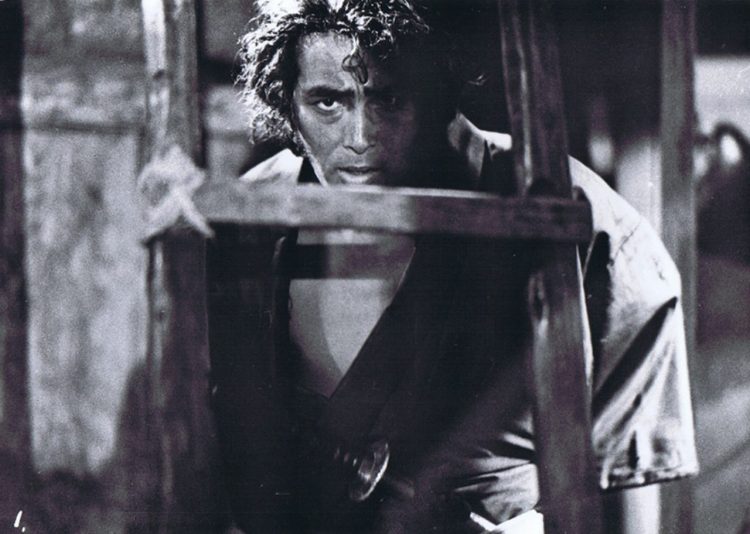
The Assassination of Ryoma (竜馬暗殺, Kazuo Kuroki, 1974)

Ryoma AnsatsuSakamoto Ryoma is a legendary revolutionary of Japan’s Bakumatsu period which encompasses the chaos that ensued after Japan was forced open after centuries of self imposed isolation. Ryoma was a low level samurai from a small town who resented the unjust treated of the arrogant true samurai above him and skipped out on his clan without the proper permission to go study sword fighting in the city. After the arrival of the Americans and witnessing their far superior technologies, Ryoma was one of several men who became convinced that Japan needed to modernise quickly or become a slave to more advanced cultures. However, this was a turbulent era and there was general infighting among all factions and all sides and Ryoma was mysteriously assassinated in 1867 along with his friend and ally Nakaoka Shintaro.
In thinking about the legacy of Sakamoto Ryoma, it’s important to try and separate the man from the legend. His legacy has become somewhat romanticised as his visionary ideas of a modernised Japan free of outside influence but also of outdated, feudalistic ideals have developed into an easily cop-opted set of talismans. Kuroki Kazuo’s 1974 film The Assassination of Ryoma (竜馬暗殺, Ryoma Ansatsu) attempts to place Ryoma firmly back within the mortal realm as it explores the events of his last days in late 1867 when he was brokering the new world from the shadows.

Played by Japan’s original ‘70s wild beast Harada Yoshio, this Ryoma is a slightly bumbling though thoughtful young man who likes to have a good time when he isn’t busy trying to overthrow the shogunate. An early scene sees him fiddling with a revolver which he claims is a better weapon to be in hiding with because it’s a little more portable and discreet than a traditional sword. However, he doesn’t quite know how to use it and can’t figure out how to make it fire in order to give his friend a demonstration. Later, having moved on slightly from his ideas of a peaceful revolution, his plan to buy a number of rifles backfires when he is sent a camera instead.

Ryoma is joined by two “allies” who both originally came in order to kill him but have apparently switched sides. The first is one of his oldest friends, Shintaro, who remained a member of a hard right revolutionary group in Ryoma’s home town which ran under the slogan “Revere the Emperor, Expel the Foreigners”. Understandably they haven’t taken too well to Ryoma’s change of heart regarding the modernisation of Japan and are committed to taking him out – hence dispatching Shintaro, though he proves reluctant to assassinate his friend. The other is a mysterious and largely silent assassin, Uta (played by Matsuda Yusaku), who also ends up forming an unlikely friendship with Ryoma which prevents him from carrying out his mission.

Kuroki shoots in black and white within a 4:3 frame and in gritty 16mm but also goes in handheld almost like newsreel footage shot by a frontline war correspondent. As well as using some silent cinema inspired compositional techniques, Kuroki also adds in a few intertitles either with historical information or to provide some additional commentary on the action such as when he tells us that violence from left wing samurai is a daily occurrence. Drawing a neat parallel between he chaos of the Bakumatsu era and its tussling between new and old, Kuroki leaves us with a sense of historical continuity by equating the left wing samurai rebellion of the 1860s with the left wing student moment of a whole century later.

However, Ryoma is just one man. In an enlightening metaphor about a cat who got stuck up a tree, Ryoma calls to it and tried to climb up to get the cat down but it just kept climbing higher and wouldn’t even take the mochi he tried to offer it on a stick. Eventually Ryoma wanted to cut the whole tree down in order to save the cat but everyone laughed at him – cut down a 10ft wide tree to save one skinny cat? At that time Ryoma laughed too but later it made him angry. He thought the idea of cutting down the tree should be allowed to be considered, that every option ought to be explored. The important thing is to see things from all angles and allow yourself the freedom to change your mind, reject all previous knowledge in the light of a new way of thinking. This kind of freedom is necessarily frightening and may lead others onto a path which you yourself do not wish to follow but all the same it is the very idea which gives birth to Ryoma’s entire philosophy.

Kuroki’s vision of this visionary hero is an unconventional one and one which was not universally accepted by the audience of the time. Just as radical as the man himself, Kuroki’s film portrays Ryoma as a modern revolutionary who lived a hundred years ago, yet wanted many of the same things that the youth of the day were still fighting for – personal freedom, equality for all, and a modern society which allowed his nation to stand independent, on an equal footing with its European counterparts. The assassination itself is brutal, bloody and efficient. It’s an uncinematic ending for a cinematic hero in which he’s violently cut down in a frenetic yet naturalistic fashion leaving a trail of polluting black blood spreading across the high contrast bright white background. His ideas were too radical for his era, and his tragic end a sadly predictable one but what does this say about the world of today and the would be revolutionaries whose voices appear to have been silenced?


(I’ve gone for surname first order here because that’s the most usual way of referring to historical figures – I accept that it’s confusing but it is at least consistant).

The life story of Sakamoto Ryoma has been dramatised many times, most recently as a Taiga drama, Ryomaden, directed by Rurouni Kenshin’s Ohtomo Keishi and starring Fukuyama Masaharu, which has apparently boosted Ryoma’s profile even more and created a raft of new tourist spots in various areas of Japan. (It’s obviously very long as it’s Taiga drama but is well worth the investment in time and effort.)

Unsubbed trailer:

http://www.youtube.com/watch?v=_9OiFk0E70I

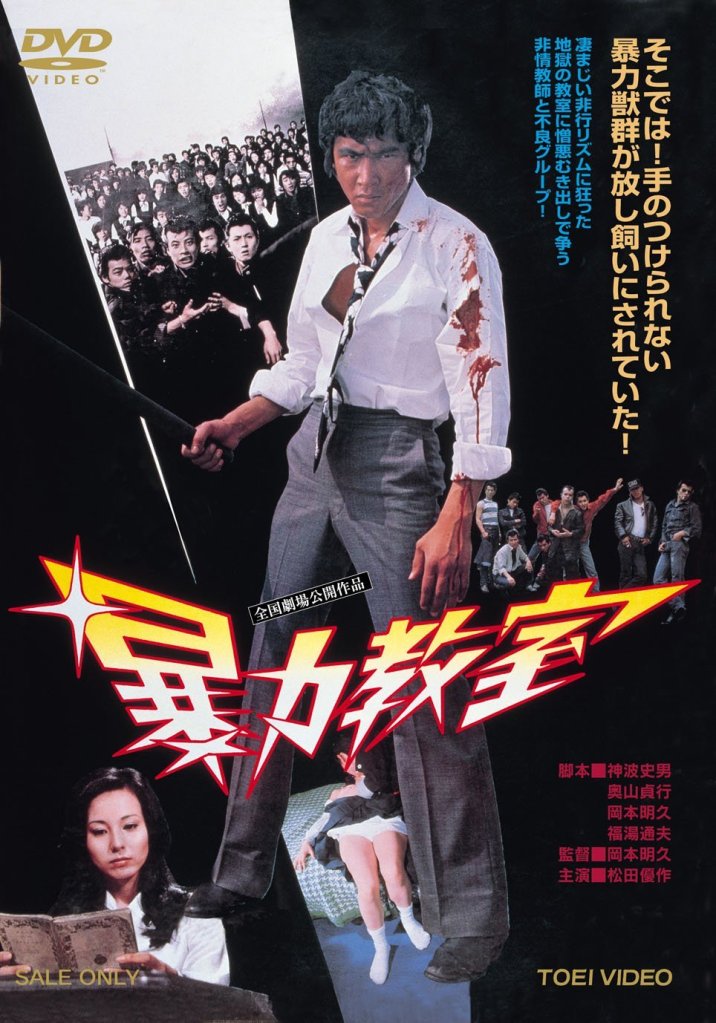
The Classroom of Terror (暴力教室, Akihisa Okamoto, 1976)

classroom of terrorWhen the teachers are as corrupt as the students are disruptive, society is going to wind up with a complex set of problems. Classroom of Terror (暴力教室, Boryoku Kyoshitsu) is, in some ways exactly what it sounds like – delinquents! Sex, drugs, fighting! etc but also subverts these aspects of the bad teen movie by turning the camera right back on the adults who are perpetuating this world of unruly adolescents. An early entry for action star to be Yusaku Matsuda, Classroom of Terror sees him cast in a recognisably manly role though one with a greater degree of nobility.
Mizoguchi is a rookie teacher at an ordinary high school with a falling reputation. Behind his back, the established teachers are virtually taking bets on how long he’s going to last with this “difficult” class that’s giving everyone grief. However, Mizoguchi is a tough, generally cool kind of guy, and he’s able to stand up to this rambunctious group of teenage boys pretty well.

That said, there’s a subset of “bousouzoku” biker gang kids in the school which seems intent on dominating not just the other kids but the entire infrastructure of the academy too. Led by Kitajo, the “Sidewinders” wear identical leather jackets with a snake on the back and all have rockabilly hairstyles which match their Brando-esque The Wild One attitudes. Delinquent doesn’t quite cover their activities and Kitajo in particular is not above seducing the principle’s daughter as part of a blackmail plot or even revenge raping the younger sister of an opponent. However, the kids are not the bad guys here as there’s an even bigger scandal going on in the school’s administration department and the Sidewinders, with Mizoguchi’s help, might be the only way to stop it.

Classroom of Terror mixes a number of genres together and then buckles them onto a typical kids gone wild delinquent movie. In actuality it has more in common with a yakuza crime pic as it turns out Mizoguchi is more or less a stooge brought in by the powers at be to quell rebellion but then realises he’s been working for the “bad guys” and switches sides. The Sidewinders operate more like rival gang, the area’s underdogs who definitely aren’t “good guys” but might be better than the corrupt administration that’s currently in place.

Of course, these guys are just teenagers and this is a school, not the back streets of some shady part of town. Mizoguchi’s class is boys only and extremely disruptive – bombarding a female teacher with paper aeroplanes made out of their test papers, developing a zip wire system to pass each other porn and just generally refusing to conform to any kind of expected behaviour. Kitajo in particular is seen to be rebelling against all kinds of authority thanks to an oppressive home environment controlled by his strict and violent father. When the older generation is shown to be corrupt as in the plot to defraud the school of money at the expense of its pupils, it’s the duty of youth to rebel and their refusal to follow the path that has been set down for them is in no way surprising.

A typical ‘70s exploitation picture, Classroom of Terror displays all the genre’s hallmarks from the swooping handheld camera shots, whip pans and zooms to the funky soundtrack. However, it does also fall into the unpleasantness associated with the lower end of these kinds of films in its use of rape as a plot device which takes on an unsavoury and salacious quality though the scenes themselves are not particularly graphic. Likewise, there is a fair amount of explicit nudity in the first half of the film during the seduction plot of the teenage daughter of the principal which is played for all its worth. Though not as sleazy as other examples of films of this kind, Classroom of Terror has a necessarily male viewpoint which runs close to generalised misogyny.

Perhaps most notable for providing early leading roles for Matsuda and also for Hiroshi Tachi who plays the leader of the Sidewinders and was at that time the lead singer of a popular rock group, The Cools, Classroom of Terror is a fairly typical youth gone wild movie though one which attempts to justify youth rebellion by pointing out the oppressive and hypocritical actions of the older generation. That said, it’s never entirely on youth’s side and the boys are very definitely unpleasant and out of control. Though the use of rape as a tactic is not exactly supported, it isn’t condemned either, rather just accepted as something that happens – but happens to men, largely, who lose face when “their” women are “damaged” by their enemies. Unpleasant yet often exciting in execution, Classroom of Terror is an interesting mix of exploitation genres though one which perhaps leaves a sour taste in the mouth.


Unsubbed trailer:

http://www.youtube.com/watch?v=dvPpGNHu2X8


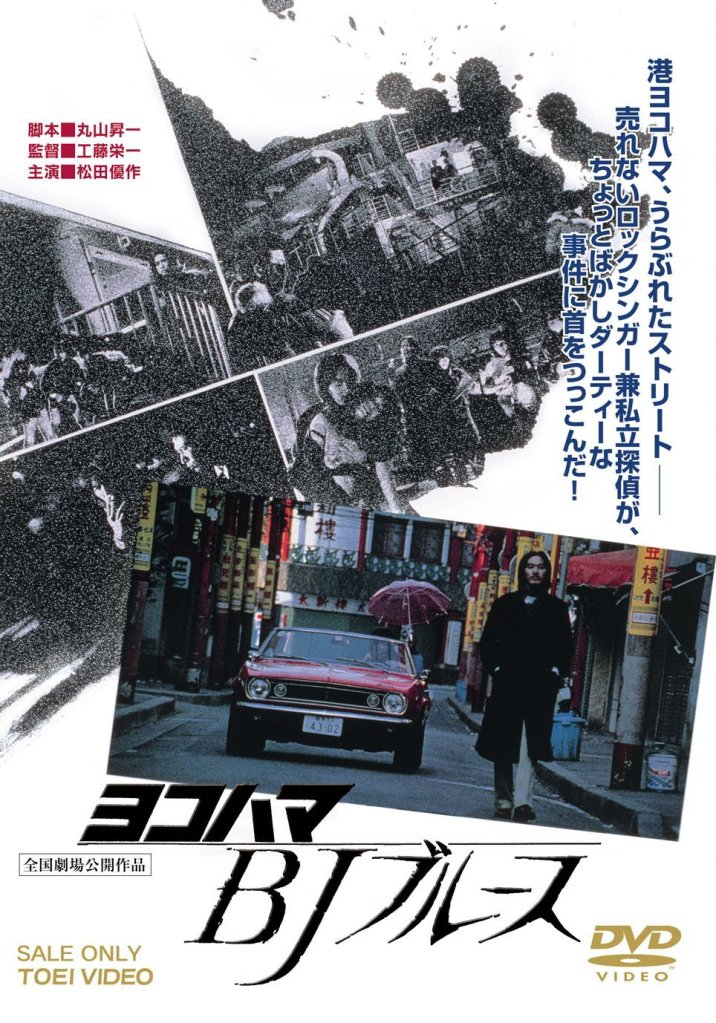
Yokohama BJ Blues (ヨコハマBJブルース, Eiichi Kudo, 1981)

Yokohama bj bluesYusaku Matsuda may have been the coolest action star of the ‘70s but by the end of the decade he was getting bored with his tough guy persona and looked to diversify his range a little further than his recent vehicles had allowed him. Matsuda had already embarked on a singing career some years before but in Eiichi Kudo’s Yokohama BJ Blues (ヨコハマBJブルース), he was finally allowed to display some of his musical talents on screen as a blues singer and ex-cop who makes ends meet through his work as a detective for hire.
After his set at a rundown jazz bar, BJ’s first job is tracking down a missing son. When he finds the guy, Akira, he seems to have become the employee (and possible sex slave?) of a gay gangster. Akira says he’s fine with his new life and wants his mother to leave him alone so BJ gets the hell out of there to give her the message but the unpleasantness of the situation lingers with him a little.

Shortly after, BJ receives a telephone call from an old police buddy, Ryo, who needs his help. Ryo got in too deep with the same gang BJ just came up against and is thinking of quitting the force in a bid to make the “Family” lose interest in him. However, Ryo is gunned down in broad daylight leaving his partner, Beniya, convinced that BJ is somehow responsible. BJ now doubly has it in for Family and starts working on his own behalf to try and find some answers and possibly a little vengeance too.

You see, back when Ryo and BJ were partners, they both liked the same girl, Tamiko, who eventually married Ryo. Beniya thinks BJ killed his friend to steal his wife and is much more interested in giving BJ a good kicking rather than investigating this very strange gang set up which seems to have some kind of drug smuggling gig going with the triads in Hong Kong.

BJ forms an odd sort of friendship with Akira in the hopes of tracking down the four gay, leather clad punk henchmen of Ali who probably gunned down his friend. However, the conspiracy only deepens and BJ finds himself suspecting even his closest of friends.

With its jazz soundtrack and melancholy tone, Yokohama BJ Blues is channelling hard boiled in a big way though does so in a distinctly modern fashion. BJ sings the blues whilst walking around this strange noir world which seems to endlessly disappoint him. Unfortunately for him, BJ is quite a good detective and quickly gets himself in way over his head only to end up finding out a few things it might be better not to know.

One of the film’s most notable components is its use of homoerotic themes with its gangs of gay gangsters, rent boys and punks. Indeed, though the wife of his former partner is floated as a possible motive, the love interest angle is never fully explored and all of BJ’s significant interactions in the film are with other men. Firstly his relationship with his former police partner Ryo which kick starts the entire adventure and then his strange almost date-like experience with Akira about half way through. BJ remains otherwise alone, a solo voice seeking justice for his fallen friends.

Of course, the film’s selling point is Matsuda’s singing so he’s allowed to play his own chorus in a sense by narrating the events from the stage in the form of the blues. Not quite “The Singing Detective”, but almost – BJ tries to bring some kind of order to his world by turning it into a song. In addition to adding to the noir tone, the bluesy soundtrack even allows for a New Orleans-esque musical funeral which oddly fits right in with the film’s weird, macabre atmosphere.

A surreal, noir inspired crime drama with musical elements, Yokohama BJ Blues is quite a hard film to categorise. Unusual for its homosexual milieu and overt homoerotic plotting the film occupies something of a unique place given its obvious marketing potential and star’s profile coupled with its decidedly murky noir tone. Difficult, yet interesting, Yokohama BJ Blues ultimately succeeds both as an intriguing crime drama and as a star vehicle for its versatile leading man.


This is a really, deeply, strange film.

Unsubtitled trailer:

http://www.youtube.com/watch?v=oYzkD-YJbjo

I actually quite like Matsuda’s foray into the world of jazz, the title song from Yokohama BJ Blues which is heard in the trailer is called Brother’s Song and is included on Matsuda’s 1981 album Hardest Day. Here he is on a talk show singing Yokohama Honky Tonk Blues:

http://www.youtube.com/watch?v=5Yr4fW2zoFk

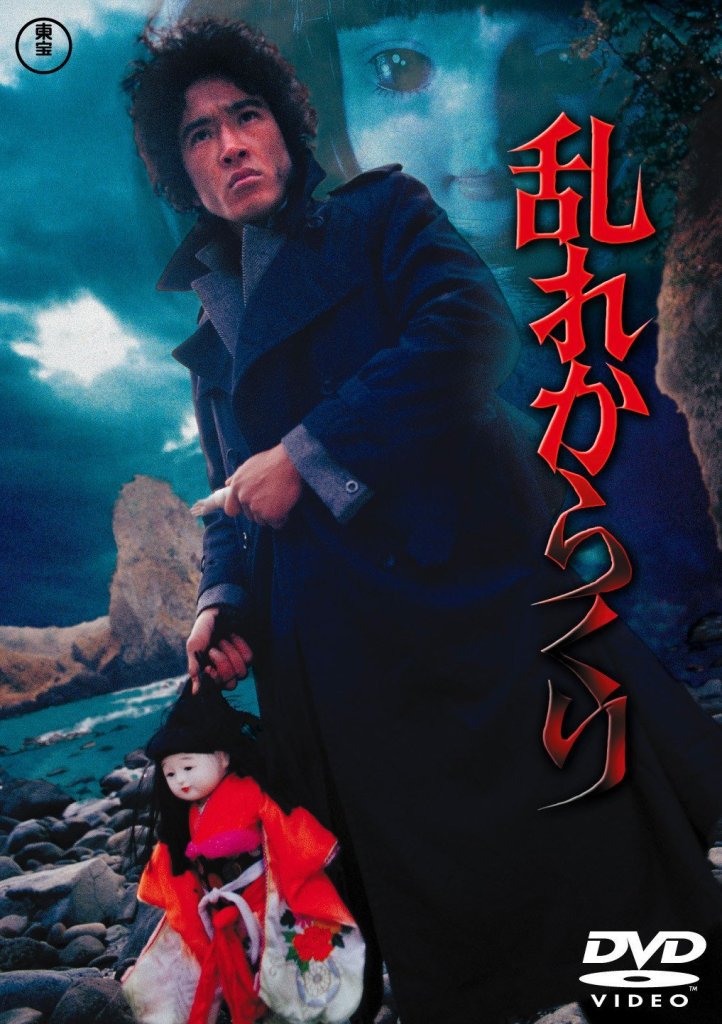
Murder in the Doll House (乱れからくり, Susumu Kodama, 1979)

murder in the doll houseYusaku Matsuda was to adopt arguably his most famous role in 1979 – that of the unconventional private detective Shunsaku Kudo in the iconic television series Detective Story (unconnected with the film of the same name he made in 1983), but Murder in the Doll House (乱れからくり, Midare Karakuri) made the same year also sees him stepping into the shoes of a more conventional, literature inspired P.I.
Toshio Katsu has had a bad day at the bicycle races, almost losing his entire salary before thinking better of it and retuning his last betting slips to buy himself some ramen. Originally hoping to write detective thrillers, Toshio had studied literature at university but later dropped out fearing he had no real talent as a writer. Spotting an ad for jobs at a P.I. firm he thinks it’s worth a shot. When he arrives at the Udai detective agency he finds it’s just one tiny office led by former police woman Maiko Udai. Being short on help, she hires Toshio right away and puts him to work on her number one case – investigating some interfamilial conflict at a top toy company. However, when their target is killed during a car chase, Maiko and Toshio find themselves trapped inside a maze of complicated tricks and devious puzzles.

Matsuda plays it a little straighter here as an, admittedly laid back, master detective with a knack for always being in the right place at the right time. The case at hand concerns an elderly toy magnate and his factory which is run by his son Soji as the president and his nephew Tomohiro as the manager of production. As might be expected there’s a fair amount of conflict between the two men which is exacerbated by an incident in which a series of racing cars the company was due launch had to be pulled following safety concerns leading Soji and Tomohiro to hold each other responsible for the failure. The old man wants the detectives to keep an eye on Tomohiro in case he decides to launch some sort of coup but just about everyone is acting suspiciously in this weird mansion which was built as some kind of folly with hundreds of built in tricks like a lakeside woodland labyrinth and secret underground passages. Oh, and there might even be some hidden Edo era treasure too. Before long people start dropping dead in increasingly bizarre ways.

In the best traditions of Japanese mystery stories which place fiendishly elaborate plots at their centre, Murder at the Doll House more than succeeds as a classic detective story. We’re presented with a set of strange occurrences which our master sleuth will explain to us in a long lecture at the end and even if one or two twists are a little obvious, the satisfaction involved in having figured them out ahead of time outweighs any kind of disappointment. Toshio may say he wants to be like Philip Marlowe but in actuality his detective is a little more in the European mould – almost like a more active Poirot or a slightly less obtuse Sherlock Holmes. Still, donning a trench coat with a turned up collar yet eschewing the classic hat which would have obscured his giant ‘70s perm, Matsuda once again turns in a very “cool” performance as super smart private eye.

Welcome to the Doll House isn’t quite as action packed as some of Matsuda’s other roles from this era even if it does have a genuinely thrilling finale. Making up for physical excitement with a more cerebral approach which mixes in a few horror tropes with the creepiness of the old house and “murder by doll” scenario, Murder at the Doll House makes for an enjoyably strange mystery adventure which also adds in a little quirky humour along the way for good measure.


Based on the novel by Tsumao Awasaka (not currently available in English).

Matsuda does some detecting (unsubtitled)

http://www.youtube.com/watch?v=mtQYeyZ6Juc


No Grave for Us (俺達に墓はない, Yukihiro Sawada, 1979)

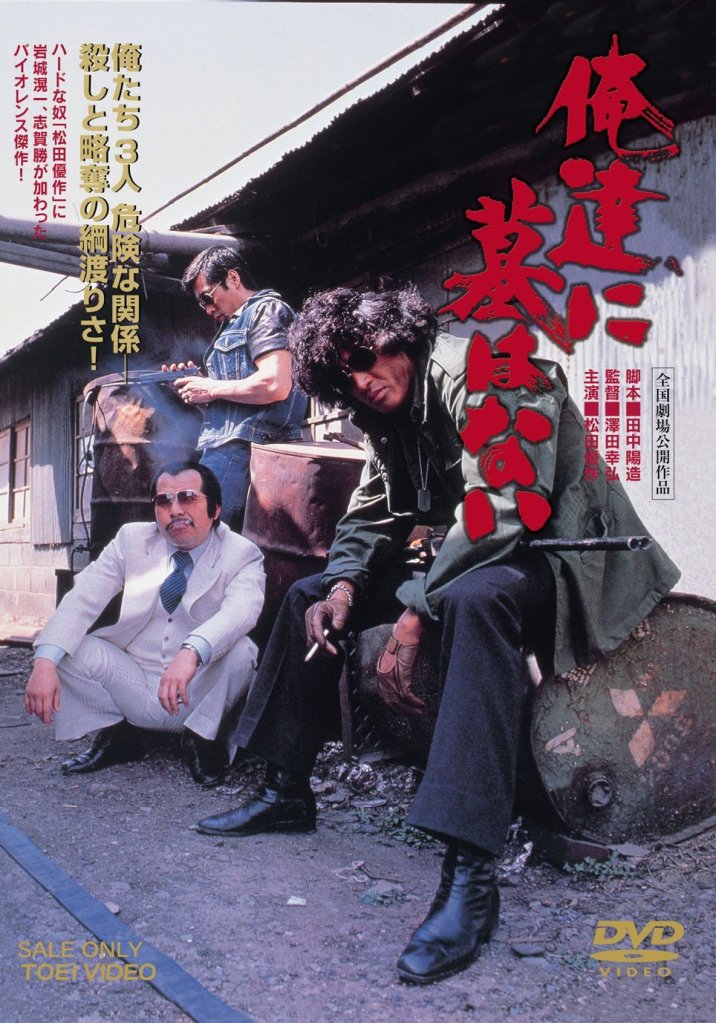
No Grave for Us posterThough he might not exactly be a household name outside of Japan, the late Yusaku Matsuda was one of the most important mainstream stars of the ‘70s and ‘80s. Had he not died at the tragically young age of 40 after refusing chemotherapy for bladder cancer to star in what would become his final film, Ridley Scott’s Black Rain, he’d undoubtedly have continued to move on from the action genre in which he’d made his name. No Grave For Us (俺達に墓はない, Oretachi ni Haka wa Nai) is fairly typical of the kinds of films he was making in the late ‘70s as he once again plays a cool, streetwise hoodlum mixed up in a crazy crime world where no one can be trusted.
The film begins with a humorous incident in which a man sets fire to a small parcel in the ladies’ area of a department store and loudly starts shouting about a bomb before using the resulting panic and chaos to calmly extract the money from the nearby tills. His plan is going perfectly except for one cashier who’s rooted to the spot, confused by the rat who lives under the counter who isn’t perturbed by the presence of a “bomb”. Shima makes off with his money and starts planning a new job which he plans to carry out with his longtime friend and brother in arms Ishikawa. The pair carry out a robbery on a rival gang but an ex-yakuza, Takita, tries to make off with the loot. Shima and Takita bond and agree to split the money but Ishikawa gets captured and subjected to humiliating treatment by the gangsters. The intrusion of Takita and of the resurfacing problematic shopgirl, Michi, slowly drive a wedge between the previously inseparable Shima and Ishikawa.

No Grave for Us is, as the title suggests, a noir inflected B-movie in which the lowlife punk Shima contends with the various trials and tribulations associated with a life of petty crime. Child of an uncaring society, he’s been in and out of trouble since adolescence. He met Ishikawa when the pair were both in reform school together, Shima for assault and Ishikawa for drug related offences. Shima is not a drug user and seems to disapprove of his friend’s habit but makes no great protest against it. When Michi turns up at Ishikawa’s bar (just by coincidence) she’s lost her job at the department store after being accused of taking the money that Shima stole. It turns out that she too is a junkie and has been living a life of dissipation since being picked up for prostitution during middle school. She fits right in with Shima and Ishikawa but, predictably, begins to prefer the more assured Shima to the loose cannon Ishikawa which begins to present something of a problem for the pair.

Shima and Takita originally reach an understanding based on a gangster code of honour which they both understand. Ishikawa aside, the pair would make a good team but their growing comradeship only adds to Ishikawa’s sense of insecurity causing him to take matters into his own hands with fairly disastrous consequences. A misunderstanding makes Takita and Shima mortal enemies putting an end to any kind of alliance that might have been possible. There’s no comradeship here, no true friendship. Every relationship is a possible betrayal waiting to take place, every warmth a weakness.

Director Yukihiro Sawada had mostly worked in Nikkatsu’s Roman Porno line other than co-helming Sogo Ishii’s first feature, Panic High School, the previous year but No Grave for Us is refreshingly light on exploitative content. There is some brief nudity but nothing particularly out of keeping for a regular studio picture of the time. Likewise, the fights are of a more realistic nature and bloodshed kept to a minimum. The look of the film is also very typical of its era though Sawada only rarely uses the extreme zooms which are the hallmark of ‘70s cinema opting for a more straightforward, often static, approach. The film’s jazz inspired score also helps to bring out its noir undertones as these three guys who could have been allies find themselves turning on each other for the most trivial of reasons.

In many ways there’s nothing particularly special about No Grave for Us save for being an excellent example of mainstream action cinema in the late ‘70s. The film is full of knowing references to other recent genre hits as well as popular culture of the time including a lengthy tribute to top idol group Pink Lady whose song Zipangu also features on the soundtrack, and has an all round “cool” sensibility to it that was no doubt very popular at the time of its original release. An enjoyable enough genre effort, No Grave for Us is an impressively handled slice of late ‘70s noir inspired B-movie action but perhaps has little else to recommend it.


Unsubtitled trailer:

and a clip of Pink Lady performing Zipangu, just because


Sorekara (それから, AKA And Then, Yoshimitsu Morita, 1985)

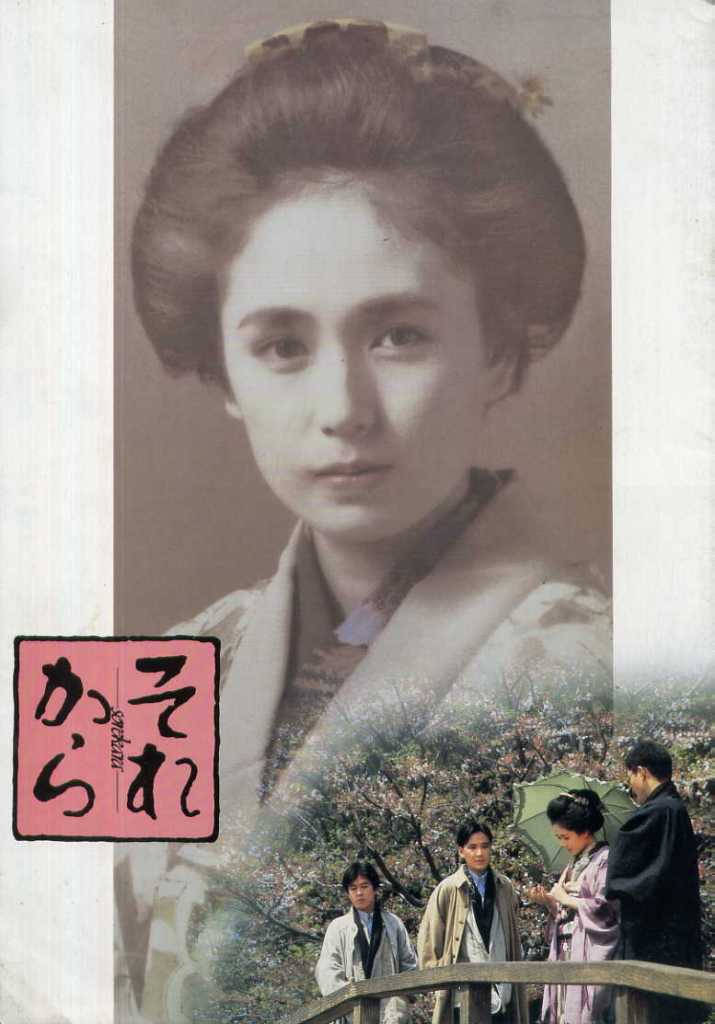
Sorekara PosterYoshimitsu Morita had a long and varied career (even if it was packed into a relatively short time) which encompassed throwaway teen idol dramas and award winning art house movies but even so tackling one of the great novels by one of Japan’s most highly regarded authors might be thought an unusual move. Like a lot of his work, Natsume Soseki’s Sorekara (And Then…) deals with the massive culture clash which reverberated through Japan during the late Meiji era and, once again, he uses the idea of frustrated romance to explore the way in which the past and future often work against each other.
Daisuke (Yusaku Matsuda) is a youngish man approaching early middle age. Thirty years old and a “gentleman” of leisure, he lives in a world of perpetual ennui where he even has to hold his hand to his chest to check that his heart is indeed still beating. His days might have gone on aimlessly had it not been for the unexpected return of an old friend from university, Hiraoka (Kaoru Kobayashi), who has been dismissed from his job following a series of problems with his superiors which has also landed him with a considerable debt to repay and no prospects of further employment. Adding to his sorrows, Hiraoka and his wife, Michiyo (Miwako Fujitani), have recently lost their infant child and have been told that due to Michiyo’s poor health they may not be able to have any more. Daisuke wants to help them, but he’s also facing a lot of pressure from his family to accept an arranged marriage which will further his father and brother’s prospects and is becoming conscious of the relative lack of freedom his life of dependent idleness entails.

Men of Daisuke’s era have perhaps had it hardest coming of age during a period of massive social change which is incomprehensible to the older generation. He’s a well educated man, an intellectual, who can speak several languages and is given to introspective contemplation, but he’s also inherited the worst of European classism as he’s come to believe that working for money is beneath his dignity as a gentleman. He’s completely unable to identify with his friend who needs to work to eat and enjoys none of the various safety nets which are provided by his own wealth and privilege. Nevertheless, he does want to try and help Hiraoka and is dismayed to discover just how little power he has do anything for him.

Hiraoka and Daisuke were part of a group of friends at university which also included another boy who, sadly, died of an illness and his sister – Michiyo, who eventually married Hiraoka. At the time, Daisuke himself had fallen in love with Michiyo but out of a misconceived idea of “chivalry” – another unnecessary adoption of European romanticism, he stepped aside in favour of his friend. This has proved to be a disaster all round and Michiyo and Hiraoka are trapped in an unhappy union which has made Michiyo physically weak and caused Hiraoka to spend the money he should be using to pay back his massive debts on drink and geisha so he can avoid going home. Daisuke’s adherence to a code of morality which is more affectation than anything else is shown up to be cowardice, another way of avoiding adulthood, as he uses his intellectual ideas to mask what is really a fear of rejection.

Daisuke later comes to believe what he did in not acknowledging his own feelings towards Michiyo was “a crime against nature”. He now finds himself at another crossroads as he faces the choice between conforming to the rigidity of his upperclass life in marrying the woman his father has chosen for him and continuing to be financially dependent, or embracing his individuality and striking out on his own to finally claim the woman he’s always loved (and, tragically, has always loved him). In choosing to make a life with Michiyo, Daisuke would be taking several transgressive actions – firstly acting against his own self image by entering the world of working men and secondly by stealing a married woman away from her husband which is no simple matter in the still relatively conservative Meiji era society.

Ultimately, the film is much more a story of Daisuke’s journey of self realisation than it is a melodrama with a love triangle at its centre though Sorekora certainly embraces these aspects too. Morita opts for a more classical tone here with a number of long, unbroken takes and static camera shots yet he also affects a strange, dreamlike tone in which the present and the past seem to co-exist, each drifting one into the other. He intercuts scenes which echo the film’s ending into the main body of the action as well as showing us the early days of Daisuke and Michiyo’s unresolved romantic connection which is poignantly brought out by an experimental technique in which the foreground appears almost like a freeze frame while the rain carries on falling behind them. At certain points there are also some surreal sequences in which Daisuke is travelling on a train but is surrounded by fellow passengers who suddenly each pull out a large sparkler or another where a gaggle of men all dressed just like him are crowded into the the other end of the train and looking at the moon through the open roof of the carriage.

A prestige picture, but one with a healthy dose of strangeness, Sorekara is an inexpressibly sad film full of the tragedy of wasted time and the regret that comes with not having acted in way which satisfies your authentic self. In order to live a life that’s true to himself Daisuke must finally learn to risk losing everything but the film’s ambiguous ending may ask whether the cost of following your heart may not be too heavy a one to pay.


Unsubtitled trailer:


The Family Game (家族ゲーム, Yoshimitsu Morita, 1983)

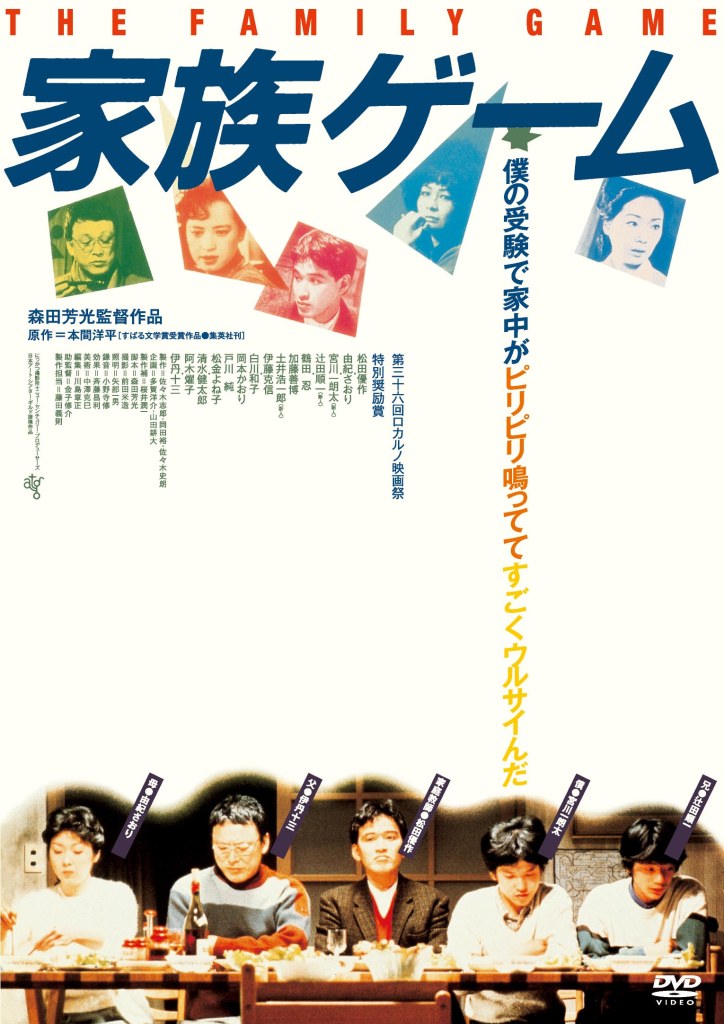
TFG_DVD_jk_ol“Why do we have to make such sacrifices for our children?”. It sounds a little cold, doesn’t it, but none the less true. Yoshimitsu Morita’s 1983 social satire The Family Game (家族ゲーム, Kazoku Game) takes that most Japanese of genres, the family drama, and turns it inside out whilst vigorously shaking it to see what else falls from the pockets.

The “ordinary” middle class Numata family consists of the salaryman father Kosuke, the regular housewife mother Chikako and their two sons – older brother Shinichi and younger brother Shigeyuki. Right now the focus of attention is very much on Shigeyuki as he approaches the difficult period of sitting entrance exams for high school. To be frank, Shigeyuki’s prospects are dismal. He ranks near the bottom of the class and though certainly bright has little interest in studying. Therefore, the family have decided to bring in a home tutor to help boost his grades. They’ve already tried several to no avail but have high hopes for Mr. Yoshimoto, a local university student, but little do they know that he’s going to end up teaching each of them a little more than they cared to learn.

Morita breaks down the modern family into its component parts and finds only archetypes representing the kinds of roles which are rigidly enforced by Japan’s conformist society. Let’s start with the “father” who is supposedly the head of the household yet barely has anything at all to do with it. He believes his role is simply to go to work and shout commands which his “family” are supposed to follow unquestioningly. His realm is everything outside the house, everything inside is the responsibility of his wife and he won’t in any way get involved with that. When he has a problem with the kids (and this problem will only be that they aren’t performing to expectation), he will tell his wife and she is expected to take care of it on her own. Of course, his authority is hollow and dependent on his family falling in with his preconceived ideas of their “individual” roles.

The wife, then, is more or less a glorified housekeeper in charge of domestic arrangements and expected to remain within the home. Barked at by her husband and treated like a servant by her own children, her existence is often a fairly miserable one. She remarks that she wishes she’d had her children later – there were so many things so wanted to do that now are denied her because she’s forced to “play the role” that’s expected of her as a wife and mother.

Of the two kids, the older brother, Shinichi, starts the film as the one who plays his pre-ordained role to the level that’s expected of him. He’s a bright boy who studies hard and got into the top high school no problem. As the film goes on and everyone’s obsessed with Shigeyuki, Shinichi’s mask begins to drop as he encounters various typically teenage phenomenons which interfere with his role as over achieving big brother.

Shigeyuki, however, refuses to play the game at all. He just does not care. He loves to get under people’s skin and takes pleasure in annoying or outsmarting them such as when he cons his mother into letting him skip school (his pancreas hurts!) which she lets him do probably knowingly because she’s still playing her role as the worried mother. Finally he only begins to study when he realises it annoys a fellow pupil when his grades improve.

When tutor Yoshimoto enters the picture he tears a great big hole through the centre of this perfect family photo. He starts by behaving very strangely with Mr. Numata by grabbing his hand and calling him “father” whilst leaning in far too close for a casual acquaintance. Similarly when he first meets Shigeyuki he leans right in and then remarks that he has “a cute face”. He proceeds to invade Shigeyuki’s physical space by regularly touching him to a degree which is odd for a teacher/pupil relationship and is almost a prelude to molestation. When Shigeyuki tries to troll him by filling pages of his notebook with the same word over and over again, Yoshimoto reacts coolly before punching him in the face. From now on, when Shigeyuki isn’t pulling his weight, he’ll get a bloody nose.

Gradually Yoshimoto begins to take over the parental roles of the household firstly by instigating the masculine discipline through violence that Mr Numata is never there to deal out as well as offering the original role of teacher/mentor which might ordinarily be found in a grandfather or uncle. Later he usurps the big brother’s place by trying to talk frankly about sex and teaching Shigeyuki how to defend himself against playground bullies which also helps the boy cement a friendship with a sometime rival. Finally, he takes on the maternal mantle too when Mrs Numata asks him to go down to the school and talk to Shigeyuki’s teachers on her behalf. By the time that his original mission is completed he’s well and truly infiltrated the household allowing him to, literally, overturn its sense of stability.

Morita’s screenplay is witty affair full of one liners and humour born of unusual frankness. Family is a fake concept which forces each of its members into predefined roles and is largely divorced from genuine feeling. What matters is the appearance of normality and the acquisition of status – i.e getting into the better university, not so much as a path to success but as a way of avoiding the embarrassment of not getting there. An absurdist social satire, The Family Game is a biting critique of the social mores of the early 1980s which punches a gaping hole through the foundation of traditional Japanese society.


Kagero-za 陽炎座 (Heat Haze Theatre – Seijun Suzuki 1981)

SuzukiKageroza1Zigeunerweisen was an unexpected commercial and critical hit in Japan netting both an improbably good box office return and more than a few awards. The next instalment in what would become Suzuki’s Taisho Roman Trilogy (though it would be another ten years before the final part, Yumeji, would arrive) therefore benefitted from a slighter bigger budget, bigger stars and even greater ambition. Like the others in the trilogy and as implied by its title, Kagero-za is once again based on a book set in the Taisho era though this time by Kyoka Izumi. Izumi was a novelist and kabuki playwright most closely associated with supernatural tales influenced by Edo era traditions and Kagero-za even features a playwright as its protagonist. With even less clarity than Zigeunerweisen, Kagero-za is not altogether as successful but nevertheless boasts Suzuki’s bizarre imagery and surreal world view.

Like Zigeunerweisen Kagero-za also throws dreams and reality into a giant melting pot with a non-linear narrative that floats and wefts like a strange nightmare. It begins with the central character, Matsuzaki (played by Yusaku Matsuda), meeting a lone woman near a shrine who asks him to accompany her to visit a friend in the hospital. She doesn’t want to go alone because she’s afraid of the old woman who sells charms and medicines there including bladder cherries which are said to contain the souls of women. Originally reluctant Matsuzaki agrees only to have her change her mind shortly after. Matsuzaki is pre-occupied over having dropped a love letter and worrying it’s been found by an ‘evil’ person – something which upsets his new friend as she’s convinced the letter was from a married woman.

This mysterious woman, it turns out, may be (or have been?) the wife of Matsuzaki’s wealthy patron Tamawaki. To make matters even more confusing, Tamawaki may have had two wives – the first a German woman he married while abroad and brought back with him to Japan who died her hair black and wore contact lenses to look more Japanese but regained her original blonde & blue eyed foreignness in the bright moonlight. The second is, apparently, dying in hospital – not that Tamawaki is terribly upset about it. Matsuzaki becomes increasingly obsessed with the mysterious woman, following her across the country only to discover Tamawaki waiting for him – apparently intent on witnessing a double suicide.

The film takes an even more surrealist dive towards the end as Matsuzaki finds himself the only adult audience member at a kabuki show entirely performed and witnessed by children. Not only that, this bizarre kabuki play appears to re-enact the exact same events from the first half of the film. A fitting trap for a playwright, this last, nightmarish section echoes the film’s ghost story origins complete with the creepy bladder cherry seller from the beginning as some kind of villainous demoness and Tamawaki as a tempting devil. Who talks of realism here? Says Tamawaki making an exit through an alleyway with a rifle on his shoulder. Who indeed? Not us, that’s for sure.

Even less coherent than Zigeunerweisen, Kagero-za is a veritable fever dream of a film. There’s barely any linear plot, Matsuzaki’s perceptions are recounted in fractured dream narrative where the true nature of events is always unclear. We can’t trust Matsuzaki to guide us here, nor can we trust Suzuki who employs fewer absurdist tricks than with the previous film but injects a heavy dose of kabuki inspired theatrics. Everything feels inevitable, like the action in a play it’s all been scripted and performed many times before. Yet for all that we don’t ever come to feel very much for Matsuzaki and his presumably tragic fate even though we realise fairly early on what sort of story this is. It’s hellish, and gruelling and honestly tries the patience at times but never achieves that sense of over arching dread that characterised Zigeunerweisen.

That said, if Kagero-za’s largest weakness is playing second fiddle to Zigeunerweisen that’s not so much of a problem. Once again filled with bizarre and trippy imagery, Kagero-za has many startling moments but fails to marry its visual virtuosity with the more individualistic focus of its script. Undeniably without the power of Zigeunerweisen, Kagero-za ultimately feels a little too clever (and perhaps too cold) for its own good but nevertheless does offer Suzuki’s visual flair and an entertaining (if baffling) narrative.