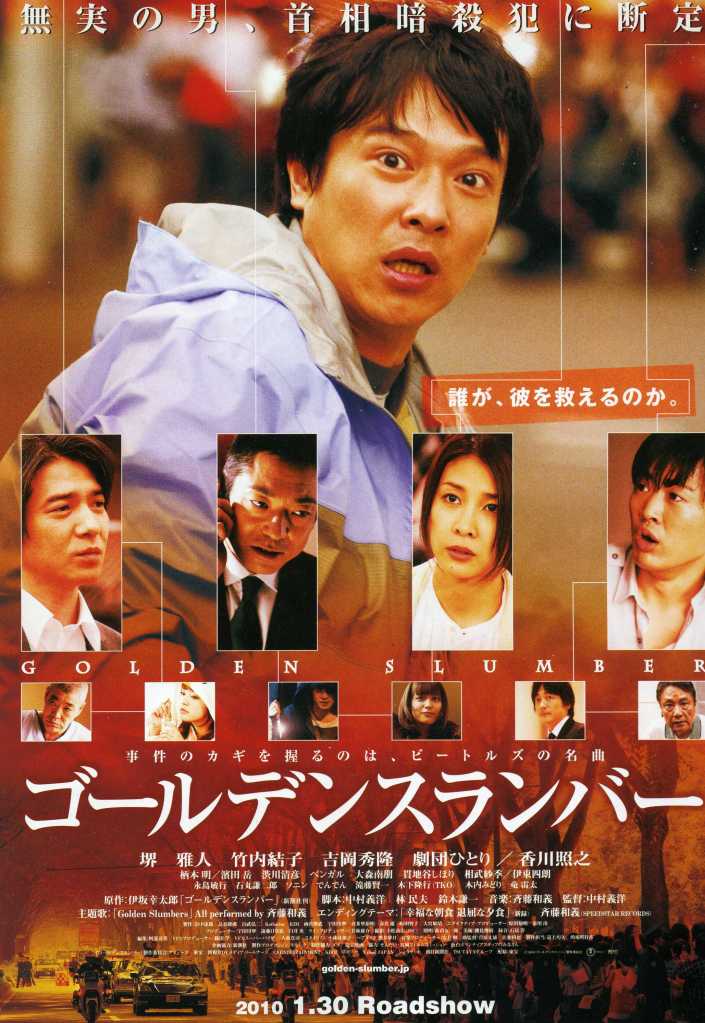
 Yoshihiro Nakamura has made a name for himself as a master of fiendishly intricate, warm and quirky mysteries in which seemingly random events each radiate out from a single interconnected focus point. Golden Slumber (ゴールデンスランバー), like The Foreign Duck, the Native Duck and God in a Coin Locker, and Fish Story, is based on a novel by Kotaro Isaka and shares something of the same structure but is far less interested in the mystery itself rather than the man who finds himself caught up in it.
30 year old delivery driver Aoyagi (Masato Sakai) is all set for a nice day out fishing with an old college buddy, Morita (Hidetaka Yoshioka), but he’s about to discover that it’s he’s been hooked and reeled in as the patsy in someone else’s elaborate assassination plot. After grabbing some fast food, Morita takes Aoyagi to a parked car near the closed off area through which the Prime Minster is due to be paraded in an open topped car. Waking up after a brief period of drug induced sedation, Aoyagi is made aware that this has all been a trick – badly in debt thanks to his wife’s pachinko addiction, Morita has betrayed him to a set of undisclosed bad guys with unclear motives and is taking this brief opportunity to give him as much warning as he can. Sure enough, a bomb goes off at the parade and Aoyagi just manages to escape before Morita too is the victim of an explosion.
Aoyagi is now very confused and on the run. Inexplicably, the police seem to have CCTV footage of him in places he’s never been and doing things he’s never done. If he’s going to survive any of this, he’s going to need some help but caught between old friends and new, trust has just become his most valuable commodity.
At heart, Golden Slumber is a classic Wrong Man narrative yet it refuses to follow the well trodden formula in that it isn’t so much interested in restoring the protagonist to his former life unblemished as it is in giving him a new one. The well known Beatles song Golden Slumber which runs throughout the film plays into its neatly nostalgic atmosphere as each of the now 30 year old college friends find themselves looking back into those care free, joyous days before of the enormity of their adult responsibilities took hold. That is to say, aside from Aoyagi himself who seems to have been muddling along amiably before all of this happened to him, unmarried and working a dead end delivery job.
As Morita tells him in the car, it’s all about image. The nature of the conspiracy and the identity of the perpetrators is not the main the main thrust of the film, but the only possible motive suggested for why Aoyagi has been chosen stems back to his unexpected fifteen minutes of fame two years previously when he saved a pop idol from an intruder with a nifty judo move (taught to him by Morita in uni) after fortuitously arriving with a delivery. Those behind the conspiracy intend to harness his still vaguely current profile to grab even more media attention with a local hero turned national villain spin. The Prime Minister, it seems, was a constantly controversial, extreme right wing demagogue with a tendency for making off the cuff offensive statements so there are those who’d rather congratulate Aoyagi than bring him to justice, but anyone who’s ever met him knows none of this can really be true despite the overwhelming video evidence.
Throughout his long odyssey looking for “the way back home” as the song puts it, Aoyagi begins to remember relevant episodes from his life which may feed back into his current circumstances. Although it seems as if Aoyagi had not seen Morita in some time (he knew nothing of his family circumstances, for example) his college friends with whom he wasted time “reviewing” junk food restaurants and chatting about conspiracy theories are still the most important people in his life. Not least among them is former girlfriend Haruko (Yuko Takeuchi), now married and the mother of a little daughter, who seems to still be carrying a torch for her old flame and is willing to go to great lengths to help him in his current predicament.
The film seems mixed on whether these hazy college days are the “golden slumber”, a beautiful dream time enhanced by memory to which it is not possible to return, or whether it refers to Aoyagi’s post college life which impinges on the narrative only slightly when he asks an unreliable colleague for help, aside from an accidental moment of heroic celebrity. It could even refer to the film’s conclusion which, departing from the genre norms, resolves almost nothing save for the hero’s neat evasion of the trap (aided by the vexed conspirators who eventually opt for a plan B). Once there might have been a road home – a way back to the past and the renewing of old friendships, but this road seems closed now, severed by the new beginning promised to Aoyagi who has been robbed of his entire identity and all but the memory of his past. Whether this means that the golden slumber has ended and Aoyagi, along with each of the other nostalgia bound protagonists, must now wake up and start living the life he’s been given, or that the old Aoyagi has been consigned to the realm of golden slumbers, may be a matter for debate.
Though the resolution may appear ultimately unsatisfying, the preceding events provide just enough interconnected absurdity to guide it through. During his long journey, Aoyagi is aided not just by his old friends but new ones too including a very strange young serial killer (Gaku Hamada) and a hospital malingerer with one foot in the “underworld” (Akira Emoto). It speaks to Aoyagi’s character that all of those who know him trust him implicitly and are ready to help without even being asked (even if they occasionally waver under pressure), and even those who are meeting him for the first time are compelled to come to his defence. An elliptical, roundabout tale of the weight of nostalgia and inescapability of regret, Golden Slumber is the story of a man on the run from his future which eventually becomes a net he cannot escape.
Original trailer (English subtitles – select via menu)
 Tony Leung Chiu-wai may have just won a best actor prize in Cannes, but that didn’t stop him getting right back on the HK treadmill with the run of the mill rom-com, Fighting for Love (同居蜜友). Reuniting director Jack Ma with Feel 100% star Sammi Cheng, Fighting for Love is the kind of wacky, thrown together romantic comedy that no one really makes any more (not that that’s altogether a bad thing). Still, even if the film is over reliant on its two leads to overcome the overabundance of subplots, it also makes use of their sparky chemistry to keep things moving along.
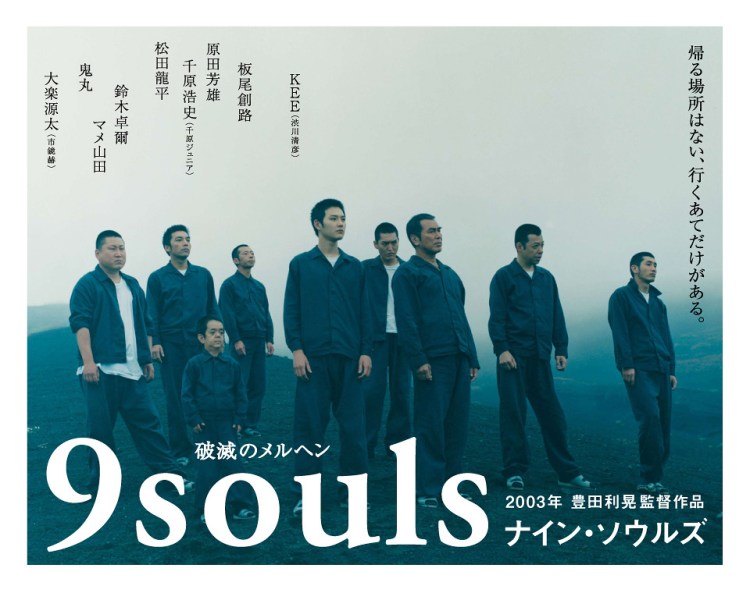 Toshiaki Toyoda has never been one for doing things in a straightforward way and so his third narrative feature sees him turning to the prison escape genre but giving it a characteristically existential twist as each of the title’s 9 Souls (ナイン・ソウルズ) search for release even outside of the literal walls of their communal cell. What begins as a quirky buddy movie about nine mismatched misfits hunting buried treasure whilst avoiding the police, ends as a melancholy character study about the fate of society’s rejected outcasts. Continuing his journey into the surreal, Toyoda’s third film is an oneiric exercise in visual poetry committed to the liberation of the form itself but also of its unlucky collection of reluctant criminals in this world or another.
 To date, Toshiaki Toyoda has released only one feature length documentary. Unchain (アンチェイン), the story of four boxers from Toyoda’s own home town of Osaka, was released between his debut feature,
  Looking back, at least to those of us of a certain age, the late ‘90s seem like a kind of golden era, largely free from the economic and political strife of the current world, but the cinema of that time is filled with the anxiety of the young – particularly in Japan, still mired in the wake of the post-bubble depression. Toshiaki Toyoda’s Pornostar (ポルノスター, retitled Tokyo Rampage for the US release) (not quite what it sounds like), is just such a story. Its protagonist, Arano (Chihara Junia, unnamed until the closing credits), stalks angrily through the busy city streets which remain as indifferent to him as he is to them. Though his wandering appears to have no especial purpose, Arano seethes with barely suppressed rage, nursing sharpened daggers waiting to plunge into the hearts of “unnecessary” yakuza.
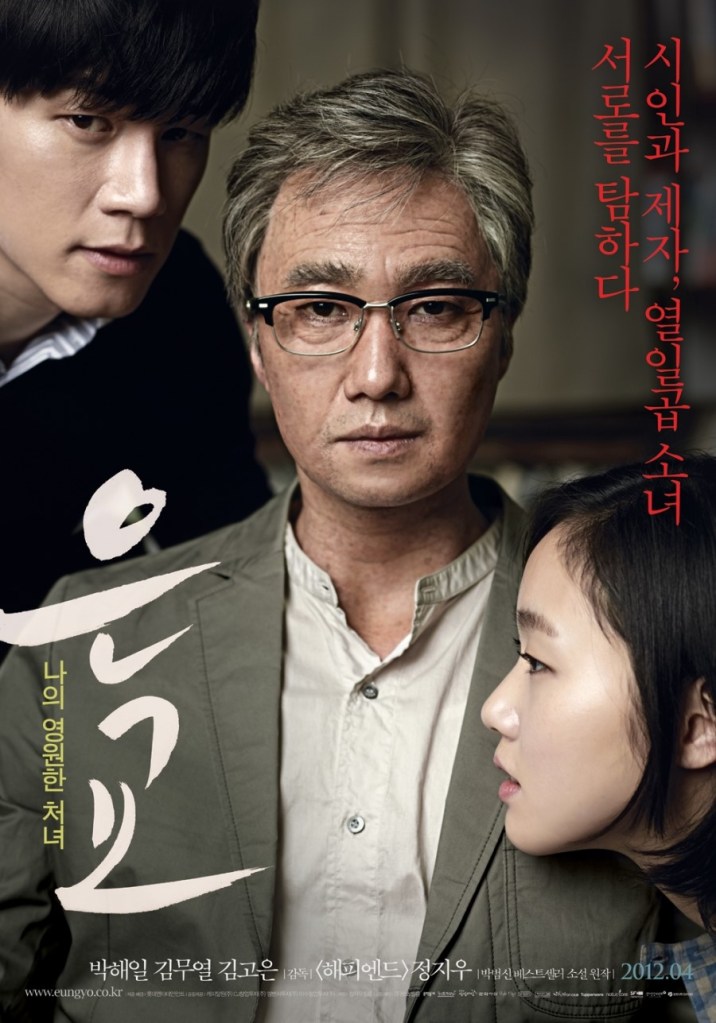 Stories of old men trying to recapture their lost youth through projecting their fantasies onto pretty young women are not exactly rare and the protagonist of Jung Ji-woo’s Eungyo ( AKA A Muse, 은교) is just as aware as most that his dreams of youthful romance border on the ridiculous. A tale of loss, nostalgia, and jealousy both professional and personal, Eungyo is a poetic exploration of the burdens and benefits of age which are often invisible to those who can only look forwards.
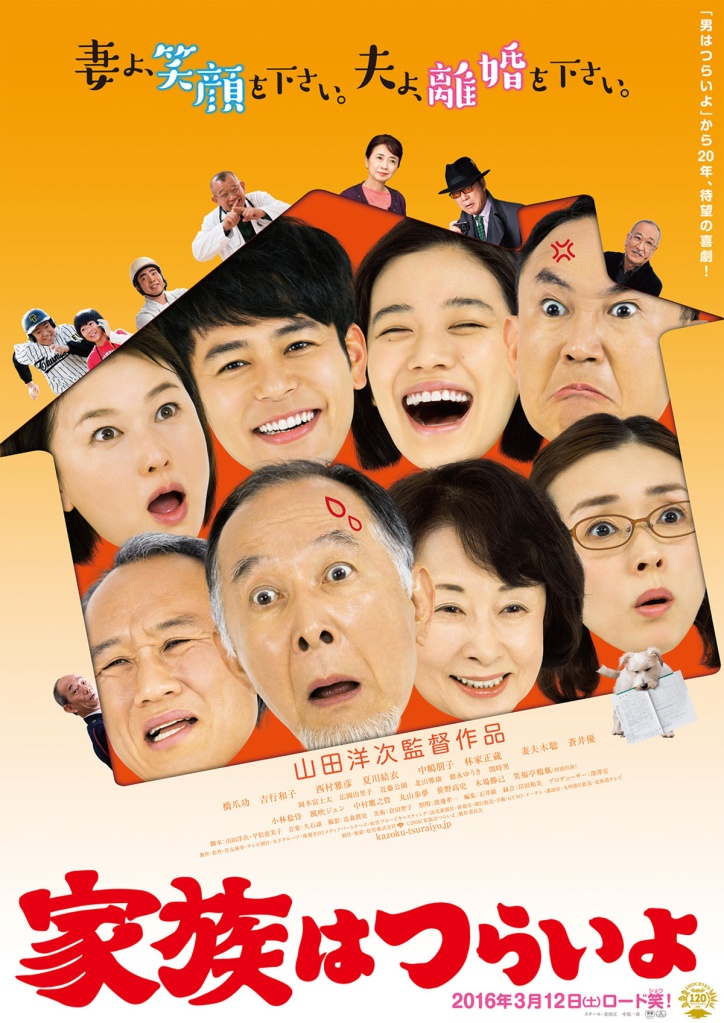 Prolific as he is, veteran director Yoji Yamada (or perhaps his frequent screenwriter in recent years Emiko Hiramatsu) clearly takes pleasure in selecting film titles but What a Wonderful Family! (家族はつらいよ, Kazoku wa Tsurai yo) takes things one step further by referencing Yamada’s own long running film series Otoko wa Tsurai yo (better known as Tora-san). Stepping back into the realms of comedy, Yamada brings a little of that Tora-san warmth with him for a wry look at the contemporary Japanese family with all of its classic and universal aspects both good and bad even as it finds itself undergoing number of social changes.
 Before Seijun Suzuki pushed his luck too far with the genre classic
 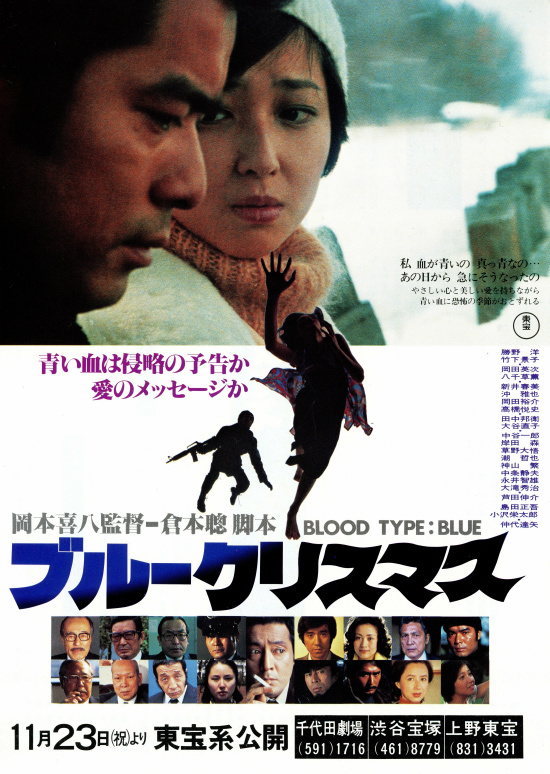 The Christmas movie has fallen out of fashion of late as genial seasonally themed romantic comedies have given way to sci-fi or fantasy blockbusters. Perhaps surprisingly seeing as Christmas in Japan is more akin to Valentine’s Day, the phenomenon has never really taken hold meaning there are a shortage of date worthy movies designed for the festive season. If you were hoping Blue Christmas (ブルークリスマス) might plug this gap with some romantic melodrama, be prepared to find your heart breaking in an entirely different way because this Kichachi Okamoto adaptation of a So Kuramoto novel is a bleak ‘70s conspiracy thriller guaranteed to kill that festive spirit stone dead.
 Based on the contemporary manga by the legendary Fujiko F. Fujio (Doraemon), Future Memories: Last Christmas (未来の想い出 Last Christmas, Mirai no Omoide: Last Christmas) is neither quiet as science fiction or romantically focussed as the title suggests yet perhaps reflects the mood of its 1992 release in which a generation of young people most probably would also have liked to travel back in time ten years just like the film’s heroines. Another up to the minute effort from the prolific Yoshimitsu Morita, Future Memories: Last Christmas is among his most inconsequential works, displaying much less of his experimental tinkering or stylistic variations, but is, perhaps a guide its traumatic, post-bubble era.
