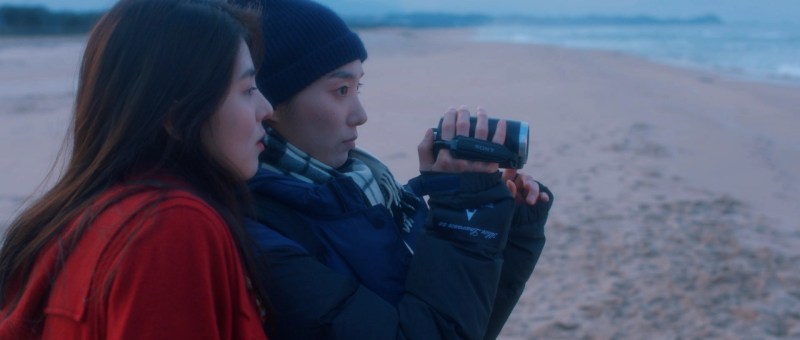
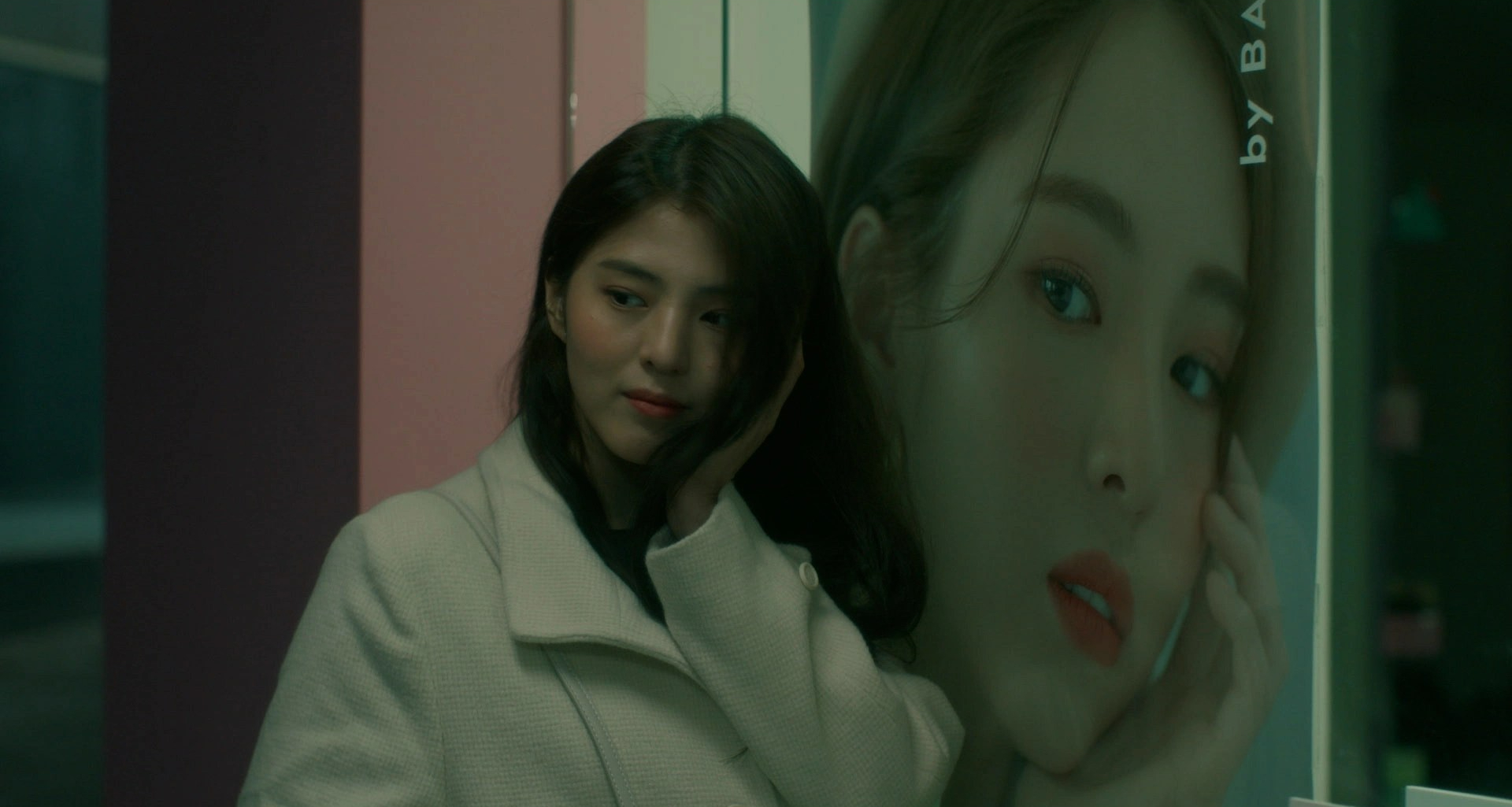
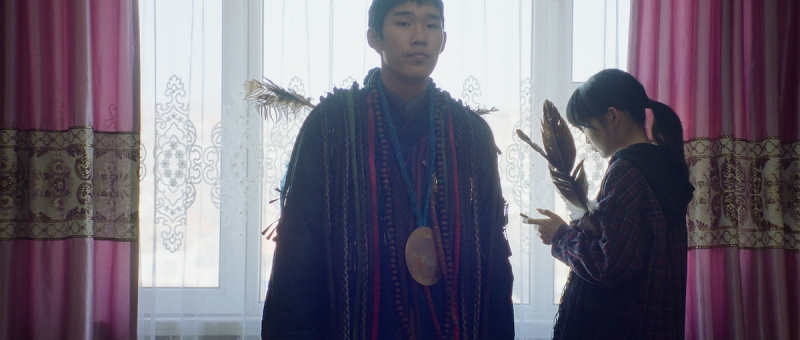
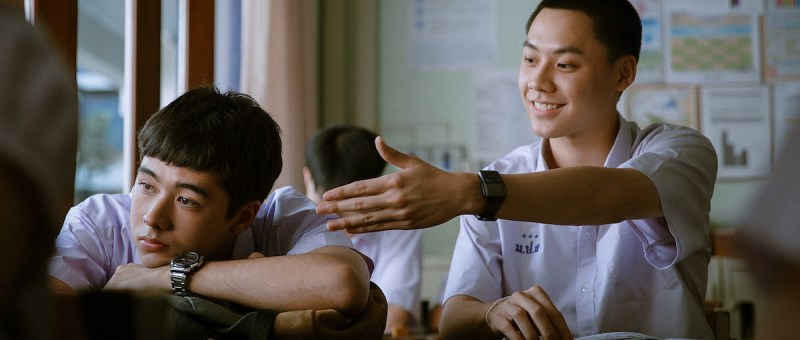
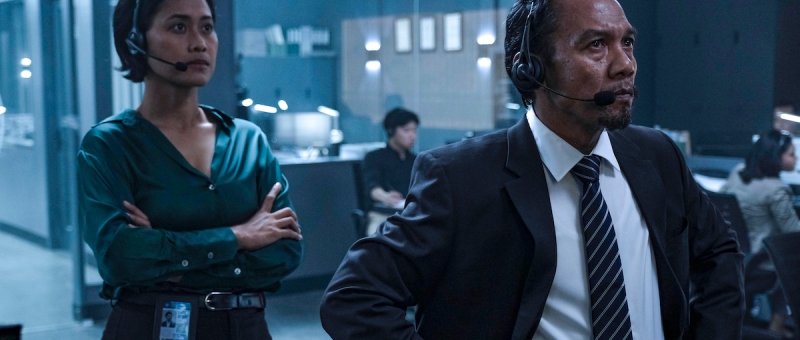
Shadow of Fire (ほかげ, Shinya Tsukamoto, 2023)

The ruins of a firebombed city become a purgatorial space haunted by tortured souls who cannot escape the traumatic wartime past in Shinya Tsukamoto’s eerie voyage through post-war Japan, Shadow of Fire (ほかげ, Hokage). Even the small boy (Ouga Tsukao) who desperately looks for a place to belong is plagued by nightmares of the flames that took his home and family while it otherwise seems that those around him live their lives in the shadow of a war which for many is still far from over. 

This state of ruination is immediately brought home to us by the heightened presence of sound. Not only do the cicadas buzz amid the scorching heat of an oppressive summer, but we constantly hear the sound of people walking over rubble or the clinking of broken glass. The unnamed woman we first meet (Shuri) lives in a room behind a small bar which appears to have scorch marks across the fusuma, a dank and dingy place filled with hopelessness and despair. The woman herself has a vacant look, a little dead behind the eyes either numbed with the sake a neighbourhood man brings her as pretext for extracting sexual favours or simply too tired of life to think much about it. Though she technically runs a bar, it’s more of a front for her only means of supporting herself, casual sex work, though as later becomes apparent she too may have been slow poisoned not only by the war but it’s immediate aftermath and the lingering traumas of those left behind and those who returned. 

The boy who eventually comes to stay with her remarks that those who did not come back did not turn into scary people, as if they were somehow lucky to have escaped this purgatorial hellscape. Later he wanders through the black market and discovers an abandoned tunnel filled with returned soldiers who stare out at him with vacant eyes sitting with eerie stillness like dormant zombies. He spots a man among them that he knew well, a young soldier (Hiroki Kono) who had been a teacher before he was drafted and took a maths textbook with him to war as a kind of talisman that reminded him he’d survive and teach again. The soldier had formed an odd kind of family unit with the woman and the boy, almost as if the husband she lost in the war and son who died in the firebombing, had been returned to her but his trauma refuses to set him free surfacing in moments of unexpected violence that hint at war’s realities. 

Later the boy meets another man with a traumatic past though one who sees himself as both victim and villain, resentful towards himself and the militarist regime that convinced him to betray his humanity and do dreadful, terrible things in its service. Tellingly this man, Shuji (Mirai Moriyama), is the only one granted a name. Perhaps names are only for the living, there’s a part of Shuji that is painfully alive a way that others aren’t even as he fixes his sights on his revenge as if it would somehow restore the humanity that was taken from him. Completing his quest, he lets down his hair and proclaims that for him at least the war is finally over. His commander, meanwhile, appears to have been living a fairly nice and successful life reminding him that he should stop dwelling on the past because it was after all a war and such things are only to be expected.

Shuji uses the boy in a way that seems counterproductive, taking advantage of the gun he’d found to help him take revenge on war. The woman tries to change the boy’s path, instructing him not to steal but to work honestly for his pay and to try to be better than this infinitely corrupted world. He wanted to be her protector, in his way acting as guide trying to free those around him from the purgatorial space of ruin and destitution but when he asks a medicine seller if he can exchange his money for something that will cure sickness he is told it’s not enough. He then tries to buy a dress for the woman, as if anticipating the salvation through consumerism that will eventually arrive though the constant sound of gunshots from the black market might indicate that for some at least there’s only one way out. The old man who visits the woman explains that he only approaches the ones who look okay, but that in the end you never really know. Shot in the half light or caught from behind the previously friendly take on an almost demonic intensity, wandering ghosts or broken souls already half consumed by the flames that in their minds at least are still burning and casting their shadows over the scorched earth of a traumatised society.


Shadow of Fire screened as part of this year’s Japan Foundation Touring Film Programme.

International trailer (English subtitles)

Undercurrent (アンダーカレント, Rikiya Imaizumi, 2023)

Part way through Rikiya Imaizumi’s adaptation of the Testuyua Toyoda manga Undercurrent (アンダーカレント) a detective asks his client what she thinks it means to “understand” someone. Of course, she doesn’t really have an answer, and the film seems to suggest there isn’t one because we are forever strangers to ourselves let alone anyone else. We do things without knowing why or that somehow surprise us, while the actions of others can an also be be worryingly opaque. But then perhaps you don’t really need to “know” someone in order to “understand” them and as someone else later says perhaps it’s true enough that most people don’t really want the truth but a comforting illusion. 

But then Kanae’s (Yoko Maki) illusions aren’t exactly comforting. Her husband of four years Satoru (Eita Nagayama) suddenly disappeared during a work trip a year previously and has not been heard from since. She turns the television off when the news announces details of a decomposing body discovered near a set of electrical pylons, but on another level she’s sure that Satoru is alive and chose to leave her for reasons she can’t understand. Kanae tells a friend that what pains her most is thinking that in the end she wasn’t a person Satoru felt he could share his worries with so she was powerless to help him. Then again, there’s something in Kanae that is equally closed off, a little distant and otherworldly as if she were also putting up a front to keep her true self submerged.

The detective (Lily Franky), whose name is “Yamasaki” yet allows people call him “Yamazaki” because it’s easier for them, says of Satoru that his “cheerful,” ever smiling nature may also have been a kind of masking designed to dissuade people from looking any deeper. Someone else admits that they lied mostly to fit in, be what others wanted them to be, only to be caught out by the gulf between their genuine feelings and and the ever expanding web of their lies. Caught in a kind of suspended animation uncertain if Satoru will ever return and if and how she should continue with her life, Kanae ends up taking in a new assistant at her family bathhouse. Hori (Arata Iura) is the polar opposite of the way her husband is described, silent, soulful and somehow sad. We might be suspicious of him, his arrival seems too coincidental and the way he looks at some children running past in the town perhaps worrying. Yet how can we judge based only on his silence knowing nothing else of his history? Nevertheless, he may understand Kanae much better than anyone would suspect and may be the comforting presence from her recurring nightmares.

In her dreams, she’s plunged into water with a pair of hands around her neck. Unknowingly, Hori asks her if she’s ever really wanted to die and she can’t answer him even if it seems to us that the dreams reflect her desire for death, to be submerged in a sea of forgetfulness. Yet we later learn they come to have another meaning reflecting her long buried trauma and the reason for her own listlessness. These are the undercurrents that run silently through her, waves of guilt and grief that obscure all else. Disappearances have happened around her all life and seem only to increase, another bath house owner seemingly disappearing after a fire having promised to sell her his boiler. Yet through her experiences, she comes to fear them less reflecting that anyone could leave at any moment and that’s alright, as Hori had said nothing’s really forever. 

Even so, she regrets that there couldn’t have been more emotional honesty from the beginning then perhaps no one would need to disappear without a word. Confessions are made and the air is cleared. Someone had said that no one wanted the truth, but it seems Kanae has chosen it as perhaps symbolised in her decision to call Yamasaki by his actual name rather than the one he allows people to use because it’s too much trouble to correct them. Aside from his multiple names, Yamasaki is a strange man who holds meetings in karaoke boxes and theme parks though perhaps because he simply thinks Kanae could use a little cheering up. In more ways than one, it’s the ones left behind who are left in the dark, but they may be able to find their way out of it with a little more light and reflection.


Screened as part of this year’s Japan Foundation Touring Film Programme.

Original trailer (English subtitles)

Twilight Cinema Blues (銀平町シネマブルース, Hideo Jojo, 2023)

Japan’s mini theatres have been in a status of crisis since the pandemic. Already struggling under the weight of changing times the immediate restrictions pushed many over the edge unable to entice older regulars back into screens or find a new audience among the young. This is doubly bad news for the industry as a whole as it’s mini theatres that allow indie films the platform they need to succeed and without them there is little avenue for films produced outside of the mainstream. Like Lim Kah-Wai’s Your Lovely Smile, Hideo Jojo’s Twilight Cinema Blues (銀平町シネマブルース, Ginpeicho Cinema Blues) similarly extols the virtues of the mini theatre which is not just somewhere to watch films but a place to belong that has room for anyone and everyone that wants to be there.

That’s more than true for Takeshi (Keisuke Koide), a struggling man approaching middle age who’s become near destitute and is almost sucked into a welfare scam targeting the homeless by a pair of shady yakuza claiming they run an NPO. At the orientation he runs into Kajiwara (Mitsuru Fukikoshi ), the owner of a mini theatre who declines to join the gangsters’ scheme but offers Takeshi the opportunity to bunk in his storeroom while working part-time little knowing that to Takeshi this particular mini cinema is like a return to source allowing him to rediscover his love of film.

But the mini cinema itself is also struggling. They simply don’t get bums on seats and Kajiawa is behind on paying his staff. Though they have a small collection of regulars, they aren’t enough to keep the lights on on their own. Even the projectionist is thinking he’ll probably retire along with the machine. Unable to afford new films, Kajiawara relies on cheap and easily licensable classics such as old favourite Casablanca but is largely unable to see away out of his situation while feeling guilty over ending what was effectively a family business and local landmark. The building’s 60th anniversary, 60 being a symbolic number in Japanese culture as it represents a full turn of the Chinese zodiac and literal new start, presents an opportunity to both Kajiawara and Takeshi to begin to move forward by renewing their faith in cinema.

The faith of Takeshi’s homeless friend Sato (Shohei Uno) needed no renewing. Though he had nothing, the ability to see a film twice a month made him feel human while the community at the cinema is perhaps the only one that still accepts him. He offers a small prayer after every film, and instructs Takeshi that he should the same. But his openhearted faith is also his undoing, allowing him to fall for the yakuza scam little realising they’ll force him to work for them taking half of the social security payments they helped him sign up for in the process. In the outside world, men like Sato find only exploitation and prejudice with cinema their only refuge.

Then again, filmmaking isn’t easy. A young woman who desperately wanted her debut film to play in her hometown cinema has based her first feature on the life of her father, a failed film director who drank himself to death (in a neat allusion to Oshima’s Cruel Story of Youth, her film’s title literally translates as “cruel story of a director”). Similarly, the suicide of a much loved assistant director has prevented those around him from moving on, preoccupied with the shock his death caused them in its suddenness and lack of obvious cause. They blame themselves sending their lives into a downward spiral that results in crushing financial debts and the end of a marriage. In some ways, the film is an ode to the ADs who keep everything running, including on occasions the director, and are in a sense the custodians of filmmaking.

Still, it’s clear that not everything can seamlessly repaired. Times have moved on even if some have been left behind and you can’t always simply reclaim what you’ve lost, but you can always start again with another spin of the wheel and make the most of what you’ve got. It won’t be the same, but that doesn’t mean it won’t be good. Jojo’s heartwarming tale of cinema has an undercurrent of darkness and despair running beneath, but also suggests that the silver screen can be a beacon hope when the world is at its bleakest and not least for those whose existence largely lies behind it.


Screened as part of this year’s Japan Foundation Touring Film Programme.

Original trailer (English subtitles)

The Boy and the Heron (君たちはどう生きるか, Hayao Miyazaki, 2023)

Sales of Genzaburo Yoshino’s 1937 novel How Do You Live? (君たちはどう生きるか, Kimitachi wa Do Ikiru ka? went through the roof when it was announced that the no longer retired Hayao Miyazaki would be directing a new film with the same title. Predictably, Miyazaki’s film turned out not to be an adaptation at all, or at least not a literal sense, but was intensely interested in the question not so much how do you live but how will you? Will you allow the past to make you bitter and live in a world of pain and resentment, or will you choose to live in a world of peace and beauty free of human malice?

These are of course the questions faced by a post-war generation, the children of Miyazaki’s own era who came of age in a time of fear and suffering. Mahito (Soma Santoki), the hero, loses his mother in the firebombing of Tokyo. He runs through a world of shadows to save her from the flames but of course, he cannot. A year later everything has changed. His father has remarried, taking his mother’s younger sister Natsuko (Yoshino Kimura) as his new wife. Natsuko is now pregnant which suggests the relationship began some time ago though Mahito knew nothing of it and had no recollection of ever having met Natsuko before being sent to live in her giant mansion in the country more or less untouched by the war. 

It’s here that Mahito’s own malice rises. He is polite, if sullen, but cannot warm to his new stepmother and resents his father’s relationship with her. Perpetually bothered by a grey heron (Masaki Suda) his first thought is to kill it, crafting a bow and arrow from bamboo and one of the heron’s own feathers. Shunned as the new boy at school he hits himself on the head with a rock while his father, Shoichi (Takuya Kimura), comically vows revenge and lets him stay home. As he points out, there’s not much “education” going on anyway with most of the students pulled away from their studies for “voluntary” labour in service of the war effort in this case agricultural. 

Shoichi has moved to the country to open a factory which it seems produces canopies for fighter planes which is all to say that he is profiting from the business of war, though transgressively referencing the failure in Saipan over breakfast with the mild implication that it might work out alright for him. There is after all a grim reason they’ll be in need of large numbers of aircraft parts in the near future. Mahito’s dark impulses are directly linked to those of militarism and the folly of war. When he finally enters the tower of madness apparently constructed by a great-uncle who went insane through reading too many books, he discovers that his enemies are an ever expanding clan of fascistic, man-eating parakeets led by a Mussolini-like despotic leader attempting to manipulate the Master of the tower. 

Inside the tower is a land out of time, a place for those already dead or in essence an eternal past. It’s here that Mahito is presented with a choice, how will he live? Will he choose malice and destruction, or will he choose to leave and build a new world of beauty and peace above? In many ways, the important point is that the choice is his as it is ours, that we are free to decide and that our choices create the world in which we live. Through his adventures in the tower, Mahito begins to come to terms with his situation and resolves to accept Natsuko as a mother and make friends of those he once considered enemies. When the tower itself crumbles, it takes with it the last vestiges of authoritarianism and tyranny.

Prompting his epiphany, Mahito discovers a copy of How Do You Live? in his room, a present from his late mother inscribed to the grown-up Mahito. He is surrounded by the world’s ugliness, forced into a surprisingly graphic fish gutting session that leaves him wiping away blood, recalling his profusely bleeding head injury and the scar it will forever mark him with. Pelicans imprisoned in the other world meanwhile tell him that they have no choice but to behave as they do for the Master of the Tower neglected to put enough fish in the rivers intending them to destroy rather nurture new life while their young too learn all the wrong lessons. Yet there is beauty and strangeness here too, along with kindness and humanity. Boundlessly inventive, Miyazaki couples surrealist visions of murderous birds and the hellish scenes of a city on fire with Mahito the only figure visible in his pale blue school uniform darting through the soot and the shadows. A vivid symphony of life, the film may in its way be about grief and the pain of moving on but finally discovers a kind of serenity in an accommodation with the present and the eternally unfinished question of how you yourself will live. 


The Boy and the Heron screened as part of this year’s BFI London Film Festival.

Iron Mask (만분의 일초, Kim Sung-hwan, 2023)

A young man seeking revenge sets his eyes on kendo glory in Kim Sung-hwan’s sporting drama Iron Mask (만분의 일초, Manbun-ui Ilcho). As his coach reminds him, a swordsman’s only opponent is himself though he continues to fixate on the man he blames for the destruction of his family still as an adult seeking reparation for the paternal influence he feels was stolen from him and the right to a legacy he feels to be rightfully his.

That might be one reason Jae-woo (Joo Jong-hyuk) is sometimes taken to task for his “entitlement” while some of the other students attending this training camp in the hope of making it onto the national team think he shouldn’t even be here seeing as he only came second in a regional competition when the others are veteran champions. But then as it turns out, Jae-woo has an ulterior motive for his participation. He is obsessed with number one challenger Tae-su (Moon Jin-seung) but for reasons outside of the sport, apparently hellbent on taking his revenge through kendo though it isn’t particularly clear what he hopes to achieve by it save personal vindication.

Kim pays particular attention to the peculiar rituals of the sport, a sense of rigorous order in the folding of the bandannas and tightening of the strings that fix the mask to the swordsman’s face while it’s clear that Jae-woo’s weakness is his emotional volatility. Though he manages to strike an impressive blow against Tae-su on the first day, his game then declines largely thanks to a hand tremor partly caused by a blow from Tae-su but also a manifestation of his jangling nerves.

He resents Tae-su on a personal level, irritated when he hears him talking on the phone to his wife about parenting their young daughter outraged that this man who he holds responsible for the implosion of his family has a family of his own while Jae-woo appears to have nothing other than his rage and resentment. He cannot forgive his estrangement from his kendo master father or that he chose to train another boy and not him, though perhaps that was simply his father’s way of coping with an impossible situation in the hope of making something good out of a personal tragedy. As another kendo master later tells him, as his father once did Jae-woo will have to find his own answers if he is to find success in kendo and indeed in life.

Still he struggles with fatherly relationships, first bonding with an older man who has two sons of his own and tries to impart paternal wisdom and comfort to the volatile Jae-woo but later accidentally injuring him during a sparring match when his temper gets the better of him. The only way he can free himself, is by moving past his image of his father to become his own man and also claim his own kendo rather than being resentful of that which was not bequeathed to him but to Tae-su for whom kendo is also a means of atonement and honouring of a paternal legacy.

Kim lends the battle a quasi-mythical quality, shooting a realm of eye-shaped mist as Jae-woo confronts Tae-su in his mind seeing only clashing swords and shadows while still unable to recognise that the man he is in competition with is only himself, his resentment and hurt in his abandonment, still a lonely little boy failing to become a man while Tae-su at least seemingly has been able to move on and make something of himself. Only by calming his nerves can he begin to perfect his art, taking the advice given to him by the team’s video replay expert seriously and apologising for his petulant behaviour. 

In essence, he has to escape from the “iron mask” of his repressed emotion and deal seriously with the traumatic past in order to progress to adulthood and also assume his rightful place on the kendo board. A psychological sports thriller, Kim lends a noirish touch to Jae-woo’s dark obsession even as it continues to consume him but finally implies the implosion of his rage through a dissolve transitioning to the falling snow as he now in white allows his resentment to melt away in favour of a more balanced hope for a peaceful future.


Iron Mask screened as part of this year’s London East Asia Film Festival.

Original trailer (Korean subtitles only)

Redemption with Life (兄弟, Zhang Wei, 2023)

A young man with old-fashioned values is slowly consumed by the contradictions of the modern China in Zhang Wei’s indie drama, Redemption with Life (兄弟, Xiōngdì). The Chinese title translates as the more straightforward “brothers” and hints at the strong bond between the three men at its centre who each find that life has not turned out quite as they hoped. While one silently plugs away, another pushes the boundaries of the law, but the third allows himself to be pulled into callous inhumanity and the exploitation of the dreams of others while working for an enigmatic businessman running what is quite obviously a dodgy pyramid scheme. 

As the film opens, Jianhua has just been released from a two-year prison sentence after taking the fall for the financial impropriety overseen by his boss, Li Gang. He is met by his two sworn brothers, fellow bikers Peng and aspiring photographer Shaofeng, and is intent on starting over described by Peng as some kind of financial hotshot though it’s surprising he would even be able to return to that line of work after being imprisoned for mismanagement. In any case, he ends up returning to Li Gang while justifying himself by using the vast amounts of cash he’s been given to repay victims who lost their life savings when the bottom finally fell out of the Ponzi scheme they’d been running. 

Though his youthful dream was to travel the world, Jianhua is materially ambitious and ties his masculinity to his ability to become wealthy. After starting a relationship with a female biker, he gets deeper into the scam telling her that he wants to make enough money for them to go travelling while otherwise claiming not to be interested in the high life of fancy parties and expensive goods that Li Gang represents. She eventually leaves him because he caused her to feel insecure with all his dodgy dealings though he repeatedly fails to learn his lessons thinking he can solve all of his problems with money. Some debts must be repaid, he solemnly intones, yet as Peng reminds him there are some things that can’t simply be compensated for and some money you just shouldn’t make if causes you to act immorally.

Peng had given his dream as making a lot of money and seems to look up to Jianhua because he works in “finance”, but is otherwise happy enough with the life he’s made for himself running a motorbike garage which is mostly honest work except that he makes extra money by selling smuggled bikes to other bikers. He wants to help Jianhua but worries that he’s already in over his head and unable to escape the allure of his old life. Shaofeng meanwhile is financially stable and pursuing his art on his own terms, turning down an offer Jianhua gets him to work with some top gallery owners because on one level he knows if Jianhua’s involved it’s not legit and on another wants to do things his way even if he’s unsuccessful. 

Skipping back and forth over a number of years encompassing time served in prison the film chronicles Jianhua’s corruption and eventual disillusionment in the realisation that he too is being scammed by Li Gang and his futile attempts to make money with money are forever doomed to failure. The suggestion is that he wants the high life he wanted to reject in order to secure his masculinity in a world now more ruled by the corporate even if this kind of corporatism is itself ruled by violence and vulgarity, not to mention a healthy dose of misogyny and female exploitation. Jianhua’s partner in crime, the similarly deluded Haitao, eventually renounces desire altogether and becomes a Buddhist monk to atone for the destruction his lust for riches wrought on those around him, though Jianhua’s solution is one of old-fashioned manliness that is predictably futile. Slowly, the biker convoy makes its way towards Tibet and a more spiritual place supposedly freer of the destructive consumerism that has already consumed Jianhua and ruined the lives of those he convinced to invest in a scheme he always knew was a scam not to mention morally wrong. A mild critique of the contemporary society ruled by status and acquisition the film’s advocation for an unconstructed masculinity may sit uncomfortably but does nevertheless make the case for a beneficial brotherhood over mutual exploitation. 


Redemption with Life screened as part of this year’s New York Asian Film Festival.

Hopeless (화란, Kim Chang-hoon, 2023)

“Why is everyone out to get him?” the stepsister of the hero asks, wondering why it is that everything in his life seems to go wrong. As its name suggests, Kim Chang-hoon’s Hopeless (화란, Hwaran) take places in a city of despair in which lives are largely defined by violence and money while a young man dreaming of a utopian future in Holland is dragged even further towards an abyss of crime and immorality.

As the film opens, a school boy picks up a rock and hits another on the head. The boy, Yeon-gyu (Hong Xa-bin) goes on to explain that he couldn’t let it go as they live together, hinting at a possible slight against his step-sister Hayan (Bibi) that he avenged more out of a code of masculinity than a genuine desire to protect her. Then again, Yeon-gyun often masks his true feelings and struggles to express himself in any other language than violence. At home, Hayan is his protector against her father, a violent and embittered drunk who makes Yeon-gyun’s life an unending hell. 

Attacking his classmates gets them to leave Hayan alone, but also to double down attacking him while he’s also liable to pay a large settlement his family can’t afford. Yeon-gyu is gifted the money unexpectedly by sympathetic gangster Chi-geon (Song Joong-ki), but his life is upended once again once again when his step-father leaves him with a nasty scar around his eye. The boss at his part-time job fires him because of it and no one else will hire him leading him straight to the gang to ask for a job. 

Yet Yeon-gyu continues to dream of escape to peaceful Holland, looking at sunny scenes of windmills and flowers while torn over his new criminal career. Though bonding with Chi-geon over a shared sense of parental disappointment and emotional abandonment, Yeon-gyu is uncomfortable with the moral dimensions of his crimes in feeling sorry for the people they rob including a man whose young son is hospitalised and in a coma because of the gang’s violence. Meanwhile, it becomes clear that the gang has political ambitions and has been bankrolling a particular candidate for an upcoming election. When the gang discuss taking out a rival, Yeon-gyu suggests blackmailing him illicit photos instead so no one ends up getting hurt .

Yeon-gyu asks Gi-cheon questions about their violence and he often tells him that these are just things that they have to do as if it were an automatic operation of the gangster code. He describes himself as already dead, a ghost of the child who drowned when his father abandoned him on a lake but takes on a quasi-paternal role over Yeon-gyu seeing him as a younger version of himself equally betrayed by corrupted paternity. Yeon-gyu in turn looks up to him, but continues to mess things up for himself by trying to help the people they’re robbing.

It does indeed seem as if everyone is out to get Yeon-gyu who finds himself engulfed by despair and hopeless, unable to see a way out for himself from his desperate situation. The irony is that a lack of communication eventually results in a kind of tragedy, but one that one ultimately frees both Chi-geon and Yeon-gyu from a word of self-destructive violence allowing Yeong-gyu to renounce it once and all and seek a better future with Hayan in a less a less hopeless place. What Chi-geon had tried to offer was in effect brotherhood, a surrogate family and a home, explaining that Yeon-gyu would be a perfect fit yet Yeon-gyu struggles to play the role assigned to him unable to put aside his humanity to commit the acts of theft and violence the gang expects. 

The irony may be that Yeon-gyu’s mother only married the violent stepfather to protect herself from the unwanted attentions of another man, attempting to fight male violence with a male protector but finding herself once again victimised. Violence arises from insecurity and an inability to communicate and it’s no wonder that Yeon-gyu finds himself caught in its snares while struggling to break free of the futility that surrounds him. Kim captures his sense of despair in his steely camera contrasting the blue skies of Yeon-guy’s Dutch dream for the grimy streets of his rundown neighbourhood but does eventually discover renewed hope for a better future in the choice to walk away from a world of violence towards one of compassion and solidarity. 


Hopeless screened as part of this year’s London East Asia Film Festival.

International trailer (English subtitles)

Eye of the Storm (疫起, Lin Chun-Yang, 2023)

In the early days of the pandemic, Taiwan was thought of as kind of safe haven which had largely managed to keep the disease a bay allowing many to live their lives more or less normally while much of the rest of the world contended with intermittent lockdowns of varying severity. The reasons for their success are said to lie in their experience during the SARS crisis of 2003. 

To that extent, there’s a kind of eeriness in Lin Chung-Yang’s poignant drama Eye of the Storm (疫起, yì qǐ) in watching the early days of this present pandemic play out 20 years earlier as medical personnel attempt to deal with a new illness about which they know almost nothing save that it appears to have a frighteningly high mortality rate. As the film opens, self-involved surgeon Xia (Wang Po-chieh) is clocking off a few minutes early in an attempt to make it to his daughter’s birthday party, rudely brushing off the complaints of warmhearted male nurse Tai-he (Tseng Ching-hua) and dismissing requests from his colleagues. Leaving in a taxi, however, he’s soon called back to deal with an emergency operation and becomes trapped when the hospital is placed into lockdown after the report of a possible SARS case. 

Unlike so many dramas centring on frontline healthcare workers during the COVID-19 pandemic, :Lin does not necessarily portray the medical staff in the best light. As the suspected case was being treated in B Wing it is the first to be shut down and some of the doctors and nurses start a protest refusing to treat patients with SARS resentful that they’ve been locked up with the disease. Meanwhile, in A Wing some of the nurses also go on strike holing themselves up in the rec room and refusing to come out. As Tai-he had been helping out in B-Wing, he is quickly rejected by his peers and exiled there despite having no symptoms while the nursing staff otherwise know that they maybe condemning him to death in sending him to the frontline battle against the disease.

Also on the frontline is journalist Yu-zhong (Hsueh Shih-ling) who snuck into the hospital after a tip off and is determined to let the people know by capturing the chaotic scenes at the hospital first hand. He and Xia eventually end up going through old records to figure out how the virus took hold while Xia mainly spends his time hiding in a storage cupboard and trying not to come into contact with anyone who might have SARS which is not very doctorly. Though originally desperate to get out of the hospital, Xia’s mindset begins to change when he sees how bad things are in B Wing after being charged with transporting food supplies while he later comes to realise that he may bear some responsibility in the rather cavalier treatment of a patient he recently operated on.

Then again, perhaps there is something also a little on the nose in the constant references to the disease’s origins in China while it’s the hospitals choice to use a Mainland construction firm that directly leads to the infection. In any case, Xia eventually beggins to come around realising that it’s selfish of him to refuse to help when the hospital is already so short staffed with some medical personnel on strike and others already falling ill and even dying. Lin lends the tunnel connecting the two wings an eerie quality in the ominous opening and closing of its oversize doors, as if Xia were really descending into hell dressed in a makeshift hazmat suit of yellow overalls. 

Xia had appeared to be a narcissistic surgeon with little interest in his patients. Criticised by Tai-he he clapped back that it’s the nurse’s job to care for them, not his, while continuing to keep his distance and fixating on being allowed to leave the hospital before beginning to empathise with the sick. Yet many other medical staff react in a similar way, overwhelmed by the fear and chaos of the situation while resentful in feeling that they’ve been unfairly imprisoned only later coming to accept the situation and returning to caring for the patients as best they can. Eerily echoing our present times, Lin’s poignant drama eventually finds a kind of serenity even among so much panic in quiet moments of small victories and human solidarity.


Eye of the Storm screened as part of this year’s New York Asian Film Festival.

Netflix trailer (English subtitles)

Lonely Eighteen (我們的十八歲, Tracy Choi Ian-Sin, 2023)

Looseley inspired by the experiences of star Irene Wan, Tracy Choi’s meandering drama Lonely Eighteen (我們的十八歲) charts the friendship between a pair of women trying to make their way in the ‘80s Hong Kong entertainment industry. Somewhat incoherent, the film positions itself awkwardly in its complicated gender politics while also ambivalent about the heroine’s commitment to her art and the things it may have cost her if also selling a mild message about female empowerment and independence.

Elaine and Ying meet as children, each from poor families and bonding in a shared sense of frustration. While Ying later moves away, Elaine’s family plan to sell her to a wealthy man though this does not appear to actually take place and she remains under the roof of her incredibly moody and abusive father. It’s her father who wanted to sell her and who makes her life a misery, yet the later part of the film will focus heavily on her love for him and guilt that her job prevented her from getting to the hospital in time when he passed away. In any case, after reuniting as teenagers, Ying introduces Elaine to a film producer she’s met through her clubland connections and the pair are signed as fledging starlets at a studio that mainly produces Cat III erotic movies. 

The film is very clear on the dichotomy between Elaine, wholesome and transcending her humble origins, and Ying who is earthier and trapped by the bad patterns of her childhood. Elaine soon progresses towards success as an actress, but Ying is somewhat traumatised by being cajoled into full frontal nudity by producer Ben and thereafter unable to shake off the label of erotic actress. Meanwhile she’s also trapped by her relationship with Shing, a guy she met at the club and wants to spend her life with but has a destructive gambling problem that disrupts her career.

In the film’s present day, it’s Elaine (now in her 50s) who is vacillating over marriage and what it might mean for her work as an actress and independence as a woman. Her manager seems to imply she won’t be getting work after the wedding, though her fiancé also seems rather controlling and disapproving of her career preferring she become a stereotypical housewife. It’s this that Elaine begins to rebel against, wanting to rediscover herself as an actress by taking on more challenging work even if her agent would prefer she stick to the commercial, while uncertain if she really wants to get married at the price of her career. The film ends with a fantasy wedding that reechoes the film’s lowkey conservative attitudes as Elaine’s fiancé effectively gives her permission to continue acting but only if she’s “transparent” with him. 

Elaine keeps saying that she wasn’t successful as an actress and feels guilty about letting her father down, though she appears to be working steadily and lives in a well appointed home whereas Ying has struggled with mental health issues and now works part time in a supermarket. The pair of them are subject to a hypocritical double standard and the vagaries of a sexist, largely unregulated industry. Ying never escapes the label of erotic actress, while Elaine’s attempt to break out of stereotypical roles in TV drama by agreeing to appear nude in a CATIII slasher backfires and leaves her exasperatiedly explaining that what she’s made is art and not porno. 

There are rumblings in the background, mentions of the Handover and the clearing of the slum where Elaine grew up which her father defiantly resists, yet the film can’t seem to find much of a through line or sense of purpose save the implication that the two women’s lives were largely defined by their family background with the perhaps unpalatable suggestion that Elaine used hers to propel herself forward while Ying’s continued to drag her down. Meanwhile, it’s also implied that Elaine’s “obsession” with acting has cost her in terms of her relationships, not only with Ying but not having said goodbye to her father because she needed to finish a scene while also remaining childless and unmarried at a comparatively late age. The resolution may point to her gaining the best of both worlds, claiming happiness on her own terms but also skews somewhat conservative in her fiancé’s chauvinism and the notion that she should be married even if she doesn’t really want to be. Even so, it does gesture at the enduring qualities of female friendship as Elaine and Ying patch up their differences while preparing to move on to a happier future.


Lonely Eighteen screened as part of this year’s London East Asia Film Festival.

Original trailer (Traditional Chinese / English subtitles)

INGtoogi: The Battle of Internet Trolls (잉투기, Um Tae-hwa, 2013)

A keyboard warrior enters a masculinity crisis after being ambushed in real life and taking a beating from an online rival in Um Tae-hwa’s graduation film, Ingtoogi: The Battle of the Internet Trolls (잉투기, Ingtoogi). Though the title may promise something more like a slacker comedy, Um subtly hints at the loserville of the contemporary Korean society which is, as the hero’s mother suggests, “only for the select few” leaving men like Tae-sik (Uhm Tae-goo), in contrast to the film’s title, losing the will to fight.

20-something and unemployed, Tae-sik still lives at home with his mother and fills his life with online fighting games. Lured to a park on the pretext of selling an online game item, Tae-sik is unexpectedly attacked by fellow gamer ManBoobs and becomes a laughing stock for getting beaten up in the street. Vowing revenge, Tae-sik makes his way to a mixed martial arts gym named Ingtoogi which as the coach explains means “we’re still fighting” and begins training in preparation to publicly call out Man Boobs for a fair fight on safer ground.

But Tae-sik is now traumatised and has become frightened of everything, hallucinating being punched in the face and in fact afraid of getting hit. It’s this sense of fear along with his wounded masculinity that he’s trying to avenge through violence and male dominance, but in order to do so has to resort to carrying around a kitchen knife as rather phallic replacement for his fractured manhood while otherwise trained by an equally disaffected teenage girl herself a former mixed martial arts champion.

Young-ja’s (Ryu Hye-young) high school class is perhaps surprisingly asked to debate capitalism in broadly positive terms only for her best friend to shock her by giving a detailed, text book answer about the loss of individuality later explaining that her nagging mother bribed the teacher to get the topic in advance so she could prepare. Young-ja is an orphan living alone though watched over by her martial arts expert uncle, Wook, but Tae-sik too has a nagging mother who is particularly disappointed in him for embarrassing himself by getting beaten up and going viral online. She wants to emigrate to Costa Rica vowing that it’s too hard to live in Korean society which is only for the elites. Tae-sik has no desire to move and in a pointed criticism states that though he and his mother live in the same space he does not feel as if they “live together” suggesting that the demands of contemporary capitalism and her job as an estate agent have placed a divide between them.

Indeed, when she suggests that Tae-sik learn the trade from her she in fact ends up in a physical altercation with a homeowner that is observed by the entire neighbourhood just standing and watching much as they’d watched Tae-sik getting beaten up online. The film seems keen to present his generation as one already beaten into submission and retreating behind the shield of their computer screens rather than taking risks in real life while those like Man Boobs who is later revealed to have been suffering with poor mental health are perhaps looking for something more “real” offline but have few ways to express themselves outside of violence. Even Man Boobs’ friend who set up the attack and filmed it is revealed to be a failed boy band star whose bid for fame in a capitalist society has crashed and burned leaving him with nothing. 

Yet for all that Tae-sik and his friend Hee-jun (Kwon Yul) who learns to take his knocks faster are fairly skeevy each attempting to ask out the teenage Young-ja despite being in their 20s, Hee-jun following up on a tip off from one of the other “loser” fighters about how to set up a date to take advantage of girl. Far from overcoming his powerlessness, what Tae-sik has to get used to is being beaten and effectively accept his “loserdom” if continuing a futile attempt to fight his dismal circumstances by less than productive means in simply not giving in and grinning through the blood no matter how many knocks he takes. The inane insults of online commenters present themselves as a kind of Greek chorus enshrouding Tae-sik in his self-loathing and powerlessness but do so only as a means of masking their own, ranting against the darkness from the comparative safety of their anonymous online personas. Though underlined by a quiet irony, Um paints a bleak picture of the contemporary city in which masochistic violence has become the only escape from an oppressive society.


INGtoogi: The Battle of Internet Trolls screened as part of this year’s London Korean Film Festival.

Trailer (English subtitles)