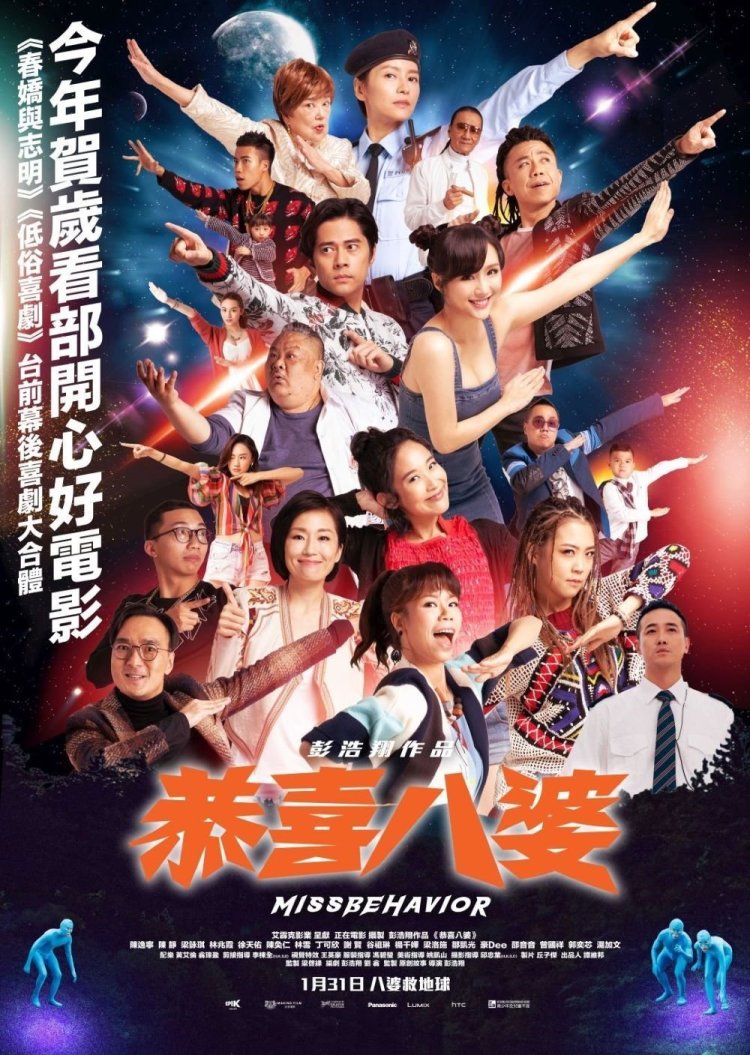
Missbehavior (恭喜八婆, Pang Ho-cheung, 2019)

Missbehaviour poster 1Pang Ho-cheung has become the king of salty, vulgar yet somehow sophisticated Cantonese comedy. Strangely, and then again maybe not, he’s never ventured into the realms of the New Year movie, until now. Missbehavior (恭喜八婆) returns the director to the bawdiness of Vulgaria but brings with it the sense of warmth and cheerful irony that marked his genial Love trilogy. A timely reminder that life’s too short for pointless grudges and maybe you should check in on that friend you haven’t seen in a while, Missbehavior is a grown up New Year treat that as silly as it often is has genuine heart and a cheerful, compassionate spirit.

The central crisis revolves around June (June Lam Siu-ha) – a model employee well used to putting up with the ridiculous requests of her boss who now demands to be known as “Luna Fu” (Isabella Leung Lok-Sze) after returning from maternity leave. Worried the new office girl Irene who is none too bright will end up offending an important client, June is charged with making his coffee but mistakes the milk labelled L.F. in the office fridge as “low fat” rather than belonging to her boss. That’s right, June has just poured her boss’ breast milk into her client’s coffee. He loved it, but Luna probably won’t which is why June calls her friend Isabel (Isabel Chan Yat-ning) who vows to mobilise their WhatsApp group to find June a new bottle of breast milk before 5pm so her boss will be none the wiser.

Once a tightly connected circle of friends, the usual middle-aged problems have led the “Bitches” to drift apart. Policewoman May (Gigi Leung Wing-kei) fell out with Isabel because she was convinced that she stole her boyfriend – her evidence being that his phone “inexplicably” connected to her wi-fi automatically despite his claims of never being in her house before. She is however big hearted enough not to let her animosity towards Isabel stop her helping out June whom, it seems, is the gang’s lynchpin and always there for everyone else in a crisis. Busy on the beat, May sends Isabel looking for some of the others all of whom have petty minor disagreements which make them reluctant to work together like rising ukulele star Minibus (Yanki Din) and her former partner Rosalin (Dada Chan Ching) who has fallen out with just about everyone thanks to writing a best selling book revealing her friends’ most embarrassing secrets.

Rosalin’s book became a hit not because of her writing talent (at least according to her friends) but because of the glamour shot she put on the cover which has earned her an army of adoring male fans which can be mobilised to help them get hold of some breast milk (though it’s unlikely any of them have babies of their own). Rosalin and Isabel chase dubious leads, while Minibus and gay couple Boris (Tan Han-jin) and Frank (Chui Tien-You) who seem to be having a few problems of their own try their luck on the black market.

Pang sends the gang all around Hong Kong (quite literally as he superimposes them on various skyscrapers so we can keep track of where they all are) on a wild goose chase trying to track down the elusive substance through various crazy capers while each of the friends gets a chance to readdress old grievances before finally coming back together again. A zany odyssey through the modern city, Missbehavior packs in the meta commentary with five year olds demanding payments to put towards their apartment funds while riffing strongly off local culture with references to aggressively rude waiters (in a scene stealing cameo from Lam Suet) and a bizarre fire fighting mascot which became an ironic internet hit.

Despite working within the relatively family friendly remit of the New Year comedy, Pang’s humour is (almost) as raucous and surreal as it ever was but he also makes time for more serious intent as in his sensitive inclusion of LGBT issues which eventually sees the gang set up a fake charity to collect milk for gay men raising babies and ends in a delightful set piece with everyone trying to evade shopping mall security by running around in rainbow capes like especially progressive superheroes. Packed out with cameos from Pang regulars, Missbehavior is an appropriately light and fluffy entry perfect for New Year that is above all else a tribute to the power of friendship and to the importance of putting aside petty disagreements and minor differences because a friend in need really is a friend indeed.


Missbehavior was screened as part of the 2019 Udine Far East Film Festival.

Original trailer (English subtitles)
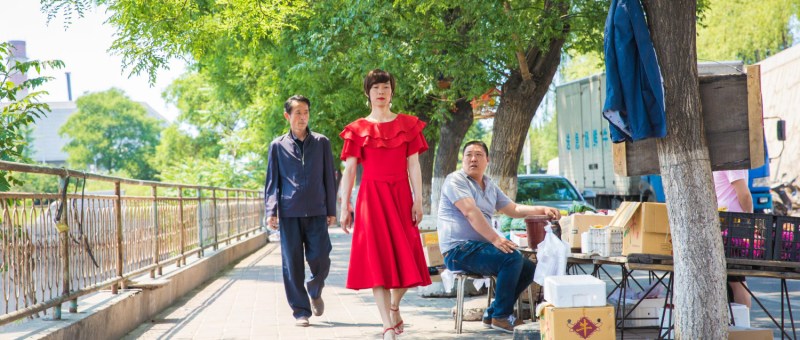
The Rib (肋骨, Zhang Wei, 2018)

“You choose to live together because you love each other, and to enter holy matrimony with our blessing” a rigid priest ominously intones at the outset of Zhang Wei’s The Rib (肋骨, Lèi). This conflict between personal choice and a need for approval from authority figures to legitimise it is at the heart of Zhang’s empathetic exploration of transgender lives in contemporary China. Given the censors’ constant preoccupation with LGBT issues (40 minutes of footage were apparently removed to gain approval though at the request of the Catholic Church rather than the state authorities), his decision to focus on a transwoman’s struggle to get through to her religious father may be a surprising one but follows a wider trend in Chinese language cinema which is beginning to embrace such formerly untouchable subjects with increasing positivity.

The Rib is, however, as much a critique of oppressive Confucianist social codes and rigid religiosity as it is a plea for greater empathy and understanding in accepting others for who they are rather than forcing them to abide by outdated ideas of conservative conformity. Huanyu (Yuan Weijie) was assigned male at birth but identifies as female and wants to undergo gender reassignment surgery. Unfortunately, however, despite the fact that Huanyu is 32 years old she still needs her father’s signature on a consent form to get the operation and not only that, her father has to be filmed signing it in person in case there are any repercussions further down the line.

The major problem is, Huanyu’s father Jianguo (Huang Jingyi) is a devout Christian who even serves as a sign language interpreter during church services. Huanyu’s mother passed away when she was small and so Jianguo raised her alone. Given his strict religiosity he is unlikely ever to agree to the surgery and Huanyu has never felt able to discuss her gender dysphoria or sexuality with her father for fear that he wouldn’t understand. Those fears are borne out when Huanyu is forced to talk to him in order to move towards surgery. Jianguo thinks it’s a joke, and then some kind of mental illness which could be cured with the right treatment. He hosts an intervention with the priest and other attendees of the church in order to talk Huanyu out of her conviction that she is a woman and even goes so far as to set her up with a selection of pretty sex workers in the belief that Huanyu will change her mind after feeling “like a man” through experiencing “proper” sex with a woman.

Of course, all this really does is drive a further wedge between father and son. Jianguo lashes out. He goes to visit a friend of Huanyu’s, Liu Mann (Gao Deng), who has recently returned from undergoing reassignment surgery in Thailand (where it’s cheaper and there aren’t so many barriers), but rather asking pertinent questions he viciously berates her. Liu Mann, Huanyu’s closest confidante, is not herself certain that Huanyu should have surgery. Returning to work after her operation she found herself fired for not being the same person who left and though she’s suing them for unfair dismissal has discovered that one kind of unhappiness has merely replaced another. Jeered at in the street, enduring the sniggers from insensitive shop staff, and labeled a pervert for just trying to use the bathroom in a public place, Liu Mann has begun to fall into despair no longer believing that a happier future where she could live as herself in freedom is a real possibility.

Jianguo insists he knows his son best and blames Huanyu’s friends for corrupting her. Huanyu is 32, but Jianguo still exercises his paternal authority in loudly declaiming that he will not “allow” this situation to continue any further. Believing that the problem may be that Huanyu had no maternal input, he even starts romancing a woman from church who has no idea she is merely a tool in Jianguo’s mission to “save” his son, while furiously praying that Huanyu will soon marry and have children. The Church itself becomes, perhaps ironically, another vessel for rigid Confucianism as Jianguo ponders the end of his family line along with his dwindling authority and the effects of his son’s “sin” on his own good standing in the eyes of the community.

Yet through witnessing the increasingly destructive results of his actions Jianguo begins to reconsider. He listens to medical advice, attends seminars, and asks himself the true meaning of his faith. After all, if God is in heaven listening to prayers from his children below, then shouldn’t a father on Earth listen to his son’s wishes? Jianguo stops worrying about sin and asks more practical questions – is it safe, is it painful, will it end Huanyu’s life sooner, and weighs the degree of his child’s suffering against his ideology. Shooting in crisp black and white with only the startling red of Huanyu’s favourite dress, Zhang captures the dullness of Huanyu’s existence as she feels herself only half alive before ending on a note of vivid colour as the faces of transgender people fill the frame. A tender, empathetic exploration of a sensitive issue, The Rib is an important step forward for trans representation in Mainland China and a powerful plea for human decency and universal understanding.


The Rib was screened at the 2019 Udine Far East Film Festival and the 2019 Chinese Visual Festival.

Original trailer (English subtitles)

Meili (美麗, Zhou Zhou, 2018)

Meili poser 2Though Mainland cinema has a famous aversion to the representation of LGBT lives on-screen, there does seem to have been a notable shift towards the positive in recent years with even big budget blockbuster comedies and family films offering subversive, if subtle, messages of tacit support. Nevertheless, lesbian life continues to be underserved with Fish and Elephant, often regarded as the “first” explicitly lesbian film from Mainland China, released only in 2001. Zhou Zhou’s Meili (美麗) is not an issue film nor does it make much of its protagonist’s sexuality but it does attempt to address the many difficulties she experiences in her life as a gay woman from a humble background.

Meili (Chi Yun) has a casual job in a laundry and lives with her high flying career woman girlfriend Li Wen (Zhou Meiyan) who is often forced to stay out late drinking to excess with colleagues in an attempt to climb the ladder. Li Wen receives the opportunity of an extended business trip to Shanghai and asks Meili to go with her only to change her mind abruptly at the last minute, fearing her colleagues will find out that she’s in a relationship with another woman and it will damage her prospects or perhaps even cost her her job. Though Meili was ambivalent about going anyway, the sudden reversal proves a huge shock, especially as she’s also been let go from her laundry job for having the temerity to ask about the annual leave policy.

Meanwhile, Meili is constantly pestered for money by her hard-pressed older sister (Li Shuangyu) who is married to a man (Wang Limin) so vile Meili can hardly bear to look at him. The reasons for her disdain will become apparent, but adding to the confusing family situation is a little girl being brought up by the couple which is apparently Meili’s. Meili is a lesbian with no interest in men which may hint at the reasons she intensely hates the child and resents the entire situation. Despite all that, however, Meili does not seem to be able to cut her sister off and finds herself going out of her way to help her even though she is herself in extreme difficulty.

Toughness and tenderness do seem to go together as we witness Meili set up an IV for her hung-over girlfriend, berating her for drinking too much yet again but caring for her anyway. Meili blows up at her brother-in-law’s, overturning their dinner table when he insults her in front of his friends, but shuts down when wounded by Li Wen, seemingly unwilling to engage in a probably destructive argument but dragged into one anyway. The relationship between the two women appears settled and positive despite the disparity of their socioeconomic statuses, but there are cracks and when Meili begins to suspect that Li Wen may be seeing a male colleague behind her back, perhaps as a cover or to improve her career prospects, she begins to wonder what they really are to each other.

For Meili who could not rely on her family, and had no future plans or real place to belong, Li Wen had become everything. “Shanghai” is a dream to the youngsters of Changchun who assume the gleaming city must be full of opportunity and excitement but it may well be one beyond their reach even if they manage to escape industrial town casual labour hell. Meili bears her difficult circumstances with fortitude. Obliged to live quietly and under the radar, she works hard and saves her money but is betrayed at every turn – by unscrupulous employers, by her toxic family, by her ambitious girlfriend, and even by her supportive and well meaning friends who reluctantly decide that they will have to leave her behind alone in order to chase their own dreams in the city. Having lost everything and all hope for the future, violent revenge seems an unavoidable consequence of her almost total oppression.

A popular name for baby girls, “Meili” means beautiful but there’s precious little beauty in Meili’s increasingly grey and hopeless world. Human selfishness, capitalistic avarice, and conservative patriarchal values conspire to rob her of all possibility for life or forward motion. There is no path out of poverty and little possibility of happiness in being able to live openly and equally with a woman by whom she is fully loved. Painting a bleak picture of life in post-reform provincial China, Zhou’s debut presents a refreshingly normalised depiction of a same sex relationship while making plain each of the various ways its heroine is backed into a corner by the oppressive and increasingly unequal society in which she lives.


Meili was screened as part of the 2019 Chinese Visual Festival.

International trailer (English subtitles)

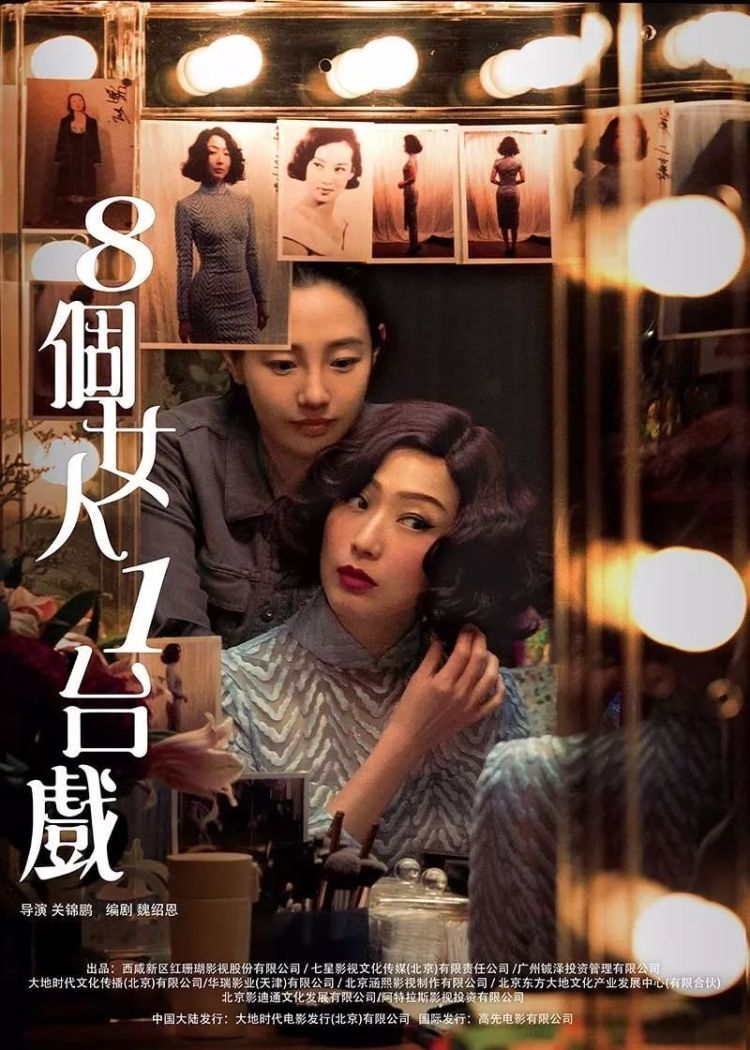
First Night Nerves (8個女人1台戲, Stanley Kwan, 2018)

First night nerves posterStanley Kwan returns to the director’s chair after a lengthy hiatus with a cheeky piece of self-referential meta comedy revolving around two “stage sisters” and their parallel quests to seize the spotlight in the increasingly competitive and celeb obsessed Hong Kong entertainment industry. As implied by its Chinese title “Eight Women, One Stage”, First Night Nerves (8個女人1台戲) is an almost exclusively female affair in which straight men barely feature, but for as much as it heartily embraces the cattiness of backstage life it is also keen to affirm the many ways in which women support and nurture each other even if it is clear that the arts are not always as liberal as one might expect them to be.

Kwan begins in high camp as the diva actresses square off during a tense press conference for an upcoming play which marks the long awaited comeback of veteran actress Xiuling (Sammi Cheng Sau-man) who abruptly retired some years previously, notably playing opposite the slightly younger starlet, Yuwen (Gigi Leung Wing-kei), many accuse of stealing her spotlight (and thereby forcing her off the stage). The behind the scenes gossip makes Two Sisters the hottest ticket in Hong Kong, which is all very good news for Xiuling’s sister-in-law Cong (Angie Chiu) – a wealthy Shanghainese heiress and theatrical impresario producing the play, some say, as a personal favour following the death of her brother in a recent plane crash which has become a minor scandal seeing as he died alongside his American mistress.

A canny business woman, Cong is not above pitting her two stars against each other as a means of getting bums on seats but she also needs to make sure the show goes on which is difficult when Yuwen, still insecure in her star billing, is intent on proving she’s not playing the second lead by constantly upstaging her co-star. Yuwen, it has to be said, is the less sympathetic of the pair – cast early as a divaish upstart who finagled her way into showbiz with sex appeal, while Xiuling remains the dignified, wounded star laid low by life. The truth is, of course, more complex as the two women circle around each other before reaching a kind of equilibrium born of mutual understanding and a healthier professional rivalry.

Before that, however, the two stars occupy two very different camps each with their own retinues. The assistants – Mainlander Nini (Qi Xi), a relative of Cong, and former pool hall girl Yilian (Catherine Chau), support their respective mistresses in different ways but are each responsible for and reflective of their emotional difficulties. Yilian, in a heartfelt conversation with the otherwise perspicacious Nini, explains that she puts up with Yuwen’s sometimes divaish antics and is happy to act as an all purpose maid because Yuwen has also been loyal to her – supporting both herself and her son even after she became famous, making plain that Yuwen is, deep down, a sincere and caring person. Xiuling, meanwhile, is cast as somewhat cold and distant, keeping Nini at arms length and the relationship professional despite Nini’s, as it turns out, entirely accurate characterisation of her strangely intense friendship with adoring lesbian heiress “Master” Fu Sha (Bai Baihe).

Despite the supposed liberality of the arts, Xiuling is not the only one to experience mild discomfort with homosexuality even if her coming around to a surprise announcement from her son eventually gives hope to the lovelorn Sha whose confused grandmother has offered a vast bounty in the hope of hooking a prime son-in-law in a ripped straight from the headlines subplot. Transgender playwright An (Kam Kwok-Leung) encounters frequent transphobic slurs passed off as an extension of divaish lovey banter and is never fully accepted as a woman by her colleagues, subtly hinting at the extent to which LGBTQ issues still struggle for mainstream acceptance.

Underneath the high camp and beautifully pitched melodrama, Kwan makes space for subtle barbs towards the creeping influence of the Mainland in Hong Kong cinema as Yuwen irritatedly admits she’s considering learning Mandarin while outraged that producers on a previous film had the audacity to dub her dialogue and insisting everyone stay in Hong Kong to watch the Cantonese version. Behind all the bitchiness and backstabbing, there is real affection for the Hong Kong entertainment industry if tempered by a mild anxiety for its future as exemplified by the strangely warm closing scene in which the two divas sit shoulder to shoulder appreciating the beauty of Victoria Harbour while acknowledging their own small role in ensuring it survives.


First Night Nerves screens as the opening gala of the 2019 Chinese Visual Festival at BFI Southbank on 2nd May where director Stanley Kwan will be present for a Q&A.

Original trailer (English subtitles)

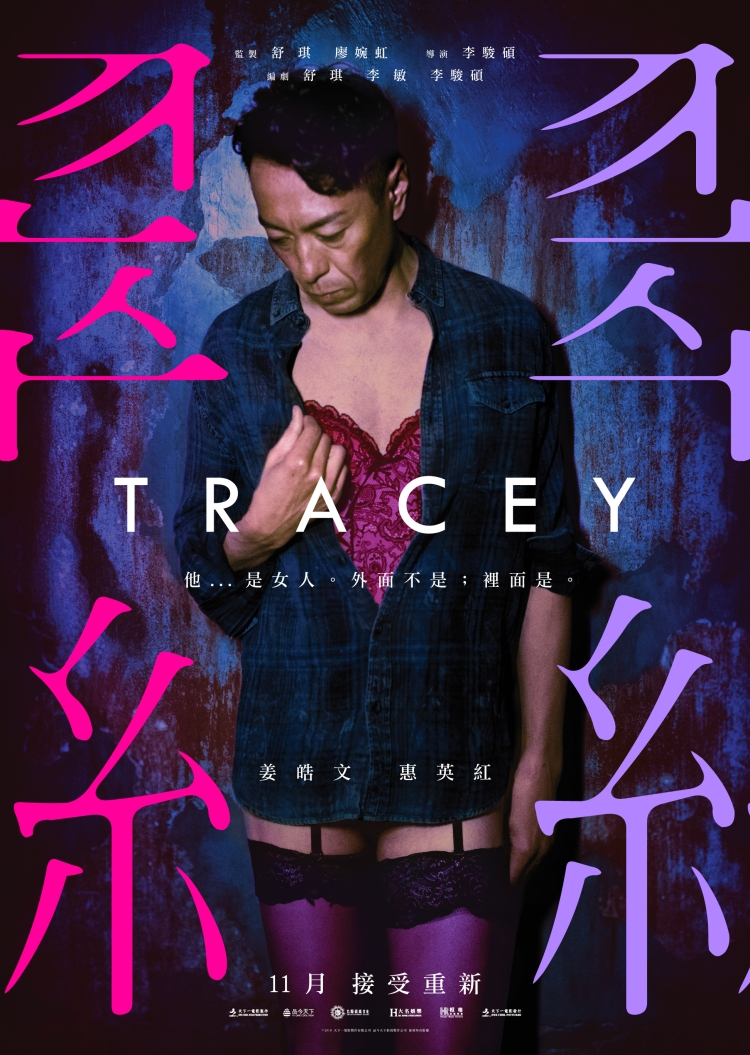
Tracey (翠絲, Jun Li, 2018)

Tracey PosterHong Kong has often sought to present itself through its cinema as an ultramodern, cosmopolitan city, claiming a kind of cultural freedom from Mainland oppression. In truth, however, there are areas in which it may disappoint itself. Jun Li’s debut feature, Tracey (翠絲), is in many ways an empathetic attempt to redress the balance in making plain the destabilising effect emotional repression can exert across an entire society, causing nothing other than the mutual unhappiness which provokes one person to oppress another in service of nothing more than conventionality.

A married, 50-something father of two grown up children, Tai-hung’s (Philip Keung) conventional, ordered life is disrupted when he receives a phone call telling him that a treasured childhood friend, Ching, has been killed while working in Syria as a war photographer. Unbeknownst to anyone, and not quite admitted even to himself, Ching had been the love of Tai-hung’s life and his death finally forces him into a reconsideration of the feelings which are now, perhaps, a lost opportunity. The sense of loss is doubly brought home when he collects Ching’s partner, Bond (River Huang), from the airport and discovers that he had been legally married to another man in the UK though the pair’s marriage certificate is not valid in Hong Kong which presents a problem in trying to repatriate Ching’s ashes.

Bond, himself from Singapore where homosexuality is at least technically still illegal, knew of Ching’s love for Tai-hung and Tai-hung’s unrealised attraction to Ching but struggles with Tai-hung’s decision to not to embrace his sexuality, preferring to marry and have children in pursuit of a conventional life. Despite having grown up in an arguably even more oppressive society, Bond is 20 years younger and has perhaps benefitted from an increasingly liberal world in which greater awareness has afforded him the vocabulary to process Tai-hung’s complex identity with a delicacy that was not available to Tai-hung in his youth, nor to his quasi-mentor Brother Darling (Ben Yuen) – a performer of Chinese Opera who specialised in female roles and confided to Tai-hung that he identified as a woman but is unlikely to have ever come across the term “transgender” let alone claim it as an identity.

Nevertheless, Bond’s arrival begins to push Tai-hung’s long repressed longing to the surface even if his first attempt to explain to Bond that he too identifies as a woman is met with mild derision as Bond misunderstands him in assuming his claiming of a female identity is an attempt to reject his homosexuality. What Tai-hung tries to explain to him is that he does not see himself as a gay man but a straight woman and therefore felt that pursuing his love for Ching, a man who loved men, would never have been a possibility. Fearing his gender identity would never be accepted by anyone, Tai-hung kept his true self hidden even from his closest friends and unwittingly placed a wedge between himself and the man he loved.

Bond pushes him still further with the perhaps unfair charge that his entire life has been essentially selfish and founded on the continued deception of his wife and children. Despite its seeming conventionality, Tai-hung’s family life is not altogether happy. His wife, Anne (Kara Hui), is a fiercely conservative sort who prizes nothing so highly as respectability as she proves by rifling through the maid’s room in search of evidence of sexual indiscretion which she later uses as grounds to suggest firing her. As the couple’s son Vincent (Ng Siu-hin) points out, there is also an unpleasant racial component to her puritanical morality which objects to her Indonesian maid having a right to a private life, fearing that she will bring “disease” into the house by sleeping with another “foreigner”. This is perhaps why she objects to her pregnant daughter’s (Jennifer Yu) desire to divorce her highflying lawyer husband when she discovers that his serial philandering has resulted in a sexually transmitted disease which he has passed to her and which has thankfully been detected early enough to avoid harming the baby.

Despite Anne’s pleas with her daughter that you don’t reject someone for turning out to be different than you assumed them to be, she is obviously not ready to accept Tai-hung’s authentic self despite having been aware that there was always something slightly amiss within their marriage which prevented it from being a true and total union. It is perhaps this sense of nagging incompleteness and unhappiness which has pushed Anne’s need for respectable conventionality into overdrive, as if a superficially successful adherence to the rules could be a substitute for emotional fulfilment. Her own suffering then seeks to push her daughter into the same space as a self-sacrificing housewife who has exchanged personal happiness for the cold comfort of social respectability. 

Thanks to reuniting with a now elderly Brother Darling and finding himself accepted by the younger Bond, Tai-hung begins to find the courage to embrace his true self and discovers that many of his friends and relatives are more supportive than he might have assumed even if some of them may need time to get over the initial shock. As his mother tells him, the important thing in life is learning to find one’s peace of mind – something which could only be helped by abandoning the outdated Confucian ideas which continue to define the social order in favour of something warmer, freer, and fairer built on mutual acceptance and compassion.


Tracey screens as the closing night gala of the eighth season of Chicago’s Asian Pop-Up Cinema on April 24, 7pm, at AMC River East 21. It will also be screened in London as the closing night of this year’s Chinese Visual Festival on 9th May, 6pm, at BFI Southbank where members of the cast and crew will be attendance for a Q&A.

 Original trailer (English subtitles)

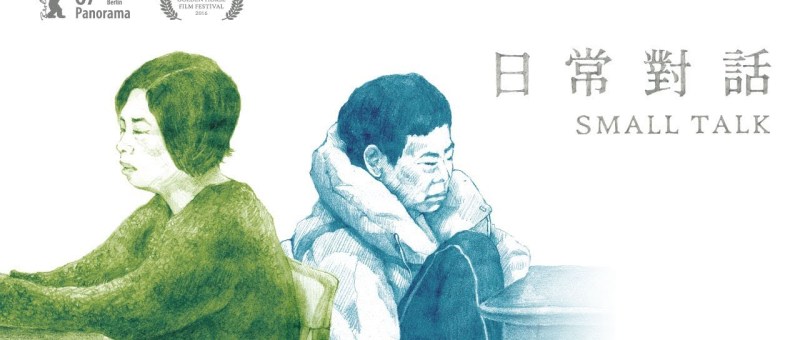
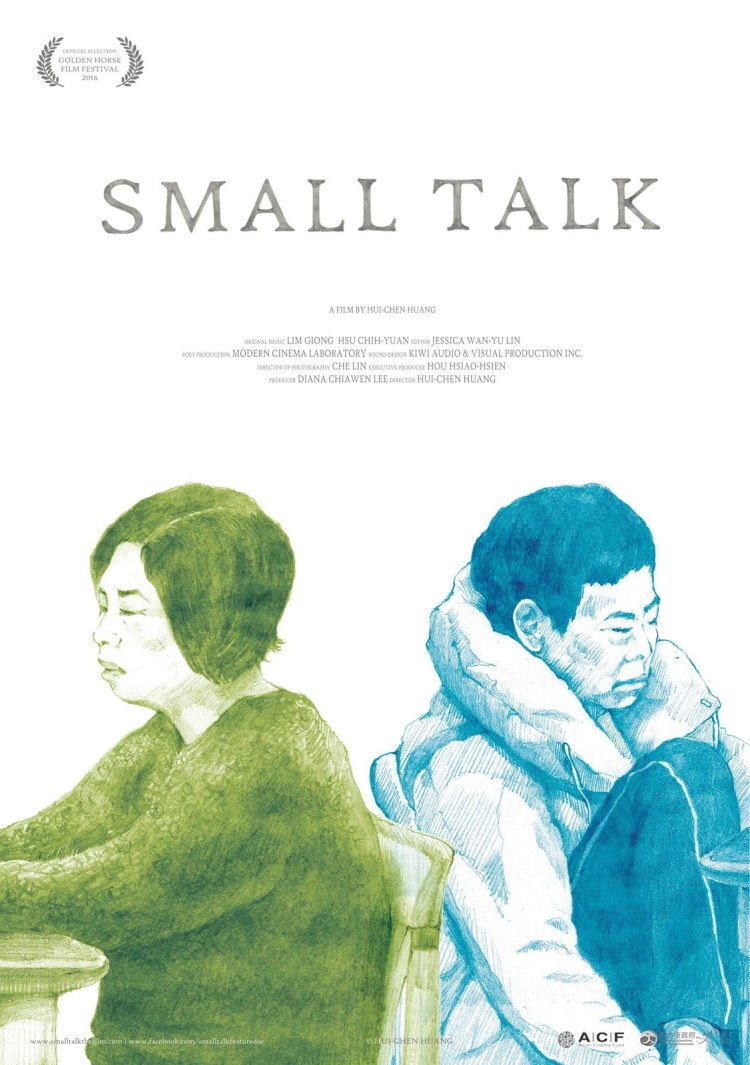
Small Talk (日常對話, Huang Hui-Chen, 2016)

Small talk poster“Who would want to understand me?” asks the laconic mother of filmmaker Huang Hui-Chen early in her autobiographical documentary, Small Talk (日常對話, Rì Cháng Duì Huà). “We do” the director replies, “but you won’t let us”. Huang’s film is, in a sense, an attempt to break through an emotional fourth wall in order to make sense of her complicated relationship with her distant mother Anu if only to ensure that her own daughter never feels as rejected or isolated as she herself has done living under the same roof with a woman she cannot quite claim to know.

In fact, Huang’s childhood memories of her mother are mainly to do with her absence. Even her younger sister eventually remarks that she always felt as if her mother was uncomfortable at home, preferring to spend time out with her friends rather than with her children. Forced to join her mother in her Spirit Guide business rather than attend school like the other kids, Huang began to resent her but also longed to be close to Anu despite her continuing distance. This desire for closeness is, ironically, only achieved through the introduction of the camera, acting as an impartial witness somehow uniting the two and making it possible to say the things which could not be said and ask the questions which could not be asked.

For Huang, the central enigma of her mother’s life is why she married man and had two daughters if she always knew she was gay. That her mother is a lesbian is something Huang always seemed to just know – it’s not as if Anu ever sat her down and explained anything to her, she gradually inferred seeing as her mother had frequent female partners and seemed to prefer spending time with groups of other women. Putting the question to her extended family perhaps begins to illuminate part of an answer. Like Anu, they will not speak of it. They claim not to know, that they do not want to know, and that they would rather change the subject. Even Anu, who otherwise seems to have no interest in hiding her sexuality, remarks that it “isn’t a good thing to talk about”. Nevertheless, her marriage seems not to have been a matter of choice. In those days marriages were arranged by the family, which is perhaps how she ended up with a man her sister describes as “no good” who later became a tyrannical, violent drunk she eventually had to flee from and go into hiding with her two young daughters.

Abusive marriages become a melancholy theme as Anu briefly opens up to recall throwing away sleeping pills her own mother had begun to stockpile in desperation to get away from her violent husband. A former girlfriend also mentions having divorced her husband because he was abusive, but seems surprised to learn that Anu had been a victim too. According to her, Anu had told her she was married once but only for a week and that her two children were “adopted”. Of course, this is mildly upsetting for Huang to hear, but seems to amuse her in discovering her mother’s tendency to spin a different yarn to each of her lovers to explain the existence of her family while also distancing herself from it. This seems to be the key that eventually unlocks something of Anu’s aloofness. Humiliated by her capitulation to marriage and then by her mistreatment at the hands of her husband, she cannot reconcile the two sides of her life and has chosen, therefore, to reject the idea of herself as a mother. Something she later partially confirms in admitting that though she does not regret her daughters, given the choice she would not marry again, not even if same sex marriages were legal believing herself to be the sort of person best off alone.

Huang interrogates her mother with a rigour that is difficult to watch, often to be met only with silence or for Anu to walk away with one of her trademark “I’m Off”s. It may be true that most people have something they would rather not talk about, and perhaps Anu is entitled to her silence but if no one says anything, then nothing will change and the cycle of love and resentment will continue on in infinity. Using the camera as a shield, Huang brokers some painful, extremely raw truths to her elusive mother and does perhaps achieve a moment of mutual catharsis but is also too compassionate to satisfy for laying blame, exploring the many social ills from entrenched homophobia to persistent misogyny and even the class-based oppression hinted at by the use of native dialect rather than standard Mandarin which help to explain her mother’s complicated sense of identity. Yet she does so precisely as a means of exorcising ghosts more personal than political in the hope that her own daughter will grow up to know that she is loved, unburdened by a legacy of violence and shame, and free to live her life in whichever way she chooses.


Small Talk was screened as part of the Taiwan Film Festival UK 2019.

Original trailer (English subtitles)
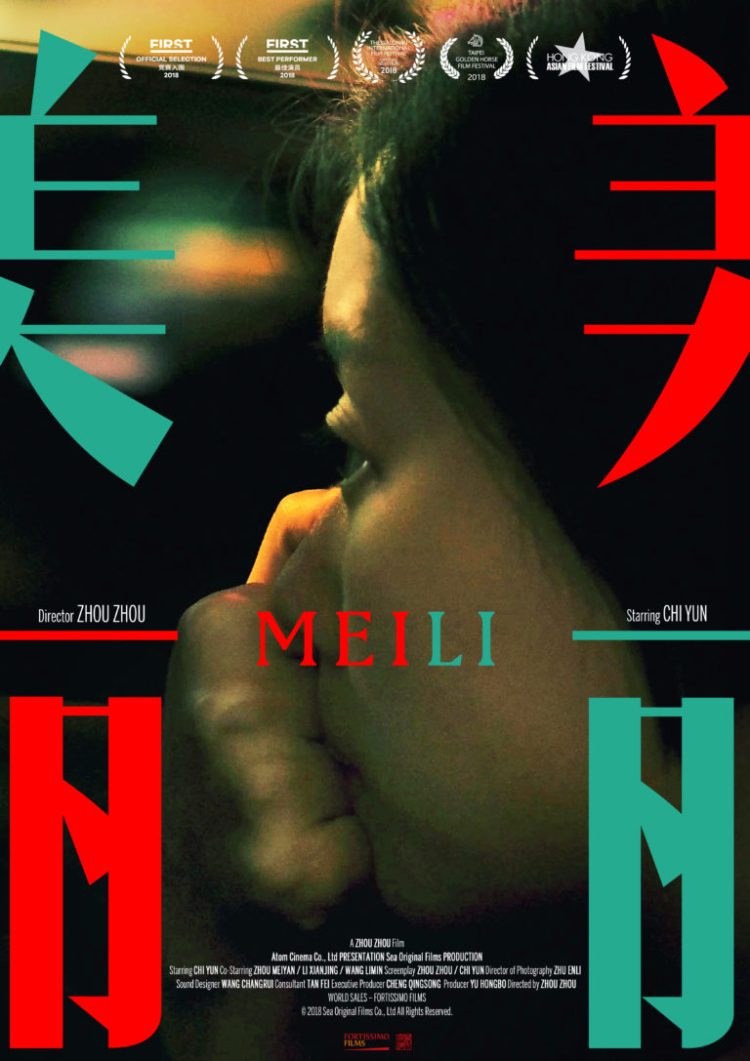
Goodbye, Dragon Inn (不散, Tsai Ming-Liang, 2003)

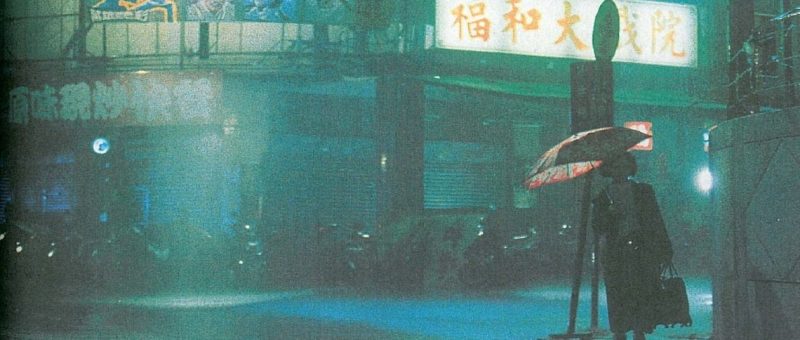
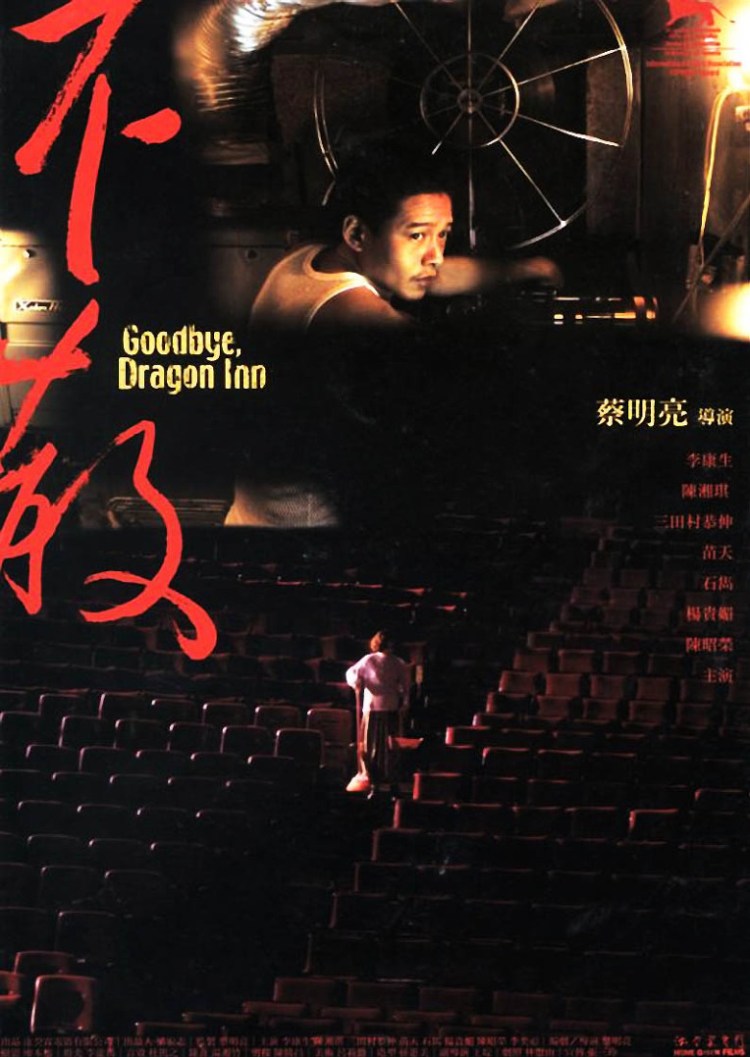
Goodbye, Dragon Inn poster“So much of the past lingers in my heart” laments the melancholy song which closes Tsai Ming-Liang’s Goodbye, Dragon Inn, (不散, sǎn) “I’ll remember with longing forever”. What is cinema if not an expression of irresolvable nostalgia, a kind of visual hiraeth for something that probably never quite existed but is so painfully missed. Everything in here stayed the same, but everything outside changed and now the present seems to be literally raining in leaving the last few fugitives from reality lost in halls of memory like lonely ghosts trapped on the wrong side of the screen.

On the wrong side of the screen is where we find ourselves. We begin in darkness with the opening narration from King Hu’s 1967 wuxia masterpiece Dragon Inn before the curtain in front of us begins to flicker and reveal an entire theatre filled with people. We pull back, and eventually the people are gone leaving just a few desperate souls returning to watch this now classic picture on what could be its very last evening as this theatre – now so unsuitable for the modern cinema environment, will be closing “temporarily” as soon as the reels stop turning.

Truth be told, no one much is even very interested in the movie. Some have merely come in to shelter from the rain, but unfortunately for them not even here is safe thanks to a leaky roof. The dazzling labyrinths of the backstage environment seem to have been co-opted by the local cruising community, men brushing past each other looking for another like them but needing to be sure their desires will be returned. Meanwhile they gaze at each other in the dim half light of the cinema screen, aching with unspeakable longing.

Longing is also something on the mind of an older gentlemen, seemingly the only one actually watching the film, who turns out to be one of its actors shedding a silent, solitary tear for time passed. Running into a friend much like himself outside he laments that “No one comes to the movies anymore”. Everyone has forgotten them, turning them into ghosts of cinema, immortal but unremembered. They have, in a sense, been attending their own funeral, entombed inside a moribund building lit only by spectres of the past.

All this is, however, secondary to the backstage drama of the lonely box office cashier (Chen Shiang-chyi) and her inexpressible crush on the projectionist (Lee Kang-sheng) who never seems to be around when she needs him. Sadly cutting into a celebratory bun, she saves half of it for him – the least ambiguous expression of love which seems to be possible within this space. Slowly climbing the stairs with a lame leg, she gazes fondly at the screen while the heroine fearlessly dispatches a series of bad guys, but the light cast on her face seems only to emphasise her lack of courage before she sadly retreats back to the ticket booth where no customers require her services.

Meanwhile, in the auditorium, a young woman (Yang Kuei-mei) munches peanuts and throws her legs over the backs of the seats in front much to the chagrin of the confused tourist whose confusion seems only to deepen when the crushing noise stops and the woman disappears (unbeknownst to him she’s on a mission to retrieve a lost shoe, or perhaps has evaporated into thin air). The first words spoken, which occur at the 45 minute mark, are to state that this theatre is haunted. Departed spirits all, the lonely denizens are indeed haunting the room and themselves as they attempt to escape the relentless march of the modern world through self-internment in a damp and crumbling mausoleum of cinema.

A lament for a dying world stripped bare by the passage of time, Tsai’s exploration of urban loneliness is a nostalgic elegy for a simpler age, filled with unresolvable longing and the ironic misconnection of an individualised communal activity. Stillness and solitude define all for these lonely, disconnected souls chasing oblivion. The past can never return, nor can the missed opportunities and brief moments spent bathed in celluloid splendour, but then perhaps you wouldn’t want it to anyway because then you couldn’t miss it. “I’ll remember with longing forever” – romanticism at its finest, but it’s a trap that’s difficult to resist.


Goodbye, Dragon Inn screened at Tate Modern as part of the Taiwan Film Festival UK 2019 and The Deserted film series.

International trailer (dialogue free)

Liu Lian by Yao Lee – the poignant song playing over the end credits.

Luxurious Bone (贅沢な骨, Isao Yukisada, 2001)

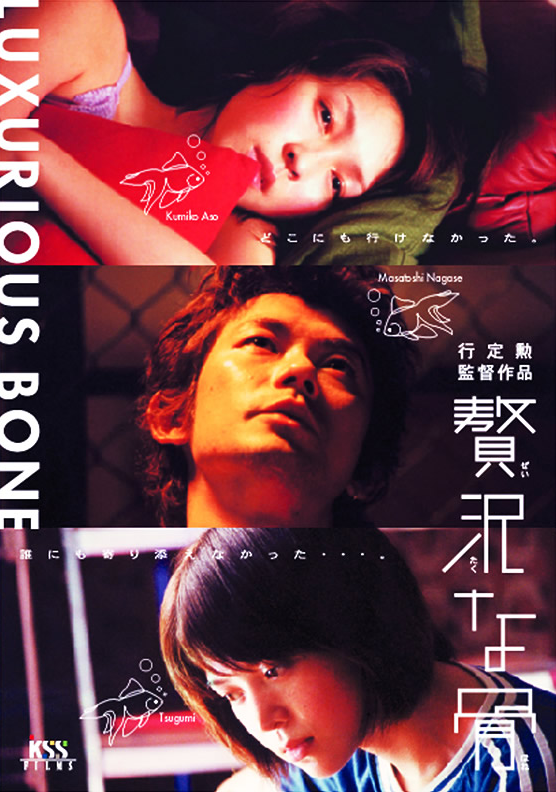
Luxurious Bone poster

Isao Yukisada made his name with the 2004 hit Crying Out Love, in the Centre of the World, but even before becoming a “junai” pioneer his early films were far from strangers to melancholy, impossible romance. The strangely titled Luxurious Bone (贅沢な骨, Zeitakuna Hone, AKA Torch Song) is a case in point in its early, ambiguous treatment of same sex love and emotional repression. Though in some senses very much of its time, Yukisada’s sad chamber drama is a sensitive exploration of the path towards awakening, if ultimately not to happiness.

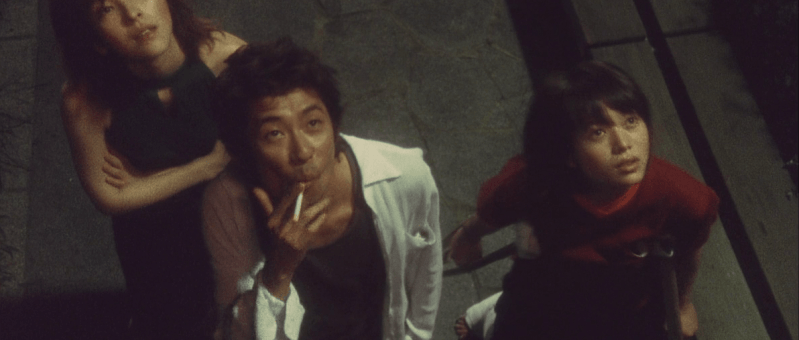
The drama begins when Miyako (Kumiko Aso) gets the titular “luxurious bone” lodged in her throat. In this case, it’s an eel bone which is a fish too expensive for either she or her roommate Sakiko (Tsugumi) to eat very often, hence its tinge of luxury even if there’s relatively little difference when it’s tickling your trachea. “Roommate” might not be the best way to describe exactly what Sakiko is to Miyako, though their relationship seems curiously ill-defined. The two women share a bed, and seemingly a life, but perhaps platonically. Sakiko wants to look for a job, but Miyako doesn’t quite want her to because she’s happy to support the pair of them on her wages as a sex worker. Likewise, Sakiko isn’t quite happy with Miyako’s line of work, not because she’s jealous or judgmental, but because she worries the job is unpleasant. Miyako reassures her that it’s fine because she feels nothing at all during sex so mostly it’s just dull.

All that changes however when Miyako meets unusual client Shintani (Masatoshi Nagase) who goes to the trouble of buying her a hamburger bento because he heard that’s the sort of thing you’re supposed to do in these situations. Shintani blows Miyako’s mind which isn’t something she was expecting or quite knows what to do with. On hearing the news Sakiko seems mildly worried, but following a strange series of events Shintani ends up becoming a minor part of their lives as the third wheel in their previously stable though somehow awkward relationship.

Miyako’s intense opening voice over makes reference to a secret she cannot bear to speak that will lie closed within her heart for all eternity. The fish bone becomes a symbol of the thing stuck in her throat, the truth she is too afraid to voice. Choking, Miyako gasps for air like a goldfish floundering in shallow water but cannot find the strength to swallow.

As we will later discover, this dark secret is bound up with her complicated feelings for Sakiko of which she seems to feel afraid and ashamed, wanting to possess her love in its entirety but also unable to access it and hating herself for her continuing need for possession and control. Her unexpected connection with Shintani is, after a manner of speaking, simply a more “acceptable” way of accepting her desire for Sakiko as she later reveals when confessing that she only ever thought of Sakiko when making love with Shintani which is presumably why only he was ever able to give her a satisfying experience.

Unable to cope with the intensity of her feelings, Miyako turns self destructive and attempts to lure Shintani into a sexual relationship with Sakiko who, apparently, is afraid of intimacy altogether having been raised in an abusive, neglectful home in which she was convinced that she was “dirty” and unloveable, an obstacle in the way of her father’s new relationship with a much younger step-mother (Makiko Watanabe).

Something of a cliché in itself, Luxurious Bone first attempts to delegitimise the feelings of the two women for each other by introducing the figure of Shintani to suggest that their problems are largely down to not having met a good man. Miyako sleeps with Shintani to feel closer to Sakiko, while Sakiko begins to move past her emotional trauma only thanks to the gentle machinations of Shintani. Their strange ménage à trois brings them together whilst driving them apart as the two women attempt to touch each other through Shintani while he remains detached and conflicted if perhaps wilfully used. Miyako’s self destructive impulses push her towards burning her world before facing what it is that frightens her. Only a strange encounter with another woman in a club shows her that her fear was not so much love as submission, while Sakiko tries to reconnect with her childhood self to move past her emotional trauma.

Despite its motion towards a positive resolution, Luxurious Bone cannot quite find the courage of its convictions and as quickly delegitimises the love as it tried to legitimise it through leaving Sakiko broadly where she started – lost, confused, and afraid, uncertain if unresolved longing is a natural condition of living. Perhaps of its time and overly simplistic in its treatment of complex issues from traumatic childhoods to shame and repressed sexuality, Luxurious Bone nevertheless has its heart (broadly) in the right place even if it leaves its lovelorn youngsters in the same position as many a Yukisada hero still looking for their place in a cruel and arbitrary world.


Original trailer (no subtitles)

Torch Song by The Humpbacks which features prominently throughout. The song was actually written for the film and is performed by Masatoshi Nagase.

Counters (카운터스, Lee Il-ha, 2017)

Counters poster 1The far right is on the rise the world over and Japan is no exception. A resurgent nationalism has long been a worry as the memory of wartime folly fades and the young, manipulated by fears of the nuclear threat from North Korea and frustrated by a stagnant economy, are duped by the messages of unscrupulous forces who convince them the cause of all their troubles is an easily scapegoated minority. Lee Il-ha’s documentary Counters (카운터스) takes a look at the deeply entrenched xenophobic racism directed at “Zainichi” Koreans and the counter protest movement against it which finds itself divided over the question of violence.

The main focus of Lee’s documentary is the enigmatic leader of the “Otoko-gumi” (lit. “men’s group”, a noticeably yakuza-esque name) – former mob boss Takahashi. Unlike many of the “Counters” who turn up to disrupt right-wing rallies, Takahashi identifies himself as a right-winger who venerates the Emperor and the Imperial past but cannot tolerate the unfettered bullying of those who shout vile racist statements while preaching the glory of Japan. A former yakuza, Takahashi himself had originally been taken in by the falsehoods spread by men like Sakurai – the virulently racist leader of Zaitokukai which makes the dubious claim that Zainichi Koreans are somehow “privileged” thanks to special residency arrangements originally set up to avoid the bureaucratic nightmare of trying to account for all the Korean (and Taiwanese) residents who arrived as Japanese citizens during the colonial period. Though he had harboured doubts about the anti-Korean propaganda he’d been hearing, it wasn’t until he had the opportunity of a straightforward conversation with an activist that he came to realise that it was all lies and the guys on the other side had a point after all.

Later, one of his comrades describes Takahashi as an old school yakuza – the kind that thinks it’s his job to protect people and stand up for those who can’t stand up for themselves. Takahashi evidently doesn’t like bullies or liars and was brought into the struggle by witnessing an old lady in kabukicho crying after a protest. His methods are, however, those of the street. Running Otoko like a gang he determines that the best way to silence the racists is to rough them up so they’ll think twice about coming back.

This places places Otoko at odds with the mainstream Counter movement which is committed to non-violent protest and social change through outreach and education. Though their aims share much in common, the Counter organisation fears becoming with associated with Otoko because of its less savoury elements – not only the violence itself but Takahashi’s criminal past and ties to the yakuza. If the Counters want to be taken seriously as a legitimate protest group, they have to be careful to present a professional, diplomatic image. Meanwhile, Otoko is free to shake things up without needing to think too hard about anything much beyond crushing the racist right.

Another activist engaged in building a shelter for oppressed minorities – not just Zainichi Koreans but Ainu, Brazilian-Japanese, LGBTQ+ etc, admits as much when he attempts to probe the paradox of Takahashi’s liminal status in the political world. The progressive movement has long been bound by its own principles and progress has been slow. Like it or not, Otoko seems to have created a shift in the political landscape no matter how one might feel about their methods. Takahashi corrals his men into building the shelter by day, but is a frequent visitor to the Yasukuni shrine in the mornings. Nevertheless, he remains an unlikely ally at the side of all oppressed peoples including transgender men and women and the LGBTQ+ community.

Lee imbues his footage with the true punk spirit, spinning back from Takahashi’s violent clashes to a whimsical jazz overshadowing the shadiness of government while playing heavily with on screen text and effects which occasionally trivialise the action as in Sakurai’s failed showdown with the Mayor of Osaka who proves once and for all that he won’t have any of Sakurai’s nonsense in his kind and welcoming city. The level of vitriol on show is truly shocking with heinous, violent statements offered by ordinary young women turning on the kawaii to call for the deaths of a persecuted minority while middle-school girls influenced by right-wing fathers preach atrocity in the streets (tacitly confirming the veracity of various other atrocities the right is usually keen to deny). The long awaited anti-hate speech law may finally have been passed, but there is still much work to do. The Sakurais of the world aren’t giving up, but neither are the Counters. A timely reminder that now more than ever resistance is the key.


Counters was screened as part of the 2018 New York Asian Film Festival.

Original trailer (Korean subtitles only)

Knockout (どついたるねん, Junji Sakamoto, 1989)

Knockout cap 1Thirty years after his debut, the career of director Junji Sakamoto has proved hard to pin down. An early focus on manly action drama gave way to character pieces, issue films, and comedy, but it was with his breakout first feature Knockout (どついたるねん, Dotsuitarunen) that something like a signature style was born. One of Japan’s many boxing movies (perhaps an unexpectedly populous genre), Knockout is once again the story of a man fighting himself as he struggles to overcome serious physical injury, emotional trauma, and his own fiercely unpleasant personality to finally become the kind of champion he has always feared himself incapable of becoming.

Dreaming dreams of boxing glory, Adachi (Hidekazu Akai) trained hard since he was a small boy and eventually became a champion of the ring. However, an ill-timed blow from a subpar opponent left him with an unexpected, life threatening injury requiring brain surgery after which he was advised to stay behind the ropes for the remainder of his days. A total asshole with a violent streak, Adachi can’t help alienating all those around him including childhood friend Takako (Haruko Sagara) whose father owns the National Brand gym where he used to train and had given vague promises of taking over once he retired. In his newly irritable state, Adachi has decided to start his own high class gym and has teamed up with a boxing enthusiast friend, Harada (Tetsuya Yuki), who runs a gay club, to buy National Brand’s promoter license to set up alone.

This being the kind of film that it is, it’s a given that Adachi will eventually want to get back in the ring despite all the inherent risks to his physical body. Nevertheless, the journey towards that realisation will be a humbling one as he is forced to confront the fact that he is a terrible person whose intense self obsession and intimidating behaviour has everyone around him walking on eggshells. Consequently, he does not make a particularly good boxing coach thanks to his didactic methods and rigid insistence on doing everything his own way. Only the kindly assistance of an older man, Sajima (Yoshio Harada), who also retired from the ring through injury, begins to show him the error of his ways but it’s not until he’s truly alienated all of his prospective pupils, as well as his patient backer, that he finally understands where it is that he belongs. 

Set in his native Osaka, Sakamoto weaves a rich tapestry of local life from the feisty Takako who dearly wanted to get in the ring herself only to be met with the constant refrain that boxing’s not for girls, to the mysterious Harada and his largely offscreen gay bar at which Adachi seems to be a frequent yet unwilling visitor who claims the place is too “weird” and fears interacting with others in the establishment. Meanwhile the applicants at his new gym which promises training with a “kindly” coach run from young toughs to softening salarymen desperate to engage with their dwindling masculinity. This is definitively a manly affair in which the frustrations of young(ish) men take centre stage though mainly through the destructive effects they have on the world around them – you’ll nary find a face around here that doesn’t have a bruise on it. While Adachi’s parents tiptoe around their own son as if he were some sort of gangster, Takako is the only one willing and able to stand up to him save the late entry of Sajima who appears to be dealing with some neatly symmetrical family issues of his own.

Starring real life boxer Hidekazu Akai, Knockout strives for realism in the ring even whilst emphasising the ongoing psychodrama that lies behind it. Adachi, like many boxing heroes, is engaged in constant battle with himself, trying to overcome the frightened little boy he once was rather than accepting him and admitting that even older he is often still scared and angry without really knowing why. Perhaps through his final, infinitely dangerous entry into the ring he will find some kind of answers to the questions he has been too afraid to ask but he has, in any case, become less of a problem for those around him in his continued quest towards becoming the best version of himself.