
Girlfriends (女孩不平凡, Tracy Choi Ian-Sin, 2025)

Now in her mid-30s, Lok (Fish Liew) feels as if she were perpetually standing at a crossing waiting for the light to turn green. She made her first film five years ago, but hasn’t been able to make another one since. A producer likes her script, but tells her that with this kind of content they won’t be able to release it in Mainland China or Malaysia, so they won’t be able to recoup their investment. As he says though, the script can always be tweaked and if she rewrote it including a role for an actress looking for a comeback they might be in business.

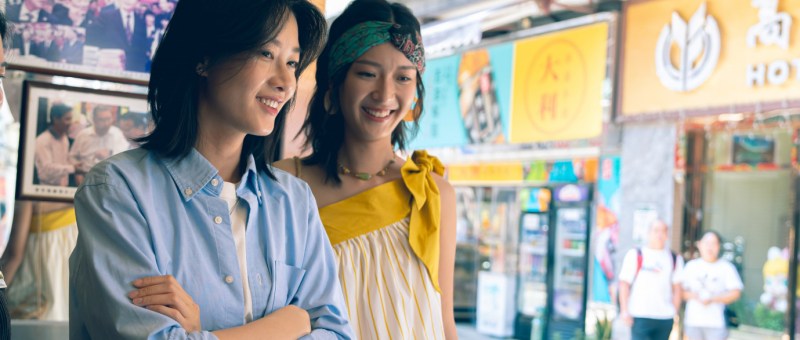
But Lok doesn’t really want to compromise. Tracy Choi Ian-Sin’s semi-autobiographical Girlfriends (女孩不平凡) is in many ways about the of fear of being railroaded into something that’s not what you really want. After an argument with her girlfriend Bei (Jennifer Yu), Lok begins to look back on her life in reverse chronological order inching towards the source of her insecurity in her Macao childhood. At 17, she faced intense pressure to conform. As a member of the debate team, she’s tasked with making an argument for something she doesn’t believe in and resents being forced to say what’s expected of her rather than how she really feels. Her parents expect her to go a local university and become a civil servant without really giving her much choice in the matter. The older sister of a classmate, Faye (Eliz Lum) is the first person who asks her what it is she really wants. 

Lok finds herself watching 2004 Hong Kong drama Butterfly and trying to sort out her confusing feelings for Faye while secretly taking the exam to study at a university in Taiwan in the hope of living a freer life, if only for four years. There seems to be a part of present-day Lok that still thinks she’s on an extended holiday and will one day have to return to Macao and become a civil servant after all. She’s incapable of thinking of the future and seems to be mothered, to a certain extent, in all her relationships as her respective partners take on the burden of practical considerations like financial planning. Each time things start to get serious, she begins to back away, even ghosting her Taiwan girlfriend to return to Macao alone without saying goodbye.

Both the Taiwan girlfriend and Bei seem to want move back to Macao with Lok without even really considering if she actually wants to go. This assumption seems to further fuel her desperation and send her looking for an escape route. Returning to Macao with a girlfriend does not seem to be an option for her because Macao represents conventionality and the life she doesn’t really want but still deep down thinks she is unable to escape. Never having fully addressed her lost love for Faye, she lacks the courage to commit or to believe in a long-term future. Her apartment seems to be full of reminders of old lovers, while she remains uncommunicative and insecure. Using sex as a means of avoiding confrontation, she has a tendency to storm out rather than have a conversation and has never fully accepted herself. When her long-term girlfriend Bei starts talking about serious things like marriage and children, she tells her that she wants her to have a “normal” life, as if she were preventing Bei from having one.

Bei is indeed under the pressure of conventionality, nagged by parents who still haven’t accepted her relationship with Lok to settle down and marry a man. Lok’s family in Macao seem to have already accepted Bei as her wife, but still Lok can’t get over the mental hurdle of believing that she has a right to a future of her own choosing. After her script is turned down, she goes to the cinema to see The Lyricist Wannabe and over identifies with a line in which the heroine is bluntly told that if she’s spent all this time waiting and still not got anywhere, perhaps it’s time to consider another career. Her lack of success further deepens her insecurity as Bei practically points out that they do actually need some money coming in, and perhaps they might have to compromise their artistic dreams as an actress and a director under the pressure of living in difficult economic circumstances while planning for their long-term financial future. It doesn’t sound very romantic, but in a way it is. It’s only by looking back over her life and failed relationships and returning to Macao to put her past to rest, that Lok is finally able to stop chasing the ghost of Faye and gains the courage to seize the future that she really wants.


Girlfriends screened as part of this year’s Queer East.

Trailer (Traditional Chinese / English subtitles)

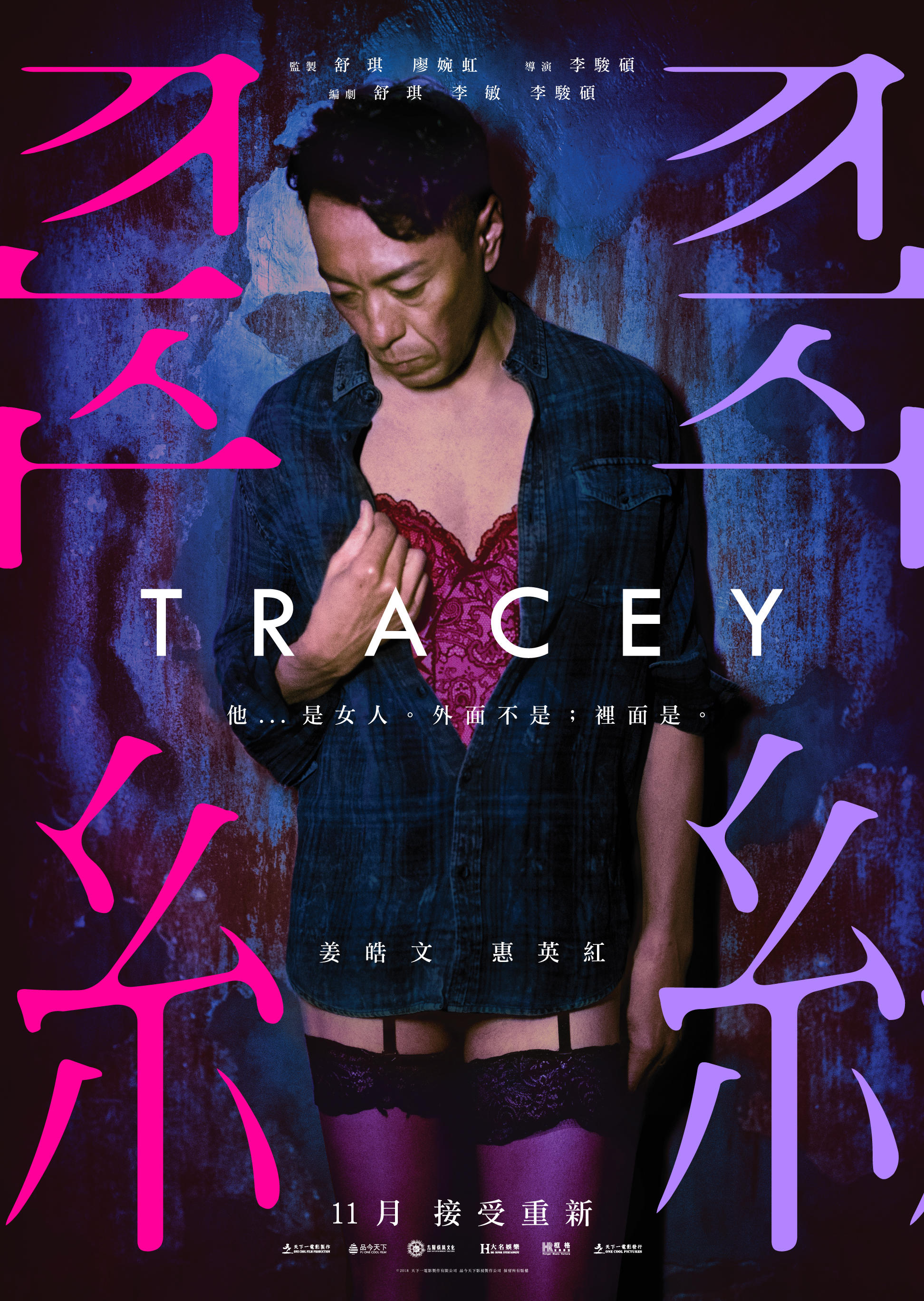
Tracey (翠絲, Jun Li, 2018)

Tracey PosterHong Kong has often sought to present itself through its cinema as an ultramodern, cosmopolitan city, claiming a kind of cultural freedom from Mainland oppression. In truth, however, there are areas in which it may disappoint itself. Jun Li’s debut feature, Tracey (翠絲), is in many ways an empathetic attempt to redress the balance in making plain the destabilising effect emotional repression can exert across an entire society, causing nothing other than the mutual unhappiness which provokes one person to oppress another in service of nothing more than conventionality.

A married, 50-something father of two grown up children, Tai-hung’s (Philip Keung) conventional, ordered life is disrupted when he receives a phone call telling him that a treasured childhood friend, Ching, has been killed while working in Syria as a war photographer. Unbeknownst to anyone, and not quite admitted even to himself, Ching had been the love of Tai-hung’s life and his death finally forces him into a reconsideration of the feelings which are now, perhaps, a lost opportunity. The sense of loss is doubly brought home when he collects Ching’s partner, Bond (River Huang), from the airport and discovers that he had been legally married to another man in the UK though the pair’s marriage certificate is not valid in Hong Kong which presents a problem in trying to repatriate Ching’s ashes.

Bond, himself from Singapore where homosexuality is at least technically still illegal, knew of Ching’s love for Tai-hung and Tai-hung’s unrealised attraction to Ching but struggles with Tai-hung’s decision to not to embrace his sexuality, preferring to marry and have children in pursuit of a conventional life. Despite having grown up in an arguably even more oppressive society, Bond is 20 years younger and has perhaps benefitted from an increasingly liberal world in which greater awareness has afforded him the vocabulary to process Tai-hung’s complex identity with a delicacy that was not available to Tai-hung in his youth, nor to his quasi-mentor Brother Darling (Ben Yuen) – a performer of Chinese Opera who specialised in female roles and confided to Tai-hung that he identified as a woman but is unlikely to have ever come across the term “transgender” let alone claim it as an identity.

Nevertheless, Bond’s arrival begins to push Tai-hung’s long repressed longing to the surface even if his first attempt to explain to Bond that he too identifies as a woman is met with mild derision as Bond misunderstands him in assuming his claiming of a female identity is an attempt to reject his homosexuality. What Tai-hung tries to explain to him is that he does not see himself as a gay man but a straight woman and therefore felt that pursuing his love for Ching, a man who loved men, would never have been a possibility. Fearing his gender identity would never be accepted by anyone, Tai-hung kept his true self hidden even from his closest friends and unwittingly placed a wedge between himself and the man he loved.

Bond pushes him still further with the perhaps unfair charge that his entire life has been essentially selfish and founded on the continued deception of his wife and children. Despite its seeming conventionality, Tai-hung’s family life is not altogether happy. His wife, Anne (Kara Hui), is a fiercely conservative sort who prizes nothing so highly as respectability as she proves by rifling through the maid’s room in search of evidence of sexual indiscretion which she later uses as grounds to suggest firing her. As the couple’s son Vincent (Ng Siu-hin) points out, there is also an unpleasant racial component to her puritanical morality which objects to her Indonesian maid having a right to a private life, fearing that she will bring “disease” into the house by sleeping with another “foreigner”. This is perhaps why she objects to her pregnant daughter’s (Jennifer Yu) desire to divorce her highflying lawyer husband when she discovers that his serial philandering has resulted in a sexually transmitted disease which he has passed to her and which has thankfully been detected early enough to avoid harming the baby.

Despite Anne’s pleas with her daughter that you don’t reject someone for turning out to be different than you assumed them to be, she is obviously not ready to accept Tai-hung’s authentic self despite having been aware that there was always something slightly amiss within their marriage which prevented it from being a true and total union. It is perhaps this sense of nagging incompleteness and unhappiness which has pushed Anne’s need for respectable conventionality into overdrive, as if a superficially successful adherence to the rules could be a substitute for emotional fulfilment. Her own suffering then seeks to push her daughter into the same space as a self-sacrificing housewife who has exchanged personal happiness for the cold comfort of social respectability. 

Thanks to reuniting with a now elderly Brother Darling and finding himself accepted by the younger Bond, Tai-hung begins to find the courage to embrace his true self and discovers that many of his friends and relatives are more supportive than he might have assumed even if some of them may need time to get over the initial shock. As his mother tells him, the important thing in life is learning to find one’s peace of mind – something which could only be helped by abandoning the outdated Confucian ideas which continue to define the social order in favour of something warmer, freer, and fairer built on mutual acceptance and compassion.


Tracey screens as the closing night gala of the eighth season of Chicago’s Asian Pop-Up Cinema on April 24, 7pm, at AMC River East 21. It will also be screened in London as the closing night of this year’s Chinese Visual Festival on 9th May, 6pm, at BFI Southbank where members of the cast and crew will be attendance for a Q&A.

 Original trailer (English subtitles)

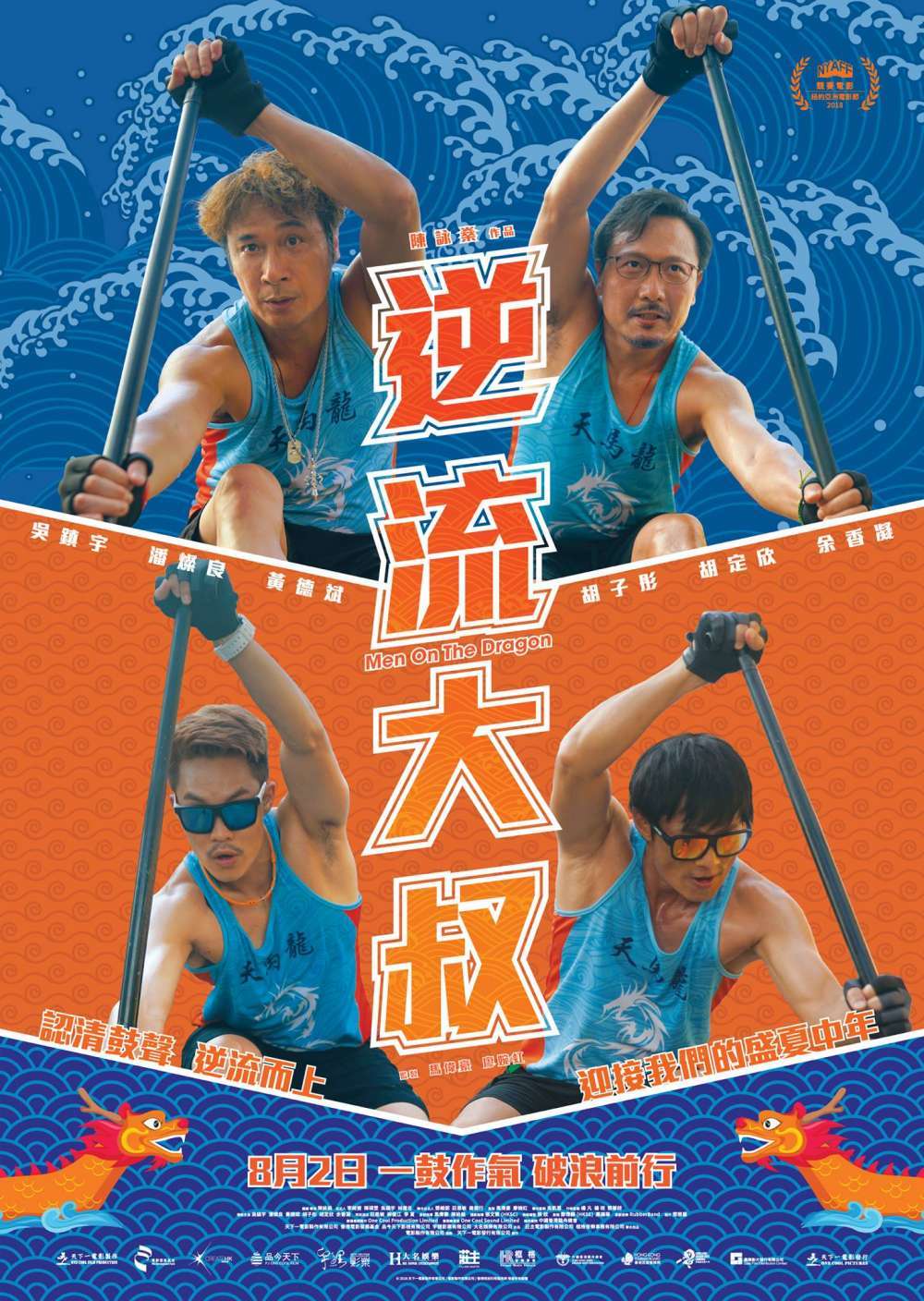
Men on the Dragon (逆流大叔, Sunny Chan, 2018)

Men on the dragon posterLife is tough for the middle-aged man in contemporary Hong Kong, at least according to the directorial debut from screenwriter Sunny Chan, Men on the Dragon (逆流大叔). Economic woes, a precarious employment environment, familial strife, and elusive Andy Lau tickets all conspire to make our guys feel powerless in a society that seems primed to crush their spirits. Can dragon boating really help put their fire back in their bellies? Conventional wisdom would say no, but then there is something about physically demanding team sports that is particularly good at inflaming individual desires.

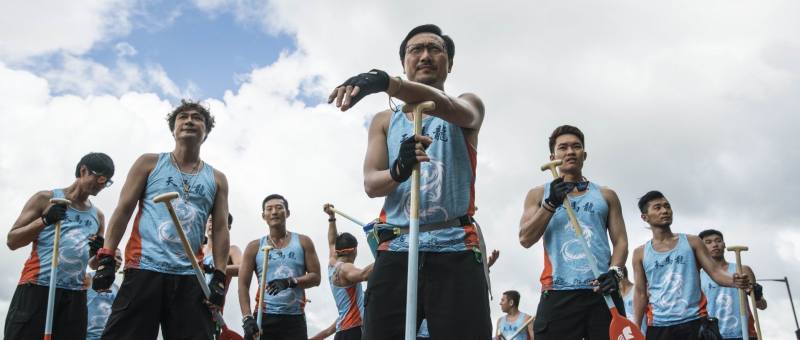
Pegasus Broadband is about to announce another round of mass layoffs which has each of our heroes worried. Participating in a mini protest strike puts them straight in the firing line (even if they were clever enough not to write their real names on the petition forms), but when they’re seemingly lucky enough to escape the axe for now at least they think they can breathe easy. An unexpected call from the boss instructing them to appear at a mysterious location with swimming trunks in hand even has them wondering if they’re being given some kind of bribe to play nice but as it turns out the reverse is true. Pegasus Broadband wants to improve its public image and has decided to do that by entering a team in the upcoming dragon boat races. The race, which they fully expect to win, will be streamed live online to demonstrate the company’s infrastructural superiority. Fearing they’ll be bumped up the redundancy list if they refuse, our guys resign themselves to becoming unlikely dragon boat champions but end up discovering unexpected sides of their potential which prove essential in solving their individual crises.

Suk-yi (Poon Chan Leung), bespectacled and mild-mannered, is the least athletic of the Pegasus Broadband employees but is half grateful for the dragon boating opportunity because it gets him out of the house where his wife and mother constantly bicker while his small daughters can’t stop fighting. Feeling pushed out and unwelcome in his house full of angry women, Suk-yi is desperately looking for some kind of escape or possibility of reasserting his authority which he begins to find while training for the dragon boat races and nursing a small crush on the pretty coach, Dorothy (Jennifer Yu). Meanwhile, Lung (Francis Ng) is unmarried but has found himself in an awkward non-relationship with the woman next-door for whom he cooks and cleans, even taking care of her moody teenage daughter. He dreams of making a real family but lacks both the courage and financial resources to make a move. The youngest of the gang, William (Tony Wu), has the opposite problem in that he’s given up his dream of being a top Ping Pong player to build a future with his girlfriend but begins to realise that he hasn’t given up on his athletic hopes while boss Tai (Kenny Wang) is secretly torn apart by the worry that his wife is having an affair with a sleazy real estate agent.

All four guys have found themselves swept along by the current of modern Hong Kong, coasting without aim or purpose but filled with middle-aged anxiety as they wonder where the river is taking them and if it’s already too late to change the destination. Suk-yi’s dilemma is perhaps the most cliched of the three as he contemplates swapping his disharmonious household for the unattainable charms of an idealised younger woman while Lung chases easy familial bliss, Tai tries to repair a relationship corrupted by modern social pressures, and William wonders if it’s worth giving up a part of yourself to make a relationship work knowing that kernel of resentment will only grow with time. Men on the Dragon is, in this sense, a very “male” story in which four put upon men feel themselves emasculated by oppressive social forces yet learn to rediscover their “manhood” through the intensely physical act of dragon boating.

They are however guided along by an austere young woman who bangs the drum to which they must all march. This is not Dorothy’s story and she gets short shrift among all the guys but there’s something interesting in the fact that she had to hire a “male foreigner” to pretend to be the “real” coach because no one would hire a female dragon boater despite her impressive list of qualifications and credentials. Gently rebuffing Suk-yi’s interest, she nevertheless guides him towards a confrontation he’d long been avoiding in reasserting himself in his own household, restoring his standing in his wife’s eyes and brokering piece with his feisty mother who can’t seem to get on with her Mainland daughter-in-law. It’s the rhythm of life that’s important, Dorothy reminds the guys – you don’t get anywhere unless you’re all pulling together. That might sound like we’re back where we started, being swept along in a mass current without control or direction but it’s individual will which drives the communal enterprise and there can be no progress without agency. Not all dreams work out, but you won’t know unless you try and at least if you crash and burn there are plenty of guys waiting to pull you out of the water.


Men on the Dragon made its world premiere at the New York Asian Film Festival 2018.

Original trailer (English subtitles)