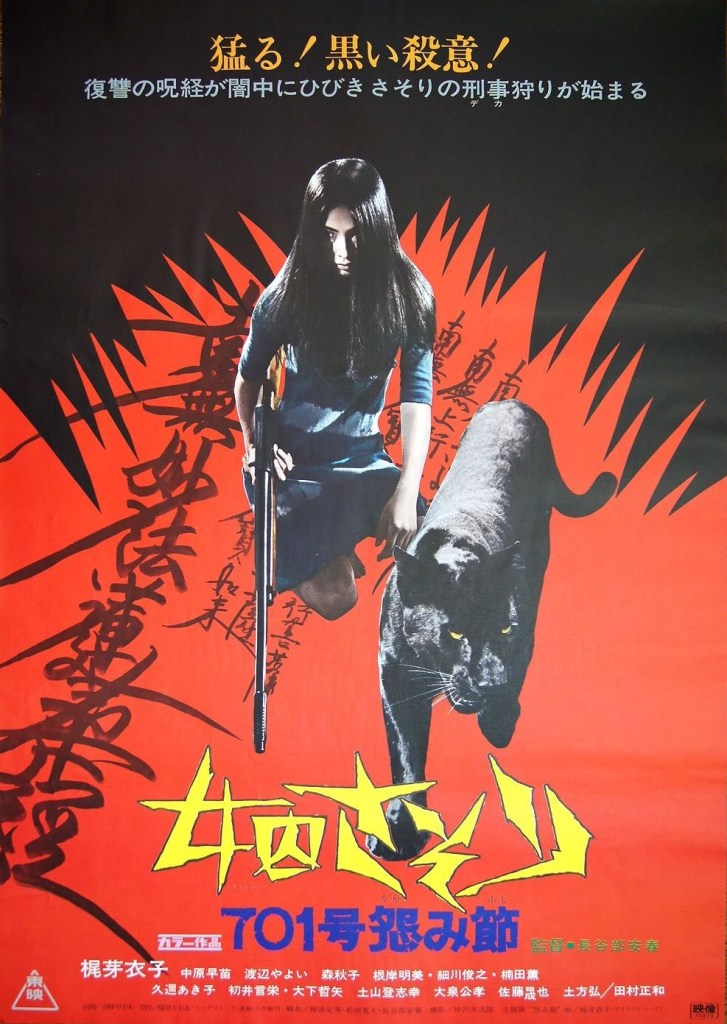
Female Prisoner Scorpion: #701’s Grudge Song (女囚さそり 701号怨み節, Yasuharu Hasebe, 1973)

The saga seemed complete with the end of Beast Stable but inevitably Matsu returns in the bonus instalment, Female Prisoner Scorpion: #701’s Grudge Song (女囚さそり 701号怨み節, Joshu Sasori – 701 Go Urami Bushi). Original director of the series Shunya Ito agreed that the ballad of Matsu was sung through, and so Yasuharu Hasebe reteams with star Meiko Kaji after their previous collaborations on Retaliation and the Stray Cat Rock series during their time at Nikkatsu. Hasebe’s style is the polar opposite of Ito’s arthouse inspired painterly majesty and heavily favours the groovy, ‘70s youth inspired aesthetic he employed in the Stray Cat Rock series. Coming as it does after Ito’s genre rocking visual tour-de-force, Grudge Song can’t help feeling a little regressive and a reminder of what a considered cash grab this fourth instalment really is but that isn’t to deny the fact that it can prove an enjoyable, genre skewing, effort when considered in isolation.

The end of Beast Song told us that Female Prisoner Scorpion served her sentence, was released and disappeared into the ether like the legendary creature she was. However, Grudge Song provides another episode to her history and begins with Matsu (Meiko Kaji) being re-arrested by police during someone else’s wedding (you have to feel sorry for the happy couple – could the police not have done this outside at least?). She fights them off in grand fashion and manages to escape though is gravely injured and not able to run very far. Luckily she is found by a damaged former protester working at a cabaret club who helps her hide out from the police. Soon the pair enter into a kind of romance but it’s not long before Matsu has some names to add to that ever increasing grudge list.

Along with the change of director comes a slight refocusing. Both the original trilogy and this fourth instalment have definite political undercurrents but Grudge Song allows these to be more overt with its constant references to the student protests of the late ‘60s and ’70s as well as to police corruption and brutality. Matsu’s ally and sometime lover, Kudo (Masakazu Tamura), had been a prominent protester picked up and repeatedly tortured by police leaving him with both physical and mental scarring. Obviously distrustful of authority but also made fearful, Kudo has been keeping his head down until he finds a kindred spirit in Matsu and decides to fight back.

The enemy here is the police – as it was to a degree in some of the other films, but Matsu’s concerns are playing second fiddle to her male saviour’s psychological traumas. This is the first film where Matsu has any kind of male help, and she’s essentially in an assisting role as Kudo attempts to defend her from the police (her injuries meaning she can’t exert the same kind of preternatural power as in the other instalments). There may be a kind of spiritual connection between Matsu and Kudo but the fact that she trusts him so quickly is strange given her behaviour throughout the series, though perhaps she has little choice given her physical condition. This is also the first time where Matsu allows an innocent woman to be killed in front of her – ironically another victim of male violence whose life is lost through no fault of her own. The other Matsu would at least find this upsetting, but this new Matsu who’s now more of an accomplice to a borderline terrorist protest cell consisting of one male member, is entirely indifferent.

Though Hasebe mimics some of Ito’s cinematography notably in the opening and his iconography of “Scorpion”, he abandons his stylistic concerns in favour of something very much more directly contemporary. In keeping with his work on the very groovy, youth orientated Stray Cat Rock movies, Hasebe turns Female Prisoner Scorpion into a standard ‘70s exploitation pic complete with gratuitous lesbianism, nudity, and random violence. Zooms, whip pans, and anarchic camera action are accompanied by jazzy electric guitar and a stoner vibe that is designed to appeal to the youth of the day but appears hopelessly dated now unlike Ito’s approach which is still of its era but manages to take on a timeless quality. As an example of ‘70s exploration cinema, Grudge Song pays its dues but as a Female Prisoner Scorpion movie, it falls far short of its predecessors.

Grudge Song marked the last outing for Kaji as the titular Scorpion, though this Matsu is not the Matsu of the rest of the series. Hasebe doesn’t seem so attached to the cult of Scorpion and more or less reboots her for a fairly straightforward genre affair which lacks the subtle intelligence of Ito’s vision. Still, taken alone Grudge Song is not without its charms though it loses the feminist edge of the rest of the series and recasts its heroine as a bit player in a game of revenge against the authorities in the name of vengeance for the death of the student movement.


Original trailer (English subtitles, NSFW)

Female Prisoner Scorpion: Beast Stable (女囚さそり けもの部屋, Shunya Ito, 1973)

beast-stableAt the end of Female Prisoner Scorpion: Jailhouse 41, Matsu – the “Scorpion” of the title, had enacted parts of her revenge but lost even more friends and allies along the way. Still filled with an intense rage, she wandered away from her imprisonment towards the dawn and a free, if uncertain, future. It’s here we find her at the beginning of Beast Stable (女囚さそり けもの部屋, Joshu Sasori – Kemono Beya) – a fugitive from justice, but a seemingly calm one. Until, that is, she is cornered.

Beginning in an extremely memorable opening sequence, the film zooms in on Matsu riding a subway train like any other young woman when she gets spotted by a couple of policemen who decide to try and take her in. Whipping out her knife from under her coat, Matsu slashes away but is almost caught when one of the policeman handcuffs her. She reacts to this situation in a typically direct way by simply hacking the policeman’s arm off and running away with it.

Hiding out in a graveyard and gnawing at her macabre bracelet in an attempt to get it off, Matsu strikes up an improbable friendship with prostitute Yuki (Yayoi Watanabe). Yuki is harbouring a dark secret in that she keeps her brain damaged brother locked up in a back room where she is forced to satisfy his sexual urges lest he attack other women.

While working as a seamstress, Matsu becomes more and more involved with the underworld and its collection of pimps and madams, each eager to profit from the weakness and misfortune of others. Eventually, after becoming too much of a problem, Matsu is locked up again – but this time inside the birdcage of a dangerous and eccentric yakuza mama-san, Katsu (Reisen Lee), with the corpse of a less fortunate victim on the other side of the bars. New names are about to appear on Matsu’s ever growing grudge list as the wrongs done to others begin to outweigh the pain of those enacted on herself.

Beast Stable differs from the first two films in the series as it mostly takes place in the “free” world until it reenters the prison environment for the final stretch. Matsu may be out of jail but she’ll never be truly free and her intense inner rage might give her away if it weren’t for her the fact her face is plastered all over the city adorning wanted posters in every conceivable location. With no particular target for her vengeful spirit, Matsu is in survival mode but her growing alliance with Yuki and the cruelty of the underground sex industry quickly awaken her old fire.

This time the big bad is another woman – a cruel madam, willing to protect her investment to the max. When she finds out one of her girls has been hiding a pregnancy, she insists on an abortion even though the baby is six months or so along. Kicking and screaming, the pregnant woman is subjected to a horrific procedure conducted by a drunken doctor which is neatly contrasted with another abortion which is carried out with a much higher level of medical care. Needless to say, Matsu cannot let this one go and makes another of her daring and mysterious escapes to enact her revenge. As she leaves, she’s become a fury of vengeance once again – her face pixelated by the surgery window, shaving her of her identity.

Though more grounded in reality than Jailhouse 41, Beast Stable is still selling the ballad of Matsu as she continues her trajectory into legendary heroine status. Always playing a long game, Matsu has the uncanny ability to escape from any holding pen save the one that burns inside her mind. Having satisfied her personal desire for revenge, Matsu moves on to the cruelties of the wider world and those that bully and misuse already vulnerable people. Her sense of greater responsibility grows as her humanity begins to return through her friendship with Yuki which eventually becomes a deep alliance between two equally trapped women.

At the end of the film we’re told that Matsu served her prison sentence and was released, but no one knows what happened to her after that. Her apotheosis is complete as she becomes the legend – a wandering heroine, meeting out justice in a cruel and indifferent world. Kaji continues to excel in her performance of the near silent Matsu, burning with rage and resentment in every scene. Beast Stable would be Ito’s final contribution to the series and acts as a suitable conclusion to the trilogy as Matsu finally becomes Scorpion in our imaginations and, strangely, our hearts.


Original trailer (English subtitles)

Female Prisoner Scorpion: Jailhouse 41 (女囚さそり第41雑居房, Shunya Ito, 1972)

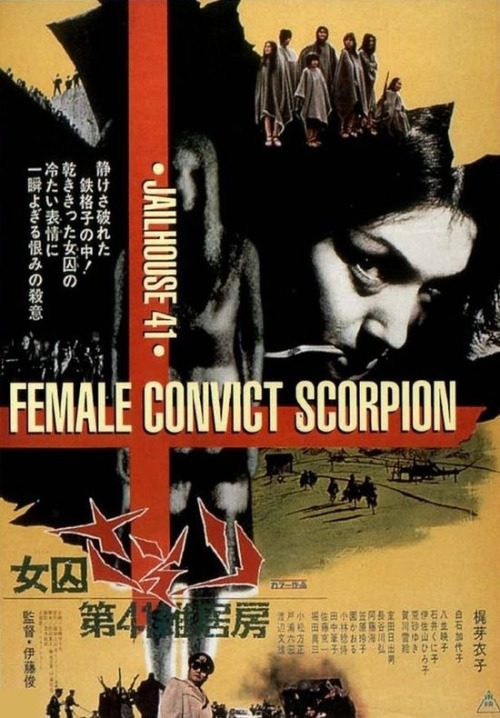
scorpion-2Female Prisoner Scorpion: Jailhouse 41 (女囚さそり第41雑居房, Joshu Sasori – Dai 41 Zakkyobo) picks up around a year after the end of Female Prisoner #701: Scorpion and finds Matsu (Meiko Kaji) tied up in a dingy prison basement, apparently left bound and in solitary confinement for the entire interval. Once again directed by Shunya Ito, the second instalment in the Female Prisoner Scorpion series is another foray into the women in prison field but Ito resolutely refuses to give in to the exploitative genre norms, overlaying his tale of individualistic rebellion with an arthouse sensibility that has a much wider scope than its ordinary vengeance driven narrative may suggest.

Matsu may have been lying bound and gagged in a dingy underground hole for the best part of a year but today is a special day and sadistic prison warden Goda (Fumio Watanabe) is going to let her out to be shown off in front of a visiting inspector who’s paying a final visit before Goda is promoted to a top job in Tokyo. When Matsu makes a lunge for Goda, the inspector is so afraid that he wets himself, sending the other woman into a frenzy and resulting in a riot. Once again the entirety of the prison is punished, but this time Matsu is singled out for a public punishment gang rape by Goda’s goons. This kind of humiliation is too much for her fellow prisoners who instantly turn on her, but their violence provides an opportunity for escape and before long Matsu is on the run, again.

At the end of the first film, Matsu had accomplished her first round of vengeance – against the man who orchestrated her downfall and the men who secured it, but ultimately she wound up a female prisoner once again. Though Goda may have had her hidden away because of her habitual escapism, Matsu had not given up as we see from her attempts to scrape the floor away with her spoon held tight in her mouth. Barely speaking, Matsu is an unstoppable column of pure rage but an elegant one, supported by her self contained restraint.

Her anger this time is directed towards Goda himself, especially after his despicable organised punishment rape that was designed both to break her own spirit once and for all and also to damage her in the eyes of her fellow inmates who are intended to see her defeated and destroyed. The guards are a stand in for society at large, using sexual dominance and social position to keep their women in line. The visiting prison inspector makes a point of telling Matsu that “they” don’t hate her personally – they’re there for her, to help her “recover” and become a functioning member of society. Which is ironic because Goda does hate her personally as he holds her responsible for the damage to his eye sustained in the previous film. His last act before moving on is one against Mastu – an attempt by the forces of authority to crush her individual rebellion and use their victory as a coercive tool to force others to conform.

In this way, Matsu’s position as a member of a subjugated class is less important than her status as an agitator but these are women who have each suffered at the hands of men. As an extremely theatrical sequence sung in the traditional form informs us, the women who escaped with Matsu committed their crimes out of love or jealousy. Poisoned rivals, dead lovers, even children murdered to get back at their philandering father in some Medea level psychotic rage which ruins the perpetrator even more than the intended victim.

Later while the women are enjoying their brief taste of freedom, one of them is brutally raped and murdered by a troupe of feral men who boast about the wartime atrocities they committed before descending on a lone woman like a pack of rabid dogs. The others take their revenge for their friend, but also for all the women who have met a similar fate inflicted by a male dominated society which sees them as something to be controlled and then made use of, little more that cattle hemmed in and milked until dry.

As in the first film Ito makes use of expressionist techniques and strange angles to give his film a more elevated feeling that might be expected but this time he adds in a surrealist, spiritual dimension as with the old woman who sings the stories of our heroines and then dies only to bury herself in leaves and disappear into the ether, like some forgotten deity of misused women. Likewise, when one of the prisoners is raped and murdered, the men throw her body into a nearby river like an empty beer can but the waterfall behind her suddenly runs with blood as an expression of the violence which pollutes the natural world. A bus suddenly splits in two, separating our subjugated women from the violent men who mentally sentence them, given free reign simply because of their sex. Ironically enough, our last glimpse of of Matsu takes place in the reflection of Goda’s glasses and then in his false eye when she is suddenly rejoined by her compatriots for a triumphant dance of freedom on a city rooftop.

Even stronger than in the original Female Prisoner #701 Scorpion, Jailhouse 41 further advances its ideology of free individuals battling the conformist authority of the state all filtered through the prism of the patriarchy. Matsu’s vengeance is personal, she keeps her distance from the other women who do not seem inclined to band together to oppose the forces which oppress them so much as seek a wary, temporary alliance of necessity, but seeing them all reassembled in spirit at the end brings a larger dimension to Matsu’s victory which now seems much less like solving a practical problem than a deliberate strike at a wall which was solely designed to keep a certain group of people in their place. The jail is broken, all that remains is to choose to escape its restraints.


Original trailer (English subtitles, NSFW/gore)

Female Prisoner #701: Scorpion (女囚701号/さそり, Shunya Ito, 1972)

scorpion-701

Meiko Kaji had already become a familiar face in Nikkatsu’s genre output when she took on the role that would come to define her career at only 25 years of age. Toei’s Female Prisoner #701: Scorpion (女囚701号/さそり, Joshu Nana-maru-ichi Go / Sasori) would launch a series of similarly themed films and create a national pop culture icon in its central character. Based on a manga by Toru Shinohara, Female Prisoner #701 Scorpion is, at heart, a women in prison film and a cornerstone of the pinky violence genre but first time director Shunya Ito has more on his mind than salacious thrills and offers up a noticeably nuanced approach to his material filled with impressive art house flourishes.

701 is the number printed on the back of the prison uniform worn by inmate Nami Matsushima (Meiko Kaji). She makes a valiant escape attempt with a fellow prisoner, Yuki (Yayoi Watanabe), but the pair are caught and put into solitary confinement where they experience torturous treatment both at the hands of the guards and their fellow prisoners. Mostly known as Matsu but also given the nickname of “Scorpion”, Prisoner #701 is not exactly popular with the other ladies in the joint who seem to resent her escape attempts and quiet dignity, annoyed by her above it all demeanour.

Matsu has just one mission in life – vengeance, on the man who wronged her, on the society that allowed her to be wronged, and on the prison system with its sadistic guards and turncoat inmates. Once an ordinary, law abiding woman, Matsu had the misfortune to fall in love with a vice cop who convinced her to go undercover in a yakuza club to get some vital info he needs to bust it. However, Sugima (Isao Natsuyagi) turns out to be the biggest crook of them all and was merely using her to try and take out the local yakuza to get in with a bigger yakuza boss and key into a slice of the drugs trade. Matsu is brutally gang raped after her cover is blown and ends up being sent to prison after making an attempt to ice her former lover with the desire to get out and complete her mission the only thing that’s keeping her going.

Ito begins with an ironic scene in which one of the prison guards is receiving a commendation for his honourable service, Japanese flag flying proudly behind above, until the occasion is interrupted by the escaped prisoner alarm. Later Ito puts the yakuza boss in a building bearing the large banner “Beautiful Soul and Harmony of Japan” and he even adds in an expressive moment as Matsu surrenders her virginity to Sugima, staining her white sheets with a large red circle. Society is corrupt everywhere from Sugima’s bent copper to gang raping yakuza and the prison system itself.

The guards are effectively running their own little empire, cut off from mainstream law enforcement and left to their own “corrective” impulses. Ito gives us salacious shower scenes and women being marched around in the nude but he places us in the place of a voyeur, making it plain that the prison guards are sating their lust for power through humiliating their charges in sexual dominance and violence. Divide and rule is the name of the game as a top tier of prisoners are “employed” in various prison tasks earning them a different colour uniform and a status bump. These ladies are even worse than some of the male guards and are responsible for much of the cruelty inflicted on Matsu and Yuki during their time in solitary.

Inter-prisoner conflict is not the central theme of the film as Matsu continues to plan for her eventual escape and revenge on the man who has ruined her life. A slight spanner is thrown in the works when an inside woman is recruited to take Matsu out, but Matsu is painted as a the ultimate vengeful warrior. Barely speaking (the bulk of her dialogue is actually voice over for her flashback scene), Matsu waits silently, observing and plotting. Biding her time she manages to take an extremely skilful and poetic revenge against her solitary abuser despite her hands and feet being bound, and when a police mole is placed in a cell with her Matsu sees through the ruse straight away. Seducing her new cellmate, Matsu neutralises the threat with ease maintaining her trademark intense elegance all the way through.

Though the synopsis smacks of cheap and nasty exploitation Ito doesn’t see it that way and films with an art house aesthetic rather than a salacious eye. Matsu’s flashback takes a very theatrical form with a rotating set and Matsu remaining present in the corner as she narrates. Her rape scene is grotesque and nightmarish, shot through a see-through floor as her attackers grin and gurn away at her like fairytale monsters. Likewise, when Matsu traps another prisoner in her own scheme, the woman turns into a classic ghost creature, face white and staring, broken glass firmly gripped manically in front. The acting style is broad and absurd. Policeman laugh loudly and for too long, blood is an artificial kind of red, gloopy like paint, and pantomimeish grotesquery is everywhere. Ito’s backgrounds are expressionist rather than realist but always perfectly pitched.

You can tell a lot about a place from the way it treats its prisoners and when its as bad as this, you start to wonder which side of the bars you’re really on. The guards are only a representation of a consistently exploitative society, but they can at least be outsmarted. “To be deceived is a woman’s crime”, says Matsu, but it’s one she fully intends to atone for – in blood, settling not just her own score but those of all her fellow prisoners caught in the patriarchal trap of hollow promises and abused honour.


Original trailer (English subtitles)

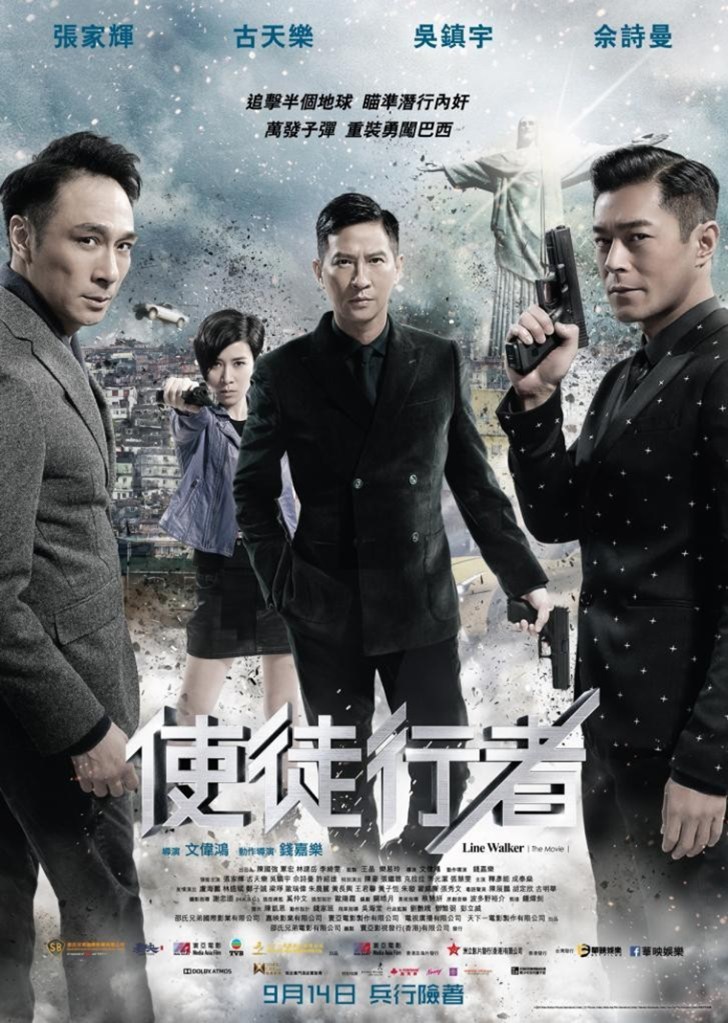
Call of Heroes (危城, Benny Chan, 2016)

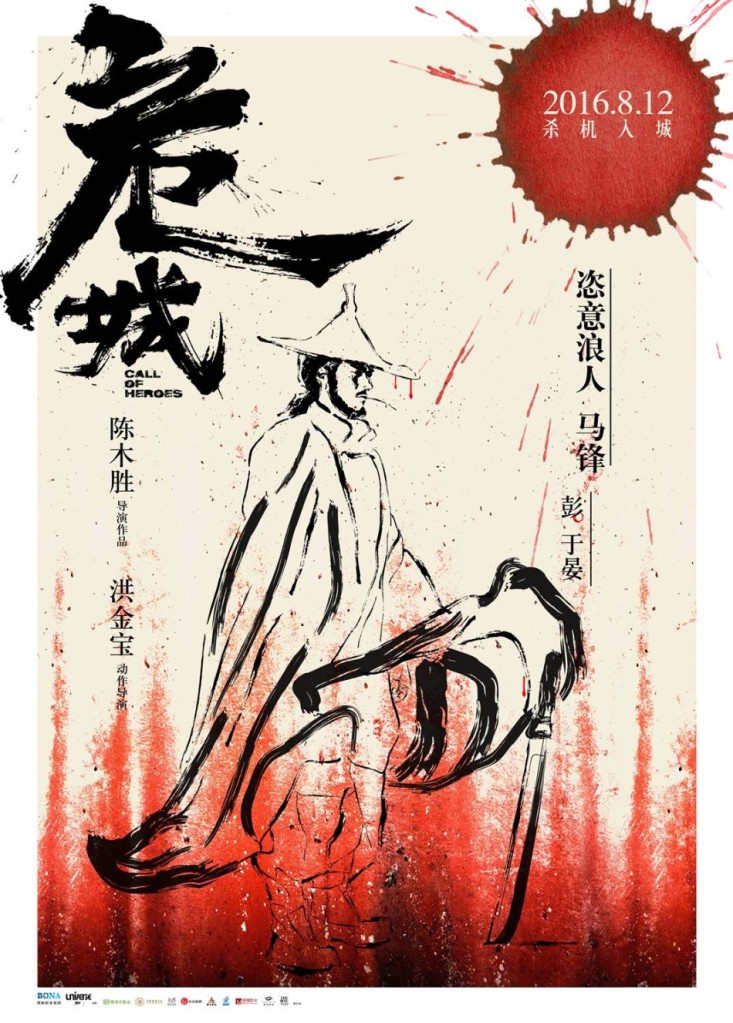
call of heroesA blast from the past in more ways than one, Benny Chan’s Call of Heroes (危城, Wēi Chéng) is a western in disguise though one filtered through Akira Kurosawa and Sergio Leone more than John Ford. Filled with Morricone-esque musical riffs and poncho wearing reluctant heroes, Chan’s bounce back to the post-revolutionary warlord era is one pregnant with contemporary echoes yet totally unafraid to add a touch of uncinematic darkness to its wisecracking world.

1914 – three years after the collapse of Chinese feudalism and warlords rule the land, each vying for power and terrain but taking little account of the displaced people in their path. The residents of Stone City find this out the hard way when notorious general Cao Ying wades into town and conducts a widespread massacre seemingly for the fun of it. Plucky school teacher Bai Ling manages to escape with some of her pupils even whilst other teachers and children are being summarily executed by Cao’s troupes.

Having left with nothing and walked miles, Bai and the children are near starvation when they stop into a noodle house to share a single bowl. Unfortunately the noodle house is about to be robbed but fortunately one of the diners is bearded wanderer Ma Feng (Eddie Peng) who isn’t up for anyone disturbing his serious food coma. Impressed with Ma’s skills, the kids and Bai make their way to Pucheng where Bai has a cousin but Cao is still on the warpath and trouble has a way of tracking good people down.

Pucheng (the name of which literally means ordinary town), is watched over by the noble sheriff Yang Kenan (Sean Lau Ching-wan) though the protective garrison has been sent to the front leaving them with only a skeleton defence. When a mysterious visitor arrives in town and proceeds to shoot dead a man, woman, and even a child, Yang arrests him but when the killer turns out to be Cao Ying’s unhinged son, a number of questions arise. Yang is committed to justice – no matter the man’s name, he ought to pay for his crimes. Yet, Cao Shaolun’s presence is sure to attract his father’s attention and so many of the townspeople feel it might be better to let Cao Shaolun go. Placate a tyrant and undermine the idea of justice by failing to enforce the law or sign your own death warrant by standing up for your principles, it’s a frontiersman’s dilemma.

The references to classic Hollywood westerns are obvious enough, particularly when the narrative takes a turn for the High Noons as Yang finds himself standing alone as the sole resistance to the oncoming militia man threat. Though the townspeople do not exactly turn on Yang in the same way they turn on Kane, they clearly choose appeasement over war. Yang’s dedication to justice is purehearted, there’s little hint of personal vanity in his decision to stand up for the rule of law but only the knowledge that folding now is the same as bowing to Cao’s tyranny.

Though introduced as a possible protagonist, Ma Feng takes a far smaller role in the action than might be expected. Clearly channeling Mifune’s Sanjuro, Peng’s wisecracking drifter and cynical, reluctant hero is almost at odds with the serious business of law vs politics over in Pucheng. His character centric subplot of conflict with a former friend who works for the other side is insufficiently developed to support the emotional weight it’s intended to carry and sometimes feels like a distraction from the main narrative though the great pot mountain based martial arts set piece is certainly one worth waiting for.

If Peng’s Ma Feng feels slightly misplaced with his cynicism and comic stunts, Louis Koo’s hammed up villain Cao Shaolun is in an entirely different film altogether. Wildly over the top, Koo plays Cao Shaolun as a permanently amused psychopath, all crazy eyes and manic laughter. A self consciously cool guy, Cao Shaolun dresses in white and murders innocents with a golden gun all the while knowing he can do as he pleases simply by the virtue of his name.

Shot with a heavily digital aesthetic, Call of Heroes’ evidently high production values are sometimes reduced to a televisual quality or otherwise let down by substandard CGI. The fight scenes themselves are filmed with an old fashioned rigour filled with innovative and exciting choreography and are refreshingly humour free. Like the best westerns, Call of Heroes contains its own parable in that the best weapon against tyranny is a strong and righteous populace but the final stretch almost undermines its noble aims by presenting what is either a revolutionary spring lead by the people for the people, or a worrying case of mob justice.

Prone to narrative dead ends in setting up major characters only to sideline or kill them off unexpectedly, Call of Heroes has a frustrated quality in not being able to decide whether it wants to be a serious call to arms for standing up for what’s right in the face of overwhelming force, or a comedic romp in which a cocky drifter sorts everything out by accident. Either way, Call of Heroes does provide a number of genuinely exciting martial arts set pieces even if floundering slightly in-between them.


Original trailer (Cantonese with Traditional Chinese/English subtitles)

Goodbye for Tomorrow (あした, Nobuhiko Obayashi, 1995)

goodbye for tomorrowAfter completing his first “Onomichi Trilogy” in the 1980s, Obayashi returned a decade later for round two with another three films using his picturesque home town as a backdrop. Goodbye For Tomorrow (あした, Ashita) is the second of these, but unlike Chizuko’s Younger Sister or One Summer’s Day which both return to Obayashi’s concern with youth, Goodbye For Tomorrow casts its net a little wider as it explores the grief stricken inertia of a group of people from all ages and backgrounds left behind when a routine ferry journey turns into an unexpected tragedy.

Three months after nine people were drowned when a local ferry sank in the harbour, friends and relatives of the dead begin to receive messages signed by their loved ones instructing them to be at a small island at midnight. Cruel joke or not, each of the still grieving recipients makes their way to the boathouse, clutching the desperate hope that the dead will really return to them. Sure enough, on the stroke of midnight the ghostly boat rises from the ocean floor bringing a collection of lost souls with it, but its stay is a temporary one – just long enough to say goodbye.

Obayashi once again begins the film with an intertile-style message to the effect that sometimes meetings are arranged just to say goodbye. He then includes two brief “prequel” sequences to the contemporary set main narrative. The first of these takes place ten years previously in which a boy called Mitsugu throws a message wrapped around a rock into a school room where his friend Noriko is studying. We then flash forward to three months before the main action, around the time of the boat accident, where an assassination attempt is made on the life of a local gangster in a barber shop. At first the connection between these events is unclear as messages begin to arrive in innovative ways in the film’s “present”. After a while we begin to realise that the recipients of the messages are so shocked to receive them because they believe the senders to be dead.

At three months since the sinking, the grief is still raw and each of our protagonists has found themselves trapped in a kind of inertia, left alone so suddenly without the chance to say goodbye. The left behind range from a teenager whose young love story has been severed by tragedy, a middle aged man who lost a wife and daughter and now regrets spending so much time on something as trivial as work, a middle aged trophy wife and the colleague who both loved a successful businessman, two swimmers with unresolved romances, and the yakuza boss who lost his wife and grandson. For some the desire is to join their loved ones wherever it is that they’re going, others feel they need to live on with double the passion in the name of the dead but they are all brought together by a need to meet the past head on and come to terms with it so that they can emerge from a living limbo and decide which side of the divide they need to be on.

Aside from the temporary transparency of the border between the mortal world and that of the dead, the living make an intrusion in the form of the ongoing yakuza gang war. The Noriko (Kaori Takahashi) from the film’s prequel sequence also ends up at the meeting point through sheer chance, as does the Mitsugu (Yasufumi Hayashi), now a gangster and charged with the unpleasant task of offing the old man despite his longstanding debt of loyalty to him. These are the only two still living souls brought together by an unresolved message bringing the events full circle as they achieve a kind of closure (with the hope of a new beginning) on their frustrated childhood romance.

The other two hangers on, an ambitious yakuza with a toothache played by frequent Obayashi collaborator Ittoku Kishibe, and a lunatic wildcat sociopath played by the ubiquitous Tomorowo Taguchi, are more or less comic relief as they hide out in the forrest confused by the massing group of unexpected visitors who’ve completely ruined their plot to assassinate the old yakuza boss and assume control of the clan. However, they too are also forced to face the relationship problems which bought them to this point and receive unexpected support from the boss’ retuned spouse who points out that this situation is partly his own fault for failing to appreciate the skills of each of his men individually. The boss decides to make a sacrifice in favour of the younger generation but his final acts are those of forgiveness and a plea for those staying behind to forget their differences and work together.

Revisiting Obayashi’s frequent themes of loss and the need to keep living after tragedy strikes, Goodbye For Tomorrow is a melancholy character study of the effects of grief when loved ones are taken without the chance for goodbyes. Aside from the earliest sepia tinged sequence, Obayashi plays with colour less than in his other films but manages to make the improbable sight of the sunken boat rising from the bottom of the sea genuinely unsettling. The supernatural mixes with the natural in unexplained ways and Obayashi even makes room for The Little Girl Who Conquered Time’s Tomoyo Harada as a mysterious spirit of loneliness, as well as a cameo for ‘80s leading man Toshinori Omi. The Japanese title of the film simply means “tomorrow” which gives a hint as to the broadly positive sense of forward motion in the film though the importance “goodbye” is also paramount. The slight awkwardness of the English title is therefore explained – saying goodbye to yesterday is a painful act but necessary for tomorrow’s sake.


Oh Seagull, Have You Seen the Sparkling Ocean? : An Encounter (鴎よ、きらめく海を見たか めぐり逢い, Kenji Yoshida, 1975)

seagullSparkling seas sound like hopeful things, especially if you’re a majestic seagull flying far above, bathed in perpetual sunshine. But then, perhaps the water below is shining with the shards of broken hopes which float on its surface, is its beauty treacherous or in earnest? So asks the singer of the title song which recurs throughout the film as if to undercut even its brief moments of happiness. There is precious little joy to be found in the lives of the two protagonists of Oh Seagull, Have You Seen the Sparkling Ocean? : An Encounter (鴎よ、きらめく海を見たか めぐり逢い, Kamome yo, Kirameku Umi wo Mitaka: Meguriai), only pain and confusion as they try to rebuild their ruined lives in an uncaring city.
Katsuo is a drifting young man, one of the many to have escaped the mining industry after the pits began to close down but now finds only temporary manual work available to him. In Tokyo, he works as part of a window washing team, gazing into high rise office buildings which are a world away from his precarious hand to mouth existence. In one particular window he spots an office lady attempting to straighten her stockings in an otherwise empty room. Smitten he decides to pursue the woman though she is far from interested in a peeping tom of a window guy who’s coming on far too strong.

Kumi has her own problems. Like Katsuo she’s found herself in the city after escaping a life of poverty and the unwanted attentions of a relative in a fishing village. Her sights are set a little higher in the increasingly consumerist environment of ‘70s Tokyo, hence her high rise career and desire to find the right kind of husband. However, even here, she doesn’t seem able to get away from possessive men and is stalked by an ex-boyfriend who just won’t take no for an answer.

Eventually Kumi and Katsuo grow closer but on a visit to the beach come across an injured seagull which Kumi immediately tries to bury despite the fact it isn’t actually dead yet – better to die than live on in shame, says Kumi. Katsuo disagrees and decides to take it home and nurse it back to health though Kumi breaks up with him because of it. After a chance encounter the pair get back together but their fragile love story is under attack from every possible direction.

Katsuo and Kumi have each led difficult lives though they have very different ways of coping with trauma. Katuso has retreated into a fantasy world inspired by Gaugin’s famous painting Where do we come from? What are we? Where are we going?. When he first meets Kumi, all Katsuo can talk about is Resipuruko and how wonderful everything will be when he gets there. The speech exasperates Kumi who at first feels stupid for not having heard of Resipuruko, but then cheated to discover its just a made up place of the kind that children create out of fun. Nevertheless, Resipuruko continues to become a symbol in their lives, a place of hope and peace in which they would be able to live together freely and in comfort, away from the difficulties of everyday city life.

Katsuo is cheerful and optimistic. Not exactly forward looking but proceeding in the name of hope. Kumi is driven more by fear and resentment, constantly looking behind her rather than ahead. Though Katsuo’s life has not been easy, Kumi has experienced more suffering with less agency which has left her with far less capacity for making the best of things. Like Nina in Chekov’s play, she is the seagull – something beautiful, destroyed, just because it could be. Katsuo’s efforts to heal the wounded bird run in parallel to his desire to save Kumi but then, the seagull wants to be free and Kumi is forced to feel as if she never will be.

At one point Kumi says she and Katsuo are on different sides of an invisible window and it’s true that they’re opposites in many ways – he thrives on fantasy, she is destroyed by reality, but they could be perfectly happy together if it weren’t for the vagaries of fate.  Oh Seagull, Have You Seen the Sparkling Ocean? : An Encounter, is a tale of tragedy as young lives are ruined by time and circumstance, leaving them with only broken hearts to face the unfair world before them. Resipuruko exists only in a spiritual sense, but it can be called forth if you believe in it enough. Dreams are fragile things, whether realistic or fantastical, but they, like the seagull, deserve their time to fly unfettered.


Original trailer (no subtitles)

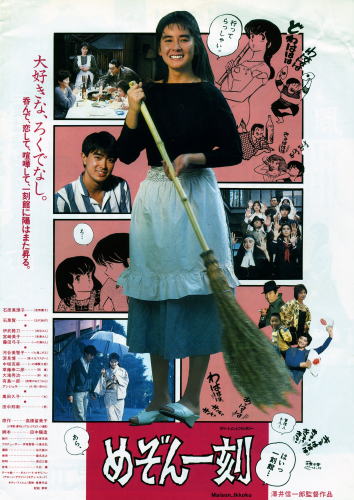
Maison Ikkoku: Apartment Fantasy (めぞん一刻, Shinichiro Sawai, 1986)

Maison IkkouIf you’ve always fancied a stay at that inn the Katakuris run but aren’t really into zombies and murder etc, you could think about spending some time at Maison Ikkoku (めぞん一刻). Based on the classic 1980s manga by Rumiko Takahashi, the 1986 live action adaptation is every bit as zany as you’d hope. Eccentric tenants, women pulled from ponds, bank robbers, and an all star dog. It’s a pretty full house, but if anything’s for certain it’s the more the merrier over at Maison Ikkoku.

Godai (Ken Ishiguro), a would-be student retaking his university entrance exams, has finally had enough and vowed to move out of Maison Ikkoku for good but just as he’s made his decision, an elegant woman arrives with a big white dog. The beautiful lady, Kyoko (Mariko Ishihara), is their new building manager. Godai falls instantly in love with her and decides to stay, but Kyoko has her own reasons for coming to Maison Ikkoku and isn’t quite ready to engage in a romance with a feckless student.

Kyoko also makes the mistake of reminding the collection of eccentric tenants that they’re behind on their rent. There are currently four residents occupying the apartment building including Godai. He’s joined by the mysterious Yotsuya (Masato Ibu) who seems to have several different jobs and speaks in an overly formal manner, Ichinose (Yumiko Fujita) – a gossipy middle aged housewife, and Akemi (Yoshiko Miyazaki) who works at a nearby bar and is almost always in her underwear. They don’t want to pay so they start coming up with plans to stop Kyoko coming after them for the money – the first one being to drug and assault her so she’ll be too embarrassed to talk to them again! Went dark quickly, didn’t it?

Despite the quirky goings on, the presence of death is constant. Kyoko is an extremely young widow sill mourning the death of her husband and has even named her dog after him. Shinichiro keeps making his ghostly presence known to her by ringing the nearby shrine bells or stealing her umbrella, making it impossible for Kyoko to move on. A non-resident but frequent visitor (played by Kunie Tanaka) recounts that his wife left him and took part in a double suicide with another man, whilst the gang also picks up another member in the form of a woman that Yotsuya claims to have fished out of the lake after she “got caught on his pole” and is now a little obsessed with him thinking that he’s the boyfriend she tried to commit suicide over.

If that all sounds a little heavy, Sawai makes sure to pile on the absurdism to keep things light and even includes a few visual gags such as a floating geisha doll during Yotsuya’s “I regret preventing a woman’s suicide because it turns out she’s quite annoying” speech. About half way through the film the entire gang suddenly decides they’re going to perform an “Ikkoku speciality” in celebration of Godai’s success which turns out to be a full scale song and dance number with everyone dressed in outfits that reflect their personality from Yotsuya in his temple singer garb, Ichinose in her wedding dress, Akemi in a nurses outfit, and Godai and Kyoto both in a school uniform, to the mysterious man dressed as a hardboiled detective the failed suicide woman for some reason dressed as a nun. Just when a big “The End” sign pops up we get yet another song accompanied by glow sticks waving in the background.

The main “drama” revolves around Godai’s attempts to pass his university entrance exams and win the heart of Kyoko though there are also various subplots concerning the odd rivalry between Yotsuya and the mysterious man over a bank robbery as well as their attempts to evade the police. Maison Ikkoku becomes a kind of sanctuary where those with wounded hearts can find a place to heal themselves. Occasionally bleak, such as in the frequent references to death and suicide, Maison Ikkoku is an absurd place filled with larger than life characters acting out their surreal existence in this shared paradise of a rundown boarding house in a quiet backwater. The film ends on another ironic note as the party goes on but the Gilbert O’Sullivan track Alone Again, Naturally plays over the end credits which is, of course, about the singer’s intention to commit suicide after being jilted at the altar. A strange if well crafted film, Maison Ikkoku is in someways ahead of its time in the quirky humour stakes but also makes use of a typically ‘80s kind of absurdism which fuses black humour with innocent, youthful charm.


Original Trailer(s) (No subtitles)

Behemoth (悲兮魔兽, Zhao Liang, 2015)

behemothEvil, so a wise man said, begins when you start treating people as things. Fritz Lang’s Metropolis showed us a city that literally was its people – nothing but a vast yet perfectly functional machine with the workers little more than cogs to be replaced and discarded once worn out. Zhao’s Behemoth (悲兮魔兽, Bēixī Móshòu) is no fantasy but a very real journey through our own world and so we follow our narrator, a poetic, naked stand in for Dante’s Virgil, through hell and purgatory on a path to paradise only to find ourselves staring into a void filled with our unfulfilled desires and forlorn hopes.

On the fifth day God created Behemoth, and the mountain brings him forth food. Where once there was a paradise of verdant green fields and pastoral hills, now there are only quarries and the sounds of men at toil have replaced those of birds and other kinds of beasts. Our journey into hell takes us into a coal mine filled with noise and fires as the mountain is asset stripped right before our very eyes. We are witnessing a murder – the brutal slaughter of natural beauty for human gain, perpetrated by exploited workers who live in penury while their bosses rake off the profits from a safe distance.

Zhao’s workers labour at all hours under the searing heat of a midday sun or the bright glow of moonlight. He lingers on their faces, some old before their time but each tired, wrinkled. The workers are not provided with much in terms of infrastructure or facilities. They have no showers as Western coal miners might, they return home to scrape themselves with towels in an attempt to remove the stain of coal dust from their skin. Coal dust is a penetrative parasite, it sinks deep, falling into the creases each worker has developed through their strenuous efforts to earn the money to survive.

The dust does not stop at the skin. It runs deeper still, into the lungs where it stifles breath even once the unbreathable air of the furnace has been left behind. In what amounts to the naked dreamer’s path through purgatory, we see former workers lying listlessly on hospital beds as the black fluid is drained from their lungs. They cough, wheeze and struggle to breathe but they receive scant care or regard for their years or backbreaking toil. Some of them have formed a pressure group, hoping to get the government involved in their struggle to improve pay and conditions in the powerhouse of the nation but, as is expected, they receive little attention – after all, there are plenty more workers out there and leverage is small when jobs are in demand.

So what of Paradise? Paradise is empty, all the righteous are trapped in hell. Vast cities of high rise buildings lie vacant – a symptom of economic hubris as supply outstrips demand by an inconceivable margin. All this progress, and no one left to enjoy it. At the beginning our naked dreamer evokes Dante to tell us that there is no greater pain than desire without hope. It is unclear if Zhao’s Inner Mongolian workers would prefer this kind of paradise to their green rolling hills, but the decision has been made for them and even so, this is a workers’ paradise that is intended for a different kind of worker, there is no space here for any of Zhao’s coal smeared faces.

Our naked dreamer was guided here by a fellow plains dweller who does not know how to write poetry, but the eloquence of his heart is equal to Dante himself. The guide claims to show us a picture of the dead but the weight he carries on his back is a mirror – it shows us death wearing our own faces. Zhao shows us who we are – the faceless monster, Behemoth, is us or a manifestation of our relentless greed. We were born in paradise, and created ourselves a hell because we wanted more than the Earth could give us. This is our never-ending tragedy, overwhelmed by desire we destroy each other in an endless quest for an unattainable paradise that only exists in dreams.

Zhao’s background in photography comes to the fore as he captures these hellish scenes with an odd kind of beauty, mixing the bucolic with the brutal. Cattle grazes on the distant fields as fires burn in the background, and a baby boy plays innocently by madly digging at the ground as if mimicking the behaviour he sees all around him. At one moment the entire screen floods with red as the hellish glow of the smelting process momentarily blinds us, as does a dust cloud of white later on. For the most part, Zhao is content to show us the faces of these men and women, weathered by years of backbreaking labour yet he also tells us that he sees past their fatigue and their resignation to the people they once were that this environment has also destroyed. This is no social realist propaganda film, Zhao respects the sacrifice of these hard working people but it’s as far from glorification as it’s possible to be.

It’s tempting to say this is a China specific issue, brought about by the country’s unique political situation and rapid industrialisation but Zhao’s canvas is wider. This is a human problem that is not bound by national borders or cultural norms. We each live complicit with this system, so desperate to keep the lights on that we’ve become afraid to ask how it’s done. We can continue feed the monster that will one day devour us, or we can try to starve it out but that would require us to acknowledge the greed and selfishness that underline human nature. History is not on our side.


UK release trailer (ICA exclusive screening):

Memories of You (ラブ・ストーリーを君に, Shinichiro Sawai, 1988)

Memories of youIf you thought idol movies were all cute and quirky stories of eccentric high school girls with pretty, poppy voices then think again because Memories of You is coming for you and your faith in idols to make everything better. Directed by W’s Tragedy‘s Shinichiro Sawai, Memories of You (ラブ・ストーリーを君に, Love Story wo Kimi Ni) stars one of the biggest idols of them all – Kumiko Goto, only 14 years old at the time of filming. Seemingly inspired by classic Hollywood melodramas of the ‘50s, Sawai’s film finds its innocent protagonist attempting to live an entire lifetime in only six months as she succumbs to a cruel and relentless disease.

Giving no clue as to its eventual destination, Memories of You begins with two young men returning from a hiking trip. You can tell the pair are committed alpinists because of their distinctly alpine attire and by the way they look at a glockenspiel. In this early comic scene, Araki (Shingo Yanagisawa) is heading straight to an important job interview that he hopes will help him get his girl back if he’s hired so he’s talking a mile a minute whilst awkwardly changing into a business suit inside a photo booth.

The other young man, Akira (Toru Nakamura), runs into the star of film, Yumi (Kumiko Goto), on her way back from the hospital. Akira used to be Yumi’s tutor and it’s obvious she has kind of a crush on him. Unbeknownst to Yumi, the results of her tests are much more serious than might be assumed from her cheerful persona. Yumi has leukaemia and the doctors do not expect her to survive for more than six months at most.

Yumi’s devasted mother shifts her grief away from the pain of losing her only child, to that of her stolen future – no high school, no romance, no love, marriage, or children. Accordingly she asks teacher in training Akira for a considerable sacrifice – essentially, pretend to date Yumi and give her the kind of love story that she will never now be able to experience.

Needless to say, this is a little creepy given that Akira is in in his mid-twenties and Yumi is only fourteen. Of course, it’s all very chaste and innocent like something out of a shoujo manga but still even in 1988 the scenario rings alarm bells. Akira is conflicted about his new role as a fake boyfriend for a dying teenager but it would be heartless to refuse, though one may wonder about what effect all of this may have on his future chosen career.

The world of 1988 is noticeably sexist in that Yumi’s mother works as a cookery teacher, reminding her pupil’s that this is the most important course because they’ll all be competing with their future mother-in-laws in the great culinary battle to win their husband’s hearts. These girls are raised to be housewives and nothing more, although, Yumi’s mother is divorced and now has a career, is taking care of Yumi alone and is not particularly looking to remarry. So, swings and roundabouts in terms of social progress.

The film flits between the viewpoints of Yumi and Akira as they both try to adapt to this unusual situation. As is common in these kinds of films, Yumi is not quite as in the dark as everyone had assumed and is readying herself to say her final goodbyes. This also brings about a reunion with her long absent father who has emigrated to Canada where he has a new wife and younger daughter. Yumi’s family status is an uncommon one for 1988, yet there is relatively little stigma surrounding it. Perhaps her father’s return after three years is one factor in Yumi’s realisation of the seriousness of her condition (as her mother feared it might be) but the final reconciliation does at least bring her a little more calmness and stability.

Yumi’s illness is a mountain which cannot be conquered. The beauty of the natural world and the desire to overcome it, in a sense, through physical exertion are the chief motifs of the film as Yumi dreams of travelling to Switzerland – the spiritual home of alpinism (it would seem). The loving looks at the glockenspiel in the opening scenes develop into an underlying musical theme as they also recur during the lengthy cabaret sequence close to the film’s climax. Of course, Yumi finally attempts to climb her mountain with Akira as her guide but there is only so far she can proceed.

Despite its melodramatic touches and desire to be a grand tearjerker, Memories of You is too restrained to make the full force of its tragedy achieve the kind of emotional effect that it aims for. Filled with syrupy, orchestral music very much like that employed by classic Hollywood examples of the genre, Memories of You really wants the viewer to experience the intense sadness of such a young life taken by a cruel and indiscriminating disease but often overplays its hand. This isn’t helped by the unsettling nature of the “romance” between Akira and Yumi or the (entirely understandable) lack of chemistry between the leads who each give independently high quality performances. An interesting example of an “idol movie” which steps outside the genre norms, Memories of You doesn’t quite have the courage of its convictions but is another nicely photographed effort from Sawai.


End credits and title song (not sung by Kumiko Goto)