Four Springs (四个春天, Lu Qingyi, 2018)

Four Springs poster“Time flies. Life is so short, isn’t it?” a cheerful relative remarks lamenting that the family only comes back together once a year during the first of Lu Qingyi’s Four Springs (四个春天, Sì gè Chūntiān). Rather than follow his family through four seasons for one year, Lu Qingyi observes his ageing parents at yearly intervals as time both moves on and doesn’t delivering joy and sadness in equal measure.

Beginning in the spring of 2013, Lu Qingyi returns home to the remote small town of Dushan where his parents have lived for decades. The family comes together again, if only briefly, to ring in the New Year much as they always have. During the second New Year, Qingyi is joined by his sister Qingwei but there is sadness on the horizon as we discover she is coping with serious illness though the family once again celebrate joyously recalling the past more than dwelling on the future. Subsequent reunions are born both of joy and sorrow as family illnesses take hold, bringing people back together again if only to unite them in sadness and anxiety. Yet life, as always, rolls on just the same.

Briefly including shots of himself, Qingwei focusses on the figures of his parents – retired teacher Yunkun and mother Guixian. Though they must have lived through some turbulent times, the couple are blissfully happy in each other’s company and used to taking pleasure in the simple things such as the swallows which occasionally nest in their roof, or making a new hive for some migratory bees come to visit. The natural world is very much a part of their existence as they make time for hiking out in the mountains, tending graves and enjoying the scenery singing always as they go.

Music, indeed, seems to be an important part of life in Dushan and song is never far away from the lips of of Qingwei’s parents who find themselves humming folk tunes or stretches of traditional opera. Yunkun makes use of his computer to listen to and edit tracks while the rattling of his wife’s manual sewing machine echoes from the next room. Though many things here are “traditional”, the couple are not so much trapped in the past as happy with what they have. Yunkun has embraced his computer, but a later attempt to introduce the couple to smartphones and teach them to use the WeChat app ends in hilarity as they attempt to process the extreme modernity of instant communication.

Technology is both a privilege and a curse, as the family discover one New Year in being deprived of watching the spring gala thanks to an ill timed power cut which also leaves them inside in the cold but perhaps makes the fireworks a little brighter. As the New Year becomes marked by its absences – the empty chairs and increasing silences, technology also provides a path back to happier times through the home videos filmed in previous years by Qingyi and his father which provide a record of ordinary family life both happy and sad in recalling past springs never to come again.

Time itself becomes a theme as it marches on invisibly. Qingyi’s cheerful parents are thankfully in good health, though his mother wishes they could dance again like they did in the old days and worries what will become of the one left behind when the inevitable happens. Nevertheless, the New Year arrives as it always does, preparations are made, too much food is cooked, the family eats, and sings, and remembers. Lu Qingyi’s Four Springs is a touching evocation of the joys and sorrows of being alive in his loving tribute to his goodhearted parents who have learned to find the tiny happinesses in the every day even in the midst of unbearable sadness.


Four Springs screens as part of the eighth season of Chicago’s Asian Pop-Up Cinema on April 7, 2pm & 5pm, at Heritage Museum of Asian Art, 218 West 26th Street.

Original trailer (English subtitles)
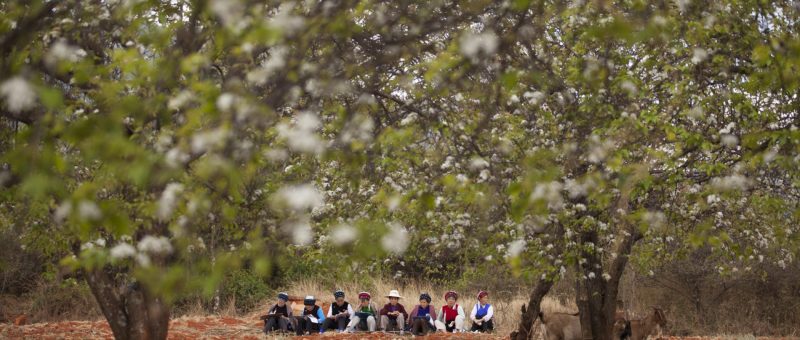
Up the Mountain (火山, Zhang Yang, 2018)

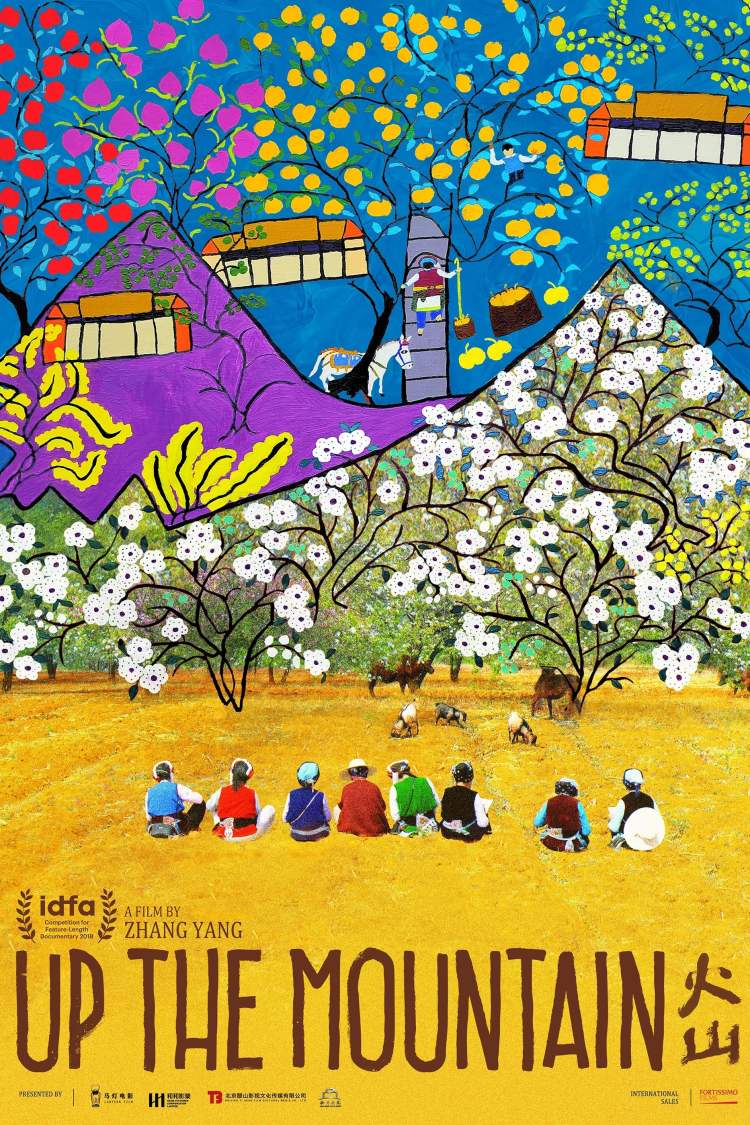
Up the Mountain posterThe story of modern China has often been one of migration as the young find themselves pulled towards the cities, sending their children back to the countryside to be raised by relatives while they earn what they can away from home. As the economic situation improves, however, there may be motion the other way. Successful artist Shen Jianhua moved from the bustling metropolis of Shanghai to a remote mountain village where he practices his art and opens his home to all who have an interest in learning from him.

Shen’s mountain home is an interesting exemplification of a blend of old and new. Though he seems to prefer the simple life, the renovated property is decorated in a modern, though fairly minimalist, style and the family do not appear to want for anything. Their living is not austere and Shen does not object to the idea of modernity, as the toys bought for his baby son seem to testify while his apprentice chats on an iPhone and his teenage daughter listens to music while she runs.

Nevertheless, life in the mountains is lived slowly and there are things which must be done which is why we see apprentice Dinglong continually chopping firewood while the gaggle of old ladies who make up the majority of Shen’s pupils come back and forth with vegetables preparing tasty food to be shared communally by the small family that has grown up around Shen’s art practice. It does not appear that the ladies pay anything for Shen’s instruction or that he draws much of an income for it, but all seem to benefit from a shared sense of creative community. One old lady describes her life before art as “stagnant, like old water”, but now she feels reenergised and happily gives away her finished paintings to her bemused children as something to remember her by when she’s not around.

Not everyone is as happy for the old women as they seem to be for each other, however, as we notice in the persistent discord between one older bickering couple. Dinglong too remains conflicted. Still young, his parents are beginning to pressure him to give up painting and the mountains to settle down. Dinglong, like many young men, doesn’t really want to and so is surprised and dismayed when Shen’s advice is more conservative than he might have expected, encouraging him to obey his parents’ wishes and reminding him that good art is founded on a wealth of life experience. Truth be told, Dinglong has a girlfriend already and is perhaps edging towards marriage but the snag is that her parents are from a nearby city. They’d rather their daughter marry nearby and would worry about her living in a remote village they perhaps assume is much more rustic than it really is. The other problem is that artists don’t earn much and Dinglong admits he only paints one picture a year with no guarantee it will sell. As a son-in-law, he’s not a particularly good catch.

Dinglong’s dilemma is perhaps unusual, most of the other youngsters are desperate to leave the country for a better life in the cities no matter how illusionary it might turn out to be. Then again, his resistance is perhaps more understandable as he complains to Shen that he is being given almost no choice in his future as everything is being sorted out by his fiancée and the parents with him the only one in favour of his staying in the mountains. His future wife has a point, however, when she objects to raising children in the village without access to a good school. Shen and his wife are educated people and they’ve been able to teach their teenage daughter at home but Dinglong is a rural boy and they won’t have the resources to give their children the best start in life unless they travel to a place those resources might be found.

Reluctantly, Dinglong is forced away from the simple, traditional life which seems to suit him best while his wife remains unsympathetic to his attachment to the village and its guardian god. Meanwhile, Shen’s life carries on much as before even after the birth of his baby son who put in an appearance a month early to be born in the middle of New Year. Zhang captures the ancient rhythms of the traditional village through its rowdy, colourful festivals filled with joy and excitement but also sees the ways in which it is changing. One older lady enlists Shen’s help to build a bathroom on her property because her daughter was too embarrassed to bring a prospective husband home to a house without one (and a daughter getting married is after all the most important thing), creating a beautiful space dedicated to modern ideas of relaxation and serenity rather than the efficient austerity usually associated with rural life. The young might not be able to stay, but given time they may return and the mountain will be waiting for them with patient warmth.


Up the Mountain (火山, Hshān) screens as part of the eighth season of Chicago’s Asian Pop-Up Cinema on April 6, 2pm, at Heritage Museum of Asian Art, 218 West 26th Street.

Original trailer (dialogue free)

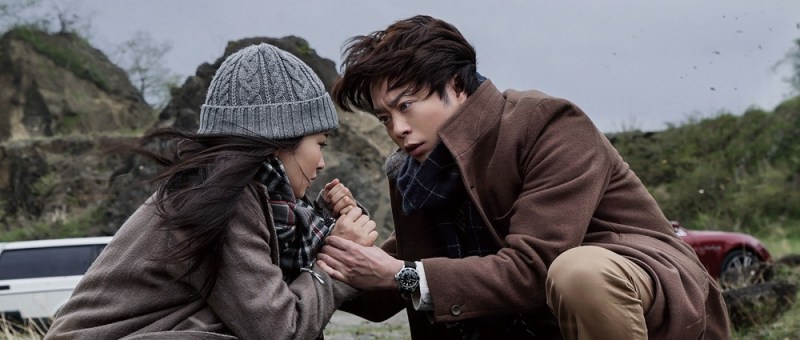
Laplace’s Witch (ラプラスの魔女, Takashi Miike, 2018)

Laplace's Witch poster 2Takashi Miike, among Japan’s most prolific of directors, teams up with one of the nation’s most prolific authors, the often adapted Keigo Higashino, for a dose of scientific mystery in Laplace’s Witch (ラプラスの魔女, Laplace no Majo). Responsible for the international smash hit The Devotion of Suspect X and the Galileo series, Higashino too has worked across several genres ranging from the detective novels for which he is best known to children’s books and fantasy. Perhaps in contrast to the director, however, Higashino’s novels tend towards the socially conservative, occasionally cynical if at times perverse. Nevertheless, there is something a little ironic in Miike choosing to adapt this particular title which revolves around the idea of authenticity in art and meaningful legacy.

The unlikely hero of the tale, climate scientist Shusuke Aoe (Sho Sakurai), is called in to investigate the mysterious deaths of a film producer and an out of work actor who appear to have died of hydrogen sulphide poisoning at separate hot springs resorts. Dying of hydrogen sulphide poisoning outdoors is considered a scientific impossibility and Aoe has no real explanation for how it might have occurred but is stunned by policeman Nakaoka’s (Hiroshi Tamaki) assertions that foul play may have been involved.

Nakaoka is not exactly a bumbling policeman, but his certainties – born of policeman’s instinct, are held up for ridicule as he rapidly switches suspects, knee-jerk accusing the film producer’s widow of conspiracy to murder before deciding there must be more involved than a simple attempt at financial gain. He is however eventually correct, quickly figuring out the surprising connection between the two dead men is a famous film producer, Amakasu (Etsushi Toyokawa), who lost his own family in ironically similar tragic circumstances some years earlier and seems to have dropped off the radar ever since.

All of which means, Aoe’s scientific knowledge is increasingly irrelevant. His major contribution to the case at hand is in his strange friendship with a mysterious teenage girl who is engaged in her own missing persons case which may have some overlap with the murders. Aoe quickly notices that Madoka (Suzu Hirose) appears to have preternatural powers which she later alludes to in branding herself the “Laplace Demon” in honour of a scientific theory which suggests that if someone were to know the exact location of each and every atom in the universe then it would be perfectly possible to calculate their courses and trajectories with mathematical certainty and thereby possess absolute knowledge of the future.

Whether one might want such all encompassing knowledge is a bigger question. As one character later puts it, the ability to discern the future may impede one’s ability to dream and therefore hinder the progress of human society. The central message is, however, somewhat banal in pointing out that we are each of us connected, essential parts of a cosmic machine in which each has a specific role to play. By such logic, murder is then not so much a moral failing as one of over engineering in which attempts to tweak the system may lead to its destruction.

Then again, we hear from the depressed Amakazu that what he fears is that life is essentially meaningless and that many go to their deaths without leaving a mark. His central theory is that objective truth is a matter of record, that whatever is shot is “real” because that is what will be “remembered” long after the fact. Through his films, which are amusingly described in a piece of meta irony as dealing with edgy themes which don’t pander to audiences, he attempts to reorder his world by recreating it, improving on its many disappointments by envisioning it differently. Yet he still yearns for authenticity in his work and may have gone to great lengths to get it in a seemingly pointless piece of behind the scenes theatre.

Perhaps it is this sense of fatalistic ennui that Miike is attempting to capture through Laplace’s continually listless aesthetics but it has to be said that the central mystery, filled with plot holes and contradictions as it is, is particularly unengaging and despite the cheerful we’re all one narrative also carries some decidedly unpleasant undertones. Never quite finding the register to unlock its central philosophy, Laplace’s Witch proves a curiously flat outing for the famously out there director which may very well be the point but then again perhaps it’s a strange point to be making. 


Singapore release trailer (English subtitles)

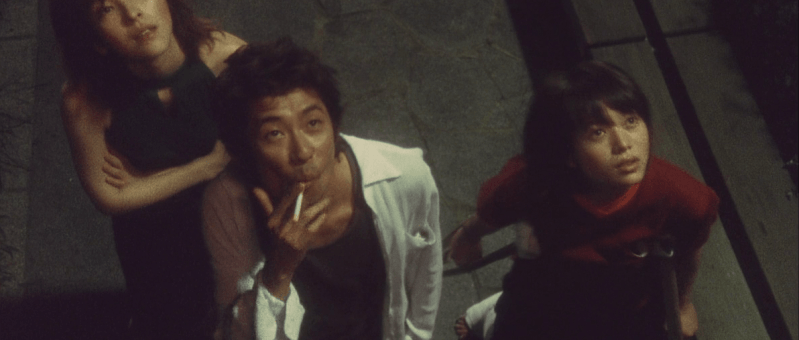
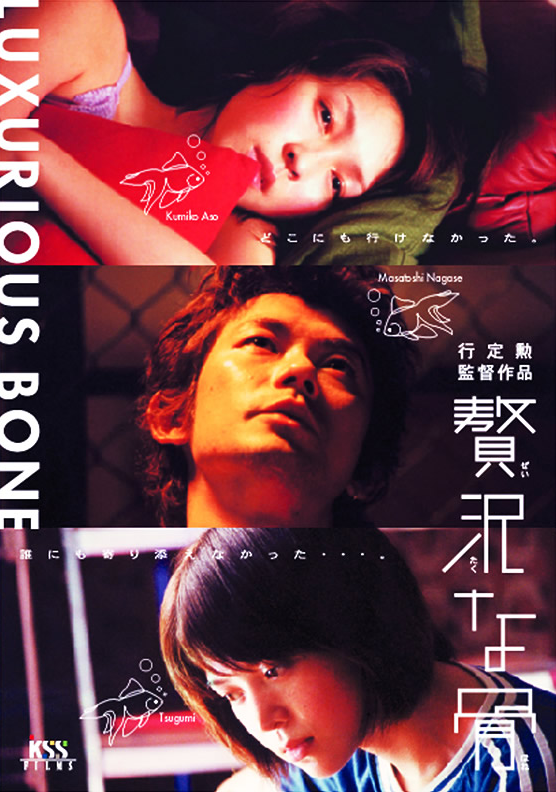
Luxurious Bone (贅沢な骨, Isao Yukisada, 2001)

Luxurious Bone poster

Isao Yukisada made his name with the 2004 hit Crying Out Love, in the Centre of the World, but even before becoming a “junai” pioneer his early films were far from strangers to melancholy, impossible romance. The strangely titled Luxurious Bone (贅沢な骨, Zeitakuna Hone, AKA Torch Song) is a case in point in its early, ambiguous treatment of same sex love and emotional repression. Though in some senses very much of its time, Yukisada’s sad chamber drama is a sensitive exploration of the path towards awakening, if ultimately not to happiness.

The drama begins when Miyako (Kumiko Aso) gets the titular “luxurious bone” lodged in her throat. In this case, it’s an eel bone which is a fish too expensive for either she or her roommate Sakiko (Tsugumi) to eat very often, hence its tinge of luxury even if there’s relatively little difference when it’s tickling your trachea. “Roommate” might not be the best way to describe exactly what Sakiko is to Miyako, though their relationship seems curiously ill-defined. The two women share a bed, and seemingly a life, but perhaps platonically. Sakiko wants to look for a job, but Miyako doesn’t quite want her to because she’s happy to support the pair of them on her wages as a sex worker. Likewise, Sakiko isn’t quite happy with Miyako’s line of work, not because she’s jealous or judgmental, but because she worries the job is unpleasant. Miyako reassures her that it’s fine because she feels nothing at all during sex so mostly it’s just dull.

All that changes however when Miyako meets unusual client Shintani (Masatoshi Nagase) who goes to the trouble of buying her a hamburger bento because he heard that’s the sort of thing you’re supposed to do in these situations. Shintani blows Miyako’s mind which isn’t something she was expecting or quite knows what to do with. On hearing the news Sakiko seems mildly worried, but following a strange series of events Shintani ends up becoming a minor part of their lives as the third wheel in their previously stable though somehow awkward relationship.

Miyako’s intense opening voice over makes reference to a secret she cannot bear to speak that will lie closed within her heart for all eternity. The fish bone becomes a symbol of the thing stuck in her throat, the truth she is too afraid to voice. Choking, Miyako gasps for air like a goldfish floundering in shallow water but cannot find the strength to swallow.

As we will later discover, this dark secret is bound up with her complicated feelings for Sakiko of which she seems to feel afraid and ashamed, wanting to possess her love in its entirety but also unable to access it and hating herself for her continuing need for possession and control. Her unexpected connection with Shintani is, after a manner of speaking, simply a more “acceptable” way of accepting her desire for Sakiko as she later reveals when confessing that she only ever thought of Sakiko when making love with Shintani which is presumably why only he was ever able to give her a satisfying experience.

Unable to cope with the intensity of her feelings, Miyako turns self destructive and attempts to lure Shintani into a sexual relationship with Sakiko who, apparently, is afraid of intimacy altogether having been raised in an abusive, neglectful home in which she was convinced that she was “dirty” and unloveable, an obstacle in the way of her father’s new relationship with a much younger step-mother (Makiko Watanabe).

Something of a cliché in itself, Luxurious Bone first attempts to delegitimise the feelings of the two women for each other by introducing the figure of Shintani to suggest that their problems are largely down to not having met a good man. Miyako sleeps with Shintani to feel closer to Sakiko, while Sakiko begins to move past her emotional trauma only thanks to the gentle machinations of Shintani. Their strange ménage à trois brings them together whilst driving them apart as the two women attempt to touch each other through Shintani while he remains detached and conflicted if perhaps wilfully used. Miyako’s self destructive impulses push her towards burning her world before facing what it is that frightens her. Only a strange encounter with another woman in a club shows her that her fear was not so much love as submission, while Sakiko tries to reconnect with her childhood self to move past her emotional trauma.

Despite its motion towards a positive resolution, Luxurious Bone cannot quite find the courage of its convictions and as quickly delegitimises the love as it tried to legitimise it through leaving Sakiko broadly where she started – lost, confused, and afraid, uncertain if unresolved longing is a natural condition of living. Perhaps of its time and overly simplistic in its treatment of complex issues from traumatic childhoods to shame and repressed sexuality, Luxurious Bone nevertheless has its heart (broadly) in the right place even if it leaves its lovelorn youngsters in the same position as many a Yukisada hero still looking for their place in a cruel and arbitrary world.


Original trailer (no subtitles)

Torch Song by The Humpbacks which features prominently throughout. The song was actually written for the film and is performed by Masatoshi Nagase.

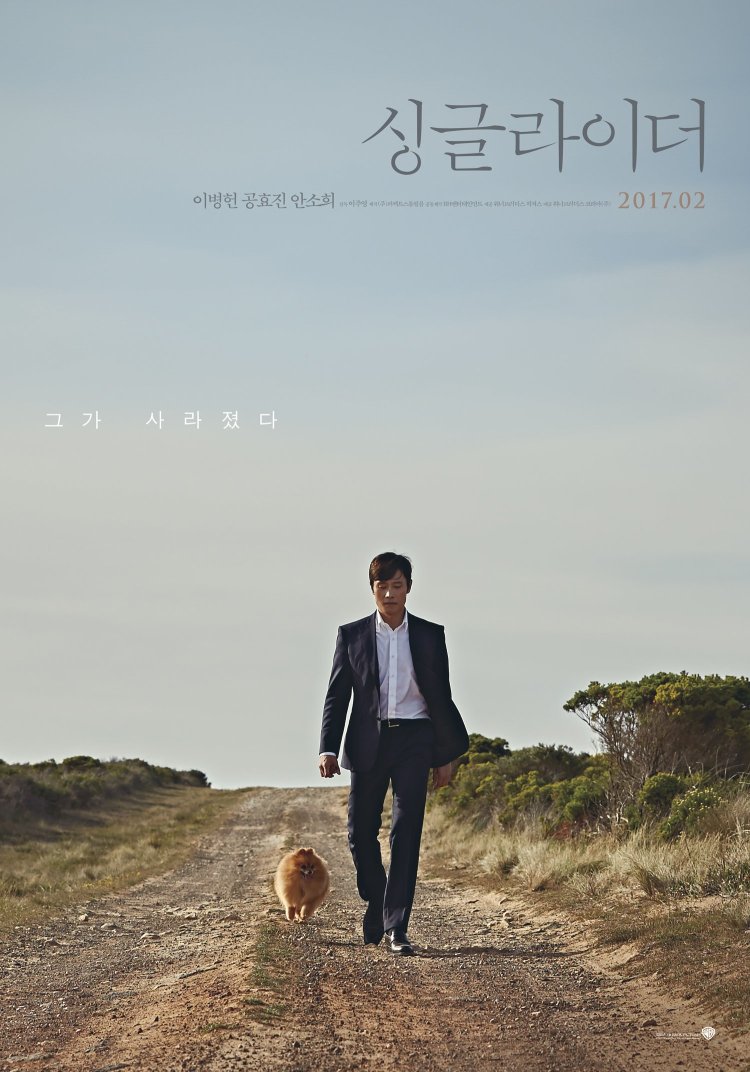
A Single Rider (싱글라이더, Lee Zoo-young, 2017)

Single Rider posterAs the old adage goes, you don’t know what you’ve got ’til it’s gone. Having sacrificed it all for “conventional success”, an emotionally repressed salaryman loses everything when his company is exposed for its immoral business practices only to discover that he’s left it all too late and those he meant to keep close have begun to draw away from him. Quietly contemplative, Lee Zoo-young’s debut A Single Rider (싱글라이더) is a gentle meditation on the way life can get away from you. Brainwashed into the salaryman dream, our financier “hero” allows himself to be swept along by the confidence of his superiors, taking friends and family with him, when he knows deep down that if something seems too good to be true, that’s because it is. Sometimes, it really is just too late, and then sometimes, tragically, it isn’t but you miss your chance anyway.

Kang Jae-hoon (Lee Byung-hun) is a broker at a securities company. Buttoned-down and near silent, he cuts a geeky if reassuringly dull figure but there’s a storm brewing under his calm exterior. His top rated company is in a lot of trouble. They’ve all been breaking the rules, and now they’re about to go under taking the savings of hundreds of ordinary, innocent people with them – people that Kang personally assured that their money would be safe because the company would never declare bankruptcy. Not quite as morally bankrupt as he seems, Kang has been depressed for some time and is on some pretty heavy duty medication. Sending what looks eerily like a suicide note to his bosses, Kang appears to rethink. He sent his wife and son to Australia to “upgrade” them through adding English functionality but hasn’t exactly paid much attention to them since. Searching for the address of the house where they live on Google Maps, he spots them captured together outside and makes an abrupt decision. Before he knows it, he’s bought a plane ticket for Sydney, heading straight to the airport with no luggage and leaving his phone behind so his boss can’t bother him.

Far from a joyful reunion, however, what Kang finds is a visual guide to all the ways he has been erased from the lives of his family. Though Kang’s wife Soo-jin (Gong Hyo-jin) and son Jin-woo (Yang Yoo-jin) have been in Australia for a couple of years, Kang does not appear to have visited before and has trouble finding the house. When he eventually locates it, he knocks at the door and gets no answer, only to find his wife laughing and joking with a neighbour – apparently the father of a friend of Jin-woo’s. Unable to bring himself to knock again, or even to find a call box and explain, Kang begins “haunting” his family, creeping around the house while they’re out, spotting pictures of the Australian neighbour, Chris (Jack Campbell), everywhere and none at all of him.

Watching them from afar, Kang is forced to reevaluate his choices. The smallest details trigger memories of his life in Korea – a flapping kitchen door left ajar when his wife had insisted on a deadlock in Seoul because she felt so afraid with him gone so often even though they lived in an upscale high-rise with an electronic entry pad, the violin she gave up for him but now apparently has taken back up, the papers on the kitchen table which imply she wants to stay rather than go “home”. Like many men who work away from their families, Kang forgot that time was passing for them too and assumed they would be waiting for him like toys put away in a box, sleeping until he’s ready to wake them. Now he wonders how close she really is to Chris, if she wants to stay for him, if she’s grown away from her husband, or simply enjoys the wide open breeziness of their spacious Sydney home with its comparatively relaxed rhythms and friendly laid-back way of life. The only thing he can be sure of is that he doesn’t seem to belong in this house anymore and this is very much not his world.

Then again perhaps Australia is not all good – Kang hates the way everyone seems to call his wife “Sue” to make her foreign name easier to remember. He runs into something similar with a young girl he noticed at the station whose name is “Ji-na” (Ahn So-hee) but everyone in Australia seems to call “Gina”. Ji-na’s problems turn out to be bigger than a misremembered name. Despite his obvious familiarity with financial scams, Kang does nothing when he overhears Ji-na on the phone to some dodgy people who want to do a “personal currency exchange”. He doesn’t see them convince her to get in their car, but does catch sight of her coming back the same way later limping and bloody having been deprived of the money she’d carefully been saving up while her labour was exploited as she lingered on after her visa had expired (which is why she can’t go to the police, as her abusers are well aware). Ji-na, like him, made a series of bad decisions though perhaps for “better” reasons and has paid dearly for her mistakes.

To be fair, Kang thought he was making his decisions for good reasons – he convinced himself he was working to provide for his family, even sending them away “for their benefit”, but now he regrets it. He regrets everything – his workaholic lifestyle, the way he allowed his principles to be compromised in pursuit of “success”, the way he bought his swanky Seoul apartment and a middle-class suburban home in Australia through defrauding people who trusted him, and the way he lost his family through a misplaced desire to “better” them rather than simply allowing them to be happy. He thinks it’s too late, that he’s ruined himself and that his family have already moved on. He may be wrong, but he won’t find out by snooping around the house and following Chris about all day to figure out how close he is to his wife.

Kang’s tragedy is that he made a series of bad decisions in which the last was the worst and the most sad. Lee Byung-hun invests Kang with an air of utter defeat, as if the air itself were crushing him while he remains unable to reconcile himself to his new circumstances or bring himself to make contact with his family. A final revelation (or perhaps confirmation of an obvious fact) makes plain why exactly it is that he seems to wander invisibly through the city streets, using public transport but miraculously disappearing from one place to appear in another as if in a trance. Kang’s only option is, perhaps, to learn to be glad that his wife and son finally have a chance to be happy even if it’s without him and be grateful that his son has found another man who’d run until his feet were sore just to keep him safe. Sometimes it really is just too late, but, tragically, sometimes you accept defeat too early when what you thought you’d lost is already on its way back to you only you’ve already given up, not on it, but on yourself.


Original trailer (no subtitles)

My Love Has Been Burning (わが恋は燃えぬ, Kenji Mizoguchi, 1949)

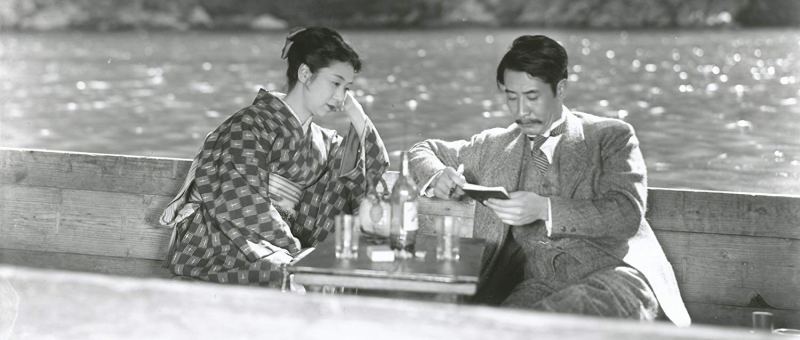
My love has been burning posterAmong the many parallels that could be drawn between the Meiji Restoration and the immediate post-war period, the most obvious is that each provided a clear opportunity for social change along with a moment of frozen introspection and internal debate about what the new promised future ought to look like. Following Victory of Women and The Love of the Actress Sumako, Kenji Mizoguchi completed a loose trilogy of films dealing with the theme of female emancipation with My Love Has Been Burning (わが恋は燃えぬ, Waga Koi wa Moenu), returning once again to the broken promises of Meiji as its heroine discovers that old ideas don’t change so quickly and even those who claim to be better will often disappoint.

The film opens in the early 1880s as a teenage Eiko Hirayama (Kinuyo Tanaka) attends a rally to celebrate the arrival of noted feminist Toshiko Kishida (Kuniko Miyake). Eiko, a committed social liberal from a conservative middle-class family, went to see her idol in the company of a childhood friend, Hayase (Eitaro Ozawa), who is shortly going to Tokyo to study and join the democratic revolution. He halfheartedly asks Eiko to come with him, but knows that she won’t because her parents will refuse permission and she will not disobey them. Soon after, Eiko’s loyalty to her family is weakened when the family’s maid, Chiyo (Mitsuko Mito), is sold to a brothel by her father. Devastated, Eiko asks her parents for the money to buy her back but they refuse, regarding Chiyo’s sacrifice as noble and in line with filial tradition. If Chiyo had refused (not that she had the right or power to refuse), her parents would starve. Eiko rushes back to the docks, but she is too late, Chiyo and Hayase have both departed for the capital and extremely different fates.

After her family situation declines still further and Eiko decides it is impossible for her to remain under her father’s roof, she makes her own way to the city but finds it not quite so welcoming as she’d assumed it to be. Hayase is not overjoyed to see her. He merely asks if she has finally decided to marry him and becomes petulant when she reaffirms her intention to study even if she implies that she intends to marry him at a later date. During his time apart from her, Hayase has been working for the fledgling Liberal Party agitating for wider democratic rights and the expansion of the franchise, though he is irritated still further when his mentor, Omoi (Ichiro Sugai) – the leader of the socialists, is supportive of Eiko’s ambitions and agrees to find a job for her working on the party paper.

Eiko’s early disappointment in Hayase is frequently mirrored in all of her subsequent dealings with men. Hayase put on a performance of believing in her cause of women’s liberation and more widely the equality of all peoples ending centuries of feudal oppression, but really just wanted to possess her body and is unwilling to accept her decision to reject him or to choose someone else. Later visiting her after she has been imprisoned on a somewhat trumped up charge, Hayase tells her that a woman is only a woman when loved by a man, and that a woman’s fulfilment is achieved through home, family, and motherhood. He tells her that he admires her for her education and talent, but that she has “forgotten” that she is a woman. He will help her remember by getting her out of prison if only she consent to marry him even though he has previously attempted to rape her and is now working for the rightwing government having betrayed the socialist cause.

Meanwhile, Omoi looks an awful lot better. He is, ostensibly, entirely committed to socialist aims, energetically engaged in promoting the Liberal Party, and trying to ensure true democracy takes root in the new Japan, lifting the common man above his subjugated position in the still prevalent feudal hierarchy. Nevertheless, he too eventually falls in love with Eiko and like Hayase is ultimately more interested in her body than their shared cause for liberal freedom. He appears to support her desire for women’s rights as an integral part of his desire to end feudal oppressions but his belief in female equality is later exposed as superficial. Eiko, reuniting with Chiyo in prison, takes her into the household she now shares with Omoi (though they are obviously not legally married) as her maid which is perhaps not entirely egalitarian but still a well intentioned attempt to free her from the life her father condemned her to.

Omoi disappoints, bedding Chiyo while Eiko is working hard at the campaign office. Confronted, he rolls his eyes and offers a boys will be boys justification before affirming that it was just a matter of sexual satisfaction and that his feelings for her haven’t changed, mildly reproving Eiko for allowing her emotional jealously to cloud her judgement in restricting his sexual freedom. If it were indeed a matter of free love, perhaps Eiko could have understood, but Omoi damns himself when looks askance at Chiyo and remarks that it doesn’t really matter because she is nothing but a servant and a concubine. All at once, Eiko sees – despite his fine talk, Omoi may have abandoned feudal ways of thinking when it comes to working men but still sees women in terms of things. If he thinks female “servants” are not worthy of respect or agency, then what is it that he has been fighting for in his supposed mission to end oppression in Japan?

Attempting to comfort a distraught Chiyo who has been so thoroughly brainwashed that she never quite expected anything “better” than being a concubine and has truly fallen for all Omoi’s pretty words about wanting to make her happy, Eiko reminds her that as long as men continue to think as Omoi does women will never be free. Freedom and equality are what will enable female happiness, and long as men refuse to recognise women not as domestic tools but as fellow human beings there can be no freedom in Japan. Mizoguchi reinforces the idea that while one is oppressed none of us is free, neatly celebrating the success of the disappointing Omoi while lamenting that his intentions for reform will not go far enough. Eiko cannot free the women of Japan on her own, but her solution is warm and committed – she will teach them to free themselves by starting a school, educating the next generation to be better than the last. Chiyo, notably, whom she never blames or rejects, will become her first pupil neatly subverting Hayase’s cruel words when she asks Eiko to teach her how to be a woman.

Unusually brutal, My Love Has Been Burning does not shy away from the violence, often sexual violence, which both women suffer both at the hands of men and of the state as they attempt to do nothing more than live freely as full human beings. It also makes plain that even those with supposedly high ideals can disappoint as they nevertheless motion towards real social good without fully committing to its entireties. A committed pro-democratic, intensely feminist statement, Mizoguchi’s lasting message lies in an affirmation of female solidarity as, unlike the self-serving Omoi, Eiko lifts her pupil up onto her own level and draws her shawl around them both committed to proceeding forward together into a fairer future.


The Love of the Actress Sumako (女優須磨子の恋, Kenji Mizoguchi, 1947)

vlcsnap-2019-03-27-01h39m45s435The Taisho era was, like that of the post-war, a time both of confusion and possibility in which the young, in particular, looked for new paths and new freedoms as the world got wider and ideas flowed in from every corner of the globe. In The Love of the Actress Sumako (女優須磨子の恋, Joyu Sumako no koi), the second of a loose trilogy films about female emancipation, Kenji Mizoguchi took the real life story of a pioneering actress of Western theatre and used it to explore the progress of lack there of in terms of social freedoms not only for women but for artists and for society as a whole.

We begin in late Meiji as theatre director Shimamura (So Yamamura) fights to establish a foothold of Western-style “art theatre”, moving away from the theatricality of kabuki for something more immediate and naturalistic. He has, however, a problem in that as women were not allowed to take to the kabuki stage all of his students are male and casting a man to play a woman’s role would run counter to his desires to create a truly representative theatre. It is therefore lucky that he runs into Sumako Matsui (Kinuyo Tanaka) – a feisty, determined young woman who had divorced her first husband for infidelity and then left the second when he complained about her desire to pursue a career on the stage. In Sumako, Shimamura finds a muse and the ideal woman to portray the extremely controversial figure of Nora in his dream production of Ibsen’s incendiary A Doll’s House.

Shimamura casts Sumako because he sees in her some of Nora’s defiance and eventual desire to be free from illusionary social constraints, but it is in fact he who ends up embodying her spirit in real life. Somewhat feminised, Shimamura is in a difficult position in having married into his wife’s family, leaving him without real agency inside his own home as evidenced by his mild opposition to his daughter’s arranged marriage. While he wishes that his daughter be happy and if possible marry for love, Shimamura’s wife is very much of the old school and wants to make the best possible match in terms of financial gain and social status, viewing emotional compatibility as a low priority (the daughter herself as relatively little say). Unwisely falling in love with Sumako, it is he who eventually decides to follow Nora’s example by walking out not only on his family but also on the theatre company. He does this not quite because the scales have been lifted from his eyes – he was never under any illusion that his arranged marriage was “real” and there is of course an accepted degree of performance involved in all such unions, but because he finally sees possibility enough in his love for Sumako and the viability of emotionally honest Western art to allow him to break free of outdated feudal ideas of familial obligation.

Nevertheless, making a career as an artist is a difficult prospect in any age and Shimamura’s emotional freedom quickly becomes tied up with that of his art. Sumako’s Nora proves a hit (in the last year of Meiji), but he is ahead of his times both in terms of his liberal, left-wing philosophy and his determination to embrace modern drama in a still traditional society. The roles we see Sumako perform, including that in Tolstoy’s Resurrection which was another of those that helped to make her name, are all from proto-feminist plays which revolve around women who, like herself, had chosen to challenge the patriarchal status quo in pursuit of their own freedom and agency. Shimamura’s wife makes no secret of her outrage to her husband’s desire to stage A Doll’s House, viewing Nora’s decision as “selfish” and perhaps of a subversion of every notion she associates with idealised femininity. Though not so far apart in age, Sumako is a woman of Taisho who left not one but two unfulfilling marriages and is determined to forge her own path even if that path eventually leads her to subsume her own desires within those of her lover as the pair attempt to put their social revolution on the stage.

The revolution, however, does not quite take off. Despite good early notices, Shimamura’s Art Theatre company quickly runs into trouble. Faced with financial ruin, he does what any sensible theatre producer would do – he begins to prioritise bums on seats and acknowledges that if he’s to keep his company afloat and facilitate his dream of making Western theatre a success in Japan he’ll have to compromise his artistic aims  by putting on some populist plays. Of course, this sudden concession to commercial demands does not go down well with all and some of his hardline actors begin to leave in protest not just of his selling out but of his twinned desire to make Sumako his star.

Tellingly, the pair are eventually forced out of Japan entirely to tour the beginnings of empire from Korea to China and on to Taiwan. Their ideas are too radical and their society not quite ready for their messages even if not initially as hostile as it would later become. Shimamura works himself to the bone trying to keep his dream alive, eventually damaging his health. Sumako remains somewhat petulant about being forced into an itinerant lifestyle while her onstage personas come increasingly to influence her offstage life until it is said of her that her performance is “no longer an interpretation but an extension of reality”. In this, Sumako has, in a sense, achieved Shimamura’s dreams of a truly naturalistic theatre, but it comes at a cost, as perhaps all art does, and, Mizoguchi seems to suggest, becomes a kind of sacrifice laid down to a society still too rigid and unforgiving to appreciate its sincerity. Nevertheless, their boldness, as fruitless as it was, has started a flame which others intend to keep burning, eventually becoming a beacon for another new world looking to rebuild itself better and freer than before.


Short clip featuring Sumako’s performance as Carmen.

Victory of Women (女性の勝利, Kenji Mizoguchi, 1946)

Victory of Women cap 1Female suffering in an oppressive society had always been at the forefront of Mizoguchi’s filmmaking even if he, like many of his contemporaries, found his aims frustrated by the increasingly censorious militarist regime. In some senses, the early days of occupation may not have been much better as one form of propaganda was essentially substituted for another if one that most would find more palatable. The first of his “women’s liberation trilogy”, Victory of Women (女性の勝利, Josei no Shori) was released in 1946 and expressly embraced the democratic philosophy espoused by the American authorities which necessarily included a motion towards female emancipation.

Played by Mizoguchi’s muse Kinuyo Tanaka, our heroine is Hiroko – a young woman working as a lawyer defending women against the cold and hard face of the law. Her family situation is, however, complicated. Her father having passed away, Hiroko’s sister Michiko (Michiko Kuwano who sadly passed away during shooting after collapsing on set) married the prosecutor Kono (Kappei Matsumoto) who financially supported Hiroko so that she might become the lawyer she is today. Meanwhile, Kono is also responsible for the arrest and incarceration of Hiroko’s fiancé Yamaoka (Shin Tokudaiji), a liberal intellectual. The political situation having changed, Yamaoka is to be released from prison after five years but is now in extremely poor health. Hiroko intends to return to him, resume their former relationship and marry once his health recovers. This is anathema to Kono who still objects to his liberalist views and views himself as having a hold over Hiroko’s future as the head of her family and in having supported her financially.

Financial support is a cornerstone if not the full foundation of Kono’s position of entitled superiority over Hiroko and her family. Despite the melodramatic underpinning of the case at hand, the real questions are the ones defining the direction of the post-war world in pitting the feudal values of “duty” and “womanliness” against a modernising liberality that prizes freedom and equality above hierarchy and obligation.

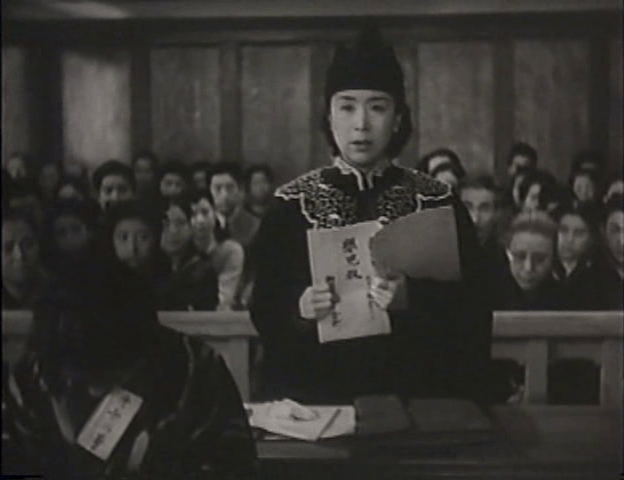
Kono, perhaps to his credit, does not appear object to the idea of female lawyers and has indeed facilitated Hiroko’s rise to just such as position but otherwise affirms that “a woman’s duty is easy. All that is required of her is self-sacrifice”. The idea of “self-sacrifice” is one which is brought up in the closing speeches of the trial in which Hiroko makes an impassioned plea in the case of a mother, Moto (Mitsuko Miura), who, mad with grief, held her baby too closely and may have suffocated it. Kono’s argument is that Moto’s transgression is against nature and the social order, that she has “failed” as a woman in rejecting her maternity by murdering her child. He rejects the “extenuating circumstances” of her grief and desperation by painting her “crime” as a selfish one in choosing to save her own life rather than sacrifice herself on her child’s behalf. Insisting that she has “disgraced the morals of women”, Kono requests she be punished severely as an example to the others.

In refuting Kono’s argument, Hiroko not only restates the extenuating circumstances of the intense strain on Moto’s mental health but attacks his entire way of thinking in positioning “motherhood” as the primary female “duty”. She does not deny that there have been many wonderful stories of women who valiantly sacrificed their own lives for their families, but reminds the court that these stories have often been misused as a kind of propaganda in service of female oppression, that under the feudal system which militarists prized so highly women were little more than slaves to men with no rights or agency. Further more, she points to the corruption of the hierarchical society which has left Moto in such a difficult position following her husband’s early death as a result of an accident at the factory for which the factory paid but only until the end of the war at which time he was cruelly cast away like so many of his generation who had perhaps been similarly exploited to serve a similar idea of “duty” only this time to the state. Kono blames Moto, insisting that her “crime” occurred because her character is “weak”. Hiroko does not blame Moto at all but the society which placed her in such an impossible position and has all but broken her spirit.

The argument is between a fair and just society in which the law exists for the protection of the people, and an austere and cruel one in which the law exists to oppress and tyrannise. Kono, an arch and unreconstructed militarist, believes in the primacy of the law. He is rigid and uncompromising, branding Hiroko’s summation as “sentimental” and “romantic”, dismissing an “irrational” woman’s logic from his elevated position on the podium. As others point out to him, his way of thinking is outdated and his tendency towards an entitled assumption that it will eventually prevail through being the proper order of things is extremely misguided yet he clings fiercely to feudalistic values which have ensured power remains in the hands of people like him since time immemorial, uncompromising to the last.

Rather than focus on Moto and her trial, Mizoguchi and his scriptwriters Kogo Noda and Kaneto Shindo, return to the realms of melodrama in shifting into the domestic as Hiroko’s older sister Michiko struggles between the feudal duty to her husband (however much she appears to dislike him) and her love for her sister whose modern liberal way of thinking still strikes her as immoral. Michiko, it seems, was forced to sacrifice herself for her family in marrying Kono for financial support. The sisters’ mother, now committed to Hiroko’s way of thinking, willingly married her daughter off telling her never to return believing it to be the proper way of things. Having suffered so long in service of an ideal no longer current, Michiko gradually comes to the realisation that she now has a choice – she does not have to stay with a husband who she does not love and does not love her, she is free to leave him and live as a full and independent woman if that is her individual will.

Nevertheless, the slightly awkward framing perhaps casts the choices of Hiroko and her sister as being defined by their respective men – Hiroko swept along by Yamaoka’s socialist politics and Michiko by her husband’s conservatism. Both men are in different senses problematic – Yamaoka vindictive and unsympathetic to Michiko’s attempts to make peace, no more forgiving than Kono while also patronising in his last impassioned speech which places such great responsibility in Hiroko’s “tiny hands”. Nevertheless, Hiroko’s clearsighted fight not only for her own freedom but for a fairer, more compassionate society founded on the idea of a literal social justice in which the law exists in service of its people rather than to oppress them is remarkably forward thinking, moving beyond “propaganda” for the new regime to the better world so often envisaged by the post-war humanists.


More than Blue (比悲傷更悲傷的故事, Gavin Lin, 2018)

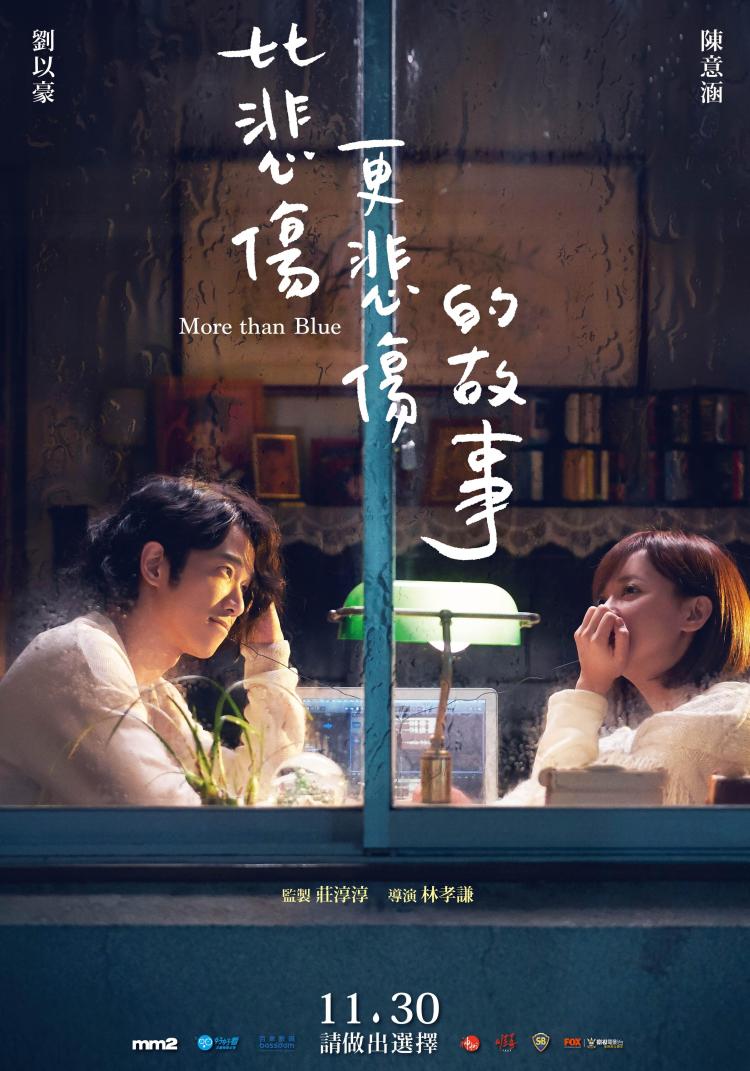
More than blue poster“What’s so romantic about eternity?” asks the heroine of Gavin Lin’s remake of the 2009 Korean film More than Blue (比悲伤更悲伤的故事, Bǐ Bēishāng gèng Bēishāng de Gùshì). As the title, which literally translates as “a sadder than sad story”, implies More than Blue is another addition to Taiwanese cinema’s growing roster of melancholy romantic melodramas though this time one which rips a page from the “jun-ai” notebook as its selfless pair of lonely lovers engage in acts of mutual self sacrifice in an attempt to make each other “happy” while remaining quietly miserable as they contemplate a future which may not actually exist.

The hero, nicknamed K (Jasper Liu), lost his father to leukaemia when he was 16. His mother left shortly afterwards on learning that he too had the same disease, unable to cope with the pain of watching her son fade in the same way her husband had. Resigning himself to a life of loneliness, K eventually met “Cream” (Ivy Chen Yi-han), a cheerful and outgoing girl who lost her entire family in a traffic accident. The pair become friends, go to the same university, and eventually move in together but despite a brief fumble and innocent kiss their relationship remains entirely platonic. 10 years later, they’re working for the same record company where Cream is a lyricist and K in promotion. K’s illness is worsening and there’s no sign of a transplant. He has never told Cream about his medical history and now fearing that the end is near, he decides that the best thing to do is to push her towards a nice guy who can look after her after he is gone.

As someone else later points out, K’s decision is a little chauvinistic. Not only has he made it entirely alone, but he’s done so on fairly mercenary terms which imply Cream is not capable of looking after herself rather than solely of hoping to cushion the blow for the time when she must eventually lose him. After all, all relationships end one way or another and it’s impossible to live a life without loss without isolating yourself entirely from the rest of the human race. Then again, that had been K’s original reaction to his mother’s abandonment. Only Cream was able to bring him back into the world again through her goodhearted cheerfulness. K wants to spare her the pain of losing him and of being left behind alone, but perhaps that isn’t his decision to make.

Echoing the title of the movie, K affirms that it’s getting used to loneliness that is “sadder than sad” while also insisting that if anyone could understand the nature of love then no one in the world would suffer because of it. What K has is the wounded nobility of the jun-ai hero who has decided that it is his duty alone to suffer and that by suffering himself he can prevent his loved one from feeling the pain, but of course his emotional aloofness only makes things worse for everyone. Determined to make a brighter future for Cream, he smiles through the tears but neglects to consider that she may prefer a shorter present with him than a long life without. All his pointless romantic engineering amounts to is a silly waste of time during which they might both have been happy if only someone had found the courage for emotional honesty in the face of eventual heartbreak.

Lin wastes no time in letting us know this will be a tragic story through the slight disconnect of a framing sequence which casts the central romance as a lengthy flashback narrated by a peripheral figure to a frustrated music producer and her A-list idol star (played by real life singer A-Lin) who have fallen in love with an unrecorded track, “A Kind of Sorrow”, penned by Cream and performed by K. The song itself references the “darkness” within the pair born of their mutual losses, but also the light that love has brought into their lives. Cream gets into an argument with a poppy idol (who proves more astute than she at first seems) over the use of the world “eternity” within a love song. She doesn’t believe in the idea of eternity because love only lasts until one of the lovers is gone. Eternity, as we later discover, is found in the moment or more precisely in the moment of togetherness which is something both K and Cream have rejected in their escalating attempts at selfless nobility which have made them both individually miserable.

The lesson seems clear – just make the most of the time you have without worrying about the future and live honestly in the moment without regrets. Sadly, it’s a lesson the lovers of More than Blue fail to learn until it’s too late. Melodrama to the max it may be, and the strangely comic tone somewhat out of sync with the eventual destination, but there is real dark heart in More than Blue’s belief in the eternity of love even if also in its inherent tragedy.


Currently on limited release in UK cinemas courtesy of China Lion.

Original trailer (English subtitles)
A Kind of Sorrow as performed by A-Lin

The Crossing (过春天, Bai Xue, 2018)

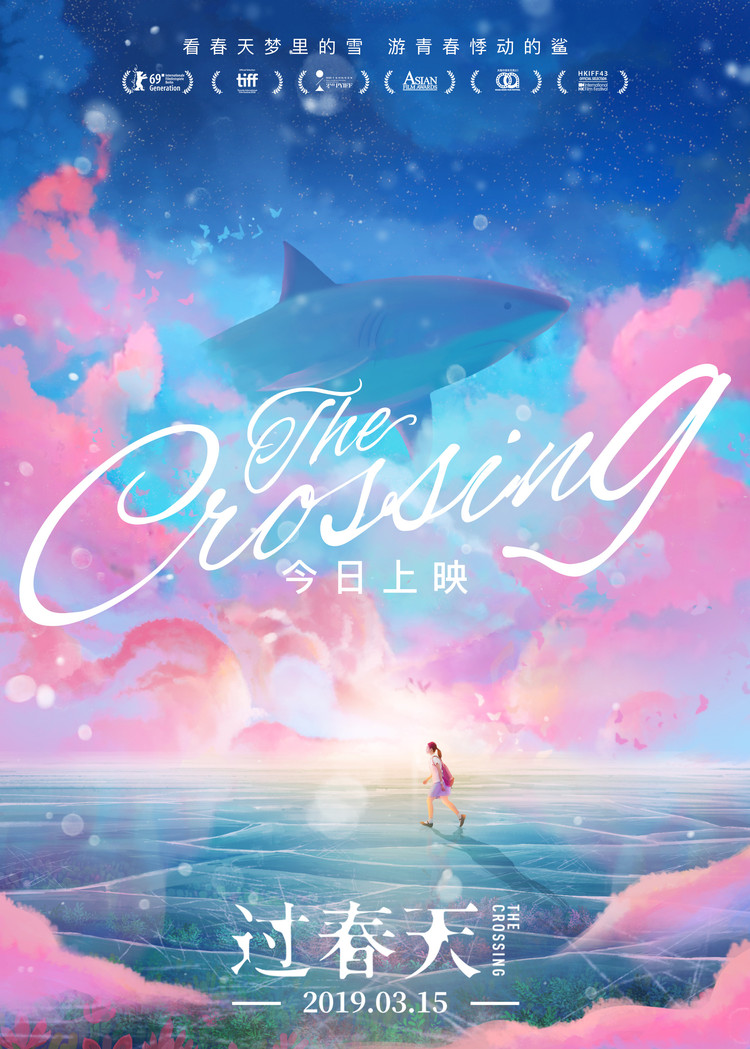
The Crossing posterReally, when it comes right down to it, a border is not much more than an imaginary line drawn across a piece of paper intended to bring order to a formless world. People have fought and died over the positioning of such lines for centuries, but then when all is said and done the boundaries which matter most are the internal ones and everybody has their lines they will not cross. An internal war over the nature of that line is very much at the centre of Bai Xue’s melancholy coming of age drama The Crossing (过春天, Guò Chūntiānin which a young girl living a life on top of borders geographical, emotional, and legal, begins to discover herself only through transgression.

It’s Peipei’s (Huang Yao) 16th birthday, but the most important fact about that for her is that she is now of legal working age and can get a part-time job. Peipei’s parents split up some time ago and now she lives with her flighty mother (Ni Hongjie) in Shenzhen while attending a posh high school in Hong Kong where she doesn’t quite fit in considering her comparatively humble background. This is brought home to her by her insensitive best friend Jo (Carmen Soup) who wants the pair to go on holiday together to Japan at Christmas while full-well knowing that there is no way Peipei can get the money together in time. Desperate to go, Peipei has been selling cellphone cases at school and now has her part-time job but it’s all very slow going. When Jo convinces her to bunk off and party with a bunch of ne’er-do-wells she ends up getting herself involved in a cellphone smuggling operation thanks to Jo’s no good boyfriend Hao (Sunny Sun). 

Peipei’s problem is the time old one of falling in with the wrong crowd, but then we most often catch her alone and it’s a lonely figure she cuts through the busy streets of her bifurcated world. Young but tough and angry, Peipei thinks she knows what she’s doing but is caught on the difficult dividing line between adolescence and adulthood and her attempts to claim her independence are filled with determined naivety. Resentful of her mother’s seeming indifference and parade of useless boyfriends, she wants to grow up as soon as possible but it’s not so much the daring and adventure that draws her into the orbit of Sister Hua’s (Elena Kong may-yee) gang of thieves as the camaraderie. Peipei likes being part of a “family”, she likes the maternal attentions of the spiky Sister Hua, and she likes being valuable even if on some level she realises that her usefulness will fade and that her growing loyalty to the gang is largely one sided.

“The big fish eat the little fish. Never trust men” Sister Hua later advises her, and it is indeed good advice if offered a little too late. Peipei knows she’s a little a fish, which is perhaps why she sympathises so strongly with the miniature shark trapped in a tank at the palatial mansion owned by Jo’s absentee aunt. Nevertheless, she tries to swim free only to find herself sinking ever deeper into a murky underworld she is ill-equipped to understand. Her first anxious crossing with a handful of iPhones in her backpack is a fraught affair, but carrying it off without a hitch an oddly empowering experience. Even so, when Sister Hua considers swapping the phones for a gun Peipei hesitates. In essence it’s the same – perhaps it doesn’t really matter what the cargo is, and Sister Hua’s “love” is indeed dependent on a job well done, but the stakes here are sky high. It’s not such a fun game anymore, as Peipei realises spotting a badly wounded gang member hovering outside having apparently received punishment for some kind of transgression.

Meanwhile she finds herself in another kind of interstitial space altogether when caught between best friend Jo and bad boy Hao. Jo, spoilt and self-centred, assumes her family will send her abroad to study and is later shocked by the realisation that her sexist dad thinks she’s not worth it, expects her to marry young in Hong Kong, and intends to invest all the money in her brother instead. Jo didn’t care much for Hao before and even jokingly offered to bequeath him to Peipei when she left, but now all her dreams are crumbling and she suspects he’s losing interest it’s a different story. Playing with fire, Peipei finds herself drawn to Hao who becomes something between white knight and big brother figure in the confusing world of crime until his protective instincts begin to bubble into something else. The pair bicker flirtatiously but also shift into a shared space born of their mutual dissatisfaction and desire to gain access to the Hong Kong inhabited by the likes of Jo whose vast wealth has left her blind to her own privilege.

Peipei crosses lines with giddy excitement, but only through burning her bridges does she begin to discover her own identity caught as she is between Hong Kong and China, between rich and poor, between the going somewheres and not, and between innocence and experience as her exciting adventure in the world of crime eventually blows up in her face. A rather strange title card informing us that efforts to limit smuggling at the border have been redoubled (seemingly ripped right out of the Mainland censor’s notebook) finally gives way to something calmer and more meditative as Peipei awakens to a new understanding of herself and the world in which she lives, looking out instead of up and ahead rather than behind as she resolves to keep moving forward as if there were no more lines to be crossed.


Currently on limited release in UK cinemas.

International trailer (English subtitles)