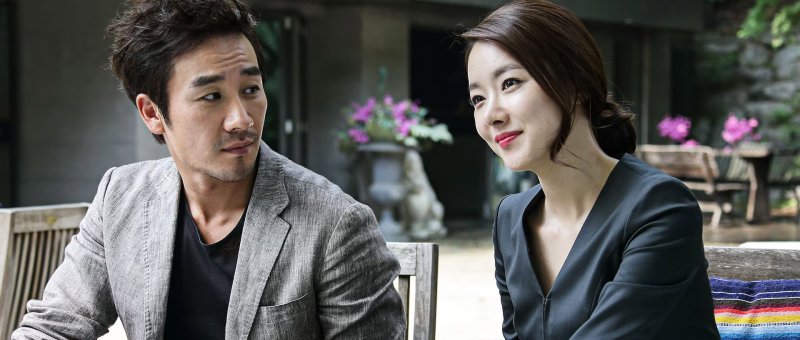

Top Star (톱스타, Park Joong-hoon, 2013)

Fame is good, but can turn you into a monster, according to entertainment industry veteran Won-joon (Kim Min-jun) in the directorial debut from actor Park Hoon-jung, Top Star (톱스타). Apparently inspired by the time park was caught smoking marijuana, the film explores the cutthroat nature of Korea’s entertainment industry in which stars are often held to unfairly high standards, but equally the pressures of success and the lengths some people will go to to maintain it.

Tae-sik’s (Uhm Tae-woong) problem is that he started out as Won-joon’s manager, or really more like a personal assistant in which he was responsible for all of Won-joon’s life including covering for his various indiscretions which Tae-sik did without a second thought. For his part, Won-joon tries to be a cool boss, but when he gives Tae-sik the night off for his birthday it backfires for both of them. Tae-sik is refused entry to a posh club he goes to all the time because he’s not with Won-joon, ramming home to him how insignificant he really is. Won-joon, meanwhile, irresponsibly gets behind the wheel of his sports car after a few drinks. He ends up knocking a delivery driver off his bike, but in consideration of his position, just drives off. Though he later considers turning himself in, his management team won’t allow it. Tae-sik ends up taking the blame, though in return Won-joon promises to make his dreams of becoming an actor come true by getting him a part in his latest TV drama.

It’s not really explained why the drunken hit-and-run would end Won-joon’s career but is apparently not a barrier to Tae-sik starting one. His star soon starts to rise to point that he begins to rival Won-joon by pinching some of his advertising gigs. Won-joon can’t help but see this as a kind of betrayal, feeling professionally threatened and also a little resentful that Tae-sik does not appear to value their friendship. There is a curiously homoerotic tension between them, but part of the problem is that despite what Won-joon says they can’t really be friends because of the power differential and the fact that they have now become rivals. Won-joon has almost become a target to hit for Tae-sik, while Won-joon continues to look down on him, making constant cracks about how he used to be his dogsbody to put him back in his place.

At the same time, others in the industry regard Tae-sik as “tasteless” and “low class”, a vulgar upstart who is too overt in his ambition and too crass to fit into the pseudo-upper-class world of show business given his working-class background. A subplot sees him wrestling with the expectation that he will take care of a father that abandoned him and has since developed dementia. In some ways, he’ll always be the driver who was turned away from the club. A film director keen enough to work with him to wait hours sitting in a park even point blank tells him that he’s not a good actor and that all he has going for him is “energy”, so he shouldn’t be so picky about his projects. Yet these kinds of comments only seem to spur Tae-sik on to prove himself by living a superstar lifestyle.

Nevertheless, he disapproves of the way Won-joon behaves with women and particularly his treatment of secret girlfriend Mi-na (So Yi-hyun), a producer, on whom Tae-sik also has a crush. His relationship with Won-joon may have begun as a kind of hero worship that Won-joon wilfully used to his advantage, but soon descends into toxic rivalry while Tae-sik’s own insecurities lead him to ruin what he has in always seeking more. He begins to treat those around him badly. Having made his own best friend his manager, what began as a friendship between equals is soon disrupted by the same power imbalance that marred his relationship with Won-joon. Betraying his management company, he strikes out on his own producing a project he pinched from the veteran actor but becomes an on-set tyrant demanding endless retakes in search of a perfection that doesn’t exist because of his own insecurities. He will stop at nothing to maintain his position as “top star”, but eventually suffers an ironic fate that nevertheless humbles him and finally reminds Tae-sik what it was he really wanted as a lowly manager dreaming of showbiz success. Won-joon was right, fame really does turn you into a monster one way or another, and even in Tae-sik’s desire to start over there’s a kernel of desperation that suggests once it’s got its claws into you, it’ll never really let go.


A Single Rider (싱글라이더, Lee Zoo-young, 2017)

Single Rider posterAs the old adage goes, you don’t know what you’ve got ’til it’s gone. Having sacrificed it all for “conventional success”, an emotionally repressed salaryman loses everything when his company is exposed for its immoral business practices only to discover that he’s left it all too late and those he meant to keep close have begun to draw away from him. Quietly contemplative, Lee Zoo-young’s debut A Single Rider (싱글라이더) is a gentle meditation on the way life can get away from you. Brainwashed into the salaryman dream, our financier “hero” allows himself to be swept along by the confidence of his superiors, taking friends and family with him, when he knows deep down that if something seems too good to be true, that’s because it is. Sometimes, it really is just too late, and then sometimes, tragically, it isn’t but you miss your chance anyway.

Kang Jae-hoon (Lee Byung-hun) is a broker at a securities company. Buttoned-down and near silent, he cuts a geeky if reassuringly dull figure but there’s a storm brewing under his calm exterior. His top rated company is in a lot of trouble. They’ve all been breaking the rules, and now they’re about to go under taking the savings of hundreds of ordinary, innocent people with them – people that Kang personally assured that their money would be safe because the company would never declare bankruptcy. Not quite as morally bankrupt as he seems, Kang has been depressed for some time and is on some pretty heavy duty medication. Sending what looks eerily like a suicide note to his bosses, Kang appears to rethink. He sent his wife and son to Australia to “upgrade” them through adding English functionality but hasn’t exactly paid much attention to them since. Searching for the address of the house where they live on Google Maps, he spots them captured together outside and makes an abrupt decision. Before he knows it, he’s bought a plane ticket for Sydney, heading straight to the airport with no luggage and leaving his phone behind so his boss can’t bother him.

Far from a joyful reunion, however, what Kang finds is a visual guide to all the ways he has been erased from the lives of his family. Though Kang’s wife Soo-jin (Gong Hyo-jin) and son Jin-woo (Yang Yoo-jin) have been in Australia for a couple of years, Kang does not appear to have visited before and has trouble finding the house. When he eventually locates it, he knocks at the door and gets no answer, only to find his wife laughing and joking with a neighbour – apparently the father of a friend of Jin-woo’s. Unable to bring himself to knock again, or even to find a call box and explain, Kang begins “haunting” his family, creeping around the house while they’re out, spotting pictures of the Australian neighbour, Chris (Jack Campbell), everywhere and none at all of him.

Watching them from afar, Kang is forced to reevaluate his choices. The smallest details trigger memories of his life in Korea – a flapping kitchen door left ajar when his wife had insisted on a deadlock in Seoul because she felt so afraid with him gone so often even though they lived in an upscale high-rise with an electronic entry pad, the violin she gave up for him but now apparently has taken back up, the papers on the kitchen table which imply she wants to stay rather than go “home”. Like many men who work away from their families, Kang forgot that time was passing for them too and assumed they would be waiting for him like toys put away in a box, sleeping until he’s ready to wake them. Now he wonders how close she really is to Chris, if she wants to stay for him, if she’s grown away from her husband, or simply enjoys the wide open breeziness of their spacious Sydney home with its comparatively relaxed rhythms and friendly laid-back way of life. The only thing he can be sure of is that he doesn’t seem to belong in this house anymore and this is very much not his world.

Then again perhaps Australia is not all good – Kang hates the way everyone seems to call his wife “Sue” to make her foreign name easier to remember. He runs into something similar with a young girl he noticed at the station whose name is “Ji-na” (Ahn So-hee) but everyone in Australia seems to call “Gina”. Ji-na’s problems turn out to be bigger than a misremembered name. Despite his obvious familiarity with financial scams, Kang does nothing when he overhears Ji-na on the phone to some dodgy people who want to do a “personal currency exchange”. He doesn’t see them convince her to get in their car, but does catch sight of her coming back the same way later limping and bloody having been deprived of the money she’d carefully been saving up while her labour was exploited as she lingered on after her visa had expired (which is why she can’t go to the police, as her abusers are well aware). Ji-na, like him, made a series of bad decisions though perhaps for “better” reasons and has paid dearly for her mistakes.

To be fair, Kang thought he was making his decisions for good reasons – he convinced himself he was working to provide for his family, even sending them away “for their benefit”, but now he regrets it. He regrets everything – his workaholic lifestyle, the way he allowed his principles to be compromised in pursuit of “success”, the way he bought his swanky Seoul apartment and a middle-class suburban home in Australia through defrauding people who trusted him, and the way he lost his family through a misplaced desire to “better” them rather than simply allowing them to be happy. He thinks it’s too late, that he’s ruined himself and that his family have already moved on. He may be wrong, but he won’t find out by snooping around the house and following Chris about all day to figure out how close he is to his wife.

Kang’s tragedy is that he made a series of bad decisions in which the last was the worst and the most sad. Lee Byung-hun invests Kang with an air of utter defeat, as if the air itself were crushing him while he remains unable to reconcile himself to his new circumstances or bring himself to make contact with his family. A final revelation (or perhaps confirmation of an obvious fact) makes plain why exactly it is that he seems to wander invisibly through the city streets, using public transport but miraculously disappearing from one place to appear in another as if in a trance. Kang’s only option is, perhaps, to learn to be glad that his wife and son finally have a chance to be happy even if it’s without him and be grateful that his son has found another man who’d run until his feet were sore just to keep him safe. Sometimes it really is just too late, but, tragically, sometimes you accept defeat too early when what you thought you’d lost is already on its way back to you only you’ve already given up, not on it, but on yourself.


Original trailer (no subtitles)