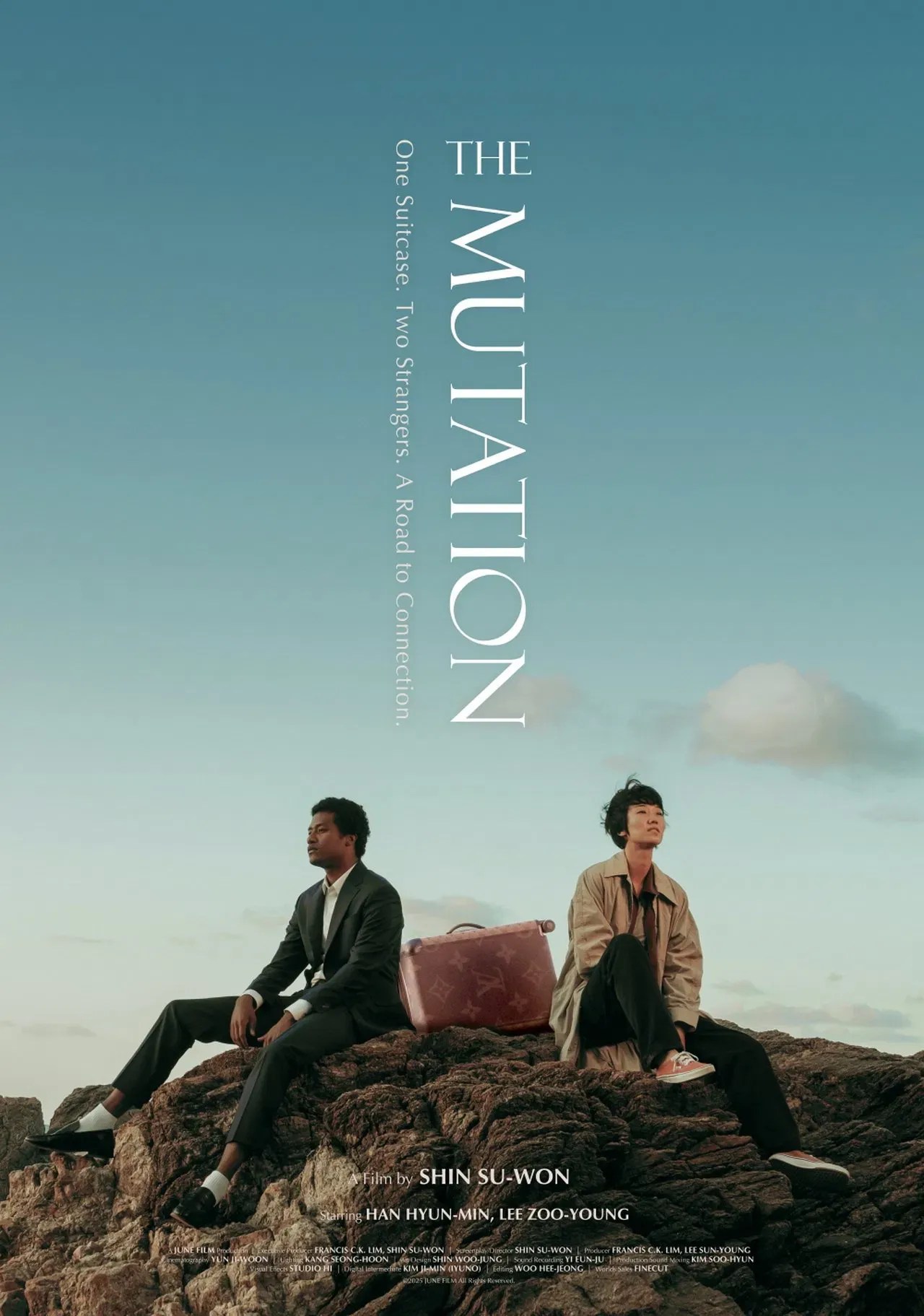
The Mutation (사랑의 탄생, Shin Su-won, 2025) [Fantasia 2026)

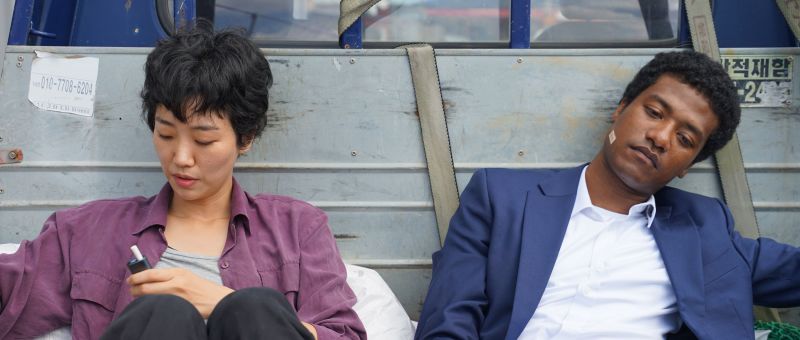
Two people largely excluded from mainstream society bond over a shared sense of loss and loneliness in Shin Su-won’s lighthearted road trip movie, The Mutation (사랑의 탄생). Though the English-language title may sound a little harsh, hinting at some kind of science fiction dystopia, the film is in other ways as the Korean title “The Birth of Love,” implies about self-acceptance and mutual solidarity among those that society has continues to other and reject.

The Korean title is quoted in each of the lives of the protagonists, Se-oh (Han Hyun-min), a man with dark skin who was born to two Korean parents, and Sora (Lee Zoo-young), a gay woman whose former partner took her own life after being pressured into a heteronormative marriage by her conservative mother. Se-oh has been rejected by his family as his father refuses to accept him as his son despite his mother’s assurance that she has remained faithful him. He tries asking an old friend of his mother’s for answers, but she tells him that what matters is only that he was born from love. Sora, meanwhile, discovers a letter written by her late partner Min-ji as a omechild that she titled “the birth of love” and recorded her growing feelings for a female classmate along with the fear that her parents would find out.

Sora’s difference is not visibly obvious in the way that Se-oh’s is, but she still finds that she is excluded from mainstream society. She says that she makes tables because they’re something to be shared rather than used selfishly, but it seems that few people are willing to come to hers despite her instructions to Se-oh that if he got a bigger table for his apartment people would soon come to sit around it. It does however signal her own openness and desire for connection, even if that desire is often rejected or goes unmet. After agreeing to accompany Se-oh on his trip, she too has somewhere she does not have the courage to go alone. On returning to the town where Min-ji lived, she discovers her mother being hassled in the market by a group of religious people who appear to be aware of exactly how her daughter died and why but berate her for not raising her “better”. Min-ji’s mother had thought that if she married, Min-ji would settle down and live a “normal” life, but in the end Min-ji could not live that way. Her mother is now filled with regrets wishing she had accepted her daughter for who she was despite what others may have said in their small and conservative town where the local pastor holds sway.

Min-ji’s mother did not tell Sora of her death for some time nor did she invite her to the funeral, hoping that no one would find out. Se-oh wasn’t invited to his mother’s funeral either and his name is conspicuously absent from the list of official mourners at the funeral hall. He is continually treated as an outsider as strangers automatically address him in English. It never occurs to them to someone who looks like him may have been born and raised in Korea and know no other language, and as such they reject his Koreanness. This has also meant that he has struggled to find employment and has been restricted to doing a series of precarious casual labour jobs, the latest of which is ironically playing the white tiger at a local amusement park. People like me better when I wear a mask, he says, which perhaps something Sora can also understand.

But she also says that Min-ji was the only person she ever knew who didn’t wear one, implying that it may not be possible to survive in this society as an authentic person without some kind of boundary between oneself and others. Nevertheless, through their gentle road trip, the pair begin to come to terms with the past and also with themselves in gaining a level of self-acceptance that allows them to move forward, together or apart. Warm and gentle in spirit, the film makes the most of its idyllic country settings while focusing on the simple power of human connection in the face of a world that can often be harsh and unforgiving of those it perceives to be somehow other.


The Mutation screened as part of this year’s Fantasia International Film Festival.

Trailer (English subtitles)

A Single Rider (싱글라이더, Lee Zoo-young, 2017)

Single Rider posterAs the old adage goes, you don’t know what you’ve got ’til it’s gone. Having sacrificed it all for “conventional success”, an emotionally repressed salaryman loses everything when his company is exposed for its immoral business practices only to discover that he’s left it all too late and those he meant to keep close have begun to draw away from him. Quietly contemplative, Lee Zoo-young’s debut A Single Rider (싱글라이더) is a gentle meditation on the way life can get away from you. Brainwashed into the salaryman dream, our financier “hero” allows himself to be swept along by the confidence of his superiors, taking friends and family with him, when he knows deep down that if something seems too good to be true, that’s because it is. Sometimes, it really is just too late, and then sometimes, tragically, it isn’t but you miss your chance anyway.

Kang Jae-hoon (Lee Byung-hun) is a broker at a securities company. Buttoned-down and near silent, he cuts a geeky if reassuringly dull figure but there’s a storm brewing under his calm exterior. His top rated company is in a lot of trouble. They’ve all been breaking the rules, and now they’re about to go under taking the savings of hundreds of ordinary, innocent people with them – people that Kang personally assured that their money would be safe because the company would never declare bankruptcy. Not quite as morally bankrupt as he seems, Kang has been depressed for some time and is on some pretty heavy duty medication. Sending what looks eerily like a suicide note to his bosses, Kang appears to rethink. He sent his wife and son to Australia to “upgrade” them through adding English functionality but hasn’t exactly paid much attention to them since. Searching for the address of the house where they live on Google Maps, he spots them captured together outside and makes an abrupt decision. Before he knows it, he’s bought a plane ticket for Sydney, heading straight to the airport with no luggage and leaving his phone behind so his boss can’t bother him.

Far from a joyful reunion, however, what Kang finds is a visual guide to all the ways he has been erased from the lives of his family. Though Kang’s wife Soo-jin (Gong Hyo-jin) and son Jin-woo (Yang Yoo-jin) have been in Australia for a couple of years, Kang does not appear to have visited before and has trouble finding the house. When he eventually locates it, he knocks at the door and gets no answer, only to find his wife laughing and joking with a neighbour – apparently the father of a friend of Jin-woo’s. Unable to bring himself to knock again, or even to find a call box and explain, Kang begins “haunting” his family, creeping around the house while they’re out, spotting pictures of the Australian neighbour, Chris (Jack Campbell), everywhere and none at all of him.

Watching them from afar, Kang is forced to reevaluate his choices. The smallest details trigger memories of his life in Korea – a flapping kitchen door left ajar when his wife had insisted on a deadlock in Seoul because she felt so afraid with him gone so often even though they lived in an upscale high-rise with an electronic entry pad, the violin she gave up for him but now apparently has taken back up, the papers on the kitchen table which imply she wants to stay rather than go “home”. Like many men who work away from their families, Kang forgot that time was passing for them too and assumed they would be waiting for him like toys put away in a box, sleeping until he’s ready to wake them. Now he wonders how close she really is to Chris, if she wants to stay for him, if she’s grown away from her husband, or simply enjoys the wide open breeziness of their spacious Sydney home with its comparatively relaxed rhythms and friendly laid-back way of life. The only thing he can be sure of is that he doesn’t seem to belong in this house anymore and this is very much not his world.

Then again perhaps Australia is not all good – Kang hates the way everyone seems to call his wife “Sue” to make her foreign name easier to remember. He runs into something similar with a young girl he noticed at the station whose name is “Ji-na” (Ahn So-hee) but everyone in Australia seems to call “Gina”. Ji-na’s problems turn out to be bigger than a misremembered name. Despite his obvious familiarity with financial scams, Kang does nothing when he overhears Ji-na on the phone to some dodgy people who want to do a “personal currency exchange”. He doesn’t see them convince her to get in their car, but does catch sight of her coming back the same way later limping and bloody having been deprived of the money she’d carefully been saving up while her labour was exploited as she lingered on after her visa had expired (which is why she can’t go to the police, as her abusers are well aware). Ji-na, like him, made a series of bad decisions though perhaps for “better” reasons and has paid dearly for her mistakes.

To be fair, Kang thought he was making his decisions for good reasons – he convinced himself he was working to provide for his family, even sending them away “for their benefit”, but now he regrets it. He regrets everything – his workaholic lifestyle, the way he allowed his principles to be compromised in pursuit of “success”, the way he bought his swanky Seoul apartment and a middle-class suburban home in Australia through defrauding people who trusted him, and the way he lost his family through a misplaced desire to “better” them rather than simply allowing them to be happy. He thinks it’s too late, that he’s ruined himself and that his family have already moved on. He may be wrong, but he won’t find out by snooping around the house and following Chris about all day to figure out how close he is to his wife.

Kang’s tragedy is that he made a series of bad decisions in which the last was the worst and the most sad. Lee Byung-hun invests Kang with an air of utter defeat, as if the air itself were crushing him while he remains unable to reconcile himself to his new circumstances or bring himself to make contact with his family. A final revelation (or perhaps confirmation of an obvious fact) makes plain why exactly it is that he seems to wander invisibly through the city streets, using public transport but miraculously disappearing from one place to appear in another as if in a trance. Kang’s only option is, perhaps, to learn to be glad that his wife and son finally have a chance to be happy even if it’s without him and be grateful that his son has found another man who’d run until his feet were sore just to keep him safe. Sometimes it really is just too late, but, tragically, sometimes you accept defeat too early when what you thought you’d lost is already on its way back to you only you’ve already given up, not on it, but on yourself.


Original trailer (no subtitles)