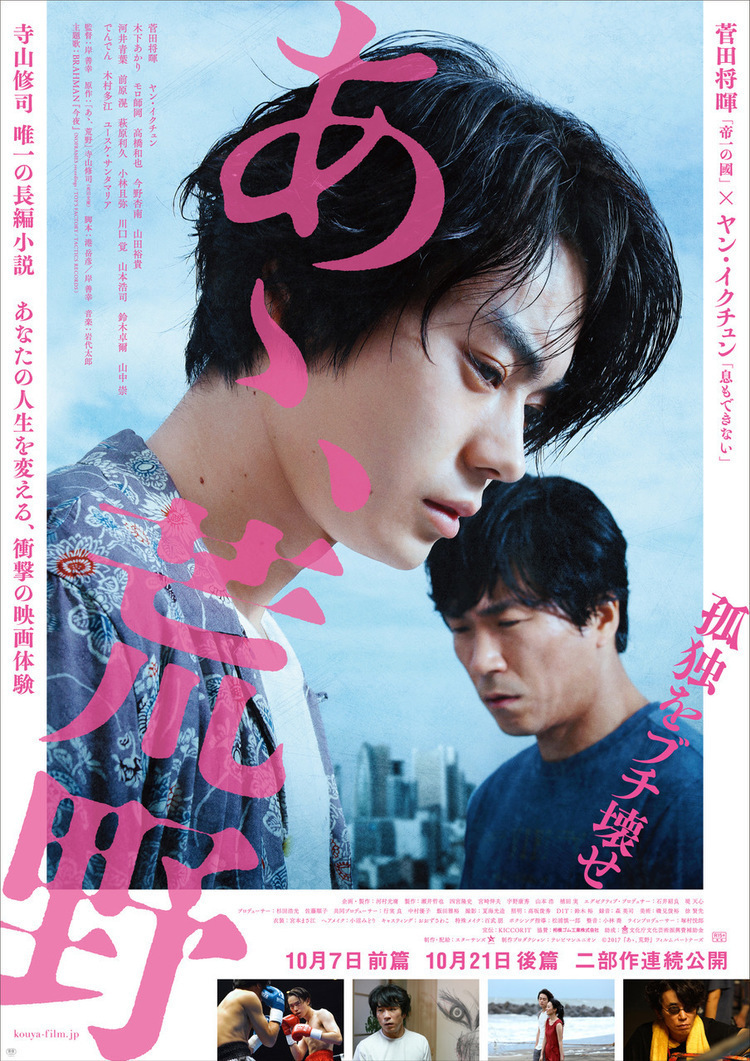
 When Shuji Terayama published his only novel in 1966, Japan was riding high – the 1964 Olympics had put the nation back on the global map and post-war desperation was beginning shift towards economic prosperity. In adapting Terayama’s jazz-inspired avant-garde prose experiment for the screen, Yoshiyuki Kishi updates the action to 2021 and a slightly futuristic Tokyo once again feeling a mild sense of post-Olympic malaise. Terayama, like the twin heroes of Wilderness (あゝ、荒野, Ah, Koya), got his “education” on the streets of Shinjuku, claiming that more could be learned from boxing and horse races than any course of study. Both damaged young men, these lonely souls begin to find a place for themselves within the ring but discover only emptiness in place of the freedom they so desperately long for.
Shinji (Masaki Suda), abandoned to an orphanage by his mother after his father committed suicide, has just been released from juvie after being involved in a street fight which left one of his best friends paralysed. Discovering that his old gang won’t take him back he’s at a loss for what to do. Meanwhile, shy barber Kenji (Yang Ik-june) who stammers so badly that he barely speaks at all, is battling the possessive stranglehold his drunken, violent ex-military father weilds over him. Raised in Korea until his mother died and his father brought him back to Japan, Kenji has always struggled to feel a part of the world he inhabits. The two meet by chance when Shinji decides to confront the man who attacked his gang, Yuji (Yuki Yamada) – now an up and coming prize fighter. Shinji is badly injured by the professional boxer while Kenji comes to his rescue, bringing them to the attention of rival boxing manager Horiguchi (Yusuke Santamaria) who manages to recruit them both for his fledgling studio.
The Tokyo of 2021 is, perhaps like its 1966 counterpart, one of intense confusion and anxiety. Plagued by mysterious terrorist attacks, the nation is also facing an extension of very real social problems exacerbated by a tail off from the temporary Olympic economic bump. As the economy continues to decline with unemployment on the rise, crime and suicides increase while social attitudes harden. In an ageing society, love hotels are being turned into care homes and wedding halls into funeral parlours. The elder care industry is in crisis, necessitating a controversial law which promises certain benefits to those who commit to dedicating themselves either to the caring professions or to the self defence forces.
Yet nothing much of this matters to a man like Shinji who ignores the crowds fleeing in terror from the latest attack in favour of “free” ramen left behind by the man who recently vacated the seat next to him out of a prudent desire to make a speedy escape. Shinji takes up boxing as way of getting public revenge on Yuji but also finds that suits him, not just as an outlet for his youthful frustrations but in the discipline and rigour of the training hall as well as the camaraderie among the small team at the gym. Kenji, by contrast, is kind hearted and so shy he can barely look his opponent in the eye. He comes to boxing as a way of finally learning to stand up for himself against his bullying father, but eventually discovers that it might be a way for him achieve what he has always dreamed of – connection.
Asked why he thinks it is we’re born at all if all we do if suffer and long for death, Kenji replies that must be “to connect” though he has no answer when asked if he ever has. For Kenji boxing is a spiritual as well as physical “contact sport” through which he hopes to finally build the kind of bridges to others that Shinji perhaps builds in a more usual way. Shinji tells himself that the only way to win is to hate, that in boxing the man who hates the hardest becomes the champion but all Kenji wants from the violence of the ring is love and acceptance. Shinji’s friend, Ryuki (Katsuya Kobayashi), has forgiven the man who crippled him and moved on with his life while Shinji is consumed by rage, warped beyond recognition in his need to prove himself superior to the forces which have already defeated him – his father’s suicide, his mother’s abandonment, and his friend’s betrayal.
While Shinji blusters, shows off, and throws it all away, Kenji patiently hones his craft hoping to meet him again in the boxing ring and “connect” in the way they never could before. There’s something essentially sad in Kenji’s deep sense of loneliness, the sketches in his notebook and strange relationship with an equally sad-eyed gangster/promoter (Satoru Kawaguchi) suggesting a hankering for something more than brotherhood. Nevertheless what each of the men responds to is the positive familial environment they have never previously known, anchored by the paternalism of coach Horiguchi and cemented by unconditional brotherly love.
Caught at cross purposes, the two young men battle each other looking for the same thing – a sense of freedom and of being connected to the world, but emerge with little more than scars and broken hearts, finding release only in a final transcendent moment of poetic tragedy. Kishi’s vision of the immediate future is bleak in the extreme, a nihilistic society in which hope has become a poison and death its only antidote. A tragedy of those who want to live but don’t know how, Wilderness is a minor miracle which proves infinitely affecting even in the depths of its despair.
Screened at Nippon Connection 2018.
Original trailer (no subtitles)
Interview with director Yoshiyuki Kishi conducted at the Busan International Film Festival (Japanese with English subtitles)