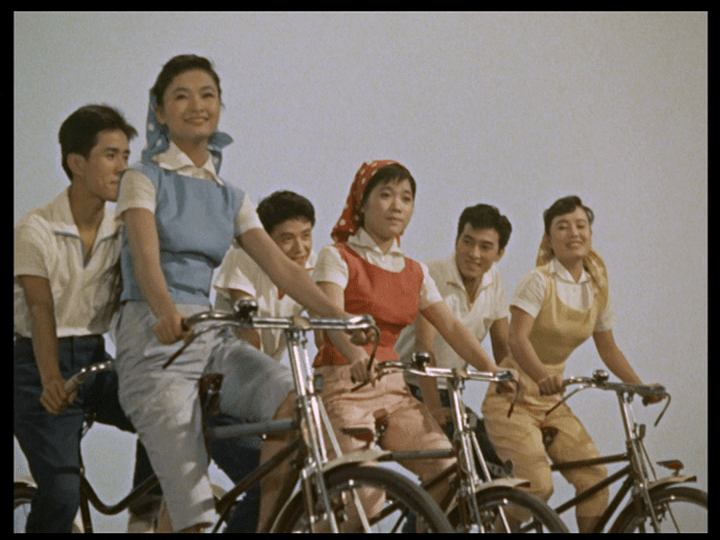
Giants & Toys (巨人と玩具, Yasuzo Masumura, 1958)

91C6JzGDYTL._SL1500_

Less acerbic than Masumura’s later Black Test Car, Giants & Toys (巨人と玩具, Kyojin to gangu) is an altogether more humorous, if no less piercing look at post-war consumerism. This time the battle ground is confectionary as the Japanese sweets industry laments the all powerful American candies taking over the Japanese landscape. Three sweet companies are duking it out for the hearts of Japanese consumers and the hard working salarymen in the PR & marketing departments are becoming ever more desperate to find the key to becoming Japan’s top selling sweet maker.

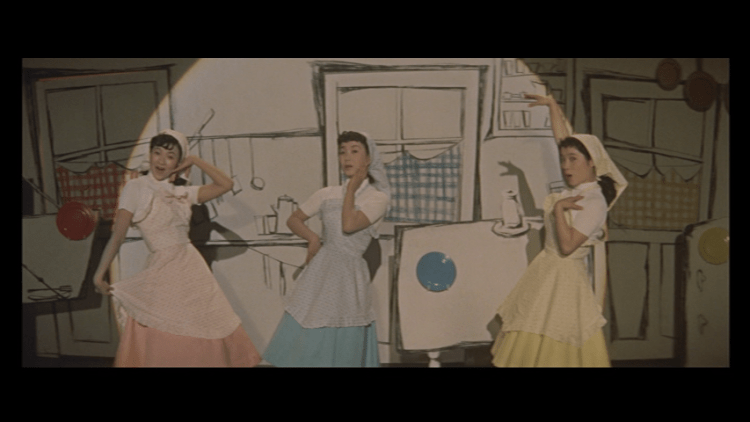
The three companies are Giant, Apollo and World, each of which is currently trying to come up with an advertising campaign which has a competition element that will really hook in the populace. Our main focus is with World whose top PR man, Goda, is currently stumped when he spots quirky hillbilly Kyoko in a bar and hatches on an idea to make her the central poster girl of his ad campaign. Kyoko is 18 with gap teeth and a childlike innocence that makes her a great fit for selling their confectionary products to the adult market. At the same time, Goda’s assistant Nishi meets an older female executive from Apollo who’s trying to shift a set of spacesuits. This fits in neatly with another of Goda’s space themed ideas and a suitably bizarre campaign is launched with the gangly Kyoko dressed up in a kitsch spacesuit and pointing a ray gun which is somehow supposed to encourage people to buy sweets. Kyoko is a hit! However, the more popular Kyoko becomes the more her innocent charms begin to dissipate. What will become of her, and of the campaign, as the competition mounts?

For an area that’s supposed to be so totally frivolous and cheerful, confectionary sales are serious business. Goda is working himself into an early grave just to sell sweets to grownups and old people. It’s advertising and marketing but like everything else in life it’s just so much spin. What they’re really trying to sell is frivolous fun and a return to childhood’s freedom all packed into a momentary suck on a salted caramel. In the Japan where “everyone works all the time” this may be quite an attractive idea, especially to the put upon members of the confectionary marketing board.

However, trivial as sweets are, they represent the fleeting unimportance of pop culture memes. During one of Kyoko’s recording sessions we meet one of the solitary female producers (labelled a “machine” by two of the other women waiting to be seen) who laments that a has been star keeps hassling her for work though her time has passed and no one’s interested. This is most likely how things will wind up for Kyoko, five minutes of being everywhere followed by a lifetime of being nowhere at all. After signing with World for their TV and radio advertising she becomes a break out personality attending events as a celebrity in her own right and later even becoming a pop star complete with a totally strange, South Pacific themed musical number referencing some kind of cannibalistic genocide where they’ll sell back the remains of the men they’ve killed to the native wives. Pointed satire in more ways than one.

Goda wants to build a kind of mass media dictatorship, cleverly controlling the public mood through all pervasive advertising (a prescient thought, if ever there was one). Having taken things too far, he’s taken to task by his underling, Nishi, who’s had a bit of a rethink following a series of heartbreaks involving friends and lovers. “I won’t sacrifice my dignity” he says, only to be shown doing just that a couple of minutes later as he himself dons the ridiculously camp space suit, takes the ray gun in hand and wanders out into the streets to be met by a series of bemused stares from the passersby. Eventually, the woman from Apollo with whom he’d been having an affair spots him and with an equally amused expression instructs him to “smile warmly”, at which point he grimaces before managing to turn it into a robotic grin.

Still oddly current, Giants & Toys is an absurdist’s guide to corporate politics where personal integrity is sacrificed on the altar of commerce. Everyone runs round in circles working hard to sell things no one really wants or needs to other hardworking people just to keep the wheel spinning. “Kanban Musume” come and go, one ridiculous meme follows another and we all just fall over ourselves to chase whichever unattainable ideal they pitch us. It would be nice to think the world has moved on since 1958, however…


Giants & Toys is available on R1 DVD with English subtitles courtesy of Fantoma.

Trailer

Black Test Car (黒の試走車, Yasuzo Masumura, 1962)

tumblr_n2w2l2mX1a1tvmqcgo1_1280The automobile business is a high stakes game. Do you want to play faster, shinier and sleeker, or safer, family friendly and reliable? Family cars are the best sellers – everyone one wants something that’s reliable for getting to work every morning, getting the grocery shopping done and that you won’t worry about taking your kids to the park in. However, it’s the 1960s and lifestyles are shifting, men (in particular) are marrying later and they want to have fun before they do – hence having quite a lot of disposable income they can blow on a flashy two-seater sports car with no wife to complain about it. Tiger have just finished a new prototype called the Pioneer they plan to launch as a revolution in commercial sports cars which is super speedy but with the convenience of an everyday sedan. However, the Yamato company are also set to launch a new car and it keeps looking suspiciously like the Pioneer – does Tiger have a mole?

Black Test Car (黒の試走車, Kuro no Test Car) begins with the prototype model of the Pioneer bursting into flames during a test run. Not the best start, but it’s early days and at least the driver wasn’t hurt. The guys at Tiger suspect sabotage as they can’t find anything wrong with car’s design. Onoda, the man who’s in charge of the project, has summoned some of his best employees to become the “industrial spying” department to flush out the mole. However, their first few plans fail and Yamato always seems to get there ahead of them. Yamato’s “chief of spying” is a slightly sleazy older man by the name of Mawatari who lost his wife and daughter during the Manchurian campaign (where he also may have been a more official kind of spy). Luckily (for some more than others), Onoda’s protege, Asahina, is dating a girl who works in the hostess industry and it’s suggested to him that he get his girlfriend to spy on Mawatari as he has a particular fondness for a certain hostess bar. The shady dealings only get worse from here on in, blackmail, bribery, pimping and prostitution – is this the yakuza or the automobile industry?

Yasuzo Masumura turns his cynical eye to big business and finds just as must drama as in your cold war spy epic. Onoda is a fanatical company man whose primary reason for living is his work. He barely comes home, rarely sees his children and views his precious Pioneer as his legacy. As such, he’s determined to find the man who’s betraying all his secrets and has become something of a petty dictator in the process. “We’re industrial spies!” he keeps declaiming, as if those words had any kind of authority. He’s not a policeman, he’s not a warrior for justice, he’s just a guy at a car firm who’s poured altogether too much of himself into a few scraps of metal.

His assistant, the up and coming Asahina, seems set to follow in Onoda’s footsteps. He’s young and ambitious, he wants to get the head of department job so he can marry his girlfriend who is still working as a bar hostess (which he doesn’t actually seem to mind about if she doesn’t mind about it either). The girlfriend, Masako, worries that work is changing him. When Asahina asks her to spy on Mawatari she refuses, but when he half jokes that he might not want to marry her she if won’t do as he says, she eventually agrees. Later he asks her for more than that which might just be enough to nip this young love story well and truly in the bud.

Having lost out several times already, the Tiger guys think they’ve got an angle and decide to launch the Pioneer way ahead of schedule to undercut Yamato’s price and release date. However, right away there is a scandalous accident which ends up all over the papers as the driver of the car (who survived unscathed, there were no serious injuries involved) drags the wreck all over town with a loud speaker to announce just how dangerous he believes the car to be. Of course, he’s a stooge, set up by Yamato and aided by another undiscovered mole in the Tiger camp. This incident is the last straw for those who still have a moral backbone at Tiger – culminating in violence and suicide, it leaves the fresh faced executives wondering whether they’re on the career ladder at a respectable firm or among the ranks of thuggish gangsters prepared to lie, cheat and extort to get along.

Shot in a noirish black and white with a moody jazz score, Black Test Car has its film noir overtones with the immorality of big business at its centre. At the beginning of the film everything is for the company – no one thinks of themselves or their own soul, they just want in and to climb the ladder while its there. Or so it seems because everyone is also taking kickbacks whilst blackmailing other people for doing exactly the same thing. There are spy cams interpreted by lip readers, undercover prostitutes masquerading as nurses and men in bushes with microphones – not a dignified way of doing business. At one point Onoda scoffs “you can’t get hung up on  morals. You’ll just have remorse” – this is the choice that presents itself, would you rather have the flashy sports car or retain your humanity?


Black Test Car is available on R1 DVD with English subtitles courtesy of Fantoma.

(unsubbed trailer)


Princess Jellyfish (海月姫, Taisuke Kawamura, 2014)

b7dec6a631e5ad87baf2ff601d6b4872Originating as an ongoing manga series by Akiko Higashimura which was also later adapted into a popular TV anime, Princess Jellyfish adopts a slightly unusual focus as it homes in on the sometimes underrepresented female otaku.

Tsukimi is an extremely awkward young woman who has an all encompassing obsession with jellyfish. Luckily for her, she’s managed to find a group of likeminded women of a similar age to room with. That is, they aren’t all as crazy about jellyfish as she is, but they all have their particular order of special interest, are fairly socially awkward with an extreme fear of “fashionable” women, and no formal form of employment. At the Amamizukan boarding house, the girls can all enjoy their otaku lives together (well, kind of separately) and, crucially there are no boys allowed!

However, one day Tsukimi finds herself at a crisis point when she notices one of the jellyfish she likes to visit at a nearby pet shop is in danger! The idiot shop boy has only gone and put a Moon Jelly in with a Spotted Jelly – does he just not know how dangerous that is?! Tsukimi will need to act fast to save her friend, but the guy behind the counter is a clueless pretty boy – absolutely the worst case scenario for Tsukimi. Despite her extreme anxiety she valiantly marches into the shop yet her confused mini lecture on jellyfish keeping only succeeds in convincing the shop boy that she’s some kind of nutcase. On being expelled from the shop, Tsukimi finds herself at the feet of an extremely glamorous looking woman who comes to her defence. What kind of strange parallel world is this? Tsukimi’s universe is about to undergo a sea change!

Though based on a manga and intended as a comedy, crucially, Princess Jellyfish casts its series of “different” heroines (and hero) in a favourable light – they are never the butt of the joke and sympathy is always placed with those who experience difficulty in their lives because they feel themselves to be different. Each of the girls is so deeply involved in their own particular obsession that they find it difficult to fit into the regular world and particularly to cope with conventional femininity. Tsukimi herself finds it particularly difficult to talk to men and the fact that no men are permitted at Amamizukan makes it clear that she is not alone in her fears.

This brings us to her new friend who is apparently a fashionable young woman – the sort who would never usually be seen dead talking to the likes of Tsukimi. However, this one not only acknowledges Tsukimi’s presence as another human of equal standing, but even lends her confidence and power as an attractive woman to Tsukimi’s predicament. There is, of course, more to this mysterious saviour than there might seem at first sight. In addition to being a fabulously well dressed lady, Kuronosuke is also a boy. This is something of a problem for Tsukimi as she only realises after letting him stay over at the strictly no boys allowed residence. The ruse also has to be maintained a little longer when Kuronosuke decides to stick around, eventually becoming known as “Kuroko”.

The situation intensifies as the girls’ secret haven comes under threat when a gang of ruthless developers want to buy up most of the town and redevelop the area. The group home is owned by one of the girl’s mothers who is also an otaku only her obsession is with top Korean actor Lee Byung-hun and she’s skipped off to Korea to be able to stalk him better. There’s no telling what she might do if it brings her closer to the object of her affections and things are looking a little desperate. Eventually a possible solution is found which plays to everyone’s strengths and offers the faintest glimmers of hope for the girls (and boy!) of Amamizukan.

Princess Jellyfish is the ultimate tale of acceptance, both in personal and societal terms. The residents of Amamizukan may be a little different, but that doesn’t mean they have nothing to offer the world and there’s no need for themselves to maintain a position of self imposed exile if the only reason is a belief in their own inferiority. This is a lesson taught to them by the exuberant rich boy and politician’s son with a traumatic past of his own, Kuronosuke. Truly unafraid to be who he is, Kuronosuke teaches the girl’s that almost any obstacle can be overcome with a combination of forthrightness and sincerity.

Though it runs a little long and gives in to some very over the top performances and melodramatic plotting, Princess Jellyfish is an enjoyably offbeat manga inspired tale. Very much not interested in demonising anyone other than those who seek to suppress individuality, it’s a cheerful celebration of the value to be found in difference offering plenty of laughter and warmth along the way. Perhaps not for those who prefer their cinematic experiences on the subtle side, Princess Jellyfish is nevertheless a fun filled film which carries its message of universal acceptance right into the closing credits.


The anime adaptation of this is actually really fun too.


Kwaidan (怪談, Masaki Kobayashi, 1964)

tumblr_ly5zbgdNH61rn3yrmo1_1280Kwaidan (怪談) is something of an anomaly in the career of the humanist director Masaki Kobayashi, best known for his wartime trilogy The Human Condition. Moving away from the naturalistic concerns that had formed the basis of his earlier career, Kwaidan takes a series of ghost stories collected by the foreigner Lafcadio Hearn and gives them a surreal, painterly approach that’s somewhere between theatre and folktale.

The first tale, Black Hair, is the story of an ambitious young samurai (Rentaro Mikuni) who abandons his one true love to marry a wealthy woman and advance his career. However, his second marriage is far from happy and he begins to appreciate just what it is he’s cast aside. Eventually returning home he meets his former wife again and harbours the desire to start afresh. However, when the sun comes up all is not as it seems.

Tale two, The Woman of the Snow, begins when two woodsmen are caught in a blizzard and a mysterious woman appears to suck one of them dry of blood. She spares the other, Minokichi (Tatsuya Nakadai), because she’s moved by his youth but she instructs him never to reveal the events of that evening or she will return to finish what she started. Minokichi returns home and meets another mysterious woman who later becomes his wife and bears him three children but will he remember to keep his secret even from the love of his life?

The third tale is perhaps the most famous, Hoichi the Earless, and features the sad tale of a blind biwa player (Katsuo Nakamura) whose storytelling ability is so great that the dead themselves petition him nightly to recount their story. Eventually the head monk finds out and disapproves of Hoichi’s dealings with the supernatural so the monks paint sutras all over his body to protect him from the malevolent spirits. However, like achilles and his vulnerable heel, they forget to paint Hoichi’s ears…

The fourth tale, A Cup of Tea, is a little more whimsical and opens with a framing sequence lamenting the fact that some ancient tales were never finished for one reason or another. The tale within the tale features a samurai who keeps seeing a face appear in his tea. Obviously this is quite disturbing, but eventually he just decides to drink it anyway only for the owner of the face to suddenly appear and complain about soul having been stolen.

Like all good fables the stories each have a moral to offer but also, crucially, paint the protagonists as victims of circumstance more than rash or unwise people. The samurai feared poverty so he abandoned his love in search of riches only to discover he’d been chasing the wrong kind of dreams. Minokichi momentarily forgot himself, perhaps entrapped by the Snow Woman’s final trick, Hoichi just wanted to play his biwa but his desires were frustrated by the powers at be who further mess things up for him by botching the sutra application. The protagonist of A Cup of Tea does choose to drink the tea himself but the resultant madness is not something that could ever have been reasonably expected. These are worlds of spirits where the doorway to the supernatural is always ajar, waiting for some ordinary person to tumble through accidentally.

Though employing slightly different styles for each of the four segments, Kobayashi sets his stage with a deliberately theatrical, almost hyperreal set design. Obviously shot on a soundstage, the tales take on the feeling of stories which have been told and retold, replayed countless times across the great theatre of life. Black Hair steers closest to a traditional kabuki play, an effect aided by Toru Takemitsu’s more traditional score but The Woman of the Snow gives way to intense color play full of cold blue ice vistas mixed with impressionistic, passionate red skies. Hoichi’s tale begins with an overlay of a scroll painting recounting the famous The of the Heike of which Hoichi sings his song. Full of epic battle scenes, ghostly apparitions and a whole load of biwa music, this segment is the lengthiest but also the meatiest when it comes to subtext. The final tale by contrast is much more straightforward and brings a little chanbara exuberance to the otherwise heavy atmosphere though it does leave us with one of the most haunting images in the entire film.

Kwaidan may look like an exercise in style for Kobayashi – it was also his first colour picture and he makes full use of that aspect of the film. However, that isn’t to say he’s abandoned his recurrent concerns. The people in the stories are all ordinary, they’re flawed but they aren’t evil. The samurai comes closest to bringing his fate on himself when he makes the selfish decision to abandon his loving wife for money and status though he pays a heavy price when he finally realises his foolishness. Minokichi’s crime is a loss of faith of perhaps of having doubted the truth of his tale in itself. In the end, he simply forgot his promise rather than making a conscious decision break it like the samurai. Hoichi is something of a passive player here as his blindness renders him unable to understand his plight – he is unable to keep his promise to the fallen samurai firstly because of the physical toll it’s taking on him and secondly as he’s prevented by his superiors. The protagonist of the final tale simply gives in to temptation and then to madness perfectly symbolising human weakness. Kobayashi maybe more artful here than acerbic but his bleak view of human nature still wins out. However, what Kobayashi crafted in Kwaidan is a beautiful, dreamlike canvas of supernatural visions which continue to dazzle in their artistry long after the screen has gone dark.


Kwaidan is available on blu-ray in the US from Citerion and on DVD in the UK from Eureka Masters of Cinema.


The Inheritance (からみ合い, Masaki Kobayashi, 1962)

the inheritance Japanese posterKobayashi’s first film after completing his magnum opus, The Human Condition trilogy, The Inheritance (からみ合い, Karami-ai) returns him to contemporary Japan where, once again, he finds only greed and betrayal. With all the trappings of a noir thriller mixed with a middle class melodrama of unhappy marriages and wasted lives, The Inheritance is yet another exposé of the futility of lusting after material wealth.

The film begins in a framing sequence in which Yasuko, an elegant woman dressed in a fashionable outfit, sunglasses and large black hat, is aimlessly window shopping when she encounters a familiar face she’d no desire to see ever again. The pair head for coffee with Yasuko lamenting that her pleasant afternoon has been ruined by the necessity of spending time with this “unpleasant” man. We then flashback to some time previously when Yasuko was just a poor secretary working for a top executive and lamenting over her sad life in her “concrete coffin” of a tiny apartment. When her boss discovers he has a terminal illness he makes a surprising declaration – he isn’t going to leave all of his money to his wife. The law says she has to get a third so she will, but the couple had no legitimate children and Kawara wants an heir. Apparently, he has three illegitimate children with whom he did not keep in contact so he intends to find these young people of differing ages and divide the money between them. As you can imagine, this news pleases no one and it’s not long before everyone is scheming how they can manipulate the situation to grab some of the money for themselves.

Shot this time in 2.40:1, The Inheritance has a slightly more whimsical air than some of Kobayashi’s other efforts. Aided by Toru Takemitsu’s jazz infused score, there’s a feeling of a chaotic, black farce lurking below the surface as the complicated schemes and counter schemes play off against each other all while an old man lies dying and largely, it seems, alone. In fact, the dying man himself is relegated to little more than a plot element, a physical countdown to the zero hour of his death and the release of his funds. Though charged with the task of tracking down these, until now forgotten, offspring, Kawara’s underlings immediately start thinking about the best way to spin their assignments. Maybe it’s better if they just can’t find the kids, or maybe if they find them and manipulate them into a more beneficial course of events. The only thing that matters is sticking to the course of action which is most likely to bring them into contact with the money.

The children themselves? Well, they’ve not turned out quite the way Kawara might have hoped. He stated that they’d only get the money if he finds out that they’re honest, decent, right living people. However, the oldest, a son, is a delinquent college student who likely wouldn’t be able to cope with receiving a sudden large lump sum of money so he’s out. The middle daughter is a nude model living a lifestyle Kawara would most likely regard as “immoral” so she will require some “fixing” if her side is to prevail. The youngest child, a seven year old daughter, has sadly passed away after being adopted in another town. However, the enterprising wife and her paramour have an ace up their sleeve in the form of another child they can substitute in her place. This child is quiet, well behaved and in all an ideal candidate for Kawara’s money (if only she actually were his daughter).

Our story is being recounted by Yasuko, so how does she fit into all of this? Commentator, heroine, perpetrator? We can guess a little of what must have happened from her appearance in the later framing sequence with which the film began. Though apparently wealthy, this Yasuko doesn’t seem particularly happy (even bar her unwanted reunion with Kawara’s lawyer). After being entrusted with the task of tracking down the oldest son who then develops a crush on her, Yasuko finds herself ensconced in Kawara’s household and eventually becoming his mistress. The affair begins with a quasi-rape after which Yasuko receives a large amount of money in a white envelope – an offering which repeats itself after each encounter with Kawara. At first she tries to pretend there was something more to it but eventually admits she got used to taking the money. Though she later tries to refuse Kawara’s offering, the corruption has already set in.

Recounted in a world weary tone by Yasuko, The Inheritance is another, though less abrasive, look at greed and lack of moral authority. Kawara is dying and perhaps regrets his devotion to his career rather than something with a greater legacy. However, he evidently showed no interest in his children before and has no real desire to meet and have a relationship with them before it’s too late – he simply wants an heir. His marriage turns out to be mostly physical convenience and even his wife is not so broken up about his illness so much as irritated to have sacrificed the last seven years and only receive a third of what she assumed would all be hers. The underlings scheme amongst themselves and unwittingly open a door for a challenger nobody expected. In some ways, from our point of view, the “right” person won but this was a game that had no right to be played. A sordid farce of squabbling over a dying man’s estate and for what, in the end? A fancy hat? Kobayashi doesn’t push as hard here as he has before, this time he casts veniality as black comedy rather than a social evil but still the lesson is clear, in most cases avarice will get you nowhere and even if you play the slow game and win you may not like where it takes you.


The Inheritance is the fourth and final of the early films from Masaki Kobayashi available in Criterion’s Eclipse Series 38: Masaki Kobayashi Against the System DVD boxset.


Black River (黒い河, Masaki Kobayashi, 1957)

20140731_762128Masaki Kobayashi is still not enamoured with the new Japan by the time he comes to make Black River (黒い河, Kuroi Kawa) in 1957 which proves his most raw and cynical take on contemporary society to date. Set in a small, rundown backwater filled with the desperate and hopeless, Black River is a tale of ruined innocence, opportunistic fury and a nation losing its way.

The tale begins as a poor student, Nishida, moves into a rundown tenement owned by a tyrannous landlady who collects rent payments as if drinking in souls. Nishida looks around his new abode with a depressed air as the landlady advises him that he can always clean the place up. The vast majority of his possessions are books and the studious Nishida quickly sets himself apart from the ordinary working class denizens of this forsaken place to whom he clearly feels himself superior. However, he does take a liking to a local waitress. This too is destined to go wrong as when Shizuko visits him late after work one night hoping to borrow a book, she is grabbed by a gang of guys who attempt to assault her. Another man turns up and disrupts them but it quickly transpires that the whole thing is a ruse set up by the local gangster, Killer Joe, who then rapes her himself.

The modern, jazz inspired score and classic love triangle plot are almost a seishun eiga cliché but Kobayashi is only partly interested in the central trio with the ruined girl at its core. Casting the net wider, he’s interested in each of the wretched people that live in this place which is on the fringes of an American military base. From the obvious and blatant pan pan girls to the secret prostitutes and black marketeers, the American military has become a disruptive force in the area offering the weak minded easy, if dishonest, ways of living. That is to say, the problem is not “the Americans” or “the occupation” so much as it is the society which is allowing itself to become corrupted by Western values.

In this place, it’s everyman for himself. One of the community is ill, probably with tuberculosis. At one point he’s in desperate need of a blood transfusion so the wife hysterically asks everyone else if they have a matching blood type which they all deny (some of them obviously lying). Nishida admits he has a match, but outright refuses his blood despite the fact that this man will likely die without it. This doesn’t matter however because someone remembers the wife herself is a match but even she did not want to volunteer her own blood to save the life of her husband. Later when he is rushed to hospital she will delay his departure trying to take all their worldly goods with them in case the husband dies and his relatives turn up to claim everything.

The landlady has hatched a plot with Killer Joe (played by a young Tatsuya Nakadai in his first film role) to evict the tenants, knock the place down and build a love hotel catering to the American troops. They have a small problem as a committed communist lives in the building and refuses to move – he also tries to organise some community action where he tries to get them to club together to reduce energy costs as the local American base doesn’t pay their bills and the community has to foot the bill for the entire area. Nobody really cares though and no one wants to pay.

Killer Joe plays the tough guy in swanky clothes and sunglasses but his authority is hollow and really he’s just a scared little boy. He rapes Shizuko because he’s too lazy and frightened to bother about doing things in the more conventional way. She, for herself, is too pure to consider herself anything other than ruined by her traumatic experience and immediately petitions Joe to marry her (he, predictably, laughs and offers to let her move in with him). She’s disgusted with herself but is completely in thrall to Joe, both attracted and repelled by him. Gone are her demure outfits and white parasol, in with the dark, figure hugging dresses with exposed shoulders, loose hair and pretty pearl earrings. Her love for Nishida is the one aspect of her former self that she clings to as a way of keeping her innocence alive. Eventually she decides the only way to reclaim her honour and be free of Joe is to kill him and kill the new self born in her by his violence.

Innocence, once lost, is not something which can ever be truly regained. Nishida makes the typically male decision and is saved from his folly by a typically female one, but the ending here can never be anything other than tragic for all involved. It’s the usual B-movie conclusion, leaving only a lonely white parasol lying abandoned on the road to ruin. The message is clear, the world is cruel because we allow it to be and that is a fact that is unlikely to change.


Black River is the third of four early films from Masaki Kobayashi available in Criterion’s Eclipse Series 38: Masaki Kobayashi Against the System DVD boxset.

Here’s a scene from about half way through the movie:


I Will Buy You (あなた買います, Masaki Kobayashi, 1956)

20140731_762129In I will Buy You (あなた買います, Anata Kaimasu, a provocative title if there ever was one), Kobayashi may have moved away from directly referencing the war but he’s still far from happy with the state of his nation. Taking what should be a light hearted topic of a much loved sport which is assumed to bring joy and happiness to a hard working nation, I Will Buy You exposes the veniality not only of the baseball industry but by implication the society as a whole.

Kishimoto works as a scout for a popular Tokyo baseball team. His job is to find the promising young players and charm them into accepting a contract before any of the other teams get to them. His first assignment doesn’t go well when he arrives at an ace pitcher’s home only to be told the subject in question is recovering from having lost a finger in a workplace accident. No major league career for him – Kishimoto heads home without even introducing himself. The next prospect is very exciting – a semi-well known college ball player who might be persuaded to turn pro. However, the student, Kurita, is “managed” by a benefactor, Kyuki (whose name literally means “ball spirit” in Japanese) who seems to be a difficult man to deal with. Nevertheless, Kishimoto is young, ambitious and determined to get Kurita on side by any means possible.

It’s just baseball, one might think but it’s almost as if we’re playing for souls. Everyone is lying, everyone is double crossing everybody else and everyone has their own interests at heart all the while swearing they only want the best for Kurita. Kurita has become a trophy, no one has even thought to ask him if he actually wants to keep playing baseball. He’s no no longer a person for them so much as a flag to be captured. This might actually work out quite well for Kurita himself who, it turns out, is far from the country bumpkin everyone has him pegged as. Though surrounded by carping relatives who are also all intent on exploiting his talent, the possibility of Kurita suddenly discovering the power to make his own decisions is a threat to everyone that they haven’t even considered yet.

Kyuki himself is the bad guy we’ve all been set up to be suspicious of but may actually turn out to be the most decent hustler in the picture. They say he spied for the Chinese during the war but is it a rumour you can really believe or just the jealous slurs of his various rivals? He himself says he taught Chinese girls to use the bayonet and carries an air of aloofness that makes him seem untrustworthy. He’s bankrolled Kurita’s education and taken on the position of a father to him over the last four years but how much of that is genuine feeling and how much financial investment? Kyuki is a married father with a family out of town but is sort of living with the older sister of Kurita’s girlfriend which is an awkward situation in itself. He also claims to have a serious gallstone problem which requires an operation though others claim he’s putting it on. Who is Kyuki, with his suspiciously apt name and hard nosed attitude can we trust him, or not?

I Will Buy You is a characteristically angry and cynical effort from Kobayashi and though it’s still a fairly early work carries some of his later technical prowess. Stripping the mask away from what is assumed to be a gentle pastime, the film lays bare the money hungry desperation of post-war Japan. Money ruins everything, even something as innocent as baseball. The Kurita from the end of the film is not the idealistic young student who came to Tokyo but a canny self-interested individual. Whether or not this transformation, and the accompanying transformation of Kishimoto whose eyes have been well and truly opened, is for the better or not maybe a matter of personal perspective but it’s not hard to guess where Kobayashi stands.


I Will Buy You is the second of four early films from Masaki Kobayashi available in Criterion’s Eclipse Series 38: Masaki Kobayashi Against the System DVD boxset.


The Thick-Walled Room (壁あつき部屋, Masaki Kobayashi, 1956)

4473285465_b5cf3a248fThere’s a persistent myth that Japanese cinema avoids talking about the war directly and only addresses the war part of post-war malaise obliquely but if you look at the cinema of the early ‘50s immediately after the end of the occupation this is not the case at all. Though the strict censorship measures in place during the occupation often made referring to the war itself, the rise of militarism in the ‘30s or the American presence after the war’s end impossible, once these measures were relaxed a number of film directors who had direct experience with the conflict began to address what they felt about modern Japan. One of these directors was Masaki Kobayashi whose trilogy, The Human Condition, would come to be the best example of these films. This early effort, The Thick-Walled Room (壁あつき部屋, Kabe Atsuki Heya), scripted by Kobo Abe is one of the first attempts to tell the story of the men who’d returned from overseas bringing a troubled legacy with them.

The Thick-Walled Room is set inside an American detention centre for soldiers who have been declared B or C class war criminals. In essence, these are the rank and file men who were “just following orders” or committed random acts of desperation because they believed it was necessary to survive. The men are kept fairly well in the prison, they aren’t treated cruelly though they are sent for forced labour in a stone quarry. The main protagonist of the story, Yamashita, insists on maintaining a beard as a form of mini rebellion (quipping that he’s trying to grow a rope to hang himself). He feels betrayed by a superior officer,  who ordered him to commit an atrocity and then cut some kind of deal to deny it afterwards and get off scot free – he returned to Yamashita’s home town, has married and is lording it over Yamashita’s own family as some kind of devious landlord.

The others in the cell include a young romantic dreaming of a girl he met in the war who, it turns out, has long forgotten him and is now living in the pleasure quarters. The film also doesn’t shy away from the other implications of the war with a Korean soldier also among the detained who laments what’s happening both to the country of his birth which is now once again at war and his adopted country tearing itself apart in guilt and defeat. When asked whether he’s from North or South Korea the soldier hesitates, perhaps offended by the question, and simply replies “I am Korean” before walking off. Others dream of home and wives and families and this whole thing being over. However, they’re all at the mercy of two governments – the Americans and the Japanese and though they believe they may finally be released when the treaty is signed, it’s never that simple.

Masaki Kobayashi begins the themes he would return to over and over again – the depths of human cruelty, repression, indifference, vengeance. These are man who risked their lives for a god only to find he was a man and nothing more. They’ve come back alive, but different. Not only must they deal with the shame of defeat and now being prisoners of their enemies but also with entire war guilt of a nation. These are just the little guys, they did as they were told even if they didn’t want to or they killed and stole to survive. They have done terrible things to those who had no role in the conflict, this is not in dispute, and they pay a heavy spiritual toll for those actions. The people who ordered and orchestrated these deliberate reigns of terror, however, have largely escaped or lied and cheated their way out of the hangman’s noose.

Kobayashi uses a lot of expressionist techniques more reminiscent of silent cinema than of the more recent films of the era. Whilst the men are inside the cell there is nothing outside it, the war still exists in here and in their minds. We start off leaning on the walls of the cell only to find ourselves thrown back into the heat of the jungle and finally thrown out again after encountering our dramatic event. The faces of the dead pass in montages across the screen crying “murderer” and “war criminal” in a constant vision of recrimination. Even if they are eventually released, these men will be in prison for the rest of their lives.

In fact, the film was so controversial that the release was held back until 1956 even though the American occupation was technically over before it was completed. Though it isn’t the most accomplished of Kobayashi’s films, The Thick-Walled Room includes many of the ideas and motifs that he would return to throughout his career. Kobayashi wants us to see things as they are and were from all angles. He sympathises with these men but doesn’t excuse what they or the nation as a whole has done, as he would continue to do he seeks a way forward that acknowledges the past but will bring us to a more compassionate future.


The Thick-Walled Room is the first of four early films from Masaki Kobayashi available in Criterion’s Eclipse Series 38: Masaki Kobayashi Against the System DVD boxset.


Twenty (스물, Lee Byeong-heon, 2015)

Twenty Movie PosterReview of Lee Byeong-heon’s Twenty (스물, Seumool) up at UK Anime Network. I really felt so old watching this film.


The age at which you become “an adult” varies according to your culture but in Korea, as in Japan, at 20 you become fully grown up with all the rights and responsibilities that carries. The three guys at the centre of the Korean film Twenty are just walking through this magic doorway which marks the end of their childhoods and the beginning of their adult lives. The road has forked for them and they have to decide which path to take. However, they’ll have to take their minds off the opposite sex long enough to make a decision.

To state the obvious, Twenty is aimed at a very specific audience and is likely to please a certain group of people very well whilst leaving others a little lost and bemused. It stars a collection of popular and very good looking younger Korean actors and actresses and is largely about what it’s like to be on the cusp of adulthood in contemporary Korea. What it’s not is a hard hitting drama. The target audience for this movie is people who are in their teens or early twenties, so they know what it is to be young, now. They just want to laugh along or sympathise with others in a similar position.

We meet the three guys, Chi-ho (popular rich kid), Dong-woo (put upon poor boy), and Gyung-Jae (doing OK middle class guy) towards the end of their high school years. The boys became friends after falling for the same girl who eventually picked Chi-ho but being boys they had a fist fight about it and are now bonded for their rest of their lives. In many ways they’re quite different, Chi-ho is rich, good looking and only interested in girls whereas Dong-woo comes from quite an impoverished background which means he’ll find it difficult to pursue his studies past high school because he needs to be supporting his mother and siblings. Gyung-Jae is almost the protagonist and is a typical middle class boy who’ll go to college and probably do alright for himself. He’s also a typical “nice guy” with a selection of fairly ordinary romantic issues (bar one interesting aspect which is raised but never followed up on) but being pretty level headed he’ll almost certainly get over it.

At twenty they have the whole of their lives ahead of them – or they kind of do given the fairly restrictive nature of Korean society. Chi-ho just thinks about sex. His parents are rich so he just lives in a perpetual adolescence where he hasn’t applied for university but hasn’t decided on a job either. He watches lots of movies and mopes but honestly he’s just a bit lost and afraid to admit it. Dong-woo wants to be a manga artist and decides to repeat the last year of high school whilst continuing to work all the other hours to support his family all the while feeling guilty about trying to pursue his dream rather than accepting the offer of a steady office job at his uncle’s company. Gyung-Jae actually has it pretty easy as his problems are just the normal sort of romantic growing pains everybody goes through and realising that makes them a little easier for him.

The film is not really a serious examination of the problems young people face. Even the eventual looming of military service is treated in quite a matter of fact way. Twenty is more of a celebration of being young and that it’s OK to be a bit lost and stupid when you’ve just left school. It gets surprisingly crude given that it’s aimed at a comparatively conservative Korean audience but generally gets away with it thanks to its cheeky tone. Undoubtedly hilarious in places (the “fist fight” finale in a Chinese restaurant being a late highlight) Twenty is a film that will play best to those around the same age as its protagonists in real terms and truthfully doesn’t offer so much for those who are already little older but it is nevertheless very funny and likely to entertain Korean idol fans of any age.


Reviewed at the London Korean Film Festival 2015.


Kinji Fukasaku’s Battles Without Honour and Humanity: The Complete Collection

138515_frontGeneral run down of Arrow’s Battles Without Honour and Humanity box set first published by UK Anime Network.


When you’re thinking about the modern gangster action movie, you’d be hard pressed to come up with a more influential name than Kinji Fukasaku. Though perhaps best remembered for his extremely controversial adaptation of Koushun Takami’s Battle Royale, he first began to make a name for himself with a series of revolutionary yakuza movies released over a short period of time in the mid ‘70s. Up until this time there had been a popular strand of “ninkyo eiga” gangster pictures which took their queue from the now less well regarded samurai movies applying the classic chivalry tropes to the criminal underworld. However, the ninkyo eiga was also becoming stale and it was time for something new. Perhaps the world was ready a depiction of the yakuza life which was a little more honest.

Teaming up with screenwriter Kazuo Kasuhara, Fukasaku’s aim was to tell the story of post-war Japan from the viewpoint of youth. Based on the real life memoirs of a famous yakuza, Battles Without Honour and Humanity is a prime example of the “jitsuroku” approach and didn’t make any attempt to hide the ugly side of the underworld.

The first film in the series introduces us to Shozo Hirono just back from the war (in fact still in his army uniform) when he witnesses a group of American soldiers attempting to rape a woman in a crowded market area. Hirono comes to the woman’s rescue only to be pulled back by the police who tell him not to mess with the GIs. Later, one of his friends is assaulted by a yakuza and teaming up with a rival gang Hirono gets his revenge but also ends up being sent to prison for twelve years. Inside, he meets another mobster who tells him you can get out on bail for a price because the prisons are so over crowded. If he helps in his escape attempt, he’ll get his yakuza buddies to bail Hirono out. Hirono quickly finds himself embroiled in the yakuza underworld.

Though nominally the protagonist of the entire series, Hirono is pushed to the sidelines for the second installment, Hiroshima Death Match. This time the protagonist, Yamanaka, is a little younger – too young to have actually fought in the war he nevertheless had kamikaze dreams that the war’s end denied him fulfilling. It’s now 1950, and young guys like Yamanaka have come of age in the difficult post-war world. With no opportunities and a fuelled by a young man’s fury it’s no mystery that he ends up in a gang. Things would probably have been OK for him but he made the mistake of falling in love with the boss’ niece with tragic consequences.

Moving back into the centre again for part three, Proxy War, Hirono has formed his own gang in the nearby town of Kure. It’s 1960 and the cold war is mounting the world over. The yakuza it seems are not immune to the internecine power struggles themselves and embark on a series of complicated alliances, double crossings and betrayals. The action may have calmed down a little here but the intricate plot elements make it one of the most impressive entries in the series.

By the time we reach Police Tactics, times have moved on. With prosperity on the up and the 1964 Tokyo Olympic Games on the horizon the public have grown tired of yakuza antics and fearing for their international reputation, it’s finally decided that the police should go hard on organised crime. With the “cold war” environment of the last film still in the background, it’s a tough time to be a yakuza.

The Final Episode is something of a bonus epilogue, written by a different screenwriter (Koji Takeda who’d previously worked on ninkyo eiga) the film picks up with the yakuza as a political corporation, morphing into violent corporate entities rather than petty thugs. The original crew are the old guys now and some of them don’t want to change. The young guy, Matsumura, seems to have his head screwed on when it comes to initiating the new brand of gangster but he still has to contend with all the complicated infighting from each of the other instalments. Hirono is in prison for much of the film writing his memoirs and seems set to retire on release. However, it’s not long before he’s dragged back into the world of yakuza crime.

Fukasaku makes his yakuza look cool, yes, but he never ignores the destructive nature of their existence. Having returned from the war defeated, these men were angry, traumatised and left with few options. They turned to crime and to violence because that was all that was left to them. Many of the films end with funerals and countless young men are cut down in their prime but in the end it all counts for nothing. Nothing gets created out of this mess except widows and orphans. The constant shots of the ruined dome (now the Hiroshima Peace Memorial) constantly remind us that this is just one example of young lives sacrificed for old men’s vanity. If “jingi”, the concept of honour and humanity often referred to in yakuza movies, ever existed at all then it’s another casualty of war because there’s nothing of that moral universe left remaining in this cruel and empty world.

All of the films follow a documentary style approach with a voice over explaining the context and frequent on screen captions giving the characters’ names and affiliations (and at the appropriate moments their time of death). The action is fast, furious and messy with lurid paint-like red blood decorating the screen. Largely captured with handheld camera and unusually dynamic movement, the series’ key signature is realism.

This new box set from Arrow presents each of the films in a top notch HD transfer which is a vast improvement on the previously available versions. Notably, the set also includes the rarer “complete saga” edit of the film which presents the first four movies cut together with a short intermission in the middle. This is as well done as could be yet suffers a little because of the floating nature of Hirono’s involvement – i.e, the second film where he’s barely present feels a little out of place in the midst of the other three where he’s more of an active player. The plots are undoubtedly complicated but the set does also include a hardback book filled with illuminative essays and also a series of “family tree” style diagrams outlining the various gangs and their makeups.

A seminal entry in the world of Japanese gangster pics, the Battles Without Honour and Humanity (also known as the Yakuza Papers) series is an essential watch for any yakuza movie enthusiast. Without Fukasaku’s input there’d be no Takashi Miike, or Kitano gangster movies – simply put he changed the course of Japanese action films. Finally available in HD with English subtitles, this comprehensive set from Arrow is the perfect way to revisit each of these hugely influential movies.


The Kinji Fukasaku’s Battles Without Honour and Humanity: The Complete Collection blu-ray & DVD box set is out now from Arrow Video in the UK and USA. The set also comes with an impressive array of bonus features including an exclusive hardback book filled with essays by some of the top scholars of today! Full list of contents from Arrow’s Store

This obviously a very compressed run down so here are some links to more in depth reviews of each of the films:

and the trailer for the first film