Au revoir l’été ほとりの朔子 (ほとりの朔子 Koji Fukada, 2013)

sakuko_mainReview of this kind of cute French new wave influenced Japanese indie up at UK Anime Network. I kind of liked this one – it’s getting another screening at The Proud Archivist on Tuesday if you couldn’t make it today. Alternatively you can watch it online via FilmDoo!


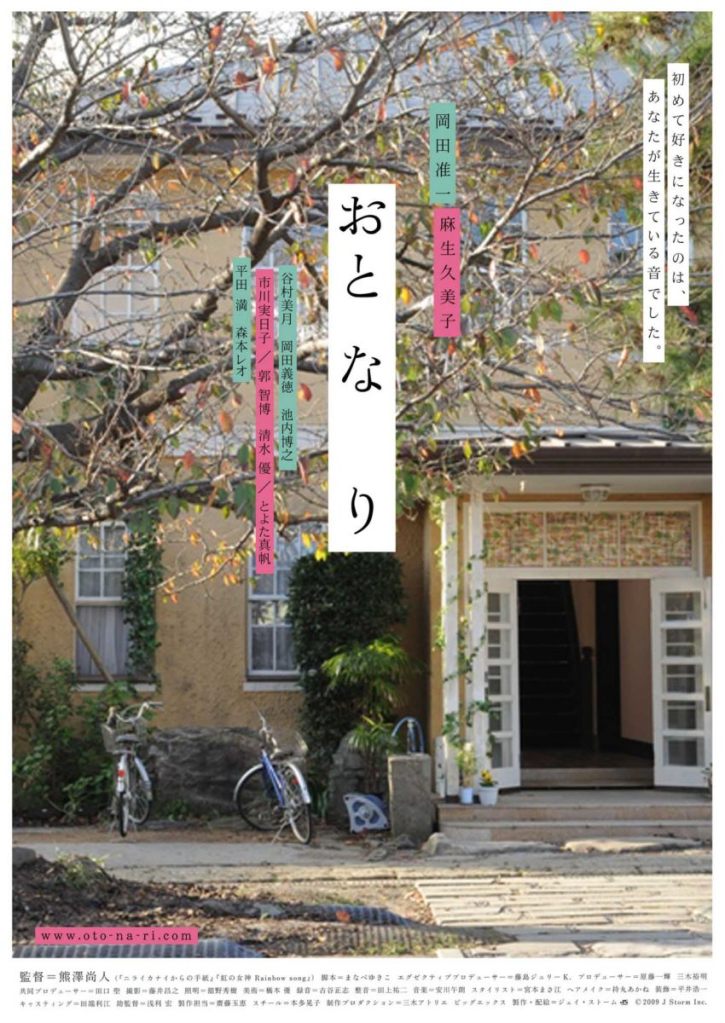
It’s generally a mistake to judge a film by its title, but catching sight of  “Au revoir l’été” on the poster or DVD cover is going to tell you several things about the film you’re about to see. First of all it’s obviously in French – a bold choice for a Japanese film, set entirely in Japan, for release in English speaking territories. Loosely translated it means “Goodbye, Summer” and closely channels the film’s obvious inspiration point Eric Rohmer’s Conte d’été (A Summer’s Tale). If you’re thinking a bit French new wave, stories filled with youthful ennui and complicated romances – well, you’re not far wrong. Indie director Koji Fukada brings the new wave’s characteristic existential angst and romantic yearnings to the Japanese small, seaside town in this unexpectedly engaging odyssey into summer themed nostalgia.

Sakuko (Fumi Nikaido) is a slightly lost young girl who finds herself on an unexpected summer trip with her aunt to house sit for another of her aunts in a small, seaside town where she can get down to studying for a second go at her university entrance exams. Summers being what they are, she finds herself less studying than getting to know her aunts’ home town and their strange collection of childhood friends including old flame of one (or maybe all) of the sisters, former thug and current “hotel” manager Ukichi (Kanji Furutachi). Rounding out the band are Ukichi’s college age daughter Tatsuko and Fukushima refugee nephew Takashi (Taiga). Matters become even more complicated when another professor and sometime lover of Sakuko’s aunt Makie, Nishida, turns up to drip sleaze all over our lovely summer vacation. Like the “hotel” that Ukichi runs which turns out to be strictly a rent by the hour affair, Nishida may look presentable and spout a lot of fine talk but underneath he’s anything but genteel. Idyllic as summer holidays can be, there’s always a lesson to be learned somewhere even if you don’t quite see it at the time.

If you had to come up with a one word descriptor for Au revoir l’été, the one you’d go for would be “wistful”. It’s full of nostalgia for those long languid summers that you only experience at a certain time of life (or perhaps never even actually experienced other than in films and books) where days of listless possibility stretch out in front of you as if the summer really will go on forever. Until, of course, it ends abruptly and rudely just you started to feel it was getting started. Walks by the beach, coffee shops, birthday parties for new friends and a tentative romance with a wounded and clueless local boy – it’s the classic French new wave summer holiday.

Perhaps deliberately, it all has the feeling of a dream, as if its charms are born of the wilful ignoring of painful truths. The sun maybe shining (well, mostly), the river water’s warm and the birds are singing but – there’s always a looming shadow of something less pleasant lurking in the background. In a fairly ordinary way, it has to be said – not in a David Lynch sort of way, just in the sort of way you forget that mean thing your boss said to you last week because “you’re on holiday!” and you’ll think about it later. The “hotel” is a love hotel, the famous professor is a jealous womaniser and Takashi is a Fukushima refugee who’s almost glad about the disaster because it got him out of a bad family situation he has no desire to return to. You can have a really great time right now by not thinking about any of these things, but sooner or later you’ll have to leave the beautiful summer beaches for the muddy path back to reality. No one can live “on holiday” forever.

Nothing really happens, no grand life changing events but somehow things have progressed by the end and everyone seems to have reached a new clarity about themselves and their lives for better or worse. If the film has a major fault it’s that it loses more than it gains by casting the net a little wide and trying to deal with everybody’s stories all at once rather than focusing Sakuko’s viewpoint and radiating out from there. The heart of the film is with its younger protagonists, but it doesn’t  shy away from showing us what might become of them with the unhappy grown ups always in the background. Mikie and Ukichi, who’ve both had their share of disappointments in life, seem weighed down by regrets and compromises that even the summer air can’t ameliorate. The most clued up character is the almost cynical Tatsuko who seems immune’s to summer’s charms and is willing to see things as they are and exploit them to her own advantage.

Like many summers, Au revoir l’été is really far too long by the end but it’s so whimsically charming that you don’t quite mind. Another standout performance from Fumi Nikaido anchors the film through her fairly passive, though perceptively gifted, Sakuko and each of her summer companions is so engagingly drawn that there’s always plenty to think about. Which is just as well because this isn’t the sort of film to offer many answers so much as be content in observation. Charming, intriguing and at times beguiling Au revoir l’été may not set the world alight but it does bathe it in a warm summer glow.


Rurouni Kenshin 3: The Legend Ends (UK Anime Network Review)

RK3_01jpgThe Legend Ends (for now?) but it certainly goes out in style! Review of the final part of this fantastically awesome trilogy up on UK Anime Network. I really did love these even if part 3 is the weakest part (can I have a Saito spin-off series, please?!).


To state the obvious, this review contains a fair few spoilers if you’ve yet to see Rurouni Kenshin 2: Kyoto Inferno so please bear that in mind before reading on.

All things must end and the legend of Rurouni Kenshin is coming to a close, for this chapter at least. Continuing on directly from the dramatic cliff hanger ending of Rurouni Kenshin 2: Kyoto Inferno we’re once again right in the middle of the battle between two former government assassins – the fearless killer Battosai, now rehabilitated and known as Kenshin Himura, and the crazed villain Shishio who narrowly survived being burned on a funeral pyre by the very government who once employed him. Shishio is still hell bent on bringing down the nascent Meiji government, preferably with as much damage as possible and the only one who can stop him is Kenshin – with a little help from his friends, of course!

At the end of the last film, Kenshin found himself washed up on a beach and carried off by a mysterious figure (played by big name actor Masaharu Fukuyama – Like Father Like Son and star of the 2010 Taiga drama Ryomaden also directed by Ohtomo, in a secret cameo). In not quite the biggest coincidence of the film, this figure just happens to be Kenshin’s mentor Seijuro! Which is handy because Kenshin really needs to learn the ultimate swordsmanship technique before he’ll be able to take on Shishio and win. That’s not to mention facing off against Aoshi who just wants to kill Battosai so he can be the number one badass and become today’s prettiest face on all the wanted posters around town. Kenshin certainly has a lot on his plate, but the future of the new Japan rests on his reverse bladed sword alone.

Kyoto Inferno and The Legend Ends were filmed back to back and released with only a short interval between them in Japan – you could argue it’s more one sequel in two parts than two separate films. Picking up right where Kyoto Inferno left off, The Legend Ends maintains the first film’s high production values and impressive action sequences though, it has to be said, with a lengthy lull in the earlier part of the film. Were the two films watched back to back, this “cooling off” period may feel a little more necessary to provide a bit of breathing space between the frenetic ending stretch of Kyoto Inferno and the lengthy battles towards the end of The Legend Ends but when the second film is watched in isolation it can’t help but feel a little slow to get going. Nevertheless, when the battles come, they come thick and fast and display some of the best swordplay sequences of any recent film. Often breathtaking in the fluidity with which it captures these beautifully choreographed sequences, The Legend Ends only improves on the promise of the first two films when it comes to the action stakes.

Unfortunately, this does lead to other aspects of the story being sidelined somewhat. This is really the Kenshin vs Shishio show – not a bad thing in itself but it does mean there’s less time for everyone else. Even big stars like Yu Aoi (Megumi) wind up with one scene only while Emi Takei’s Kaoru is relegated to looking pained in the background. Fan favourite character Sonsosuke gets the most airtime providing his trademark comic relief, and Saito still gets to smoke and look cool with his Drunken Angel era Mifune-like floppy hair to bring his characteristic powerful indifference to every single scene he’s in. Still, fans of the manga in particular may feel disappointed as their favourite scenes and characters get short shrift – especially given the speed at which some of the much feted Ten Swords are met and dispatched in the final battle.

It may be way too long, but The Legend Ends is a fitting finale to this exciting saga. Packing in a number of fantastically choreographed action sequences the film also makes sure to bring Kenshin’s internal story to a satisfying climax (though leaving room for a return to his world should the opportunity arise). Engaging performances, interesting direction and high production values all ensure this trilogy of Rurouni Kenshin live action films has been one of the most successful Japanese mainstream efforts of recent times. Another sterling effort from this expert team, The Legend Ends may not be the strongest entry in the series, but remains a fantastically enjoyable treat!


Out in (very) selected cinemas from today, 17th April 2015

Here’s where it’s on (good luck!):

  • Cineworld Bolton
  • Cineworld Cardiff
  • Cineworld Crawley
  • Cineworld Enfield
  • Cineworld Glasgow Renfrew St.
  • Cineworld Sheffield
  • Cineworld Stevenage
  • Cineworld West India Quay

Kagero-za 陽炎座 (Heat Haze Theatre – Seijun Suzuki 1981)

SuzukiKageroza1Zigeunerweisen was an unexpected commercial and critical hit in Japan netting both an improbably good box office return and more than a few awards. The next instalment in what would become Suzuki’s Taisho Roman Trilogy (though it would be another ten years before the final part, Yumeji, would arrive) therefore benefitted from a slighter bigger budget, bigger stars and even greater ambition. Like the others in the trilogy and as implied by its title, Kagero-za is once again based on a book set in the Taisho era though this time by Kyoka Izumi. Izumi was a novelist and kabuki playwright most closely associated with supernatural tales influenced by Edo era traditions and Kagero-za even features a playwright as its protagonist. With even less clarity than Zigeunerweisen, Kagero-za is not altogether as successful but nevertheless boasts Suzuki’s bizarre imagery and surreal world view.

Like Zigeunerweisen Kagero-za also throws dreams and reality into a giant melting pot with a non-linear narrative that floats and wefts like a strange nightmare. It begins with the central character, Matsuzaki (played by Yusaku Matsuda), meeting a lone woman near a shrine who asks him to accompany her to visit a friend in the hospital. She doesn’t want to go alone because she’s afraid of the old woman who sells charms and medicines there including bladder cherries which are said to contain the souls of women. Originally reluctant Matsuzaki agrees only to have her change her mind shortly after. Matsuzaki is pre-occupied over having dropped a love letter and worrying it’s been found by an ‘evil’ person – something which upsets his new friend as she’s convinced the letter was from a married woman.

This mysterious woman, it turns out, may be (or have been?) the wife of Matsuzaki’s wealthy patron Tamawaki. To make matters even more confusing, Tamawaki may have had two wives – the first a German woman he married while abroad and brought back with him to Japan who died her hair black and wore contact lenses to look more Japanese but regained her original blonde & blue eyed foreignness in the bright moonlight. The second is, apparently, dying in hospital – not that Tamawaki is terribly upset about it. Matsuzaki becomes increasingly obsessed with the mysterious woman, following her across the country only to discover Tamawaki waiting for him – apparently intent on witnessing a double suicide.

The film takes an even more surrealist dive towards the end as Matsuzaki finds himself the only adult audience member at a kabuki show entirely performed and witnessed by children. Not only that, this bizarre kabuki play appears to re-enact the exact same events from the first half of the film. A fitting trap for a playwright, this last, nightmarish section echoes the film’s ghost story origins complete with the creepy bladder cherry seller from the beginning as some kind of villainous demoness and Tamawaki as a tempting devil. Who talks of realism here? Says Tamawaki making an exit through an alleyway with a rifle on his shoulder. Who indeed? Not us, that’s for sure.

Even less coherent than Zigeunerweisen, Kagero-za is a veritable fever dream of a film. There’s barely any linear plot, Matsuzaki’s perceptions are recounted in fractured dream narrative where the true nature of events is always unclear. We can’t trust Matsuzaki to guide us here, nor can we trust Suzuki who employs fewer absurdist tricks than with the previous film but injects a heavy dose of kabuki inspired theatrics. Everything feels inevitable, like the action in a play it’s all been scripted and performed many times before. Yet for all that we don’t ever come to feel very much for Matsuzaki and his presumably tragic fate even though we realise fairly early on what sort of story this is. It’s hellish, and gruelling and honestly tries the patience at times but never achieves that sense of over arching dread that characterised Zigeunerweisen.

That said, if Kagero-za’s largest weakness is playing second fiddle to Zigeunerweisen that’s not so much of a problem. Once again filled with bizarre and trippy imagery, Kagero-za has many startling moments but fails to marry its visual virtuosity with the more individualistic focus of its script. Undeniably without the power of Zigeunerweisen, Kagero-za ultimately feels a little too clever (and perhaps too cold) for its own good but nevertheless does offer Suzuki’s visual flair and an entertaining (if baffling) narrative.

Zigeunerweisen (Seijun Suzuki, 1980)

ZigeunerweisenSeijun Suzuki maybe most well known for his 1967 weird hitman themed existential crime movie Branded to Kill but the film almost cost him his career and definitely did cost him his job at Nikkatsu after studio bosses lamented that his films made no sense and no money. The next decade saw Suzuki involved in a complex set of legal battles and unable to sit in the director’s chair. The positive result of all this is that he obviously had some time to save up all his crazy so he could put it all into his personal statement of rebirth – Zigeunerweisen. Inspired by Hyakken Uchida’s novel Sarasate no Ban, Zigeunerweisen is a surreal and nightmarish journey through Taisho Era Japan as seen through Seijun Suzuki’s very idiosyncratic gift for storytelling.

As far as the plot goes, it begins with two men listening to a record of Sarasate’s Zigeunerweisen on which it sounds as if someone says something before the music starts but neither can quite make it out. It transpires that the two men are Aochi, a Westernised professor of German and his old university friend Nakasago who has become something of a wanderer. The pair are reunited in a small fishing village where Nakasago is implicated in the death of a local woman who had apparently fallen in love with him (something which seems to happen to him a lot). After Aochi manages to make all the charges go away with his “I’m a professor don’t you know!” routine, the pair retire to a local inn where they insist on getting the one geisha in the place who’s just returned from her brother’s funeral to come and cheer them up. Later, Aochi is stunned to discover that Nakasago has got married to a noble woman but even more surprised when he realises the wife looks exactly like the geisha from the sea side town! Dualities build upon dualities with an ever multiplying sequence of bizarre love triangles as dreams and reality continue to become ever more indistinct. That’s not to mention the recurrent presence of a blind singing trio, a sister-in-law in a coma and that the main character may or may not be dead the whole time….

The Taisho Era, 1912 -1926 in our dating system, was a short lived historical time period as the Emperor Taisho was in poor health. A little like Weimar Germany, this brief period has taken on a sheen of tragic romanticism, innocent and decadent at the same time – safe from the chaos of the Meiji Era which saw rapid changes resulting from Japan’s emergence from centuries of isolation, but also a time of youthful exuberance before the darkness of the Showa Era’s militaristic bent took hold. Aochi seems to represent an intellectual, civilised Western looking outlook with his European clothing, house and free spirited wife whereas Nakasago represents a more primal force with his traditional dress, Japanese style house in the middle of nowhere and, when he marries, traditional Japanese wife who dresses in kimono and stays home all day waiting for her husband’s return. However, Nakasago also gives full vent to his passions leaving his wife at home to go wandering and break a few hearts along the way. He uses and abuses women with no thought at all – he simply takes what he wants from them and moves on. He cares nothing for so called traditional morality or the rules of society, he is quite literally a law unto himself. Where Aochi thinks, Nakasago does.

As for feeling? Maybe neither of them are particularly engaged in any kind of emotional activity. Adding to the film’s dreamlike quality is a kind of permanent listlessness. A pervading sense of ennui which seems to say that none of this is really of any consequence. Logical sense has no real place here – we’re suddenly in a cave mid conversation, figures appear and disappear from the frame without reason or warning and characters which were once fully grown adults are suddenly children. Oh, and the murder / suicide victim at the beach? she died because six crabs emerged from her nether regions. There are also constant allusions to death – most obviously through Nakasago’s skeleton fetish which is certainly one of his more outlandish (and disturbing) qualities. That’s not to mention the title track itself Zigeunerweisen and its strange recurrence in the plot where the inability to decipher its mysterious message takes on an unsupportable level of importance. Alive or dead? Awake or dreaming? Are those things even mutually exclusive?

What does it all mean then? Absolutely no idea – but that’s OK. Zigeunerweisen throws up mirrors everywhere, demonstrating the curious symmetry of life. Dualities abound, the real and the unreal intersect in strange and inseparable ways. Perhaps that’s the point, there is nothing absolute – all things consist of other things. All moments truly are one moment, coexisting on a vast plane uncrossable by will but nevertheless traversable (or so the bizarre blind trio children would have you believe with their strangely anachronistic Manchurian war song). Suzuki is obviously uninterested in concrete answers, but as in many things it’s the questions themselves which become the most interesting.

Han Gong-ju (한공주, Lee Su-Jin, 2014)

Photo 1Review of this complex Korean social drama up at UK Anime Network. Went a bit intense with this one….


Hot on the heels of A Girl at My Door, we’re confronted with another impressive debut film from a Korean director which once again deals with a series of important, if unpleasant, often over looked social phenomenons. It’s difficult to review Han Gong-ju without revealing the mysterious events at its centre yet much of the film’s impact is bound up with the slow drip of its structural dissection of its raw and painful wounds. Based on a real life case from 2004, Hang Gong-ju is a harrowing tale of victim shaming, social injustice and ingrained systems of corruption which will shock even the most cynical Korean cinema fan.

At the beginning of the film, Hang Gong-ju is being a little less than sensitively dealt with by her school teacher who hands her a new mobile phone and instructs her not to call anyone she knows, not even her father, and only to accept calls from his own phone. She’ll be transferring to a new school and staying with her teacher’s mother until other suitable accommodation can be arranged. We don’t know why any of this is happening but the teacher seems put out, less than willing to help Gong-ju – almost as if he finds her existence a little embarrassing. At her new school she keeps herself to herself, making sure to remain distant from her fellow pupils. However, a group of singers finds out that Gong-ju has musical talents and becomes intent on adding her to their group. Though fearful and unwilling, Gong-ju gradually becomes closer to them. The reason for her aloofness leads back to the very reason she’s been exiled from her hometown and is a secret Gong-ju is terrified will eventually be revealed. Following a possibly well meaning (or maybe a little less so) action by her new group of friends, the true reasons for her being forced into hiding are thrown into the light and Gong-ju once again becomes the centre of a storm composed of a complex system of societal repercussions.

Without giving too much away, nothing that happens to Han Gong-ju is her fault yet she’s the one sent away from her home, from her friends and family, and forced to feel ashamed for having undergone a terrifying ordeal. She’s just a normal teenage girl, but there’s no one to stand with her or for her – she is left totally alone in the home of a stranger with no one to talk to or be comforted by. Those that are responsible, the guilty parties, who were able to act in such a morally repugnant way thanks to their connections, social standing and the arrogance the combination of those things afforded them seem to have largely escaped the shame and ignominy which has continued to dog Gong-ju who is still subject to physical manifestations of their actions – let alone the mental scarring. Not only that, Gong-ju is also pursued by the families of those that have caused her harm who seem to want her to change her statement of events in favour of their children. The father of one whom she had been close to even wants her to sign a petition to say that his child was “forced” into these heinous acts. Perhaps even, in a sense, he was though it’s hard to see how any rational person could ever see that as a mitigating factor in the events which did actually take place.

It’s not only Gong-ju who’s found herself at the mercy of rigid social codes. Her hard nosed and originally reluctant landlady-cum-responsible-adult Mrs. Lee has also had her fair share of disapproval from the local housewives thanks to her relationship with the town’s police chief. Her middle aged romance also causes a degree of resentment from her horrified son who doesn’t seem to care very much about his mother’s actual feelings or those of Gong-ju whom he deposited at his mother’s house like an inconvenient suitcase in the hope of making a good impression with his boss. Although originally put out by the sudden arrival of a teenage house guest who may even be some sort of delinquent, Mrs. Lee comes to a grudging admiration for this obviously damaged girl and is close to being her only real supporter (though perhaps only up to a point). Gong-ju’s growing closeness with Mrs. Lee is even more valuable as her relationship with her own mother was fractured even before the events that have befallen her and leave her unable even to count on her mother’s love and support during such a difficult time.

Told with remarkable assurance by Lee Su-jin who opts for a complex, non linear structure Han Gong-ju is frankly more harrowing than any horror film as the demons which plague the central character (and actually, many of the other women in the film) are all too real – manmade by a rigidly conformist, conservative society riddled with corruption and all too quick to point the finger of blame at those incorrectly positioned within its complex network of social hierarchies no matter what the facts of the matter may be. Shocking, even if sadly somewhat unsurprising, Han Gong-ju dares to shine a bright light on this dark corner of human suffering and by telling the sad story of this one lonely, victimised girl who nevertheless tries to live her life in spite of her difficult circumstances may help others finally wake-up to the kind of injustices we allow to take place in the world which we, daily, create.


Out today on DVD & blu-ray from Third Window Films

The Grandmaster (UK Release) (UK Anime Network Review)

background_46481“Once upon a time in Kung Fu”? Really? “Inspired by the True Story of Bruce Lee’s Master”? Yeah, this poster tells you everything you need to know. 1000+ word rant Review of the Weinstein cut of Wong Kar Wai’s latest up at UK Anime Network.


You’d be hard pressed to find a more internationally well loved Chinese director than the achingly cool Wong Kar-wai. When it was revealed that Wong was going to tackle the story of legendary martial arts practitioner Ip Man with frequent collaborator Tony Leung along for the ride, excitement levels were obviously dangerously high and only set to rise. However, the project never quite seemed to get off the ground and, in fact, several other Ip Man movies were made in the meantime including the hugely successful series starring Donnie Yen the third of which is currently in development. The film finally found its way to the Berlin Film Festival in 2013 and received a brief cinema run in the UK last year but is only now reaching UK homes courtesy of Metrodome.

As usual with Wong who’s never quite managed to find the “save & quit” button, The Grandmaster exists in three different versions – the first being the original “Chinese cut” which runs 130 minutes, the second the “Berlin Cut” which runs 123 minutes and then there’s the “Weinstein Cut” which is 108 minutes long. If alarm bells are already ringing on hearing the name Weinstein, you are unfortunately correct – the UK release is limited to the shorter Weinstein cut. Not only is the film 18 minutes shorter than the longest version, it is an entirely different movie. Subplots have been streamlined or removed altogether, scenes have been reordered and rearranged and crucially additional voice over and explanatory title cards have been added for the “benefit” of an international audience. Seeing as few people will have the opportunity to see either of the other cuts of the film, there’s little point in explicating every last difference but suffice to say if you do have the opportunity to view the 130 minute Chinese version of the film it is a much better option than this overly accommodating “Ladybird Book” style international offering.

As for the plot of this Weinstein version, it runs more like a traditional martial arts thriller with Ip Man as the challenger who must fight various bosses to become the king of martial artists with some stuff about not kowtowing to the Japanese thrown in. The film has been “refocused” to centre more definitely on Ip Man himself as THE Grandmaster whereas the Chinese cut of the film situates him slightly to one side of things – almost an impassive observer of the chaotic events which over took Chinese society from the mid 1930s through to the early 1950s as seen through the mirror of the popularism of the kung-fu world both real and imaginary. In fact, in the Chinese  version the real story is arguably that of Zhang Ziyi’s Gong Er whose tragic life story serves as a metaphor for the dangers of a stubborn adherence to traditional values. Left with little to reflect on, this Ip Man’s story is relegated to a martial arts serial style retelling of the early adventures of the man who went on to train Bruce Lee which is both reductive and actually a little insulting.

The Chinese cut of the film is a sweeping, operatic epic rich with restrained emotions and barely suppressed personal, and implied national, tragedies. Most obviously the subtleties of the central love story between Ip Man and Gong Er are all but lost in this version as the scenes which allowed them to build up the necessarily emotional resonance have either ended up on the cutting room floor or been rearranged ruining the careful rhythms of their relationship and robbing the film of its beating heart in the process. Adding to the zombified feeling are the various title cards interspersed throughout the film which simply display a a few stage directions in an extremely ugly white font, almost like the kind you might see in the restoration of a rare film in which some reels are missing and the only way to fill in the blanks for the audience is to provide a scene synopsis for the intervening action. To put it bluntly, this is an extremely amateurish solution which both takes you out of the ongoing action of the film and adds to the feeling that one is being talked down to.

However, it isn’t all bad. The beautifully balletic fight sequences and often stunning cinematography have both made it through largely unscathed. The film has an undeniable aesthetic appeal and those action scenes are just as exciting as they are good to look at. Likewise, the central performances, though often frustrated by the problems raised by this new edit, are universally strong though it’s shame that Zhang Ziyi’s quite extraordinary work here is being unfairly disrupted by the butchering of her character arc. Coming to the film cold entirely unaware that another version exists, you may feel it’s a so so art house kung-fu movie with a bit too much talking, not enough fighting and altogether too much too much distance between the two but perhaps not find it altogether unenjoyable.

It’s a shame that the UK will likely never see the longer cut of The Grandmaster. Though apparently Wong Kar-wai worked closely with Harvey Weinstein to create a version that was more accessible to non Chinese viewers, it’s difficult to believe this extremely dumbed down approach could really be what he was looking for. After all, there is no dubbed track here – viewers opting to watch a subtitled film most likely aren’t looking for something familiar, they’ve chosen it because they’re interested enough in another culture to spend two hours exploring it. They almost certainly don’t need the kind of bald explanatory text offered here (though, really, who would?) and will most likely feel insulted at having been treated like children who need every last little thing explained in painful detail. Nevertheless, if this is the only way to see the latest film from Wong Kar-wai, there is still a fair amount to enjoy but be aware that it’s far from the true version of The Grandmaster and it may be worth your while to seek out the 130 minute Chinese cut to see Wong’s complete vision.


My Man 私の男 (Kazuyoshi Kumakiri, 2014)

162276_02Based on the Naoki Prize winning novel by Kazuki Sakuraba, My Man tackles the difficult subject of a quasi-incestual “love” affair between a young orphaned girl and the “distant” relative who adopts her as his “daughter”. Though this taboo subject has never been far from Japanese screens (find me an art film from the ’60s which doesn’t involve incest in some way), My Man dares to examine in it in all its realistic muddiness and is marked by nothing so much as its raw intensity. Brought to the screen by Kazuyoshi Kumakiri whose last picture Summer’s End chronicled the romantic and existential dilemmas of a woman approaching middle age, My Man is a disturbing and unsettling film which poses a fair few unpleasant questions about the nature of familial and romantic relationships.

The film begins with a young girl, Hana, crawling away from a scene of intense devastation. Finally ending up at a refugee centre, it seems that Hana’s entire family have been killed in a natural disaster. Creeping back to her house, Hana is discovered by a rescue worker, Jungo, who by coincidence happens to be a distant relative of hers. Asked who the little girl is, Jungo immediately asserts that she is his daughter and there after claims her as his own. The pair continue to live together in a small, seaside Hokkaido town until Hana reaches middle school age at which point their relationship changes and the lines between father/daughter and husband/wife become exceedingly blurred. Only growing in intensity, the two will eventually even go so far as to kill to protect their illicit relationship which eventually takes them to the comparatively more anonymous Tokyo but what the outcome of their unconventional bond will ultimately be, only time will tell.

Hana and Jungo are both people in search of “family” and unbreakable bonds. Hana, having just lost her entire world in a tsunami is haunted by nightmares of being carried by her desperate father running from the coming storm but comes to see her new guardian Jungo as something more than a paternal figure. Jungo, as the kindly uncle Oshio remarks, is the sort of man who shouldn’t have a family. At this point, we don’t know why Oshio feels this way, merely that people seem uneasy in Jungo’s company and there’s something a little strange in his bearing and in his willingness to adopt an orphaned little girl with very little consideration. Though they are described as “distant” relatives, Jungo spent sometime in Hana’s familial home just before she was born and claims to have had a fondness for her mother – perhaps not such a “distant” relative after all.

In fact, Hana comes to feel an indestructible bond with Jungo precisely because of their blood ties. She believes he may be her true father and makes him also her carnal lover. Hana’s possessiveness begins almost at the beginning of their relationship with a repeated motif where she sucks on his fingers which takes on an increasingly erotic context as the film goes on. Seeing off Jungo’s more age appropriate girlfriend, Komachi, Hana delights in her triumphant ownership of Jungo decrying that he needs a blood relative and nothing else will do. Horrified, Komachi eventually leaves the area altogether and Hana and Jungo to their strangely intense “family” life. When Oshio accidentally discovers what exactly goes on in their household and comes to the conclusion Hana may once again need rescuing, talking may not quite be enough. Though their relationship has crossed social taboos the pair see nothing wrong in it yet are afraid of the possibility of being discovered and will go to great lengths to protect their illicit secret.

The tale starts to lose momentum a little after the move to Tokyo but it’s here that the central problem makes itself most plain. Jungo, having left the sea behind him, works as a cab driver in the city but eventually drifts into a life of aimless alcoholism as Hana grows up and away from him. “I just want to be a father” he cries after having just had a bizarre and humiliating encounter with a would be suitor of Hana’s. “You’re not good enough” he tells him, a repeated phrase offered to another of Hana’s men at the end of the film – fatherly words, but tinged with the jealousy of a rival. In the end, it seems as if Hana may have abandoned their “family” for a more conventional life, however, in a telling sequence set in a restaurant everything else appears to disappear leaving just the two of them isolated in their own world. Flirtatious and possessive, theirs is a bond which will truly never be broken, for better or worse.

Kumakiri shoots this bleak tale in a mostly naturalistic style occasionally giving way to expressionism and snaps of non-linear editing. In a pivotal scene as Jungo and Hana indulge their carnal passions one morning before school, the entire room rains blood – first falling as droplets on Hana’s back before becoming a torrent which leaves them both stained crimson. A blood wedding or presaging their further transgressions, this startling moment is only one of Kumakiri’s impressively nuanced symbolic touches. Though the film has its B-movie, melodramatic elements, Kumakiri has been able to integrate these into his slightly elevated tone with little difficulty to create a modern, melancholic mood piece which is rich with mystery and only hinted at implications.

Another interesting film from Kumakiri, My Man is an impressively directed dissection of its difficult subject matter. Anchored by extraordinary performances from Tadanobu Asano and particularly from Fumi Nikaido as the complicated and conflicted Hana, Kumakiri thankfully keeps the sleaze factor low though simmering enough for its necessary impact. It may not be a pleasant watch, but for those who can bear its unrelenting melancholy My Man offers a fascinating portrait of the modern family in crisis.

When Marnie Was There 思い出のマーニー (Hiromasa Yonebayashi 2014)

When-Marnie-Was-There-GhibliPerhaps the final effort from Studio Ghibli, When Marnie was There is directed by Hiromasa Yonebayashi whom some had seen as a potential successor to the company though it seems he too has now left Ghibli’s employ! Like Yonebayashi’s previous film The Secret World of Arriety, Marnie is also based on a vintage British children’s book – this time by Joan G. Robinson, though When Marnie Was There hasn’t enjoyed the same level on ongoing popularity as The Borrowers (maybe because it hasn’t received the same kind of televisual treatment as Mary Norton’s novels). Nevertheless, Marnie has been successfully shifted to modern day Japan whilst still managing to feel quite like ’60s England.

Anna is a solitary 12 year old orphaned girl living with her adoptive parents in Sapporo. A constant worry to her fretting mother, Anna suffers from severe asthma and has received complaints at school regarding her aloofness and seeming inability to make friends. Part blaming herself and her often absent husband, Anna’s mother decides to send her to the country for a while over the summer, hoping both that the clean air will be good for her lungs and a change of scene might help bring her out of herself. After arriving at a small seaside town to stay with some relatives of her mother’s, Anna hears tell of a mysterious grain silo which the local children think is haunted and also becomes strangely drawn to an apparently empty Western style mansion. Anna starts to dream about the house and eventually ends up meeting a mysterious and cheerful blonde girl there dressed in a distinctly old fashioned style. Though opposites in many ways the two have more than you might expect in common and quickly become firm friends. However, why can’t Marnie go very far from the mansion and why doesn’t anyone else seem to know about her? Only through solving the mystery of Marnie can Anna unlock the secrets that have been causing her pain in her own life.

Perhaps oddly, there are a lot of similarly themed children’s books from this period – enough to form a small genre all of their own though there are certainly much more well known examples than When Marnie was There. They are in fact so well known that to name any one of them might accidentally spoil the story but any British adult over 30 who grew up reading this kind of material or watching the numerous television adaptations has probably already figured out where this is going. Having said that, the film at least deviates from the norm in that the country relatives are actually nice if content to let Anna figure herself out while she’s there rather than the stern guardians you often see which necessitate the children getting out of the house to go on their adventures. Likewise, generally the stories focus on the accidental friendships developed by (oftentimes originally mismatched) children as they investigate whatever mystery has arisen – though Marnie has this, it leaves it as a nice, subtle detail that actually pays off in the end. Thankfully, though the resulting story is sad, there’s nothing really malevolent lurking and the resolution is such that it allows the central characters to close the loop on a traumatic event with their memories returned to them so they can move on with their lives.

By and large, the animation is just as impressive as any other Ghibli movie (though perhaps unremarkable by their very high standards). The pacing is, at times, strange – particularly the last segment in which the revelation is played as one long narrated tale, but Yonebayashi has been able to imbue this little seaside village with plenty of character full of tiny details and a fully realised life of its own. Though it’s a little more obviously sentimental than many of Ghibli’s other works and eschews some their more usual concerns, When Marnie was There stays true to the emphasis on the importance of friendship, loyalty and decency that has long been a mainstay in Ghibli movies. Unlike The Wind Rises or Princess Kaguya, this one is firmly aimed at girls of around the protagonist’s age and may have a little less to offer to those outside of it but its tale of adolescent connection still rings true.

Some might claim it’s second tier Ghibli, and they might be right, but even second tier Ghibli is still a ways ahead of most other animation. An old fashioned children’s mystery melodrama with friendship at its heart, When Marnie was There doesn’t exactly break any new ground but it does offer an intriguing tale told with characteristic warmth and intelligence by the promising young director Yonebayashi.

Monsterz (2014)

Monsterz_2014Hideo Nakata is best remembered as one of the driving forces of the J-Horror boom of the late ’90s thanks to his hugely influential Ring movies. However, despite a few notable hits including Dark Water, his career has seen something of a slump following a foray into American filmmaking with The Ring 2 – a sequel to the remake of his own Ring (though entirely different from his Japanese language Ring 2 completed in 1999). Monsterz sees him helming a remake of another foreign property – this time the Korean sci-fi thriller Haunters.

The film begins from the POV of Monster no. 1 (played by Tatsuya Fujiwara), who narrates much of the story and refers to himself solely as “monster”. Blindfolded, a small boy is dragged home by his mother only to be discovered by his abusive father who beats him and berates his mother whilst insisting “the monster” needs to die. At this point the blindfold comes off and the boy controls his fathers actions eventually persuading him to snap his own neck. Beginning to also control his mother, the boy stops short of giving her the same treatment and wanders off into the rain. Fast forward 20 years and the monster is now a criminal mastermind who uses his time freezing and mind control capabilities to make a living as a bank robber. However, one day he discovers someone who seems to be immune to his powers (Takayuki Yamada) and his whole world is shaken. The monster sets about removing this threat to his supremacy but it appears his opponent is also “a monster” – a man with super healing properties who cannot die! It takes a “monster” to fight a monster but which one will come out on top?

Yes, lots of predictably comic book style action adventures begin as the two guys with opposing super powers face off against each other. The most interesting aspect of the film is that it’s mainly told from the point of view of the otherwise unnamed “monster” though Nakata’s attempts to make him a sympathetic anti-hero never quite work out despite Fujiwara’s committed performance. The film’s ending is also unconventionally unresolved (though also very true to its American comic book roots) with a pleasing note of tolerance and inclusivity thrown in. However, that is in part facilitated by the lack of tension in the central dynamic – the two opposing forces are at a perpetual stalemate which only ends up feeling, well, stale – in a word. The monster’s freezing and mind control powers are impressive but the action sequences are much of a muchness and just get bigger rather than more interesting.

Having said that the action sequences aren’t unexciting, there are some impressive moments (bar the odd use of dodgy CGI and green screen). The main problem with the film is a slight mismatch in tones between Nakata’s portentous doom laden fatalism and the playful lightness of its comic book inspiration. The conventional hero, Shuichi, takes second lead here with his gang of sidekicks – otaku Akira and flaming queen Jun offering odd moments of comic relief. Though actually the role of Jun is another interesting inclusion as, despite offering a stereotypically “gay” character camping things up spectacularly, Jun is also presented fairly normally as a valued friend and comrade of the hero. His sexuality is merely a character trait, never a joke in itself which is a refreshing element particularly in a Japanese film. In the end, Monsterz aims to offer a message of tolerance and inclusiveness – that, oddly, there are no monsters and would be no villains if we could all just learn to accept each other’s differences and live together in harmony. However, the message is a little hamfisted and clumsily delivered and, some might feel, out of place in an action orientated film such as this.

Very typical of the comic book movie genre (though perhaps more Fantastic 4 than Dark Knight), Monsterz is middling mainstream fare which, while mildly diverting, fails to offer anything particularly memorable. A fine way to spend 90 minutes, Monsterz never outstays its welcome and offers generally high production values plus Nakata’s trademark visual flair but is unlikely to satisfy more genre savvy fans.

Morning for the Osone Family 大曾根家の朝 (Keisuke Kinoshita, 1946)

81avzyD41gL._SL1500_So, after making the subtly subversive Army, Kinoshita found himself persona non grata but all that changed with Japan’s final surrender and the coming of the Americans. You might think that means an end to the system of censorship and a greater freedom of expression but the truth is one master had simply been swapped for another. The Americans now imposed their own censor’s office and banned the depiction of various dangerous or inconvenient ideas including anything xenophobic, militaristic or anti-democratic. In short, the complete reverse of before but perhaps no less restrictive. However, the new requirements were undeniably closer to Kinoshita’s true feelings so there were fewer problems when it came to getting a film made. Accordingly Kinoshita began working on Morning for the Osone Family soon after the surrender and the film was released in 1946. Extremely raw and probing, the film deals with the effects of the war on a well to do, liberal intellectual family but turns their plight into a metaphor for the country as a whole.

The film begins in the Christmas of 1943 as the Osones gather together around the piano for a rendition of Silent Night as they prepare to say goodbye to the daughter’s fiancé who’s been drafted and will shortly be leaving for the war. The celebration is short lived as their peace is shattered by an ominous knock at the door. Oldest son Ichiro is carted off by military police for having written a mildly subversive essay in a newspaper. Whilst all this is going on Yuko’s fiancé, Akira, takes his leave handing her a letter to say she needn’t wait for him with the future so uncertain. It’s at this point that meddling fascist uncle first appears to reveal he has written to Akira’s family to break off the engagement because they are of a high status and with Yuko’s brother’s arrest he feels it’s inappropriate to bring them shame. As the war drags on, Uncle Issei comes to have more and more control over their lives but will the progressive atmosphere of the Osone household ever be able to withstand the bluster of Uncle Issei’s militaristic fervour?

Made immediately after the war, Morning for the Osone Family is filled with the bitterness and anger of disillusionment. Coloured by the knowledge of Japan’s impending defeat, the events can’t help but take on a portentous air and it’s pretty obvious the Osone family will never be able to return to that final Christmas in 1943 before everything was taken away from them. The obnoxious Uncle Issei becomes a metaphor for Japanese fascism as a whole with his heartless militarism and personal corruption. During one telling episode, Yuko remarks that the more they simply obey him the worse he’ll get and that they should stand up to him every now and then. The mother, Fusako, agrees but thinks it’s impossible. Later, in a last impassioned speech, she laments that she should have done more, said no earlier, but she tried to do what was expected of her. Fusako voices the rage and disappointment of the masses of ordinary people who went along with things they didn’t agree with because they felt it was the proper thing to do. Now she sees no need for the pretence, in this brave new world it’s time for the younger generation to do as they see fit without feeling beholden to these corrupt ideas peddled by those who claim to speak for everyone but have only ever been speaking for themselves.

Oddly, Morning for the Osone Family may have the most overtly propagandistic feeling of any of the films in Criterion’s Kinoshita and World War II boxset. Though it ends on an undeniably powerful declaration of hope for renewal and rebirth, its epilogue feels like a step too far – both hollow and needlessly over the top. Apparently this final scene was added at the behest of the Americans who wanted more deliberately democratic sentiments which may explain its on the nose tone though it isn’t entirely out of keeping with the rest of the film and most likely represents Kinoshita’s real feelings. Morning has arrived after a long night filled with pain and sorrow, all that remains now is to banish the darkness and welcome in the light.