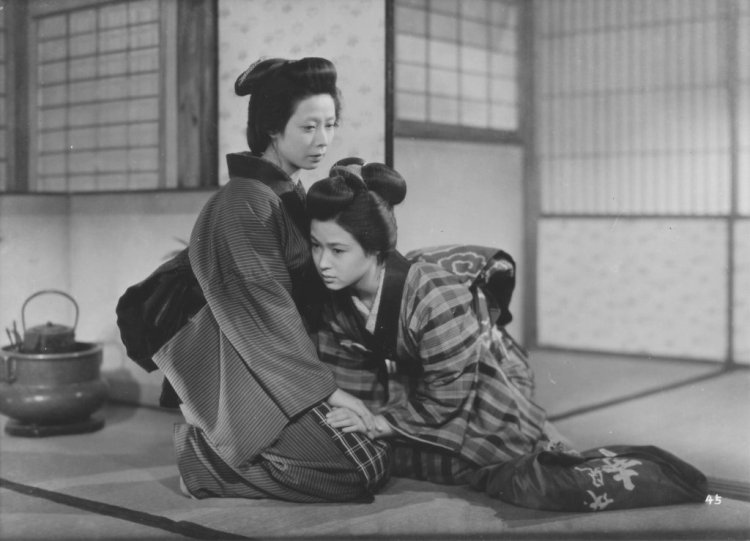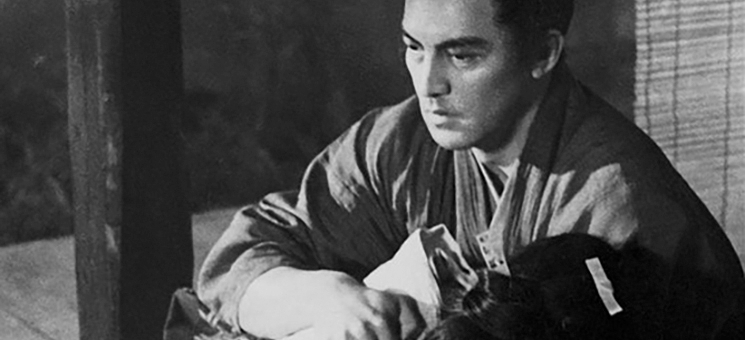
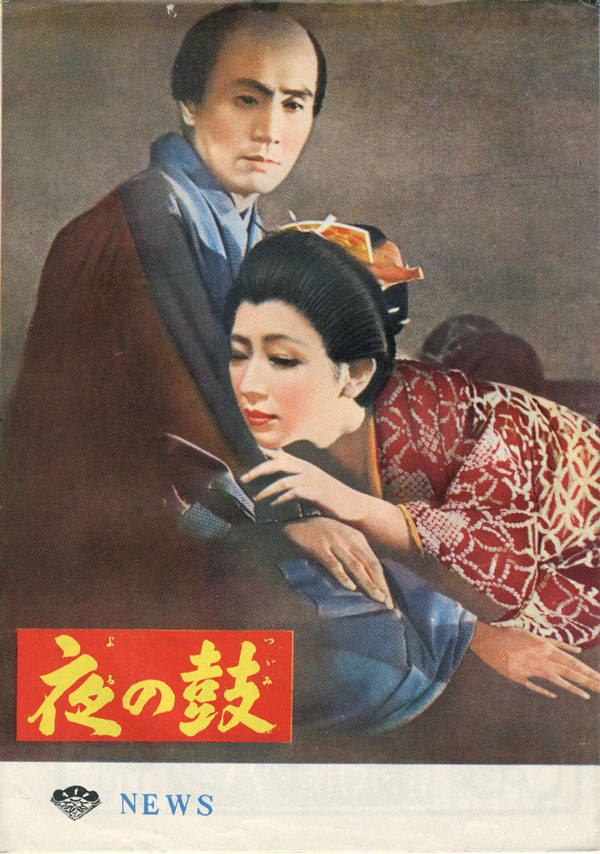
The Fireflies (螢火, 1958, Heinosuke Gosho)

bxbnzqmccaa5-cg-jpg-largeHistory marches on, and humanity keeps pace with it. Life on the periphery is no less important than at the centre, but those on the edges are often eclipsed when “great” men and women come along. So it is for the long suffering Tose (Chikage Awashima), the put upon heroine of Heinosuke Gosho’s jidaigeki The Fireflies (螢火, Hotarubi). An inn keeper in the turbulent period marking the end of the Tokugawa shogunate and with it centuries of self imposed isolation, Tose is just one of the ordinary people living through extraordinary times but unlike most her independent spirit sparks brightly even through her continuing strife.
Beginning in the “present” – the late 1860s, Tose is the de facto manager of Teradaya, a successful inn in Kyoto. Japanese history buffs will instantly recognise the name of the establishment, as well as that of Tose’s 18 year old adopted daughter, Oryo (Ayako Wakao). Nevertheless, that story can wait as we flashback with Tose as she gazes blankly at a stretch of water, remembering the time she first came to Teradaya as a young bride. The daughter of peasant farmers, Tose was not welcomed by her mother-in-law, Sada, both because of the class differences, and because the man she’s married is not Sada’s son but that of a concubine and she would prefer her biological daughter, Sugi, to inherit. Tose’s husband Isuke, though by no means unpleasant towards her, is a feckless man obsessed with cleaning and singing folk songs, leaving the bulk of the work to his wife.

Tose bears all, taking on the running of Teradaya and making it the most popular inn in town thanks to her friendliness, efficiency, and discretion. However, her position is threatened when she is almost ruined by a bizarre scam involving dummies and ventriloquism. Vindicated, Tose’s position is strengthened but there is more trouble in store when Sugi runs off with the conman leaving her infant illegitimate daughter in Tose’s care. Becoming a mother as she’s always wanted, Tose begins to find a little more fulfilment in her life only to have her dreams cruelly dashed once again. In an act of kindness she later adopts another orphaned girl, Oryo, who arrives at the inn starving and in the care of an older man who’d been looking after her since her doctor father was murdered for supposedly collaborating with the rebel ronin trying to over throw the shogunate.

This is the first mention of the ongoing political instability present in the country at large but largely unseen in the peaceful world of a small inn in Kyoto. Of course, you can’t say Teradaya and Oryo without eventually saying Sakamoto Ryoma (Miki Mori). Ryoma does eventually arrive in all his revolutionary glory albeit in an appropriately humanised form and proceeds to turn Tose’s life upside down in more ways than one. Locked into her loveless, but far from cruel, marriage Tose’s spirited nature is reignited by Ryoma’s fervour. Falling in love with him for his commitment to creating a better world for all, Tose’s dreams drift a little but are dashed again when she realises he and Oryo are the more natural pair.

Though Tose reacts badly to the discovery that Oryo is also in love with Ryoma, she is later able to patch things up, entrusting the man she loves to her daughter in an act of maternal sacrifice. Tose talks about her admiration for those who sacrifice all of themselves for other people but this is exactly what she has done with her own life, only in a much quieter way. Where Ryoma was a father to a movement, Tose is a mother to the world. Denied a child of her own through her husband’s indifference, Tose first adopts her niece and then an orphaned girl but consistently acts in the best interests of others rather than herself. Hearing the cries of betrayed revolutionaries, she describes them as sounding like howling babies – an idea she repeats several times including when describing Oryo’s famous naked dash from the bath to warn Ryoma of the impending arrival of the Shinsengumi. Tose’s only instinct is to silence those cries through maternal warmth, even if it ultimately causes her pain.

Tose, for Gosho at least, is no less a heroic figure than Ryoma as her everyday acts of kindness and strength contribute to an ongoing social change. Where other inn owners turn in the rebels either for material gain, active opposition, or desire to avoid the hassle, Tose stands firm and allows Teradaya to become known as a safe haven for the revolutionary movement. Ryoma shone brighter but for a short time, whereas Tose’s life goes on and Teradaya continues to be the favourite stop for beleaguered travellers passing through the old capital in these difficult times. Reconciling with her husband who finally offers the possibility of having a child of their own to inherit the inn, there is a glimmer of hope for Tose once again even if it’s clear that Isuke hasn’t really changed. It may seem that Tose’s firefly has blinked out as she takes her dull and self centred husband back, vowing to spend less time on the inn as she does so, but there is a glint of light in her few final words which are followed by putting her apron straight back on to meet the first boat, shouting the virtues of her beloved Teradaya all the way.


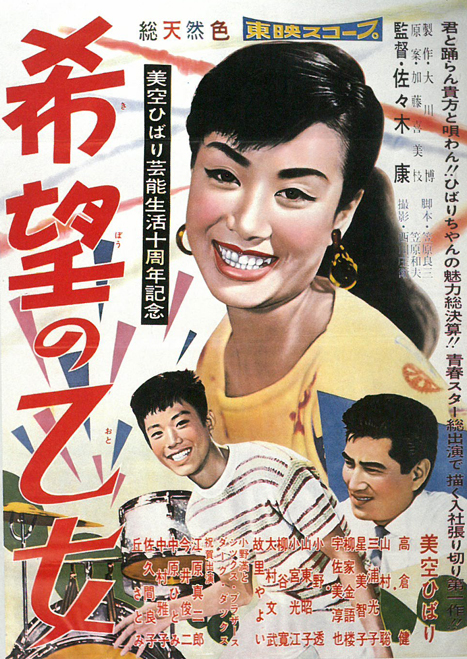
With Song in Her Heart (希望の乙女, Yasushi Sasaki, 1958)

song in her heartAnother vehicle for post-war singing star Hibari Misora, With a Song in her Heart (希望の乙女, Kibo no Otome) was created in celebration of the tenth anniversary of her showbiz debut. As such, it has a much higher song to drama ratio than some of her other efforts and mixes fantasy production numbers with band scenes as Hibari takes centre stage playing a young woman from the country who comes to the city in the hopes of becoming a singing star.
After beginning with a rural, almost cowboy-style number in which Hibari appears as the well dressed lady of the manor, Sayuri, riding her horse across the wide pastureland, the action quickly moves to the city when Sayuri’s mentor finally convinces her uncle that her future lies in showbiz and not an early marriage as he had envisioned. However, once she gets there she finds her potential tutor extremely unwilling to fulfil his promise to take her on. After winning him over, she quickly makes friends with the locals who also want the singing teacher to become the leader of a band they’ve formed in the hopes of raising some money to build a proper children’s playground to stop them playing in dirty ditch land nearby which is a well known health hazard. Soon enough the band takes off but there’s more trouble ahead for Hibari and co. as they are betrayed by those closest to them.

Working as a celebration of Hibari’s career so far With a Song on Her Heart is filled with excuses for Hibari to sing both as a music student and band vocalist as well as fantasy production numbers some of which are even bigger on dance than on song. The plot is quite simple but there is a lot of it, in contrast to other films of this kind, as Hibari sets about healing the grief stricken heart of her bandleader and fulfilling the hopes of the ordinary people turned musicians through the power of song. The romance element is a light one and not the focus of the film but bears mentioning as Hibari’s love interest is played by Ken Takakura – the archetypical star of the yakuza movie who was to marry fellow singing sensation (and frequent Hibari Misora co-star) Chiemi Eri the following year.

Despite its nature as a celebratory project, With a Song in Her Heart doesn’t quite meet the high production standards of other Misora starring films. Shot in colour and in 2.35:1, the majority of the film is studio bound (often very obviously so) with simple sets and a straightforward directing style. Nevertheless, even if it fails to impress on a technical level, With a Song in Her Heart knows what it’s about and so it makes sure to fill its relatively short duration with as many songs as possible, light romance and a cheerful atmosphere of people coming together to try and solve a social problem through spreading love and joy in the form of music. The musical styles are unusually varied embracing Hibari Misora’s regular ballads as well as mixing in world influences from mariachi to african drums with a strong big band jazz undercurrent.The overall feeling is one of goodnatured wholesomeness and even if low on impact With a Song on Her Heart is a decent showcase for Hibari Misora’s talents as she celebrates her tenth year in the business at the age of only 21.


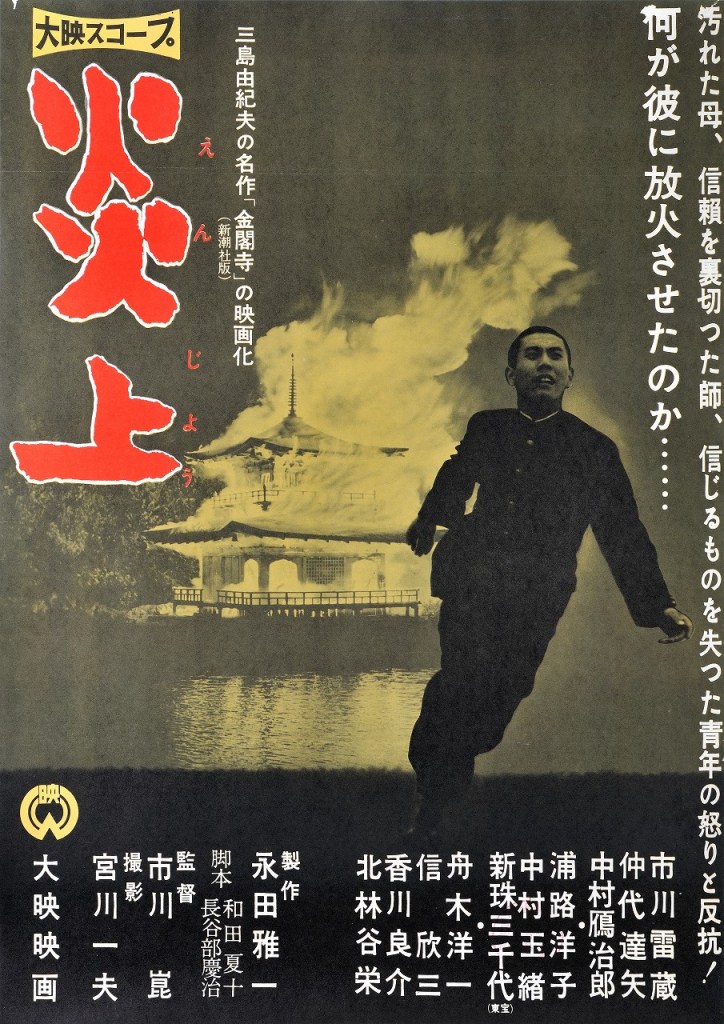
Enjo (炎上, Kon Ichikawa, 1958)

a0212807_23483150Kon Ichikawa turns his unflinching eyes to the hypocrisy of the post-war world and its tormented youth in adapting one of Yukio Mishima’s most acclaimed works, The Temple of the Golden Pavilion. Inspired by the real life burning of the Kinkaku-ji temple in 1950 by a “disturbed” monk, Enjo (炎上, AKA Conflagration / Flame of Torment) examines the spiritual and moral disintegration of a young man obsessed with beauty but shunned by society because of a disability.
The film begins near its ending as a young boy with a monk’s haircut sits in a police interrogation room. He was found passed out in the woods behind a burning temple with two knife wounds on his chest plus the knife and a packet of matches lying next to him. The police would quite like to know why he, obviously, set fire to one of Japan’s most popular historical monuments, but the boy refuses to speak.

At this point we enter a series of extended flashbacks as the boy, Goichi (Raizo Ichikawa), enters the Soen Temple after his father’s death as an apprentice to the head monk there, Tayama, who was a friend of his father’s. The assistant chief monk is unhappy about this as he’s long wanted his own son to be accepted as a novice with an eye to one day inheriting the temple as the current head monk is not married and has no son of his own. When the other monks find out that the reason Goichi rarely speaks is his stammer, they begin to doubt his suitability to become a representative of their organisation.

Having grown up in a temple, Goichi idolised his father and wants nothing other than to become a monk himself. His father also loved the golden temple, “Shukaku-ji” more than anything else in the world and so it has come to symbolise a shining pillar of purity for the young Goichi who will stop at nothing to protect it. Simply being allowed to be near it is enough for him. That the temple survived the wartime air raids and subsequent chaos is nothing short of a miracle, if not proof of the gods’ love for it.

Yet, Goichi burns it down. He destroys this thing that he loved above all else, so why did he do it? The temple is too good for the world, too pure to be permitted to exist. Simply put, we don’t deserve it. One of Goichi’s earliest attempts to protect the sacred environs of the monument sees him physically push a woman away from its doors. The woman, dressed in a very modern style, had been having an argument with a GI and though it originally looks as if Goichi may come to her rescue it’s the temple he runs for. After the woman lands flat on her back, the GI thanks him for saving them “a lot of trouble with the baby”.

After having committed an unintended sin in defending his beloved temple from being defiled by an impure woman, Goichi has the urge to confess but never quite brings himself to do it. This begins to create a rift between himself and his mentor the head priest. Though the priest had been his champion, Goichi always doubted that he really saw him as a possible successor because of his stammer and only now realises that the priest has lost faith in him because of his cowardliness in not informing him of the incident with woman outside Shukaku-ji. After this slight the priest goes on supporting Goichi but not with the same warmth as before and Goichi eventually comes to resent him.

The priest has feet of clay – though it’s not unusual for priests to marry and have families, Tayama has nominally dedicated himself to the temple only, leaving himself with a problem as to its succession. However, Goichi discovers that the priest has a mistress in one of the most popular geisha houses in Kyoto. The monks are some of the wealthiest people around thanks to pimping out Shukaku-ji as a major tourist attraction and Tayama has already forgotten himself, becoming lost in the “worldliness” necessary to manage a religious establishment which is actually a lucrative business enterprise. The temple is itself defiled, prostituted, by the very people who are supposed to be protecting it and the proceeds fed back into funding an “immoral” lifestyle for its “CEO”.

This hypocrisy adds to the injustice dealt Goichi by the uncharitable nature of the monks who also, like just about everyone else, shun him because of his stammer. Though he never stammers reading the sutras and can even speak English plainly, his lifelong stutter has left him reluctant to speak and he finds only one friend at the temple. Later he meets another bad tempered man with a lame leg and the two develop an odd bond based on their shared “deformities”. Kashiwagi (Tatsuya Nakadai) is at odds with the world and encourages Goichi further onto the course of mistaken anger born of insecurity. He urges Goichi to test Tayama’s true virtue by constantly provoking him which only leads to a further fall in Goichi’s fortunes. However, Kashiwagi is also shown up for a hypocrite who exploits other people’s reactions to his disability for his own advantage.

All of Goichi’s idols fall. His parents – his mother an adulteress and his father a sickly heartbroken monk, his mentor a lecherous hypocrite and his friend a self hating coward. The world he saw in Shukaku-ji can never exist, humans are fallible and always will be including Goichi himself who is tormented by dark thoughts. An idealistic absolutist, the existence of Shukaku-ji in this imperfect world becomes to much for him to bear.

Ichikawa tells his story in a fractured, dreamlike way full of gentle dissolves as one period segues into another without warning. Goichi’s memories become more disparate and keenly focussed at the same time as his spiritual health deteriorates. Ichikawa tries to capture some of Goichi’s inner claustrophobia through the oppressive architecture of the temple environment but can’t get close to the pervading sense of dread in Mishima’s novel. Enjo is the dissection of one man’s self immolation in the fire of his own spiritual disintegration but is also a condemnation of the corrupting modern world which enables such pollution to take place and its tale of the doomed innocence of the idealist is one which is retold throughout history.


I can’t seem to find any video clips of this film, but as a side note 炎上 is current Japanese netslang for a flamewar so I did find a bunch of other “interesting” stuff.

Here’s a short video featuring clips from several of Ichikawa’s films including Enjo which you’ll be able to spot what with the temple on fire and everything…

Red Pier (赤い波止場, Toshio Masuda, 1958)

Snapshot-2016-01-24 at 11_01_43 PM-1747507265Loosely inspired by Julian Duvivier’s 1937 gangster movie Pépé le Moko, Toshio Masuda’s Red Pier (赤い波止場, Akai Hatoba) was designed as a vehicle for Nikkatsu’s rising star of the time, Yujiro Ishihara – later to become the icon of the Sun Tribe generation. On paper it sounds like a fairly conventional plot – young turk of a gangster comes to town to off a guy, sees said guy killed in an “accident”, and shrugs it off as one of life’s little ironies only to accidentally become acquainted with and fall head over heals for the dead guy’s sister. So far, so film noir yet Masuda adds enough of his own characteristic touches to keep things interesting.
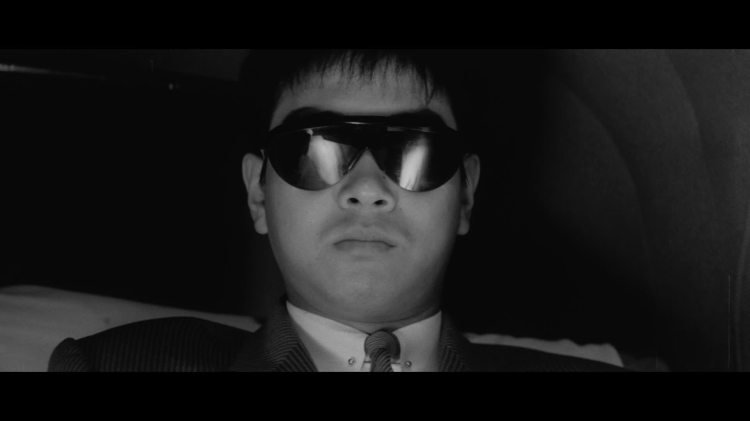
“Jiro the Lefty” (Yujiro Ishihara) is a sharp looking petty yakuza type in a bright white suit and sunglasses. Another of Japan’s post-war abandoned street kids, he found a home in a gang and has never known anything one could call a “normal” way of life. Other than his obvious talent with a gun, he has a cheerful and ironic personality that has him even almost respected by the police and is generally well liked in the area.

Early on Jiro rescues a little boy from almost being hit by a car and later when playing the harmonica for him gets hit by a thunderbolt of love when catching sight of the boy’s aunt, Keiko (Mie Kitahara). This causes him several problems at once: to begin with, she’s the sister of the guy he saw get hit by a crane and she doesn’t seem to know her brother was a gangster, two – Keiko is obviously of a much higher social class and a little out of his reach even if he managed to go straight, three – he can’t go straight, he doesn’t know how to do anything else, four – Mami, his current nightclub dancer “girlfriend” who’s invested a little more in the relationship than he has. Actually this is only the start of a long list of problems Jiro has to deal with, he just doesn’t know about them yet.

The story is set around the docks of Kobe where the living is hard and life is cheap. The local policeman is a fairly laid-back, ironic chap who’s made an odd sort of friendship with Jiro wherein he doesn’t really want to see anything too bad happen to him. He can see this thing with Keiko is not a very good idea and is constantly lurking in the shadows trying to control the situation as much as he can. Jiro, doesn’t know it yet but his own guys are out to get him too and after one of his sworn brothers ends up paying the price for Jiro’s rising profile in the yakuza world, he finds himself on the run from pretty much everyone.

This sounds like quite a complicated set up but Masuda manages to martial everything into a coherent order and even adds a hearty dose of realistic emotion too. As far as the aesthetic goes, Masuda takes his cues from American film noir with harsh lighting and canted angles all employed to show us the crookedness of this underground world but he also makes sure to add occasional touches of artistic flair such as the light bouncing off Jiro’s sunglasses during a night time cab ride or the sheer shock on Ishihara’s face as he first sees Keiko framed against the bright sunshine of Kobe’s harbour.

The too noble for his own good gangster who wants to go straight but knows he has a crooked heart – it’s an old story, but a good one. Red Pier pushes a lot of these ideas to the max but handles them well and adds a traditional “crime doesn’t pay” ending which is both endlessly sad and completely appropriate at the same time. You can’t help feel for Jiro and his small scale existential crisis in which the reluctant gangster wants to jump ship for more peaceful climes but can’t for both personal and societal reasons. Red Pier may not be the best Masuda/Ishihara collaboration but it is certainly an excellent example of everything its genre has to offer.


Red Pier is the Second film included in Arrow’s Nikkatsu Diamond Guys Vol. 1 collection.

http://www.youtube.com/watch?v=JppZs7c9AIY

Voice Without a Shadow (影なき声, Seijun Suzuki, 1958)

Snapshot-2016-01-24 at 10_45_06 PM-571365520
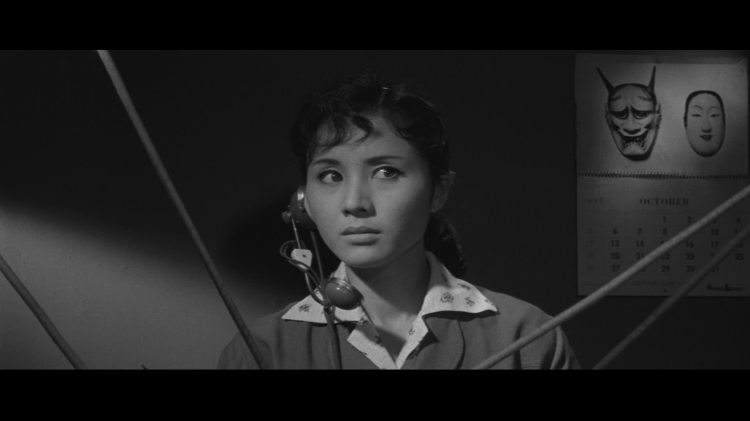
Make friends with this Oni mask – you will be seeing a lot of him throughout the film.

Seijun Suzuki might be best remembered for his surrealist pop art masterpieces from the late sixties or his even less comprehensible art films which followed his return to directing after settling his dispute with Nikkatsu, but everyone’s got to start somewhere and it comes as something of a relief to know that Suzuki was perfectly capable of making a straightforward movie if he wanted to. Voice Without a Shadow (影なき声, Kagenaki Koe) is exactly what it sounds like – a fifties style, US inspired noir however, Suzuki adds his usual flourishes and manages to wrong foot us pretty much the whole way through so that we never end up where we thought it was that we were going.

To begin with, our story is fairly straightforward. Reporter Ishikawa (Hideaki Nitani) provides our film noir style voice over as switchboard operator Asako (Yoko Minamida) accidentally dials a wrong number only have it picked up by a strange man who tells her she’s rung a crematorium then laughs hysterically. It turns out that the number was actually for a pawn shop which was in the process of being knocked over and the owner killed – Asako heard the perpetrator’s voice and thanks to her switchboard experience isn’t going to forget it. Ishikawa grows closer to Asako as the case becomes a media sensation but backs off after learning she’s already engaged.

Three years later Asako hears the voice again – a friend of her husband’s who keeps co-opting their living room for mahjong games that go on for days and cost everyone but him a lot of money. Before long Hamazaki (Jo Shishido) is found dead and Asako’s husband is the prime suspect but did he really do it? And if he didn’t, does Ishikawa really want to find out who did?

As you can see it’s a story that wouldn’t be out of place in any B movie noir from the fifties and the telephone set up is even a little reminiscent of Sorry, Wrong Number (though that film has a very different conclusion indeed). Based on a short story by Seicho Matsumoto, Voice, Voice Without a Shadow is full of the classic play of light and shadow that characterises the best film noir and the mood is ably supported by a suitably jazzy score from Hikaru Hayashi. If there’s a criticism to be made in this area, it’s that Nitani’s Ishikawa is a little too nice and pure hearted in comparison to the broken hearted heroes from the detective serials. He seems content to try and help Asako whilst uncovering the truth even if it ends up costing him in the end.

Although Asako herself is technically the leading character she quickly gets relegated to a more conventional woman in peril role. She is the one who recognises Hamazaki’s voice and the only clue linking him to the pawn shop murder three years ago but, while he’s alive anyway, Hamazaki is more interested in having fun terrorising everyone rather than trying to rub her out. In fact, the sudden demise of Hamazaki, played by an extremely young Jo Shishido, is one of the most surprising things about the film in which you’d expect him to remain the central antagonist right up until the grand finale.

Voice Without a Shadow is then a fairly conventional, noir inflected B movie which wears its Hollywood influences on its sleeve. However, there are glimpses of Suzuki’s individual style leaking through such as in his occasional and surprising use of double exposure, innovative composition and other modernist techniques which all help to lift the rather workmanlike script onto another level. In someways, it’s all a little too nice – even Hamazaki’s nasty lowlife activities are neatly skirted around almost like a film noir that’s been through a car wash though its strange pleasantness also has a nicely refreshing quality.

A minor film from the master of the surreal then, but an interesting one none the less. The mystery element proves satisfying even if it could do with a little more dirt under its fingernails and the committed performances also do their bit to enhance the mood. A prime example of its genre, Voice Without a Shadow is a notably restrained entry in Suzuki’s back catalogue but its classical style mixed with an offbeat, absurdist undercurrent make it one worth seeking out.


Voice Without a Shadow is the first film included in Arrow’s Nikkatsu Diamond Guys Vol. 1 collection.


Giants & Toys (巨人と玩具, Yasuzo Masumura, 1958)

91C6JzGDYTL._SL1500_

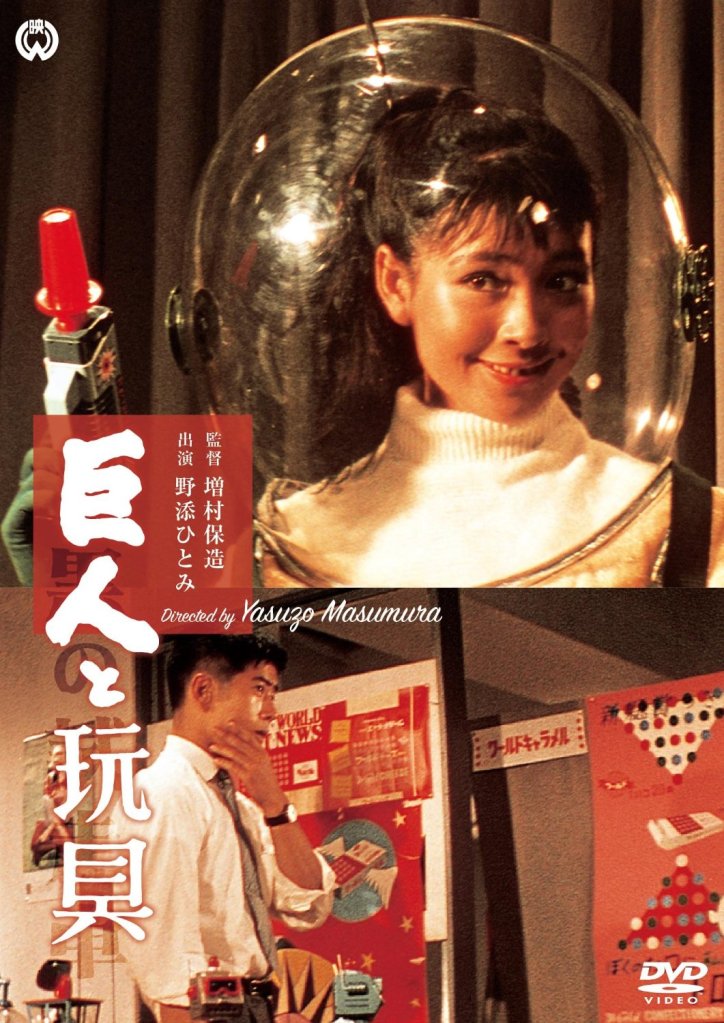
Less acerbic than Masumura’s later Black Test Car, Giants & Toys (巨人と玩具, Kyojin to gangu) is an altogether more humorous, if no less piercing look at post-war consumerism. This time the battle ground is confectionary as the Japanese sweets industry laments the all powerful American candies taking over the Japanese landscape. Three sweet companies are duking it out for the hearts of Japanese consumers and the hard working salarymen in the PR & marketing departments are becoming ever more desperate to find the key to becoming Japan’s top selling sweet maker.

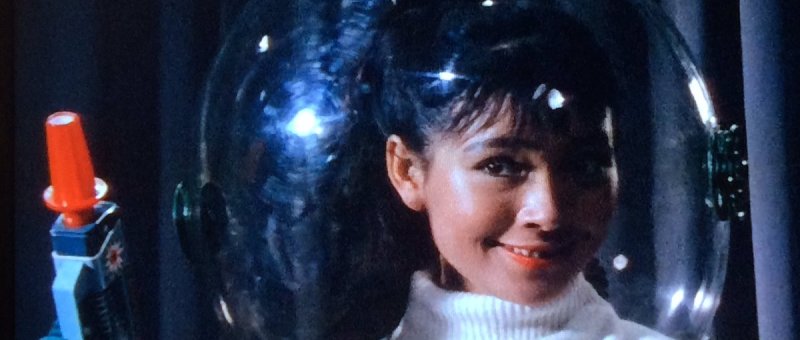
The three companies are Giant, Apollo and World, each of which is currently trying to come up with an advertising campaign which has a competition element that will really hook in the populace. Our main focus is with World whose top PR man, Goda, is currently stumped when he spots quirky hillbilly Kyoko in a bar and hatches on an idea to make her the central poster girl of his ad campaign. Kyoko is 18 with gap teeth and a childlike innocence that makes her a great fit for selling their confectionary products to the adult market. At the same time, Goda’s assistant Nishi meets an older female executive from Apollo who’s trying to shift a set of spacesuits. This fits in neatly with another of Goda’s space themed ideas and a suitably bizarre campaign is launched with the gangly Kyoko dressed up in a kitsch spacesuit and pointing a ray gun which is somehow supposed to encourage people to buy sweets. Kyoko is a hit! However, the more popular Kyoko becomes the more her innocent charms begin to dissipate. What will become of her, and of the campaign, as the competition mounts?

For an area that’s supposed to be so totally frivolous and cheerful, confectionary sales are serious business. Goda is working himself into an early grave just to sell sweets to grownups and old people. It’s advertising and marketing but like everything else in life it’s just so much spin. What they’re really trying to sell is frivolous fun and a return to childhood’s freedom all packed into a momentary suck on a salted caramel. In the Japan where “everyone works all the time” this may be quite an attractive idea, especially to the put upon members of the confectionary marketing board.

However, trivial as sweets are, they represent the fleeting unimportance of pop culture memes. During one of Kyoko’s recording sessions we meet one of the solitary female producers (labelled a “machine” by two of the other women waiting to be seen) who laments that a has been star keeps hassling her for work though her time has passed and no one’s interested. This is most likely how things will wind up for Kyoko, five minutes of being everywhere followed by a lifetime of being nowhere at all. After signing with World for their TV and radio advertising she becomes a break out personality attending events as a celebrity in her own right and later even becoming a pop star complete with a totally strange, South Pacific themed musical number referencing some kind of cannibalistic genocide where they’ll sell back the remains of the men they’ve killed to the native wives. Pointed satire in more ways than one.

Goda wants to build a kind of mass media dictatorship, cleverly controlling the public mood through all pervasive advertising (a prescient thought, if ever there was one). Having taken things too far, he’s taken to task by his underling, Nishi, who’s had a bit of a rethink following a series of heartbreaks involving friends and lovers. “I won’t sacrifice my dignity” he says, only to be shown doing just that a couple of minutes later as he himself dons the ridiculously camp space suit, takes the ray gun in hand and wanders out into the streets to be met by a series of bemused stares from the passersby. Eventually, the woman from Apollo with whom he’d been having an affair spots him and with an equally amused expression instructs him to “smile warmly”, at which point he grimaces before managing to turn it into a robotic grin.

Still oddly current, Giants & Toys is an absurdist’s guide to corporate politics where personal integrity is sacrificed on the altar of commerce. Everyone runs round in circles working hard to sell things no one really wants or needs to other hardworking people just to keep the wheel spinning. “Kanban Musume” come and go, one ridiculous meme follows another and we all just fall over ourselves to chase whichever unattainable ideal they pitch us. It would be nice to think the world has moved on since 1958, however…


Giants & Toys is available on R1 DVD with English subtitles courtesy of Fantoma.

Trailer

Pigs and Battleships / Stolen Desire – Eureka MOC Blu Ray Review


contains mild spoilers

 Pigs and Battleships, Shohei Imamura’s 1961 absurd portrait of the transformation of a small fishing port during the American occupation is a biting indictment of postwar society. Kinta (Hiroyuki Nagato), the young would be Yakuza, is excited when he is given responsibility over the gang’s latest asset – a herd of pigs, which they plan to fatten up and sell back to the Americans at an inflated price. His girlfriend, Haruko (Jitsuko Yoshimura), is unhappy about his connection to gang and constantly urges him to get a proper job. Kinta, however is unwilling to do this because he doesn’t want to end up like his father, sacked from his long time factory job after becoming ill, or be just another ordinary low age worker living hand to mouth. He seems to want to be something, someone more than that but also seems unable to do anything about it other than follow the gang. He likes the respect and the feeling of being the big man that the gang affords him but is unable to see that it’s illusionary, his status is only that of expendable fall guy in a petty gang of punks. Haruko’s family on the other hand are unhappy with her relationship with Kinta and constantly urge her to become the kept mistress of a wealthy American who’s shown an interest in her. For obvious reasons this isn’t something Haruko is very interested in doing but her mother’s quite violent instructions are becoming harder and harder to defy. Eventually Kinta agrees to go with Haruko to an uncle in another town who might be able to find them work, after he’s completed one final gang related task which he hopes will provide them with money to take with them. However, predictably things do not go to plan and the young couple’s hopes are frustrated.

There are only really two things going on in this town, the pigs and the battleships. Everyone is completely (and quite desperately) dependent on the Americans, they drive the entire town’s economy. The red light district in which the film is set is dedicated to catering for the foreigners on shore leave, and most of the women in the picture are engaging in either casual or outright prostitution, encouraged by their petty yakuza boyfriends or families. Even our heroine Haruko at one point, angry with Kinta but also with her family, decides to give this a go with disastrous results which leads to one of the most masterful shots of the film – the much praised spinning top shot which perfectly articulates the chaos and horror of that terrible situation. The entire town has become like pigs running toward a feeding trough, the final scene of the town’s women running to greet the newly arrived ship, desperate for attention and the material benefits that attention might bring. The only hope in this final scene is with Haruko finally leaving her overbearing mother, defiantly marching straight ahead through this crowd of baying women to start again in a new town, with a proper honest job away from all these corrupting influences.

Pigs and Battleships is a masterful film and in fact quite darkly humourous, highly recommended  for anyone interested in the history of Japan or Japanese Cinema. The Blu Ray release from Eureka’s Masters of Cinema series is top notch, the picture quality is mostly excellent  as is the soundtrack (the disc comes with optional English subtitles which are also very good).

Also provided is Imamura’s debut feature for Nikkatsu, Stolen Desire, the story of a middle class young man (also played by Hiroyuki Nagato) who ends up joining a traveling Kabuki (though leaning more and more towards burlesque elements) group, not so far away from the directors own youthful experiences. This is a more typical Nikkatsu B Movie, a ribald comedy with jokes about randy peasants, vain/difficult actors, misplaced love and the sort of tensions present within a traveling group  of artists who’ve hit upon slightly low times. However there are the uniquely Immamura elements that lift this above the rest, the documentary like opening for example and the genuine warmth with with he paints the earthy peasants in all their unbridled vitality. This is the first time this film has been available commercially available with English subtitles in the West and is definitely well worth seeing, its transfer, whilst not quite as strong as that of Pigs and Battleships is certainly very good. There is the odd cut or damage in the frame and the image is certainly a bit softer but it’s still an excellent transfer given the nature of the material. Both releases are accompanied by a booklet containing essays by Tony Rayns about each film which are very useful and informative. This is another fantastic release from MOC, very much deserving of a place in every collection. Fantastic.