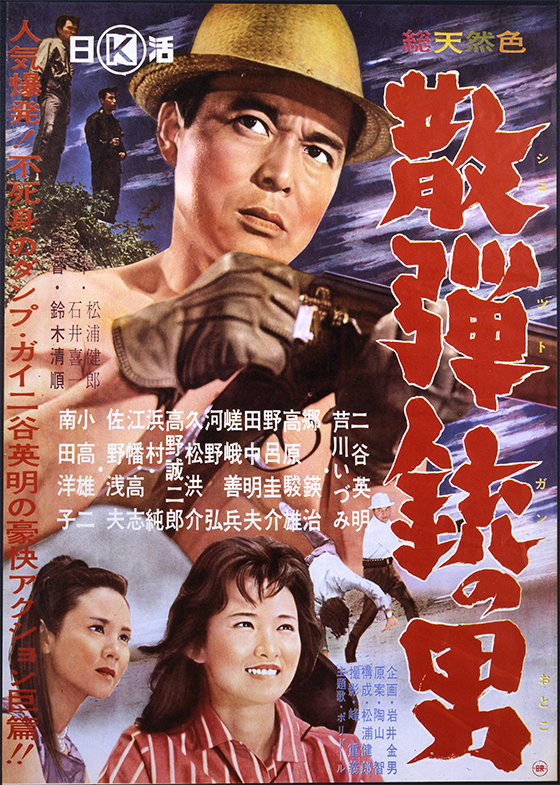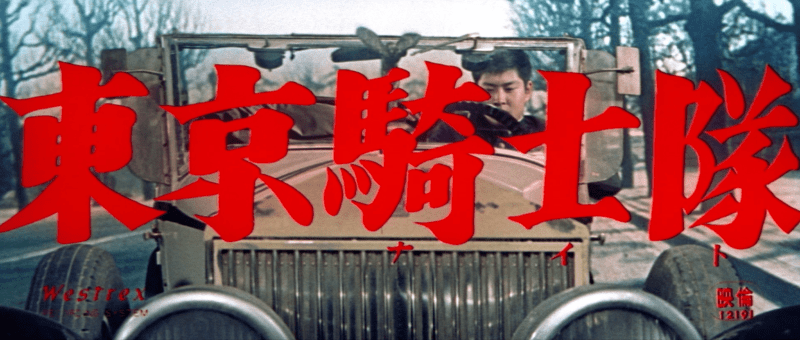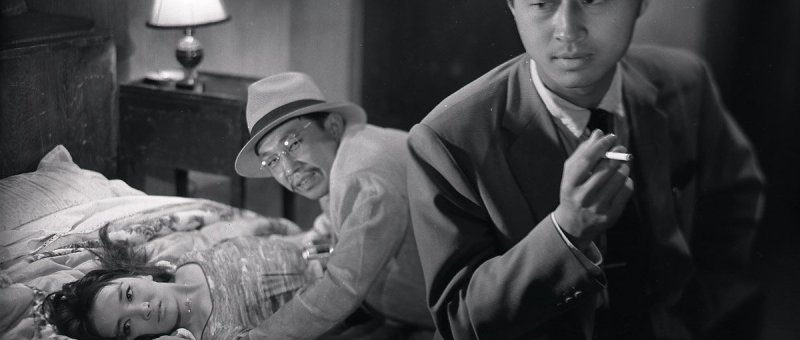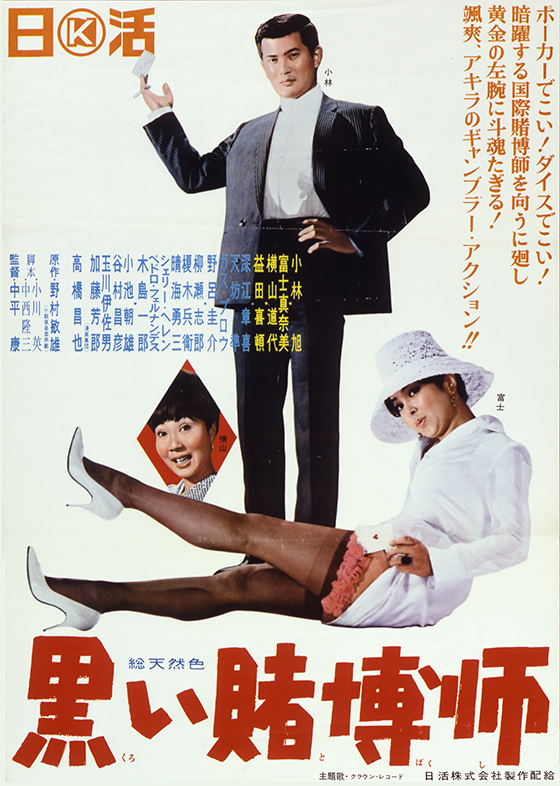
Tokyo Knights (東京騎士隊, Seijun Suzuki, 1961)

Tokyo Knights posterUnlike those from elsewhere, Japanese teen movies can often exist inside their very own bubbles in which the central characters refuse their coming of age stories and either die senselessly or simply carry on from their zany adventures as if nothing had really happened. Tokyo Knights (東京騎士隊, Tokyo Knight) definitely falls into the comedy category as its teen heartthrob hero, played by the then up and coming matinee idol Koji Wada, pulls a Hamlet in being called back from overseas studies to become CEO in waiting to his late father’s company only to suspect there’s something rotten in the state of Matsubara Construction. Quirky high school antics quickly give way to conspiracy thriller, but Koji (Koji Wada) remains steadfast and unwavering in the face of adversity as he faces off against the forces of darkness with little more than Nikkatsu spirit.

The film opens with a rather strange ceremony in which high school student Koji is instated as the new CEO of his father’s company. Koji’s dad apparently died suddenly in a freak accident meaning Koji has had to come home early from studying abroad in the US. Despite apparently being an amazing student who is good at absolutely everything and has joined all the after school clubs on offer, Koji has chosen the Catholic Elizabeth Academy because it’s well known as a coasting school where you can graduate with average grades. Fairly low attainment goals might be just as well because Koji is about to have his hands full with another mission. He’s convinced his dad’s death wasn’t an “accident” and he suspects his deputy, Mishima (Nobuo Kaneko), who is also getting close to his mum, might know more about it than he’s letting on.

In the grand tradition of heroes in Japanese teen drama, Koji has just found himself at the centre of a huge and dark conspiracy involving dodgy yakuza construction deals, blackmail, and murder. He does not lose heart or look to the grown ups for help but decides to handle the problem himself, settling back into the Hamlet-esque role he’s been assigned in neatly setting traps for the treacherous Mishima only doing it with a little more cosmopolitan flair carried back from abroad. Swapping roles like one of his much loved Noh costumes, he then becomes a kind of Romeo to the high school darling Yuriko (Mayumi Shimizu) whose dad, unbeknownst to her, turns out to be a horrible gangster who might be involved in the nefarious plan to take over the family firm. Enjoying a minor romance with the melancholy Yuriko, Koji considers the best way to get revenge and expose evil while protecting his mother, surrogate little sister figure, and his newfound love (?) Yuriko who will undoubtedly suffer now that she knows what kind of man her father really is.

Suzuki apparently incited the wrath of studio bosses when he took a serious crime script and turned it into an anarchic teen comedy but then you have to wonder what they thought it was he would do with it. The impossibly cool Koji is certainly an unrealistic hero, presented unironically he’d be sure to irritate – guys like Koji are, after all, more usually the antagonist set up to make our imperfect everyman feel inferior while he progresses towards some kind of self actualisation as a result of the standard narrative. Koji is, however, heroic and easily likeable as he assumes complete control, handling every situation with practiced ease and remembering to remain kind and just while he does so. He even stops to listen to his mother’s problems, sympathising with her when she reveals her unhappiness with his father, and urging her to grasp happiness wherever she sees it without worrying whatever he or anyone else might think.

Perhaps because of the relative simplicity of the plot, and the opportunity to shoot in colour, Suzuki flexes his muscles a little more than usual in adding in a fair few post-modern techniques including on screen graphics such as a series of large question marks zooming out of the major players Koji suspects may be involved in his father’s death and making a joke out of the need to include the songs of the day with frequent cuts to a teen cabaret club. For all of the tale’s darkness and almost Shakespearean overtones, Suzuki keeps his tongue firmly in cheek with a cartoonish sense of fun and lightness, allowing our heroes to emerge from their ordeal fairly unscathed while honour and justice are preserved. Who knew Catholic school could be so much fun?


Available as part of Arrow’s Seijun Suzuki: The Early Years Vol. 2 Border Crossings box set.

Original trailer (English subtitles)

Smashing the 0-Line (密航0ライン, Seijun Suzuki, 1960)

(C) Nikkatsu 1960

(C) Nikkatsu 1960Looking from the outside in, the Tokyo of 1960 seems to have been one of rising economic prosperity in which post-war anxiety was beginning to transition into a relentless surge towards modernity, but there also seems to have been a mild preoccupation with the various dangers that same modernity might present. Like The Sleeping Beast Within released just two months previously, Smashing the 0-Line (密航0ライン, Mikko Zero Line) centres on a mystery which leads straight back to Hong Kong and a dangerous, international smuggling ring – this time involving both drugs and people. Our heroes are both reporters, but at odds with each other despite being old friends in having diametrically opposed notions of professional ethics.
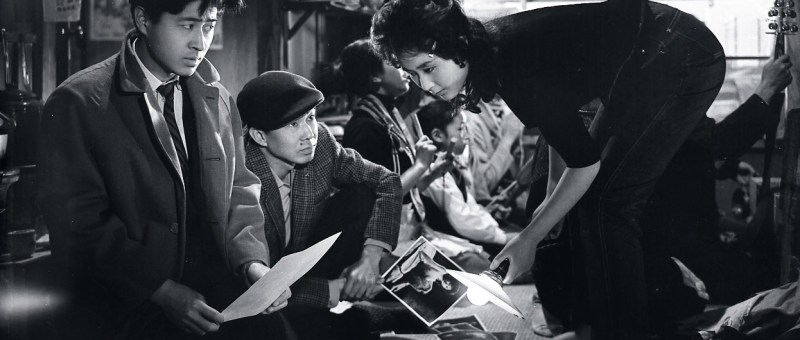
Katori (Hiroyuki Nagato), our anti-hero, is a man so desperate to get a scoop that he thinks little of engineering one. Thus we witness him making passionate love to a woman one minute before turning her into the police the next. The woman, Reiko (Sanae Nakahara), is also the little sister of one of his oldest friends, Saiko (Ryohei Uchida), whom he also decides to turn into the police in service of his story. Another old friend, Nishina (Yuji Kodaka), has also become a reporter but for a more respectable paper and is dating Katori’s little sister, Sumiko (Mayumi Shimizu), who is now the announcer at the local baseball stadium. Katori’s decision to turn on Reiko will have profoundly negative consequences for her former lover who is prepared to sacrifice all in pursuit of his goal.

Three men, once college friends, have chosen three radically different paths in the post-war world. Saiko has become a gangster while Katori has become an unscrupulous yet apparently publicly minded newshound and Nishina a pure hearted journalist who insists on doing everything by the book and abiding by conventional journalistic ethics. Yet despite himself, or possibly because of his love for Sumiko, Nishina tries to help Katori see the dangers of his extremely dangerous pattern of behaviour in which he has been content to use people like things to get what he wants.

Katori claims to be on the same side as Nishina – he thinks something is going sour in the city and that only he can stop it by exposing the various conspiracies in play. Katori’s chief fear is that Tokyo will become “another Hong Kong” – a crime ridden state of drug addled lawlessness (an extremely biased and seemingly inaccurate view of ‘60s Hong Kong but one that speaks of a certain fear of Japan’s new spot on the global scene). This particular conspiracy does indeed ping back to Hong Kong and the illegal traffic of drugs but also people heading in both directions. In the Japan of 1960, it was near impossible to get a passport and so smuggling yourself out might be the only way if you really need to get to Hong Kong which means you’ll need to pay a people trafficker to do it.

Katori, broadly, seems to think people trafficking is a bad thing he doesn’t want in Japan but is entirely blind to the same ways he himself uses people in pursuit of his goals. Not only does he bed Reiko (his friend’s little sister) only to make a speedy exit minutes before the police arrive, but he also palms off another mark on his informant only to turn them both in in hope of greater gain. He even manages to find time to seduce a doctor at the centre of the scandal who tries to pull a gun on him but later surrenders completely, only to fall victim to some proactive tidying up from the bad guys. Not content with sacrificing former lovers, Katori will not give in even for his sister, refusing to give up on his lead even when Sumiko is threatened with gang rape. When Nishina turns up and saves the day, Katori doesn’t even stop to ask how Sumiko is but walks off in the direction of the story with nary a second glance to his unconscious sister.

Yet Katori’s particular brand of nihilistic heroism consistently fails. His scoops are uninteresting and he only gets them by inserting himself into the story. Nishina, steadfast and honest – he even goes to the trouble of getting a proper passport to hide on his person in case he’s caught pretending to be a stowaway, is the one who gets there in the end, breaking the smuggling ring, rescuing Katori after he gets himself in trouble, and generally always being around to save the day. Mildly ironic themes of xenophobia aside, Smashing the 0-Line is a typically frenetic piece from Suzuki which offers only a few instances of unusual experimentation in his use of freeze frames and onscreen text but packs in plenty of punch in its amoral anti-hero and the dogged investigative reporter trailing along behind.


Available as part of Arrow’s Seijun Suzuki: The Early Years Vol. 2 Border Crossings box set (also features incisive audio commentary from Jasper Sharp providing a wealth of background information not just about Suzuki’s career but the state of the Japanese film industry at the time)

The Sleeping Beast Within (けものの眠り, Seijun Suzuki, 1960)

Sleeping Beast Within posterTo those of a “traditional” mindset, a woman’s career is her home and she never gets to retire. Men, by this same logic, are killed off at 60 and reborn into a second childhood where they get to indulge their love of fly fishing or suddenly discover an untapped talent for haiku. Seeing as a man often lives at the office, being excommunicated from his corporate family can seem like a heavy penalty for those who’ve devoted their entire existence to the salaryman ideal. So it is for the old timer at the centre of Seijun Suzuki’s 1960 mystery thriller, The Sleeping Beast Within (けものの眠り, Kemono no Nemuri) in which the sudden disappearance of a model employee sparks his daughter and her dogged reporter boyfriend to investigate, unwittingly discovering a vast drug smuggling conspiracy headed by a dodgy cult leader.

Veteran salaryman Junpei Ueki (Shinsuke Ashida) has been working in Hong Kong for two years and is finally coming home, to retire. His family have come to meet him but, as his daughter’s reporter boyfriend Kasai (Hiroyuki Nagato) points out, no one much else has turned up – so it is for those who don’t play office politics, claims one of the few colleagues who has arrived to greet the recently returned businessman. Ueki isn’t very happy about his retirement and believes he’ll be getting a part-time job at the same company only to be informed position has been “withdrawn”. When he doesn’t come home after his retirement party, something surely out of character for such a straight shooting family man, his wife and daughter become worried. Keiko (Kazuko Yoshiyuki) enlists Kasai to help figure out what’s happened to her dad only for him to suddenly turn up with a bad excuse and an almost total personality transplant. Kasai keeps digging, and the reporter in him loves what he finds even if the nice boyfriend wishes he didn’t.

Suzuki sets up what a good guy Ueki is when he brings back a modest ring for Keiko only for her to mockingly ask if her dad couldn’t have brought something a bit flashier. Ueki points out that the customs people might not have liked that so she jokes that he should have just smuggled it in like everyone else. Kasai reminds her that her dad’s not that kind of man, but two years in Hong Kong have apparently changed him. Having spent two years away from his family and 30 years slaving away at a boring desk job, Ueki feels he’s owed something more than an unceremonious kiss off and a little more time for gardening. The reason he ended up entering the world of crime wasn’t the money, or that he was blackmailed – it started because of his sense of integrity. He felt he owed someone and he did them a favour. It went wrong and he ended up here. His decision to join the gang came after he tried to “pay back” the money for some missing drugs only to realise that his entire retirement plan was worth only a tiny fraction of his new debt. Ueki felt small and stupid, like a man who’d wasted his life playing the mugs game. He wanted some payback, but his life as criminal mastermind turned out not to be much of a success either.

Trying to explain her father’s actions to the wounded Keiko, Kasai explains that everyone has a sleeping beast in their heart which is capable doing terrible things when it awakens. Ueki’s sleeping beast was woken by his resentment and sense of betrayal in being so cruelly cast aside by the system to which he’d devoted his life while the guys who broke all the rules – drug dealers, gangsters, and corrupt businessmen, lived the high life. One could almost argue that a sleeping beast is stirring in Kasai’s heart as he pushes his investigation to the limit, occasionally forgetting about the harm it will do to Keiko even whilst acknowledging the greater good of breaking the smuggling ring once and for all. Keiko too finds herself torn, confused and heartbroken by the change in her father’s personality though her mother feels quite differently.  Claiming that “a woman has no say in her husband’s work”, Keiko’s mum tells her daughter that a wife’s duty is to do as her husband says and avoid asking questions. Keiko has asked a lot of questions already and shows no signs of stopping now, even once she realises she won’t like the answers.

Despite the grimness of the underlying tenet that it doesn’t take much for honest men to abandon their sense of morality, Suzuki maintains his trademark wryness as Kasai and Keiko go about their investigation like a pair of pesky kids chasing a cartoon villain. Though the tale is straightforward enough, he does throw in a decent amount of experimentation with two innovative flashback sequences in which the flashback itself is presented as a superimposition with the person narrating it hovering at edges as if referring to a slide. The beast is quelled with a shot to the heart, but not before it wreaks havoc on the lives of ordinary people – not least Ueki himself who is forced to confront what it is he’s become and who he was prepared to sacrifice to feed the hungry demon inside him.


Available as part of Arrow’s Seijun Suzuki: The Early Years Vol. 2 Border Crossings box set.

The DMZ (비무장지대 / 非武裝地帶, Park Sang-ho, 1965)

DMZ 1965 posterTalking about the “reunification” of Korea could be a risky business in the increasingly censorious 1960s. Directors had been jailed for less, and the anti-Communism drama was fast becoming a staple genre in the rapidly expanding film industry. Director Park Sang-ho had been at the forefront of Korea’s burgeoning International cinematic success when his 1963 film A Happy Businesswoman had been selected for the Tokyo film festival. Whilst there to present the film (which picked up a best actress award for Do Keum-bong), Park was met with consternation by foreign delegates who assumed he was Japanese and could show them around Tokyo. On learning he was Korean all they wanted to know about was the Demilitarised Zone and the village that was trapped inside it – Panmunjeom. Park had no answers for them. He’d never been to Panmunjeom and knew nothing about it, but he was surprised and concerned that an obscure little village and an ongoing political dispute had come to dominate the thinking surrounding his country with Panmunjeom emerging as a grim tourist destination for those interested in experiencing the “thrill” of life in a dormant war zone.

On return to Korea he knew he had to make a film about the DMZ, but the subject was a difficult, perhaps taboo one which had to be approached carefully. Park’s first cut which was released in theatres ran to 90 minutes and conformed more obviously to the standard commercial cinema of the time. In a radical move, the director then decided to re-edit it with the intention of submitting to foreign film festivals. Cutting most of the scenes with well known actors, Park retained only the stock footage which bookends the film (apparently enough to qualify the remainder as a “documentary” rather than narrative feature), and the central drama focussing on two small children desperately wandering the ruined landscape alone in search of their mothers.

The younger of the two, Yong-ha (Ju Min-a) – a five year old girl, falls into a lake and is rescued by an 8-year-old boy (Lee Yeong-gwan) she originally mistakes for a grown man because of the ragged military uniform and soldier’s helmet he is wearing. The unnamed little boy tells Yong-ha he had a little sister with her name, and there are enough coincidences in their back stories to make one wonder if they really might be related, but in any case the boy “becomes” Yong-ha’s big brother and agrees to protect her while they each look for their long lost mothers.

As the pair are only children, they do not really know that they’re in the “DMZ” or what the DMZ is, they only know they are alone and surrounded by danger. Skeletons and decomposing bodies are a frequent sight, as are abandoned tanks, overturned trucks, broken trains, and rusty equipment. There are no other people, and nature has begun to reclaim the land – wild dogs and foxes are potential perils, while Yong-ha later finds herself separated from her brother after chasing a cute rabbit into a woodland grove and then being unable to find her way back.

The allegory becomes clearer as the children engage in absurd games exposing the arbitrary and destructive nature of the division itself. Walking up to the line, the boy gleefully jumps over to show Yong-ha how meaningless it is. Yong-ha, enjoying the game, thinks “division” seems fun and they should try it out for themselves. Her brother agrees, marking his territory and then insisting that they turn their backs on each other and refuse to speak. He keeps this up for quite a while until Yong-ha becomes distressed, at which point he jumps up and smashes the makeshift division marker to pieces so he can once again embrace his sister.

Nevertheless the anticommunist sentiments are present in the form of a cruel and callous North Korean spy who tries to kidnap the children and take them away with him. To add to the spirit of adventure, the boy sings a nationalist song which honours those who have given their lives to “liberate” the country from “oppression”, while a propaganda broadcast tries to do something similar whilst the children are playing division by offering a message of solidarity to those in the North who might like to come South. Dangerous as the situation is, the children’s innocent naivety eventually leads to a small diplomatic incident when they unwittingly pick up a landmine to use as a firestone but are frightened away by the approach of soldiers just before it explodes, leading both sides to claim the act as one of provocation by the other.

Park takes the dangerous step of shooting directly within the real DMZ with all of its eeriness as a place abandoned by humanity and filled with man made dangers. The children attempt to survive in it alone – foraging for food, using the wood from crosses put up as grave markers to start fires, and looking after each other in the absence of adults. They play when they can, swimming, pretending to commandeer tanks and steal trains, pilfering left behind supplies and always talking about their families and how best to find them. The theatrical version, as was expected at the time, apparently has a more positive ending but Park refuses to soft-pedal the disproportionate suffering experienced by children in time of war, even whilst adding a pointed statement to the end advancing the cause of Korean brotherhood and calling for an end to the unfair and arbitrary separation of a people which feels itself to be of one blood. Unusual for the time but ending on a note of hope (if however bleak), DMZ is part anti-communist propaganda, part unification treatise, and most of all the story of two unlucky orphans created by a war and a diplomatic stalemate who find themselves alone in no-man’s land with no safe refuge in sight.


The DMZ (비무장지대 / 非武裝地帶, Bi-mu-jang Ji-dae) is available on DVD with English subtitles courtesy of the Korean Film Archive. The set also includes an English subtitled documentary about the career of director Park Sang-ho as well as a 32-page bilingual booklet. Not currently available to stream online.

A Thousand & One Nights (千夜一夜物語, Eiichi Yamamoto, 1969)

one thousand and one nights poster 2The “Godfather of Manga” Osamu Tezuka had been a pioneer of what later became the mainstream of a burgeoning industry, kickstarting TV anime in the process with the long running Astro Boy. His ambitions, however, increasingly ran towards the avant-garde and he feared that the heavy association between his production company, Mushi Pro, and genial kids’ cartoons would only lead to diminishing artistic returns even if the increasing merchandising opportunities would perhaps allow the studio to engage in other less profitable areas such the adult-orientated anime he longed to produce. By the late ‘60s, Tezuka’s polite, inoffensive brand of child-friendly adventure stories were becoming distinctly old hat while the “gekiga” movement, acting more or less in direct opposition, continued to gain ground with older readers keen to move on to more adult fare. The Animerama series was intended to prove that Tezuka still had something new and dynamic to bring to the table and that there was a market for “racy” animation which embraced mature themes and experimental artwork.

The first of the Animerama films, A Thousand & One Nights (千夜一夜物語, Senya Ichiya Monogatari), is, as the title implies, loosely inspired by classic Arabian folktales as its hero “Aldin” (Yukio Aoshima) finds and then loses true love, overcomes the urge for vengeance, is himself corrupted by wealth and power, and then is returned to the very same state in which we first encountered him walking off into the sunset in preparation for the next adventure.

The tale begins with a slave auction at which the lowly water seller Aldin first catches sight of the beautiful Milliam (Kyoko Kishida). He tries to buy her but is too poor while the son of the local police chief (Asao Koike) outbids all to win the prize. However, in the first of many strokes of luck that will befall Aldin, a sandstorm allows him steal away with Milliam who falls in love with him too and gives herself willingly to a man she sees as an equal rather than a master. Sadly, their true love story is short lived and they are soon separated sending Aldin off on a quest to return to his beloved that will only end in tragedy.

Despite the later protestations that the love of Aldin and Milliam is one of equals in which there are no masters or slaves, only a man and a woman, it remains true that Aldin watched the slave auction with a degree of titillation and would have bought Milliam had he only been able to afford her. Surviving on his wits, Aldin is a cheeky chancer waiting for that big lucky break he is sure is waiting somewhere round the corner but he is not, perhaps, above becoming that which oppresses him. Later, having become a wealthy and powerful man, he uses his wealth and his power in the same way that others use theirs against him in pressuring a vulnerable young girl to become his mistress against her will, ripping her away from her own true love in the same way he was once ripped away from Milliam by another man wearing a crown. As a “king” he wonders what “power” is, pushing his as far as it will go in order to find out and risking “losing himself” in a way he’d once thought he’d overcome in rejecting a pointless act of vengeance that would forever have changed him.

Milliam, and later Jallis – the daughter of Aldin and Milliam raised by their worst enemy, Badli (Hiroshi Akutagawa), fight for the right to decide their own romantic destiny. Like Madlia (Sachiko Ito), the feisty bandit’s daughter, they resist the social codes of their era in which women are merely prizes divided among men and actively attempt to free themselves through love only to find defeat and despair. Yet love, or more precisely lust, can also be a force of constraint and or ruin as Aldin discovers on a paradise island when he unwisely decides to abandon Madlia, who has also fallen in love with him, for the empty pleasures of orgiastic sex with the voracious islanders whose unrestrained desire soon threatens to consume him whole.

A picaresque adventure, A Thousand & One Nights is a bawdy, flippant retelling of the Aladdin myth in which the hero begins as a poor yet free and cheerful young man before experiencing what it is to be wealthy and all powerful and discovering that it only makes him mean and miserable. Shifting from model shots to live photography and abstract to cartoonish animation, Yamamoto’s direction may appear restrained in comparison to the more outlandish and surreal Belladonna of Sadness but is a masterclass in finding artistry through budgetary limitations. A psychedelic odyssey through freedom and constraint, desire and obsession, A Thousand & One Nights is a forgotten landmark of experimental animation as relentlessly strange as it is endearing.


Available on blu-ray from Third Window Films as a part of double release with Eiichi Yamamoto & Osamu Tezuka’s Cleopatra.

Original trailer (English subtitles, NSFW)

The Devil’s Stairway (마의 계단 / 魔의 階段, Lee Man-hee, 1964)

devils-staircase-poster.jpg

By 1964, Korea’s economic situation was beginning to improve and for many there seemed to be a bright light shining in the distance, a fixed point to which they could aspire and felt was in their grasp if they could only catch a lucky break. Throughout Lee Man-hee’s relatively short career (the director sadly passed away at the young age of only 45 – apparently a casualty of his fondness for drink and intensive work habit which accounts for his high output), his protagonists struggle with a conflict between the desire for the new kind of “success” their society promises them, and a feeling that they can never truly obtain it. Ambitious surgeon Dr. Hyeon (Kim Jin-kyu) attempts to climb The Devil’s Stairway (마의 계단 / 魔의 階段, Maui Gyedan, AKA The Evil Stairs) by abandoning the compassion that ought to define his profession for coldhearted pragmatism but discovers that the path has its price while his victims are not quite so passive as he’d assumed them to be.

When we first meet Dr. Hyeon he’s lounging around in bed while his female companion, Nurse Nam (Moon Jeong-suk), dresses and prepares to leave. Somewhat coldly, Hyeon tells her to exit via the back stairs and avoid being seen by the security guard on her way. Irritated, Nam leaves and the pair go back to work at the hospital the next morning pretending there’s nothing more between them than the relationship between a nurse and a chief surgeon. This situation might have continued indefinitely were it not for the fact that Jeong-ja (Bang Sung-ja), the daughter of the hospital’s head doctor, has taken a liking to Hyeon and seeing as her father has no sons to take over when he retires, an arranged marriage is in the offing. Dr. Hyeon, who is ambitious and emotionally cold, considers accepting the offer but Nurse Nam is unwilling to let him go, especially as she is pregnant with his child. When she threatens to spill the beans about their illicit relationship, he decides to kill her by dosing her up with sedatives and throwing her body in the pool behind the hospital to make it look like she drowned herself in heartbreak and shame, but Nurse Nam refuses to go quietly.

The titular “Devil’s Stairway” is a literal staircase from the hospital floor to the head doctor’s office. There has recently been accident in which the bannister was broken and a woman was killed. The banister is repeatedly mended throughout the film but represents a point of fracture in the spiritual path to success. Nurse Nam is another early casualty when she and Hyeon argue in the middle of the stairs and the recently mended bannister breaks as he struggles with her. Despite the minimal drop to the floor, Nam is left with serious injuries requiring surgery, loses her baby, and gains a conviction that Hyeon bears her ill will. Her position is extremely difficult – the accident has exposed the fact that she had conceived a child outside of wedlock and though she has not yet disclosed the name of the father, Hyeon fears that she will destroy his bright future either by speaking out or through forcing him to marry her to avoid social disgrace.

Hyeon gives in to darker instincts. He tells Nam that his heart is hers, perhaps intending to carry on an arrangement even after he’s decided to accept the marriage proposal, but excuses himself for stringing her along by reminding her of his lack of financial stability and comparatively low social status. We are reminded later that he is old be unmarried and, even stranger, is assumed to be a “virgin” – a solitary, perhaps dull, bachelor not known for mixing with women. This again signals his coldhearted ambition – he waits and he calculates. He wants a hospital of his own and knows his only way to get one is to marry into it, and so he does even if it means sacrificing “love” and emotional happiness for the cold comforts of conventional success and the false acclamation of social status.

Hyeon thinks he’s got away with it, but his crime haunts him. Going slowly out of his mind, Hyeon sees Nam everywhere, placing a strain on his relationship with his new wife who grows wary of his increasing violence and bad temper. His madness culminates in a tense surgery scene in which everyone around him has Nam’s face and he finds himself surrounded by his crime, forced to confess himself as a murderer in order to free himself of her ghost. Yet, things are not quite as they seem and it is not he alone who finds his grand plan floundering.

Hyeon posits his poverty as a reason for his crime, but it’s his greed which guides him towards the Devil’s Stairway. He could have married Nam, had his child, and led an ordinary middle-class life of relative comfort perhaps even opening his own clinic in good time, but he chose the quick fix in marrying for money and (literally) throwing over the woman he claimed to love to ease his feelings of insecurity and resentment at his position in the social order. His murder is cowardly but, as Nam points out, the law may protect him while there are precious few looking out for her, a betrayed woman, pregnant outside of marriage, and without a family to press her case.

As he did in the same year’s Black Hair, Lee co-opts the murkiness of the film noir, sending its sense of betrayed morality into the realms of the gothic with an ever increasing atmosphere of supernatural dread. The pond seems to emanate evil while the stairs beckon ominously, the wind rattles the doors open without warning and the rain pours down outside adding to the claustrophobic gloom of the creepy old hospital as if attempting to embody the evil that lies at its centre. Drawing heavily from Les Diaboliques, Lee declares no winners in his tale of fractured morality and emotional betrayal, painting it as a symptom of a confused era in which all emerge tarnished from a struggle to gain some kind of personal agency in an otherwise oppressive environment. Taut to the last, The Devil’s Stairway is a forgotten masterpiece of psychological horror and a mild condemnation of a society’s slide into national paranoia and greedy consumerism at the cost of true human feeling.


Available to stream online via the Korean Film Archive’s YouTube Channel.

The Descendants of Cain (카인의 후예 / 카인의 後裔, Yu Hyun-mok, 1968)

Descendents of Cain poster 1Yu Hyun-mok, often regarded as among the more “intellectual” of film directors in Korea’s Golden Age, is also among those to have been arrested for violation of the Anti-Communist laws. Yu was later exonerated and went back to filmmaking as before but it remains true that Yu betrays a little more ambivalence to the anti-communist message so often required than many of his colleagues. That is to say, Yu often leans economically left in his frequent criticism of social inequality and his anti-consumerist stance, but remains socially conservative if with a strong desire for social justice. The Descendants of Cain (카인의 후예 / 카인의 後裔, Kainui Huyea), adapted from a novel by Hwang Sun-won, is as anti-communist as they come, but also offers its share of ironies in painting “communism” as a kind of disease born of greed and self-interest which thrives on fear and eventually consumes those who are seduced by its false promises.

Irony is indeed our starting point as our cheerful villagers enjoy a raucous celebration in honour of Independence Day only for the communists to suddenly turn up and spoil the party. Worst of all, one of the communists is a long lost son of the village – Choe is the absentee husband of Ojaknyeo (Moon Hee), a maid, who has developed an affection for her boss, the nephew of the local landlord, Park Hun (Kim Jin-kyu). The communists’ first action is to close down the school that Park Hun opened to provide education for the peasants and co-opt it as their base. Park knows he’s in a dangerous position and has little power to resist, opting to wait it out and see how far the communists really intend to go. The peasants, however, are becoming excited hearing about the land redistribution programme and are starting to forget everything that Park and his family have done for them over the generations, swayed by the false promises of the communists who preach equality while insisting on deference.

The central conflict is, in many ways, between the feudal past and the “democratic” future. Set in what would shortly the “the north” in 1946, Descendants of Cain positions itself on more than one kind of dividing line with the lingering spectre of tragedy always on the horizon. High on a ridge there’s a large stone slab erected as a memorial to the late Park, Park Hun’s grandfather, whose solicitous care for the villagers had earned their eternal respect and perhaps their love. The Parks are “good” landlords. They take their “feudal” responsibilities seriously as evidenced by Park Hun’s school and his father’s desire to finish construction on the local reservoir which is both his legacy and an important failsafe precaution against draught which is in the interests of all. By all appearances this is a well functioning village where no one is hungry or alone. The peasants have not felt “oppressed” or been unhappy, which is not to say they don’t want to better their lot but they have no burning desire for revolution and have nothing in particular to rebel against.

This leaves the communists with a problem – they have little leverage over happy peasantry which has never acknowledged its own oppression let alone longed for freedom from it. Their approach is therefore one of divide and conquer. Cynical in the extreme, the communists set about exploiting petty village disputes to foster discord between people – something which eventually contributes to a murder which they also manipulate for political gain. The “landowners” are of course a prime target, but their judgement must be at the hands of “the people” by means of a farmers’ trial. Having recruited something close to a former village leader, the communists assume they will have the villagers on side but they all (bar two) refuse to indict the Parks. The communist leader, fond of irony, gestures towards towards his armed men and reminds the villagers that no one here is “impinging on their freedom”. That is, their freedom to express the views they are required to express or suffer the consequences.

Threatened with violence and intimidation, feudal deference bends or perhaps shifts to a different master. The villagers, losing their attachment to the Parks, salivate over the possibility of “redistribution” and of being handed “free land”. Their desires are material and not political. Thus when the Parks’ estate is “returned” to the people, they simply walk in and start taking things. Not the most sensible way to redistribute wealth concentrated in the hands of the elite – the fast get horses, the indecisive dented pans which sounds like a recipe for rancour and discontent. When the old village chief becomes disillusioned with his choices and smashes the memorial to old Park, a small fight breaks out among villagers keen to snag the large pieces of stone for various other projects. Happy peasants who once shared everything and wanted for nothing, are now fighting with each other over rubble and trinkets.

The communists, far from fostering collective spirit, have become the evil feudal lords they rail against, oppressing the peasants with their rules and regulations while wilfully creating an atmosphere of fear in order to better oppress them. Their hypocrisy is rammed home early on by the slimy Cheol who complains about his wife’s supposed faithlessness while molesting a barmaid and smugly repeating the story of a large scar he has on his forearm. His superior, believing he got the scar during a labour dispute at a mine, promoted him for his communist spirit, but Cheol really got the scar in a scuffle over a girl (not his wife, incidentally).

Cheol is “a” force which comes between the two lovers, Ojaknyeo and Park Hun, as both are too morally upright to pursue a full romance when Ojaknyeo is still married to another man, even if the other man’s first action on seeing her is to throw her to the ground and begin kicking the living daylights out of her. Later Ojaknyeo gets another, more serious, beating from her father but this time because she’s chosen the wrong side in refusing to step away from the feudal world in her responsibility to Park Hun and his household, even if that responsibility is partly romantic desire. Yet Park Hun and Ojaknyeo are also separated by the feudal world’s rules in their obvious class difference. Communism is supposed to break down these barriers, not to mention removing the “patriarchal tyranny” of marriage, yet the communists would rather award Ojaknyeo to her former husband, little caring that he is abusive and neglectful. Ojaknyeo, at least, will not be freed from her oppression any time soon.

If Yu is making a mild defence of paternalistic feudalism as a metaphor for compassionate government, it is probably a little ambitious given the times in which he lived. Following a regular pattern, Yu paints the world as a terrible place where fear and self interest trump all, only to find small rays of light in the closing moments when an act of violence provokes a series of unexpected epiphanies and reconciliations. He ends on a note of hope in which an older man sacrifices himself for a younger one but is then rewarded with the possibility of salvation and a happier future with the woman he loves (and is now unafraid to pursue) south of the border. Communism seduces and betrays, whereas liberal democracy at least affords the “freedom” to be miserable with personal integrity.


Screened as part of the Korean Novels on Screen season at the Korean Cultural Centre London.

Three Resurrected Drunkards (帰って来たヨッパライ, Nagisa Oshima, 1968)

Three Resurrected Drunkards posterThe pop star movie has a long and distinguished history in Japanese cinema, but one might not have expected it to include Nagisa Oshima – a legendary iconoclast and conscientious objector to this particular strain of pop culture frivolity. Then again, taking a much hated form and turning it in on itself as a multifaceted form of protest is exactly the sort of thing one might expect Oshima to do. Therefore we find him in 1968 teaming up with The Folk Crusaders – a folk rock band enjoying a sudden flash of popularity after pressing their own indie record and seeing it go gold when radio stations picked up their North Korean themed Imujingawa and turned it into a giant hit. The band’s best known hit remains Kanashikute Yarikirenai which was released the same year, but it was perhaps Imujingawa with its melancholy Korean theme which attracted Oshima’s attention. A Monkees-esque surreal pop-star vehicle, Three Resurrected Drunkards (帰って来たヨッパライ, Kaette Kita Yopparai) is the third and most direct (strangely) in a series of films critiquing Japan-Korea relations, pushing further into the contemporary era with additional questions to ask about American imperialism and the complicity of both nations in the ongoing conflict in Vietnam.

Three students, played by the three members of The Folk Crusaders, frolic on a beach recreating the famous Vietnam war photo of General Nguyen Ngoc Loan executing a prisoner in the street, before stripping off to go swimming. While they’re enjoying the waters, a hand rises up from beneath the sand and exchanges their clothes for a set of Korean military uniforms and some cash. The boys put on the strangers’ clothes and try to go home, but run into trouble when they try to scam an old grandma running a tobacco stand by pretending to have forgotten the price of cigarettes has gone up by 10 yen, assuming a dotty old grandma out in the sticks might not know anyway. Instantly suspicious, and seeing as this is “crack down on stowaways week”, the grandma tips off the authorities. After all, no Japanese person could be unaware of the rise in the price of cigarettes, so our heroes must be the “them” everyone is looking for.

What transpires is a surreal adventure of mistaken identities and rampant xenophobia in which our three students become temporarily transposed with their Korean counterparts – a draft dodging corporal trying to escape being sent to die in Vietnam, and his friend who’s come with him in the hopes of getting into a Japanese university. The third student, “Beanpole”, gets to keep his “Japanese” identity as a kind of control, but finds himself punished alongside his “Korean” friends as they face the harshest of punishments in this increasingly cruel and arbitrary world.

The three “stowaways” are then chased by the “real” Koreans who want to kill them and fake their own deaths to become Japanese. Later the three turn the tables on their pursuers but find themselves unable to pull the trigger because “Koreans don’t kill other Koreans”. In a bold piece of narrative reframing, Oshima abruptly resets the narrative halfway through, literally “resurrecting” our three drunkards who are instantly aware of what’s going on and determine to do things differently this time around – offering the grandma the right money, not taking the Korean uniforms with them when they leave the bathhouse etc, but they still get caught by the “real” Koreans and manage to survive only by “becoming” Koreans themselves, owning their new identities and rejecting their Japaneseness whilst turning their captors’ questions back on them and accusing them of being Japanese.

Meanwhile, the students take to the streets for an extended voxpop session in which they ask the question “are you Japanese?” to which all of their interviewees reply “No.”, asked “so how’s that then?”, they all calmly state it’s because they’re Korean. Aside from a pointed shot at a Westerner, Oshima seems to be making the rather banal point that Japanese and Koreans cannot be distinguished visually despite what some rather ignorant people might think – hence the identity confusion resulting from putting on “Korean” clothes, but he goes a little further in muddying the waters with a comparison between ongoing American imperialism and that of the Japanese past. Koreans in Japan experience oppression and xenophobic racism, but their nation as a whole also suffers from external oppression born of their government’s reliance on America for military support in the event that their truce with the North will someday be broken. Hence they find themselves packed off to another controversial war killing other Asians at the behest of a foreign government and its intense cold-war paranoia. 

Japan of course is also subject to this same oppression in reliance on American military power and so is also complicit in the horrors of Vietnam. These twin threads meet not only in the melancholy folk song penned by The Folk Crusaders, but in the final image which sees the executed Vietnamese man replaced by a Korean “stowaway” and the soldier by a Japanese policeman. Concentric circles flash in and out but Korea is always left in the middle, suffering at the hands of external powers, though Oshima remains largely silent on that presented by the authoritarian government of the day save criticising its determination to cling to American military might. A pop star movie with a title named for one of the band’s biggest hits – the high pitched and cartoonish Kaette Kita Yopparai which is itself a nonsense adventure of silliness, Three Resurrected Drunkards is a psychedelic treatise against systemic prejudices, complicity, and the seemingly inescapable cycle of geopolitical manoeuvring such prejudices fuel and enable.


Original trailer (English subtitles)

Imujingawa

Sing a Song of Sex (日本春歌考, Nagisa Oshima, 1967)

20120910022716257Aimless youth wastes its potency on repressed desires in Oshima’s avant-garde treatise on power dynamics and political fallacies. Sing a Song of Sex (日本春歌考, Nihon shunka-ko), less the bawdy romp the title promises than an irony tinged journey through music as a weapon against oppression, is the first of three films Oshima would make in the late ‘60s examining Japan’s complicated relationship with Korea. Its “heroes” however are about as depoliticised as it’s possible to get – they interrupt protests they don’t understand and obsess over a single pretty girl they fantasise about raping in an elaborate classroom based piece of erotic wish-fulfilment. All that matters to them is their craving for physical satisfaction which knows no morality or greater purpose save satiation, conquest, and implied humiliation.

Japan, spring, 1967. Four boys sit their university entrance exams with (externally at least) less seriousness than might be expected. Huddling together away from the snow they smoke cigarettes and gossip about miss 469 whose name they don’t know but caught their eye in the exam hall. The boys, along with three girls, are nominally under the care of their teacher, Mr. Otake (Juzo Itami), who takes them to a pub to “celebrate” before getting extremely drunk and kicking off on an inappropriate lecture about bawdy folk songs and their lasting legacy as the voice of the poor and the oppressed who have no other way of expressing their needs and desires. Lamenting that the young people of today lack the capacity for real feeling, Otake offers to put the kids up in a local inn, perhaps hoping to provoke some kind of awakening among his teenage charges but the loss of innocence he inspires in them is of a very different nature. Still extremely drunk, Otake falls asleep next to a faulty gas heater and dies of carbon monoxide poisoning.

One of the boys, Nakamura (Ichiro Araki), went to see Otake during the night and saw him keeled over in a room that smelt of gas but did nothing. The girls, wailing and distraught, attempt to make their way home while the boys joke about having murdered their teacher and continue to exchange increasingly lewd and disturbing banter about their female classmates including collective rape fantasies (but only of the pretty one). The “other” girl that they collectively decide they don’t fancy, Kaneda (Hideko Yoshida), is disturbed enough by the boys’ murderous joke that she comes back to make sure it isn’t true, accidentally finding out about their dreamscape rape of no. 469 and pushing Nakamura towards paying a visit to Otake’s girlfriend, whom the boys have also been fantasising about, to apologise to her about his possible contribution to Otake’s death.

While Kaneda and the other three set off to track down 469, Nakamura splits off for Otake’s wake where he finds himself alone among a collection of former student protestors with differing views about Otake’s legacy and relation to the cause. The protestors break into a traditional Japanese leftwing anthem, but Nakamura isn’t having any of it. That’s not the Otake he knew. He resists their politicisation of his mentor’s funeral by loudly singing the bawdy drinking song Otake taught them at the pub. The song becomes something like an anthem for Nakamura and his friends who sing it at every conceivable opportunity, delighting in its inappropriateness and ironic similarity to the acts they frequently discuss but seemingly do not directly engage in. Like the peasants Otake idolised, Nakamura takes up the song as a weapon against his own oppression and the unwilling repression of his physical desires.

The battle becomes one of audience and agency. Nakamura sings his song over the hymn of protest being offered by the defeated left while Kaneda later attempts to counter with a female tale of exploitation, snatching a microphone away from some Americanised hippies singing Woody Guthrie and protesting the Vietnam war while dancing round the stars and stripes. Kaneda eventually gets her moment in the spotlight but she pays a heavy and ironic price for it, partly at the hands of miss 469 who re-enters the boys’ rape fantasy after it is directly revealed to her and she dares them to realise their baser desires. Suddenly back in an empty classroom presided over by Otake’s girlfriend, Miss Tanigawa (Akiko Koyama), and the silent spectre of Kaneda now dressed in a sparkly white hanbok, the boys get an intense lesson in Japanese history and more specifically the origins of the Japanese state in the royal courts of Korea.

The songs of the youthful protestors, some Japanese some co-opted from abroad, have lost their meaning and their fire. Their protest is affected and purposeless, as solipsistic as the boys’ destructive desires. On the one hand, youth embraces the pop culture of rebellion – joining the flower power revolution and adopting the Americanised protests against a foreign war and (perhaps tangentially) their nation’s complicity in it, while age fixes its sights on a recently revived imperial holiday and a rejection of the fascist past (though not a rejection of the imperial past or a recognition of its lingering legacy). Painted in tones of red and white, the rising sun occasionally replaced with the blackened flag of protest, Sing a Song of Sex is a paradoxically nihilistic condemnation of post-war youth who allow their oppression to push them into senseless acts of violence rather towards the noble causes of revolution and social change which might finally set them free.


Original trailer (no subtitles)

Violence at Noon (白昼の通り魔, Nagisa Oshima, 1966)

Violence at Noon posterFor Nagisa Oshima, the personal is always political and urges for destruction and creation always inextricably linked. Violence at Noon (白昼の通り魔, Hakuchu no Torima), a noticeable shift towards the avant-garde, is a true crime story but the murder here is of idealism, the wilful death of innocence as manifested in the rampage of a disaffected sociopath whose corrupted heart ties together two women who find themselves bound to him in both love and hate. Each feeling responsible yet also that the responsibility for action belongs to someone else, they protect and defend the symbol of their failures, continuing on in despair and self loathing knowing that to turn him in is to accept the death of their idealism in its failure to reform the “demon” that won’t let them go.

Bright white gives way to the shadow of a man lurking behind bars. He opens a door and gazes at a woman doing the washing, lingering on her neck before he forces himself in. The woman, Shino (Saeda Kawaguchi) – the maid in this fancy household, knows the man – Eisuke (Kei Sato), a drifter from her home town, but her attempts at kindness are eventually rebuffed when she tells him to go back to his wife and he violently assaults her causing her to pass out at which he point he decides to spare her and murders her employer instead. Rather than explain to the police who Eisuke is, Shino offers only cryptic clues while writing to Eisuke’s wife, Matsuko (Akiko Koyama) – an idealistic schoolteacher, to ask for permission to turn him in and end the reign of terror her husband is currently wreaking as a notorious serial rapist and murderer.

Eisuke, Shino, and Matsuko are all inextricably linked by an incident which occurred in a failing farming collective the previous year. Matsuko, a kind of spiritual leader for the farming community as well as its schoolteacher, preaches a philosophy of absolute love, proclaiming that those who love expect no reward and that through the eyes of love all are equal. Meanwhile, Shino – daughter of a poor family, contemplates suicide along with her father after their lands are ruined by a flash flood and they are left without the means to support themselves. She enters into a loose arrangement with the former son of a village elder, Genji (Rokko Toura), exchanging a loan for sexual favours, later beginning develop something like a relationship with him but one which is essentially empty. Nevertheless when Genji suggested a double suicide she felt compelled to accompany him, only to survive and be “saved” by Eisuke who, believing her to be dead, raped what he assumed was her corpse before planning to dump her body in a nearby river.

It is this original act of transgression that underpins all else. Shino believes herself in someway responsible for Eisuke’s depravity, that his rape of her “corpse” was the trigger for the death of his humanity. Matsuko, meanwhile, sees herself as the embodiment of love – she “loved” Eisuke and thought her love could cure his savage nature and bring him back towards the light and the community. Matsuko was wrong, “love” is not enough and perhaps what she has come to feel for the man who later became her husband on a whim is closer to hate and thereby a total negation of her core philosophy. To admit this fact to herself, to consider that perhaps love and hate are in effect the same thing, is tantamount to a death of the self and so she will not do it. She and Shino are locked in a spiral of inertia and despair. They each feel responsible for Eisuke’s depraved existence, but each also powerless to stop him. Shino in not wishing to overstep another woman’s domain, and Matsuko in being unwilling to admit she has given up on the idea of forgiving the man who has dealt her nothing but cruelty.

Literally seduced by nihilism, Eisuke finally rejects both women. He claims they are responsible – that if Shino had married him instead of attempting double suicide with Genji he might not have “gone astray”, going on to characterise his crimes as “revenge” against his wife’s “hypocrisy”, but then he calmly states that he is the man he is and would always have done these terrible things no matter where and when he was born. Passivity has failed, blind faith in goodness has allowed a monster to arise and those who birthed him remain too mired in solipsistic soul-searching to do their civic duty. Too afraid to let go of their ideals and take decisive action, Shino and Matsuko choose to watch their society burn rather than destroy themselves in an act of personal revolution – Oshima’s thesis is clear and obscure at the same time, “Sometimes cruelty is unavoidable”.


Original trailer (no subtitles, incorrect aspect ratio)