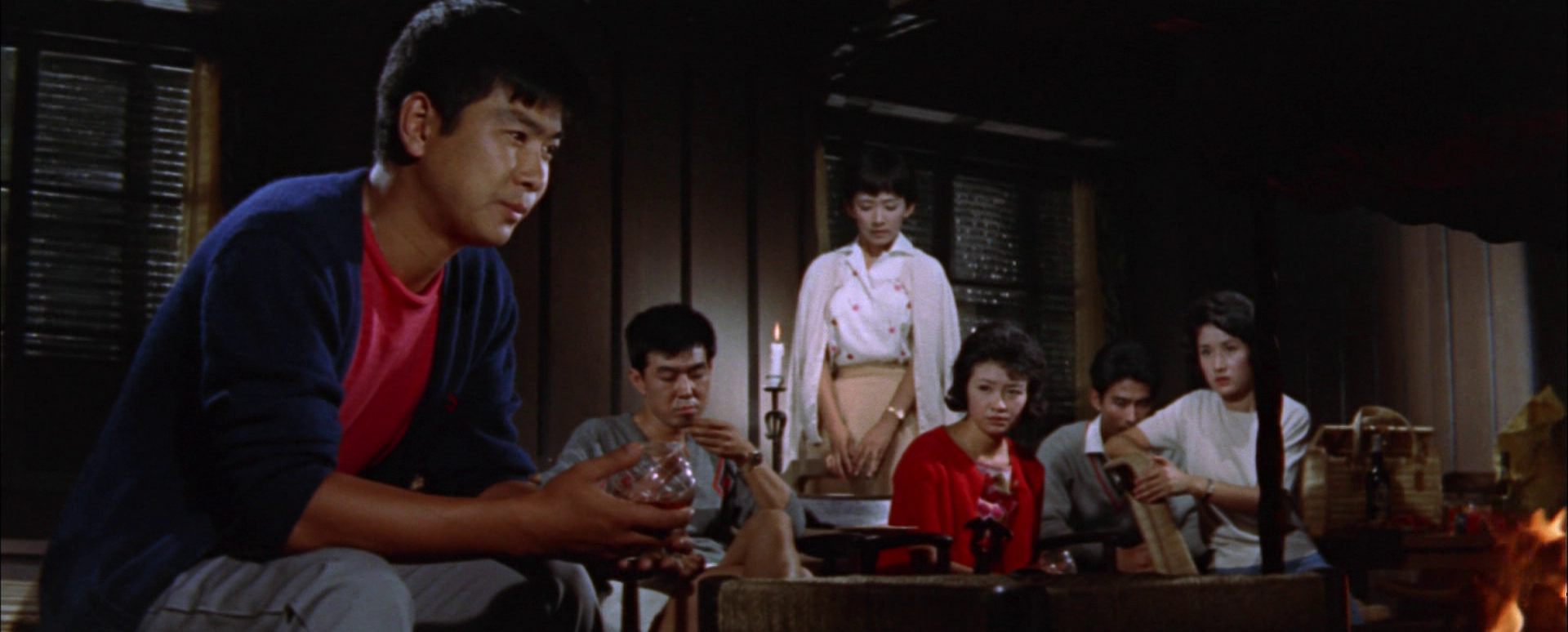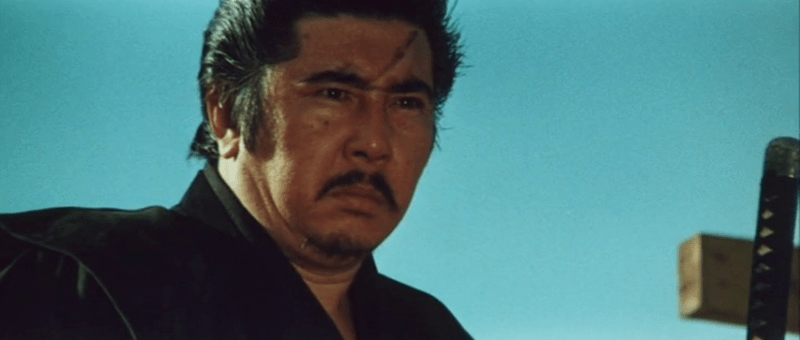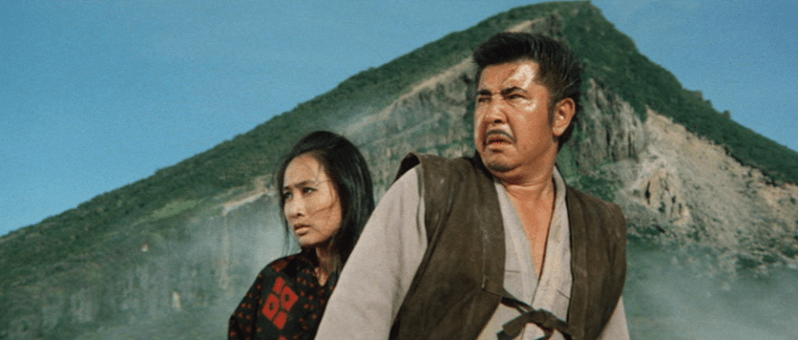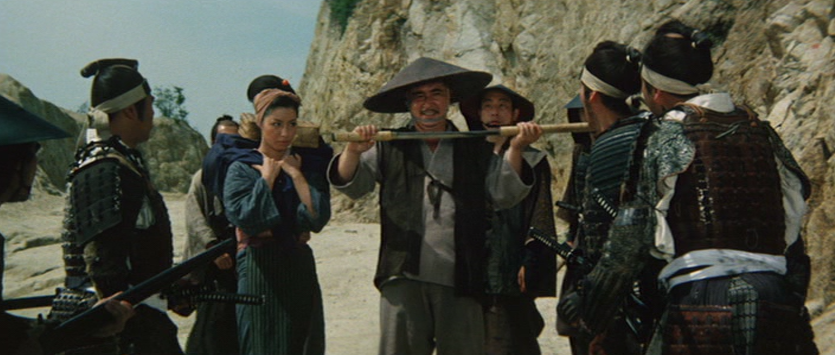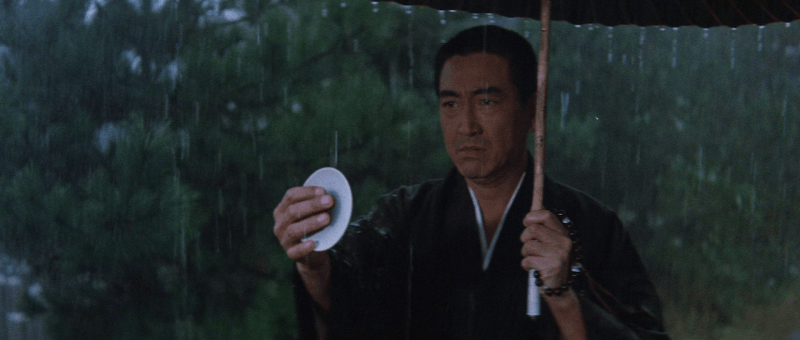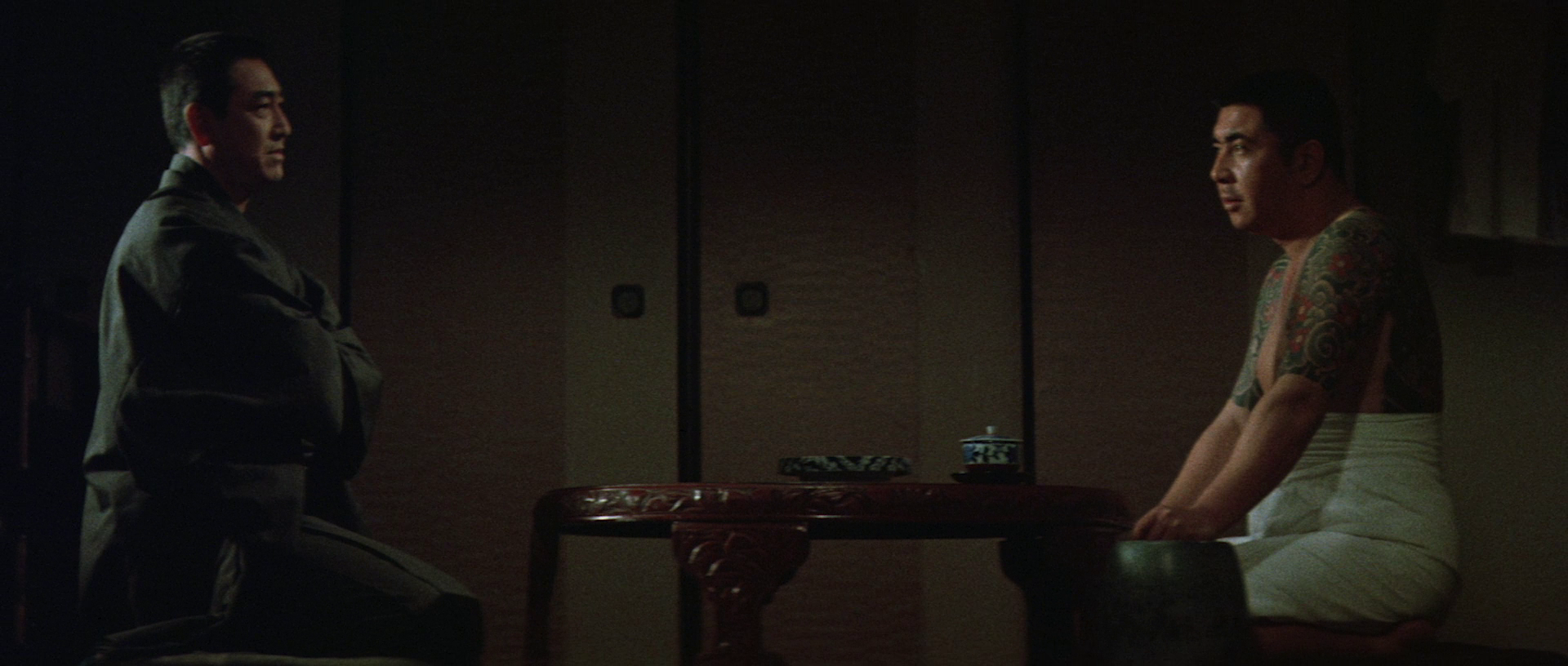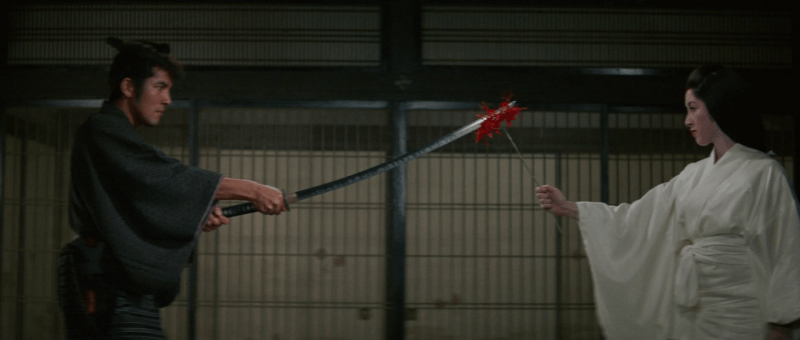
Wicked Priest 3: A Killer’s Pilgrimage (極悪坊主 念仏人斬り旅, Takashi Harada, 1969)

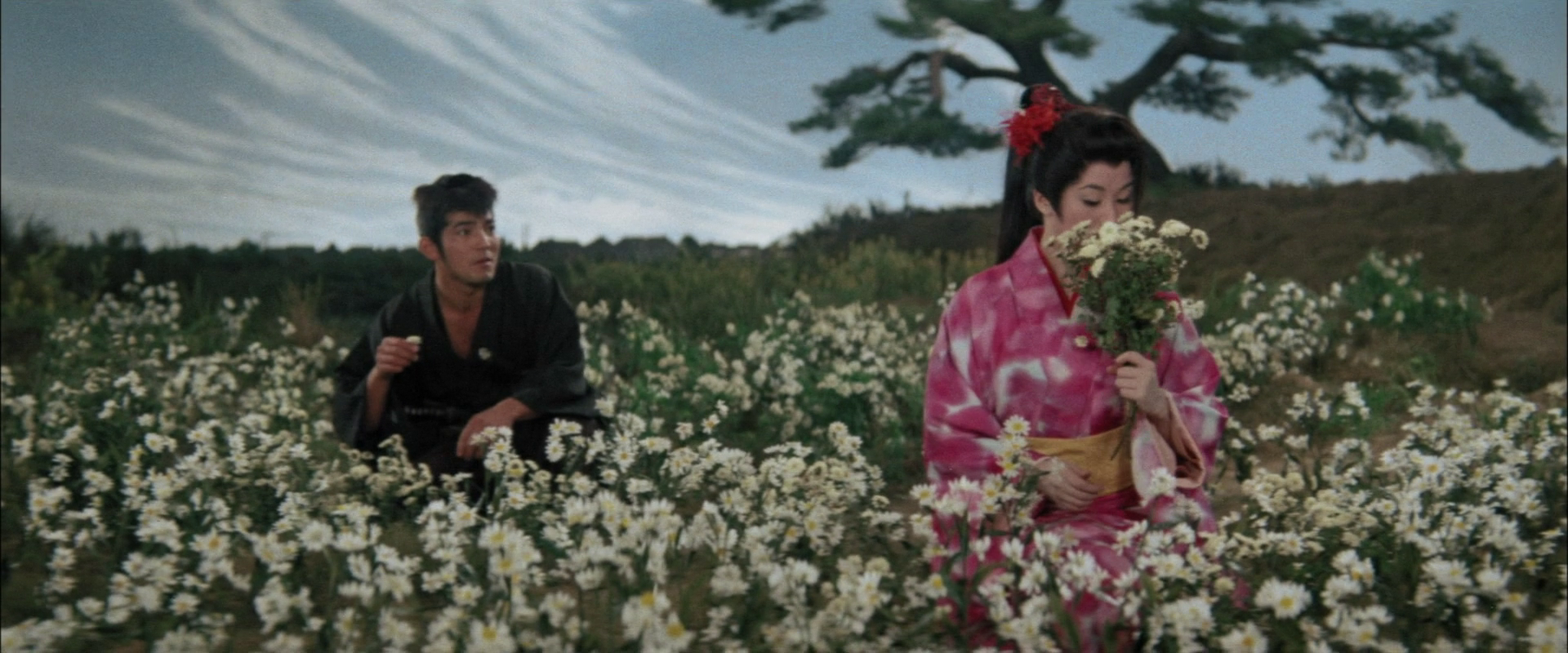
Three years on from his arrest at the end of the previous film, Shinkai (Tomisaburo Wakayama) returns for more lecherous adventures across Japan in Wicked Priest 3: Killer’s Pilgrimage (極悪坊主 念仏人斬り旅, Gokuaku Bozu: Nenbutsu Hitokiri Tabi). This time he finds himself mixed up with revolutionary pirates planning to overthrow the government with weapons smuggled in from Singapore, but it isn’t so much politics that bothers Shinkai as injustice as he tries to help the townspeople defend themselves against politicised bandits and a weird new religion while dealing with the fallout from the last time he found himself enacting justice. 

As usual however the film opens with an odd prologue in which a randy Shinkai is invited to the home of a man who tells him there’s a strange local custom in which women soon to be married think it good luck to be deflowered by a passing stranger and even better if he’s a monk. Of course, Shinkai nearly gets a little more than he bargained for before heading off towards the central fishing village which is at this time of the year home to only women and old men with all the husbands and sons off chasing tuna for the foreseeable future. Taking a liking to a widow named Omine (Hiroko Sakuramachi), Shinkai’s plans are scuppered when she realises that he’s the man who killed her admittedly no good, violent drunk of a gambling husband. Being the charmer that he is, Shinkai manages to talk her round only her brother-in-law Ryuji (Tatsuo Terashima), who’s supposed to marry her sister Otae (Eiko Ito), is hellbent on revenge. Meanwhile, the town is invaded by cruel pirates who commandeer the local well and keep the villagers prisoner. 

“Helping people is my duty,” Shinkai had told the man who weirdly wanted him to sleep with his daughter and true enough he’s never been one to turn away from those in need even if he’s not all that keen on taking responsibility for them. He feels bad for Omine that he ended up killing her husband even if he thinks her husband brought it on himself because of his behaviour, and even after encountering Ryuji tries to talk him down from his revenge rather than simply fighting him even though Ryuji still refuses to forgive him even after Shinkai is nearly fed to sharks in his place by the cruel leader of the pirates. He is later saved by Yamanami (Minoru Oki), a fugitive on the run for killing a politician in Tokyo presumably as part of his revolutionary activities but has become disillusioned with the gang whom he thinks have lost sight of their cause and are now no better than bandits. Shinkai had claimed he could see Yamanami was a good man because of his all-seeing monk eyes, and later praises him as someone who held fast to his beliefs while bravely standing up to his sociopathic gang boss. It isn’t so much that Shinkai has much opinion on their political stance and desire to overthrow the government, only about the way they conduct themselves, callously throwing dynamite around and hassling the local women. Yamanami asks his boss what the point of winning is if everyone resents you, but his boss simply tells him to think about winning first and ideological purity later. 

In a bizarre subplot, meanwhile, Shinkai also finds himself squaring off against a weird sex cult/fake religion on an island connected with the pirates who are also planning to sell off the village women as payment for their Singaporean weapons. Once again, the randy monk becomes a staunch defender of women, saving Otae from becoming the weird priest’s sex slave and shutting down the trafficking plot by indulging his strange love of eye gouging. Meanwhile he’s still being pursued by Ryotatsu (Bunta Sugawara), the blind monk from the previous two films. Blow for blow, there may not be as much action for the warrior monk despite his heroic attempt to reach the well while under fire and eventual descent on the bandit hideout in a single-handed bid for justice, but there is something in Shinkai’s demands for a just world despite his lasciviousness that overcomes his fixation on women even if this time it seems as if the sun may have set on his travels. 


Wicked Priest 2: Ballad of Murder (極悪坊主 人斬り数え唄, Takashi Harada, 1968)

The Wicked Priest returns for a second instalment but once again finds himself confronted with imperfect paternity in The Wicked Priest 2: Ballad of Murder (極悪坊主 人斬り数え唄, Gokuaku Bozu: Hitokiri Kazoe Uta). This time directed by Takashi Harada, the series begins to embrace its anarchic nature in the sometimes cartoonish exploits of its hero who largely just wants to have a good time but is inconveniently called to missions of justice while silently stalked by ghosts of the past in the form of spooky monk Ryutatsu (Bunta Sugawara) whom he blinded in a fight at the end of the previous film. 

Now a lonely wanderer, Shinkai (Tomisaburo Wakayama) comes across a fleeing yakuza with a small boy in tow and steps in to help. As he discovers, the man, Rentaro (Asao Koike), is a former gangster whose wife has passed away leaving him the sole parent to Seiichi, a little boy of around six. Rentaro wants to turn himself in to the police so he can fully sever his ties to the underworld and start again along a more honest path to raise his son right, but needs to deliver him to his father, a jujitsu instructor, before he can. Somewhat surprisingly, Rentaro suddenly asks Shinkai, a man he’s never met before, to take Seiichi to his grandfather before rushing off supposedly to give himself over to justice. When Shinkai arrives, however, Iwai (Hideto Kagawa), the grandfather, refuses to let them in having disowned his son over a local scandal some years previously. 


As in the first film the major theme is paternal disconnection, Rentaro caught between wanting to be a good father to his son and seeking his own father’s approval. Fatherless himself, Shinkai cannot understand nor condone Iwai’s stubbornness in refusing even to look at his small grandson but resolves to care for him himself until his grandfather changes his mind or for as long as he is needed. Meanwhile it turns out that Rentaro was once involved with the evil gang, Godo, who have been causing trouble in the town by trying to muscle on the local cockfighting scene. 

Godo have also been force recruiting some of the local men to increase their dominance while schmoozing with a corrupt politician, Kadowaki (Hosei Komatsu), hoping to make cockfighting a local speciality, even going so far as to kidnap a young woman known to Shinkai and gift her to him. Shinkai manages to rescue her after dressing up as a head priest and subtly suggesting to Kadowaki that his election prospects might suffer if any rumours were to get out about untoward goings on in his household. Iwai explains that jujitsu is not meant to be a violent art used to tackle evil gangsters but is anyway posited as a kind of local resistance leader standing up to Godo but with little effect other than making himself a target for their ire while left vulnerable in their ability to use Rentaro against him. 

While getting mixed up in a local dispute trying to stand on the side of the little guy while looking after Seiichi, Shinkai’s exploits are often comedic in nature as he continues to play the part of the ironic monk though with real sincerity. Sneaking into a temple and belatedly discovering it to be a convent he becomes captivated by a Buddhist nun who appears to experience some kind of sexual awakening but then becomes fixated on him, insisting on becoming his wife and causing him to hide in a chicken coop to avoid her. On the other hand, his stalking by Ryutatsu takes on an almost spiritual quality as the near silent monk, now even more gaunt than before, shuffles his way towards him. Yet this Ryutatsu is a little more spiritual than before, agreeing to postpone his quest for vengeance unwilling to fight Shinkai with little Seiichi looking on and even at one point stepping in to protect him himself because all children are Buddha. Nevertheless, the film ends with another bloody battle surprising in its intensity with severed limbs and sudden violence as Shinkai ensures that those in the wrong get what’s coming to them, speeding up the wheel of karma by a turn or two to make sure they face justice, of one sort of another, in this world if not the next.  


Wicked Priest (極悪坊主, Kiyoshi Saeki, 1968)

A bunch of corrupt monks get a lesson in business ethics from one of their own in the aptly titled Wicked Priest (極悪坊主, Gokuaku Bozu). The first in a series of five films starring Tomisaburo Wakayama as a rogue Buddhist monk who enjoys fighting, drinking, and women but deep down has a powerful sense of moral righteousness, Wicked Priest is in its own way another take on classic ninkyo only this time it’s temples acting like yakuza clans rather than actual gangsters with “wicked priest” Shinkai the ironic symbol of nobility. 

Set in early Taisho, the film opens with a prologue set five years before the main action in which Shinkai breaks up a fight between another violent monk, Ryotatsu (an incredibly gaunt Bunta Sugawara), and some yakuza he challenged while they were hassling a young man for supposedly messing with the wrong girl. Predictably, it’s Shinkai who ends up in trouble. Relieved of his duties, he’s exiled to another temple and sentenced to spend a whole year in isolation thinking about what he’s done. Five years later we can see that the conclusion he’s mostly come to is that the religious world is full of hypocrisy anyway and he might as well live his life to the full while he can.

Indeed, the opening scene sees him ironically reciting a sutra with his head between a woman’s legs and preparing to drink holy water from her belly button. The problem here seems to be one of inter-temple politics that sees Shinkai hassled by officious monk Gyotoku (Hosei Komatsu) who objects to Shinkai’s behaviour and to the leniency which is shown to him by head priest Donen (Kenjiro Ishiyama). Of course Gyotoku is later discovered to be the source of corruption, wanting to depose Donen and take control of the temple in part to facilitate a sex ring he’s running that involves live peep shows literally on temple grounds. Shinkai, meanwhile, has a particular dislike for abusers of women and especially for pimps eventually rescuing some of the women indentured by a local brothel and unfairly kept on after redeeming their contracts with bogus loans, and starting a women’s refuge in the temple where they can find “honest” work and eventually lead “normal lives” as farmers or waitresses free of the abuse and oppression they faced in the “hell” of indentured sex work.

Wandering around the town, he saves one young woman newly arrived in Tokyo from falling victim to a scam and being forced into sex work by getting her a waitressing job at a local restaurant. To keep her safe, he jokes with the cafe owner that he’s already slept with her which in the bro codes of the time makes her his woman and owing to his famously violent nature no one else is going to bother her. For what it’s worth, women young and old come to admire him greatly for his gallantry though he never abuses his position. All of his sex partners are at least of his own age and fully consenting even if he is not exactly faithful in love. 

Meanwhile there’s some minor commentary more familiar from post-war gangster films that sees the temple as a refuge for orphaned men. The fatherless Shinkai finds a beneficent paternal authority in Donen and is, he says, “reformed”, if living to a code that seems to be mostly his own but informed by a kind of moral righteousness not found in others at the temple. Having discovered that a wayward young man Shinkai is attempting to save from his life of petty crime exploiting women for his own gain is a son he never knew existed, Donen would have left the temple to fulfil his familial role but is prevented from doing so by the intrusion of temple politics. Unless undertaking specific vows, Buddhist priests are not necessarily expected to practice celibacy and are permitted to marry yet Donen’s father objected to his choice of bride and she left not wanting to disrupt his temple career. Shinkai entrusts the boy to Donen, talking him into accepting a new paternal authority as a means of returning him to the “proper” path while himself swearing that he will leave the temple in order to ensure justice is served against the true “wicked priest” Gyotoku. Directed by ninkyo specialist Kiyoshi Saeki, the film ends in an outburst of bloody violence as Shinkai takes revenge on institutional corruption but once again leaves its hero a lonely wanderer in an unjust world.


Original trailer (no subtitles)

Curse of the Blood (怪談残酷物語, Kazuo Hase, 1968)

Vengeful ghosts in Japanese cinema usually originate from some kind of injustice. Generally, they’ve met a bad end through no real fault of their own while the person who killed them continues to prosper, though it’s also true that becoming a vengeful ghost means becoming an embodiment of vengeance which is itself indiscriminate and directed towards an unjust society more than one particular transgressor. In The Ghost of Kasane, for example, the curse extends to target the murdered man’s own daughter rather than just the descents of the man who murdered him.

Loosely based on the same tale, Curse of the Blood (怪談残酷物語, Kaidan Zankoku Monogatari) is indeed rooted in an injustice, but the emotions that create the ghost are greed and pettiness much more than a desire for retribution. A hatamoto lord has borrowed a large sum of money from a blind masseur evidently running a sideline as a loan shark. The monk, Sojun (Nobuo Kaneko), points out the term is coming to a close and the money should be repaid but Shinzaemon (Rokko Toura) doesn’t want to pay. Having just watched Sojun give his wife Toyo a sexually charged acupuncture session, he coldly remarks that he’ll be paying with his wife’s body. Toyo is obviously not really onboard with this plan, while Sojun at first declines only for Shinzaemon to state that he has the husband’s permission so it’s all fine. But Sojun then attempts to pay Shinzaemon with the improbably large sum of money he’s currently carrying, agreeing to sleep with Toyo but stating that the debt and interest will remain unchanged.

In any case, as soon as Sojun begins caressing his wife’s body Shinzaemon brutally cuts him down. He asks his recently returned grown up son Shinichiro (Masakazu Tamura) to help him dump the body in a nearby lake. Shinichiro complies, but it soon becomes evident that he disapproves of his father’s debauched ways and treatment of his mother. Despite being in debt to Sojun, Shinzaemon has a mistress and an illegitimate child with another woman he is also raising in his house. Shinichiro is painted as the good samurai son, one who behaves with the proper decorum and is unlike his father in his sense of righteousness. Shinzaemon even says as much, urging him to study Confucius and martial arts to one day restore the family he has ruined through his moral transgressions. 

But in taking a sword to the mistress, Shinichiro is himself corrupted. She merely seduces him and it seems to be this that pulls him over to the dark side. Some years later, Shinichiro becomes a bandit, conman, and murderer accidentally killing a woman during rough sex and then running off with the stash of gold from the home of the man who had taken him and promised him a respectable future. Then again, the man had run a pawn shop so perhaps he was’t as morally upright as he might seem despite his kindness to Shinichiro while it also transpires that he was extracting sexual favours from the maid, Ohana (Yukie Kagawa), who turns out to be one of Sojun’s two daughters. 

In another strange twist it was Ohana and her sister Suga (Saeda Kawaguchi) that Sojun had cursed when he died. He blamed them for somehow orchestrating his death and was insistent he was taking his money to hell with him, so they couldn’t have any of it. Suga takes him to task, decrying that he wasn’t fit to be a father and tormented their mother to death while otherwise complaining that he’s a sleazy old miser who doesn’t share his wealth with them so she’s taking it and running away. Suga’s determination to take the money is an attempt to seize autonomy, but she ends up using it in much the same way as her father, essentially as means of buying sexual companionship. Unbeknownst to her, she becomes besotted by Shinzo (Yusuke Kawazu), Shizaemon’s now grown-up illegitimate son, and binds him to her through her wealth.

Just like Shinichiro, Shinzo has been corrupted by the world around him and has little sense of humanity or morality. As he says, you’d have to be a fool to be honest in this world. Like his brother he has a caustic voiceover stating what he really thinks in contrast to his meek and obedient exterior, decrying Suga as an ugly old hag and expressing disgust at the idea of sleeping with her but also a willingness to put up with it in order to get his hands on her gold. Money lies at the root of all problems, but less so the need for it than simple greed. Shinzo has unwittingly entered a more romantic sexual relationship with Ohisa (Hiroko Sakurai), who turns out to be his half-sister, but her material desires outweigh his own and they are unable to move forward with their lives because they lack the economic stability to set up home. 

To that extent, money is a means of overcoming the barriers of social class or gender to pursue greater freedom that inevitably becomes a means in itself. Sojun does not appear often as a ghost but haunts all the same, an evil smile on his face each time he manifests and takes pleasure in the sight of those who robbed him of his wealth paying the price. Simply put, he remains jealous of his money and can’t bear the thought of anyone else having it so is determined to drag it all the way to hell. Shinzaemon may have cursed his family through his immoral behaviour, but Sojun is simply annoyed about the money. Then again, perhaps he’s just a product of the world in which he lives in which money is the only way to overcome the oppressive barriers of disability, social class, and gender for to be without it is to be a lonely ghost with no currency or agency in society ruled by a fiercely patriarchal hierarchy. Hase conjures some haunting ghost imagery and uses bouts of solarisation as if the world itself were being bleached by all this cruelty and cynicism, occasionally isolating each of the protagonists in a theatrical spotlight which doubles as a personal hell yet in the end suggesting that there really is no escape from the vengeful haunting of an unjust society.  


The Pit of Death (怪談おとし穴, Koji Shima, 1968)

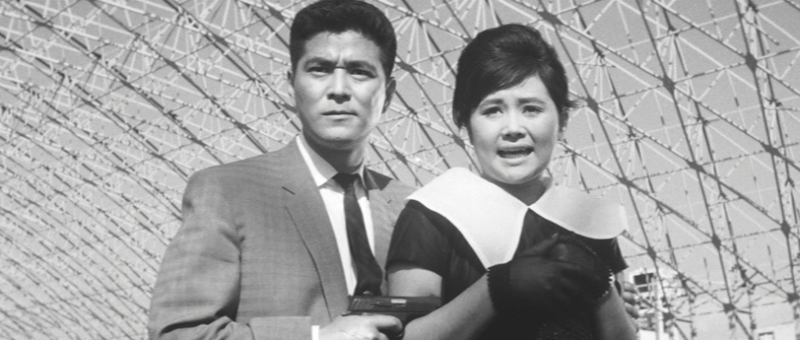
The building at the centre of Koji Shima’s dread-fuelled horror noir Pit of Death (怪談おとし穴, Kaidan Otoshi Ana) is said to be haunted by the spirits of the many people who died during its construction. In his opening voiceover, anti-hero Kuramoto (Mikio Narita) likens the city to a hornet’s nest, the salaryman drones mindlessly buzzing around the business district as if driven by some supernatural force. In that sense, the office building itself becomes an eerie place, the nexus of the salaryman dream which in the end drags all to hell. 

Largely a retelling of Yotsuya Kaidan for the mid-20th century with a little A Place in the Sun thrown in, the film finds Kuramoto an ambitious man deluded by consumerism and resentful of the classism and snobbishness which limit his prospects as a man who has otherwise been able to pull himself out of poverty. His boss pointedly speaks of his talents which include the ability to speak several languages despite only having attended night school rather than university while it’s unusual for a man of his background to hold this kind of position even if he’s only a secretary and not yet an executive. Nevertheless, his boss clearly sees him as a potential successor and plans to marry him to his daughter (Mako Sanjo) who has in some ways inexplicably developed a crush on him.

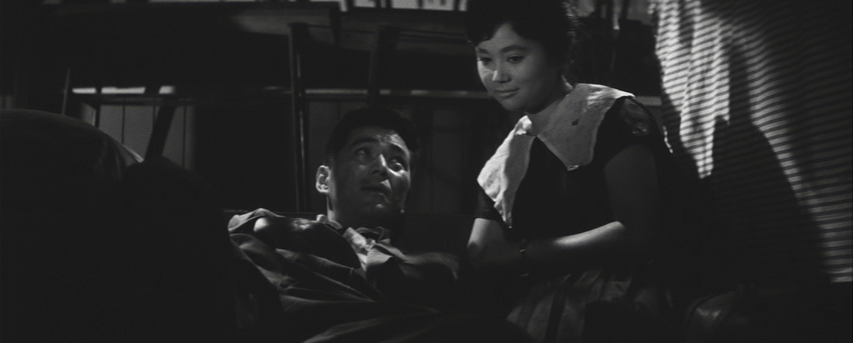
But Kuramoto is already in a relationship with typist Etsuko (Mayumi Nagisa). In fact, the reason the boss is so pleased with him is largely down to her in that he asked Etsuko to sleep with their foreign client, Mr Hancock, to seal the deal which she duly did. Kuramoto plans to throw her over in order to pursue his dream of taking over the company so he can look down on those who once looked down on him. He tells Etsuko that the marriage will be in name only, that he isn’t attracted to the boss’ daughter Midori, and their relationship will continue as before only to be confused when Etsuko is not totally on board with the plan. She tells him she’s pregnant with his child though he callously points out it could be Hancock’s and insists on an abortion thereafter determining he must kill her so that he can fulfil his destiny by joining the executive class. 

His desires are obvious when he steps into Midori’s home and gazes at a painting crassly asking how much it’s worth, admitting that he’s the kind of poor person who has a fascination with luxury. His forward propulsion is driven by a fear of poverty, the trauma of the hard life he’s had and the futility he felt in his inability to escape it. Yet it’s also a kind of class rebellion motivated by resentment for the prejudice held against him as a man without means in a highly stratified society. Paradoxically, he will do anything and everything to be accepted as a member of the elite class including murdering Etsuko, the symbol of the working class past he fears will drag him down.

Etsuko does indeed drag him down eventually in her own revenge against his callousness and the double standards of a patriarchal society. Her relationship with Kuramoto seems to be a secret in the office while he uses and discards her when no longer useful to him. She too is trapped within this building of a newly corporatised society but can rise no further alone and is in a fairly bleak position without Kuramoto for she has already thrown away her only bargaining chip by entering a sexual relationship with him. Should she attempt to raise his child alone as a never married single mother, her life would be very difficult indeed if not actually impossible. Nevertheless, she does have real power over Kuramoto in her ability to expose the affair and ruin his chances of career advancement through dynastic marriage destroying any possibility of his future success. 

In Kuramoto’s mind, Etsuko cackles like a witch or evil spirit. Her hair billows out into the wind like a vengeful ghost, though the first few times Kuramoto only imagines her death. He sees himself push her off a roof, only to be surprised to see her still standing over him. Etsuko haunts Kuramoto while alive as an image of his destruction all while he silently plots hers. He plans to use the building against her, hiding her body inside it where he assumes no one will see. In the end, it’s as if this building, an edifice of soulless corporatising capitalism, consumes them both, drawing them in with their unfulfilled desires until they fall into the bottomless pit of post-war ambition. Shima makes frequent use of solarisation and film noir lighting to destabilise Kuramoto’s world as his mental state starts to fracture along with innovative use of split screens to lend the space a sense of eerie continuity but ultimately posits the salaryman society as a kind of death trap beckoning greedy souls towards their demise with an inexorable fatalism.


Dissolution Rites (解散式, Kinji Fukasaku, 1967)

“We’re all legitimate businessmen now” as a former yakuza explains to a recently released foot soldier stepping out into a very different Japan in Kinji Fukasaku’s Dissolution Rites (解散式, Kaisan Shiki, AKA Ceremony of Disbanding). The funereal opening scenes feature the first in a series of dissolution rites as a man dressed in black reads from a scroll and explains that all the local yakuza clans will be disbanding because despite “working day and night for the benefit of the world and humanity in the spirit of democracy” times have changed and they find themselves unnecessary.

There at the beginning of that change, Sawaki (Koji Tsuruta) served eight years in prison for the murder of a rival gang boss to ensure his gang got hold of a local landfill site where they later built an oil complex. While he was inside, his boss died and his clan disbanded leaving him with nowhere to go but thankfully looked out for by an old friend, Shimamura, who has since become a construction magnate. On his arrival at Shimamura’s office, however, he’s ambushed in a suspected case of mistaken identity while the man driving him is killed. 

Shimamura (Fumio Watanabe) tells him he’s gone straight, but it soon becomes clear that even as yakuza forsake the streets for more organised crime they still behave like thugs using the same old tactics to get what they want. Shimamura is in cahoots with a corrupt local politician, Kawashima (Asao Uchida), and is determined to get access to another stretch of bombed out wasteland owned by an egalitarian doctor, Omachi, who refuses to sell because he’s set up a community there of marginalised people, including Sawaki’s former girlfriend Mie (Misako Watanabe), who work on his chicken farm. Meanwhile, Shimamura is targeted by rival “legitimate businessman”, Sakurada (Hosei Komatsu), who pulls a few dirty tricks of his own in an effort to cut Shimamura out of the picture.

Once again Tsuruta plays a man who is out of step with his times, partly because he’s been in prison but also in his fierce commitment to a now outdated code of gangsterdom. “The chivalry that we were taught was just a way for bosses to use their soldiers” Shimumura insists, “you’ll look foolish if you don’t get rid of it”, disingenuously casting his transformation into a legitimate businessman as a way of freeing himself from yakuza oppression. Sawaki turns down his offer to join the business because it seems a bit dodgy while intensely disappointed to discover another former colleague, Kubo (Kyosuke Machida), running a trafficking ring masquerading as a management studio for cabaret singers and strippers by tricking women with the offer of good jobs then getting the hooked on drugs and shipping to them to Okinawa to do sex work near the US bases.  

On his return, Sawaki is also stalked by the man whose arm he severed in killing the rival boss who turn out to be, like him, an old school gangster which is why he insists on his revenge only to find an unexpected kindred spirit as the two men find themselves each adrift in a world in which no one really cares about humanity and honour. Sakai (Tetsuro Tanba) chooses to walk a different path, conducting his disbandment ceremony in protest of yakuza corruption. Like many Tsuruta heroes, Sawaki also has the possibility of walking away and living a conventional family life as a husband and father having been forgiven by Mei but inevitably is pulled in a darker direction by the necessities of his code. The oil complex he helped to create is only a symbol of the duplicities of the post-war society allowing men like Shimamura to get rich while literally choking the life out of those like Mei whom they now want to kick out of her home to add insult to injury. 

There’s no one more tragic than a yakuza Sawaki admits, knowing there is no longer any place for him in an amoral gangster society while unable to simply leave it and enjoy a quiet life with the woman he loves. An indictment both of corporatised yakuza and the equally duplicitous practices of “legitimate” businesses and corrupt authorities, the film ends in another righteous assault filmed handheld with Fukasaku’s characteristically canted angles amid the chaos and confusion of a rapidly changing society. 

A Swordsman in the Twilight (황혼의 검객, Jeong Chang-hwa, 1967)

Jeong Chang-hwa is better known for the films he made with Shaw Brothers in Hong Kong, including the iconic King Boxer which helped to kick start the Kung Fu craze of the 1970s, than for earlier films he made in his native Korea. Nevertheless, while he was there he also instrumental in creating a new genre of Korean swordplay films with A Wandering Swordsman And 108 Bars of Gold and 1967’s A Swordsman In The Twilight (황혼의 검객, Hwanghonui Geomgaek).

Drawing inspiration from both Japanese samurai movies and King Hu’s wuxia dramas, the film is set in 1691 and like many Korean historical dramas revolves around intrigue in the court. Our hero is however not a high ranking courtier but as he describes himself a struggling vassal who was lucky to get his job as a lowly palace guard because he has no real connections nor does he come from a prominent family and his skills and long years of study mean almost nothing in this society ruled by status. The more things change, the more they stay the same. In any case, he was not unhappy with his life, got on well with his father-in-law, a poor scholar, and had a loving wife and daughter, who like him, valued human decency over ambition. 

But it’s that gets them into trouble when the venomous Lady Jang stages a palace coup to usurp the position of rightful queen, Min. Queen Min is depicted as a shining example of traditional femininity and idealised womanhood. Though the situation she finds herself in is unfair, she bears it with good grace and refuses the small comforts others offer her saying only that she is a sinner and it’s only right she suffers this way for displeasing the king. Hyang-nyeo (Yoon Jeong-hee), wife of swordsman Tae-won (Namkoong Won), was once her servant and shares her birthday so feels an especial connection to her. Pitying Queen Min seeing her forced to walk barefoot through the mud she offers her shoes and for this crime is hounded by the Jang faction on account of her supposed treason.

Having taken the local governor and his clerk, who are also against the Jang faction but don’t know how to oppose it, hostage, Tae-won narrates his long sad story and reasons for his desire for revenge against corrupt courtier Oh Gi-ryong (Heo Jang-kang) who, it seems, is also motivated by resentment and sexual jealousy after having once proposed to Hyang-nyeo but been instantly rejected by her father who did not wish to marry his daughter off to a thug. As such, he comes to embody the evils of the feudal order in his casual cruelty and pettiness. When we’re first introduced to Tae-won he saves a young woman who was about to be dragged off by Gi-ryong’s henchmen presumably as a consort for their immediate boss, Gi-ryong’s right-hand man, but is warned by the other villagers that he should leave town quickly else the Jang gang will be after him. That is however, exactly what Tae-won wants. He fights a series of duels with Gi-ryong, the first of which ends with Gi-ryong simply running away when Tae-won breaks his sword and in their final confrontation he resorts to the cowardly use of firearms not to mention an entire squad of minions pitched solely against a wounded Tae-won and the unarmed governor.

What it comes down to is a last stand by men who know the right path and are now willing to defend it rather than turn a blind eye to injustice. Tae-won’s own brother (Park Am) had thrown his lot in with Gi-ryong in the hope of personal advancement, willingly aligning himself with the winning side and complicit in its dubious morality. This of course puts him in a difficult position, though he implies he will be prepared to sacrifice Tae-won and his family if necessary even if he also tries to find a better solution such as suggesting Tae-won kill Queen Min to prove his loyalty to the Jang faction. In an odd way, it speaks to the contemporary era as a treatise on how to live under an authoritarian regime not to mention the creeping heartlessness of an increasingly capitalistic society. 

This sense personal rebellion may owe more to the jianghu sensibility found in the wuxia movies of King Hu than to the righteous nobility of the samurai film even if the ending strongly echoes chanbara epics in which the hero is displaced from his community and condemned to wander as a perpetual outlaw in a society which does not live up to his ideals. While staging beautifully framed action sequences such as fight at a rocky brook, Jeong undoubtedly draws inspiration from Hu in the use of trampolines and majestic jumps that have an almost supernatural quality. The sword fights are largely bloodless until the final confrontation but also violent and visceral. Gi-ryong’s henchman plays with a minion he feels has betrayed him by lightly scratching his throat before going in for the kill and such cruelty seems to be a hallmark of the Jang faction. But despite the seeming positivity of the ending in which a kind of solidarity has been discovered between Tae-won and the governor, the film ends on an ambivalent note with the fate of the nation still unknown as Lady Jang stoops to shamanic black magic to hold sway and darkness, the lingering shadows of authoritarianism, still hang over the swordsman even if he is in a way free as s rootless wanderer no longer quite bound by feudal constraint. 


A Swordsman in the Twilight screened as part of Echoes in Time: Korean Films of the Golden Age and New Cinema.

Wild Ducks and Green Onions (カモとねぎ, Senkichi Taniguchi, 1968)

Outside of Japan, Senkichi Taniguchi is most likely best known as the director of Toshiro Mifune’s debut film Snow Trail, or else as the screenwriter of one of Akira Kurosawa’s lesser known works The Silent Duel. Yet throughout the 1960s, he also made a series of silly comedies including Wild Ducks and Green Onions (カモとねぎ, Kamo to Negi), an absurd crime caper revolving around a gentleman thief’s attempts to plot the perfect crime while assisted by two bumbling henchmen and a young woman with a hidden agenda.

The film’s Japanese title is likely inspired by a proverb, “a duck comes carrying an onion” which means something close to “there’s a sucker born every minute” though it might be up for debate who exactly is the sucker here. In any case, dapper mastermind Nobukichi (Masayuki Mori) has plotted the perfect heist which involves rigging a speedboat race by nobbling the propellers on two of the four boats and then betting accordingly. So far so good, but the enigmatic Mami (Mako Midori) has been watching their every move and is able to swipe the bag containing the money before henchmen Yosuke (Hideo Sunazuka) and Kyuhei (Tadao Takashima) can return it to their boss who for once has agreed to an equal split. The guys eventually track her down, but she tells them she spent the money on bail for her husband but it turns out he left the police station with two other women and hasn’t been seen since. The gang then determine to track him down to get the money back, but become involved in several other scams along the way. 

Despite having been able to rob them blind, all the men seem to be under the impression that Mami is a brainless airhead though she later reveals herself to speak fluent English and in fact comes up with a few scams of her own that are better than Nobukichi’s whom the guys refer to as “Cap’n”. Nevertheless, the guys only tolerate her because they need to find her husband though all’s not quite as it seems. Kyuhei in particular seems to have a rather misogynistic streak and is somewhat jealous that Nobukichi gets to have Mami to himself though he remains a perfect gentleman, sleeping on the sofa and giving her the bed. But it’s Kyuhei’s lascivious nature that eventually gets them into trouble when he tries to drag a reluctant Yosuke into a cinema screening pink films only to be pulled aside by some kind of anti-delinquency brigade who read off some unconvincing statistics stating that 80% of young male sex offenders are fans of pink films. 

This annoys them so much they decide to scam the organiser, Tomiko (Hisano Yamaoka), by appealing to her vanity and tricking her association, which is dedicated to conservative family values, into watching (and apparently enjoying) a porn film on school premises believing it to be an “educational movie”. Tomiko in some senses represents the forces of order against which the gang are rebelling, though she’ll get her revenge in time. In any case, they find a more worthy target after travelling to a seaside town and encountering the daughter of a man who has been poisoned by industrial pollution while the local factory insists everything is within “safe limits” and they aren’t the cause of the sickness spreading across the area. 

Conducting another expert heist to steal the secret documents to prove otherwise, Nobukichi could make a lot of money blackmailing the factory owner but instead gives the report to the man’s daughter so she can pursue justice and compensation for her father much to the chagrin of Mami and proving that it isn’t all about the money after all. Then again, he has another document that, once translated by Mami, reveals the factory has actually been producing Napalm for the Americans which is a bit of a grey area as far as the constitution is concerned. This time, they play a nasty trick on the heartless factory owner (Eijiro Tono) though he is hardly remorseful and in fact was too greedy to pay their blackmail money despite the vast sums it would cost him if the news ever got out. 

Despite its silliness and absurdity, the film takes an ironic swipe at serious issues of the day such as scandals like the Minamata disease and Mary Whitehouse-esque social campaigners ranting about a decline in morals while simultaneously enjoying the platform that protesting them grants them. In some ways, the gang themselves exist as a kind of rebellion against the salaryman society with their various scams presented as silly games targeting faceless or ridiculous figures who can either afford to lose the money or were ripe for a comeuppance though in the end, crime doesn’t really pay either and the gang find themselves hoist by their own petards, robbed of enjoying their ill-gotten gains by unexpected twists of fate. Very much of its time the film has a kind of charm in its whimsical score and pastel colours but has lingering darkness in its threats of unexploded bombs and hidden Okinawan torture facilities in a society increasingly ruled by amoral capitalists.


Tengu Priest (お坊主天狗, Yasushi Sasaki, 1962)

Disparate denizens of Edo are united in one thing in Yasushi Sasaki’s light hearted jidaigeki, Tengu Priest (お坊主天狗, Obozu tengu), revenge. Like many jidaigeki, what they really want is revenge against the evils of feudalism to which they have each fallen victim, but also acknowledge that they have found something better in being outside it in the solidarity that exists between them as outsiders free from the obligations of samurai society if also with loose ends waiting to be tied.

Once a hatamoto with a 1000 Koku stipend, Obo Kichiza (Chiezo Kataoka) is now a much feared figure keeping order in Edo. When some yakuza toughs are hassling the geisha Kozome (Hibari Misora) at the theatre, insisting that she serve them sake even as she reminds them she’s off the clock, one look from him stops them dead though Kichizo is also impressed with Kozome’s nerve. Like him, Kozome is also in Edo for revenge. Formerly a samurai’s daughter, she became a geisha to look for the man who killed her father in a stupid quarrel over a fencing duel. Kichiza, meanwhile, seeks revenge against the local lord, Honda Etsu (Masao Mishima), who killed his father in a fit of temper when he ordered him to commit seppuku for causing his son-in-law to fall off his horse but he refused. 

Loyal retainer Kinpei (Ryutaro Otomo) had begged for his forgiveness and insisted that he could get Etsu to reform but three years have passed and not only has he bribed his way to head office but his behaviour has declined still further. We see him cruelly cut down a maid seemingly for no reason, simply ordering his men to get rid of the body. Etsu has a reputation for random violence while drunk, but as he is the lord, there are no real consequences for him. His retainers cover up his crimes, and Kinpei’s sole attempt to talk some sense into him goes nowhere, meanwhile his chief adviser Shichinosuke (Sentaro Fushimi) is basically running the show telling others the lord is not in his right mind and cannot make decisions so he must make them for him.

They are all, including Etsu himself, victims of the feudal order in which the systems of power are necessarily corrupt. In his yakuza persona, Kichiza has struck up a friendship with another geisha, Kozuru (Naoko Kubo), who was actually a lady in waiting working as a maid at his estate. She has long been in love with him, but the class difference would have made any union impossible. Ironically, she remarks to Kozome that even in their present state they are still a Hatamoto and a lady in waiting so she dare not express her love for him. Only once his revenge is concluded and he’s fully abandoned his samurai status can Kichiza truly be free to embrace a relationship with Kozuru while conversely Kozome regains her life as a samurai’s daughter by avenging the death of her father.

Kozome asks for Kichiza’s help to track down the target of her revenge, but he also respects her wishes and understands that it’s something she must do herself as does eccentric sword sharpener Shinzaburo (Hashizo Okawa ) who actively stands back so she, another wronged woman, can stick the knife in. Hibari Misora’s role in the film is smaller than one might expect as her revenge subplot is secondary to Kichiza’s and she has relatively little screen time with only a brief musical sequence during a naginata dance though she does participate in the high octane final showdown in which all grievances are exorcised and a kind of order returned to the samurai realm even if it must be destroyed to so as Kinpei resolves to protect both the lives and livelihoods of their many retainers and the integrity of Kichiza, going so far as to congratulate Kozome on the successful completion of her revenge. 

Yet what made the whole thing possible was Kichiza’s own band of outlaw drifters whom he allowed to live in his home he later says just so that they would have a place to come and be together so that they might more easily reintegrate into mainstream society. He might have lost his domain and samurai status but has discovered something better in this accidental community. They may be in a sense almost like retainers to him, but if so they stay by choice rather than obligation and help out of a genuine sense of loyalty and affection. In essence, in taking his revenge, he frees himself from the oppressive nature of the samurai code and is able to live like an ordinary man lamenting that if only he and Kinpei had both been ronin they could have enjoyed their time together for longer. Lighthearted and cheerful despite its dark themes, the film is nevertheless a condemnation of the hypocrisies and abuses of a feudal society in which freedom is to be found only among those who live outside it.


Jungle Block (地図のない町, Ko Nakahira, 1960)

The contradictions of the post-war era are thrown into stark relief in the forced redevelopment of slum area on the edge of an increasingly prosperous city in Ko Nakahira’s intense noir, Jungle Block (地図のない町, Chizu no nai Machi). The slightly unfortunate English title may hark back to that chosen for a US screening of Nakahira’s landmark film Crazed Fruit, Juvenile Jungle, or just echo the titles of classic Hollywood noir movies such as Asphalt Jungle and Blackboard Jungle, but otherwise has little to do with the content of the film. The Japanese title, meanwhile, means something like “a town not marked on the map” and hints at the invisibility of those who live in this slum, a self-built post-war shantytown inhabited by those largely left behind by the nation’s rising prosperity. 

Then again, Shinsuke (Ryoji Hayama) seems to have fallen behind on his own account. We’re later told that he resigned from his position at the hospital because of some kind of medical mistake for which he blames himself and has since taken to drink and gambling while working at the poor clinic run by his former mentor Kasama. The most immediate effect of his, perhaps unnecessary, decision to resign was that it prevented the marriage of his younger sister, Sakiko (Kazuko Yoshiyuki), as he was then financially dependent on her. Having delayed the wedding for two years waiting for Shinsuke to pull himself together, Sakiko and her fiancé are set upon by local gangsters working for yakuza turned politician and legitimate businessman Azusa (Osamu Takizawa). Sakiko attempts to take her own life and the relationship does not survive this crisis thanks to her fiancé’s wounded masculinity in having been unable to save her or stand up to the goons afterwards. 

As repeated flashbacks reveal, Azusa is the root of the disease spreading across the city. It’s he that’s intent on clearing the slum, as he says just doing what the government has asked him to do, planning to build luxury apartments on its site along with supermarkets and entertainment facilities. Perhaps it’s not an entirely bad thing to clear a slum, the living conditions are in themselves a health hazard, but Azusa has drastically cut the amount of compensation on offer preventing the residents from securing new places to live and essentially rendering them homeless which defeats the humanitarian justification for forcing them out when most of them don’t want to go. 

Kayoko (Yoko Minamida), an old flame of Shinsuke’s who’s since become a sex worker to pay off her father’s debts to loan sharks and ends up as Azusa’s mistress, has a cat that she confesses to mistreating which makes her feel better only to feel terrible afterwards. The film seems to align the cat with the people of the slums who are bullied by men like Azusa who have untold influence buying off police and politicians while he himself later holds public office. The cat eventually fights back by scratching Kayoko who acknowledges it’s her own fault for her treatment of it, while it’s clear that the anger of the slum dwellers will eventually boil over and they too will strike back against the corruptions of this post-war era which otherwise sees fit to leave them behind. 

Meanwhile, Shinsuke plots a revenge he may not have the courage to take explaining to Kasama (Jukichi Uno), otherwise the voice of moral reason, that it’s the city that sick and the only way to save it is an operation to remove the Azusa-shaped tumour that’s currently killing it. It’s not for mere convenience that his weapon of choice is a scalpel. Kasama, however, tells him that he’s got the wrong idea and it’s their responsibility as doctors to take the long-term view and patiently run their clinic to produce results in the far off future. But Kasama’s eventual decision would seem to walk that back, suggesting that perhaps a radical solution really is necessary to save the patient from the ravages of amoral capitalism. 

Then again, like Kayoko’s father Yoshichi (Jun Hamamura) who is branded a “cripple” and “only half a man” by Azusa, Shinsuke begins to realise that perhaps you can’t create lasting change on your own and taking out Azusa won’t solve the problem as someone else will simply rise to take his place. There is a pervasive sense of hopelessness, Shinsuke caught and frantic amid the dim backstreets of this rundown town desperate for revenge when the police are in league with Azusa and no one really cares about the residents of the slum who are beginning to lose the will to resist. Nevertheless, eventually rediscovering himself Shinsuke opts to follow Kasama’s path insisting that will join the ranks of “good, honest, people” who, like the cat, will eventually scratch back until then resisting by “doing the right thing” even in the face of violence and intimidation while staunching the flow of corruption and cruelty from the seeping wounds of the post-war society.


DVD release trailer (no subtitles)