It Was a Faint Dream (あさき夢みし, Akio Jissoji, 1974)

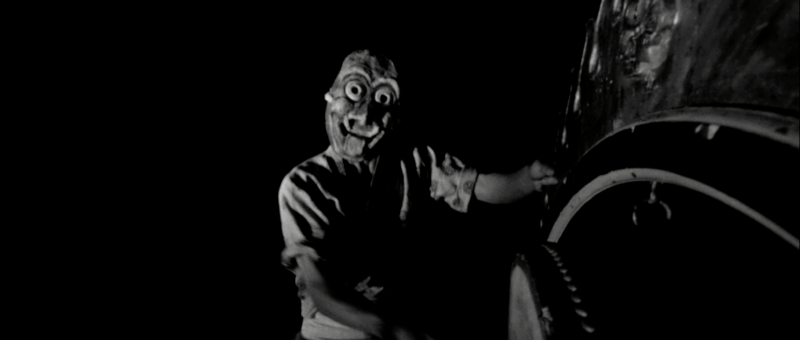
It was a faint dream posterFollowing his ultramodern Buddhist Trilogy, Akio Jissoji casts himself back to the Kamakura era for a tale of desire and misuse in It Was a Faint Dream (あさき夢みし, Asaki Yumemishi, AKA Life of a Court Lady). Taking its name from a Heian era Buddist ode to transience, Faint Dream follows its melancholy heroine on a fleeting path of love, loss, romantic disappointment, and finally spiritual rebirth while the nation faces the external threat of putative invasion by warlike imperialists hellbent on domination and conquest.

Shijo (Janet Hatta), an orphaned young woman taken as a concubine by the lord Tameie (Kotobuki Hananomoto), has returned home to await the birth of her child. The baby she is carrying, however, is not Tameie’s but that of another young noblemen, Saionji (Minori Terada), with whom Shijo had fallen in love before being taken by the lord. Hoping to pass the baby off as merely premature, Shijo has been deceiving Tameie and remains fearful she will be found out. Meanwhile, Saionji’s wife is also pregnant. When Saionji’s legitimate child is stillborn, an obvious solution presents itself and Shijo loses the first of her children.

A young woman without means or protectors, Shijo finds herself forced to indulge the whims of men in order to survive. Yet Tameie, falling ill, apparently thinks only of her when he pushes Shijo towards sleeping with other men in order to keep the peace, so that their resentment doesn’t become an all consuming evil. Thus it is that Tameie’s own brother, the high priest Ajari (Shin Kishida), falls for Shijo with a burning passion which Tameie fears could drag her down to hell with its implacable intensity. Reluctant and half disgusted, Shijo follows her lord’s advice, falling for the priest as she goes, and becoming pregnant with another child she must also lose.

Ajari’s radical Buddhist philosophy insists that chanting sutras is enough for salvation. It doesn’t matter if you’re high born or low or whether you believe or not, simply saying the words gets you into paradise. It’s a philosophy that appeals to Shijo for obvious reasons, but still she finds it near impossible to reconcile herself to her position of powerlessness within the court. A figure of desire, she is “courted” by just about every man she meets but has little right to refuse their attentions, especially as they often hold financial as well as social power over her. Tameie’s warning, ironic as it is in insisting that hell hath no fury like a man scorned, has its merit in bearing out the intensely destabilising properties of romantic love in a highly regimented society.

For all of that, however, Tameie is a romantic man, himself embittered by the disappointments of his life. Born to be a king, he prefers music and poetry to the sword but still laments his “betrayal” at the hands of the older generation who crowned him at three only to depose him at 16 and hand power to his 10-year-old brother with only a promise, apparently now broken, that his son would inherit the throne. Abandoned as a child, he has little sympathy for Shijo’s maternal pain on repeatedly having her children taken from her because of social propriety, merely reminding her that children and parents walk different paths and hers is evidently here, with him, at court.

Even so, men are content to have it both ways. Romance is a transient thing, Shijo is told, a flower which blooms in an instant of truth but then scatters. Attachment is the enemy of love, the wise man admires the flower as its falls but does not mourn its loss forever. Shijo finds this hard to understand, but continues to live her life as an object of desire rather than an active participant until she finally stops and makes a firm decision of her own in choosing to reject it. She becomes a nun and wanders the land looking for serenity despite being told that no woman can become a Buddha because of the five obstacles in her way no matter how nobly she might seek it.

Ironically enough, Shijo’s life is in itself a “faint dream”. She chooses to reject her desires, but admires other women for embracing theirs, and remains seemingly ageless while the fleeting loves of her youth grow old and fade. The lords sit around perfecting their poetry while boys are pulled off their farms to combat a Mongol invasion, and a deadly disease ravages the country. Shijo turns to ask her former lover about the child they conceived together, but it’s as if she were asking about someone else in another time. Having received her answer, she walks off into the distance, a nameless nun, free of the cares of the world and no longer burdened by desire.


It Was a Faint Dream is the fourth of four films included in Arrow’s Akio Jissoji: The Buddhist Trilogy box set.

Original trailer (no subtitles)
Poem (哥, Akio Jissoji, 1972)

Poem dvd coverThere might be a temptation to view Akio Jissoji’s “Buddhist Trilogy” as an intensely Japanese affair given its obvious preoccupation with Eastern religious thought and background dialogue with the political confusion of the day, but like fellow New Wave outsider Kiju Yoshida, Jissoji had studied French literature and there is something classically European about his nihilistic ennui in the midst of a decaying social order. Poem (, Uta), the trilogy’s final instalment, bears this out most of all as the servant boy of a noble house, secretly its spiritual heir, alone attempts to resist the march of time to save the natural essence of a culture about to eclipse itself in consumerist emptiness.

Jun (Saburo Shinoda), a strange young man, is a servant/legal clerk to a lawyer, Yasushi (Shin Kishida), who is the oldest son of the Moriyama family. Though he has inherited stewardship of the house and mountains, Yasushi and his wife Natsuko (Eiko Yanami) long to break free of its traditionalist constraints by ripping it apart and replacing tatami mat comfort with Western modernity. They can’t do that, however, because old Moriyama (Kanjuro Arashi), Yasushi’s father, is still alive and Yasushi doesn’t particularly want to have to talk to him. Meanwhile, the spacious mansion is also shared by a legal student, Wada (Ryo Tamura), who is kind of interning with Yasushi while repeatedly failing the bar exam, and the family’s maid Fujino (Hiroko Sakurai).   

Unlike Yasushi, Jun sees his life’s purpose as serving the Moriyama family. Intensely worried that a fire may engulf this fine house built with only the best Japanese cedar, Jun gets up every night at midnight and patrols with an electric torch, looking for loose sparks. One night he finds some, though not the kind he was expecting, on accidentally witnessing Wada make love to Fujino. Apparently uninterested, Jun looks it over and moves on while the lady of the house, Natsuko, starved of affection by her impotent husband, finds herself stirred by such unexpected eroticism.

Yasushi’s physical impotence is perhaps merely a manifestation emasculated powerlessness as the oldest son of a noble house who, nevertheless, wields no real power and is entirely unable to make decisions for himself. Yet his big case at work is thrown into confusion when his social climbing client suddenly tries to have his partner, Arita (Haruhiko Okamura), removed days before the court hearing because it might look nicer to have someone of Moriyama’s standing representing him. Even so, Yasushi is so clueless with the modern world that he needs Jun, a calligraphy enthusiast and advocate for the old, to operate the photocopier because he doesn’t know how (and neither does Wada). Only Jun, in another contradiction, insists on working to rule and leaving at 5pm because his “main job” is protecting the house and serving the Moriyama family, not Yasushi. Jun allows himself to be seduced by Natusko on the grounds that if she does not receive sexual satisfaction inside the house she will need to look for it outside which could bring shame on the Moriyama name. Finding out his wife is sleeping with another man, the weird servant boy no less, Yasushi doesn’t even care (besides being mildly turned on), as long as she doesn’t do anything which might arouse “rumours”.

The dirty secret that neither Yasushi or his debauched brother Toru (Eishin Tono) know is that Jun, whose name means “pure”, is their illegitimate half-brother that their father had with a maid. As we later discover, old Moriyama plans to divide his estate not in two but three, believing that it hardly matters anyway because division, in a break with the system of traditional succession by the oldest son, will be the end of the Moriyama family. He may well have a point as neither Yasushi, who eventually abandons the house to Toru and escapes to Kyoto, or his brother are interested in legacy. Once Moriyama passes, they plan to sell the entire plot, mountains and trees and all, to developers. In fact, the house already technically belongs to someone else because as soon as he moved in Toru started taking out exorbitant loans to fund his wastrel playboy lifestyle and has already figured out the jig is up and they’re all broke. Only Jun, who hears the voice of the mountains as if it were the voice of existence itself, is desperate to save the family name though he is at this point almost beyond saving himself.

Looking for the “absolute” in tombstones, Jun is told that only darkness exists inside. Yet he is certain that as long as form survives, content can return. He sees the Moriyamas’ forests as the essence of an older Japan and their untouched natural beauty the rock on which their souls are anchored. Yet his half-brothers oppose him. For them, Japan, even the world, is already ruined and nothing worth protecting remains. Existence itself is nothing more than a dream, and suicide no different. They no longer feel they can live “in such an age”.

Yet Jun, his father’s spiritual heir even if he doesn’t know it, keeps reaching, perhaps not quite hoping but demanding even in his powerlessness which may, in a sense result in a kind of transcendence in its purity. Unlike the ambiguously hopeful ending of This Transient Life, or the urgent ominousness of that of Mandala, Poem ends in defeat and futility, suggesting that time cannot be stopped or progress arrested even by those who seek the eternity of enlightenment. And so Jissoji brings us full circle by showing us a world in entropy unsalvageable in the cruelty of its contradictions.


Poem is the third of four films included in Arrow’s Akio Jissoji: The Buddhist Trilogy box set which also features an introduction and selected scene commentaries by scholar of the Japanese New Wave David Desser plus a 60-page booklet with new writing by Tom Mes and Anton Bitel.

Original trailer (English subtitles)

Mandala (曼陀羅, Akio Jissoji, 1971)

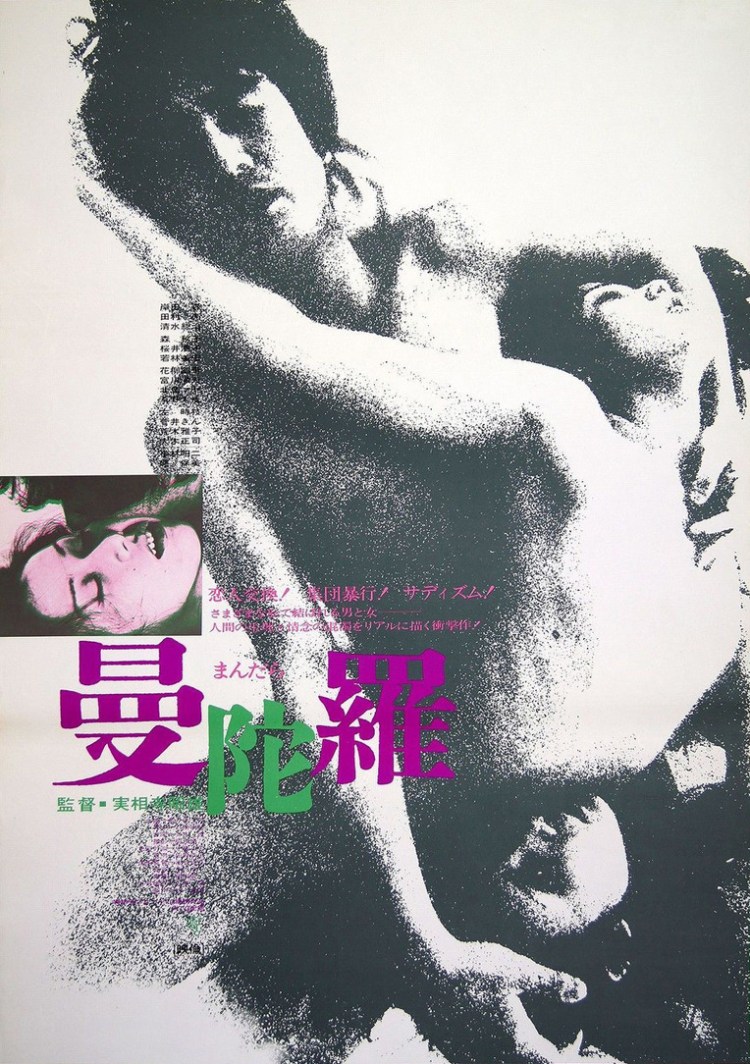
Mandala jissoji poster 2Politically speaking, the Japan of 1971 was trapped in a kind of limbo. The student movement had been dealt a serious blow with widespread supressionary measures in the run-up to the renewal of the ANPO treaty in 1970, which was finally signed despite opposition. It was not, however, yet dead and would stumble on, losing its way, until the climactic events of Asama-Sanso in 1972. Following hot on the heels of his radical This Transient Life, Akio Jissoji’s second film for ATG Mandala (曼陀羅) finds him exploring just this conflict as two young men look for “utopia” in an escape from the tyranny of time.

Kyoto uni students Shinichi (Koji Shimizu) and Hiroshi (Ryo Tamura) have taken their girlfriends to a strange little beachside inn for a spot of wife swapping. Where Shinichi’s girlfriend Yukiko (Akiko Mori) is only too happy to oblige her boyfriend’s whims, Hiroshi’s squeeze Yasuko (Ryo Tamura) goes along with it but instantly regrets her decision. Meanwhile, unbeknownst to them, the couples are being spied on by weird ultra-Buddhist cult leader Maki (Shin Kishida) who comes to the conclusion that Shinichi and Yukiko are good candidates to add to their commune which is built around the concepts of agriculture and eroticism. Maki’s violent recruitment method is knocking out the guys and then subduing the women so they can be raped by cult members and thereby inducted.

Maki’s strange philosophy which posits a new “utopian” future born of a return to a more primitive way of life in which love does not exist and sex is a free and natural act whose only purpose is reproduction, wins an acolyte of Shinichi because of its key offering – the ability to stall time. Always looking for a way to be dead yet alive, Shinichi is obsessed with the idea of stillness. Movement is the image of time passing. Coming to and finding the comatose, naked body of Yukiko lying on the beach after being raped by Maki’s minions, Shinichi cannot resist the urge to have sex with her “lifeless” body (which she apparently consents to, playing dead even after regaining consciousness part way through). Yukiko too confesses her own fantasy of being ravished as a corpse, a body outside of conscious time.

Shinichi, proclaiming he no longer believes in the future or in that a classless anti-State will ever arise, leaves the struggle and joins Maki’s atavistic utopia to which only those who “deny time and history” are permitted. Hiroshi, meanwhile, berates him for betraying the “continuous revolution” while he himself is on the run having left university after a disagreement with his Trotskyist protest group. The two men are each fleeing the centre and heading in different directions if perhaps ultimately bound for a similar destination. A hyper individualist, Hiroshi declares that there is no such thing as mankind, only a confluence of individuals, with the exception perhaps of those who have dedicated themselves to religion. He doesn’t want the child that Yasuko is carrying, not because he fears it may be Shinichi’s, but because he does not see the point in contributing to “the multiplication of mankind”, which is a key tenet of of Maki’s primitivist manifesto.

Unlike Hiroshi, Yasuko is not seeking revolution but conventionality. She wants the baby, and perhaps a marriage. At the end of her tether, having suffered horribly at the hands of Maki’s minions, she draws a small cottage with a friendly bird flying above as if to symbolise the simple dream that has been destroyed by the cruelty of men. Too late, Hiroshi realises that his irritation with Yasuko was simply a reaction against the shadow of himself he saw reflected in her, and he cannot forgive those who have caused her harm.

Harm there is plenty. Maki’s vile philosophy, overseen by his shaman wife (Yoshihiro Wakabayashi), supposedly the embodiment of many gods, strips women of their right to autonomy, insisting that “love” is an unwelcome modern sophistication which should be replaced by “benevolence” in an egalitarian affection for all mankind. In “ancient times”, he says, a woman would willingly submit to a man and, therefore, there was no such thing as “rape”. “A woman’s silence and resistance make a man a rapist” he tells his minions while Shinichi is busy raping the latest kidnap victim in a room equipped with CCTV for Maki to watch from behind a screen. His tenet of fecundity, both in terms of agriculture and human reproduction, comes at the cost of basic human decency and reduces the role of women to mere vessels for men’s desires.

Throughout the history of Japanese cinema, “love” has indeed been the destabilising, individualising force which threatens the social fabric, but for Maki it serves as a palpable evil. Like Hiroshi, he too believes that men exist as individuals, but also that “benevolence” could raise them to become a “community”. Hiroshi wants to live in a world of revolution, free of charisma and religion, but Shinichi seems to have found peace in atavistic simplicity. Faced with the choice, Hiroshi again chooses individualism, declaring that he would rather die alone than go mad along with everyone else. Yet his frustration may perhaps take him to a dark and unexpected place that sees him pick up a sword and a copy of the Manyoshu as if on some sort of nationalistic mission of revenge against an intransigent government and society. Revolutions fail, and then they start again. Hiroshi has perhaps picked a side, even if that side is merely opposition, but what he’s chosen is movement, action, maybe even life however fleeting, over the cold meaninglessness of Maki’s grand plan for a primitivist utopia.


Mandala is the second of four films included in Arrow’s Akio Jissoji: The Buddhist Trilogy box set which also features an introduction and selected scene commentaries by scholar of the Japanese New Wave David Desser plus a 60-page booklet with new writing by Tom Mes and Anton Bitel.

Original trailer (English subtitles, NSFW)

Sandakan No. 8 (サンダカン八番娼館 望郷, Kei Kumai, 1974)

Sandakan 8 posterSome might argue that Japanese cinema has often been reluctant to examine the nation’s traumatic 20th century history with the proper rigour, but even if subtle and coming from unexpected angles there have been many and varied attempts to ask questions about the lingering consequences of feudalism. Sandakan No. 8 (サンダカン八番娼館 望郷, Sandakan Hachiban Shokan: Bokyo), inspired by a true life account of a woman unwittingly sold into sexual slavery as a child at the turn of the century, is not only a condemnation of socially approved people trafficking and its role in building the short-lived Japanese empire but a mild provocation of the contemporary society which refuses to engage with its traumatic past.

In the contemporary era, graduate student Keiko Mitani (Komaki Kurihara) is engaged in researching the “karayuki-san” – Japanese women who were sold into sexual slavery throughout Asia in the early 20th century. Almost forgotten, the karayuki-san are a taboo subject and even those still living in the areas from which women and girls were sent away are unwilling to speak of them. By chance, however, Keiko runs into an old woman in a cafe who speaks with a standard Tokyo accent and tells them that she spent most of her life “abroad”. Quickly realising she doesn’t mean she was a diplomat’s wife, Keiko wonders if the woman might be have been a karayuki-san and delays her return to Tokyo in order to find out.

There is something, it has to be said, ironically exploitative in Keiko’s determination to get the old woman, Osaki (Kinuyo Tanaka), to open up about a subject on which she so obviously does not want to be drawn. A visit to Osaki’s home reveals her to be living in a run-down hovel on the edge of town which is filled with stray cats whom Osaki feeds because “they’re all abandoned, but still they have to live”. Keiko gets herself brownie points by reacting politely to Osaki’s reduced living situation, eventually staying three weeks during which time she gradually teases out Osaki’s sad life story. Finally asking if there wasn’t anything Osaki might have liked to know about her, Keiko’s hypocrisy is fully brought home to her when Osaki admits that no one was more curious about Keiko than she was but that “people have reasons for not confiding in others” and if it’s something you need to ask about then it’s probably something that the other person may not want to share. In any case, Osaki seems to have known Keiko had an ulterior motive but does not regret sharing her story and has no worries about what Keiko might do with it as long as she makes sure to tell the truth.

The truth, in a sense, seems to be something the villagers feel themselves well acquainted with which is why Osaki lives in a shack on the edge of town. Tricked into sexual slavery as a child by an amoral people trafficker who lured her with promises of money to be made overseas, Osaki found herself in Borneo and a prisoner of “Sandakan No. 8” which was one of 10 numbered brothels on the island largely catering to Japanese travellers overseas, facilitating the expansion of the Japanese empire as accidental emissaries and ports of call. When Osaki was a child, Japan was a poor country and it was considered normal to sell one’s daughter in order to feed a family. Working overseas carried with it a kind of cache though no one, except perhaps her brother, seems to be fully aware of what Osaki is going to and she herself has not in any way chosen or consented to become a sex worker. When she eventually returns to Japan, she finds herself unwelcome in her brother’s house, which her money paid for, because of the shame associated with those who have “worked away”. Even 50 years later, she finds herself living alone, all but disowned by her only son, on the outskirts of her childhood village ostracised by the “respectable” townspeople who don’t for a second believe Osaki’s quick introduction of Keiko as her daughter-in-law.

The daughter-in-law deception is only one heartbreaking aspect of the complex relationship between the two women who are each, in a sense, hiding something from the other but end up forming a genuine connection anyway. Intensely lonely and having lived a life filled with suffering, Osaki is willing to pay for company with her story while Keiko is, not quite deliberately, using her loneliness against her in an attempt to earn her trust and get her to reveal her secrets. Nevertheless, Keiko is able to mine a rich and deep seem of 20th century trauma through the tragic story of just one woman which reaches out to hundreds like her some of whom rest in a graveyard in the forests of Borneo with their backs forever to Japan. The enemy is, once again, poverty more than it is patriarchy or even feudalism, a problem less of the essence in the rapidly improving post-war economy, but as Kumai is keen to point out, this system of state sanctioned people trafficking (finally outlawed only once Japan’s status on the world stage began to rise) had far wider implications than it might be thought which still echo into the present day and perhaps beyond if not for the efforts of women like Keiko who do not wish to forget.


Original trailer (no subtitles)
Promise of the Flesh (肉体의 約束 / 육체의 약속, Kim Ki-young, 1975)

Promise of the flesh poster 1Lee Man-hee’s Late Autumn is one of the great lost gems of ‘60s Korean cinema and despite its unavailability has been remade three times in Korea and once in Japan. Kim Ki-young’s version, Promise of the Flesh (肉体의 約束 / 육체의 약속, Yukche-ui Yaksok), arrives two years after the acclaimed Japanese remake directed by Koichi Saito and takes a decidedly different, frustratingly ambivalent approach in which its heroine’s imprisonment is directly linked to emotional frigidity and a refusal to submit herself to the social conventions of womanhood which include home, family, and being sexually available to men.

We first meet Sook-young (Kim Ji-mee) taking a train to meet someone she is fairly certain will not be coming. While travelling she recalls a previous journey during which she met a man who changed her life – the very man she is now travelling to (not) see. Before that fateful day, however, Sook-young had endured an extremely troubling history of long term sexual abuse at the hands of various men all of whom expected her to surrender her body to them to do with it what they wanted. Eventually Sook-young snapped and killed a man who was trying to make love to her, getting herself sent to prison where she gradually fell into suicidal despair. In an effort to reawaken her sense of being alive, a kindly prison guard (Park Jung-ja) agreed to escort her to visit her mother’s grave which is how she met Hoon (Lee Jung-gil) – the first man we see being “nice” to her, which in this case extends to buying her a box lunch on the train.

Kim has a noticeably ambivalent attitude to female sexuality which eventually embraces the socially conservative, casting Sook-young’s plight as a great moral wrong but also insisting that her salvation lies in unwanted sex with a “nice” man as if that would somehow show her that “not all men” are violent sex pests and thereby make it possible for her to fulfil her “natural duties” as a woman by marrying and raising children. “A woman’s role is raising a child – everything else is pointless” Sook-young is instructed by a man who turns out to be, once again, deceiving her. Gradually we get the feeling that Sook-young has wound up in prison not because, as she later claims, the weight of all her degradations suddenly crushed her but because she attempted to live a life without men and is being punished for it.

At her first job interview, undertaken because her parents passed away and she had to leave university, Sook-young is advised to guard her body until she can “cope with men” otherwise she’ll “become a whore like all the others”. Shy and nervous, she is bullied into sex by a belligerent customer who turns out to have done it as some kind of rape revenge on behalf of a slighted friend to whom he later passes her on. Just about every man she meets, until Hoon, is after her body and nobody seems to think Sook-young has any right to refuse them access to it. Kim may lament the subjugated position of women in Korean society in condemning the actions of these “bad men”, but still insists that Sook-young needs “fixing” through finding a good man as a means to curing her despair.

This is why the prison guard enlists Hoon to teach Sook-young that “a woman needs a man” and that there is joy still in the world. Originally reluctant, Hoon decides to do just that by convincing her that she is wrong to be so mistrustful because human beings are basically good. Unfortunately he chooses to this in exactly the same way as all the other men she’s ever known – by pushing her into a dark corner and attempting to seduce her. In this case however it seems to work. Claiming she is too lonesome to ignore him, Sook-young is swept into Hoon’s rather romantic view of the world, little realising that he too is a fugitive from justice and will also have to pay for having become involved with the wrong people. Nevertheless, through meeting him, Sook-young affirms that she has been able to find a new capacity for living and convinced herself that “the meaning of life is to marry a good guy and live well”.

Socially conservative as it is, the message is undercut by the persistent melancholy that defines Sook-young’s existence even as she declares herself cured of her past traumas and vows to live on free of her “delusion of persecution”. Nevertheless, the picture Kim paints of Korean society is one of socially acceptable misogyny in which even women insist that women are nothing without men and the primacy of the male sex must be respected. At once resigned and angry, Kim paints Sook-young’s capitulation as a positive motion towards conformity but refuses to fully condemn the conservative society which has caused her so much misery.


Promise of the Flesh was screened as part of the 2019 Udine Far East Film Festival. It is also available to stream online via the Korean Film Archive’s YouTube Channel.

The Village (同胞, Yoji Yamada, 1975)

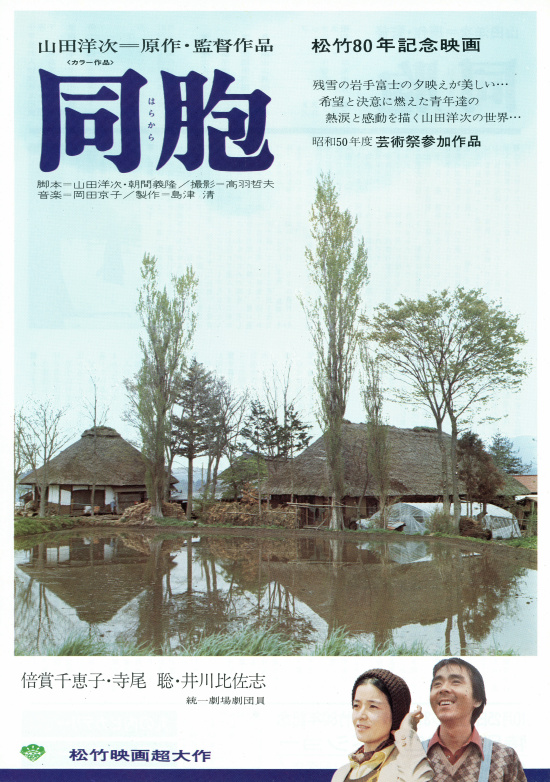
The Village posterBest known for the long running Tora-san series, Yoji Yamada has often been disregarded by international critics for a perceived over indulgence in sentimentality. Nevertheless, his films are often at pains to capture a Japan which is changing with a noted ambivalence towards the results of those changes. Home From the Sea had rooted itself in the difficult decision of a young couple in realising that their way of life was no longer sustainable in a rapidly modernising economy. The Village (同胞, Harakara) returns to a similar theme, once again harping on “furusato” while the conflicted younger residents of a farming village struggle with the decision to accept the life passed down to them by their parents or abandon it in favour of the bright lights of an urban future.

Narrated by Takashi (Akira Terao), a young farmer and president of the local youth club, The Village revolves around one heady spring in which the arrival of a sophisticated woman from Tokyo injects additional stimulation into the sometimes stagnant community. Takashi, in many ways a very typical resident of Matsuo and many other rapidly depopulating rural villages like it, has taken over his family dairy farm following the death of his father when he was relatively young. His brother, Hiroshi (Hisashi Igawa), took a factory job to help make ends meet and put Takashi through school but has now become embittered and resentful as the widowed father of two young girls. Trapped by circumstance he berates Takashi for his diffidence in remaining uncommitted to farm life while perhaps dreaming of something better that he is too afraid to pursue.

The arrival of Hideko Konno (Chieko Baisho) seems to give Takashi a new sense of purpose. Hideko works for an itinerant theatre company based out of Tokyo which makes a point of taking shows to remote areas which might not ordinarily get much access to the arts. The snag is that the locality will have to take the responsibility of producing the show and absorbing the shortfall should they fail to sell enough tickets to cover costs. Takashi is tempted but he’s also well aware of the risks – the investment is sizeable given the relative poverty of the rural area and the risks involved with failure extreme.

Yamada places the dilemma surrounding whether or not to produce the show at the forefront, but the questions are bigger than they might at first seem. It has to be said that farming, whatever its rewards, is an extremely hard life. As a character puts it in the emotively titled play “Furusato”, it’s disheartening when you get a bad harvest and all your work goes for nothing but it’s almost worse when the harvest is good and the value of your work drops exponentially. For Takashi and the others, the youth association is a much needed social outlet even if many of them regard it as something of a joke and rarely get around to doing very much with it. The idea of the play is attractive to them for several reasons, having something more interesting to do not the least among them, not to mention offering a valuable break in routine in what can often be an overly ordered and somewhat stagnant existence.

However, the very same reasons the play appeals to the youngsters are the ones their elders find suspicious. Having made their peace with rural life and learned to adapt to its rhythms, the older generation worry that the young ones are being swayed by outside influences and neglecting their work in favour of idle pursuits. Meanwhile, many of the youngsters have already left to try their luck in the cities, some of them returning and bringing new experiences back with them while others resolve to remain where the lights are brighter.

Setting the scene, Yamada reminds us the factories have long been encroaching on farmland and that this “ancient” way of life is becoming ever harder in a rapidly modernising economy, but through their involvement with the play and its extremely close to home themes, the members of the youth association are finally able to look at their village through new eyes, seeing not only its immense visual beauty for the first time but learning to reappreciate the value of community and friendship. Life in the city might be more glamorous but perhaps it’s no less hard and only lonely in a different way. At once a celebration of and lament for a changing rural landscape, The Village asks an accidentally profound series of questions about life and happiness but once again puts its faith in goodhearted people creating meaning from togetherness in a world that might otherwise set them apart.


Original trailer (no subtitles)
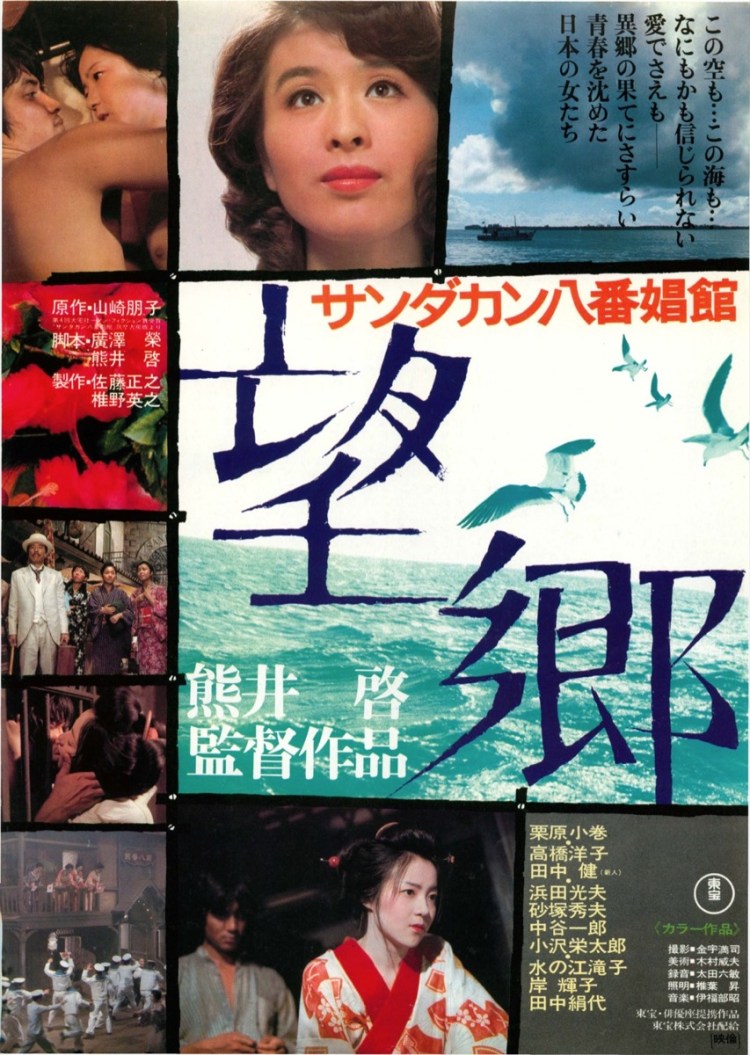
The Inugami Family (犬神家の一族, Kon Ichikawa, 1976)

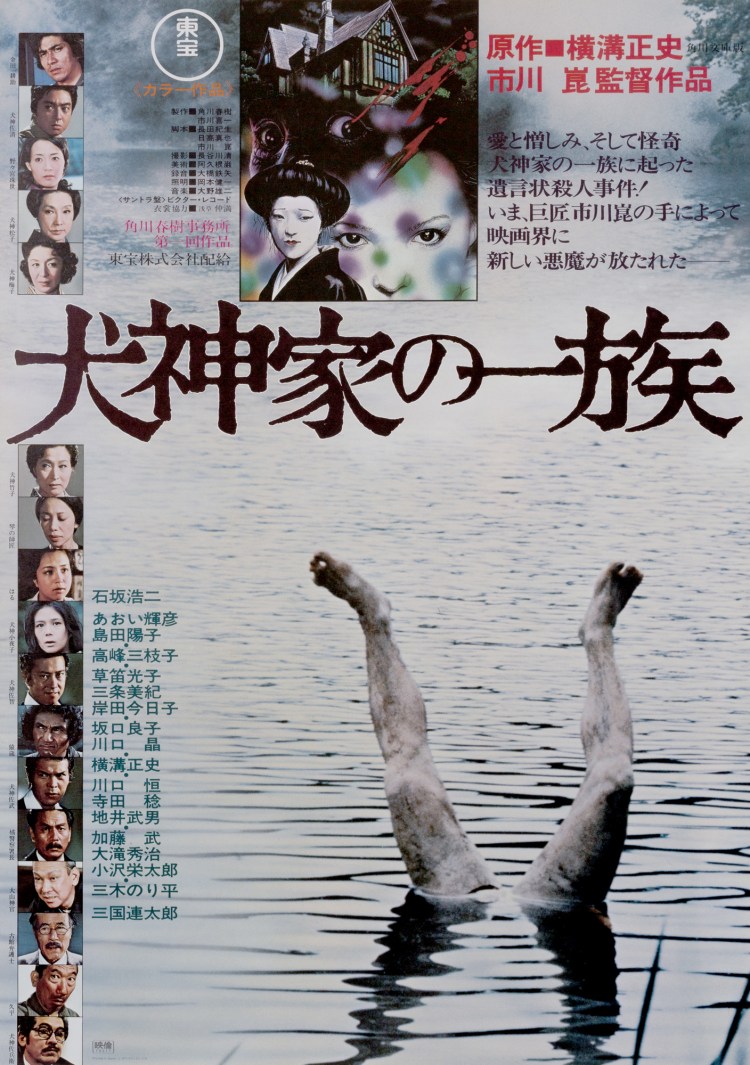
the inugami family 1976 posterUnlike many of his contemporaries, Kon Ichikawa was able to go on working through the turbulent ‘70s and ‘80s because he was willing to take on purely commercial projects. The phenomenal and hugely unexpected success of 1976’s The Inugami Family (犬神家の一族, Inugami-ke no Ichizoku) set him in good stead for the rest of the decade during which he followed up with another four movies starring Koji Ishizaka as the eccentric detective Kosuke Kindaichi as featured in the novels of Seishi Yokomizo each of which was a bonafide box office success partially thanks to the effect of Haruki Kadokawa’s intensive multimedia marketing strategy then still in its infancy. In fact, Ichikawa would return to the sordid world of the Inugamis for his final picture in which he dared to remake his “greatest hit” with a now much older Koji Ishizaka reprising his role exactly 30 years later. Ichikawa might have been making “commercial” movies, but he never lost his experimental spirit.

Old Sahei Inugami (Rentaro Mikuni) finally drops dead in 1947 after a lifetime of seemingly doing exactly as he pleased. As a 17-year-old orphan he was taken in by a kindly priest and thereafter founded one of the biggest pharmaceuticals companies in Japan which is to say he leaves behind him a vast estate and desirable name. Unfortunately, he also leaves a messy family situation. Sahei was never legally married, but fathered three daughters with three different women who each have a son. In his 50s, he also fathered a son with his maid who would be about the same age as the grandchildren if anyone knew where he was. Sahei’s will, which in dramatic fashion can only be read with everyone present, leaves everything to a young woman, Tamayo (Yoko Shimada), who isn’t even part of the family but was doted on all the same by the elderly patriarch. In order to inherit, Tamayo must consent to marry one of the three grandsons – Suketake (Takeo Chii), Suketomo (Hisashi Kawaguchi), or Sukekiyo (Teruhiko Aoi) with whom she seems to have shared a past attachment. The will stresses that she is free to choose though if she decides to marry someone else entirely, the fortune will be divided in five with one part each to the grandsons and the rest to the maid’s son. As one can imagine, the daughters are furious.

Kindaichi is called in by a clerk (Hajime Nishio) at the solicitor’s office who has seen the will and finds it all decidedly strange (plus he’s in love with Tamayo so it’s very bad news for him). The clerk gets murdered before he can spill the beans, but the solicitor himself, Furudate (Eitaro Ozawa), decides to enlist Kindaichi’s help in figuring all of this out before it claims any more lives. Unfortunately, claim more lives it will.

Greed, as ever, is at the root of all evil but like the other entries in the Kindaichi series the crimes are largely a result of the world which surrounds them. Old Sahei made his money in some dubious ways. Ingratiating himself with the rich and powerful, later becoming a militarist for what seems like opportunistic reasons, he got himself special dispensation to grow poppies for their medicinal properties. Which is to say, he got rich selling opium to the masses. Inugami pharmaceuticals profited hugely from suffering incurred in wars spanning the century – with Russia, with China, through the first world war and the second. There was Inugami, ready to fuel the fire by numbing the pain.

Yet it’s his own unresolved emotional suffering that seems to have sent him such a dark and amoral path. Later we discover that a strange and emotionally difficult set of circumstances involving a quasi-incestuous, bisexual love triangle seem to have left him craving something to numb his own pain but only succeeding in passing it on to those around him. Firstly through the women he kept around to satisfy his carnal desires and then sent away, keeping the children with him but in a loveless, austere home. The sisters – Matsuko (Mieko Takamine), Takeko (Miki Sanjo), and Umeko (Mitsuko Kusabue) share an uneasy sort of camaraderie but are quick to turn on each other when it becomes clear that only one of them will inherit the family fortune and that they are now each rivals for the hand of Tamayo.

Like their grandfather, the Inugami boys are not an especially good catch. Two of them eventually attempt to rape Tamayo in an attempt to force her into marriage through shame (despite the fact that one has already fathered a child with his cousin), while she also has her doubts that Sukekiyo, with whom she has always felt a connection, is really who he says he is. Having gone away to the war, Sukekiyo did not return home after being demobbed because of intense survivor’s guilt. He also sustained severe burns to his face which require him to wear a latex mask over his entire head making positive identification difficult seeing as his voice, which he rarely uses, is also changed.

Rather than submit himself to the necessarily pokerfaced approach common to prestige murder mysteries from across the globe, Ichikawa uses the saleability of the property as an excuse to go all out. His tone varies wildly, almost to the point of parody in his frequent cuts to Kindaichi causing another of his famous anxiety induced dandruff avalanches. The blood eventually flies as do severed heads while upended corpses do handstands in lakes. The story of the Inugami family is a strange one filled with moments of bizarre whimsy but somehow it all works. As in many a Japanese mystery, the past refuses to die and the guilty eventually realise how misguided their enterprise has been, but there is hope for those left behind if they can free themselves from the cycle of guilt and suffering on which the Inugami name was built.


Original trailer (no subtitles)
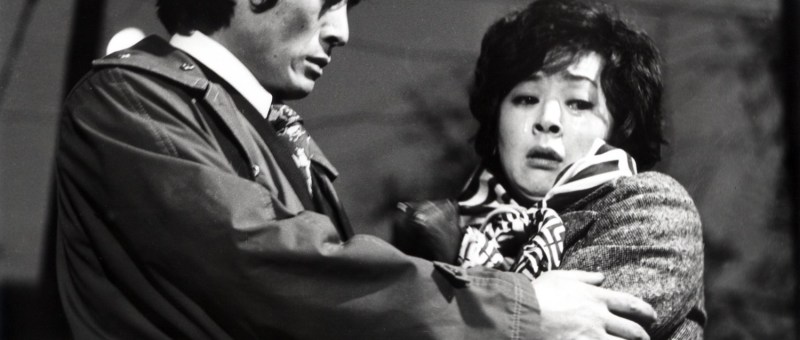
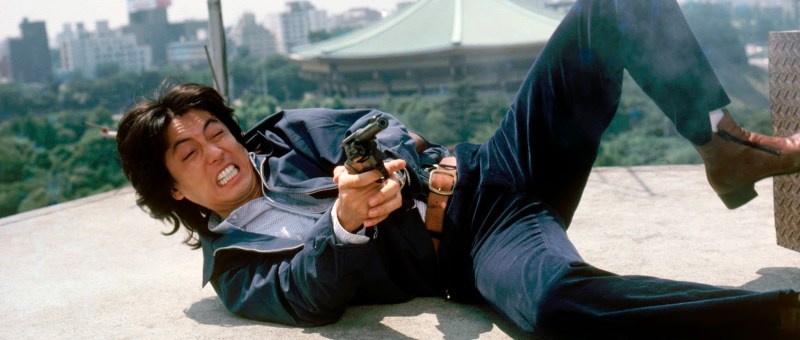
The Man Who Stole the Sun (太陽を盗んだ男, Kazuhiko Hasegawa, 1979)

(C) Toho 1979

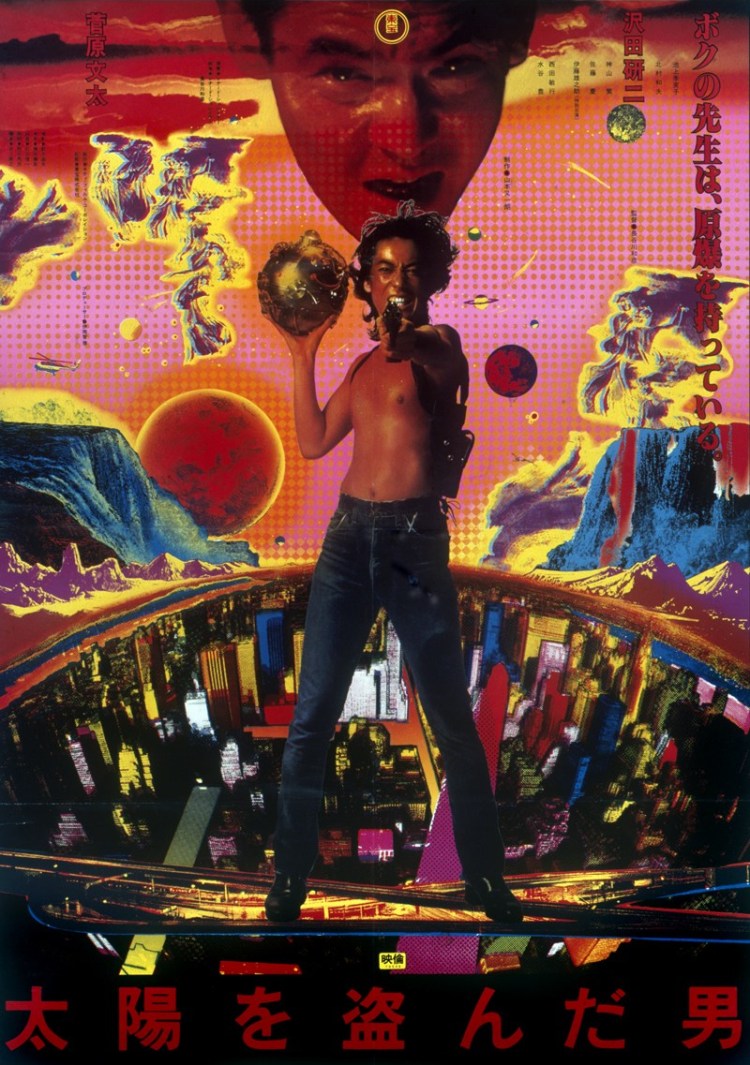
man who stole the sun posterIn the post-Asama-Sanso world, Japanese society had shifted into period of intense calm in which improving economic prosperity was in the process of delivering comfort rather than the creeping acquisitive anxiousness that began to overshadow the bubble era. Nevertheless, in cinematic terms at least anxiety was everywhere and not least among the young who, swept along by this irresistible economic current, were quietly doubtful about their place in a changing society. Co-scripted by an American screenwriter, Leonard Schrader (brother of Taxi Driver’s Paul), The Man Who Stole the Sun (太陽を盗んだ男, Taiyo wo Nusunda Otoko) provides a satirical snapshot of this confusing moment as an oppressed, belittled high school science teacher builds an atomic bomb in his apartment just to show he can but then realises he has absolutely no idea what to do with it.

Technically speaking, the science teacher’s name is Makoto Kido (Kenji Sawada) but no one really calls him that. The kids at school refer to him as “Bubble-gum” because he always seems to be chewing on the rather childish confectionary. Not the most conscientious of teachers, he tailors the curriculum to his own interests, teaching the kids all about atomic energy and the bomb, but the kids aren’t interested. They only want to know what’s going to be on the test. To them Kido’s information is irrelevant and so they ignore him, talking amongst themselves while he carries on, preaching to a seemingly empty room.

Meanwhile, Kido is building the bomb at home, for real. As he tells the kids, anyone can build an atomic bomb – you only need the plutonium which is, admittedly, tightly controlled for just this reason. He acquires his through a daring heist on a nuclear plant. Kido never elaborates on what prompted him to begin his bizarre masterplan, but there is certainly a degree of pent up rage inside him born of resentment with his reduced circumstances. “Just” a high school science teacher, who would really think he’d have the capability to build an atomic bomb, alone, using only household equipment (plus the plutonium and a custom furnace purchased after nearly exploding his oven)?

Kido’s problems are the same as many middle-aged men in ‘70s Japan in that he feels intensely oppressed from above and below. What he’s trying to tell the kids is that they have access to this power already – anyone can build a bomb, if you bother to learn how. The only thing that’s being kept from him is the plutonium (and for good reason), which he manages to acquire anyway. A chance encounter with the madness of the age seems to kickstart his plan into gear when he meets his opposing number in police inspector Yamashita (Bunta Sugawara).

Kido, having halfheartedly escorted a group of students on a school trip, finds himself rendered powerless once again when the bus is hijacked by a distressed older gentleman (Yunosuke Ito) armed with a rifle and grenade and wearing a World War II soldier’s uniform. He demands to be driven to see the emperor from whom he intends to demand the return of his son, presumably killed in the war 30 years earlier. Yamashita, clean cut and authoritative, is the gung-ho cop who masterfully brings the hostage crisis to a close by lying to the man that the emperor has consented to see him. During the evacuation the old man is killed by police snipers (despite Yamashita’s too late cries of “don’t shoot” after having dispatched the grenade and disarmed the suspect).

Like Kido, the old man likely didn’t really know what he intended to do, only that he was lonely and desperate. The emperor couldn’t give him back his son (whose uniform he seems to be wearing) and his gesture is one of futile defiance coupled with a suicide bid that has no real goal save making an elaborate protest against the world in which he lives. Kido makes the bomb, lets the authorities know he has it, but then realises he has no demands. He asks them to fix something minor that annoys him, to stop the TV networks pulling the plug on late running baseball games to make way for the news, and finds himself rewarded. He has taken back the power, they believe he has the bomb and they fear him, but he has no further goals or notion of how his society should change. There is no idealised future he is fighting for, all there is is futility and indifference.

Meanwhile, ironically enough, Kido’s desperation provokes a mini revolution in others. A talkshow radio host (Kimiko Ikegami) named “Zero” (in contrast to Kido’s adoption of the codename “No. 9” as the 9th owner of a nuclear device and the only individual), broadcasts his on-air request for ideas, believing it to be a kind of thought experiment. The ideas she gets from the public are of the usual kind – lonely men who want to bathe with naked women, nationalists who want to start a war with America, dreamers who think it might be better not to want anything and just embrace the dream, while she muses that she wants the Rolling Stones concert that was cancelled a few years ago after a band member’s narcotics conviction to be reinstated. That being as good as anything is what Kido goes for in an overture that passes as an odd kind of romance and a suitably ironic kick back against strait-laced authority.

Kido’s war is, in a sense, a war with the fathers of the world as symbolised by men like Yamashita with their suits and neatly trimmed haircuts. Their button-down existence has never offered anything to men like Kido who feel trapped and angry within it. Yet Yamashita is also reacting against his own generation of fathers as symbolised by the old man on the bus, the last remnant of wartime resistance offering a defeated cry against a world which got away from them. Yamashita let the old man die when he prioritised his own sense of heroism, and that annoyed Kido. He can’t help sympathising with his plight which is in a way also his own in being relentlessly silenced and ignored by austere authority figures.

Turning down Yamashita’s clumsy attempt at a pickup, Zero affirms that Kido has given her a dream, which no small thing and she feels bound to him because of it. It’s an ironic statement because Kido has no dreams and not only that, he has no future either – he is slowly dying of radiation poisoning despite his precautions during the building of the bomb. In their final confrontation, Yamashita, adopting a paternal authority, neatly summarises Kido’s dilemma. The only life he has the right to take is his own, and his own death is the only thing he really wants, but he’s embarked on this elaborate plan to make his presence felt all the while aware that he will remain totally anonymous. No one will ever see him. He will die, like thousands of others, faceless. A lowly high school science teacher, no terrorist mastermind or bomb building genius. His revenge is as absurd as it is futile. Male inferiority complexes threaten to drown us all in a sea of violent resentment, and as the Earth dies screaming all we will have to reflect on is that we ourselves brought this world into being through our own incurable apathy.


Original trailer (no subtitles)

The Midnight Sun (0시(영시) / 0時, Lee Man-hee, 1972)

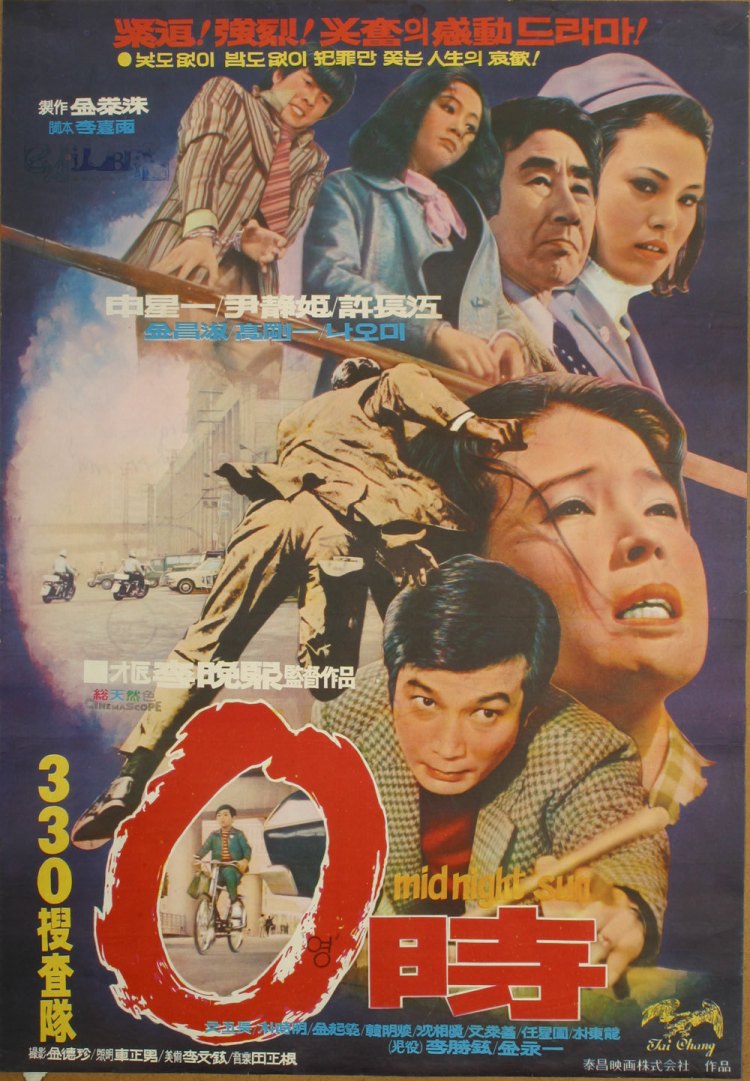
midnight sun posterIn Korean cinema, the police are a problematic presence. Often corrupt, violent, self-interested, and incompetent, even when the cops are the good guys it’s generally because they’re badder than the bad. 1972’s The Midnight Sun (0시(영시) / 0時, 0 Shi), however contains a rare example of a virtuous policeman whose fierce commitment to ethical values perhaps runs too far in endangering his role as a husband and father.

Police captain Jang Jung-han (Heo Jang-gang) has been charged with tracking down a couple of delinquents who’ve been going round committing robberies on a motorcycle they stole from the son of a high ranking police officer. Meanwhile, his son, Kyuseok, has made friends with a boy from the country, Dol Lim, who’s looking for his sister. Feeling sorry for the boy who’s all on his own, Jang takes him in until Kyuseok manages to get him a job as a greeter outside a local restaurant. Complications arise when Lee Min-soo (Mun Oh-jang), a felon previously arrested by Jang, is released and signals his intention to get revenge on Jang whom he blames for the death of his son while he was inside.

Jang is in all ways a model police officer who is good at his job and pursues all of his investigations with the utmost professionalism. His work is, however, not always compatible with being a regular family man. An early scene sees him greeted by his young son, up early on a part-time job delivering newspapers on his flashy pushbike, who reminds him he’s not been home in a couple of days. Kyuseok has been given a message from both his aunt and his mum to make sure his dad remembers to come home early – Jang has completely forgotten that it’s his wife’s birthday (and not for the first time).

Though she has long made her peace with being a policeman’s wife, Mrs. Jang (Yoon Jeong-hee) has her share of troubles with a husband whose safety is not assured while he is often absent from home for extended periods of time. Jang’s salary is also comparatively low and the family have a very modest quality of life with little chance of any kind of advancement. For all of these reasons, she counsels her sister, Hye-rung (Kim Chang-sook), not to get into a relationship with Jang’s junior officer, Park (Shin Seong-il). Hye-ryung, unmarried, lives with the Jangs and works as a tour guide on a tourist bus. Rather than advocating marriage, Mrs. Jang thinks her sister should look into becoming an air hostess, hinting at new possibilities outside of the home for the next generation of Korean women. Despite her sister’s advice, however, Hye-ryung purses a tentative, spiky romance with Park even if somewhat irritated that he only takes her out for noodles rather than something fancier. A policeman’s salary only stretches so far, after all.

Jang’s loyalties are strained when his cases begin to overlap. Lee Min-soo has returned from his prison sentence to find his wife has left him for another man and his son has died. Lee only turned to crime because his son was ill and he needed money for medical treatment, but Jang wouldn’t listen to his mitigating circumstances and arrested him anyway. While he was inside his boy died and Lee holds Jang responsible. In revenge, he kidnaps Kyuseok but rather than drop everything to look for his son, Jang continues to work on the delinquent case and reminds his colleagues to split their workloads. He regards his son’s predicament as “personal” and refuses to dedicate extra resources or take men and time away from other matters for his own benefit. Jang’s coolness further strains his relationship with his wife who can’t understand why he isn’t trying harder to find their son. Yet in Jang’s officious mind, to do so would be wrong and a betrayal of his duty as a police officer.

Lee eventually decides to give up on his revenge and let Kyuseok go after bonding with the boy and being swayed by his cheerful innocence. Kyuseok forgives his kidnapper and wants his dad to do the same. Jang too is a compassionate soul – he is eventually able to help Dol Lim find his sister though, unfortunately, also has to arrest her. Like Lee, Dol’s sister is also forced into a reconsideration of her life of crime after seeing her brother. Arrested by Jang, she resolves to atone, swaps her bright red mini skirt for modest attire, and ties her hair up in a more innocent style. She even manages to convert her boyfriend to the same cause and the pair decide to get married once they’ve paid their debts to society. Wanting to help Dol, Jang does his best to get the pair as a light a sentence as possible while ensuring justice is served both on a legal and on a human level.

Mixing the crime genre with family drama, Lee Man-hee continues his tendency towards experimentation but with a more hopeful outlook, allowing for a happier ending in which family bonds are restored and crimes forgiven rather than punished. Rather than the frustration and inertia which often traps Lee’s conflicted heroes, Jang and his family are able to free themselves from their various prisons through nothing more than compassion and goodness. Sponsored by the Seoul Metropolitan Police Agency, Midnight Sun is an oddly cheerful piece of pro-police propaganda in which the stigmatised face of authoritarian rule is given a humanising makeover even while remaining steadfast and selfless in the pursuit of justice.


Available to stream online via the Korean Film Archive’s YouTube Channel.

Home from the Sea (故郷, Yoji Yamada, 1972)

Home from the sea still 1By the early 1970s, Japan was well on its way to an economic recovery with memories of post-war privation fading and modern consumerism rapidly taking hold in the national mindset. Contemporary cinema understandably saw this as a good thing, that brighter times were coming and soon enough everyone would be enjoying a comfortable, prosperous life. The future, however, was not always evenly distributed and modernisation brought with it problems as well as solutions. Yoji Yamada’s Home from the Sea (故郷, Kokyo/Furusato*) paints a melancholy picture of a changing Japan as an earnest young couple are forced to consider leaving their beloved hometown to seek their fortunes elsewhere.

Seiichi Ishizaki (Hisashi Igawa) owns a small transport boat he uses to ferry rocks between construction sites. He is sometimes joined by his wife, Tamiko (Chieko Baisho), who serves as the boat’s engineer. The couple live with Seiichi’s elderly father (Chishu Ryu) and their two daughters on a small island in the Inland Sea. Times are hard. Fuel costs are increasing making Seiichi’s business much less profitable while his boat is old and slow. The maintenance costs alone are difficult to contemplate and the family cannot afford to invest in one of the new steel boats which are currently sucking up most of the available work. Seiichi’s younger brother who used to work on the boat with him has already given up and moved on, taking his wife and children to another town where he works in a factory. Many people seem to think Seiichi would do well to do the same, but he is stubborn. He refuses to be pushed out of his ancestral home and occupation simply because of the unfairness of his times.

A little way into the film, a friendly fishmonger, Matsushita (Kiyoshi Atsumi), who often stops by to have dinner with the family expounds on the beauty of the town. He can’t understand why anyone would want to leave somewhere as lovely as this. Unlike the Ishizakis, Matsushita wasn’t born on the island but in Korea – his parents died during the repatriation after the war and he’s been getting by on his own ever since. He’s done many different jobs and lived in many different places but has chosen to make his home here. A fishmonger’s job is probably always safe (to an extent, at least) in a small harbour town, but Seiichi’s isn’t and he needs money to feed his family. There is no other work on the island, and so there is no way to stay without making the boat pay.

The boat, however, is already 19 years old. Transport ships are only intended to last 10. The engine is faulty and the hull is in desperate need of repair but a visit to the original shipwright reveals that to do so would not be cost effective. The best thing to do would be to buy one of the shiny new steel vessels like their neighbour’s, but that’s far out of Seiichi’s reach. All along the shoreline, you can see the charred remains of boats belonging to those like Seiichi who’ve finally come to the conclusion that their era has passed.

“Can’t beat the Big” is a local mantra. In early ‘70s Japan, counterintuitively enough, size is everything. Not just the boats themselves, but the fleets and the architecture of life. You can’t survive as your own boss anymore because the little guy alone has no power when corporations and conglomerates are extending their reach even into tiny islands. Seiichi goes to have a look at the factory in Onomichi to which he’s been recommended by a friend. It’s not as bad as he thought, but it’s huge and filled with hundreds of identically dressed faceless men. The food is awful, and they’d have no friends. Nevertheless, needs must. If you can’t fight the Big you’ll have to become a part of it or it’ll swallow you whole.

Still the sadness of leaving one’s hometown behind against one’s will with one eye always looking back towards the shoreline is difficult to bear. Seiichi’s father, who had been looking after the children and was therefore extremely close to them, will be staying behind with no one left to look after him save the community itself. Progress might be a good thing, but there are costs too and small town Japan is one of them. It’s sad, but there’s nothing you can do about it. The post-war world might not require so much “gaman” anymore, but bearing the demands of modernity just might.


*According to Shochiku’s website and the narrator in the trailer, the official title is “Kokyo” which is the Sino-Japanese reading of the kanji (故郷) but it’s also often listed under the title “Furusato” – the slightly more emotive native Japanese reading.

Original trailer (no subtitles)