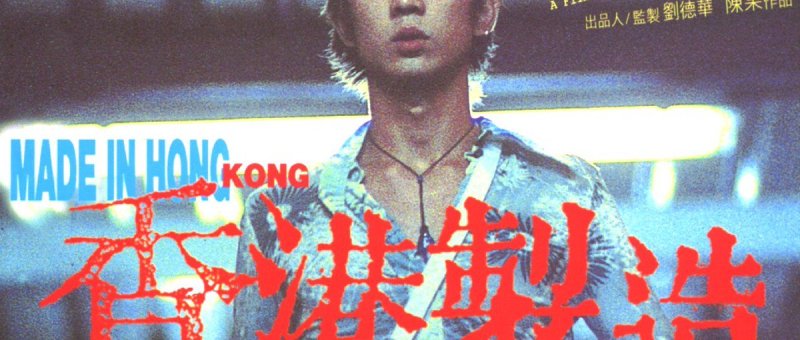
Made in Hong Kong (香港製造, Fruit Chan, 1997)

made in HK vertical posterThe Hong Kong of 1997 becomes teenage wasteland for the trio at the centre of Fruit Chan’s urgent yet melancholy debut, Made in Hong Kong (香港製造). Made on a shoestring budget using cast-off film and starring then unknowns, Chan’s New Wave inflected meditation on dead end youth is imbued with the sense of endings – illness, suicide, murder, and despair dominate the lives of these young people who ought to be beginning to live but find their paths constantly blocked. The world is changing, but far from possibility the future holds only confusion and anxiety for those left hanging in constant uncertainty.

Autumn Moon (Sam Lee), our narrator, is a boy fighting to become a man but too afraid to leave his adolescence behind even if he knew how. Living alone with his mother (Doris Chow Yan-Wah) after his father abandoned the family, Moon is a high school drop out with no real job who spends his time playing basketball with the neighbourhood kids and running petty errands for small scale Triad Big Brother Wing (Sang Chan). Already indulging in a hero complex, Moon is friends with and the de facto protector of a young man with learning difficulties, Sylvester (Wenders Li), who has been disowned by his birth family and is constantly picked on, beaten up, and molested by the local high schoolers. Taking Sylvester with him on a job one day, Moon runs into Mrs. Lam (Carol Lam Kit-Fong) whose debt he’s supposed to collect but when Sylvester has one of his frequent nosebleeds on seeing Mrs Lam’s beautiful daughter, Ping (Neiky Yim Hui-Chi), Mrs. Lam manages to send them packing. Nevertheless, Sylvester and Moon end up becoming friends with Ping and enjoying the last days of Hong Kong together, engaged in a maudlin exploration of teenage mortality pangs.

As Moon puts it in his voice over, everything starts to go wrong when Sylvester picks up a pair of blood stained letters in the street. They belonged to a high school girl, Susan (Amy Tam Ka-Chuen), who we later find out killed herself from the pain of first love. The spectre of Susan haunts the trio of teens left behind who remain morbidly fascinated with her fate yet also afraid and anxious. Together they pledge to investigate her death and return the letters to their rightful owners as, one assumes, Susan would have wanted. Even so, when they finally track down the recipient of the first letter, the man Susan gave her life for, he barely looks at it and tears her carefully crafted words of heartbreak into a thousand pieces, scattering them to the wind unread.

In investigating Susan’s tragic love affair, Moon and Ping begin to fall in love but Ping too already has the grim spectre of death around her. Seriously ill, Ping is at constant risk if she can’t get a kidney transplant but the list is long and she’s running out of time. Moon wants to be the hero Ping thinks he is, but he’s powerless in the face of such a faceless threat. He makes two decisions – one, to get the money to pay her debt, and two to go on the organ donor’s register so that if anything happens to him, Ping might get his kidney, struggling to do something even if it won’t really help.

Powerlessness is the force defines Moon’s life as he adopts a kind of breezy passivity to mask the fact that he has no real agency. He says he doesn’t want to join the Triads full-time because he values his independence, prefers making his own decisions, and hates taking orders but he rarely makes decisions of his own and when he does they tend not to be good ones. Moon drifts into a life of petty gangsterism partly out of a lack of other options, and partly out of laziness. Abandoned by his father and then later by his mother too, Moon’s only real source of guidance is the minor Triad boss Big Brother Wing who, unlike his mother, at least pretends to trust and respect him. Getting hold of a gun, Moon dances around like some movie vigilante drunk on power and possibility but once again fails in the hero stakes when a friend comes to him in desperate need for help but he’s so busy playing the cool dude alone in his apartment that he doesn’t even hear him over the music.

When it comes to pulling a trigger, Moon can’t do it, no matter how many times he’s visualised the moment and seen himself making the precision kill like an ice cold hitman in a stylish thriller. Moon’s illusion of his heroic righteousness crumbles. He couldn’t save his friends, has been rejected by his family, and has lost all hope for a meaningful future. As if to underline the hopelessness and fatalism of his times, Fruit Chan ends on a radio broadcast which instructs the lister to say the same thing again, only this time in Mandarin – the language of the future. Moon, Sylvester, and Ping are all cast adrift in this dying world, abandoned by parental figures and left to face their uncertain futures all alone. As a portrait of youthful alienation and despair, Made in Hong is a timeless parable in which an indifferent society eats its young, but it’s also the story of a Hong Kong Holden Caulfield standing in for his nation as they both find themselves approaching an unbreachable threshold with no bridge in sight.


Screened at Creative Visions: Hong Kong Cinema 1997 – 2017

Trailer for the 4K restoration which premiered at the Udine Far East Film Festival 2017 (English subtitles)

Green Fish (초록 물고기, Lee Chang-dong, 1997)

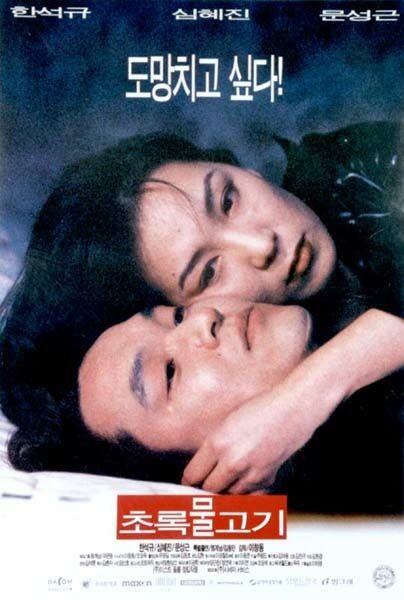
Green Fish poster

You can never go home again. Lee Chang-dong’s debut, Green Fish (초록 물고기, Chorok Mulgogi), is as much a chronicle of his rapidly modernising nation’s gradual loss of innocence as it is that of its melancholy hero, Makdong (Han Suk-kyu), whose simple dream of family harmony is destroyed by the forces of desire and oppression. Perpetually someone’s little brother, Makdong struggles but finds no schoolyard protectors in his ongoing quest for leadership and direction from someone or something external to himself. All he finds is a gradual descent into darkness and criminality in which misplaced loyalties eventually carry the heaviest of penalties.

Returning home from his mandatory military service, still dressed in his warm weather combats, Makdong inhales a taste of freedom by hanging out of the open train doorway. He notices a woman doing the same thing a few doors down. Her red scarf floats away on the breeze and hits Makdong in the face. Later he notices the same woman being hassled by a gang of louts and decides to intervene. Despite his military uniform, Makdong is no great warrior and he’s quickly beaten up and humiliated, retreating to the bathroom where he soaks the woman’s scarf in water and puts it over his bloodied face, inhaling her scent through the fabric as it somehow expresses his otherwise repressed scream.

Vowing revenge for his humiliation Makdong jumps off the train and attacks the louts with a heavy stone trophy, but he mistimes his attack and ends up running after the departing carriages before being forced to abandon all hope of catching up and concentrate on evading the louts who are once again on his tail. On his arrival home, Makdong discovers nothing is as he left it. His family is scattered – father dead, mother going mad, one brother married and a policeman though apparently also a drunk, other brother a wideboy punk, little sister working as a hostess, where there were fields now there are apartment blocks as far as the eye can see, only his older brother with developmental disabilities remains the same. Unable to find work, Makdong chases the scent of the woman on the train, eventually encountering her in the city. Miae (Shim Hye-jin) is a nightclub singer involved with petty gangster Bae Tae-gon (Moon Sung-keun). Remaining close to her, Makdong finds himself drawn ever further into Maie’s self destructive spiral of desire and darkness.

Makdong, whose name literally means “youngest sibling”, is perpetually looking for a family. Turned away from the chaos of his childhood home, he looks for it in the traditional place of the dispossessed male – the gang. Desperate to prove himself and be accepted, Makdong is willing to undergo any kind of pain and humiliation. Given his first job, he sings a snatch of the karaoke song playing in the bar about a prodigal son who disappoints his parents, looks himself in the mirror then hesitates before slamming the stall door shut across his fingers, leaving them swollen and bloodied. He then picks a fight with a rival gangster to give Bae Tae-gon an excuse to settle a score. Bae, solicitous, expresses irritation with Makdong’s act of self-harm but also gives him a leg up into the organisation, something which does not prove universally popular with the already established crew.

Bae’s decision to make Makdong his latest “little brother” (a sort of pun on his name and Bae’s position as the gang’s “big brother”), is mirrored in Bae’s own turbulent relationship with his superior/rival, Yang-gil (Myung Gye-nam). Yang-gil, setting up shop right across from Bae’s establishment, describes Bae disparagingly as a scrappy puppy dog biting at his master’s heels. Much as he feels humiliated by Yang-gil’s authoritative disdain, he refuses to move against him, ordering his guys to back off even though it makes him look weak and diminishes him in the eyes of his followers. Just as Makdong has placed his faith in Bae, Bae’s is already installed in Yang-gil, something which Makdong tragically fails to understand.

Makdong’s loyalty to Bae also presents a conflict in his desire for Miae. A much stereotyped gangster’s moll, Miae is the melancholy nightclub singer familiar from classic noir. Her world is just as ruined and broken as Makdong’s. She wants to leave Bae and his life of violent chaos in which she’s often pimped out to serve his interests, but she’s looking for someone to help her, just as Makdong is looking for someone to defend him. A long train journey brings the pair together in a moment of innocent tenderness, but presented with a choice Makdong choses Bae and his new world of male chivalry over his original act of white knight rescue which brought him to Miae’s attention in the first place. Later he makes another, more final choice, burning Miae’s scarf which he’d been carrying like a talisman all along. The flames reflected in his sunglasses give him eyes of fire, but behind the frames there are tears too as he bids goodbye to one dream in the mistaken belief of buying himself another.

Facing his end, Makdong rings home and reminisces about a story of idealised childhood innocence in which he spent a day at the river with his siblings, trying to catch the green fish of the title from under a railway bridge. Earlier on the family had another picnic in a similar spot which quickly degenerated into a chaotic family spat with the trains passing ominously behind them. The world that Makdong wants is already fading, he is, in some sense, already its ghost and the future has no place for him. His dreams were small – a modest family restaurant, and a return to the warmth and security he felt as a child surrounded by unconditional love. His family, however, no longer support him, he is alone and unloved. The world has moved past him like a train leaving the station, Makdong runs but he can’t catch up. The future belongs to those who can move fast enough to adapt to the new reality of modern Korean life, not to old romantics like Makdong who still believe in archaic ideals of family and brotherhood. Yet, there is something of that old world remaining in the posthumous fulfilment of Makdong’s only wish, even if he himself is not permitted to witness it.


Screened at London Korean Film Festival 2017.

Cabaret scene (no subtitles)

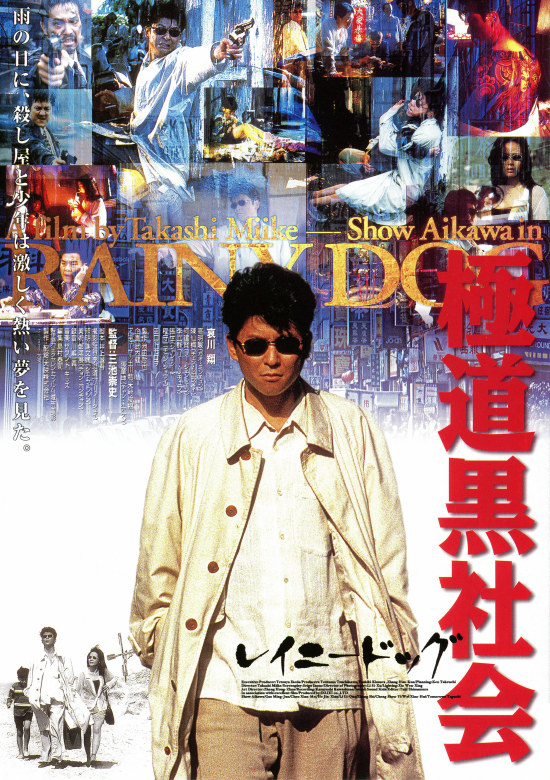
Rainy Dog (極道黒社会, Takashi Miike, 1997)

rainy-dogThey say dogs get disorientated by the rain, all those useful smells they use to navigate the world get washed away as if someone had suddenly crumpled up their internal maps and thrown them in the waste paper bin. Yuji (Show Aikawa), the hero of Rainy Dog (極道黒社会, Gokudo Kuroshakai) – the second instalment in what is loosely thought of as Takashi Miike’s Black Society Trilogy, appears to be in a similar position as he hides out in Taipei only to find himself with no home to return to. Miike is not generally known for contemplative mood pieces, but Rainy Dog finds him feeling introspective. A noir inflected, western inspired tale of existential reckoning, this is Miike at his most melancholy but perhaps also at his most forgiving as his weary hitman lays down his burdens to open his heart only to embrace the cold steel of his destiny rather than the warmth of his redemption.
Yuji’s day job seems to be hulking pig carcasses around at the meat market but he’s also still acting as a button man for the local Taiwanese mob while he lies low and avoids trouble in Taipei following some kind of incident with his clan in Japan. Receiving a call to the effect that following a change of management it will never be safe for him to go home, Yuji is as lost as a dog after the rain but if there’s one thing he hadn’t banked on it was the appearance of a rather sharp Taiwanese woman who suddenly introduces him to a mute little boy who is supposedly his son. Yuji is not the fatherly type and does not exactly take to his new responsibilities. He half remembers the woman, but can’t place her name and isn’t even sure he ever slept with her in the first place. Nevertheless, Ah Chen follows Yuji around like a lost little puppy.

Two more meetings will conspire to change Yuji’s life – firstly a strange, besuited Japanese man (Tomorowo Taguchi) who seems to snooze on rooftops in a sleeping bag and is intent on getting the drop of Yuji for undisclosed reasons, and the proverbial hooker with a heart of gold (and a fancy computer for running an internet blog) with whom he will form a temporary makeshift family. Getting mixed up in something he shouldn’t Yuji’s cards are numbered, but then it couldn’t have been any other way.

As in Shinjuku Triad Society, Miike returns to the nature of family and of the tentative bonds which emerge between people who have been rejected from mainstream society. Yuji is a displaced person, forced out of his homeland and lost in a foreign city. Though he appears to have a good grasp of the local language, the landscape confuses him as he wanders through it like the man with no name, adrift and permanently shielded by his sunglasses. The Taiwanese gangster he’s been freelancing for repeatedly describes him as “like a son” despite the fact that they seem to be around the same age but it’s clear that he could have Yuji eliminated in a heartbeat if he found he’d outlived his usefulness.

Similarly, Yuji does not immediately jump into a paternal mindset when presented with this strangely cheerful young boy. Eventually he lets him come out of the rain and presents him with a towel, greeting him with the words “you’re not a dog” but subsequently abandons him for what seems like ages during his time with the prostitute, Lily, who describes his tattoos as beautiful and shares his dislike of the intense Taipei rain. Asked if she’s ever considered going somewhere sunnier, Lily admits that she has but the fear that perhaps it would all be the same (only less wet) has put her off. Perhaps it’s better to live in hope, than test it and find out it was misplaced.

Gradually, Yuji begins to a least develop a protective instinct for Ah Chen as well as some kind of feeling for Lily which leads him to carry out another hit in order to give her the money to escape on the condition that she take Ah Chen with her. However the trio get ambushed on their way out ending up at a beach leaving them with nowhere left to run, signalling the impossibility of getting off this inescapable island. Just when it seems all hope is lost, Ah Chen finds a buried scooter which he and Lilly begin to dig up. Eventually, Yuji joins them, fully confirming his commitment to the mini family they’ve accidentally formed as they work together to build themselves a way out. Yuji’s decision separate from them and return to the world of crime, albeit temporary, will be a final one in which he, by accident or design, rejects the possibility of a more conventional family life with Ah Chen and Lilly for the destiny which has been dogging him all along.

Birth and death become one as Yuji regains his humanity only to have it taken from him by a man exactly mirroring his journey. There are no theatrics here, this is Miike in paired down, naturalistic mode willing to let this classic story play out for all that it is. Working with a Taiwanese crew and capturing the depressed backstreet world of our three outcasts trapped by a Taipei typhoon for all of its existential angst, Rainy Dog is Miike at his most melancholic, ending on a note of futility in which all hope for any kind of change or salvation has been well and truly extinguished.


Original trailer (English subtitles)

https://www.youtube.com/watch?v=bgN0BnrwruQ

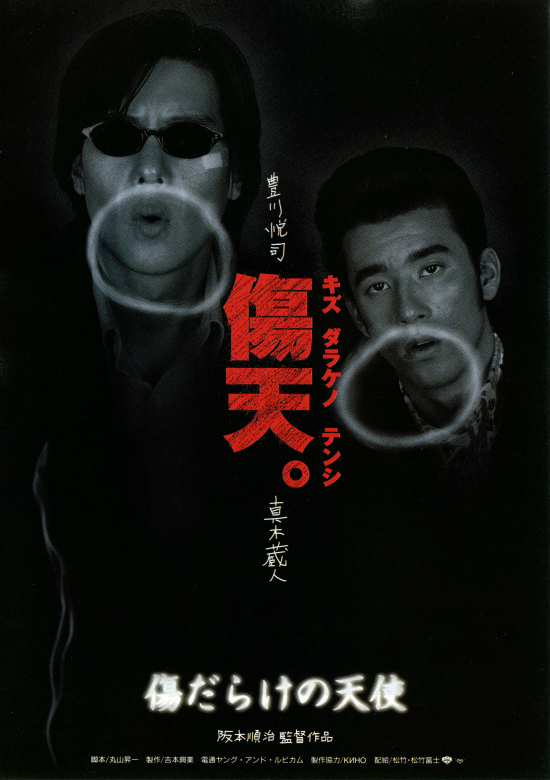
Injured Angels (傷だらけの天使, Junji Sakamoto, 1997)

injured-angelsDespite having started his career in the action field with the boxing film Dotsuitarunen and an entry in the New Battles Without Honour and Humanity series, Junji Sakamoto has increasingly moved into gentler, socially conscious films including the Thai set Children of the Dark and the Toei 60th Anniversary prestige picture A Chorus of Angels. Injured Angels (傷だらけの天使, Kizudarake no Tenshi) marries both of aspects of his career but leans towards the softer side as it finds genial private detective Mitsuru (Etsushi Toyokawa) accepting a request from a dying man to ensure the safe passage of his young son to the boy’s mother in Northern Japan.
Reluctantly taking on an assignment to question the last remaining tenant of an office block, Mitsuru discovers the man inside already mortally wounded. During their conversation, the man offers him all the money he has left to take his young son to his estranged wife, currently living in a small town in the North of Japan. Mitsuru doesn’t really want this kind of hassle but feels sorry for the man and his son and eventually decides to make sure the boy, Hotaru, gets to someone who can take of him. The pair set off on a kind of road trip eventually joined by Mitsuru’s partner Hisashi (Claude Maki) meeting friends old and new along the way.

Inspired by the 1970s TV series of the same title, Injured Angels adopts an oddly jokey tone throughout as Mitsuru has various strange adventures whilst trying to guide a small child to someone willing to take him in. At one stage, the film goes off on a long and improbable tangent in which Mitsuru runs into an old friend who is currently wearing a lucha libre mask “for work”. The pair then board the bus with the wrestlers before Mitsuru himself ends up in the ring. Though fun, the sequence has little to do with the ongoing plot other than adding to the already absurd atmosphere.

Predictably, when Mitsuru reaches the address he’s been given, Hotaru’s mother has already moved on but even when they eventually find her, the reaction is not the one you’d expect. Soon to be married again, Hotaru’s mother (Kimiko Yo) is not keen to resume custody of her son (or rather, her husband to be has no desire to raise another man’s child and even goes so far as to use physical violence on Mitsuru to show the strength of his feeling). Hotaru starts to grow attached to the two detectives who are probably giving him the most normal kind of family life that he has known for a very longtime. The guys seem to know they can’t keep him indefinitely and are intent on finding another relative but the mini family they’ve formed may be painful to break up.

While all of this is going on, Mitsuru also has a series of meetings with a woman from Tokyo, Eiko (Tomoyo Harada), who keeps bumping into him. Though an obvious attraction develops, Eiko is also fleeing her own kind of trouble and the pair seem content to leave things up to fate and possible drinks in Tokyo at an unspecified point in time, but this oddly integrated plot strand fails to have a real impact within the narrative as a whole. It does, however, add to Mitsuru’s ongoing existential dilemma as he begins to reexamine his life and relationships after bonding with Hotaru. Ultimately he opts for asking his partner, Hiasashi, to move in with him when they get back to Tokyo but at the same time Mitsuru seems to know he may be headed for another destination entirely.

This tonal strangeness is a serious weakness where would expect a more nihilistic atmosphere as Mitsuru’s journey begins to take shape but the inconsequential humour and mildly absurdist approach continues right until the anticlimactic ending. Perhaps feeling a need to recreate the feeling of the TV series, Sakamoto fails to reconcile these differing levels of seriousness into a convincing whole in allowing for the kind of light and breezy action in which everything is definitely going to be OK by next week’s episode. For what’s actually a look at neglected, abandoned children coupled with intense friendships and romantic dilemmas, the bouncy, ridiculous tone is an odd fit and robs the piece of its dramatic weight. Nevertheless, despite the structural problems, Injured Angels is often a fairly enjoyable, if odd, character drama even it ultimately fails to amount to very much as a whole.


Original trailer (no subtitles)

https://www.youtube.com/watch?v=9rbcjFtONGQ

The Eel (うなぎ, Shohei Imamura, 1997)

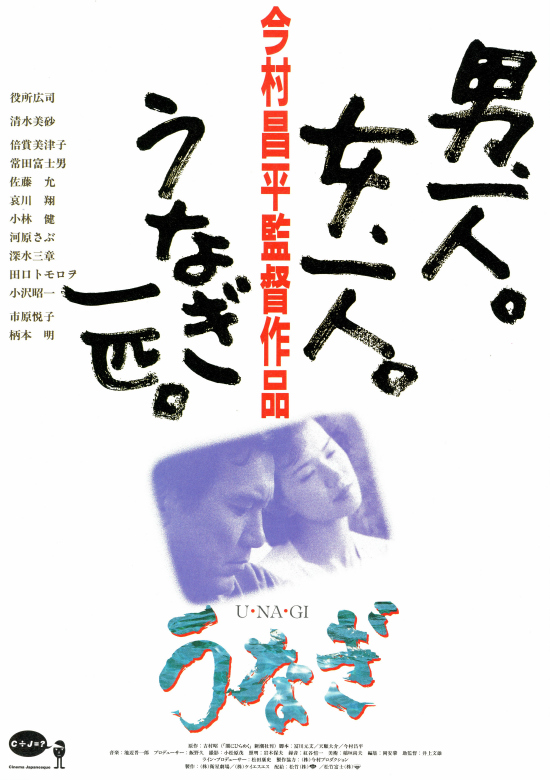
The EelDirector Shohei Imamura once stated that he liked “messy” films. Interested in the lower half of the body and in the lower half of society, Imamura continued to point his camera into the awkward creases of human nature well into his 70s when his 16th feature, The Eel (うなぎ, Unagi), earned him his second Palme d’Or. Based on a novel by Akira Yoshimura, The Eel is about as messy as they come.
Mild-mannered salary man Yamashita (Kouji Yakusho) receives a handwritten letter filled with beautiful calligraphy delivering the ugly message that his wife has been entertaining another man whilst he enjoys his weekly all night fishing trips. Confused at first, the note begins to work its way into Yamashita’s psyche and so he decides to leave his next fishing trip a little earlier than usual. Peeping through the keyhole, he finds his beloved wife enjoying energetic, passion filled sex with another man. Drawing a knife from a nearby shelf, he enters the room and attacks the pair killing the woman but letting the lover get away.

Yamashita immediately and with perfect calmness turns himself in at the local police station, still covered in his wife’s blood and carrying the murder weapon. Released on a two year probationary period after eight years in jail, there is no one to meet Yamashita when he comes out and so he remains under the guardianship of a Buddhist priest in a nearby town. Accompanied by his only friend, a pet eel, Yamashita takes possession of a local disused barbershop and sets about trying to rebuild his life.

Things change when Yamashita comes across an unconscious woman lying in the grass while he’s out looking for things to feed his eel. The strange thing is, this woman looks exactly like his wife. Eventually, Keiko (Misa Shimizu) recovers and comes to work with Yamashita in his new enterprise but as the pair grow closer the spectres of both of their troubled pasts begin to intrude.

As the small town residents of Yamashita’s new home often remark, Yamashita is a strange man. His deepest relationship is with his eel which the prison guards, who seem quite well disposed towards him, allowed him to keep in the prison pond even though pets are not generally allowed. When asked why he likes his eel so much, Yamshita replies that the eel listens to him and doesn’t tell him the things he does not wish to hear. Like Yamashita, the eel is isolated inside his tank, content to absent himself from interacting with other creatures, both protected and constrained by transparent walls.

After his release from prison, Yamashita begins to reflect on his crime which he doesn’t so much regret but has no desire to repeat. His other double arrives in the form of fellow inmate and double murderer Tamasaki (Akira Emoto) who keeps trying to convince Yamashita that he is living dishonestly by not having visited his wife’s grave or read sutras for her. Though Yamashita pays no heed to most of his advice which is more self-pity and anger than any real concern for Yamashita’s soul, some things begin to get to him, most notably that perhaps the fateful letter never existed at all and is nothing more than the manifestation of Yamashita’s jealous rage.

Though the film presents everything that happens to Yamashita as “real”, his state of mind is continually uncertain. Not only is the provenance of the letter doubted, he doubts the existence of Keiko because she looks (to him at least) like the returned ghost of the woman he killed, and even the final confrontational arguments with Tamasaki take on an unreal quality, as if Yamashita were arguing with himself rather than another man who also represents his own worst qualities – impulsivity, violence, self doubt and insecurity. The film is so deeply embedded in Yamashita’s subjective viewpoint that almost nothing can be taken at face value.

Yamashita is, in a sense, trapped in a hall of mirrors as his own faults are reflected back at him through the people that he meets. Keiko, rather than being physically murdered by a jealous lover, attempted to take her own life after being misused by a faithless (married) man. Her past troubles are, in some ways, the inverse of Yamashita’s as she finds herself at the mercy of dark forces but internalises rather than externalises her own anger. Cheerful and outgoing, she quickly turns Yamshita’s barbershop into a warm and welcoming place which the local community takes to its heart.

Yamashita, however, remains as closed off as ever though he does strike up something of a relationship with a lonely young man who wants to use his barber’s pole to try and call aliens. When Yamashita asks him what he’s going to do if the aliens actually come, the young man replies that he wants to make friends with them. Yamashita astutely remarks that the young man’s desire to meet aliens is down to a failure to connect with people from his own planet – an idea which the young man equally fairly throws back at him. Perhaps out of fear rather than atonement, Yamashita exiles himself from the world at large though gradually through continued exposure to the genial townsfolk and Keiko’s deep seated faith in him, he does begin to swim towards the surface.

Imamura adopts his usual, slightly ironic tone to lighten this otherwise heavy tale allowing the occasional comic set piece to shine through. Yakusho delivers another characteristically nuanced performance as this entirely unformed man, unsure of reality and trapped in a spiral of self doubt and confusion. His original crime of passion is at once chilling in its calmness but also messy and violent as he gives in to animalistic rage. After showing us a street lamp glowing an ominous red, Imamura steeps us in blood as his camera becomes progressively more stained making it impossible to forget the shocking betrayal of this unexpected violence.

Yamashita remarks at one point that he died that day alongside his wife. The Eel is a story of rebirth as its protagonists begin to swim towards the shore in support of each other, though like the titular marine creature there is no guarantee that they will make there alive. Yamashita is a cold blooded murderer and creature of suppressed rage yet Imamura is not interested in moral judgements as much as he is in the messier sides of human nature. A chance offering of redemption for the unredeemable, The Eel offers hope for the hopeless in a world filled with goodhearted eccentrics where all faults are forgivable once they are understood.


Original trailer (no subtitles)

https://www.youtube.com/watch?v=yAC3KZth7E0

Lost Paradise (失楽園, Yoshimitsu Morita, 1997)

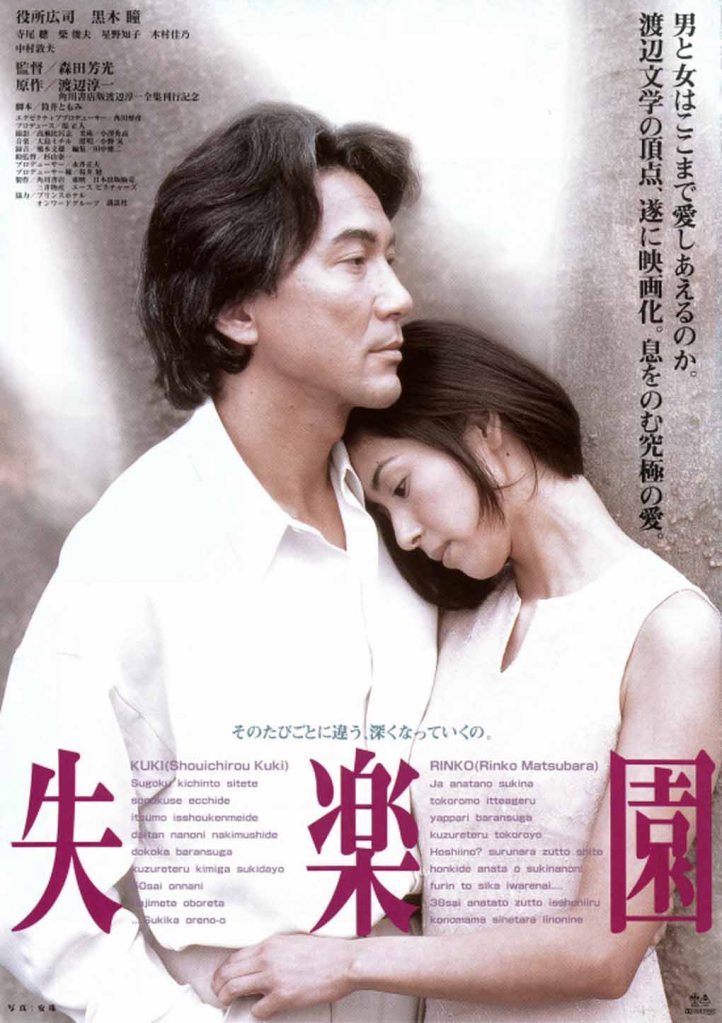
lost paradiseYoshitmitsu Morita tackled many different genres during his extremely varied career taking in everything from absurd social satire to teen idol vehicles and high art films. 1997’s Lost Paradise (失楽園, Shitsurakuen) again finds him in the art house realm as he prepares a tastefully erotic exploration of middle aged amour fou. Based on the bestselling novel by Junichi Watanabe, Lost Paradise also became a breakout box office hit as audiences were drawn by the tragic tale of doomed late love frustrated by societal expectations.
We meet Kuki (Koji Yakusho) and Rinko (Hitomi Kuroki) about to bid each other goodbye for the day, playfully in love though perhaps self conscious. It’s not until later that we realise they are both already married – just not to each other. Kuki, 50 years old, has reached an impasse in his life. Effectively demoted and sidelined at work, his homelife is not exactly unhappy but has long since lost his interest. His daughter is grown up and married herself, his wife has a career of her own, his mortgage is already paid off. There is really nothing left for him to do. That is until he meets calligraphy teacher Rinko and falls passionately in love for the first time in his life.

Rinko, 38, entered into an arranged marriage at 25 though the kindest way of describing it would be “unfulfilling”. Haruhiko (Toshio Shiba), her husband, is a doctor by profession and cuts a cold and distant figure. Prone to violent outbursts and pettiness, he treats Rinko more as a house keeper than a wife ordering her to buy his favourite kind of cheese (even urging her to travel to a different shop if the first one doesn’t have it) but then not even looking up when she brings it into his study for him. Lasciviously poking a spoon into the soupy mess, he pauses only briefly after savouring his first taste to give Rinko her next set of orders with no word of thanks or even acknowledgement of her success in obtaining this oddly specific cheese related request.

Finally in each other Rinko and Kuki find completeness long after they’d stopped seeking it. Rinko is unhappy in an arranged marriage which offers scant comfort, though Kuki’s problems are more akin to a mid life crisis as he finds himself an unnecessary presence at home whilst also realising that he’s already passed the high point of his career. Though there are no real barriers to Rinko and Kuki simply leaving their spouses and starting again together, it’s never quite that simple as the social stigma of an extra-marital affair continues to undermine their new found romance.

As in many of Morita’s films, the overall tone is one of pessimism as Rinko and Kuki face opposition from all sides whilst falling ever deeper into a whirlwind of self destructive passion. Rinko confides in a recently divorced friend who has guessed her secret and urges her to try and be happy, but Kuki keeps matters to himself whilst listening to the romantic problems of his workmates many of whom state that they too would like to fall madly in love, just once. When one of Kuki’s most valued colleagues falls ill, he laments having lived his life in the straightforward way expected by society. He’s done everything right – spent all his time working hard, built a career which was about to go south anyway. If all that happens is that you get old and die what was it all for – perhaps you’re better off just doing as you please, social expectations be damned.

Eventually the pair get an apartment and indulge in some part-time domesticity though an ill thought out blackmail plot soon changes things for both of them. Haruhiko refuses to divorce Rinko but Kuki’s wife is more sympathetic and open to the idea of sorting things out as quickly as possible. Though he suffers in other ways, Kuki finds it easier to accept the idea of moving on than Rinko who also faces opposition from her own mother who brands her as immoral and someone to be pitied for having given in to weakness and allowed her baser instincts to take over. Soon the couple find themselves thinking about a way to be together for eternity even if it lies in another world than this one.

Likened to the famous case of Sada Abe (also the inspiration for Oshima’s In the Realm of the Senses), Rinko and Kuki are consumed by their own passion and ultimately unable to continue living outside it. Morita opts for an artful aesthetic and keeps his eroticism on the classy side rather than descending into exploitation or salaciousness. Making use of frequent handheld camera and odd angles to bring out the giddy, unbalanced mindset of the central couple Morita also experiments with colour often cutting to black and white or sepia mid-scene. The tragedy of this love story is that it occurs at a societally inconvenient time – there is nothing wrong in Rinko and Kuki’s romance save that it started after they were already married to other people. This may not seem such a great problem but in a society which demands conformity and adherence to its rules, those who break them must be prepared to pay a heavy price. Perhaps the last words ought to belong to Kuki’s poetic friend who points out that life if short and rarely rewards those who play by the rules, it may be better to burn out brightly rather than flicker away for an eternity.


Original trailer (no subs)

Keiko Desu Kedo (桂子ですけど, Sion Sono, 1997)

Keiko desu kedoI was 21 years when I wrote this song, I’m 22 now but I won’t be for long…the leaves that are green are turning to brown for the heroine of Keiko Desu Kedo (桂子ですけど, “I am Keiko”). Approaching her 22nd birthday and with the recent death of her father ever present in her mind, she’s begun to feel the passage of time even more keenly. She doesn’t want to miss out on or forget anything so she’s going to share with us the last three weeks of her 21st year on Earth.
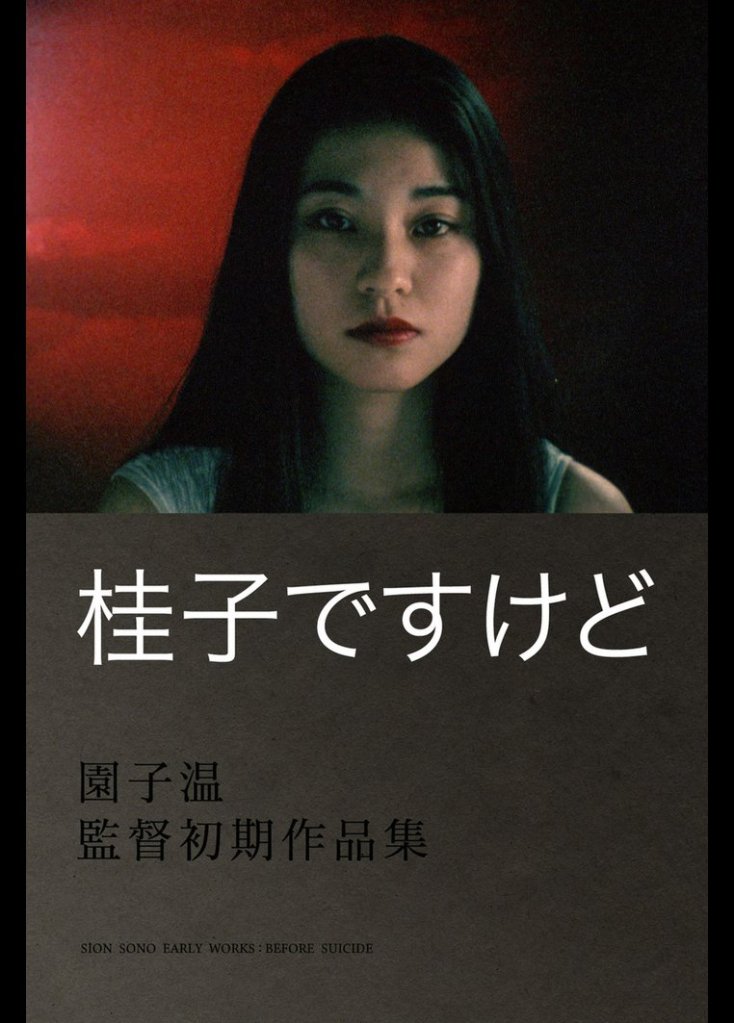
The first image we see of Keiko has her looking directly at us, holding our gaze while a Rothko-esque backdrop and ambient sounds of children arguing and birds singing provide our only context. After a few minutes she looks away, shyly, before resuming contact with a sad smile. Eventually a single tear courses down her cheek and she looks away again. We become her audience as she narrates her existence to us, filled with moments of everyday tedium – cleaning, sitting in silence and gazing out of windows. As the time begins to run out, she moves on to more direct forms of communication including a daily news broadcast where she relates the fact that once again it has been a slow news day in the land of Keiko. The time passes, Keiko grows older, as we all do, nothing changes, nothing stays the same.

This relatively early effort from Sono has a very definite French new wave influence with a little Fassbinder thrown in to boot. Much of the film takes the form of still frames accompanied by Keiko’s voice over which often consists of her counting out loops of 60s to aurally honour each passing second. Keiko lives in an oddly colourful, childlike world in her bright red apartment which has bright yellow furniture though the rest of her existence is fairly empty. As she tells us at the beginning, the only things in this apartment are herself and the bones of her father. As if to bear witness to the French new wave theme, she even shows us some other relics of the life she’s lost in the form of a packet of her father’s Gauloises cigarettes inside their unopened and equally colourful light blue box.

In a touch of Godardian mischief, Sono breaks the film into mini chapters with the help of frequent colour cards bearing the names of the days of the week (notably Keiko skips a day here and there or elides two days into one with another colour card simply stating the hour). It seems as if Keiko is eager to pass the time, she will be “reborn” the moment she crosses over into year 22 – leaving this grief filled coda behind her. Yet the time passes slowly, tediously spent in inconsequential pursuits. Actress Keiko Suzuki excels in the difficult task of playing the identically named Keiko, imbuing her depression filled voice overs with a degree of melancholy warmth. She seems to want to connect with us, staring up at us after scribbling out the words “I am” written on an otherwise blank piece of of paper with her father’s fountain pen. She reaches out to us, but we are powerless to respond, all we can do for her is to listen and bear witness to these final three weeks of her soon to be former life.

In the light of Sono’s later career, Keiko Desu Kedo may seem like a strange entry in his back catalogue. Tightly focusing on one young woman as she comes to terms with grief and the passage of time, Keiko Desu Kedo is an exercise in minimalism from a man later known for his cinematic excesses. Yet, there is excess here too in the stylisation of Keiko’s world, her brightly coloured living environment and various “disguises” she adopts in her news reader persona. Tellingly, in her final broadcast Keiko appears as herself but has nothing to say to us, once again looking directly into the camera with moistened eyes, full of loneliness. Presumably at the end of the film as she skips off away from her apartment trash bag in hand and counting down the seconds, she no longer needs us and all that remains is for her to read the credits of her confessional video diary, thereby bidding adieu to her old self via this strange obituary pausing only to thank us as the lights go out.


Unsubbed trailer:

Welcome Back, Mr. McDonald (ラヂオの時間, Koki Mitani, 1997)

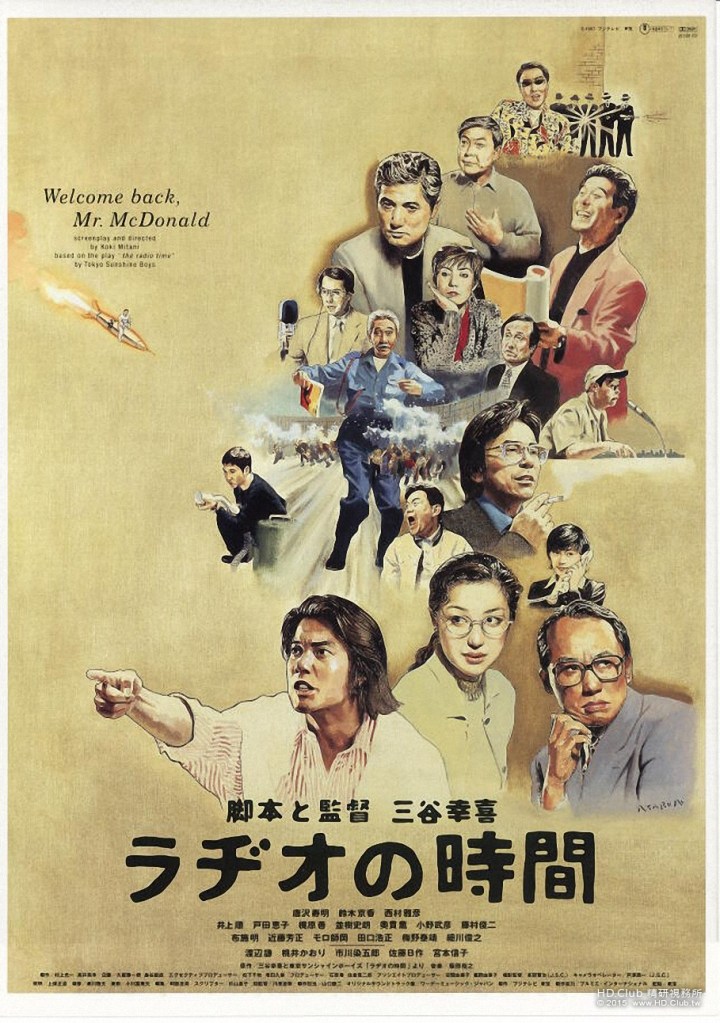
Welcome Back Mr. McDonaldKoki Mitani is one of the most bankable mainstream directors in Japan though his work has rarely travelled outside of his native land. Beginning his career in the theatre, Mitani is the master of modern comedic farce and has the rare talent of being able to ground often absurd scenarios in the  humour that is very much a part of everyday life. Welcome Back, Mr. McDonald (ラヂオの時間, Radio no Jikan) is Mitani’s debut feature in the director’s chair though he previously adapted his own stage plays as screenplays for other directors. This time he sets his scene in the high pressure environment of the production booth of a live radio drama broadcast as the debut script of a shy competition winner is about to get torn to bits by egotistical actors and marred by technical hitches.

Mild-mannered housewife Miyako Suzuki (Kyoka Suzuki ) has won a competition to get her radio play, titled “Woman of Destiny”, on air. A romantic tale of a bored housewife unexpectedly finding love at the pachinko parlour, her story may have a thin layer of autobiography or at least wish fulfilment but at any rate she is very close to her material. Unfortunately, “difficult” actress Nokko (Keiko Toda) has been foisted on the production crew due to entertainment world politics and objects to her character’s name because she once dated a married guy whose wife shared it. Eventually Nokko demands to be called something more interesting like “Mary Jane” (the irony!). At this point, all the other actors start wanting changes too and before you know it Miyako’s gentle tale of forbidden romance has become a gangster crime thriller set in Chicago filled with mobsters and tommy guns!

The writer is god, in one sense. Only, god has been locked out of the room leading to total chaos. Each small change necessitates a series of other changes and seeing as this is all being done live and on the hoof, no one is quite thinking through the implications of each decision. When the actor playing “Mary Jane’s” love interest suddenly goes off book and declares his name is “Donald McDonald” (inspired by left over fast food cartons) and he’s a pilot not a fisherman as agreed (though why would a fisherman be in the mountains of Chicago anyway?), everything goes completely haywire eventually ending up in an outer space based love crisis!

If all this wasn’t enough, someone has also wandered off with the key to the sound effects machine which would be fine if they hadn’t added all the gangster shenanigans in the first place. The show’s producer, Ushijima (Masahiko Nishimura), explains to Miyako at one point that radio has a very important advantage over visual media as you really can do anything even on no budget because your biggest resource is your audience’s imaginations. He has a very real point, though the completely bizarre saga of “sexy female lawyer” Mary Jane, her “Nasa Pilot” (a quick save after “Donald’s” plane is reported missing and someone remembers this slot is sponsored by an airline) true love, and her husband who for some reason is a random German named Heinrich is going to require a significant suspension of disbelief from the confused listeners at home.

As a theatre practitioner Mitani is an expert at creating ensemble comedy and even though he is playing with a large cast and a fast moving environment each of his characters is extremely well drawn. We see the shy writer beginning to lose heart after her story is shredded by the unforgiving production environment whilst also trying to persuade her husband who has turned up unexpectedly to go home before he figures out her script is suspiciously close to their real lives. We also see the production team frantically trying to fulfil their obligations so they can avoid getting into trouble with the higher ups and finally go home for the day. Ushijima is caught in the middle, surrounded by nonchalant yes men and lazy bosses, he’s desperately trying to compromise to keep everything on schedule whereas the jaded director just wants to do his job as written. However, it’s the director who is ultimately most moved by Miyako’s script and eventually decides it does deserve the happy ending that Miyako has been longing for.

By the end of the recording, something of the old magic has returned to the otherwise work-a-day world of the radio studio. They’ve even brought back old fashioned foley effects and retrieved the old school sound guy who’d been relegated to playing his gameboy in the security booth because no one needed his expertise anymore. Nothing went as planned, but everything worked out in the end and it’s happy endings all round both in the real world and in the completely surreal radio play. They might even do a sequel!

Mitani breaks the action every now and then to take us outside of the studio environment and into the cab of a petrol tanker being driven by a strangely dressed trucker (in a brief cameo from Ken Watanabe, no less!) who keeps trying to change the channel for more country influenced Enka but finds himself enthralled by the strange tale of the true love between Mary Jane and Donald mcDonald. We might not be quite as moved as he is, having been party to all the backstage goings on, but we have perhaps laughed more than cried through the almost screwball comedy and farcical set up of Mitani’s spot on depiction of the less than glamorous workings of the fast paced live production environment.


English subtitled trailer:

Hana-bi (はなび, AKA Fireworks, Takeshi Kitano, 1997)

Original quad poster from UK theatrical release (some of these cinemas no longer exist. Also, sponsored by Yo! Sushi.)

Review of Takeshi Kitano’s Hana-bi (はなび) first published by UK Anime Network.


Takeshi Kitano might still be best known for his ultra violent gangster pics, but after making it into the international arthouse repertoire with Sonatine back in the early ‘90s it was Hana-bi which put him on the map as one of Japan’s most prominent exports. Kitano plays the lead in the film once more adopting his cooler than cool persona with occasional flashes of violence only this time on the side of the law (to begin with, anyway).

Told in an initially confusing, flashback structure, Hana-bi follows middle aged policeman Nishi who experiences several life changing events in a short space of time. At the beginning of the film he’s let off a stakeout and told to go visit his wife who’s ill in hospital. Unfortunately, as we later find out, this will prove to be a poor decision as pretty much everything goes wrong – Nishi’s partner, Horibe, is shot and ends up paralysed, one of his other men is wounded and tragically another killed right in front of Nishi’s eyes. After being told that nothing more can be done for his wife and it’s better that she just come home from the hospital, Nishi quits the police force, gets involved with the yakuza and robs a bank before taking off with his wife for one last holiday.

Actually, the film skips over its climactic event until quite a way into its running time. Kitano unsettles us right away by giving us very little explanation for what we’re seeing. He shows us Nishi meeting with the widow of a man we didn’t even know was dead yet (not that he really told us who she was anyway). We’re left to piece events together like a detective listening to a confused witness testimony only our information is primarily visual – there isn’t even a lot of dialogue to guide us on our way. This refreshing technique is one the generally laconic Kitano seems to favour and greatly adds to Hana-bi’s low-key style.

Kitano never says too much in his movies anyway, but this time his is wife also near silent uttering the grand total of two words in the entire film and both of those come in the final scene. We know that she has a terminal illness (though it isn’t clear that she knows this, or how much she understands). Nishi and his wife also apparently lost their young daughter not long ago and it’s implied that perhaps she just hasn’t been fully present ever since. Her lack of speech, shyness and constant game playing coupled with her outwardly cheerful (if sometimes vacant) demeanour give her a childlike quality but the two words she does offer at the film’s conclusion imply (at least in that moment) that she knows what’s going on and understands what is about to happen.

Nishi and his wife have an extremely close relationship, they rarely need to speak to each other. However, Nishi’s partner, Horibe, discovers that his marriage was not as secure as he assumed as his wife and daughter walk out on him after his accident. In an effort to give him something to strive for, Nishi sends him some painting supplies and henceforth Horibe’s artwork (actually designed by Kitano himself) becomes a prominent motif in the film. The first series takes animals and then people and paints them with the heads of flowers but this then gives way to more complicated pointillist scenes. Many of Horibe’s works feature a repeated motif of a man, woman and child (neatly echoed in the films closing scenes) seemingly enjoying a happy family occasion. Perhaps this is an odd sort of masochism on Horibe’s part, lamenting everything he’s lost since his accident but the two figures could also represent the Nishis reunited with their lost daughter.

Shot in Kitano’s trademark blues, Hana-bi is a melancholy tale. Flowers and fire, Kitano shows us both extreme tenderness and fits of violence as he’s both the loving husband, grieving father, nurturing best friend and hardline cop who bears personal responsibility for the loss of his own. This path only leads in one direction and we’ve figured out where we’re headed long before nearing the end of our journey. Nevertheless, Hana-bi is a rich, poetic experience which continues to prove deeply moving and endlessly fascinating.


Hana-bi is re-released in the UK today on blu-ray courtesy of Third Window Films who will also be releasing Dolls and Kikujiro in the near future.